August 31, 2025
August 31, 2025


Doctrinal Messages, Pastoral Suggestions & Papal Homilies
Homily Notes


Humility
22nd Sunday of Year C

The point of reference of this Sunday’s liturgical texts clearly seems to be humility. It is man’s attitude before the richness of the material world or of the world of the spirit (First Reading). It is and should be the best attitude of human beings, especially Christians, in their relations with others, in the different situations which life offers (Gospel). It should especially be man’s behavior towards God, a behavior through which we discover our smallness in God’s magnanimity (Second Reading).
© 2000 Dicastery for the Clergy A | B | C
VIEW 2025 NOTES – Father Gaetano Piccolo (SI)
Featured Video
17 August 2025 | Catholic News Service

CATHOLIC NEWS SERVICE (2:10) – Pope Leo XIV spent the day Aug. 17 with people experiencing homelessness and families in need — celebrating Mass with over 100 guests and volunteers from the Diocese of Albano’s Caritas programs.
Two Parables
28 August 2016 – Saint Peter’s Square

This discussion guide has been generated by GOOGLE'S AI Gemini 2.5 Flash LLM.
The homily begins with Jesus observing guests rushing to choose the places of honor. He uses this scene to teach a lesson on the value of humility.
- The homily says Jesus's recommendation to choose the last place is not about social etiquette, but about humility. What is the difference between being polite to make a good impression and being truly humble?
- The text notes that "pride, careerism, vanity and ostentation are the causes of many evils." Can you think of a time when you have seen one of these attitudes cause harm, either in your own life or in the world?
- Jesus says, "he who humbles himself will be exalted." What kind of "exaltation" do you think Jesus is promising? How is it different from the worldly honor the guests were seeking?

The guide highlights the contrast between the attitude of those who "choose their own place" and those who "allow God to assign it and await a reward from Him."
- What does it mean to "choose your own place" in a spiritual sense? What are some ways we try to control our own status or importance in our relationship with God or others?
- The homily reminds us, "God pays much more than men do!" Why is it often so difficult to trust in this future, divine reward rather than seeking immediate, earthly recognition?
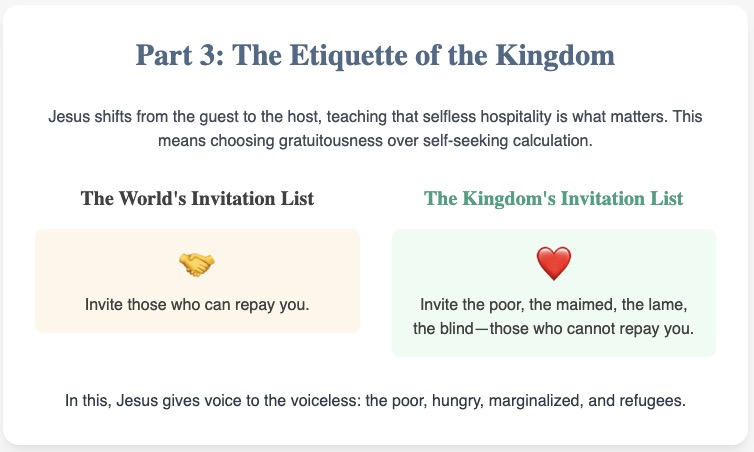
In the second parable, Jesus shifts from the guests to the host, teaching that the selflessness of our hospitality is what matters.
- Jesus's instruction is to invite "the poor, the maimed, the lame, the blind" precisely because "they cannot repay you." Why is this act of choosing "gratuitousness rather than self-seeking" so central to the Gospel message?
- The text says Jesus "gives voice to those who are voiceless." Who are the "voiceless" or "discarded" in our community or society today?
- The homily connects this teaching to the "sufferings and anxieties of the poor, the hungry, the marginalized, the refugees." What is one practical way our parish or community can better open its heart to one of these groups?

The homily concludes by highlighting works of mercy, like volunteering at soup kitchens, as a "training ground for charity that spreads the culture of gratuity."
- How do works of mercy, like visiting the sick or imprisoned, train us to be more charitable and less self-focused?
- The guide says that in these acts of service, "the love of Christ [is made] visible and credible." Can you share an experience where you witnessed an act of selfless service that made God's love feel more real to you?
- What is one "work of mercy," big or small, that you feel called to practice this week to help build this "culture of gratuity"?
Homily Excerpt
In the scene from today’s Gospel passage, Jesus, in the home of one of the chief Pharisees, observes that the guests at lunch rush to choose the first place. It is a scene that we have seen so often: seeking the best place even “with our elbows”. Observing this scene, Jesus shares two short parables, and with them two instructions: one concerning the place, and the other concerning the reward.
The first analogy is set at a wedding banquet. Jesus says: “When you are invited by any one to a marriage feast, do not sit down in a place of honor, lest a more eminent man than you be invited by him; and he who invited you both will come and say to you, ‘Give place to this man’, and then you will begin with shame to take the lowest place” (Lk 14:8-9). With this recommendation, Jesus does not intend to give rules of social behaviour, but rather a lesson on the value of humility. History teaches that pride, careerism, vanity and ostentation are the causes of many evils. And Jesus helps us to understand the necessity of choosing the last place, that is, of seeking to be small and hidden: humility. When we place ourselves before God in this dimension of humility, God exalts us, he stoops down to us so as to lift us up to himself; “For every one who exalts himself will be humbled, and he who humbles himself will be exalted” (v. 11).
The Lowest Place,
The Highest Good
29 August 2010 | Castel Gandolfo

This discussion guide has been generated by GOOGLE'S AI Gemini 2.5 Flash LLM.
The homily begins by explaining that Jesus's parable is not about etiquette, but a crucial lesson on humility. "Every one who exalts himself will be humbled, and he who humbles himself will be exalted."
- The text says Jesus is not giving a "lesson on etiquette." What is the difference between being polite to make a good social impression and the spiritual virtue of humility?
- The "lowest place" is presented as representing the "condition of humanity degraded by sin." How does thinking about sin in this way (as a low place we have put ourselves in) change your understanding of the need for a savior?
Christ's Radical Humility
The guide connects our "lowest place" to Christ's own act of self-emptying. "Christ himself 'took the lowest place in the world—the Cross—and by this radical humility he redeemed us.'"
- How does viewing the Cross as the "lowest place in the world" help you understand the depth of Christ's love and humility?
- The text says that Christ "constantly comes to our aid" from this place of humility. How have you experienced God's help not as a display of overwhelming power, but as a gentle, humble presence in your life?
The Call to Gratuitous Giving
Jesus suggests inviting to our table not those who can repay us, but the poor and marginalized, "so that the gift may be given freely."
- Why is it so natural for us to practice "transactional" hospitality (inviting those who can invite us back) rather than "gratuitous" hospitality?
- The true reward for selfless giving will be given by God. Why is it often difficult to trust in this future, divine reward rather than seeking an immediate, earthly one?
- Who are the "poor, kinsmen, or rich neighbours" in your life? Who are the "poorer and more marginalized people" that Jesus is calling you to invite?
The Model of the Saints
The homily points to Christ and St. Louis IX as models of humility, especially in the face of temptation and prosperity.
- We are called to learn from Christ "patience in temptation, meekness in offence, obedience to God in suffering." Which of these three is most challenging for you to practice?
- St. Louis IX wrote to his son, "If the Lord grant you some prosperity... take care not to become worse by boasting." How can success and prosperity sometimes become spiritual dangers that lead us into conflict with God?
- What is one practical way you can "humbly thank" God for a specific gift or success in your life without letting it lead to pride?
Homily Excerpt
On his last journey to Jerusalem someone asked him: “Lord, will those who are saved be few?” And Jesus answered: “Strive to enter by the narrow door; for many, I tell you, will seek to enter and will not be able” (Lk 13: 23-24). What does this “narrow door” mean? Why do many not succeed in entering through it? Is it a way reserved for only a few of the chosen?
Indeed, at close examination this way of reasoning by those who were conversing with Jesus is always timely: the temptation to interpret religious practice as a source of privileges or security is always lying in wait. Actually, Christ’s message goes in exactly the opposite direction: everyone may enter life, but the door is “narrow” for all. We are not privileged. The passage to eternal life is open to all, but it is “narrow” because it is demanding: it requires commitment, self-denial and the mortification of one’s selfishness.
Sunday’s
Core Themes
Right Relationships Spring from Humility
Authentic human relationships with God, others, and the world spring from humility. While flawed connections are based on hatred, possession, or fear, true relationships manifest as love. Humility allows us to recognize our condition as creatures, fostering a love that perceives God’s greatness and generosity. This humble love translates into tangible actions like service, respect, gratitude, and solidarity, creating the harmony our Creator desires for us and the universe.
Humility, A Virtue, Is Pleasing to God
Humility pleases God because it means accepting our condition as creatures, which establishes a right relationship with Him and all creation. This creates the harmony God desires. The humble person does not see God as a rival but as a father and friend. Recognizing they are also sinners, they ask for mercy and forgiveness. The proud seek to please themselves, even at God’s expense, while the humble seek to please God, even at their own expense.
Humility Means Truth
Humility is truth—seeing ourselves as we truly are before God. At our core is the reality that “Everything is a gift, everything is grace.” To deny this is to live a lie, leading to pride and self-deception. In ourselves, we are nothing, but by God’s grace, we are His image and children. Living in this truth, as St. Paul did, changes our way of life and helps build a more authentic and faithful Church.
Beware of False Humility!
Beware of false humility, which lacks truth and often conceals pride or laziness. Seemingly humble acts like expressing an inferiority complex (“I am worthless”), rejecting all praise, or being overly pessimistic are masks for pride. True humility, in contrast, recognizes personal worth and achievements but attributes them entirely to God, their source. It accepts praise by raising it to God and finds the good even in imperfect situations, trusting that all things work for the good of those who love Him.
- RIGHT RELATIONSHIPS SPRING FROM HUMILITY
- HUMILITY, A VIRTUE, IS PLEASING TO GOD
- HUMILITY MEANS TRUTH
- BEWARE OF FALSE HUMILITY!
Doctrinal Messages

It is a truism to say that man is a relational being, and that he entertains such relations with his peers, with the world that surrounds him and with God. What perhaps is not equally obvious is what authentic and proper relations are. The history of humankind offers many examples of different ways of living one’s relational dimension.

Click to Enlarge
There are those whose behavior was guided by a relationship of hatred and destruction. Others are enemies, and they must be done away with; God is an enemy, he should be killed, as Nietzsche proclaimed. Nature must be destroyed to build cities and human settlements. This is an extremely erroneous relationship!
There is also the relationship based on possession. One wants to possess things to build a kingdom of well-being; one wants to possess others to use them to build up one’s greatness and power. One wants to possess God to manage him according to will. This does not seem to be the right kind of relationship either! Will a relationship based on fear be a good relationship? Fear of a God whose greatness is imposing and who is terrible in his judgment; fear of people and things due to an inferiority complex or the lack of a practical spirit. No, fear is not an adequate relationship either. The true relationship springs from humility and manifests itself as a relationship based on love.

Click to Enlarge
If I am humble, I recognize my condition as a creature and my immense smallness, I live my personal relationship with God in an attitude of love. This love induces me to perceive his greatness and his generosity towards me, to trust him in spite of my smallness, to be thankful for his gifts in this city of Zion, which is a condensation of all the goods that God can grant to the human being (Second Reading).
If I am humble, I love others and I do not consider myself superior to them, nor do I try to give them something so that I will receive something in return (Gospel). If I am humble, I do not become arrogant with the power of the riches that I may have, or with the greatness of the science that I possess (First Reading).
In our being, in our relationships, we are the pure gift of God, so what is there for us to be proud of? The right relationship between us and God, with our peers and with things is one based on love, a love that translates into service, respect, gratitude and solidarity.

Click to Enlarge
© 2000 Dicastery for the Clergy A | B | C
Infographics on this page have been added by THE WORD THIS WEEK using AI generative tools (i.e. Chart.js and Tailwind CSS). They may be copied for personal use or for any non-profit ministry. Graphics may not be sold or used for personal financial gain.
Man, A Relational Being
Your notes begin by stating that “man is a relational being.” The Catechism affirms this as a core truth of anthropology, rooted in our creation. We are made in the image of a Trinitarian God, who is a communion of persons. Therefore, we are designed for communion.
- CCC 356: “Of all visible creatures only man is ‘able to know and love his creator.’ He is ‘the only creature on earth that God has willed for its own sake,’ and he alone is called to share, by knowledge and love, in God’s own life.”
- CCC 1879: “The human person needs to live in society. Society is not for him an extraneous addition but a requirement of his nature. Through the exchange with others, mutual service and dialogue with his brethren, man develops his potential; he thus responds to his vocation.”
Flawed Relationships and Sin
The notes accurately identify three types of erroneous relationships—hatred, possession, and fear—which the Catechism understands as consequences of sin that rupture our intended communion.
- Hatred and Destruction: This is a direct violation of the Fifth Commandment (“You shall not kill”) and the core commandment to love. The Catechism teaches that this sin begins in the heart. Deliberate hatred is a grave sin, and desiring harm to a neighbor is contrary to the virtue of charity (CCC 2302-2303). Your notes’ reference to destroying nature also connects to the Church’s teaching on stewardship, where creation is a gift to be cared for, not a domain to be destroyed (CCC 2415).
- Possession: The desire to “possess things… others… God” is a form of idolatry, which the First Commandment forbids. Idolatry consists in “divinizing what is not God.”
- CCC 2113: “Man commits idolatry whenever he honors and reveres a creature in place of God, whether this be gods or demons…, power, pleasure, race, ancestors, the state, money, etc.” When we seek to possess and control others or God, we are attempting to reduce them to objects that serve our own ego, which is a profound rejection of their dignity and God’s sovereignty.
- Fear: The notes describe a relationship of servile fear, born of an “inferiority complex” or terror of a “terrible” God. The Catechism makes a crucial distinction between this and the true “fear of the Lord.”
- Filial Fear vs. Servile Fear: True “fear of the Lord” is a gift of the Holy Spirit that inspires reverence, awe, and a desire not to offend the God we love. It is a “filial” or sonly fear. Servile fear, in contrast, is the fear of a slave who only obeys to avoid punishment (CCC 1828). An authentic relationship with God is based on love, not terror.
The True Foundation: Humility
Your notes correctly identify humility as the source of true relationships. The Catechism defines humility as the virtue that allows us to live in the truth of our creatureliness.
- CCC 2559: “Humility is the foundation of prayer… Man is a beggar before God.” This paragraph highlights that in humility, we recognize our profound dependence on God for everything.
- Recognizing Our Condition as a Creature: This is the essence of humility. We are not self-made. We are the “pure gift of God,” as your notes state. The Catechism affirms that “being in the image of God the human individual possesses the dignity of a person, who is not just something, but someone… called by grace to a covenant with his Creator” (CCC 357). Humility is simply living in the truth of this reality.
From Humility to Love
Humility opens the door to charity, the theological virtue by which we love God above all things and our neighbor as ourselves for the love of God (CCC 1822).
- Love of God: A humble person, recognizing their “immense smallness,” does not see God as a rival but as a generous Father. This fosters the love, trust, and gratitude your notes describe.
- Love of Others: Because the humble person knows that everything they have is a gift from God, they do not consider themselves superior to others. This truth is the foundation for loving our neighbor as Christ commanded (CCC 1823). The Gospel principle of not giving just to receive in return is an expression of this selfless, divine love (CCC 2447 on the works of mercy).
Conclusion: Love in Action
The final statement that a right relationship translates into “service, respect, gratitude and solidarity” is a perfect summary of the Christian moral life as described in the Catechism.
- Solidarity: This is explicitly named as a key virtue of the Christian life. The Catechism calls it “social charity” and a “direct demand of human and Christian brotherhood” (CCC 1939). It is the recognition that we are all responsible for all, and it is born from the humble understanding that we are one human family under God.
Part 1: Identifying Flawed Relationships
The text outlines three “extremely erroneous” ways of relating to God, others, and the world: hatred, possession, and fear.
- The text mentions hatred/destruction (seeing others or God as an enemy), possession (using others for power), and fear (acting from inferiority or terror). Which of these three flawed relationships do you see most often in the world today? Why?
- Can you think of a time when you were tempted to relate to a situation or a person through one of these flawed lenses? What were the results?
- The text says we can even try to “possess God to manage him according to will.” What does this look like in a person’s spiritual life?
Part 2: The True Foundation – Humility
The text states, “The true relationship springs from humility and manifests itself as a relationship based on love.”
- How does the text define humility? (Recognizing our “condition as a creature and our immense smallness.”) Why is this recognition the necessary first step for authentic love?
- The text says, “In our being, in our relationships, we are the pure gift of God, so what is there for us to be proud of?” How does internalizing this truth change the way we view our own talents and accomplishments?
- If humility is the root, what are some of the “fruits” of that humility that the text mentions?
Part 3: Humility and Love in Action
A humble person’s love is expressed differently in their relationships with God, others, and the world.
- With God: The text says a humble person has an “attitude of love” that allows them to perceive God’s greatness and trust Him. How does humility overcome the “fear of a God whose greatness is imposing”?
- With Others: The text notes that a humble person does not consider themselves superior or “try to give them something so that I will receive something in return.” How does this challenge our modern understanding of networking and transactional relationships?
- With the World: The humble person is not “arrogant with the power of the riches… or with the greatness of the science” they possess. How can humility help us be better stewards of creation and knowledge?
Closing Reflection
Leader: The text concludes that the right relationship is based on a love that translates into “service, respect, gratitude and solidarity.”
- Which of these four actions—service, respect, gratitude, or solidarity—do you feel most called to cultivate in your life right now? What is one small, concrete step you can take this week to practice it?
Doctrinal Messages

Click to Enlarge
God, the Creator, is pleased when we accept our condition as creatures and establish the right kind of relationship with him and with all creation, for this is what humility is all about. The lack of humility, by contrast, destroys the harmony of our inner being and of the universe itself, and this rupture is not pleasing to the Creator.
This is why in Sirach we read “The greater you are, the more humbly you should behave, and then you will find favor with the Lord,” and in the Gospel we read, “For everyone who raises himself up will be humbled, and the one who humbles himself will be raised up.”

Click to Enlarge
Why is humility pleasing to God? Precisely because the humble person does not seek to supplant God, to “be like God,” or to consider himself a super-man or a wise man above all others. Sirach recommends, “Do not try to understand things that are too difficult for you, or try to discover what is beyond your powers.”
The humble person pleases God because he does not consider God as a rival, but as a father and a friend instead. The humble person pleases God not only because he recognizes himself as a creature, but also because he recognizes himself as a sinner, and unworthy of his condition as a son. Precisely because of this, the humble person maintains the attitude of a son with God, a son who begs mercy and loving forgiveness.

Click to Enlarge
All this makes us understand more fully what Scripture itself assures, “The greater you are, the more humbly you should behave, and then you will find favor with the Lord.” The difference between the proud and the humble may be summarized as follows: “The proud man seeks to please himself, even at God’s expense, while the humble man seeks to please God, even at his own expense.”
© 2000 Dicastery for the Clergy A | B | C
Infographics on this page have been added by THE WORD THIS WEEK using AI generative tools (i.e. Chart.js and Tailwind CSS). They may be copied for personal use or for any non-profit ministry. Graphics may not be sold or used for personal financial gain.
Humility as Accepting Our Creaturely Condition
Your notes state that God is pleased when we “accept our condition as creatures.” This is the foundational truth of humility. The Catechism teaches that to be a creature is to have received one’s entire being from God. Humility is simply living in this truth.
- CCC 2559: “Humility is the foundation of prayer… To be humble is to acknowledge… our creaturely dependence on him. Once we have humbled our hearts, we can receive it freely.” This paragraph establishes that recognizing our dependence is the prerequisite for receiving God’s gifts.
- CCC 357: “Being in the image of God the human individual possesses the dignity of a person, who is not just something, but someone… he is called by grace to a covenant with his Creator, to offer him a response of faith and love that no other creature can give in his stead.” Humility is not self-hatred, but the truthful acknowledgment of our unique place in creation as beings who receive everything from God.
Pride: The Rupture of Harmony
The notes correctly identify the lack of humility (pride) as a destructive force that “destroys the harmony” of creation. The Catechism identifies this as the very essence of sin.
- CCC 398: “In that sin man preferred himself to God and by that very act scorned him. He chose himself over and against God, against the requirements of his creaturely status and therefore against his own good.” This describes the first sin as an act of pride, an attempt to “supplant God” and “be like God,” which shattered the original harmony.
- CCC 2094: “Hatred of God comes from pride. It is contrary to love of God, whose goodness it denies, and whom it presumes to curse as the one who forbids sins and inflicts punishments.” This directly links pride to the error of seeing God as a rival rather than a loving Father.
God as Father and Friend, Not a Rival
The humble person, as your notes point out, “does not consider God as a rival, but as a father and a friend.” This filial relationship is central to the Christian faith.
- CCC 239: “By calling God ‘Father,’ the language of faith indicates two main things: that God is the first origin of everything and transcendent authority; and that he is at the same time goodness and loving care for all his children.” Humility allows us to embrace both God’s majesty and His intimate, paternal love.
- CCC 374: The Catechism speaks of the state of original justice as man being “established in friendship with his Creator and in harmony with himself and with the creation around him.” Sin ruptured this friendship, and it is through the humility of Christ that we are invited back into it.
The Humble Recognition of Sin
A key aspect of humility is the honest recognition of our sinfulness and our need for God’s mercy.
- CCC 1847: “‘God created us without us: but he did not will to save us without us.’ To receive his mercy, we must admit our faults. ‘If we say we have no sin, we deceive ourselves, and the truth is not in us.'” This paragraph directly affirms that acknowledging our sin is necessary to receive the forgiveness God offers.
- CCC 1489: “To return to communion with God after having lost it through sin is a process born of the grace of God who is rich in mercy… One must ask for this precious gift for oneself and for others.” The “attitude of a son who begs mercy” is precisely the posture the Church calls us to in the Sacrament of Reconciliation.
The Defining Difference: Pleasing God vs. Pleasing Self
The summary statement—”The proud man seeks to please himself, even at God’s expense, while the humble man seeks to please God, even at his own expense”—captures the fundamental orientation of the Christian moral life.
- CCC 1703: The human person is destined for beatitude (perfect happiness with God) and “It is essential to a human being freely to direct himself to this fulfillment.” Pleasing God is the act of freely directing our lives toward our true end, while pleasing the self is to turn away from it.
- CCC 2024: “Sanctifying grace… makes us ‘pleasing to God.’” Grace, which is the life of God within us, is what enables us to please Him. Since humility is the necessary disposition to receive grace, it is the very path to a life that is pleasing to God.
Part 1: Accepting Our Condition as Creatures
The text states that humility is accepting our “condition as creatures” and that a lack of it “destroys the harmony of our inner being and of the universe itself.”
- What does the phrase “accept our condition as creatures” mean to you in a practical, day-to-day sense?
- The text says pride “destroys harmony.” Can you share an example from your own life or observation where pride led to conflict or a loss of peace, either internally or with others?
- Reflect on the quote from Sirach: “The greater you are, the more humbly you should behave.” Why do you think greatness and humility are so closely linked in Scripture?
Part 2: God as Father, Not a Rival
The text explains that a humble person “does not consider God as a rival, but as a father and a friend instead.”
- What are some ways people might unconsciously treat God like a “rival”? (e.g., trying to control outcomes, refusing to accept limitations, etc.)
- The text says the humble person recognizes themselves as both a creature and a sinner, which leads them to beg for “mercy and loving forgiveness.” How does acknowledging our sinfulness actually help us see God more as a loving Father than a harsh judge?
- Discuss the recommendation from Sirach: “Do not try to understand things that are too difficult for you.” How is this an act of humility and trust, rather than an encouragement of ignorance?
Part 3: The Defining Difference
The guide concludes with a powerful summary: “The proud man seeks to please himself, even at God’s expense, while the humble man seeks to please God, even at his own expense.”
- What does it look like to “please God, even at his own expense”? Can you think of a real-world example of this kind of selfless love?
- Conversely, what are some subtle ways we might “please ourselves, even at God’s expense” in our daily choices?
- How can we use this summary statement as a guide for examining our own conscience and motivations throughout the day?
Pastoral Suggestions

Click to Enlarge
What Jesus Christ tries to give in the Gospel is a lesson in courtesy and good manners. Jesus goes into greater depth, he gets down to the core, to the most intimate layer of the person. And what does he find there? He finds a sign that says: “Everything is a gift, everything is grace.” The person who is not capable of admitting it is lying, he is deceiving himself, and will try to deceive others in many ways. Such a man will be pleased with his own achievements, talking about his success, extolling his many qualities, striving to be important…

Click to Enlarge
But humility is the truth with which we see ourselves before God. In himself, the person before God is dust, wind, nothing. By the grace of God, man is God’s image and his son. May we, too, be able to say like Paul, “By God’s grace I am what I am, and God’s grace has not been vain in me.”

Click to Enlarge
How different our way of life becomes when we live in truth! The humble man always seeks truth in love: the truth about himself, the truth about others and the truth about God. I suggest that you look at yourself in the mirror of humility to see if you recognize yourself or if the impact of the contrast with reality is such that the mirror cannot bear it and breaks into a thousand pieces. The Church of humble people will be a more authentic Church, more faithful to the original plan of its Founder. Each one of us, with our humility, can contribute in some way.
© 2000 Dicastery for the Clergy A | B | C
Infographics on this page have been added by THE WORD THIS WEEK using AI generative tools (i.e. Chart.js and Tailwind CSS). They may be copied for personal use or for any non-profit ministry. Graphics may not be sold or used for personal financial gain.
“Everything is a Gift, Everything is Grace”
The central theme of the notes—that at our core, “Everything is a gift, everything is grace”—is a foundational principle of Catholic teaching. To live in this truth is to live in humility.
- CCC 2001: “The preparation of man for the reception of grace is already a work of grace. This latter is needed to arouse and sustain our collaboration in justification through faith, and in sanctification through charity.” This paragraph underscores that even our ability to cooperate with God is itself a gift. The proud person who boasts of their achievements is, as the notes say, “lying,” because they fail to acknowledge the prior gift of grace that made any achievement possible.
Pride as a Lie, Humility as Truth
The notes define the proud person as one who “is not capable of admitting” that all is grace, thereby deceiving himself and others. The Catechism sees this prideful self-deception as a rejection of truth.
- CCC 1849: “Sin is an offense against reason, truth, and right conscience; it is failure in genuine love for God and neighbor caused by a perverse attachment to certain goods.” Pride, by claiming for itself what belongs to God, is a direct offense against the truth of our existence.
- CCC 2559: “Humility is the foundation of prayer… Humility is the disposition to receive the gift of prayer freely: man is a beggar before God.” To be a beggar is to live in the truth of our need. The proud person, by contrast, lives the lie of self-sufficiency.
Our Dual Identity: Dust and Sonship
The notes beautifully capture our dual reality: “In himself, the person before God is dust, wind, nothing. By the grace of God, man is God’s image and his son.” The Catechism explains this truth in detail.
- Our Creatureliness (“Dust”): The Catechism reminds us that our very being is dependent on God. CCC 300 states, “God is the sovereign master of his plan. But to carry it out he also makes use of his creatures’ co-operation. This is not a sign of weakness, but rather a token of almighty God’s greatness and goodness.” We are creatures, not the Creator.
- Our Dignity (“God’s Image and Son”): By grace, we are elevated to an astonishing dignity. CCC 1996 explains that sanctifying grace is “a participation in the life of God… It is a gratuitous gift of God which makes us pleasing to him.” St. Paul’s statement, “By God’s grace I am what I am,” is the perfect expression of this humble truth.
The Mirror of Humility and the Authentic Church
The call to look into the “mirror of humility” is a call to self-examination in light of the truth. This personal humility, as the notes conclude, is what builds a more authentic Church.
- CCC 1454: The Sacrament of Reconciliation requires an “examination of conscience,” which is precisely this act of looking at oneself in the light of God’s truth and love. It is an act of humility that shatters the false image of pride.
- CCC 827: “‘But while in the most holy Virgin the Church has already reached that perfection whereby she is without spot or wrinkle, the followers of Christ still strive to increase in holiness by conquering sin.’ And so they turn their eyes to Mary: in her, the Church is already the ‘all-holy.'” The humble saints, especially Mary, are the clearest mirrors reflecting what the Church is called to be. A Church of humble people is a Church that more perfectly reflects its Founder, who “humbled himself” for our sake (Phil 2:8).
Part 1: “Everything is a Gift”
The text says that at our core, we find a sign that says: “Everything is a gift, everything is grace.” A person who cannot admit this is “lying” and “deceiving himself.”
- What does it practically mean to believe that everything in your life—your talents, your successes, even your very existence—is a gift of grace?
- The text lists the signs of someone living the “lie” of self-sufficiency: being pleased with their own achievements, talking about success, striving to be important. Why are these behaviors a form of self-deception?
- How does the world around us encourage this lie of self-made success, and how can we consciously push back against it in our daily lives?
Part 2: Our True Identity Before God
The text presents a powerful contrast: “In himself, the person before God is dust, wind, nothing. By the grace of God, man is God’s image and his son.”
- How can we hold both of these truths at the same time—our “nothingness” as creatures and our immense dignity as children of God? Why is it important to not forget either side of this reality?
- Reflect on St. Paul’s words: “By God’s grace I am what I am.” How is this statement a perfect expression of humble truth, acknowledging both gift and identity?
- The text says, “How different our way of life becomes when we live in truth!” What specific changes in attitude or action might occur in a person who truly embraces this dual identity?
Part 3: The Mirror of Humility
The guide suggests we “look at yourself in the mirror of humility.” This mirror shows us the truth about ourselves, others, and God.
- When you look into this “mirror of humility,” what do you see? Do you recognize the person looking back?
- The text asks if the “impact of the contrast with reality is such that the mirror cannot bear it and breaks into a thousand pieces.” What does this powerful image suggest about the gap that can exist between our prideful self-image and the truth of who we are?
Closing Reflection
Leader: The text concludes by stating, “The Church of humble people will be a more authentic Church, more faithful to the original plan of its Founder.”
- How does the personal humility of each member contribute to the authenticity and faithfulness of the entire Church?
- What is one practical way you can “contribute in some way” with your own humility this week to help build a more authentic community in your family, parish, or workplace?
Pastoral Suggestions

Click to Enlarge
We have said that humility is truth, following the teaching of St Theresa of Jesus (or of Avila). However, there are also “apparent” forms of humility. But since they lack truth, such forms cannot be expressions of true humility. Let us recall some forms of false humility.
A clear case is the inferiority complex: “I am worthless, so I leave the work for others”, “I cannot do this work”, “I do not have such and such a talent.” Sometimes such sentences conceal an enormous laziness. Most of the time, they conceal a crafty pride, which wants to avoid cutting a poor figure or looking bad to other people’s eyes at all costs. The humble person recognizes his qualities, his worth, and his achievements, but he attributes it all to God who is their source.
Another example of false humility is not accepting the praise of others, rejecting any form of public recognition, feigning indifference before other people’s opinion. Ultimately, it is often a way of secretly enjoying the received praise, or of having people insist on one’s achievements, flattering one’s ears with the good opinion of other people. By contrast, a humble person accepts praise but raises it up to God; he accepts public recognition for a good deed or the good opinion of other people, but sees in this a gesture of fraternal charity and God’s mysterious action.
One last case is that of the person who thinks that he cannot do anything right, that he was born under a bad star, and that there is nothing that he can do. The pride of such a person is so great that it blinds him and prevents him from seeing the good things that he does. He only has eyes for the bad things, for the limits and imperfections of the good things that exist in him. The humble person, instead, knows how to see the good side of things, even those that do not come out so well. And with Saint Paul he says, “For those who love God all things contribute to their good.”
Sunday is a good day to think about all this, to stop on our daily path and think about how much life and eternity are worth. If salvation were more present in our minor everyday tasks, wouldn’t it change our way of living and acting? This is not the time for complaints! It is the time for action and hope.

Click to Enlarge
© 2000 Dicastery for the Clergy A | B | C
Infographics on this page have been added by THE WORD THIS WEEK using AI generative tools (i.e. Chart.js and Tailwind CSS). They may be copied for personal use or for any non-profit ministry. Graphics may not be sold or used for personal financial gain.
The “Inferiority Complex”: A Mask for Pride and Sloth
The notes identify the “I am worthless” or “I cannot do this” attitude as a form of false humility. The Catechism helps us understand the dual error at its root:
- It conceals laziness (Sloth/Acedia): The refusal to act under the guise of unworthiness can be a form of spiritual sloth, or acedia. This is not mere laziness, but a deeper sadness and aversion to the good things God calls us to do.
- CCC 2094: “Acedia or spiritual sloth goes so far as to refuse the joy that comes from God and to be repelled by divine goodness.” By saying “I can’t,” the person is refusing the joy and responsibility of using the gifts God has given them.
- It conceals a crafty pride: The desire to “avoid cutting a poor figure” is rooted in self-love, not God-love. It is a pride that is more concerned with protecting one’s own image than with serving God and others.
- The Glossary of the Catechism defines pride as “undue self-esteem or self-love, which seeks attention and honor and sets oneself in competition with God.” Fearing failure because of how it will make us look is a classic sign of this vice.
In contrast, the truly humble person, as the notes state, “recognizes his qualities, his worth, and his achievements, but he attributes it all to God.” This aligns perfectly with the Catechism’s teaching on the gifts of the Holy Spirit, which are given not for our own glory, but for the common good.
- CCC 2003: “Grace also includes the gifts that the Spirit grants us to associate us with his work, to enable us to collaborate in the salvation of others and in the growth of the Body of Christ, the Church.”
Rejecting Praise: A Secret Enjoyment
The notes astutely point out that rejecting praise can be a manipulative way of seeking more of it. While the Catechism doesn’t have a specific section on how to receive compliments, it speaks volumes about the importance of right intention and truthfulness.
- The sin here is one of duplicity. The person’s external action (rejection of praise) does not match their internal desire (to be flattered). This is contrary to the Eighth Commandment’s call to live in the truth.
- The humble response—accepting praise but raising it up to God—is an act of the virtue of praise. CCC 2639 defines praise as the prayer that “recognizes most immediately that God is God. It lauds God for his own sake… simply because HE IS.” The humble person acts as a clear lens, directing the light of praise back to its true source.
Pessimism: A Sin Against Hope
The final case, the person who “thinks that he cannot do anything right,” is perhaps the most spiritually dangerous form of false humility because it is a manifestation of despair.
- CCC 2091: “The first commandment is also concerned with sins against hope, namely, despair and presumption. By despair, man ceases to hope for his personal salvation from God, for help in attaining it or for the forgiveness of his sins. Despair is contrary to God’s goodness, to his justice… and to his mercy.”
- This pessimistic attitude is a form of pride because it implicitly claims that one’s own brokenness is greater than God’s power to heal and work through them. It is a failure to trust in God’s providence.
The humble person, who “knows how to see the good side of things” and trusts that “for those who love God all things contribute to their good,” is living out the theological virtue of hope.
- CCC 1817: “Hope is the theological virtue by which we desire the kingdom of heaven and eternal life as our happiness, placing our trust in Christ’s promises and relying not on our own strength, but on the help of the grace of the Holy Spirit.”
Part 1: The Inferiority Complex
The text describes the person who says, “I am worthless… I cannot do this work.” This attitude often conceals laziness or a “crafty pride, which wants to avoid… looking bad.”
- Have you ever found yourself using language of unworthiness (“I’m no good at this,” “Someone else would be better”) to get out of a task? What were the real feelings behind those words?
- The text says this is often a “crafty pride” that fears “cutting a poor figure.” In what ways is the fear of failure or looking bad actually a form of pride, not humility?
- Contrast with True Humility: The truly humble person “recognizes his qualities, his worth, and his achievements, but he attributes it all to God.” How can we practically acknowledge our God-given talents without falling into pride?
Part 2: Rejecting Praise
This section discusses the false humility of rejecting compliments or recognition, which can be a way of “secretly enjoying the received praise.”
- Why can it be so uncomfortable to receive a compliment or public recognition for a good deed? What is the “secret enjoyment” the text describes in having people insist on our achievements?
- Contrast with True Humility: The humble person “accepts praise but raises it up to God.” What does this look like in practice? Can you think of a specific phrase or attitude that accomplishes this?
- How is graciously accepting a compliment a “gesture of fraternal charity” toward the person offering it?
Part 3: The Pessimist
The final case is the person who thinks “he cannot do anything right” and only has eyes for his own faults. The text calls this a pride “so great that it blinds him.”
- How can a constantly negative view of oneself be a profound form of pride? How does it prevent a person from seeing the good God is doing in and through them?
- Contrast with True Humility: The humble person “knows how to see the good side of things, even those that do not come out so well.” How is this outlook an act of trust in God’s providence rather than a focus on one’s own performance?
- Reflect on the quote from St. Paul: “For those who love God all things contribute to their good.” How can this truth free us from the pride of pessimism?
Closing Reflection
Leader: The text concludes by saying, “This is not the time for complaints! It is the time for action and hope.”
- How would our daily lives change if salvation and eternity were more present in our minds during our everyday tasks? How can this perspective move us from a state of complaint (rooted in false humility) to one of hopeful action?