October 5, 2025
October 5, 2025


Homily Videos Bishop Barron
Homily Videos Bishop Barron
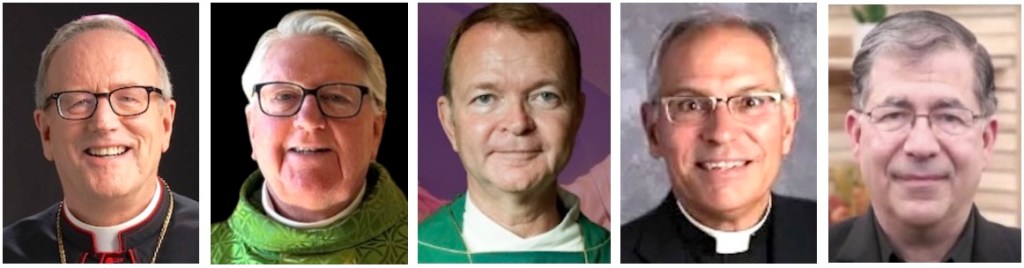
Bishop Robert Barron

27th Sunday of Year C

Stand Strong in the Spirit
Bishop Robert Barron focuses on the second reading from Paul’s second letter to Timothy for the 27th Sunday in Ordinary Time Year C. He discusses the authenticity and spirit of the letter, highlighting its origins in Paul’s imprisonment for proclaiming Jesus as Lord against the societal norms that recognized Caesar as such.
TWTW Visual Summary and Discussion Questions
Click to enlarge
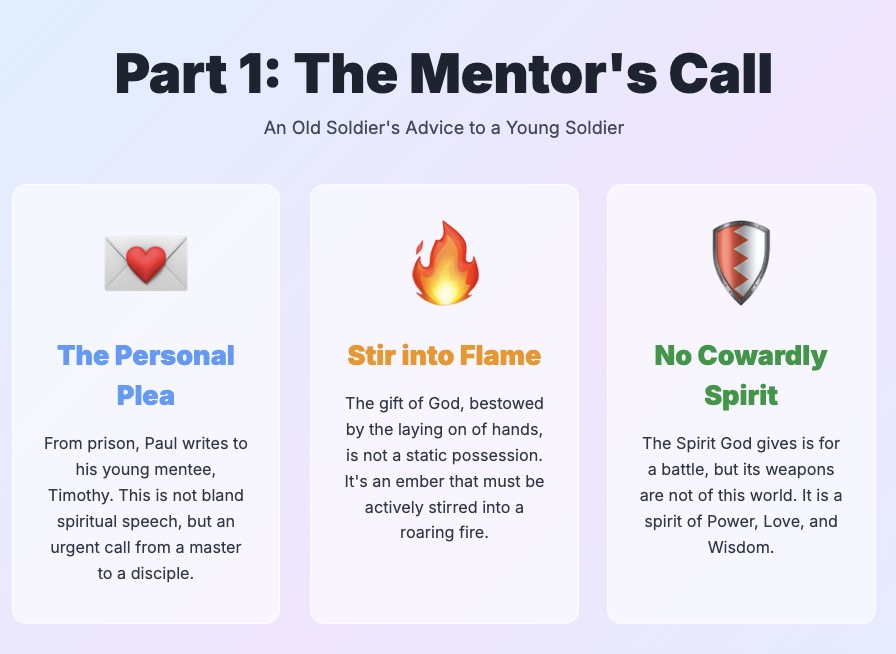
Part 1: The Mentor's Call to Stir the Flame
Core Idea: The spiritual life is not passive; it requires actively "stirring into flame" the gift of God we have received. This gift is not a spirit of fear, but one of supernatural courage that must be channeled through the gospel virtues of love and wisdom, not the world's weapons of power.
Key Points from the Homily:
- The Mentor and Mentee: The homily frames the reading as a personal and urgent message from an "old soldier" (Paul) to a "young soldier" (Timothy). This highlights the need for guidance, encouragement, and the passing on of wisdom in the spiritual life.
- The Laying on of Hands: This ancient gesture of ordination is the moment the "gift of God" is bestowed. Paul reminds Timothy of this powerful moment to anchor him in his identity and mission.
- Stir into Flame: The gift is not static; it's like an ember that can die out if not tended. We have an active role in fanning the flame of the Holy Spirit within us through prayer and action.
- The True Nature of Courage: The spirit we receive is for a battle, but it is "no cowardly spirit." Critically, its strength is expressed not through worldly violence or aggression, but through power, love, and wisdom. Fighting evil on its own terms makes no progress toward the kingdom.
- Who have been the "Pauls" in your life—mentors who have encouraged you to be strong in your faith? Who is the "Timothy" you are called to encourage?
- The homily connects the "laying on of hands" to ordination, but all Christians receive the Holy Spirit in Baptism and Confirmation. How can you "stir into flame" the gift of the Spirit you have already received?
- Think of a current struggle or conflict. How would approaching it with the weapons of "power, love, and wisdom" differ from approaching it with the world's weapons (anger, retaliation, etc.)?

Click to enlarge
Part 2: The Soldier's Witness: The Story of Fr. Jerzy Popiełuszko
Core Idea: The life of Blessed Jerzy Popiełuszko provides a modern, dramatic example of what it looks like when an ordinary person allows the "no cowardly spirit" to be stirred into a transformative flame, changing the course of history through non-violent "soul force."
Key Points from the Homily:
Martyrdom and Victory: Like many who challenge worldly powers with the truth of the Gospel, he was martyred. However, his death did not lead to a violent uprising as his killers expected. Instead, it solidified his message of non-violent resistance and became a powerful spiritual force that contributed to the fall of Communism.
The Unlikely Hero: Fr. Jerzy was not a star seminarian. He was quiet, unsure, and "a little on the mousy side." This emphasizes that God's power is made perfect in our weakness.
Finding a Voice: Inspired by St. John Paul II, this quiet priest found his voice, preaching powerful sermons on human dignity and rights that galvanized the Polish people.
The Power of Non-Violence: Fr. Jerzy insisted on opposing oppression not with violence, but with what Gandhi called "soul force"—the power of the spirit. He taught the people a new way to fight.
- Fr. Jerzy's courage was a surprise to many who knew him. In what area of your life do you feel "mousy" or unsure, but where God might be calling you to speak or act with courage?
- "Soul force" is the power of the spirit. What does this look like in your daily life? How can you practice non-violent resistance to the injustices or evils you encounter?
- The government saw Fr. Jerzy's non-violent message as "particularly dangerous." Why is a message of courageous love and wisdom often more threatening to worldly powers than a message of violence?

Click to enlarge
Part 3: Our Personal Summons to Bear the Hardship
Core Idea: The call given to Timothy and lived by Fr. Jerzy is not just for priests or saints in faraway lands; it is a summons to every Christian in every generation to stand against the sinful world and bear our share of the hardship the Gospel entails.
Key Points from the Homily:
The Final Charge: The homily concludes by reiterating the central theme: our spirit of courage must be tied to wisdom and love. This is the only way to take real steps toward the kingdom of God.
A Story that Inspires: The homilist recounts how hearing Fr. Jerzy's story as a seminarian inspired him and his classmates, forming a prayer group in his name. This shows how the witness of one generation stirs the flame in the next.
The Universal Call: Paul's closing words to Timothy are presented as words to us today: "Therefore never be ashamed of your testimony to our Lord... but with the strength that comes from God, bear your share of the hardship which the gospel entails."
Standing Athwart the World: We are meant to stand against a world often predicated on violence, hatred, and injustice. This will inevitably involve hardship.
- What "hardship which the gospel entails" are you currently facing or being called to face in your life, family, or community?
- The homilist was stirred by the example of Fr. Jerzy. Whose story of faith has stirred up the spirit within you? How can you share that inspiration with others?
- What is one concrete step you can take this week to tie your courage more closely to "wisdom and to love" in a difficult situation?

Trust in God’s Plan
Friends, this Sunday, I want to talk to you once again about faith. As I’ve said before, faith is the most misunderstood word in the religious vocabulary. And both the first reading and the Gospel today shed very interesting light on the nature of faith, which is not a kind of superstition—believing in any old nonsense—but rather an attitude of humble trust in the ways of the Lord.
TWTW Visual Summary and Discussion Questions
Father Geoffrey Plant
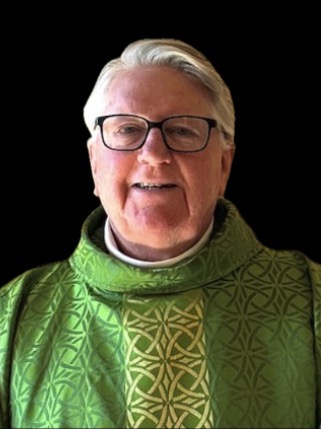
27th Sunday of Year C

Increase Our Faith
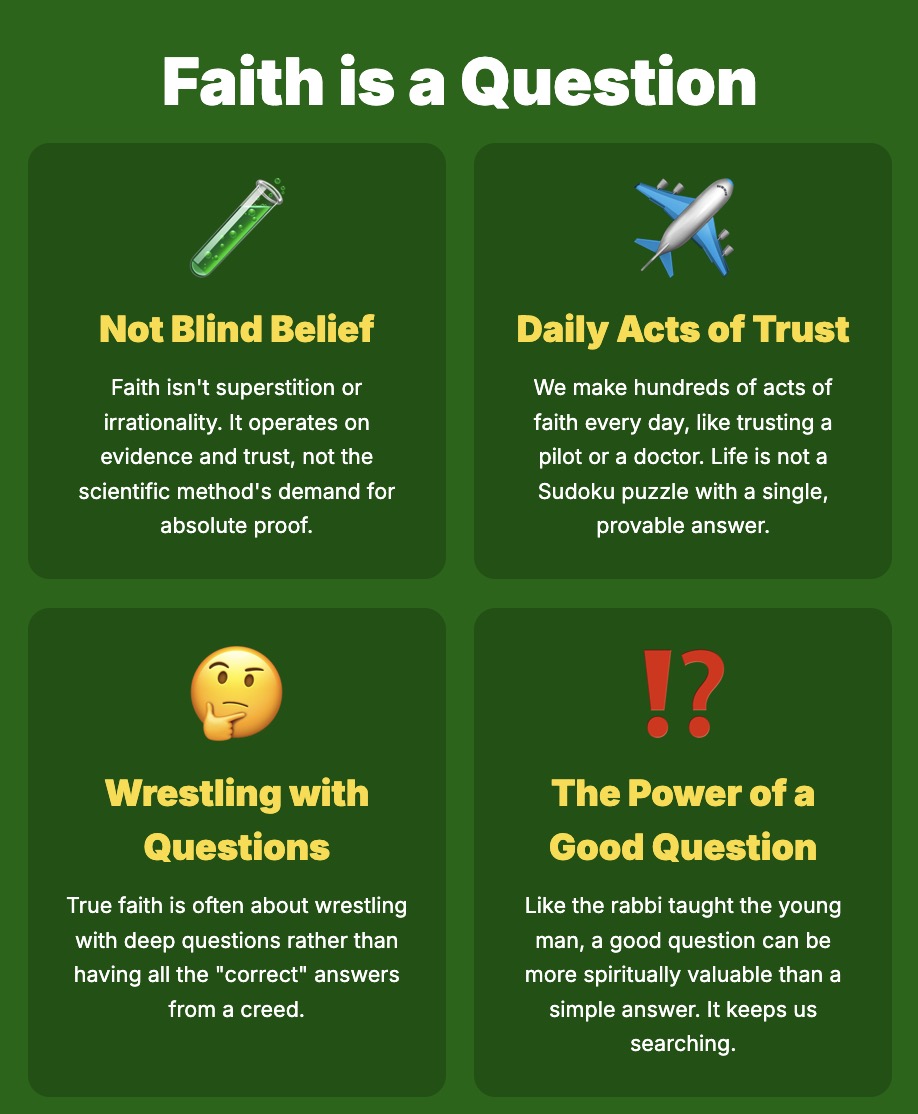
Fr. Geoffrey Plant reframes faith, moving it beyond blind belief. He explains that true faith often begins by wrestling with questions rather than having simple answers. It becomes a new perspective, a “way of seeing” that illuminates the world’s meaning, much like stepping inside a cathedral reveals the beauty of its windows.
TWTW Visual Summary and Discussion Questions
Click to enlarge
FAITH, PROOF, AND QUESTIONS
Discussion Questions:
- Fr. Plant contrasts scientific proof with the evidence-based trust we use in daily life (e.g., boarding a plane). In what areas of your life do you rely on trust rather than absolute proof? How does this compare to your spiritual faith?
- The homily suggests that “faith, more often than not, is wrestling with the question rather than sitting smugly with the correct answer.” Does this description challenge or affirm your own experience of faith? Why might a good question be more valuable than a simple answer?
- The homilist states that atheism's demand for empirical proof is not, itself, an empirically provable belief. How does this idea help in conversations with those who see faith as irrational?

Click to enlarge
FAITH AS A WAY OF SEEING AND A JOURNEY
Discussion Questions:
- Reflect on the analogy of the stained-glass windows at Chartres Cathedral. Have you ever experienced a situation that looked completely different once you viewed it from "inside the household of faith"?
- The homily emphasizes the theme of faith as a journey, a central idea in Luke’s Gospel and for Pope Francis. What are some of the obstacles, wrong turns, or discoveries you have encountered on your own journey of faith?
- How does understanding the early Christians as “members of the Way” change your perception of the Church from a static institution to a dynamic movement of disciples journeying together?
Click to enlarge
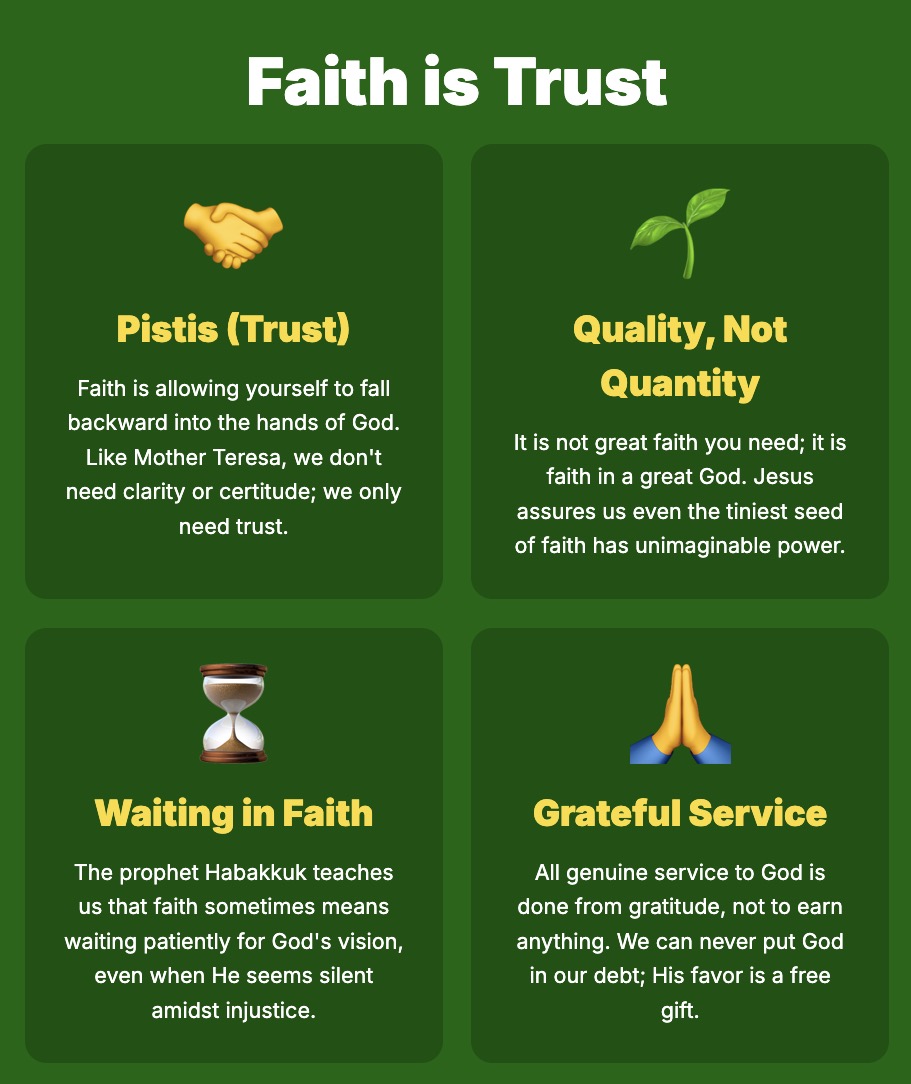
FAITH AS TRUST
Discussion Questions:
- Mother Teresa’s distinction between clarity and trust is profound. In what areas of your life are you seeking clarity when God might be calling you to simply trust?
- Jesus says that faith the size of a mustard seed can move a mulberry tree. How does Fr. Plant’s explanation—that it’s not about great faith, but faith in a great God—change your perspective on the moments when you feel your own faith is small?
- The Gospel concludes with the image of the "unworthy servant." How does this teaching free us from the anxiety of trying to "earn" God's love and instead root our service in simple, grateful duty?
Father Kevin Rettig
27th Sunday of Year C

On a Thread Finer than Hair
Life is a fragile balance, akin to a high wire act, where the presence of guardian angels—both seen and unseen—helps us navigate the uncertainties and fears we face. Life is a delicate balance, suspended on a thread finer than hair, where love and time intertwine.
TWTW Visual Summary and Discussion Questions
Click to enlarge
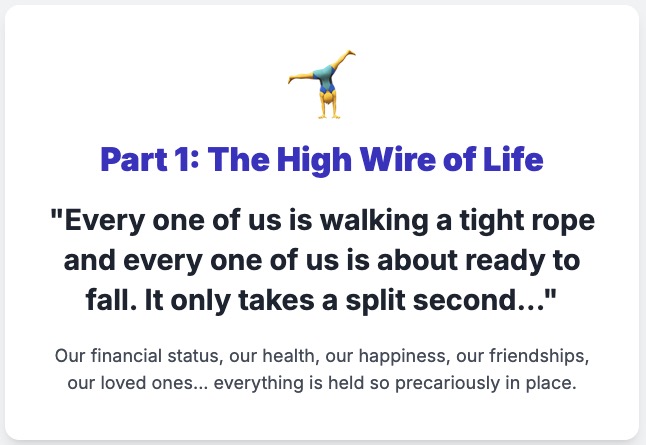
Summary of Key Ideas: The homily opens with the vivid image of acrobats on a high wire, performing dangerous feats far above the ground. This becomes a powerful metaphor for the human condition. Just like the performers, we are all "walking a tight rope," where our health, finances, relationships, and happiness are held in a delicate balance. A single misstep, a split second, can change everything.
Central Theme: Our Shared Vulnerability The core message here is that no one is immune to the precariousness of life. We are all in a state of vulnerability, whether we are conscious of it or not. The tightrope represents the path of our life, stretched over unseen depths.
Discussion Questions:
- When have you most felt like you were "walking a tightrope" in your life? Was it related to your health, your career, a relationship, or your faith?
- The speaker felt fear for the acrobats. Who in your life are you currently "afraid for"? Who seems to be on a particularly difficult high wire right now?
- How does acknowledging our shared vulnerability change the way we look at the struggles of others?

Click to enlarge
Summary of Key Ideas: To deepen the metaphor, the homily introduces a poem by the Hungarian priest László Mécs. The poem describes all of existence—time, creation, human life, love, and the entire universe—as hanging from a "thread finer than hair." This image intensifies the sense of extreme fragility and the preciousness of every moment.
Central Theme: The Fragility of Everything This section moves from the vulnerability of our personal lives to the fragility of all creation. It confronts the "terror that lurks inside our minds"—the deep-seated anxiety that comes from knowing how quickly things can be lost. The "nail of a moment" is all that holds our reality in place.
Discussion Questions:
- The poem states that our "loves and our loved ones" also hang from this delicate thread. How does this image encourage you to cherish the people in your life today?
- The "mice of time" are described as gnawing at the roots of life. What are the "mice of time" in your own life that distract you or wear you down?
- The final line of the poem says, "Our Christmas hangs from the hand of god on a thread finer than hair." What does it mean to you that this fragile thread is ultimately held by God?
Click to enlarge
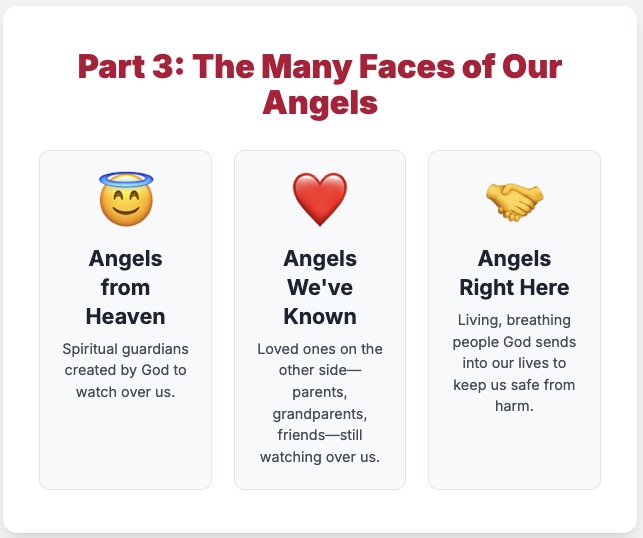
Summary of Key Ideas: Faced with such profound fragility, the homily asserts our deep need for "guardians." It then beautifully expands our understanding of who these angels are. They are not just the spiritual beings created by God, but also the souls of our loved ones who have passed on, and, critically, the living people God sends into our lives to keep us safe.
Central Theme: Divine Providence in Human Form God’s protection is not an abstract concept; it is made real through a network of spiritual and human relationships. We are surrounded by a "cloud of witnesses" and earthly companions who are instruments of God's care.
Discussion Questions:
- Who have been the "guardian angels right here" in your life—the living people God sent to keep you on the path? Have you thanked them?
- Do you ever feel the presence or intercession of loved ones "already on the other side"? How does the Communion of Saints bring you comfort?
- How can you be a guardian angel for someone else this week? Who might need you to be the one to help them stay on their tightrope?
Click to enlarge
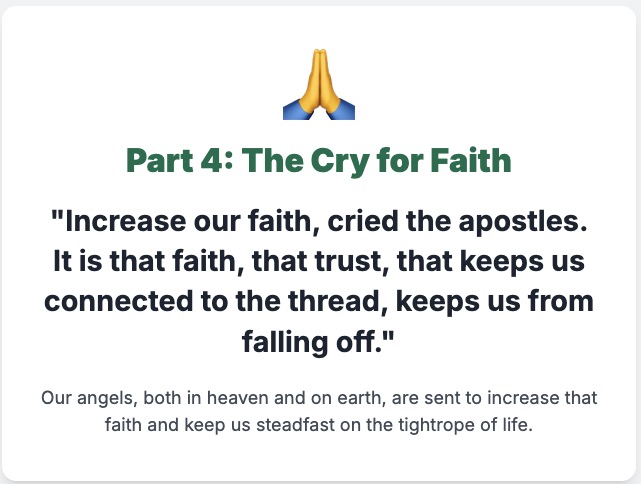
Summary of Key Ideas: The homily masterfully connects our precarious human condition and our need for angels to the day's Gospel, where the apostles cry out, "Increase our faith!" This faith, this trust, is presented as the very thing that keeps us connected to the thread held by God. It is the ultimate safety net.
Central Theme: Faith as Our Connection Faith is not just a set of beliefs; it is the vital connection that keeps us from falling. It is the trust that allows us to walk the tightrope of life, knowing that even if we stumble, the thread held by God will not break. The role of our angels—both in heaven and on earth—is to help increase that very faith within us.
Discussion Questions:
- In what specific area of your life do you most need God to "increase your faith" right now?
- How does viewing faith as a "connection to the thread" rather than a feeling change your perspective on moments of doubt?
- How can we, as a community, act as angels for one another to help strengthen a collective faith that can withstand any trial?

The Sin of Not Noticing
Fr. Ruttig’s homily explores sacrificial love through the Cross. It confronts our tendency to feel that God is distant in our pain and reveals the Cross as God’s definitive, empathetic answer: a powerful, flesh-and-blood “Me too.”
TWTW Visual Summary and Discussion Questions
Click to enlarge
The Practice of Noticing
Fr. Rettig's personal experiment reveals that noticing is a spiritual practice. These questions explore what it means to cultivate this virtue in our own lives.
Discussion Questions:
Fr. Rettig begins with a story about a tombstone that read, "I told you I was sick," highlighting the deep human need to be noticed. Think of a time you felt truly "seen" and understood by someone. What did that feel like? Conversely, have you ever felt overlooked or invisible? How did that impact you?
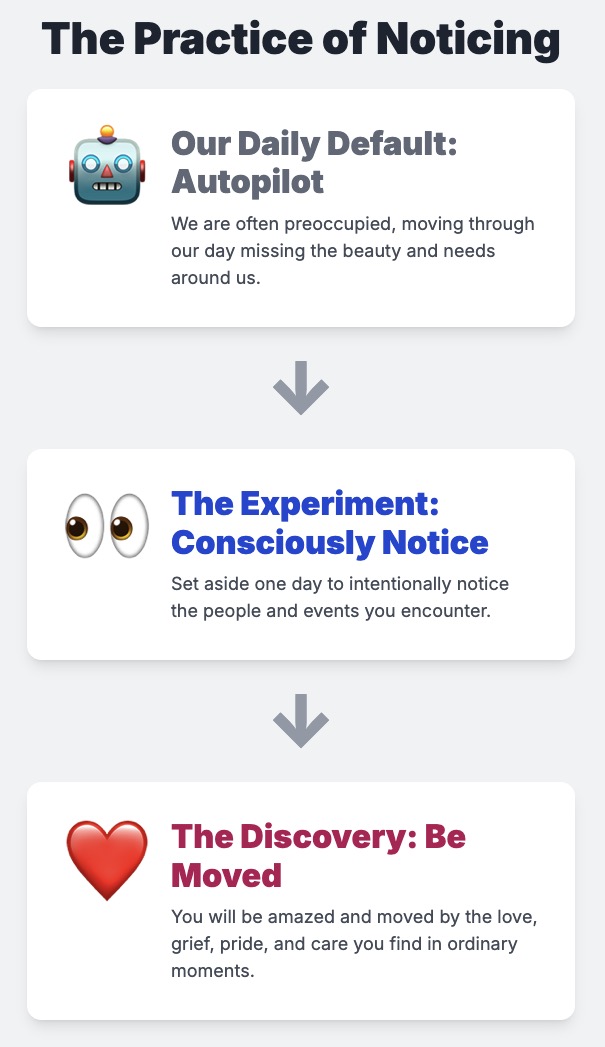
Fr. Rettig undertook a personal project to "consciously notice things all day." He was amazed at how moved he was by the ordinary people and events he encountered (parents at school, nurses in a hospital, a young woman's pride in her first home).
- What do we often miss when we are preoccupied or moving through our day on autopilot?
- If you were to set aside one day to "consciously notice," what are someof the things or people you would focus on? What do you think you might discover?
Click to enlarge
The Sin of the Rich Man
Fr. Rettig offers a challenging reinterpretation of the parable of Lazarus and the Rich Man. The following questions delve into this new perspective on sin and morality.
Discussion Questions:
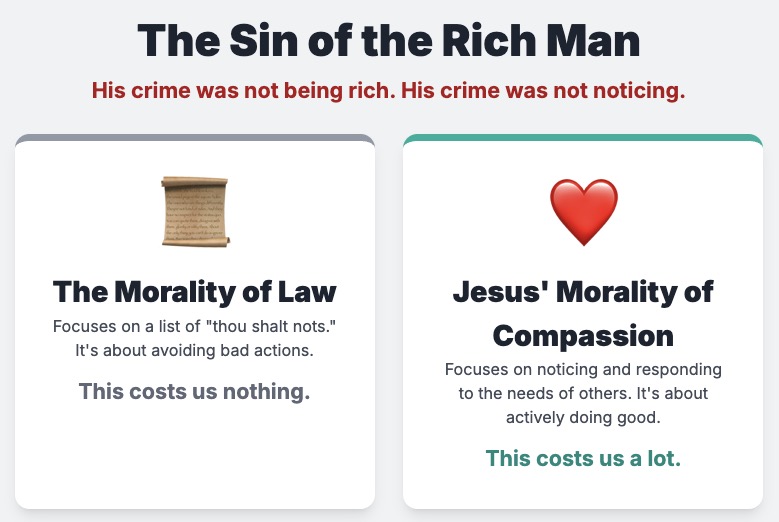
The homily defines the Rich Man's sin not as being wealthy or mean, but as the "crime of not noticing."
- Do you agree with this interpretation? Why is simply "not noticing" a serious sin?
- Fr. Rettig contrasts Jesus' morality of compassion with a morality of law (obeying a list of "thou shalt nots"). He says the morality of law "costs us nothing," while the morality of compassion "costs us a lot." What does he mean by this? What is the "cost" of compassion?

Click to enlarge
The Blinders of Our Age
Fr. Rettig identifies modern technology as a significant obstacle to being present. These questions ask us to consider the specific challenges of our time.
Discussion Questions:
Fr. Rettig identifies the "two screens" (television and computer) as the primary tools that put blinders on us, monopolizing our attention and fostering a culture of not noticing.
- In what specific ways do our screens (phones, computers, TVs) prevent us from noticing the people and world around us?
- The homily suggests the person we fail to notice might even be "in your own house." How can we be more present and attentive to our own family members and loved ones?
Click to enlarge
Living the Message
Ultimately, reflection must lead to action. This final set of questions is designed to help translate the homily's message into concrete steps and a deeper understanding of our relationship with God.
Discussion Questions:
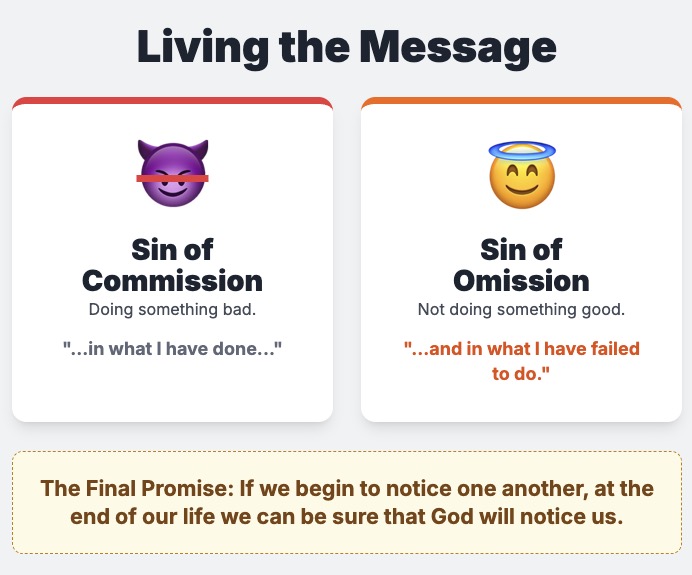
The homily states, "Sin is not necessarily doing something bad. Sin is far more often not doing something good." This refers to sins of omission, which are included in the Mass when we pray, "...in what I have done, and in what I have failed to do."
- Why do you think it's often easier to avoid doing wrong than it is to actively do good?
- What is one practical, concrete step you can take this week to "look up from your screen" and notice someone who might need "an understanding word, a smile, or an ear to listen"?
The homily concludes with a powerful promise: "If we begin to notice one another, at the end of our life we can be sure that God will notice us."
- What does this final thought mean to you? How does our compassion for others relate to how we are received by God?
Monsignor Peter Hahn
27th Sunday of Year C

Increase Our Faith
Faith is a vital gift from God that provides hope and strength in life’s struggles, urging us to respect the sanctity of life and trust in His divine plan. Respect Life Sunday emphasizes gratitude for the gift of life, highlighting the tragic societal mindset that views the unborn as disposable, undermining the sanctity of all human life.
TWTW Visual Summary and Discussion Questions

Click to enlarge
The Universal Cry and God's Unfailing Promise
Core Idea: Our human weakness often leads us to feel overwhelmed by life's struggles, prompting a universal cry for stronger faith. God's response is not to remove the struggle, but to offer a promise of His unfailing presence and purpose.
Key Scriptural Points:
- Luke 17:5: The apostles' plea, "Increase our faith," is the universal plea of every human heart consumed by problems and struggles.
- Habakkuk 1:2-3: The prophet gives voice to our own longing when he cries out, "How long, O Lord? I cry for help... I only have misery and ruin." This validates the real pain and frustration we feel when waiting on God.
- Habakkuk 2:3: God’s response is a call to patient trust. He tells us to "relax and to trust," because "the vision still has its time; it presses on to fulfillment and will not disappoint."
Theological Takeaway: Faith is not the absence of doubt or struggle, but the ability to trust in God's promise even when we cannot see the outcome. God's plan has its own timing, and our faith assures us that He will provide everything we need to sustain us in hope.
Discussion Questions:
- When have you personally felt the cry of Habakkuk or the apostles in your own heart? What circumstances prompted this feeling?
- How does the knowledge that God's vision "will not disappoint" change how you view a current struggle or a prayer that seems unanswered?
Click to enlarge
Part 2: The Gift of Life and the Struggle for Hope
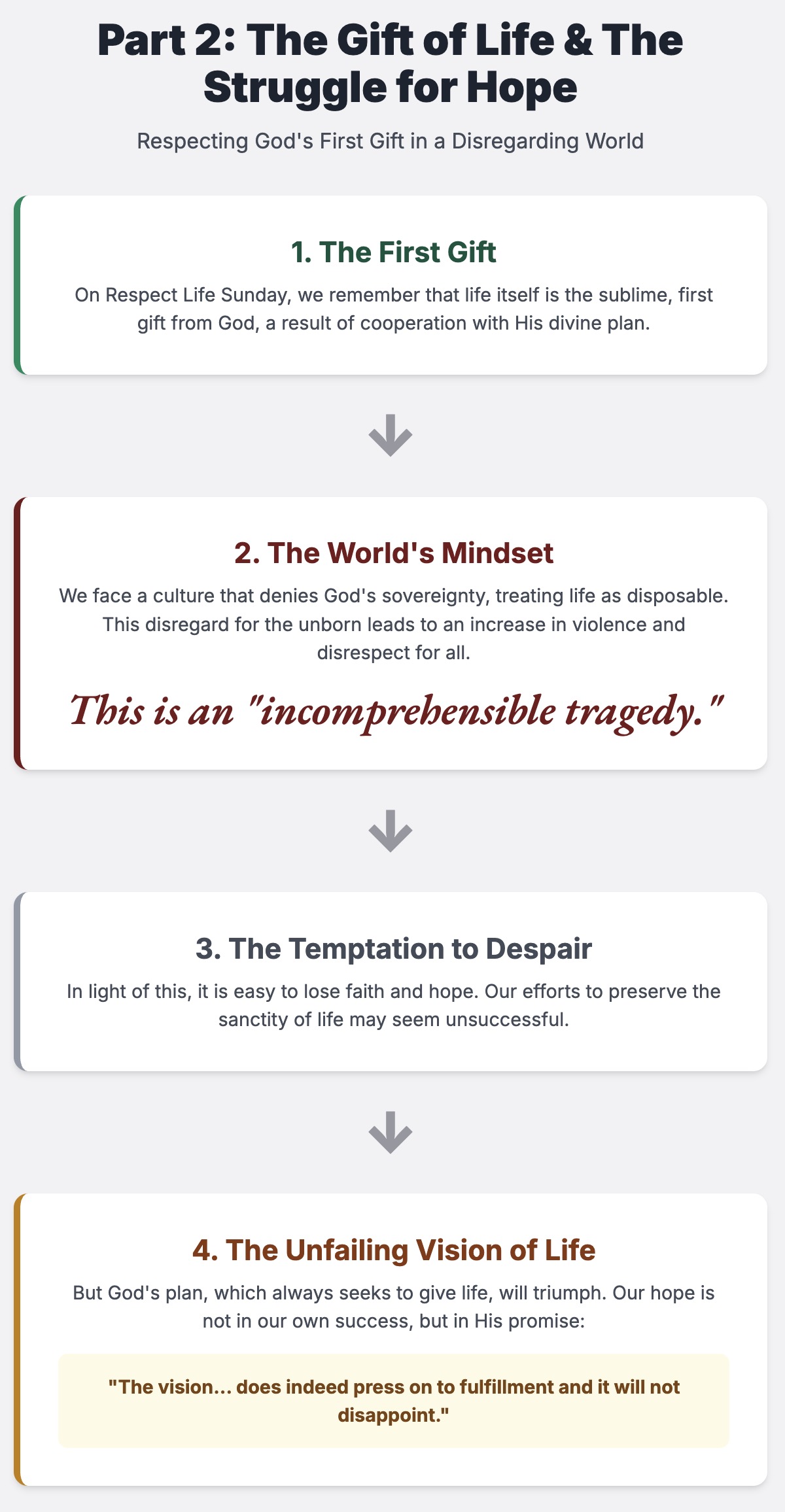
Core Idea: The gift of faith is tied to the first gift we receive: life itself. In a world that often treats life as disposable, our call to respect life from conception to natural death can feel like a losing battle, testing our faith and hope.
Context:
- Respect Life Sunday: This first Sunday of October is a time to reflect on life as the first gift from God and thank our parents for their cooperation in His plan.
- The World's Mindset: This is contrasted with a worldly view that denies God's sovereignty and treats life as disposable, tragically sanctioned in our nation through abortion.
- The Consequences: This disregard for the unborn has unavoidable consequences, leading to an increase in violence and a growing disrespect for the dignity of every person.
Theological Takeaway: It is easy to lose hope when faced with such an "incomprehensible tragedy." However, the promise from Habakkuk applies directly here: the vision of a culture of life, which is God's plan, "does indeed press on to fulfillment and it will not disappoint." Our success is not measured by immediate results, but by our faithfulness in trusting God's ultimate victory.
Discussion Questions:
- In what ways do you see the "disregard for the sanctity and dignity of every human person" in our society today?
- How can you personally help build a culture of life, even when your efforts feel small or unsuccessful? Where does your hope come from in this struggle?
Click to enlarge
The Source of Strength and the Joy of Humble Service
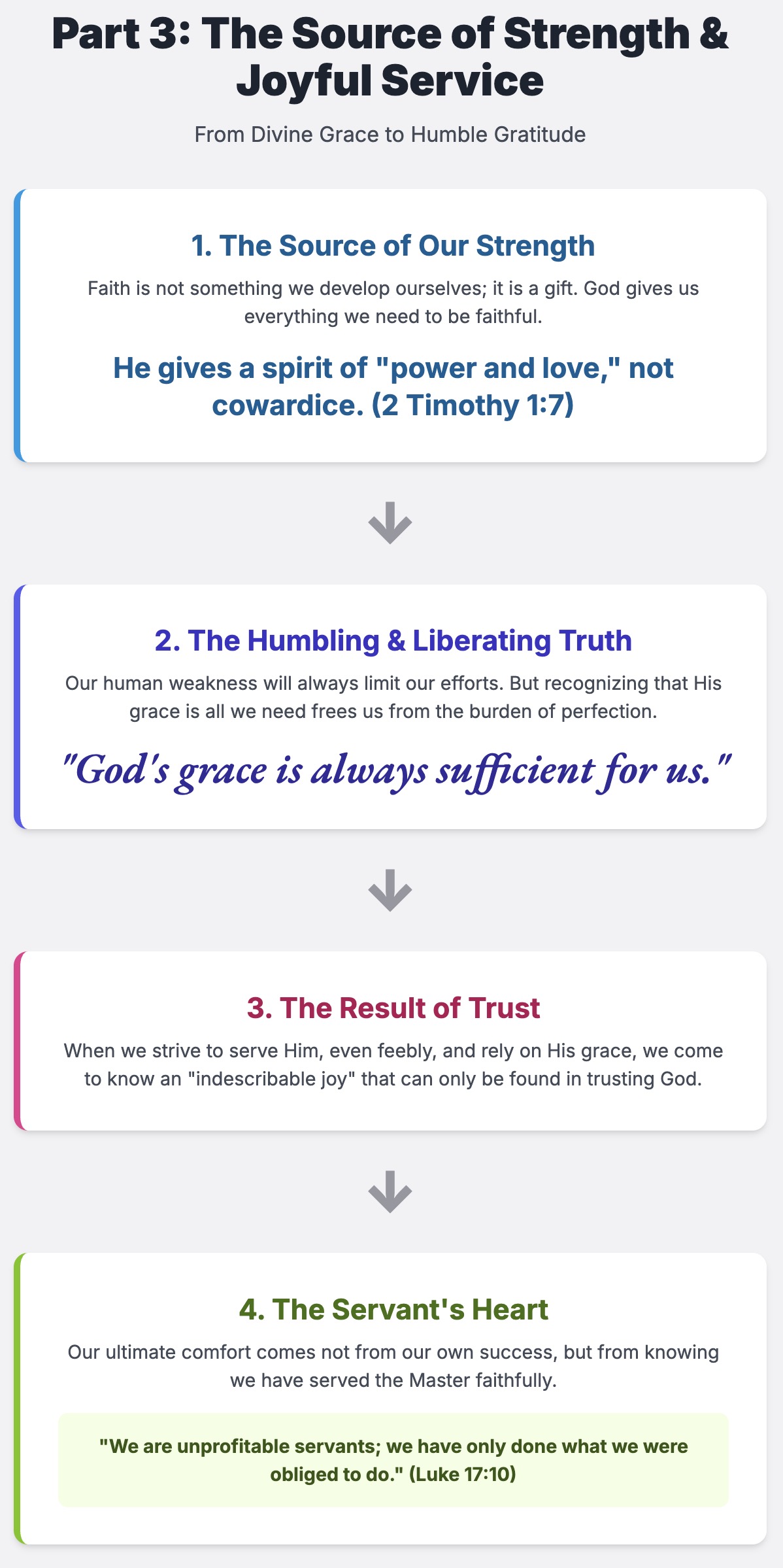
Core Idea: The strength to persevere in faith and service does not come from us. It is a gift from God, a grace that is always sufficient. Recognizing this is both humbling and liberating, leading to a joy found only in trusting Him.
Key Scriptural Points:
- 2 Timothy 1:7: Our strength is a gift. God does not give us a spirit of cowardice, but one of "power and love and self-control." He provides everything we need to be faithful.
- The Humbling and Liberating Truth: Our own efforts will always be limited by human weakness, but "God's grace is always sufficient for us." This frees us from the burden of having to be perfect or successful on our own.
- Luke 17:10: After striving to serve the Lord, even feebly, we find an "indescribable joy." We can then say with gratitude, "We are unprofitable servants; we have only done what we were obliged to do." Our comfort comes not from our accomplishments, but from the Master's commendation.
Theological Takeaway: True spiritual freedom is found in complete dependence on God. When we stop relying on our own strength and start relying on His grace, we are freed from the anxiety of failure. Our service becomes not a burden to be accomplished, but a joyful response to the God who gives us everything.
Discussion Questions:
- How does the idea that "God's grace is always sufficient" change how you view your personal weaknesses or past failures?
- What does it mean to you to be an "unprofitable servant"? How can finding your identity in this role be a source of joy and liberation rather than self-deprecation?

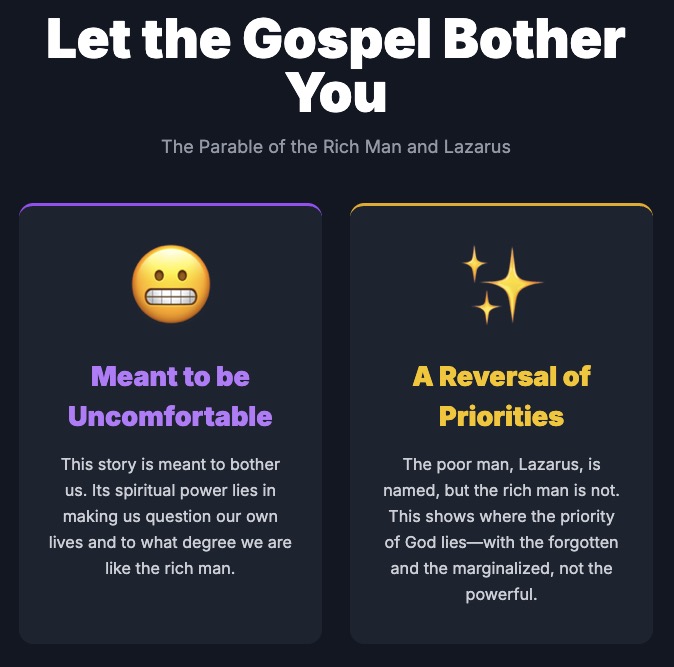
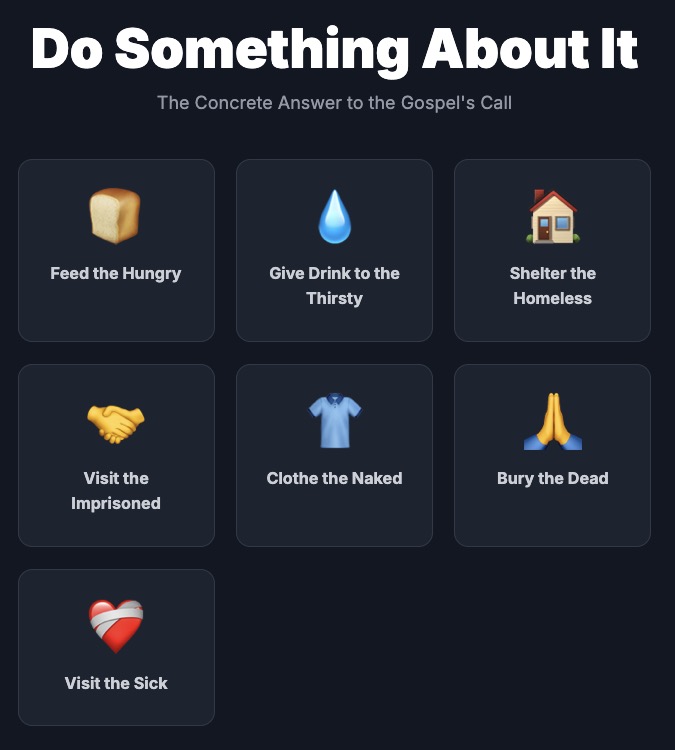
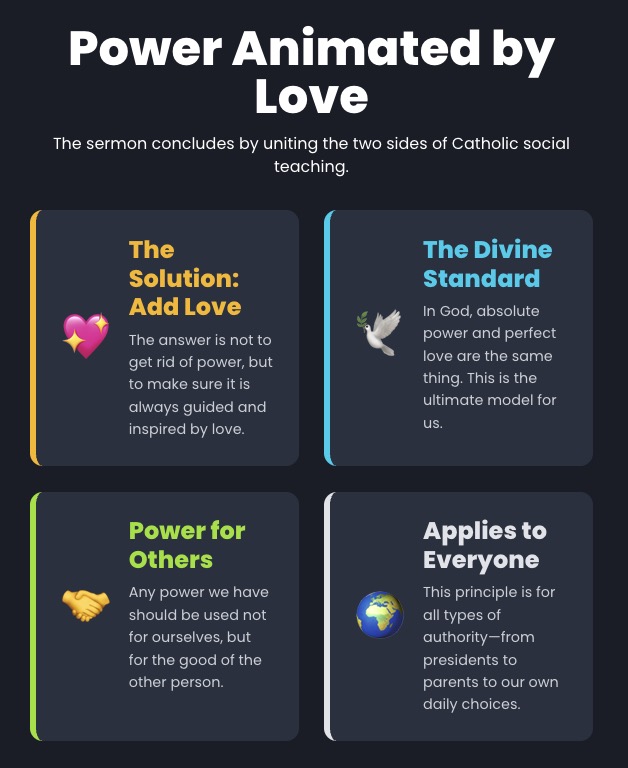
Our Faith is Meant to Afflict the Comfortable
Faith challenges complacency and calls for personal reform and stewardship of God’s gifts, emphasizing the importance of caring for others and adhering to the Church’s teachings to avoid societal and spiritual downfall.
TWTW Visual Summary and Discussion Questions
Click to enlarge
Part 1: The Warning Against Worldly Comfort
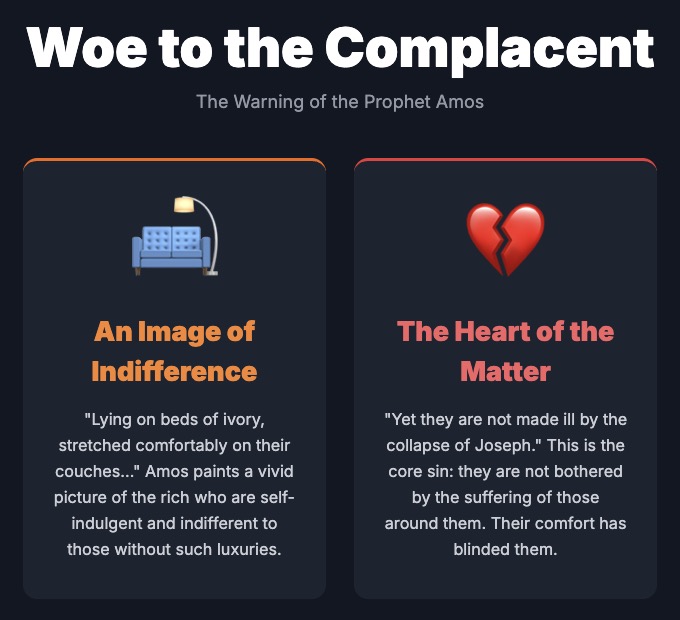
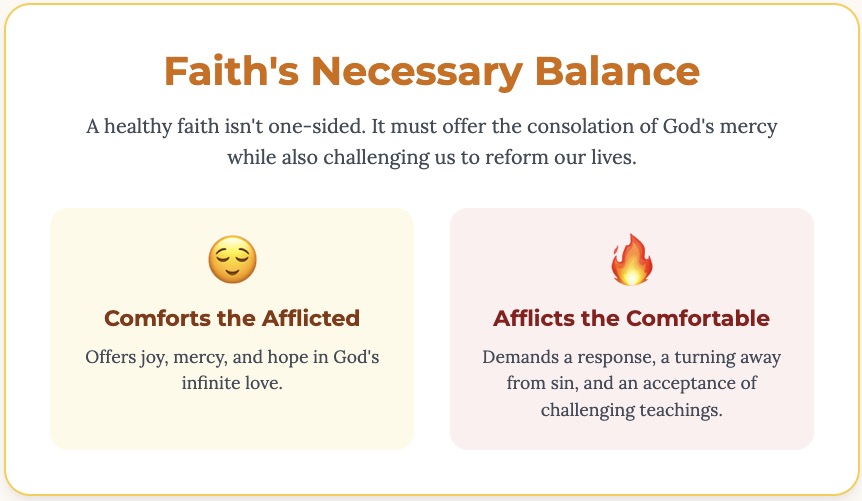
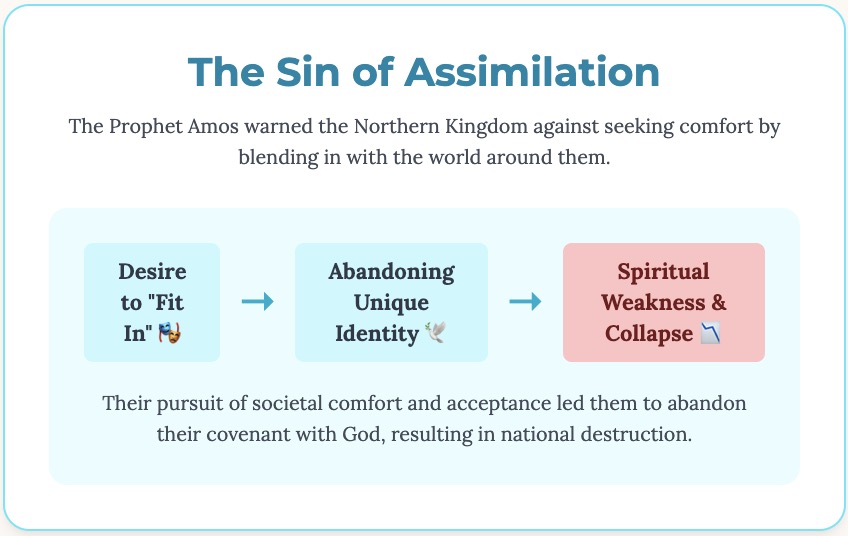
Focus: This section explores the homily's opening theme: that faith must both comfort and challenge us. It examines the historical example of the Prophet Amos warning Israel against the spiritual danger of seeking comfort through cultural assimilation.
Discussion Questions:
- Msgr. Hahn begins with the saying that faith is meant to "comfort the afflicted, but sometimes to afflict the comfortable." Can you recall a time when your faith was a great comfort? Can you recall a time when a teaching or scripture reading made you feel "afflicted" or challenged in your comfort? Why is this balance important?
- The people of the Northern Kingdom wanted to be "assimilated" and not seem different from the cultures around them. In what specific ways do we, as modern Catholics, feel pressure to "blend in" with secular society?
- Amos warned that this desire for comfort would lead to weakness and collapse. Where do you see this principle at work today? How does abandoning our unique Catholic identity in favor of societal acceptance make our faith weaker?

Click to enlarge
Part 2: The Individual Face of Complacency
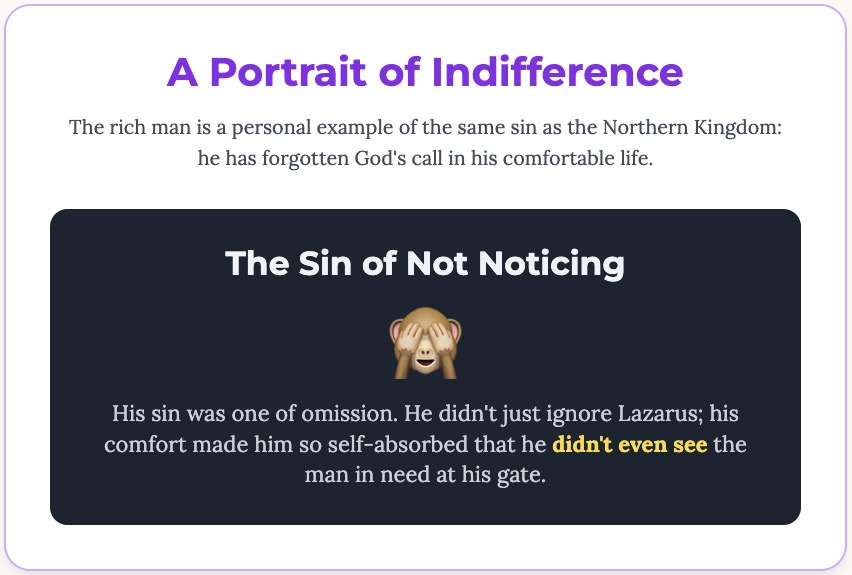
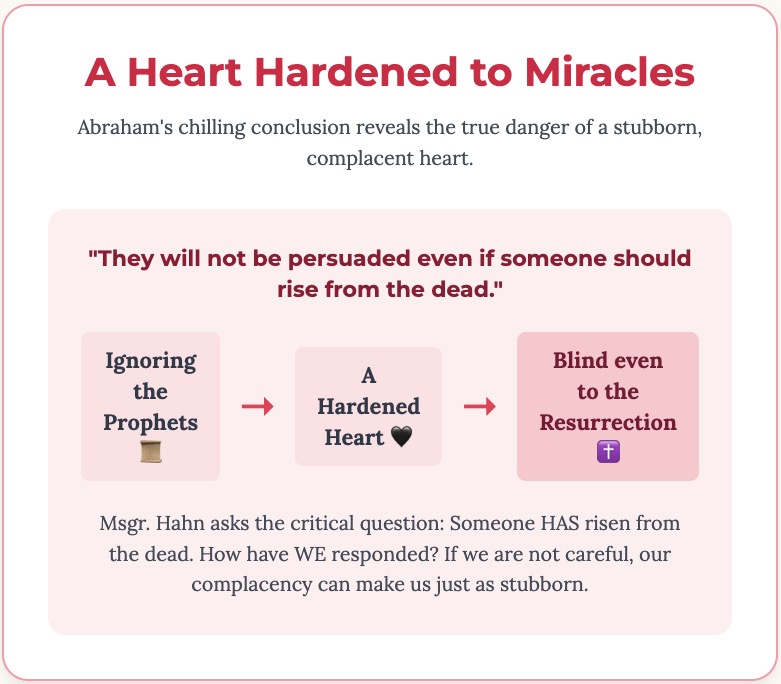
Focus: This section analyzes the Gospel parable of the rich man and Lazarus as a powerful, individual example of the destructive nature of self-centered indifference and the hardness of a complacent heart.
Discussion Questions:
- The homily emphasizes that the rich man's sin was a failure to notice. Why is this type of indifference, born from being overly comfortable, so spiritually dangerous? Who is the "Lazarus" at the gate of our society (or our own lives) that we might fail to notice?
- Abraham says the brothers have "the benefits of all the law and the prophets." What are the "prophetic voices" God gives us today to warn us against complacency (e.g., Scripture, Church teaching, the words of the Pope, our conscience)?
- Msgr. Hahn connects Abraham’s final words directly to us: "Someone has risen from the dead... and yet how do we respond?" If the Resurrection is the ultimate sign, why do we still fall into the trap of complacency? What does this say about the stubbornness of the human heart?

Click to enlarge
Part 3: The Urgent Call to Stewardship and Holiness
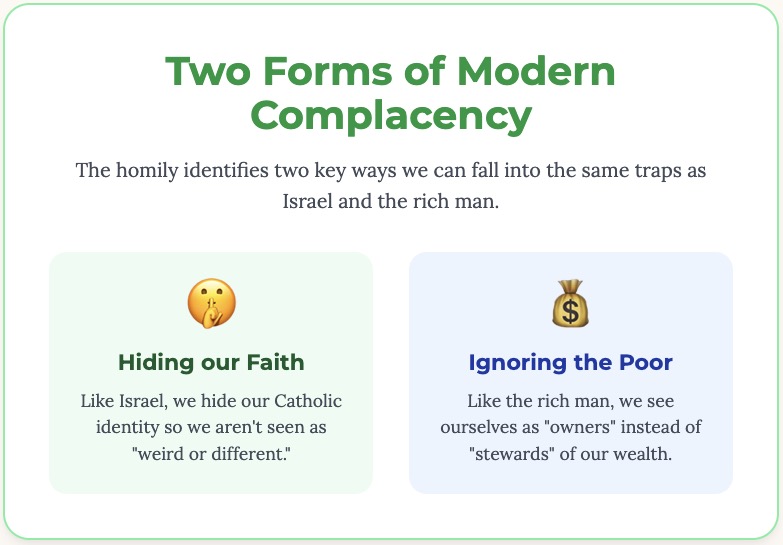
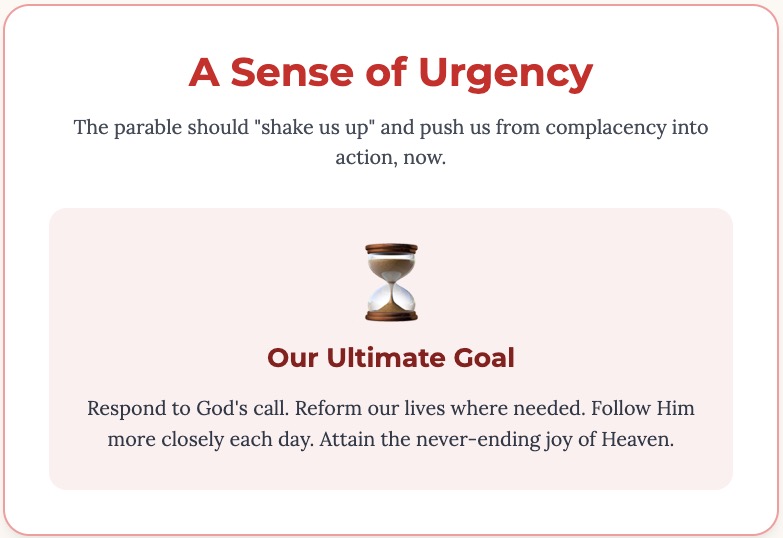
Focus: This final section applies the warnings to our modern lives, identifying contemporary forms of complacency and issuing an urgent call to reform our lives by embracing our role as stewards and actively pursuing holiness.
Discussion Questions:
- The homily presents two modern forms of complacency: hiding our faith to fit in, and failing to share our resources. Which of these two temptations do you find more challenging in your own life? Why?
- Discuss the concept of being "stewards" rather than "owners" of God's gifts. How does this shift in perspective change your view of your time, talents, and money?
- The readings are meant to give us a "sense of urgency." What is one practical area of your life (e.g., prayer, a specific sin, a relationship, an act of charity) where you feel God is calling you to move from complacency to urgent action?
- The homily concludes by calling us to "follow him more closely each day." What is one concrete step you can take this week to respond to that call and break out of a comfortable spiritual routine?
Frank Pavone
27th Sunday of Year C

How Long O Lord?
The prophet Habakkuk expresses what many believers say in the face of the culture of death: “How long, O Lord? I cry out to you, ‘Violence!’ but you do not intervene.” The Lord says to us what he said to Habakkuk. “The vision still has its time, presses on to fulfillment, and will not disappoint.” Yet we still struggle, in and through Christ, to bring about a Culture of Life.
TWTW Visual Summary and Discussion Questions
Click to enlarge
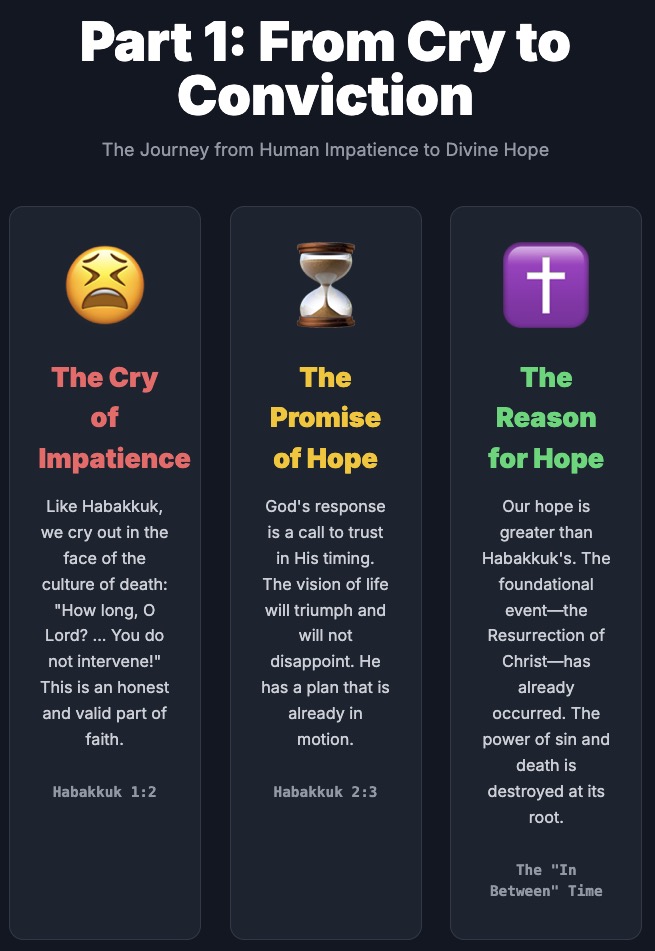
Part 1: The Cry of Impatience and the Promise of Hope
Core Idea: The frustration we feel when confronting the "culture of death" is an ancient and valid part of faith, first voiced by prophets like Habakkuk. God's response is not immediate intervention, but a firm promise that His vision of life will ultimately triumph because of Christ's resurrection.
Key Scriptural Points:
- Habakkuk 1:2: The prophet's cry, "How long, O Lord? I cry out to you, ‘Violence!’ but you do not intervene," perfectly captures the believer's anguish in the face of persistent evil.
- Habakkuk 2:3: God’s answer is a call to hope rooted in divine timing: "The vision still has its time, presses on to fulfillment, and will not disappoint."
- The "In Between" Time: We have even more reason for hope than Habakkuk. We live after the Resurrection, in a time when Christ's kingdom is inaugurated but not yet fully manifest. The power of sin and death has been destroyed at its root.
Theological Takeaway: Our struggle against evils like abortion takes place within the context of a victory that has already begun. We are not fighting for a victory that is in doubt, but are participating in the unfolding of a victory already won by Christ.
Discussion Questions:
- When you see the evils of the world, do you identify more with Habakkuk's cry of impatience or God's call to patient hope? Why?
- How does knowing that Christ has already destroyed sin and death at their roots change your perspective on the daily struggle for a Culture of Life?

Click to enlarge
Part 2: The Meaning of "Living by Faith"
Core Idea: The phrase "the just man shall live by faith" means more than simply being guided by faith. It means that faith is the very source of our true life, rescuing us from the "kingdom of death" and placing us into the "kingdom of his beloved Son."
Key Scriptural Points:
- Luke 17:5: The apostles' plea, "Increase our faith," is a request for more of this true, rescuing life.
- Colossians 1:13: St. Paul declares that God "has rescued us from the kingdom of darkness and brought us into the kingdom of his beloved Son." Faith is this transference from one kingdom to the other.
- 2 Timothy 1:7: Because we have been transferred into Christ's kingdom, the Spirit we have received is "no cowardly spirit." Our faith is not timid because it is rooted in the power of the Resurrected Christ.
Theological Takeaway: Faith is not a human quality we develop; it is the gift of participating in a new reality. It is our connection to the life of Christ which has already conquered death. This is why we can have courage; our life source is no longer subject to the powers of this world.
Discussion Questions:
- How does viewing faith as your "life source" rather than just a "moral guide" change your approach to daily challenges?
- In what areas of your life do you feel the influence of the "kingdom of darkness"? How can "living by faith" rescue you from the grip of that kingdom?

Click to enlarge
Part 3: The Stance of Victory
Core Idea: Because Christ has already won the ultimate battle, our posture when confronting evil should not be one of fear or doubt, but a "stance of victory." We are called to courageously apply the victory that is already ours.
The Central Shift in Mindset:
- Instead of: Looking at the world's evils and wondering how we will ever overcome them.
- We now: Look at the world's evils and renew our conviction that they have already been overcome in Christ.
The Call to Action: Our work for justice and a Culture of Life is not a desperate struggle against an overwhelming force. It is a confident, courageous, and joyful mission to claim the territory that Christ has already won back from the enemy. We say to evil, "You no longer have any place here! Your kingdom has been overcome!"
Theological Takeaway: We are not soldiers fighting a war with an unknown outcome. We are the occupying force of a victorious King, tasked with bringing His peace, order, and life to a world still experiencing the echoes of a battle that is already over. This is the source of our courage and our conviction.
Discussion Questions:
- What is one specific evil or "culture of death" issue that often makes you feel discouraged or fearful?
- How would your thoughts, prayers, and actions regarding that issue change if you approached it from a "stance of victory," knowing it has already been overcome in Christ?brother or sister"?
Non-profit ministries have permission to copy/paste any infographics on this website into bulletins, presentations, or class/home school worksheets. A link and/or shoutout to THE WORD THIS WEEK and respective contributors would be greatly appreciated.