ENERGY! Eat your Wheaties or drink strong coffee! That’s the kind of super-glad energy this reading requests! Practice eye contact and smiling 🙂 It’s joyful news you are proclaiming.
SECOND READING
A short reading from Paul. Make sure you know the point(s) you want to deliver: it’s for our benefit we are SO “lucky” and graced to be coheirs…
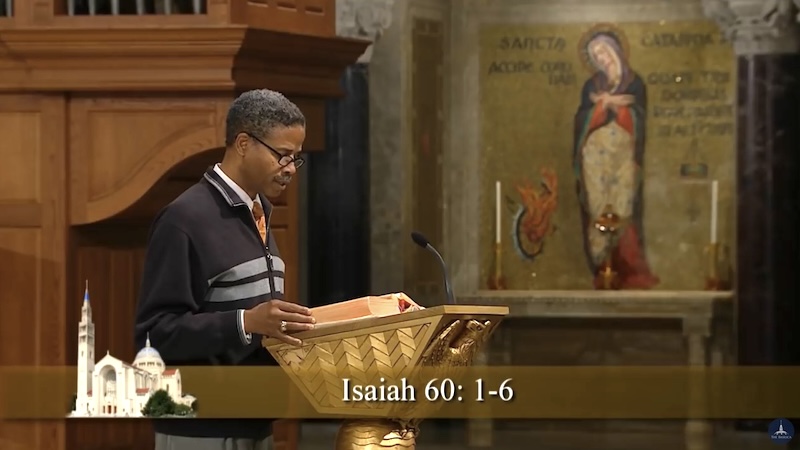
Some general tips for lectors reading Is 60:1-6 using the New American Bible (NAB) during Mass.
Begin with confidence:
Start reading verse 1 with a clear and confident voice to capture the attention of the congregation.
Emphasize key themes:
Give special attention to words like “arise,” “glory,” “light,” “shine,” and “radiance.”
Highlight contrasting ideas:
In verse 2, emphasize the contrasting ideas of darkness and light. You can slightly slow down the pace on the word “darkness,” and then speed up on “radiance” to emphasize the contrast between the two.
Use appropriate voice modulation:
During verses 3-5, express a sense of joy and grandeur in your voice to depict the excitement and anticipation associated with the arrival of God’s glory and the gathering of nations. Use a slightly higher pitch and vary your tempo to convey the uplifting tone.
Pause for effect:
At the end of verse 5, take a brief pause before beginning verse 6. This pause will help separate the descriptions of the camels and the gold, and provide a moment to emphasize the significance of the gifts being brought to the people of Jerusalem.
Vary pace during lists:
In verse 6, there is a list of items being brought to Jerusalem—camels, dromedaries, gold, frankincense, and proclaiming the praises of the LORD. Vary your speed slightly as you read this list, so that each item is distinct but not rushed.
Convey enthusiasm:
When reading the phrase “They proclaim the praises of the LORD” in verse 6, bring enthusiasm to your voice. This should reflect the joy and gratitude of the people receiving these gifts and the expressions of praise for God.
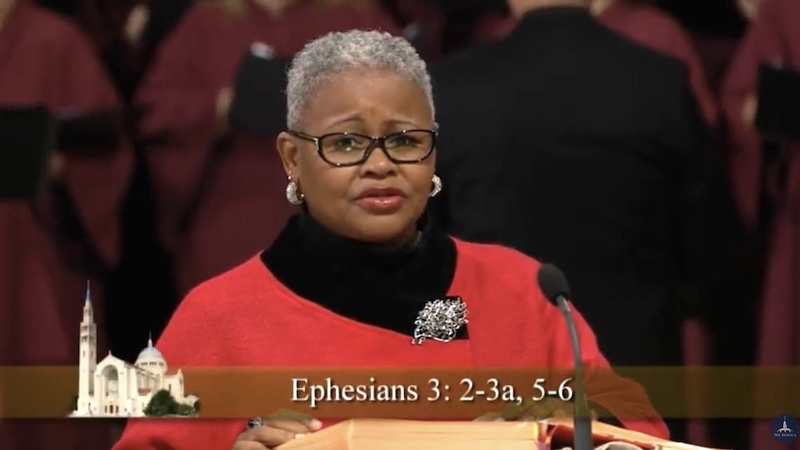
Ephesians 3:2-3a, 5-6
Certainly! Here are specific tips for a lector reading Ephesians 3:2-3a, 5-6 using the New American Bible (NAB) at Mass:
Emphasize the commission:
In verse 2, place emphasis on the word “stewardship” to highlight the responsibility entrusted to Paul by God. This word indicates the significance and weight of the message he carries.
Maintain a fluid flow:
Read verses 2-3a with a steady pace, ensuring clarity and maintaining an even rhythm to help the listeners follow along.
Slow down for emphasis:
When you reach verse 5, slow down slightly when reading “it has now been revealed,” giving weight to this pivotal moment where the mystery of Christ is being uncovered.
Pause for effect:
After reading the phrase “in the Spirit,” take a short pause to allow the congregation to absorb the statement before continuing with verse 6.
Emphasize inclusivity:
In verse 6, emphasize words that illustrate the inclusivity of God’s plan, such as “Gentiles,” “heirs,” and “coheirs.” This emphasizes the message that all people are included in God’s promise.
Vary your tone:
When reading the phrase “members of the same body,” bring a sense of unity and connection to your voice. Let your tone convey the significance of this concept and the unity of believers in Christ.
Speed up for the final phrase:
As you reach the closing phrase of verse 6, “partakers of the promise in Christ Jesus through the gospel,” increase your pace slightly to create a sense of momentum and anticipation, highlighting the climax of the passage.
General Notes
As a lector, it is an important responsibility to effectively convey the Word of God to the congregation during the Mass. Here are some practical tips:
1. Although tips on what words and phrases to emphasize and when to pause can be helpful, your delivery should ultimately depend on your own prayerful interpretation of the passage. From the series of tips given each week on this page, reader should choose which verses and words they want to emphasize. It’s important to find a balance that helps communicate the message effectively.
2. Familiarize yourself with the text: Read and study the Scripture passage several times before the Mass. Understand the context, the message it conveys, and the emotions it evokes.
3. Practice pronunciation and enunciation: Ensure that you know how to properly pronounce the words and names mentioned in the passage. Practice enunciating clearly and maintaining a steady pace throughout.
4. Use appropriate intonation and emphasis: Experiment with different ways to emphasize certain words or phrases that carry significant meaning. This can help in conveying the depth and impact of the message to the congregation.
5. Maintain a calm and confident demeanor: Approach the ambo with a serene presence and a sense of confidence. Maintain good posture, make eye contact with the congregation, and avoid rushing through the reading.
6. Speak slowly and clearly: Take your time while reading, ensuring that the words are clearly audible to everyone present. However, avoid artificially elongating words or sentences, as it may sound unnatural.
7. Pause when necessary: Pause at appropriate intervals, particularly at natural breaks in the text, such as commas or full stops. Pausing can help listeners absorb the message and reflect on its meaning.
8. Use nonverbal cues: Employ body language and gestures to effectively convey the emotions and ideas expressed in the passage. However, be mindful that gestures do not distract from the message or become exaggerated.
9. Maintain a respectful tone: Isaiah 61:1-2A, 10-11 is a text of hope and joy. Let the tone of your voice reflect the reverence and beauty of the passage. Be mindful of the emotions conveyed in the words and try to transmit them genuinely to the congregation.
10. Breathe and relax: Take a deep breath before beginning the reading to calm any nerves or anxiety. Remember, you are called to facilitate a meaningful encounter with the Word of God, and the Holy Spirit will guide you.
11. Pray before and after your reading: Seek God’s guidance and ask for His grace to effectively convey His message to the congregation. Offer a prayer of thanksgiving after the reading, asking for a blessing on the listeners and yourself.
By following these practical tips, you will be better equipped to deliver a clear, engaging, and spiritually uplifting reading during Mass.
Ask your presider to tell your listeners (or tell them yourself):
The Epiphany of the Lord, January 8, 2023
Before the first reading:
When the Jews began slowly to return from exile in Babylon, their capital Jerusalem was desolate. The prophet encourages them with images of brightness, then surprises them with the prediction that they will attract pagan nations to God.
After the psalm, before the second reading:
Even Jewish converts to Christ maintained the ancient belief that Jews were God’s only chosen people. Paul says God has now revealed a long-secret mystery, namely that Gentiles, too, are to enjoy God’s favor, because of Christ.
Before the gospel acclamation:
Today’s gospel reinterprets the first reading’s themes of light and of pagans bearing gifts, applying them not to the city Jerusalem, but to Jesus.
First Reading, Isaiah 60:1-6
The Historical Situation: This is from that part of the book of Isaiah where the author addresses the Jews trying to re-establish themselves in their homeland after a few decades in exile in Babylon. As these Notes said of the Isaiah, chapter 62, passage for the Christmas mass at dawn, “Other parts of this section of Isaiah (chapters 56-66), tell us how slow and frustrating that project was. Those already home fretted about the slow pace of the others’ return (‘Your sons come from afar, your daughters in the arms of their nurses.’) To get the flavor of it, imagine how American Southerners might have felt during Reconstruction, or a contemporary family might feel when they return to a fire-damaged home.”
The Theological Background: For a dispirited people, there are two important points here:
Though they feel helpless, God can and will intervene to restore them, by God’s power rather than by their own.
God will use them to attract to himself other nations, other nations for whom the embattled and just recently exiled Jews had very little respect.
To describe God’s method of accomplishing this, Isaiah uses the metaphor of light. The world’s people are in darkness, and Judah will illuminate them.
Proclaiming It: So how shall you proclaim this? Remember Isaiah was speaking to beaten-down people engaged in a frustrating struggle. How would the prophet have used his voice in encouraging them? Also, be sure to contrast the Judeans (“you”) with the others, who are described as “the peoples” and “nations” and “they all.” The description of the wealth arriving in Jerusalem should find you sounding awe-struck.
Second Reading, Ephesians 3:2-3a, 5-6
The Historical Situation: This reading, too, is about a revelation. The medium is not light piercing darkness, however, but the historical acting out of God’s once secret plan. The plan, as Paul now sees, was to nourish the Jews as God’s chosen people for a long time, then to extend God’s favor beyond the Jews to the Gentiles, by the coming of Jesus into the world. Ephesians is written by a Jew to Gentiles. So when Paul says something was “given to me for your benefit” he means “as a Jewish Christian I have something to pass on to you previously not-chosen people, something that has been kept from you until now.”
Proclaiming It: To proclaim this in a way faithful to Paul’s intention, you have to emphasize “mystery” and “revelation” in the first sentence, then “Gentiles”, “coheirs”, and “copartners” in the last sentence. An unprepared listener hearing you should get an idea like this, “There was an in group and an out group, and then Jesus came, revealing God’s plan to invite the outsiders inside.”
A Homily Starter, based on one or more of the day’s readings
Like post-Exilic Jerusalem, the author of these Notes lives in a parish to which the contemporary demographics are not being kind at all. The siren-song of more-house-for-the-money in ethnically-less-diverse suburbs is drawing our young people away. We who stay in the old neighborhood feel like those left behind in Jerusalem, wishing the exiles would come back and invigorate our community again. Well, when Isaiah spoke to such an embattled group, he told them to quit navel-gazing and to expect the Lord to use them to attract pagans, that is, to let themselves become a beacon for outsiders. Perhaps, in our shrinking inner-ring suburban parishes, the Lord is asking us to be evangelistic instead of nostalgic.
Starter for a Different Homily: As other sources linked on this page show, the magi arrived at the knowledge of God’s plan by astrology, a practice forbidden to the orthodox. Indeed, one of the purposes of the gospel of Matthew as a whole, and of this passage in particular, is to open the orthodox to embrace God’s all-embracing plan. Matthew is saying, “You cannot foreclose, a priori, the possibility that God is doing something unprecedented.” The second reading says it was God’s plan all along, but only now fully revealed. Now in the first reading there is a glimmer of universality, but it’s triumphal. Trito-Isaiah expects the nations to come to Jerusalem saying, “You Jews were right all along; we’re here to do it your way now.” Matthew’s message to Jewish Christians is, “For generations we’ve been underestimating God’s embrace.” This all raises questions like “Have we let our natural tribal loyalties limit our openness or our missionary zeal?” and “Have we grown smug with our fixed catalog of ways we’ll recognize God at work in the world?”
Yet Another Homily Starter: It’s interesting how the story of Jesus is framed by accounts of nervous rulers conniving to protect their turfs. In the beginning it’s Herod. On the recent feast of the Holy Innocents we heard the lengths to which he would go to hold onto his power. And at the end of Jesus’ life, it’s the religious leaders, colluding with the Roman procurator, who sacrifice the innocent rather than risk a revolution. At both boundaries of the story, Jesus’ messiaship, really his kingship, is presented with subtlety. For Jesus is king in unprecedented ways. He is born not in a palace but a stable, attended not by sycophants and courtiers but by shepherds and foreign astrologers. At the beginning of his public ministry, after he fasted in the desert, someone credibly shows him and offers to give him “all the kingdoms of the world in their magnificence,” which he refuses. (It’s telling to reflect on who made the offer.) In adulthood, he commands the loyalty of his subjects not by force of arms but by loving, teaching, healing, forgiving and serving them. His frame of reference was never himself but of God his Father, whose reign he proclaimed, not his own. (He declined the title “messiah” and used the title “Son of Man,” which usually means “just another son of another man.”). At the climax of his life, he is raised up not upon a throne but upon a cross, crowned not with gold but thorns.
So those who would follow Jesus the way he wants to be followed must be wary of their desires for power, both as individuals and as institutions. We love to measure our revenue, productivity, and profits, our membership, attendance and capital campaign burse, our web-site hits and referring sites, our majorities in the legislatures, troop strength, and tax reductions. But all that status is sand if we love our power more than our neighbor, if we’re more like Herod than like Jesus.
Hearing the Word as a Community
(The church does a great job of fostering the faith of individuals. What we do less well is foster the faith of, and define the identity of, the church as a community with a mission to the world. I’m trying to contribute to that goal, and to get the church to direct some new energy to it. The difference strikes me when I listen to preaching that applies the Word to guiding the choices that individuals make, but doesn’t ask the community to discuss its corporate responses to the Word. I hope that if we do more of that, taking responsibility for how we as the Body of Christ engage the world, our congregations will enjoy new vigor, and members will identify with the Body with deeper commitment. That’s behind this draft of an essay that I wrote in early December, 2007. It’s thoughts on Epiphany, or how the church could hear Matthew 2:1-12 as a community.)
[Title:] You’re Bringing Us What?
Saint Matthew wrote his gospel for Jews who had become Christians. Their embrace of Jesus caused them predictable trouble with mainline Jews. This and the unpredictable drawing of some Gentiles to Jesus shook up their old categories. Now it was harder to know which people were chosen and which were not. Ancient hopes about what the Messiah would accomplish had to be revised. Matthew tells the story of Jesus to people engaged in a complicated dance with two other partners: Gentile converts and Jews who never accepted Jesus.
Let’s read Matthew 2:1-12, the story of the Magi’s visit to the newborn Jesus, in this light. To the people of Judea, including Herod, Mary, Joseph and the infant Jesus, the magi are complete outsiders. They come from the vaguely described East. Their profession, astrology (Matthew doesn’t say they were kings), really puts them outside Jewish orthodoxy, which prohibited divination and similar arts. But the magi come to the seat of this ancient religion, alien to them, looking for something of value both to Jews and pagans. They can only express their hopes in political terms, expecting to find a king who holds great promise for his own people and for the rest of the world.
Tradition interprets the three specific gifts of the magi as follows: They bring gold because that’s the medium of tribute one offers a king, and they expect the object of their hopes to fulfill their hopes by the exercise of royal power. That’s the only way they could imagine someone or something, or even some god, making a difference in the world. They bring incense because that was the medium of worship of any divinity; the magi assume the new king must be at least the agent of a god, if not a god himself. The magi also bring a burial spice, because, as everyone in Matthew’s audience already knows, the whole story of Jesus culminates in his death, described in grisly detail, his burial, and his resurrection, described in a mysterious lack of detail. Matthew’s audience also knew that some, maybe all, of Jesus’ followers would follow him into martyrdom. So the evangelist doesn’t shrink from casting the pall of death over the otherwise charming scene of elders excitedly gathering to visit a newborn.
Let’s draw an analogy to the life of the church today. We within the church have something of value, and at least some outsiders are looking for what we have. They’re like the astrologers from the East, coming to our Judea. We have a great truth, a great treasure, a great power, which attracts the outsiders. In some respects, the treasure we have is as underdeveloped as a baby, now full of promise only, but one in which we have great hope. In other respects, what we offer the world is solid, publicly known for centuries, well developed but ever adaptable.
Were these outsiders to choose to join us, it would make big differences for them and for us. We can fathom those differences by analogies to the gold, frankincense and myrrh from the magi story.
The gold they bring us represents wealth, some wealth in the crass material sense, but more importantly the wealth of energy and love they’d bring to the life of our church. They can help invigorate us, and bring new life to our withering communities. That’s a mixed blessing, of course, because new energy and new members entail new challenges.
The incense suggests that new members can help us renew the way we experience and express reverence for God. Outsiders are interested in us not just because we’re an attractive social group or a place to hear nice music. They hope we’re a channel for contact with an ineffable, mysterious God. That we are, but sometimes we nail God down too tightly, and assume we understood much more about God than we really can. The essence of God will always be to us as elusive as the smoke of incense. It’s an act of reverence to admit that, and to express humility about our theological certainties. Sometimes we express God in only narrow ways that admit no variation. Some of our practices are quite opaque to newcomers, who themselves may have ways of knowing God that we should share. So if we’re going to let strangers bring us incense, we have to acknowledge humbly the God who alone is worthy of that.
The most daring thing for us to accept is the burial spices. The outsiders want us to be willing to bear the cross when a faithful life asks that of us. Those who want the prosperity gospel know where to tune that in. But the outsiders coming to us want a community of courageous believers whose convictions and bonds are stronger than death. When we act like cowards, we repel these seekers, as we have done by our botched, defensive handling of abusive clerics. The world has plenty of self-absorbed, smug and comfortable groups. We’re called to offer a generous alternative, and to put our community at the disposal of the Reign of God in the world.