June 1, 2025


Mass Readings
Mass Readings

Fr. Paul Galetto, OSA
Ascension of the Lord (Year C)
The Ascension of Jesus
Acts 1:1-11

Sticky Statement
ASCEND
The acronym ASCEND effectively summarizes the key points of
Acts 1:1-11 regarding the Ascension of Our Lord.
- A – Ascension: Jesus ascends to heaven.
- S – Spirit: Promise of the Holy Spirit.
- C – Command: Spread the word to all nations.
- E – Eyewitnesses: The apostles as witnesses to His works.
- N – Nations: The mission to reach every nation.
- D – Duration: They wait in Jerusalem for the Spirit.
Anticipation

As Jesus speaks, he disappears from view [9]. But, the disciples still don’t get it. They stand there and wait for Jesus’ return [10]. Yes, he will return, but don’t waste your life in passive anticipation. There is work to be done! And God will send his Spirit to work through us, so we can continue the mission Jesus began.
What is your anticipation style? Do you prepare with joy or with anxiety? Do you actively prepare or do you allow others to do the work? And what is God’s place in your anticipation?rsy.
Homily Starters
Outline of the Reading
Ascension

I. Introduction (vv. 1-5)
- A. Previous work: The Gospel account of Jesus’ life and teachings (v. 1)
- B. Post-resurrection appearances and teachings (vv. 2-3)
- C. Promise of the Holy Spirit (vv. 4-5)
II. Ascension of Jesus (vv. 6-11)
- A. Final meeting and question from the disciples (v. 6)
- B. Jesus’ response: God’s authority and timeline (v. 7)
- C. Witnessing the ascension: A cloud and two men (vv. 9-11)
- D. The disciples’ reaction and obedience (vv. 10-11)
SOURCE: AI Generated Outline; Clipart by Fr. Richard Lonsdale

- Kieren O’Mahony OSA
- Fr. Conley Bertrand
- Fr. George Corrigan OFM
- Fr. Thibodeau
- St. Charles Borromeo
- Edriann Ezell
- Vince Contreras
- Bp. John P. Dolan
- Fr. Eamon Tobin
- Carmelite Lectio Divina
Ascension of the Lord (Year C)
John Bergsma
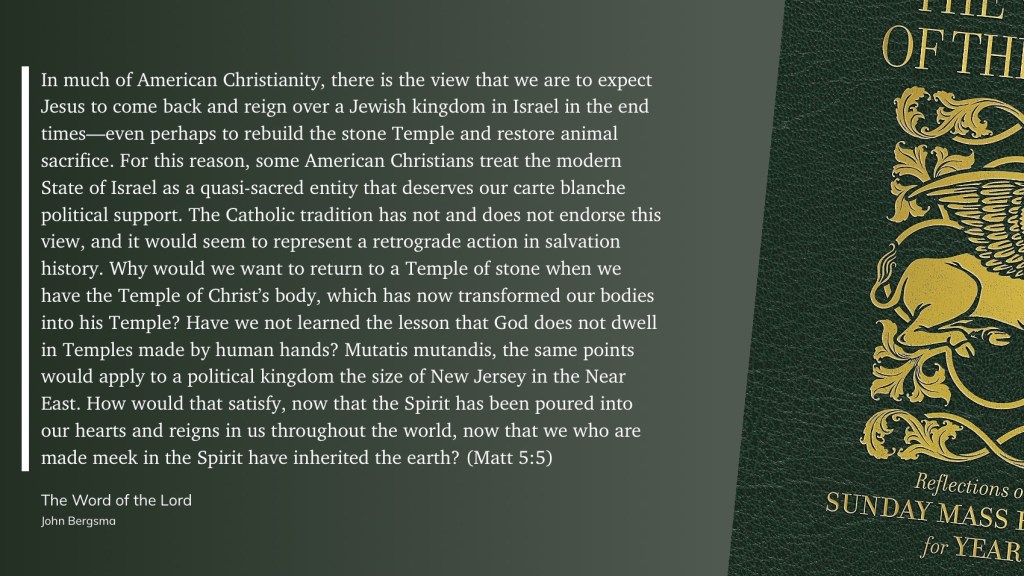
SOURCE: The Word of the Lord: Reflections on the Sunday Mass Readings for Year C
HISTORY
Acts 1:1-11 recounts Jesus’ ascension and the events preceding it. This passage was written by Luke, a Gentile physician and companion of Paul, and was addressed to Theophilus, possibly a Roman official or a new Gentile convert.
Historically, this event took place around 33 AD, shortly after Jesus’ resurrection. At the time, the Jewish people were living under Roman occupation, anticipating a messianic figure to restore their sovereignty. Politically, the crucifixion of Jesus marked a turning point, as his followers faced persecution and struggled to understand their role without his physical presence.
In Acts 1:3, Luke mentions the post-resurrection appearances of Jesus, a significant event highlighting the disciples’ transformation from fearful followers to bold proclaimers of the Gospel. This transition set the stage for the growth of the early Christian church.
The author’s reference to the Holy Spirit in Acts 1:5 is critical, as it signifies the new power believers would receive to continue Jesus’ work. This promise of spiritual empowerment would be essential to the early Christian community, particularly in the face of Roman opposition.
In Acts 1:9-11, Jesus’ ascension is described, emphasizing his divine nature and authority. This pivotal event provided closure to Jesus’ earthly ministry and inaugurated a new era marked by the disciples’ mission to spread the Gospel, as mentioned in Acts 1:8.
Ascension of the Lord (Year C)
SOCIETY
Acts 1:1-11 describes Jesus’ ascension and the disciples’ response within a specific socio-cultural context. The passage reflects a time when the Jewish people, living under Roman occupation, yearned for a messianic figure to restore their sovereignty.
Sociologically, the disciples, as Jesus’ followers, faced marginalization and persecution in this context. Their gathering in Jerusalem (Acts 1:4) demonstrates their resilience and solidarity amidst adversity. This event marks a shift in their identity as they became witnesses of Jesus’ ministry and resurrection.
Culturally, the reference to the Holy Spirit in Acts 1:5 reflects a significant aspect of Jewish belief. The Spirit of God was understood as a divine force empowering individuals for specific tasks. This promise of spiritual empowerment would have provided hope and encouragement to the early Christian community, as they faced challenges in the aftermath of Jesus’ ascension.
In Acts 1:6, the disciples ask about restoring the kingdom to Israel, revealing their adherence to Jewish messianic expectations. This question demonstrates the cultural belief in a political messiah who would free Israel from foreign domination.
Jesus’ response in Acts 1:7-8 redirects their focus from political aspirations to a spiritual mission, reaching all nations with the Gospel. This global outlook challenged the disciples’ cultural understanding of God’s kingdom and expanded their vision beyond Jewish nationalistic boundaries.
Ascension of the Lord (Year C)
THEOLOGY
Acts 1:1-11 holds significant theological meaning within the Roman Catholic tradition, particularly regarding Jesus’ ascension and the promise of the Holy Spirit.
Jesus’ ascension in Acts 1:9-11 affirms his divine nature and marks the conclusion of his earthly ministry. Catholic theology interprets this event as a demonstration of Christ’s victory over sin and death, solidifying his role as the savior of humanity.
The promise of the Holy Spirit in Acts 1:5 has profound theological implications for Catholics. The Church teaches that the Holy Spirit, the third person of the Trinity, empowers believers to continue Jesus’ mission on earth. This divine presence guides and sanctifies the Church, enabling Catholics to live out their faith and share the Gospel.
The disciples’ transformation in Acts 1:8 exemplifies the Church’s ongoing mission to spread the Good News globally. Modern-day Catholics can learn from this passage by embracing their role as witnesses of Christ and actively participating in evangelization efforts.
The reference to the kingdom of Israel in Acts 1:6, followed by Jesus’ response in Acts 1:7-8, highlights the theological shift from a Jewish nationalist understanding of God’s kingdom to a universal perspective. This emphasizes the Church’s mission to unite all people under Christ, transcending cultural and national boundaries.
Connecting Faith and Life

7th Sunday of Easter
A reading from the Acts of the Apostles
(Chapter 7:55-60)
Here we have two stories, one an end and one a beginning. Stephen, “filled with the Holy Spirit,” a deacon, was a powerful preacher and witness to the Gospel and who infuriated the religious leaders, who stoned him to death. Following in the footsteps of Jesus, Stephen forgave his murderers. He is considered the first Christian martyr, a glorious ending.
Saul is an avid Jew who feels called to persecute what he considers to be a dangerous sect of Judaism, the young Christian community. He obviously was held in esteem by the Sanhedrin, and the witnesses who testified against Stephen “laid down their cloaks at the feet of a young man named Saul” as they were stoning Stephen. This is a shocking story about the man, known to us as Paul, who was most instrumental in the growth of the early Church. He had a deep fear and hatred for all that Stephen proclaimed. Yet, after his dramatic conversion, he became the most important and courageous apostle who is more responsible than anyone for spreading the message of Christ. That is the power of the Holy Spirit at work in the Church, the same Spirit that abides in each of us today and in our Church with all its problems and weaknesses.
SOURCE: Branching Out Blog (2022) with Bill Ayres from RENEW International—Founded in 1978, RENEW is a not-for-profit organization based in Plainfield, NJ. Our mission is simple yet powerful: to connect faith and life. We use the RENEW process combined with a theme that meets the needs of your community to help parishes and dioceses build small groups to transform the Church so the Church can transform the world! / 2022 Archive
Fr. Paul Galetto, OSA
Ascension of the Lord (Year C)
The Church as Christ’s Body
Ephesians 1:17-23


Sticky Statement
SEEKER
- Spiritual Wisdom
- Enlightenment
- Eye-opening Knowledge
- Knowing God’s Hope
- Exceeding Power
- Reign of Christ
Standing In the Presence of God
(Alternate Reading: Hebrews)
What was the upshot from the author’s argument? Because of Christ’s perfect sacrifice, he became the High Priest before God in heaven. And, through faith, we faithful share in his heavenly worship, primarily through baptism (…hearts having been sprinkled from an evil conscience, the body having been washed clean) and through Eucharist (washed with his blood,…through the veil, which is his flesh).
So, what is the distance between heaven and earth? In Christ, there is no distance. In him, we stand before the face of God. In him, we partake in the worship of heaven itself.
What would you say to God if you stood before him now? Why don’t you say that prayer now?
Outline of the Reading
Enlightenment
I. Paul’s Prayer for Wisdom (vv. 17-19)
- A. Petition for wisdom and revelation (v. 17)
- B. Purpose: Knowing the hope of God’s call and glorious inheritance (v. 18)
- C. Power for believers: Resurrection and ascension of Jesus (vv. 19-20)
II. Christ’s Supremacy and the Church (vv. 21-23)
- A. Christ above all: Head of the Church and all things (v. 22)
- B. Church as Christ’s Body: The fullness of Jesus filling all things (v. 23)
SOURCE: AI Generated Outline; Clipart by Fr. Richard Lonsdale
- Kieren O’Mahony OSA
- Fr. Conley Bertrand
- Fr. George Corrigan OFM
- Fr. Thibodeau
- St. Charles Borromeo
- Edriann Ezell
- Vince Contreras
- Bp. John P. Dolan
- Fr. Eamon Tobin
- Carmelite Lectio Divina
Ascension of the Lord (Year C)
John Bergsma

SOURCE: The Word of the Lord: Reflections on the Sunday Mass Readings for Year C
HISTORY
Ephesians 1:17-23 is part of a letter written by the Apostle Paul to the early Christian community in Ephesus, a significant city in ancient Greece. This passage provides insight into Paul’s theology and his view of the Church’s role in God’s plan.
Historically, the letter was written around 60-62 AD, during a time of Roman political dominance. The Ephesian church consisted primarily of Gentile converts facing challenges of unity and identity within a pagan culture.
The author, Paul, was a former persecutor of Christians who experienced a dramatic conversion. As an apostle, he played a vital role in spreading the Gospel throughout the Roman Empire. His unique background influenced his theology and approach to ministry.
In Ephesians 1:17-23, Paul addresses the Ephesian believers as recipients of God’s grace and spiritual blessings. He encourages them to embrace their identity as members of Christ’s body, reflecting unity amidst cultural diversity.
Paul’s reference to the Holy Spirit in Ephesians 1:17 demonstrates the early Church’s reliance on spiritual empowerment to navigate the challenges of the Roman world. The promise of spiritual enlightenment and wisdom offered hope and guidance for a community striving to live out their faith.
Ephesians 1:22-23 highlights Christ’s supremacy over all things, emphasizing God’s sovereignty amidst Roman political dominance. This affirmation of Christ’s authority would have encouraged the Ephesian believers, reminding them of their allegiance to a higher power.
Ascension of the Lord (Year C)
SOCIETY
Ephesians 1:17-23 offers valuable insights into the sociocultural context of the early Christian community in Ephesus. The passage highlights key aspects of social identity and spiritual empowerment within a diverse, pagan society.
Sociologically, the Ephesian church faced challenges of unity as a predominantly Gentile community in a multicultural city. Paul’s emphasis on spiritual blessings and the believers’ position in Christ (Ephesians 1:3, 17-18) provided a foundation for their identity and cohesion as a distinct group within this context.
Culturally, the reference to the Holy Spirit in Ephesians 1:17 reflects the early Christians’ belief in spiritual forces, contrasting with the surrounding pagan culture that attributed power to various gods and goddesses. This affirmation of the Holy Spirit’s role in the lives of believers would have been particularly significant in Ephesus, a city steeped in pagan worship.
The metaphor of Christ as the head and the Church as his body in Ephesians 1:22-23 conveys a sense of belonging and interconnectedness within the diverse Christian community. This imagery would have resonated with the Ephesian believers, offering a vision of unity in the midst of cultural and ethnic differences.
Ascension of the Lord (Year C)
THEOLOGY
Ephesians 1:17-23 holds profound theological insights for contemporary Catholics, emphasizing divine wisdom, Christ’s supremacy, and the Church as Christ’s body. These concepts remain central to Catholic theology and offer guidance for modern-day believers.
Paul’s prayer for divine wisdom in Ephesians 1:17 highlights the importance of spiritual enlightenment in understanding one’s faith. In the Catholic tradition, this underscores the value of religious education, ongoing spiritual formation, and seeking guidance from the Holy Spirit.
Ephesians 1:22-23 emphasizes Christ’s supremacy and authority over all creation, affirming his divinity within the Catholic understanding of the Trinity. This concept encourages modern Catholics to deepen their relationship with Christ, acknowledging his role as the source of salvation and guidance in their lives.
The metaphor of the Church as Christ’s body in Ephesians 1:23 highlights unity and interconnectedness among believers. In the Catholic Church, this unity is exemplified through shared sacraments, the papacy, and the celebration of liturgy worldwide. This unity provides a powerful witness of Christ’s love and the transformative power of faith.
Connecting Faith and Life
7th Sunday of Easter
A reading from the Book of Revelation
(Chapter 22:12-14, 16-17, 20)
“Come Lord Jesus.” These are the last words of the Book of Revelation and Revelation is the last book of the Bible. Those words were written at a time of persecution and great distress to give hope to a struggling people. “Come Lord Jesus. Come Lord Jesus.” Could these words be part of our prayer when we experience crises, disappointments, and fears for the safety of our loved ones or our own safety and health; when we see pictures and hear stories of the millions of refugees and victims of war and persecution? We may feel helpless in the face of such daunting personal or global tragedy. Let us pray, “Come Lord Jesus.”
SOURCE: Branching Out Blog (2022) with Bill Ayres from RENEW International—Founded in 1978, RENEW is a not-for-profit organization based in Plainfield, NJ. Our mission is simple yet powerful: to connect faith and life. We use the RENEW process combined with a theme that meets the needs of your community to help parishes and dioceses build small groups to transform the Church so the Church can transform the world! / 2022 Archive
Fr. Paul Galetto, OSA
Ascension of the Lord (Year C)
The Ascension
Luke 24:46-53

Sticky Statement
ASCEND
- A – Ascension of Christ
- S – Scriptures Fulfilled
- C – Commission to Preach
- E – Empowerment from the Holy Spirit
- N – New Witnesses
- D – Divine Blessing
The Inspiration for Christian Witness
Like the disciples in that forgotten room, we need inspiration. God has given us living inspiration, the Spirit itself. The Spirit moves us to vision and action, to praise and worship. We will soon celebrate the gift of the Spirit. Until that time, let us see the wider picture and thank God for his vision, not just our own.
God calls us to give witness to his power. How can you give such a witness this week? How can you praise God for that opportunity?
Outline of the Reading
Commission

I. Jesus’ Appearance and Instruction (vv. 46-49)
- A. Jesus appears to the disciples (v. 46)
- B. Proclamation of suffering and glory (v. 46)
- C. Repentance and forgiveness of sins preached in Jesus’ name (v. 47)
- D. Disciples as witnesses to all nations (v. 48)
- E. Promised power from on high: The Holy Spirit (v. 49)
II. Jesus’ Ascension (vv. 50-53)
- A. Jesus leads disciples to Bethany (v. 50)
- B. The blessing and departure of Jesus (v. 51)
- C. The disciples’ response: Worship and joy (v. 52)
SOURCE: AI Generated Outline; Clipart by Fr. Richard Lonsdale
- Kieren O’Mahony OSA
- Fr. Conley Bertrand
- Fr. George Corrigan OFM
- Fr. Thibodeau
- St. Charles Borromeo
- Edriann Ezell
- Vince Contreras
- Bp. John P. Dolan
- Fr. Eamon Tobin
- Carmelite Lectio Divina
Ascension of the Lord (Year C)
John Bergsma
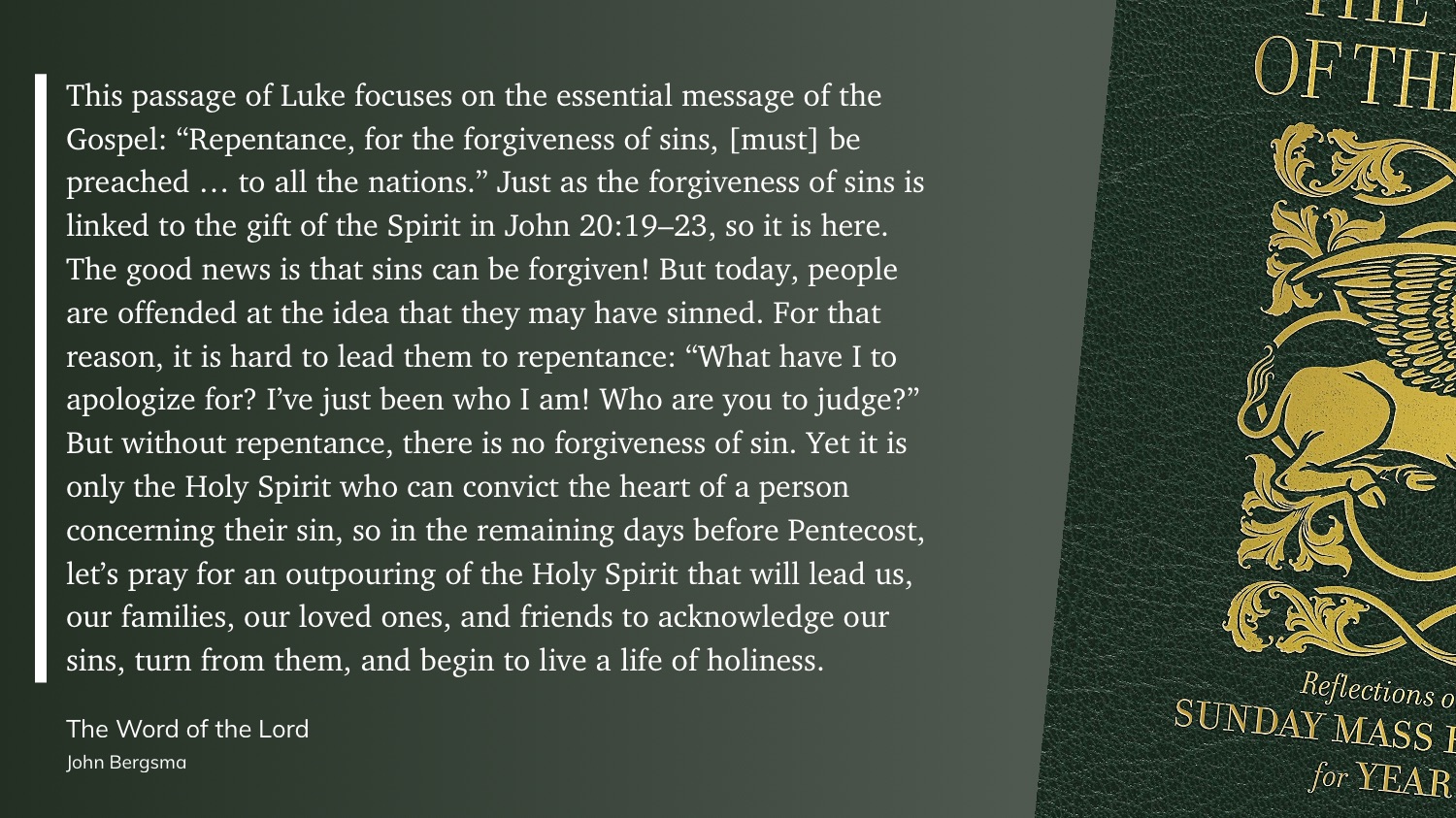
SOURCE: The Word of the Lord: Reflections on the Sunday Mass Readings for Year C
HISTORY
Luke 24:46-53 recounts the final moments of Jesus’ earthly ministry and his ascension, emphasizing the disciples’ calling to witness and spread the Gospel. Written by the physician Luke, this passage offers a glimpse into the historical and political context of early Christianity.
Historically, this event occurs around 33 AD in Jerusalem, following Jesus’ resurrection. At this time, the Jewish people were living under Roman occupation, anticipating a messianic figure who would restore their sovereignty and fulfill God’s promises.
Politically, Jesus’ teachings and actions often challenged the religious and political authorities, leading to his crucifixion. His ascension marked a turning point, as his followers had to navigate a new reality without his physical presence.
Luke, the author, was a Gentile convert and companion of Paul. His writing is characterized by a focus on Jesus’ compassion, prayer, and the role of the Holy Spirit. In Luke 24:46-53, he emphasizes the disciples’ transformation from fearful followers to bold witnesses of the Gospel.
The intended audience would have been both Jewish and Gentile believers in the early Christian community. The passage addresses their questions about the restoration of Israel (v. 46) and encourages them to share the message of repentance and forgiveness with all nations (v. 47).
Ascension of the Lord (Year C)
SOCIETY
Luke 24:46-53 provides valuable insights into the sociocultural context of the early Christian community, focusing on the disciples’ transformation and their calling to witness. By exploring prevailing customs, beliefs, and practices, one can better understand the passage’s significance for its original audience.
Sociologically, Jesus’ ascension in Luke 24:46-53 marked a critical moment for his followers. As a marginalized group within a dominant Jewish and Roman culture, the disciples had to navigate their new identity and mission as witnesses of the Gospel.
Culturally, the reference to the “restoration of the kingdom to Israel” in Luke 24:46 reflects the Jewish hope for national redemption and restoration. However, Jesus redirects their focus to the spiritual message of repentance and forgiveness (v. 47), challenging prevailing beliefs and emphasizing the universal scope of the Gospel.
The metaphor of the “power from on high” (Luke 24:49) highlights the early Christian belief in spiritual empowerment and divine intervention. This concept would have been particularly significant for the original audience, as they faced challenges in spreading the Gospel amidst persecution and opposition.
Ascension of the Lord (Year C)
THEOLOGY
Luke 24:46-53 offers rich theological insights and applications for contemporary Catholics, focusing on Christ’s ascension, the role of the Holy Spirit, and the call to witness. These concepts remain central to Catholic theology and practice today.
Theologically, Jesus’ ascension in Luke 24:46-53 affirms his divine nature and marks the beginning of a new era for the Church. This event serves as a model for contemporary Catholics, reminding them of their ultimate hope in eternal life and union with God.
The promise of the Holy Spirit (Luke 24:49) emphasizes the importance of spiritual empowerment in Christian life. In the Catholic tradition, this is realized through sacraments such as Baptism and Confirmation, which provide grace and guidance for believers today.
The call to witness in Luke 24:46-53 challenges contemporary Catholics to spread the Gospel message in their daily lives. This can be applied through personal testimony, evangelization efforts, and active involvement in parish ministries or charitable works.
Connecting Faith and Life
7th Sunday of Easter
A reading from the holy Gospel according to John
(Chapter 17:20-26)
John wrote his Gospel long after the death of and resurrection of Jesus, and it includes not only the basic story that the other Gospels tell but also John’s accounts that are somewhat different from what the other evangelists recorded. This passage has a powerful theme: “so that they may all be one, as you Father, are in me and I in you, that they may also be in us.” The dual message here is that Jesus and the Father are one and that we are one with them. That is the basis of our faith. We do not believe in an isolated being up in the sky, as it were, but in a Trinity, a community of persons—the Father, Son, and Holy Spirit—and the best part is that we, in a way, are part of that community. God is our Father, too. Jesus is our brother, and the Holy Spirit lives within us. That is quite a community in which to share!
SOURCE: Branching Out Blog (2022) with Bill Ayres from RENEW International—Founded in 1978, RENEW is a not-for-profit organization based in Plainfield, NJ. Our mission is simple yet powerful: to connect faith and life. We use the RENEW process combined with a theme that meets the needs of your community to help parishes and dioceses build small groups to transform the Church so the Church can transform the world! / 2022 Archive
FIRST READING | SECOND READING | GOSPEL