May 25, 2025


Mass Readings
Mass Readings

Fr. Paul Galetto, OSA
6th Sunday of Easter C
Council of Jerusalem
Acts 15:1-2, 22-29

Sticky Statement
GENTILE
The acronym GENTILE effectively summarizes the key points of Acts 15:1-2, 22-29 regarding the council of Jerusalem’s decision on circumcision for Gentile converts:
- Guidance: The early church leaders sought divine guidance to resolve the issue of whether Gentile converts should follow Jewish customs like circumcision.
- Empathy: The apostles and elders demonstrated empathy by considering the cultural and spiritual implications for both Jewish and Gentile believers.
- Negotiation: Through discussion and debate, they negotiated a solution that balanced tradition with the new faith’s inclusivity.
- Trust: The decision relied on trust in the Holy Spirit’s leading and the consensus reached by the apostles and elders.
- Inclusion: The church emphasized the inclusion of Gentiles without imposing unnecessary burdens, promoting unity in diversity.
- Letter: A letter was sent to the Gentile believers explaining the decision, helping to communicate and clarify the council’s stance.
- Encouragement: The resolution was meant to encourage Gentile believers in their faith without the additional requirement of circumcision.
Principle or Peace?

The growing influx of Gentiles into the community raised a problem of Christian self-identity. Because the Savior was Jewish, shouldn’t the converts also be Jewish? Because the community was originally Jewish, shouldn’t the converts share the same cultural values as those already in the community? To these questions, Paul said “No”; faith in Christ is the only thing necessary for salvation. Paul’s answer, of course, meant that the cultural “pollution” of the Gentiles would invade what was then a Jewish sect. This caused great controversy.
Homily Starters
Outline of the Reading
Unity

I. The Jerusalem Council
- Dispute over circumcision and salvation (Acts 15:1-2)
- Jerusalem Council’s discussion and decision-making process (Acts 15:6-21)
II. Letter to the Gentile Believers
- The Jerusalem Council’s letter addressing the issue (Acts 15:22-29)
- Outlining necessary guidelines for Gentile Christians
- Emphasizing unity among Jewish and Gentile believers
- Sending the letter with Paul and Barnabas to Antioch
III. Response and Unity in Antioch
- Reading the letter to the believers in Antioch (Acts 15:30-31)
- Encouragement and strengthening of the believers
- Unity in the early Church despite differences
IV. Impact and Growth of the Church
- Continued growth of the Church through the Holy Spirit’s guidance (Acts 15:32-16:5)
- Spreading the Good News to various regions and cities
- Appointing leaders and strengthening local communities
SOURCE: AI Generated Outline; Clipart by Fr. Richard Lonsdale

- Kieren O’Mahony OSA
- Fr. Conley Bertrand
- Fr. George Corrigan OFM
- Fr. Thibodeau
- St. Charles Borromeo
- Edriann Ezell
- Vince Contreras
- Bp. John P. Dolan
- Fr. Eamon Tobin
- Carmelite Lectio Divina
6th Sunday of Easter C
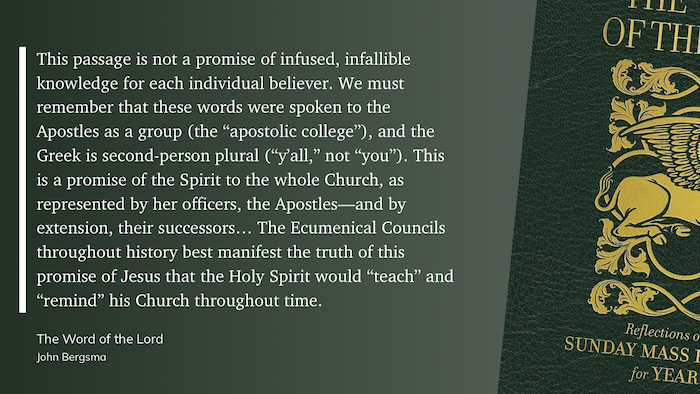
John Bergsma
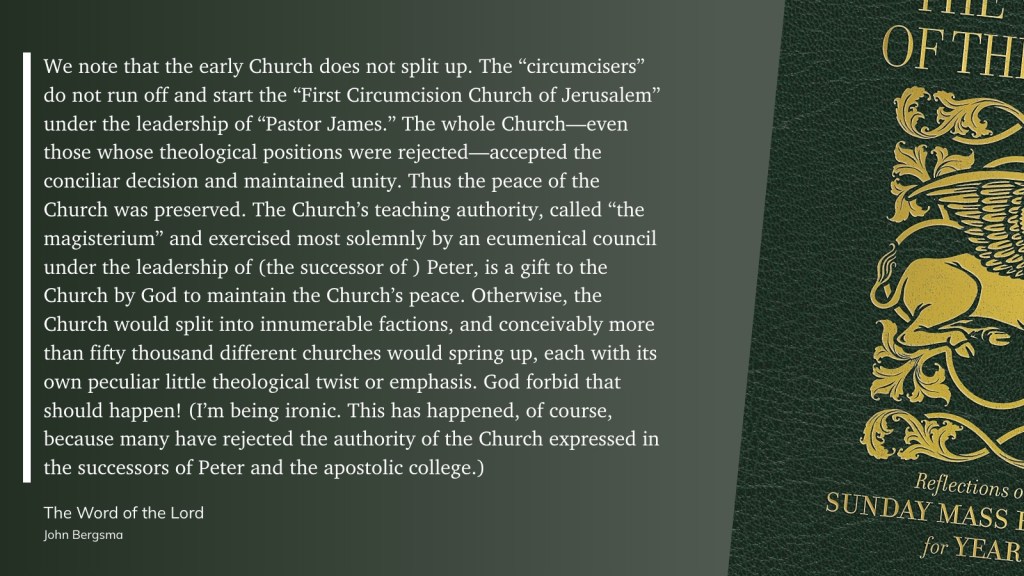
SOURCE: The Word of the Lord: Reflections on the Sunday Mass Readings for Year C
HISTORY
The passage Acts 15:1-2, 22-29 is set within the historical and political context of the early Christian Church, around 49-50 AD. The key event in this passage is the Council of Jerusalem, convened to address the question of whether Gentile Christians needed to adhere to Jewish customs, particularly circumcision.
The author, traditionally believed to be Luke, was a Gentile Christian and physician who accompanied Paul on his missionary journeys. His intended audience consisted of Christians, both Jewish and Gentile, living in the Roman Empire. During this time, the political climate was characterized by Roman rule and tensions between Jewish and non-Jewish communities.
Key figures in the passage include Paul, Barnabas, and James, all important leaders of the early Church. The Council’s decision to welcome Gentiles into the Church without requiring circumcision was a turning point in the development of Christianity, allowing the faith to spread more rapidly among non-Jewish communities and fostering a greater sense of unity among believers.
In Acts 15:1-2, 22-29, we see the intersection of faith and politics, as the early Church navigated complex theological and social issues to foster unity in a diverse community of believers. By providing context for this pivotal event, we gain a deeper understanding of the challenges and triumphs of the early Church and the enduring impact of their decisions on Christian history.
6th Sunday of Easter C
SOCIETY
The sociological and cultural context of Acts 15:1-2, 22-29 plays a crucial role in understanding its message and relevance to the original audience. During this period, the Roman Empire was a melting pot of various cultures and belief systems, including Judaism and Hellenism. The clash between Jewish and Gentile cultures was particularly significant for the early Christian community, as they struggled to find unity amid diversity.
At the center of the debate in Acts 15:1-2, 22-29 is the issue of circumcision, a long-standing Jewish tradition rooted in their covenant with God. Some Jewish Christians believed that Gentile converts should adhere to Jewish customs, including circumcision, to be fully accepted into the community of faith.
However, the decision reached at the Council of Jerusalem acknowledged the changing cultural landscape and the need for flexibility in welcoming non-Jewish believers. This decision not only paved the way for greater unity among early Christians but also reflected a broader shift in sociocultural norms.
By examining the sociocultural context of Acts 15:1-2, 22-29, we gain a deeper understanding of the challenges faced by the early Church and the importance of adapting to diverse cultural backgrounds in spreading the message of faith. This passage remains relevant today as it encourages us to embrace unity and understanding amidst differing cultural practices and beliefs.
6th Sunday of Easter C
THEOLOGY
Acts 15:1-2, 22-29 holds theological significance within the Roman Catholic tradition, as it highlights the role of the Holy Spirit and the Church’s authority in discerning and interpreting God’s will. The Council of Jerusalem’s decision to welcome Gentiles without imposing Jewish customs demonstrates the Church’s ability to adapt and grow in understanding of divine truth.
This passage also underscores the Catholic belief in the importance of unity among believers. The early Church’s commitment to finding common ground and fostering unity amidst diverse cultural backgrounds serves as a model for contemporary Catholics, encouraging them to seek harmony within the Church and the broader community.
Moreover, the Council’s decision emphasizes that salvation comes through faith in Christ, not strict adherence to specific cultural practices. This principle resonates with modern Catholics, reminding them of the centrality of faith and the need for inclusion and understanding amidst diverse expressions of worship.
Pope Leo XIV’s emphasis on building bridges and welcoming those in need reflects the early Church’s commitment to unity and understanding amidst diverse cultural and theological perspectives. Pope Leo XIV’s efforts to foster peace and engage with the modern world echo the Council of Jerusalem’s decision to embrace Gentiles without imposing strict Jewish customs. This serves as a reminder to Catholics today that the Church’s role in fostering unity and understanding remains as essential as it was in the time of the early Church.
Connecting Faith and Life

A reading from the Acts of the Apostles
(Chapter 15:1-2, 22-29)
One of the first great controversies in the early Church was about whether Gentiles needed to be circumcised. This issue arose in Antioch because, as Luke writes, “Some who had come down from Judea were instructing the brothers, ‘Unless you are circumcised according to the Mosaic practice, you cannot be saved.’” The apostles and elders in Jerusalem sent this response, which opened the Church to all: “It is the decision of the Holy Spirit and of us not to place any burden on you beyond these necessities, namely, to abstain from meat sacrificed to idols, from blood, from meats of strangled animals and from unlawful marriage. If you keep free of these, you will be doing what is right.”
The animal restrictions may seem strange to us, but it was an important part of Jewish practice that the apostles kept while eliminating the need for circumcision. This was a major breakthrough that opened the doors to thousands of Gentiles who otherwise might not have become Christians.
SOURCE: Branching Out Blog (2022) with Bill Ayres from RENEW International—Founded in 1978, RENEW is a not-for-profit organization based in Plainfield, NJ. Our mission is simple yet powerful: to connect faith and life. We use the RENEW process combined with a theme that meets the needs of your community to help parishes and dioceses build small groups to transform the Church so the Church can transform the world! / 2022 Archive
Fr. Paul Galetto, OSA
6th Sunday of Easter C
The Heavenly Jerusalem
Revelation 21:10-14, 22-23

Sticky Statement
SHINE
- Splendor of the Holy City
- Heavenly glory illuminating
- Inclusions of God’s presence
- No need for earthly light
- Eternal radiance of divine light
The Heavenly Jerusalem
Clearly, the heavenly Jerusalem was the Church. The Church was built on the Apostles (the twelve foundation stones) and continued the faith of God’s people (the twelve gates inscribed with the tribes of Israel). Like the open city in 21:25, the Church would welcome all peoples into its ranks. The invitation to enter and the reason to remain would be the presence of God himself.
John described the Church in the fullness of God’s presence. While the Church is blessed with the divine presence, it is still on a journey to fullness, to the perfection that the end times promise. As members, we are on that road. The end is within sight. But, until then, we take one step at a time.
Outline of the Reading
New Jerusalem
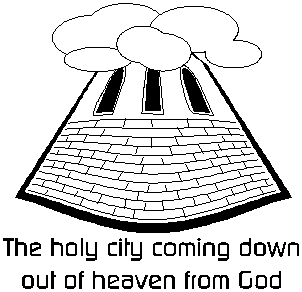
I. Description of the New Jerusalem
- The holy city descending from heaven (Revelation 21:10)
- Radiant appearance and architectural features (Revelation 21:11)
- High walls with twelve gates and angelic guards (Revelation 21:12)
- Inscribed names of the twelve tribes of Israel on the gates (Revelation 21:12)
II. Divine Presence in the New Jerusalem
- The city’s foundations adorned with precious stones (Revelation 21:19-20)
- Twelve foundation stones inscribed with the names of the twelve apostles (Revelation 21:14)
- God’s glory illuminating the city (Revelation 21:23)
- The Lamb as the city’s light (Revelation 21:23)
III. Life and Healing in the New Jerusalem
- The river of the water of life flowing from God’s throne (Revelation 22:1)
- The Tree of Life bearing fruit and leaves for healing (Revelation 22:2)
- No more curse or night in the city (Revelation 22:3)
- God’s servants worshiping and reigning with Him eternally (Revelation 22:3-5)
IV. Final Words and Invitation
- Testimony of the angel and the one seated on the throne (Revelation 22:6-21)
- An invitation to partake in the blessings of the New Jerusalem (Revelation 22:17)
- Closing remarks and the grace of the Lord Jesus (Revelation 22:21)
SOURCE: AI Generated Outline; Clipart by Fr. Richard Lonsdale
- Kieren O’Mahony OSA
- Fr. Conley Bertrand
- Fr. George Corrigan OFM
- Fr. Thibodeau
- St. Charles Borromeo
- Edriann Ezell
- Vince Contreras
- Bp. John P. Dolan
- Fr. Eamon Tobin
- Carmelite Lectio Divina
6th Sunday of Easter C
John Bergsma
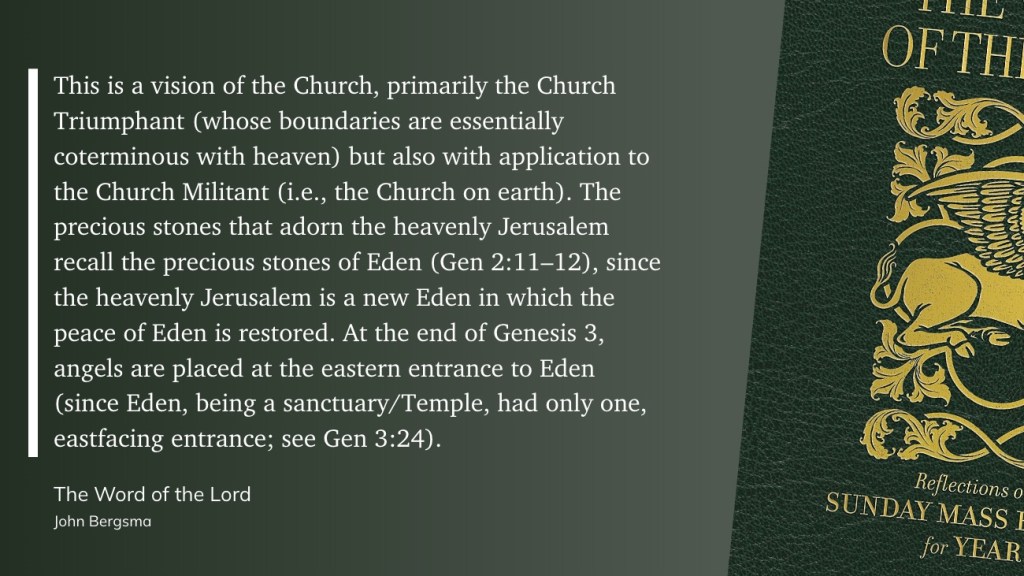
SOURCE: The Word of the Lord: Reflections on the Sunday Mass Readings for Year C
HISTORY
Revelation 21:10-14, 22-23 is set within the historical and political context of the late 1st century AD, during the reign of the Roman Empire. This passage, part of the apocalyptic literature, aims to provide hope and encouragement to the early Christian community facing persecution.
The author, traditionally believed to be John the Apostle, was a significant figure in the early Church and was exiled to the island of Patmos, where he received these visions. His intended audience consisted of Christian communities in Asia Minor, who were facing difficulties due to their faith.
During this period, the Roman Empire exercised significant political and cultural influence. Emperor Domitian’s reign saw increased persecution of Christians, who were seen as a threat to the established order. Against this backdrop, John’s vision of the New Jerusalem and the promise of a world free from pain and suffering offered hope to persecuted Christians.
By examining the historical and political context of Revelation 21:10-14, 22-23, we gain insight into the challenges faced by the early Church and the significance of this passage in providing hope and inspiration. Today, this passage continues to offer encouragement to Christians facing adversity and reinforces the belief in a future free from suffering.
6th Sunday of Easter C
SOCIETY
The sociocultural context of Revelation 21:10-14, 22-23 is characterized by the struggles and challenges faced by early Christian communities living within the Roman Empire. The author, John, draws upon prevailing customs and beliefs to convey a message of hope and assurance to his audience.
During this period, the Greco-Roman world was heavily influenced by the idea of a perfect, idealized city. John’s vision of the New Jerusalem subverts this concept, presenting a divine city where God’s presence replaces the need for a temple. This image provided a powerful contrast to the harsh realities experienced by early Christians and offered hope for a future free from oppression and suffering.
Furthermore, John’s descriptions of the New Jerusalem would have resonated with Jewish and Christian audiences familiar with the Old Testament prophecies of a restored Jerusalem. By incorporating elements of Jewish tradition and reinterpreting them through a Christian lens, John’s vision provided a sense of continuity and reassurance to those who might feel alienated by the dominant Roman culture.
Revelation 21:10-14, 22-23 serves as a powerful reminder of the sociocultural context of the early Christian community and how their struggles and beliefs shaped their understanding of the divine promise. Today, this passage continues to inspire Christians, offering hope and comfort in the face of adversity and reminding them of the eternal reward that awaits the faithful.
6th Sunday of Easter C
THEOLOGY
Revelation 21:10-14, 22-23 holds significant theological meaning within the Roman Catholic tradition, emphasizing the hope of the New Jerusalem and eternal life with God. In this passage, John’s vision of the holy city reflects the Catholic belief in the ultimate fulfillment of God’s divine plan.
Pope Leo XIV’s teachings on unity and the importance of faith in daily life align with the message of Revelation 21:10-14, 22-23. His emphasis on building bridges and fostering peace within the Church and the world at large echoes the passage’s theme of unity and hope for a better future.
In today’s world, Revelation 21:10-14, 22-23 continues to resonate with Catholics, reminding them of the ultimate reward that awaits the faithful. Amidst the challenges of modern life, the passage’s message of hope and the promise of eternal life provides comfort and strength to believers, encouraging them to remain steadfast in their faith.
For example, the New Jerusalem’s description as a place where “the glory of God gives it light, and the Lamb is its lamp” (Revelation 21:23) emphasizes the centrality of faith in the Catholic tradition. This vision of the divine presence guiding and illuminating the lives of believers inspires Catholics to maintain their faith and trust in God’s ultimate plan.
Connecting Faith and Life
A reading from the Book of Revelation
(Chapter 21:10-14, 22-23)
The writer tells us, “The angel took me in spirit to a great, high mountain and showed me the holy city of Jerusalem coming down out of heaven from God.” This was written long after the physical city of Jerusalem had been destroyed. “I saw no temple in the city for its temple is the Lord God almighty and the Lamb. The city had no sun or moon to shine on it, for the glory of God gave it light.”
Jerusalem, the heart of Judaism, had been destroyed, but in the vision the new holy city came down from heaven. It was the symbol of the new faith, built on Judaism but fulfilled in Jesus Christ.
SOURCE: Branching Out Blog (2022) with Bill Ayres from RENEW International—Founded in 1978, RENEW is a not-for-profit organization based in Plainfield, NJ. Our mission is simple yet powerful: to connect faith and life. We use the RENEW process combined with a theme that meets the needs of your community to help parishes and dioceses build small groups to transform the Church so the Church can transform the world! / 2022 Archive
Fr. Paul Galetto, OSA
6th Sunday of Easter C
Sending of the Holy Spirit
John 14:23-29

Sticky Statement
PEACE
- P – Promise : Jesus promises to dwell with those who love Him.
- E – Eternal : The love and peace He offers are eternal.
- A – Assurance : Assurance is given by the Holy Spirit.
- C – Comfort : Jesus provides comfort by speaking His peace.
- E – Encouragement : Encouragement to not be troubled or afraid.
Peace and Love
While the generation of the 60’s and 70’s were correct that love and peace should be freely given, they (and people like me) did not responsibly receive these gifts. The love and peace that came from the world were transitory; they could be taken for granted, ignored, and used for selfish ends. But the love and peace that came from God required a response that matched the gifts. As the love and peace from God were meant to be everlasting, the commitment to the One that gave the gifts should be total and unchanging. In other words, the gift and the response should share a sense of timelessness. Eternal gifts require eternal responses.
Outline of the Reading
Promises
I. Jesus’ Promise of a Dwelling Place
- Jesus reassures his disciples about his Father’s dwelling places (John 14:23)
- Emphasizing that the disciples know the way to the Father through Jesus (John 14:4-7)
II. The Promise of the Holy Spirit
- Jesus’ teaching on the Holy Spirit as the Advocate (John 14:16-17, 26)
- The role of the Holy Spirit in teaching and reminding the disciples of Jesus’ words (John 14:26)
- Jesus’ promise of peace through the Holy Spirit (John 14:27)
III. Jesus’ Final Words and Encouragement
- Encouraging the disciples to not be troubled or afraid (John 14:27)
- Affirming that Jesus is going to the Father but will return (John 14:28)
- Reassuring the disciples of their faith in Jesus and his continued presence with them (John 14:29)
IV. Obedience and Love as the Path to Unity
- Jesus’ emphasis on obedience to his teachings as a sign of love (John 14:15, 21, 23-24)
- The promise of the Father and Son making their home with those who love and obey Jesus (John 14:23)
- The connection between love, obedience, and unity with God and Jesus (John 14:21, 23-24)
SOURCE: AI Generated Outline; Clipart by Fr. Richard Lonsdale
- Kieren O’Mahony OSA
- Fr. Conley Bertrand
- Fr. George Corrigan OFM
- Fr. Thibodeau
- St. Charles Borromeo
- Edriann Ezell
- Vince Contreras
- Bp. John P. Dolan
- Fr. Eamon Tobin
- Carmelite Lectio Divina
6th Sunday of Easter C
John Bergsma
SOURCE: The Word of the Lord: Reflections on the Sunday Mass Readings for Year C
HISTORY
John 14:23-29 is situated within the broader historical and political context of the 1st century AD, during the time of Jesus’ ministry. Set within the Roman Empire, this period was marked by cultural tensions and the oppression of Jewish people under Roman rule.
The author, traditionally believed to be the Apostle John, was one of Jesus’ closest disciples and a key figure in the early Christian community. His Gospel was written to address the needs and concerns of both Jewish and Gentile believers, who faced persecution and uncertainty in their faith.
In this passage, Jesus speaks to his disciples during the Last Supper, assuring them of his continued presence through the Holy Spirit and the importance of obeying his teachings. These words provide comfort and encouragement in the face of the trials and tribulations experienced by the early Christians.
The teachings of Jesus in John 14:23-29 reflect the political and cultural context of the time, emphasizing the need for unity, love, and obedience within the Christian community. By understanding the historical and political background of this passage, we can appreciate the significance of Jesus’ words and their enduring relevance for contemporary readers.
John 14:23-29 serves as a powerful reminder of the challenges faced by the early Christian community and the importance of maintaining faith in the face of adversity. Today, this passage continues to provide inspiration and guidance for Christians seeking to live out the teachings of Jesus in their daily lives.
6th Sunday of Easter C
SOCIETY
The sociocultural context of John 14:23-29 is characterized by the diverse social and religious dynamics of the 1st century AD, with Jewish and Gentile communities living under Roman rule. This passage reflects the tensions and challenges experienced by early Christians as they sought to live out their faith amidst opposition and persecution.
During this time, the concept of a personal relationship with God and the promise of eternal life were radical ideas that challenged prevailing Jewish and Greco-Roman beliefs. In John 14:23-29, Jesus assures his disciples of his continued presence through the Holy Spirit, emphasizing the importance of obedience to his teachings and the role of the Holy Spirit in guiding and supporting believers.
By addressing these concerns, John’s Gospel provides reassurance and comfort to the early Christian community, helping them navigate the complexities of their social and cultural context. The passage emphasizes the need for unity, love, and obedience within the Christian community, offering a countercultural alternative to the dominant religious and social norms.
John 14:23-29 highlights the relevance of Jesus’ teachings to the original audience, providing guidance and encouragement in the face of adversity. Today, this passage continues to inspire Christians, offering a model for maintaining faith and hope amidst the challenges of contemporary life and encouraging them to live out the teachings of Jesus in their daily lives.
6th Sunday of Easter C
THEOLOGY
John 14:23-29 holds significant theological meaning within the Roman Catholic tradition, emphasizing the role of the Holy Spirit, the importance of obedience to Jesus’ teachings, and the promise of eternal life. This passage reflects key Catholic beliefs, including the significance of the sacraments and the role of the Church in guiding and supporting believers.
Pope Leo XIV’s teachings on unity and the importance of faith in daily life align with the message of John 14:23-29. His emphasis on building bridges and fostering peace within the Church and the world at large echoes the passage’s themes of love, obedience, and hope.
In the modern world, John 14:23-29 continues to resonate with Catholics, reminding them of the ongoing presence of Jesus through the Holy Spirit and the importance of living out their faith in daily life. For example, the passage’s focus on the role of the Holy Spirit highlights the Catholic belief in the sacraments, particularly Confirmation, as a source of grace and strength for believers.
John 14:23-29 serves as a powerful reminder of the Catholic Church’s enduring message of hope and unity, offering encouragement and inspiration to contemporary Catholics navigating the complexities of modern life. By reflecting on the teachings of Jesus and their relevance to today’s world, Catholics can draw strength and guidance from this passage as they seek to live out their faith and maintain a personal relationship with God.
Connecting Faith and Life
A reading from the holy Gospel according to John
(Chapter 14: 23-29)
“Jesus said to his disciples: ‘Whoever loves me will keep my word, and my Father will love him and we will come to him and make our dwelling with him. . . . I have told you this while I am with you. The Advocate, the Holy Spirit, whom the Father will send in my name will teach you everything and remind you of all that I told you. Peace I leave with you; my peace I give to you. . . . Do not let your hearts be troubled or afraid. You heard me tell you, ‘I am going away and I will come back to you.’ If you loved me you would rejoice that I am going to the Father.’”
Here we have Father, Son, and Holy Spirit in one passage. This occurred right before Jesus left for the last time, so he wanted to be clear about what was most important for the apostles to remember and follow. They should not worry about what to teach. The Holy Spirit would teach them everything they needed to know and remind them of what Jesus had already taught them.
This is what was most important to remember—that the Holy Spirit would be with them, guiding them always and helping them make important and difficult decisions such as the question of circumcision that we heard about in the reading from the Acts of the Apostles. We believe that the same Holy Spirit is with us today, guiding us and our leaders. Of course, the Spirit has been stifled so many times throughout the history of the Church, including in our own time when some Church leaders failed to act property to deal with sexual abuse by clergy. That does not mean that the Spirit is absent but rather that it is not heard and followed.
Let us pray that our Church and each of us in our own lives will be open to the power of the Holy Spirit, that we may seek wisdom and follow it in the love of Jesus Christ.
SOURCE: Branching Out Blog (2022) with Bill Ayres from RENEW International—Founded in 1978, RENEW is a not-for-profit organization based in Plainfield, NJ. Our mission is simple yet powerful: to connect faith and life. We use the RENEW process combined with a theme that meets the needs of your community to help parishes and dioceses build small groups to transform the Church so the Church can transform the world! / 2022 Archive
FIRST READING | SECOND READING | GOSPEL