May 18, 2025


Mass Readings
Mass Readings

Fr. Paul Galetto, OSA
5th Sunday of Easter C
End of First Mission
Acts 14:21-27

Sticky Statement
FAITH
- F – Faithful proclamation: The apostles preached the good news and made disciples.
- A – Affirmation: They encouraged and strengthened the believers.
- I – Intention: Appointed elders to lead and guide the community.
- T – Trials: They acknowledged the hardships and the need to persevere.
- H – Homecoming: Returned to Antioch to report and celebrate the work God had done.ion.
Unintended Consequences

In the midst of Paul’s first missionary journey, there is success that produced new problems. As we studied last week, Christian preaching like Paul’s had two affects. First, it split the Jewish synagogues into Nazorean (i.e., Christian) and non-Nazorean camps. Where there was a split and the Nazorean Jews were expelled from the synagogue, a new assembly (church) was created. Second, Paul’s preaching encouraged non-Jewish peoples to join become believers (without observing the Jewish Law) and join the new assemblies. As a result, new assemblies formed by Jewish Christians were quickly becoming non-Jewish. There was a external pressure from the non-Christian Jews, and internal pressure from the growing numbers of incoming Gentile converts.
Homily Starters
Outline of the Reading
Strengthening the Churches

I. Appointing Elders (Acts 14:21-23)
- Derbe and Lystra
- Prayer, fasting, and commending to the Lord
II. Paul and Barnabas Return to Antioch (Acts 14:24-26)
- Traveling through Pisidia
- Strengthening the disciples
- Arrival at Antioch
III. Reporting the Missionary Journey (Acts 14:27)
- Gathering the church
- Reporting on God’s works
- Recounting the opening of the door of faith
SOURCE: AI Generated Outline; Clipart by Fr. Richard Lonsdale

- Kieren O’Mahony OSA
- Fr. Conley Bertrand
- Fr. George Corrigan OFM
- Fr. Thibodeau
- St. Charles Borromeo
- Edriann Ezell
- Vince Contreras
- Bp. John P. Dolan
- Fr. Eamon Tobin
- Carmelite Lectio Divina
5th Sunday of Easter C
John Bergsma

SOURCE: The Word of the Lord: Reflections on the Sunday Mass Readings for Year C
HISTORY
Acts 14:21-27 highlights the early Christian community’s growth and challenges amidst various historical and political contexts. Paul and Barnabas, key figures in this passage, were central in spreading Christianity and establishing churches across the Roman Empire.
The text mentions Derbe, Lystra, and Pisidia, cities in modern-day Turkey, which were under Roman rule during the first century. These cities formed part of the Roman province of Galatia. Paul and Barnabas faced resistance from both Jewish and Gentile populations, exemplifying the tensions between early Christians and the surrounding societies.
The Roman Empire’s political structure allowed for the relative ease of travel and the spread of Christianity along Roman roads. However, as seen in this passage, this political system also presented challenges to the growing Christian community, such as persecution and opposition.
The author, traditionally believed to be Luke, was a well-educated Gentile and companion of Paul. The intended audience for Acts was likely Gentile Christians, interested in understanding the origins of the church and being encouraged by the apostles’ examples. The narrative emphasizes the spread of Christianity to Gentiles, the power of faith, and the Holy Spirit’s role in sustaining the church.
5th Sunday of Easter C
SOCIETY
Acts 14:21-27 provides valuable insights into the sociological and cultural context of the early Christian community. This passage illustrates the significant role of apostles, such as Paul and Barnabas, in establishing and strengthening churches. These apostles were crucial in spreading Christianity and overcoming the various challenges faced by the early church.
The practice of appointing elders (Acts 14:23) reflects the sociocultural context of the early church, as it emphasizes the importance of local leadership and continuity within emerging Christian communities. Furthermore, the act of prayer and fasting (Acts 14:23) represents common spiritual practices that united early Christians in their faith and reliance on God.
The cultural context of the Roman Empire, with its vast network of roads and cities, facilitated the rapid spread of Christianity. However, this passage also reveals the tensions and opposition faced by Christians within this context, as seen in the persecution and martyrdom of figures like Stephen (Acts 7) and the Jewish and Gentile resistance encountered by Paul and Barnabas (Acts 14:2).
The original audience, likely composed of Gentile Christians, would have found encouragement in this passage, as it emphasizes the church’s growth despite adversity. The narrative highlights the power of faith and the relevance of community, values that would resonate with early Christians seeking to establish their identity within a diverse and often challenging sociocultural environment.
5th Sunday of Easter C
THEOLOGY
Acts 14:21-27 offers insights into the Roman Catholic theological context, highlighting concepts such as faith, perseverance, and the role of apostles in the early church. These themes remain relevant for contemporary Catholics, offering guidance and inspiration for modern-day application.
The appointment of elders in Acts 14:23 demonstrates the importance of leadership within the Catholic Church. Similarly, modern-day Catholics recognize the significance of papal authority, bishops, and priests who continue to guide and strengthen communities of faith.
Perseverance, illustrated by Paul and Barnabas in Acts 14:21-22, inspires Catholics to remain steadfast in their faith despite challenges and difficulties. This aligns with the Catholic understanding of the virtues of faith, hope, and charity, which encourage believers to remain committed to their spiritual journey.
Faith in God’s providence and the power of the Holy Spirit are central themes in Acts 14:21-27. Today, Catholics continue to rely on the guidance of the Holy Spirit in their daily lives, trusting that God will provide the strength and wisdom needed to navigate life’s complexities.
Acts 14:27 highlights the importance of sharing experiences and testimonies with fellow believers. In contemporary Catholic communities, believers are encouraged to share their personal faith stories, much like Paul and Barnabas, as a means of inspiring and edifying others in their journey of faith.
Connecting Faith and Life

A reading from the Acts of the Apostles (Chapter 14:21-27)
Another name for this book could be “The Travels of the Apostle Paul,” because even though other apostles are mentioned in the book, it is mostly about the heroic and enormously important 30-year journey of this amazing man. Paul was a driven man, driven by his new found faith in Jesus, driven by his guilt for having persecuted the early Church, but also energized by the forgiveness he received from the risen Jesus and by his initial belief that Jesus would soon come again and so would the end of the world. Of course, Paul was wrong about that expectation, as were so many early Christians. We don’t know when he became enlightened and changed his belief, but what is clear is that he was faithful to the end in preaching Christ crucified and resurrected.
Here we see Paul and Barnabas at the end of one of Paul’s early journeys. We are told that “they made a considerable number of disciples” and that they “strengthened the spirits of the disciples and exhorted them to persevere in the faith, saying, ‘It is necessary for us to undergo many hardships to enter the Kingdom of God.’” That was an understatement. Many of the new disciples would be martyred by the Roman Empire which regarded them as dangerous to imperial authority. That is why it was most important that they leave behind someone to be in charge, and so, “They appointed elders for them in each church.” The new faith spread everywhere Paul traveled.
SOURCE: Branching Out Blog (2022) with Bill Ayres from RENEW International—Founded in 1978, RENEW is a not-for-profit organization based in Plainfield, NJ. Our mission is simple yet powerful: to connect faith and life. We use the RENEW process combined with a theme that meets the needs of your community to help parishes and dioceses build small groups to transform the Church so the Church can transform the world! / 2022 Archive
Fr. Paul Galetto, OSA
5th Sunday of Easter C
The New Creation
Revelation 21:1-5a

Sticky Statement
HEAVEN
- H – Hope – The promise of a new heaven and a new earth gives us hope for the future.
- E – Eternal – The new creation will last forever, free from pain and suffering.
- A – Aliveness – God’s presence makes everything vibrant and truly alive.
- V – Victory – The final triumph over death and decay is assured.
- E – Embrace – God’s dwelling among people signifies closeness and love.
- N – Newness – All things are renewed, reflecting God’s original intention and beauty.
The Presence of God
Image what could happen with the presence of God among us. John the Elder many have seen the effects in images that were larger than life. But, we can see the effects of God’s presence in the small, but definite changes within people. When he is present, there is the destruction of evil, the presence of good. God is the ultimate change agent.
How has the presence of God changed you? How has he changed you for the good?
Outline of the Reading
Renewal

I. A New Heaven and Earth (Revelation 21:1)
- First heaven and earth passing away
- Sea no longer existing
II. The New Jerusalem (Revelation 21:2-4)
- The holy city descending
- God dwelling among his people
- Elimination of death, mourning, and pain
III. God’s Proclamation (Revelation 21:5a)
- Seated on the throne
- Making all things new
SOURCE: AI Generated Outline; Clipart by Fr. Richard Lonsdale
- Kieren O’Mahony OSA
- Fr. Conley Bertrand
- Fr. George Corrigan OFM
- Fr. Thibodeau
- St. Charles Borromeo
- Edriann Ezell
- Vince Contreras
- Bp. John P. Dolan
- Fr. Eamon Tobin
- Carmelite Lectio Divina
5th Sunday of Easter C
John Bergsma
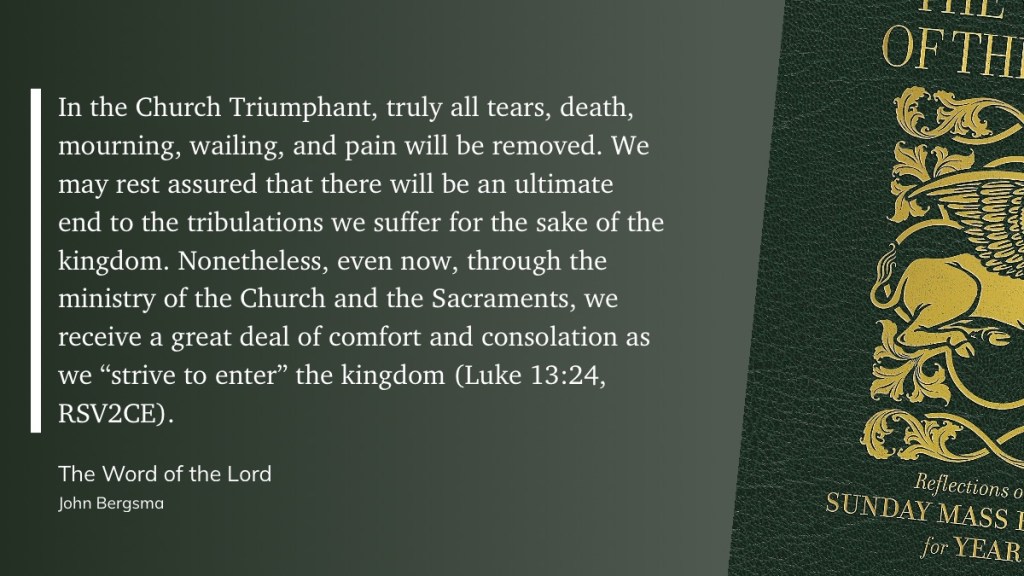
SOURCE: The Word of the Lord: Reflections on the Sunday Mass Readings for Year C
HISTORY
Revelation 21:1-5a presents a vision of a new heaven and earth, offering insight into the historical and political context of early Christianity. The author, traditionally identified as John of Patmos, wrote during a time of persecution and turmoil for the Christian community in the late first century.
The Roman Empire’s political context plays a significant role in interpreting this passage. Roman persecution of Christians created an atmosphere of fear and uncertainty, leading to a longing for a better world. The vision of a new heaven and earth represents the hope for deliverance from suffering and the establishment of God’s eternal kingdom.
John’s intended audience likely consisted of Christians enduring persecution, who would have found comfort in the promise of a new heaven and earth. This vision of renewal and hope served as a reminder that God’s plan would ultimately triumph over the challenges faced by the early church.
Additionally, the passage alludes to the political structure of the Roman Empire by mentioning the “holy city, Jerusalem.” This connection highlights the desire for a transformed and perfected world, where the divine reign replaces earthly powers.
5th Sunday of Easter C
SOCIETY
Revelation 21:1-5a holds significance in its sociocultural context, addressing the customs, beliefs, and practices that shaped the experiences of early Christians. The passage presents a vision of hope and renewal, reflecting the social context of persecution and hardship faced by the original audience.
The cultural concept of a heavenly city, represented by the new Jerusalem, was a familiar image in the ancient world. This idea of an ideal city offered a powerful vision of hope and transformation, particularly for those experiencing suffering and oppression.
Early Christian communities believed in the imminent return of Christ and the establishment of God’s kingdom on earth. The sociocultural context of this belief provides the backdrop for the passage’s message of hope and renewal.
Additionally, the emphasis on God’s presence among his people highlights the communal aspect of early Christianity. The social structure of the early church revolved around the community of believers, who found strength and support in their shared faith.
Revelation 21:1-5a provided assurance to its original audience by affirming the Christian belief in eternal life and the ultimate triumph of God’s plan. This message was particularly relevant for early Christians facing persecution, as it offered a powerful reminder of their ultimate destiny in the new heaven and earth.
5th Sunday of Easter C
THEOLOGY
Revelation 21:1-5a offers valuable insights into Roman Catholic theology, with themes such as hope, renewal, and the ultimate triumph of God’s plan. These concepts remain relevant for contemporary Catholics, providing guidance and inspiration for modern-day applications.
The passage’s vision of a new heaven and earth aligns with Catholic eschatology, which anticipates the ultimate fulfillment of God’s promises at the end of time. This belief encourages Catholics to persevere in faith, knowing that suffering and hardship will ultimately give way to eternal joy.
The presence of God among his people in Revelation 21:3 reflects the Catholic understanding of divine immanence. Catholics believe that God is present in the world and in the lives of believers, offering guidance and support in daily life.
The promise of renewal in Revelation 21:1-5a resonates with Catholic teachings on redemption and salvation. Catholics believe that through Christ’s sacrifice, the world is transformed and made new, offering hope and redemption for all who believe.
Contemporary Catholics can draw inspiration from Revelation 21:1-5a by reflecting on the passage’s message of hope and renewal. This message can provide comfort and encouragement during challenging times, reminding believers of the eternal joy that awaits them in the new heaven and earth.
Connecting Faith and Life
A reading from the Book of Revelation (Chapter 21:1-5a)
There is a controversy about when the Book of Revelation was written, whether around 70 AD or much later in the 90s. We know from the text that it was written during a time of terrible persecution by the Roman emperors who saw Christians as a major threat to their power. In this reading, John gives the Christians hope, a new vision. “Then I, John, saw a new heaven and a new earth. . . . I also saw the holy city, a new Jerusalem, coming down out of heaven from God, prepared as a bride adorned for her husband. . . . I heard a loud voice from the throne saying, ‘Behold, God’s dwelling is with the human race. He will dwell with them and they will be his people and God himself will always be with them as their God.’”
And here is the best news for a persecuted people who were in danger of death and imprisonment every day: “He will wipe every tear from their eyes, and there shall be no more death or mourning, wailing or pain, for the old order has passed away.” Imagine hearing that in the midst of terror.
SOURCE: Branching Out Blog (2022) with Bill Ayres from RENEW International—Founded in 1978, RENEW is a not-for-profit organization based in Plainfield, NJ. Our mission is simple yet powerful: to connect faith and life. We use the RENEW process combined with a theme that meets the needs of your community to help parishes and dioceses build small groups to transform the Church so the Church can transform the world! / 2022 Archive
Fr. Paul Galetto, OSA
5th Sunday of Easter C
The New Commandment
John 13:31-33a, 34-35

Sticky Statement
LOVE
- L – Lead by example: Jesus showed unconditional love and asked us to do the same.
- O – Obey His command: Love one another as He has loved us.
- V – Value others: Demonstrate love through your actions.
- E – Extend grace: Love is the mark of His disciples.
The Power of Example
Jesus gave an example of God’s presence in the world. We are to continue that example. The love Jesus gives us is the same love we share with others. That love defines us and motivates us. It is the love that grows beyond words.
Reflect on ways you can show God’s love to others. Plan two or three ways to share his love this week.
Outline of the Reading
Love

I. Glorifying God (John 13:31-32)
- The Son of Man glorified
- God glorified in the Son
II. Jesus’ Commandment of Love (John 13:33a, 34)
- Love for one another
- Love as Jesus’ commandment
III. Recognizing Discipleship (John 13:35)
- Love as a sign of discipleship
- Recognition by others
SOURCE: AI Generated Outline; Clipart by Fr. Richard Lonsdale
- Kieren O’Mahony OSA
- Fr. Conley Bertrand
- Fr. George Corrigan OFM
- Fr. Thibodeau
- St. Charles Borromeo
- Edriann Ezell
- Vince Contreras
- Bp. John P. Dolan
- Fr. Eamon Tobin
- Carmelite Lectio Divina
5th Sunday of Easter C
John Bergsma

SOURCE: The Word of the Lord: Reflections on the Sunday Mass Readings for Year C
HISTORY
John 13:31-33a, 34-35 unfolds within the historical and political context of the early Christian community, as the Gospel’s author, traditionally identified as John the Apostle, sought to address the concerns and experiences of his audience. This passage takes place during the Last Supper, shortly before Jesus’ arrest and crucifixion.
Jesus’ words in this passage reflect the political tension between the Jewish community and the Roman authorities. His prediction of glorification through death alludes to the impending crucifixion, a form of execution used by the Romans to maintain control over their subjects.
The intended audience of John’s Gospel was primarily the early Christian community, many of whom were facing persecution and hostility from both Jewish and Roman authorities. The Gospel’s message emphasizes the importance of unity and love among believers, providing guidance and encouragement in the face of adversity.
Within this context, John 13:31-33a, 34-35 highlights the significance of Jesus’ impending sacrifice and the importance of love and unity among his followers. By emphasizing these themes, John sought to strengthen the faith of early Christians and prepare them for the challenges they would face as a persecuted minority.
5th Sunday of Easter C
SOCIETY
John 13:31-33a, 34-35 reflects the sociocultural context of the early Christian community, addressing prevailing customs, beliefs, and practices that shaped the experiences of its original audience. Set during the Last Supper, the passage emphasizes the importance of love and unity among Jesus’ followers, reflecting the communal values of early Christianity.
In the cultural context of the ancient world, communal meals held significant social and religious importance. The setting of the Last Supper highlights the bonds of friendship and shared faith among Jesus and his disciples, reinforcing the message of love and unity in the passage.
The passage also addresses the expectation of persecution and hardship within the early Christian community. By emphasizing the importance of love and unity, John sought to prepare his audience for the challenges they would face as followers of Christ.
Moreover, the sociocultural context of John 13:31-33a, 34-35 underscores the significance of Jesus’ impending sacrifice. His commandment of love reflects the early Christian belief in self-giving love as a means of imitating Christ and fostering unity within the community.
5th Sunday of Easter C
THEOLOGY
John 13:31-33a, 34-35 holds theological significance within the Roman Catholic tradition, addressing themes of love, unity, and Christ’s glorification that remain relevant for contemporary Catholics. Through a deeper understanding of the passage’s theological context, Catholics can apply its message to their own spiritual journeys.
The passage emphasizes the importance of love as a central value within the Christian community. This aligns with Catholic theology, which teaches that love is the foundation of Christian life and a reflection of God’s love for humanity.
Moreover, the concept of unity among believers highlights the communal aspect of Catholicism. The Church emphasizes the importance of fellowship and shared faith, as reflected in the passage’s call for unity among Jesus’ followers.
The theme of Christ’s glorification through his sacrifice serves as a reminder of the centrality of the crucifixion in Catholic theology. Catholics believe that Christ’s sacrifice on the cross is the source of salvation and redemption, making his glorification a pivotal moment in the narrative of Christian faith.
In the modern day, contemporary Catholics can draw inspiration from John 13:31-33a, 34-35 by reflecting on the passage’s message of love, unity, and Christ’s glorification. By applying these themes to their own lives, Catholics can deepen their understanding of the faith and find guidance for living a Christ-centered life.
Connecting Faith and Life
A reading from the holy Gospel according to John (Chapter 13:31-33a, 34-35)
It is now time for Jesus to leave and go to his Father. He gives the disciples a beautiful gift and a challenge: “My children, I will be with you only a little while longer. I give you a new commandment: love one another. As I have loved you, so you also should love one another. This is how all will know that you are my disciples, if you have love for one another.”
That’s it! Simple, powerful, life-giving, and challenging! It was all of that for the early disciples who needed to stand by one another in a time of crisis, persecution, and possible betrayals. History records many instances of persecution against the Church, in the Church, and sometimes by the Church. Could it all have been avoided if during the two thousand years of our history as the people of God we had followed this simple, profound gift, living the call of Jesus to love one another? Yes, of course, easier said than done, but possible for us today if we first totally accept the gift of merciful all powerful love from Jesus. This is not something we promise to do, and then it happens. It is a lifelong journey into the mystery of God’s unconditional, ever-present merciful love. It is a love that we can never earn, no matter how we might try. But we need not try, only accept this love that Jesus gave to the disciples two thousand years ago and still gives us today.
SOURCE: Branching Out Blog (2022) with Bill Ayres from RENEW International—Founded in 1978, RENEW is a not-for-profit organization based in Plainfield, NJ. Our mission is simple yet powerful: to connect faith and life. We use the RENEW process combined with a theme that meets the needs of your community to help parishes and dioceses build small groups to transform the Church so the Church can transform the world! / 2022 Archive
FIRST READING | SECOND READING | GOSPEL