May 11, 2025


Mass Readings
Mass Readings

Fr. Paul Galetto, OSA
4th Sunday of Easter C
Paul and Barnabus
Acts 13:14, 43-52

Sticky Statement
SPREAD
- Strength: Embrace and persist in faith amidst opposition.
- Preaching: Proclaim the message to believers and seekers alike.
- Reaction: Recognize both acceptance and rejection of the word.
- Encouragement: Motivate believers to continue in grace.
- Alertness: Be aware of barriers while spreading the word.
- Divine Guidance: Trust in the Holy Spirit’s direction.
Friends in Need

Paul should have befriended his fellow Jews with whom he had a shared interest, but he gave a message to the non-Jews who found joy in faith [48-49,52]. That’s where Paul found his true friends.
What is the basis of our friendships, shared interests (what you can share with me) or sharing Good News (what I can share with you)? Is friendship found in selfishness or evangelization?
Homily Starters
Outline of the Reading
Paul and Barnabus

I. Introduction (Acts 13:14)
- Paul and Barnabas arrive in Antioch of Pisidia and attend the synagogue on the Sabbath.
II. Invitation to Speak (Acts 13:15)
- After the reading of the Law and the Prophets, the synagogue leaders invite them to speak.
III. Paul’s Address (Acts 13:16-41)
- Paul reviews Israel’s history, culminating in Jesus’ ministry, death, and resurrection.
- He proclaims that through Jesus, forgiveness of sins is offered to those who believe.
IV. Response to the Message (Acts 13:42-43)
- Many Jews and converts to Judaism accept the invitation and follow Paul and Barnabas.
- Paul and Barnabas urge them to remain faithful, recognizing their role as God’s chosen people.
V. Spreading the Word (Acts 13:44-46)
- The next Sabbath, nearly the whole city gathers to hear the word of the Lord.
- Some Jews become envious, contradicting Paul’s message and speaking abusively against him.
- Boldly, Paul and Barnabas assert that their mission is to turn to the Gentiles.
VI. Concluding Remarks (Acts 13:47-48)
- Paul proclaims that he has been sent to spread the light of salvation to the Gentiles.
- The Gentiles rejoice and glorify God’s message.
VII. Persecution and Departure (Acts 13:49-52)
- The word of the Lord spreads throughout the region, stirring up persecution.
- Paul and Barnabas are expelled from the region, shaking the dust from their feet in response.
- They continue to preach the Gospel and strengthen the disciples in other cities.
SOURCE: AI Generated Outline; Clipart by Fr. Richard Lonsdale

- Kieren O’Mahony OSA
- Fr. Conley Bertrand
- Fr. George Corrigan OFM
- Fr. Thibodeau
- St. Charles Borromeo
- Edriann Ezell
- Vince Contreras
- Bp. John P. Dolan
- Fr. Eamon Tobin
- Carmelite Lectio Divina
4th Sunday of Easter C
John Bergsma
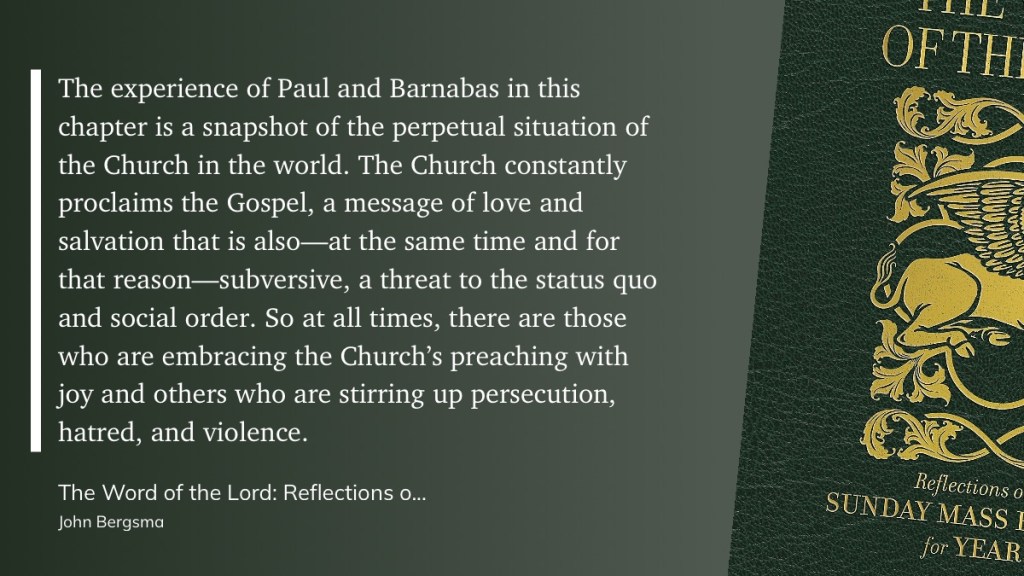
SOURCE: The Word of the Lord: Reflections on the Sunday Mass Readings for Year C
HISTORY
The passage from Acts 13:14, 43-52 is situated within a rich historical and political context. During the time of Paul and Barnabas’ missionary journey to Antioch of Pisidia (v. 14), the region was under Roman rule, and Judaism had been legally recognized as a religion. Despite Roman dominance, Hellenistic culture influenced the region, leading to a blend of cultural influences.
As Jewish Christians, Paul and Barnabas attended the local synagogue and were invited to speak (v. 15). Paul delivered a sermon focusing on Jesus’ death and resurrection, emphasizing the fulfillment of Jewish scripture (vv. 16-41). The apostles’ message of salvation through faith in Jesus instead of adherence to Jewish law stirred opposition among some Jews (v. 45), echoing broader conflicts between early Christians and Jewish leaders.
In the face of persecution, Paul and Barnabas declared their mission to spread God’s word to the Gentiles (v. 46). This reflects the early Christian community’s efforts to expand beyond Jewish converts, setting the stage for the growth of Christianity as a distinct religion in the Roman Empire. The apostles’ courage amidst adversity (vv. 50-52) exemplifies the commitment of early Christian leaders to their faith, despite the political and social challenges they faced.
4th Sunday of Easter C
SOCIETY
Acts 13:14, 43-52 is significantly shaped by its sociocultural context, particularly the interactions between Jewish and Gentile communities in the early Christian era. In Antioch of Pisidia, a region influenced by both Jewish and Hellenistic cultures, Paul and Barnabas encountered diverse belief systems and social practices.
As Jewish Christians, the apostles attended the local synagogue and engaged with the Jewish community (v. 14). Paul’s sermon emphasized the continuity between Jewish history and the message of salvation through Jesus (vv. 16-41), addressing the concerns of Jews who questioned Jesus’ role as the Messiah. The apostles’ adherence to their faith, even when faced with opposition (vv. 45-52), reflects the strength of Jewish religious identity in this period.
However, Paul and Barnabas also recognized the importance of reaching out to Gentiles (v. 46), as many non-Jews were attracted to the Jewish faith and open to new religious ideas. This reflects the broader cultural context of the Roman Empire, where diverse religious traditions coexisted and interacted.
4th Sunday of Easter C
THEOLOGY
Acts 13:14, 43-52 offers theological insights relevant to contemporary Catholics, particularly in understanding the relationship between Judaism and Christianity, and the importance of perseverance in faith amidst challenges.
Paul’s sermon in Acts 13 emphasizes the continuity between Jewish history and the message of salvation through Jesus Christ (vv. 16-41). This passage reminds contemporary Catholics of the shared roots of Judaism and Christianity, encouraging interfaith dialogue and understanding.
The apostles’ decision to preach to Gentiles (v. 46) also reflects the Church’s mission to spread the Gospel universally, transcending cultural and religious boundaries. This inclusivity remains a core value for Catholics today, as the Church continues to engage with diverse communities worldwide.
Moreover, the passage highlights the apostles’ resilience in the face of opposition (vv. 50-52), providing an example for modern Catholics to remain steadfast in their faith, even when faced with adversity. This determination reflects the enduring power of God’s love and the importance of trusting in divine guidance.
Connecting Faith and Life
Branching Out Blog—Bill Ayres
FIRST READING: What we read in the Acts of the Apostles implies that Paul and Barnabas were inspired speakers who had a powerful effect on their listeners. They started out preaching mainly to Jewish people and converts to Judaism, but at this point their message is being received more positively by the Gentiles. It must have been hard for Paul who, in his previous life as Saul, was a rabid persecutor of the new Christian community. Up to this point, most of the followers of Jesus were Jews. From now on, Paul will truly be the Apostle to the Gentiles. It is because of him more than any of the other apostles that Christianity spread all over the Mediterranean world and beyond. Without him, it may have only been one more sect within Judaism. From what we know of Paul, he could be difficult at times but always courageous and persevering in his mission.
SOURCE: RENEW International—Founded in 1978, RENEW is a not-for-profit organization based in Plainfield, NJ. Our mission is simple yet powerful: to connect faith and life. We use the RENEW process combined with a theme that meets the needs of your community to help parishes and dioceses build small groups to transform the Church so the Church can transform the world!
Fr. Paul Galetto, OSA
4th Sunday of Easter C
Vision of Salvation
Revelation 7:9, 14b-17

Sticky Statement
GUIDE
- Great: The vast multitude described in Revelation 7:9.
- Unity: The people stand together before the throne.
- In: Indicating the presence and location before God.
- Diversity: From every nation, tribe, people, and language.
- Embraced: Held by God’s love and protection, as described in verses 14b-17.
Suffering and Glory
This scene leaves us with one overarching theme. When we worship God, we should bring our sufferings to him. Being Christian may not bring us popularity; it may bring us pain. But Christ did not promise relief from pain. In fact, he promised us a share in his pain. But a share in his pain will bring a share in his glory. This is the meaning of the Eucharist. Share in suffering. Share in glory.
Outline of the Reading
Vision of Salvation

I. Multitude in White Robes (vv. 9, 14b)
- Vision of a great multitude from every nation, race, people, and tongue
- They wear white robes and hold palm branches
**II. God’s Dwelling and Service (v. 15)
- The multitude stands before God’s throne and serves him day and night
- God’s dwelling is among them
III. God’s Protection and Relief (v. 16)
- God will spread his tent over the multitude, sheltering and protecting them
- They will no longer experience hunger, thirst, or harm
IV. God’s Guidance and Comfort (v. 17)
- The Lamb in the center of the throne will guide and shepherd the multitude
- They will find comfort and joy in God’s presence, living in an eternal state of peace and salvation
SOURCE: AI Generated Outline; Clipart by Fr. Richard Lonsdale
- Kieren O’Mahony OSA
- Fr. Conley Bertrand
- Fr. George Corrigan OFM
- Fr. Thibodeau
- St. Charles Borromeo
- Edriann Ezell
- Vince Contreras
- Bp. John P. Dolan
- Fr. Eamon Tobin
- Carmelite Lectio Divina
4th Sunday of Easter C
John Bergsma
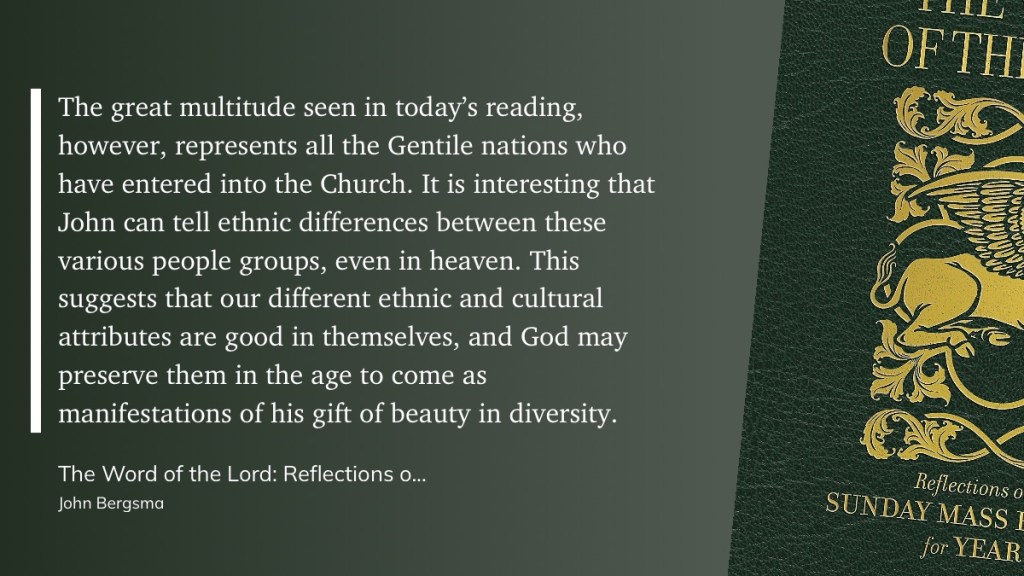
SOURCE: The Word of the Lord: Reflections on the Sunday Mass Readings for Year C
HISTORY
Revelation 7:9, 14b-17 is part of a larger vision experienced by John of Patmos during a time of political turmoil and persecution in the Roman Empire. The passage portrays a multitude of people from various backgrounds united in their faith and protected by God.
During the 1st century AD, early Christians faced significant challenges, including persecution under Roman authorities. John’s audience, likely comprised of both Jewish and Gentile Christians, may have found hope in his visions, which depicted God’s ultimate triumph over evil and the establishment of a new, just world.
The passage’s emphasis on unity among diverse peoples (v. 9) challenges the political and cultural divisions of the Roman Empire, asserting that God’s love transcends human boundaries. This message would have resonated with early Christians, who sought to navigate their faith amidst a multicultural, often hostile environment.
4th Sunday of Easter C
SOCIETY
Revelation 7:9, 14b-17 reflects the sociocultural context of early Christianity, particularly the experiences of diverse communities navigating religious and cultural differences. The passage portrays a multitude of people from various backgrounds (v. 9), united in their faith and protected by God.
In the multicultural environment of the Roman Empire, early Christians would have encountered a wide range of belief systems and social practices. This passage affirms the value of unity amidst diversity, emphasizing that God’s love extends to people of all backgrounds. This message would have been particularly meaningful for John’s audience, which likely included both Jewish and Gentile Christians, as it speaks to the importance of finding common ground in their shared faith.
Furthermore, the passage’s depiction of divine protection (vv. 15-17) reflects the challenges faced by early Christians, including persecution and social marginalization. By envisioning a world where God shelters and comforts the faithful, John offers hope and encouragement to his audience, reassuring them that their commitment to Christ is not in vain.
4th Sunday of Easter C
THEOLOGY
Revelation 7:9, 14b-17 offers valuable theological insights for contemporary Catholics, particularly regarding the unity of diverse believers and the promise of divine protection.
The passage’s vision of a multitude from various backgrounds (v. 9) serves as a reminder of the Church’s universal mission and the value of inclusivity. Just as John’s audience would have found hope in this image, contemporary Catholics can draw inspiration from this vision as they work to welcome and embrace individuals from diverse cultures and traditions.
Furthermore, the depiction of God’s shelter and comfort (vv. 15-17) emphasizes the ongoing relevance of faith in the face of adversity. As Catholics today encounter various challenges, both personal and global, they can take heart in the promise that God remains present and attentive to their needs.
Connecting Faith and Life
Branching Out Blog—Bill Ayres
SECOND READING: The book of Revelation was written long after the death and resurrection of Jesus—around 95 AD. By this time, there were many thousands of believers, but they were being persecuted by the Roman Empire. It is hard for us, centuries later, to imagine how hard it was for people to be practicing Christians. By then, the Romans saw them as a major threat to the empire’s power and did everything they could to wipe Christians out. Some emperors were worse than others, but persecution was the order of the day. The author of the Book of Revelation wants to assure his readers and listeners that God is with them. Their suffering will end, and they will be rewarded.
We do not face anything like the vicious all powerful and pervasive force that was ancient Rome, although Christians in other parts of the world are subject to violent persecution even today. We do all suffer in many ways at numerous times in our lives. When you are in your deepest and most prolonged suffering, do you still believe in the healing, saving power of God’s unconditional love? Are you able to go back in time to other occasions of deep suffering and remember how you made it through? Remembering those past experiences can help you be conscious of, and rely on, the supportive Spirit within you.
SOURCE: RENEW International—Founded in 1978, RENEW is a not-for-profit organization based in Plainfield, NJ. Our mission is simple yet powerful: to connect faith and life. We use the RENEW process combined with a theme that meets the needs of your community to help parishes and dioceses build small groups to transform the Church so the Church can transform the world!
Fr. Paul Galetto, OSA
4th Sunday of Easter C
The Good Shepherd
John 10:27-30

Sticky Statement
SHEEP
- Seek: My sheep listen and actively seek to follow the divine guide.
- Hear: They hear my voice, recognizing the true path of the shepherd.
- Eternal: I give them eternal life, an everlasting gift.
- Embrace: They will never perish, embraced in the safety of divine care.
- Protect: No one will snatch them from my hand, ensuring their protection.
What Unites Us
God is the cause of our community. He sent his Son into the world to call us, to embrace us, to unite us. He makes us one with his Son. He sanctifies us with his Spirit. He gives us the gift of a full faith and the power to reach out to others, no matter who they are. He sends us out the same way he sent out the apostles, to spend the Good News to others.
As we reach out to the Father, do we reach out to others, to become one with them? How can we share our unity with them?
Outline of the Reading
The Good Shepherd

I. Jesus’ Sheep (v. 27)
- Jesus’ sheep hear his voice, and he knows them.
- He calls them, and they follow him.
II. Eternal Life (v. 28)
- Jesus gives his sheep eternal life, and they will never perish.
- No one can snatch them from his hand or separate them from his love.
III. Greater Power (v. 29)
- Jesus and the Father are one, united in their purpose and power.
- This unity demonstrates the security found in following Jesus.
IV. Shared Glory (v. 30)
- Jesus and the Father share the same divine glory.
- This glory testifies to their unity and divine nature.
SOURCE: AI Generated Outline; Clipart by Fr. Richard Lonsdale
- Kieren O’Mahony OSA
- Fr. Conley Bertrand
- Fr. George Corrigan OFM
- Fr. Thibodeau
- St. Charles Borromeo
- Edriann Ezell
- Vince Contreras
- Bp. John P. Dolan
- Fr. Eamon Tobin
- Carmelite Lectio Divina
4th Sunday of Easter C
Fr. Francis Martin
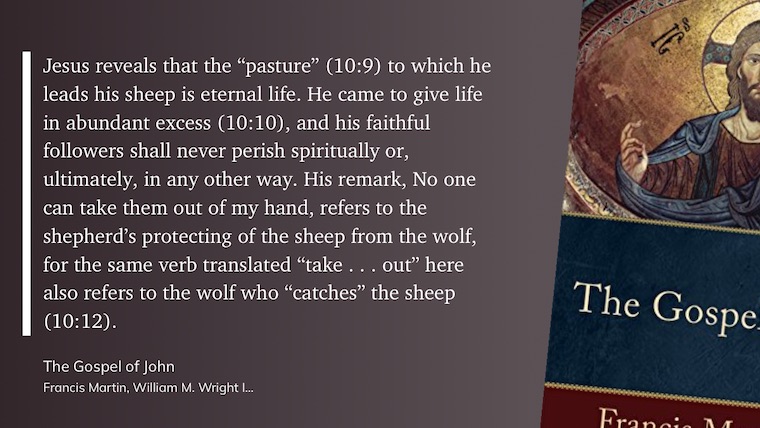
SOURCE: The Gospel of John
HISTORY
John 10:27-30 is part of Jesus’ discourse on being the Good Shepherd, which takes place during the Jewish festival of Dedication (Hanukkah) in Jerusalem. This passage emphasizes the intimate relationship between Jesus and his followers and highlights the protective care he provides.
During this time, the region was under Roman occupation, and Jewish people were divided in their responses to this political reality. Jesus’ teaching about the Good Shepherd can be seen as a counterpoint to the Roman emperor’s claim to be the “shepherd” of his people, challenging earthly authorities and asserting his divine authority.
John’s Gospel was likely written for a predominantly Jewish-Christian community facing marginalization and expulsion from local synagogues. The theme of Jesus as the Good Shepherd would have been particularly meaningful for John’s audience, offering them comfort and reassurance that they belonged to Christ’s flock.
4th Sunday of Easter C
SOCIETY
John 10:27-30 reflects the sociocultural context of Jesus’ ministry, particularly the significance of shepherd imagery and the importance of belonging to a community. In this passage, Jesus asserts his role as the Good Shepherd, promising protection and eternal life to his followers.
Shepherding was a familiar concept in the agrarian society of 1st century Palestine, where people relied on shepherds to care for their livestock. By presenting himself as the Good Shepherd, Jesus draws on this cultural understanding to convey his loving and protective relationship with his followers.
Additionally, the emphasis on unity and belonging (v. 28) reflects the social importance of community in Jewish society. In a world where kinship and religious identity were central, Jesus’ promise of security and eternal life for his followers would have provided comfort and reassurance.
For John’s audience, facing social ostracism and exclusion from their Jewish communities, this message would have been particularly impactful. By presenting Jesus as the Good Shepherd who unites and protects his flock, John offers a powerful vision of belonging and identity rooted in faith in Christ.
4th Sunday of Easter C
THEOLOGY
John 10:27-30 offers valuable theological insights for contemporary Catholics, emphasizing the unity of believers, the protective care of Christ, and the promise of eternal life.
In this passage, Jesus presents himself as the Good Shepherd who knows and protects his sheep (vv. 27-28), emphasizing the intimacy of his relationship with his followers. This image highlights the importance of a personal connection with Christ, encouraging Catholics to deepen their faith through prayer, Scripture, and the sacraments.
Additionally, Jesus promises that no one can snatch his sheep from his hand (v. 28), reflecting the security found in belonging to the Church, the Body of Christ. This unity is particularly relevant for contemporary Catholics, who are called to build community by welcoming and supporting fellow believers.
Finally, Jesus speaks of giving his sheep eternal life (v. 28), offering hope and reassurance to those who face challenges and uncertainties. This promise reminds contemporary Catholics that their ultimate fulfillment lies in union with Christ and encourages them to persevere in faith, even in difficult times.
Connecting Faith and Life
Branching Out Blog—Bill Ayres
GOSPEL: The role of shepherd in the ancient world is something that we often romanticize today. In ancient times, shepherds were shadowy figures, often shunned in everyday society. Some were good and took care of their sheep, but others were not devoted or honest. A good shepherd was highly regarded, because he had to take care of a large herd often in dangerous and lonely conditions. Jesus knows all this when he calls himself the Good Shepherd. He knows that his audience will get it in a way that is more difficult for us today when we do not like to be thought of as sheep.
The last line of this passage is the most important. “The Father and I are one.” Remember that this Gospel is the last to be written, long after the death of Jesus and the writing of the other three Gospels. Why does John write such a powerful sentence? It is precisely because that is what people believed about Jesus these many years later. Jesus is not only the Messiah, not only the Son of God, but Jesus and the Father are one. Gradually, this level of belief developed into the central dogma of our faith, the Holy Trinity. It took centuries, but then something so extraordinary was not to be written on the back of a napkin.
We are truly created in the image and likeness of God, and God is a community of persons, not a solitary isolated being. We are communal persons as well, in our families, among our friends, and in our parish. We are not meant to be alone. It is not in our nature.
SOURCE: RENEW International—Founded in 1978, RENEW is a not-for-profit organization based in Plainfield, NJ. Our mission is simple yet powerful: to connect faith and life. We use the RENEW process combined with a theme that meets the needs of your community to help parishes and dioceses build small groups to transform the Church so the Church can transform the world!
FIRST READING | SECOND READING | GOSPEL