May 4, 2025


Mass Readings
Mass Readings

Fr. Paul Galetto, OSA
3rd Sunday of Easter C
Trial before the Sanhedrin

Sticky Statement
BOLD
- B: Boldness in speaking the truth
- O: Obedience to God over human authority
- L: Loyalty to the mission of spreading the Gospel
- D: Divine witness through the Holy Spirit
The Apostles Before the Sanhedrin

Just as the Apostles continued the work of Jesus after his resurrection (their healing ministry and presence in the Temple), they suffered the persecution of the Sanhedrin (the assembly of Jewish leaders in Jerusalem). This passage describes the second trial of the apostles before the Sanhedrin. The apostles were instructed by the highest religious authority in Judaism to stop preaching, but the court’s order was ignored.
Homily Starters
Outline of the Reading
Standing Firm in Faith
I. Sanhedrin Interrogation (vv. 27-28)
- Apostles brought before the Sanhedrin
- Charged with disobeying orders and spreading Jesus’ teachings
II. Peter’s Defense (vv. 29-32)
- Apostles’ allegiance to God over human authority
- Jesus’ death and resurrection as God’s plan
- Apostles as witnesses to the Holy Spirit’s work
III. Sanhedrin’s Deliberation (v. 33)
- Outraged council members wanting to execute the Apostles
IV. Apostles’ Release and Reaction (vv. 40b-41)
- Continued daily preaching in the temple and homes
- Apostles flogged and ordered to stop teaching in Jesus’ name
- Apostles rejoicing in suffering for Christ’s sake
SOURCE: AI Generated Outline; Clipart by Fr. Richard Lonsdale
HISTORY
In Acts 5:27-32, 40b-41, the apostles are brought before the Sanhedrin, the highest Jewish governing body, to address their persistent preaching in Jesus’ name despite previous warnings. The apostles argue that obedience to God takes precedence over human authority. The Sanhedrin, led by the high priest, grows increasingly enraged by the apostles’ perceived defiance.
Gamaliel, a respected Pharisee and teacher of the law, intervenes and advises caution, urging the council to release the apostles, as the will of God will prevail. Consequently, the apostles are flogged and released. Despite the suffering they endure, they rejoice in their role as witnesses to Christ.
During this period, the political climate in Jerusalem was tense due to the presence of the Roman Empire and the collaboration of the Jewish elite with the Roman authorities. Christianity was still in its nascent stages, and the Roman Empire perceived it as a threat to the status quo. This backdrop heightened the hostility and persecution faced by early Christians.
The author, Luke, was a Gentile convert who sought to address both Jewish and Gentile audiences, highlighting the universal nature of Christianity. His writings demonstrate the conflict between Christianity and both Jewish and Roman authorities, underscoring the courage and conviction of the apostles as they navigated an increasingly challenging political environment.
3rd Sunday of Easter C
SOCIETY
In Acts 5:27-32, 40b-41, the apostles defy the Sanhedrin’s orders, highlighting the sociocultural tension between emerging Christianity and traditional Jewish beliefs. The apostles, empowered by the Holy Spirit, prioritize their divine calling over the cultural expectation to submit to religious authority.
The belief in resurrection, central to Christianity, contradicts the Sadducees’ doctrine within the Sanhedrin, contributing to the conflict. The apostles’ insistence on preaching Jesus’ resurrection serves as a catalyst for their persecution.
Culturally, obedience to religious authority was paramount in Jewish society. The apostles’ defiance undermines the Sanhedrin’s credibility, leading to its outrage and the decision to flog the apostles. Despite this, the apostles rejoice, showing their commitment to their faith and mission.
The apostles’ steadfastness exemplifies the sociocultural shift occurring as Christianity emerges. Early Christians form a countercultural community, united by their shared beliefs and practices, which often challenge traditional Jewish customs.
Luke, the author, emphasizes the apostles’ determination in the face of persecution, providing a model for Christians facing similar challenges in their own cultural contexts. By recounting the apostles’ experience, Luke encourages Christians to remain steadfast in their faith, even when it conflicts with prevailing societal norms and beliefs.
3rd Sunday of Easter C
THEOLOGY
Acts 5:27-32, 40b-41 highlights the apostles’ unwavering commitment to proclaiming the message of Christ, despite the threats posed by Jewish authorities. Catholic theology underscores the belief that Christians must prioritize obedience to God over human authority, a principle exemplified by the apostles’ actions.
Their obedience to God reflects their understanding of the Church’s mission to evangelize, proclaiming the truth of Christ’s resurrection despite persecution. The Catechism affirms the importance of this mission, emphasizing that “all Christians are called to be witnesses of the Gospel at all times and in all places” (CCC, 1655).
The apostles’ suffering and subsequent rejoicing remind contemporary Catholics of the importance of embracing redemptive suffering, uniting their pain with Christ’s on the cross (Colossians 1:24). The passage shows how adversity can strengthen faith and encourages perseverance amidst challenges.
The apostles’ response to persecution is a model for Catholics today. In places where the Church faces challenges, the passage encourages believers to remain steadfast and trust in God’s ultimate purpose.
The passage also stresses the value of community support in difficult times. The apostles’ ability to rejoice despite their suffering is indicative of the power of communal encouragement and solidarity.
Fr. Paul Galetto, OSA
3rd Sunday of Easter C
Celestial Worship

Sticky Statement
PRAISE
- Power – Recognizing the omnipotence of God and the Lamb.
- Rejoice – Joining the multitude of angels in joyful worship.
- Adoration – Deep-seated love and reverence for the divine.
Infinite – Understanding the limitless nature of God’s majesty. - Salvation – Acknowledging the sacrificial role of the Lamb.
- Exaltation – Lifting up God and the Lamb above all.
Praise to the Lamb!
While the Book of Revelation may be mysterious with its emphasis on symbols, the context for the symbols should not cause wonder. The context was worship. John the Elder witnessed heavenly praise. The kind that we should emulate. The kind that, if we look closely, we can easily imagine creation itself offering to its maker.
Outline of the Reading
Worship at God’s Throne

I. Myriads of Angels (v. 11)
- Countless angels surrounding the throne
- Voices joining in worship
II. Universal Acclamation (vv. 12-13)
- Creatures and elders attributing worthiness to the Lamb
- Praise for the Lamb’s sacrifice and honor
- Heavenly beings offering blessings
III. Universal Adoration (v. 14)
- All creatures in heaven, earth, and sea worshiping
- Four living creatures and elders prostrating before the throne
SOURCE: AI Generated Outline; Clipart by Fr. Richard Lonsdale
HISTORY
Revelation 5:11-14 is situated within a tumultuous historical and political context, marked by persecution under Roman Emperor Domitian. The author, John of Patmos, addresses a suffering Christian community in Asia Minor, aiming to provide hope and reassurance amidst their struggles.
The text presents a heavenly vision of worship, where a multitude of angels and living creatures sing praises to the Lamb (Jesus Christ). The passage draws on Old Testament imagery, alluding to figures such as Daniel, Ezekiel, and Isaiah, as well as Jewish apocalyptic literature. These allusions anchor the Christian community in its Jewish roots while offering solace through the promise of divine victory over earthly struggles.
In the political context of Domitian’s reign, Revelation’s symbolic language critiques the Roman Empire’s power structures and calls for faithfulness to God instead. The Lamb’s triumph illustrates the ultimate victory of divine sovereignty over oppressive earthly regimes.
The text also speaks to the challenges faced by the early Christian community, who, like John, were often persecuted for their beliefs. By depicting heavenly worship centered on the Lamb, the author encourages perseverance and faithfulness, asserting that Christ’s death and resurrection will ultimately lead to God’s triumph over evil.
Through its historical and political context, Revelation 5:11-14 offers both critique and hope to a struggling Christian community, reminding them of their spiritual heritage, Christ’s redemptive power, and the promise of divine victory over their oppressors.
3rd Sunday of Easter C
SOCIETY
Revelation 5:11-14 reveals the sociocultural dynamics of the early Christian community, specifically their understanding of worship and identity in relation to the larger Roman society. This passage occurs within a heavenly vision of worship centered on the Lamb, a symbolic representation of Jesus Christ.
The scene presents a countercultural model of worship in contrast to the Roman imperial cult, challenging prevailing customs and beliefs. Instead of glorifying the emperor as divine, the passage exalts the Lamb and offers a critique of imperial power structures.
The original audience, facing persecution under Emperor Domitian, would find solace in this vision of heavenly worship focused on the Lamb. This portrayal not only distinguishes their identity as Christians but also encourages their continued faithfulness amidst oppression.
The worship scene reflects early Christian practices, with hymns, praise, and acclamations directed toward the divine. By portraying this heavenly worship, the author reminds the Christian community of the centrality of their faith practices, helping to solidify their distinct identity in a hostile society.
Moreover, the passage draws upon Jewish apocalyptic literature and imagery from the Old Testament, reaffirming the connection between Jewish heritage and emerging Christian identity. This literary backdrop highlights the sociocultural context of early Christianity and emphasizes the continuity between Jewish and Christian traditions.
Revelation 5:11-14 thus reflects the sociocultural aspects of early Christian identity and worship, encouraging faithfulness, resilience, and hope for an oppressed community in the midst of the Roman Empire.
3rd Sunday of Easter C
THEOLOGY
Revelation 5:11-14 holds significant theological importance within Catholic tradition, emphasizing the centrality of Christ’s redemptive sacrifice and the role of worship in Christian life. The passage depicts a vision of heavenly worship centered on the Lamb, symbolizing Jesus Christ. This scene highlights Christ’s divine status and His ultimate victory over sin and death, resonating with core Catholic beliefs.
The passage illustrates the Catholic understanding of Jesus as the Paschal Lamb, whose sacrifice on the cross atones for humanity’s sins (1 Corinthians 5:7). This interpretation emphasizes the role of Christ’s death and resurrection in salvation history, a fundamental aspect of Catholic theology.
Moreover, the heavenly worship scene serves as a model for Catholic liturgy, with hymns, praise, and acclamations directed toward the divine. Revelation’s vision of worship thus shapes the Church’s understanding of its liturgical practices and underscores the importance of communal worship.
For contemporary Catholics, the passage’s message remains relevant in several ways. Firstly, it emphasizes the centrality of Christ’s redeeming sacrifice, encouraging believers to reflect on its significance in their own lives. Secondly, it highlights the importance of active participation in worship and community life, fostering spiritual growth and resilience amidst modern challenges.
Revelation 5:11-14 ultimately offers a theologically rich vision of worship that continues to shape Catholic belief, practice, and identity, connecting contemporary believers with their spiritual heritage and affirming their faith in Christ’s ultimate triumph.
Fr. Paul Galetto, OSA
3rd Sunday of Easter C
Peter’s Restoration

Sticky Statement
RISE
- – Recognize: Jesus appears to the disciples, who initially don’t recognize Him.
- – Invite: Jesus invites the disciples to cast their nets again, leading to a bountiful catch.
- – Serve: Jesus serves breakfast to the disciples on the shore.
- – Empower: Jesus empowers Peter with the charge to “feed my sheep,” indicating leadership and responsibility.
The Catch, the Meal, and the Commitment
Unlike the other resurrection stories found in the Gospels, this appearance took place in Galilee, at the so-called “Sea of Galilee” (which actually was a lake). In this story it is known as the “Sea of Tiberias” named in honor of the Emperor]…
Like much of John, these few sentences were packed with symbolism. The boat was an old symbol for the church; fishing at night represented a failing missionary effort. It must have felt like the night Jesus was dead in the tomb. But with the dawn, the Risen Lord was present, and with him came the great number of new Christians (represented by the great number of fish). According to some early Christian writers, the number of fish (153 in verse 11) represented all the known species in the world at the time… With the great catch, the Lord was recognized.
Outline of the Reading
Miraculous Catch
I. Fishing Encounter (vv. 1-6)
- Apostles fishing without success
- Jesus guiding them to a miraculous catch
II. Recognition and Reinstatement (vv. 7-14)
- Beloved disciple recognizing Jesus
- Peter’s threefold affirmation of love for Jesus
- Jesus’ prophecy about Peter’s martyrdom
- Jesus commanding Peter to tend his flock
III. Commissioning and Purpose (vv. 15-17)
- Jesus asking Peter to feed his lambs and sheep
- Peter questioning Jesus about the beloved disciple’s fate
- Jesus’ instruction for Peter to follow him
IV. Conclusion and Author’s Note (vv. 18-19)
- Jesus foretelling the manner of Peter’s death
- Jesus commanding Peter to follow him
- Author’s note on the beloved disciple and Jesus’ return
SOURCE: AI Generated Outline; Clipart by Fr. Richard Lonsdale
HISTORY
John 21:1-19, often referred to as the “miraculous catch of fish,” takes place during the early days of the Christian movement, set against the backdrop of political and religious tensions within the Roman Empire. The Gospel of John, authored by the apostle John, aims to deepen the faith of early Christians, primarily of Jewish origin, while also addressing a Gentile audience.
During this time, the Roman Empire exerted significant influence over political and social structures, often resulting in religious persecution. Jesus’ followers faced the challenges of living out their faith in a hostile environment. The political backdrop, marked by unrest, provides a context for understanding the disciples’ confusion and fear as they attempt to navigate their lives following Jesus’ crucifixion and resurrection.
The Gospel writer, John, was an eyewitness to Jesus’ ministry and likely sought to provide an accurate account for the early Christian community, affirming their faith in Christ. The passage serves as a testimony to Jesus’ post-resurrection appearances and the events surrounding the formation of the early Church.
This passage speaks to the original audience by providing a narrative that instills hope and faith in their daily lives. By sharing the experiences of Jesus’ closest followers, the author highlights the human emotions and struggles involved in embracing the Christian faith during a time of uncertainty and challenge. John 21:1-19 remains an essential text for understanding the historical and political context of early Christianity, offering timeless insights into faith and discipleship.
3rd Sunday of Easter C
SOCIETY
John 21:1-19 takes place within a rich sociocultural context characterized by the intersection of Jewish and Greco-Roman traditions. As a Jewish community, the disciples would have been familiar with the social practices and customs rooted in their faith, including the significance of fishing as a profession and a metaphor for spiritual nourishment.
Fishing held both practical and symbolic importance in the sociocultural context of the disciples. The Sea of Galilee served as a crucial economic resource and was often a backdrop for Jesus’ teachings and miracles. The abundant catch of fish in this passage symbolizes spiritual nourishment and echoes other fishing metaphors in the Gospels, such as Jesus’ call for his disciples to become “fishers of men” (Luke 5:10).
The passage also reflects the communal nature of early Christian life, with the disciples sharing a meal together and engaging in communal fishing practices. This sociocultural context underscores the importance of community support and fellowship in the face of religious and political adversity.
For the original audience, this narrative would have offered both reassurance and guidance in their own faith journeys. By highlighting the disciples’ challenges and successes, the author provides a model for navigating doubt, embracing faith, and fostering strong community bonds.
John 21:1-19 serves as a powerful example of how the sociocultural context shapes the message of a biblical passage, offering insights into the challenges, practices, and beliefs that defined the world of the early Christian community.
3rd Sunday of Easter C
THEOLOGY
John 21:1-19 holds significant theological importance within the Catholic tradition, addressing themes such as redemption, the Eucharist, and the mission of the Church. This passage recounts Jesus’ miraculous provision of fish and his recommissioning of Peter, offering insights into Catholic teachings on faith, reconciliation, and discipleship.
The breakfast scene on the shore of the Sea of Galilee symbolizes the Eucharistic meal, where Jesus invites his disciples to share in the bounty he has provided. This evokes the theme of the Last Supper, emphasizing the centrality of the Eucharist in Catholic theology. The abundant catch of fish also symbolizes the spiritual nourishment that Jesus offers to his followers.
Moreover, the passage highlights the role of Peter as the leader of the early Church. Jesus’ threefold questioning of Peter’s love corresponds to Peter’s three denials during Jesus’ passion, demonstrating the Catholic belief in forgiveness and reconciliation. By commissioning Peter to “feed my lambs” and “tend my sheep,” Jesus establishes a foundation for the Church’s mission to care for and guide believers.
For contemporary Catholics, John 21:1-19 offers several meaningful applications. The passage emphasizes the importance of reconciliation and the need to seek forgiveness when one has strayed from their faith. Additionally, it reminds Catholics of their call to share in the mission of the Church, offering spiritual nourishment to others and fostering strong community bonds.

- Kieren O’Mahony OSA
- Fr. Conley Bertrand
- Fr. George Corrigan OFM
- Fr. Thibodeau
- St. Charles Borromeo
- Edriann Ezell
- Vince Contreras
- Bp. John P. Dolan
- Fr. Eamon Tobin
- Carmelite Lectio Divina
3rd Sunday of Easter C
John Bergsma
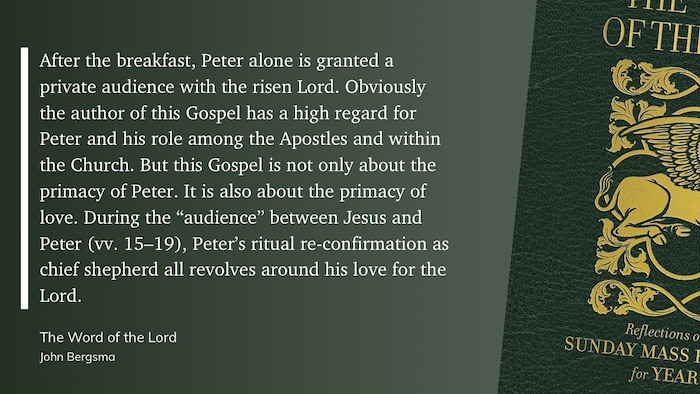
SOURCE: The Word of the Lord: Reflections on the Sunday Mass Readings for Year C
FIRST READING | SECOND READING | GOSPEL