
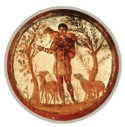

2nd Sunday of Year B
The calling or vocation is at the center of the readings for this Sunday with which Ordinary Time begins. This is the call to follow, or in other words, to abide with Jesus Christ, like the two disciples in the Gospel. It is a calling to which we must reply generously, as Samuel did: “Speak, Lord, your servant is listening” (first reading). A call implies “self-emptying”, not belonging to oneself, but to God and to his Spirit; hence the clear awareness of and demand for a pure life, far from lust and all that prevents one from belonging to the Lord (second reading).
P. Antonio Izqeuirdo, L.C., Copyright © Dicastery for the Clergy
The Lord’s Call
17 January 2021 | Library of the Apostolic Palace
2nd Sunday of Year B
The Gospel for the Second Sunday in Ordinary Time (cf. Jn 1:35-42) presents the meeting between Jesus and his first disciples. The scene unfolds along the River Jordan the day after Jesus’ baptism. It is John the Baptist himself who points out the Messiah to the two of them with these words: “Behold, the Lamb of God!” (v. 36). And those two, trusting the Baptist’s testimony, follow Jesus. He realizes this and asks: “What do you seek?”, and they ask Him: “Rabbi, where are you staying?” (v. 38).
Jesus does not respond: “I live in Capernaum, or in Nazareth”, but says: “Come and see” (v. 39). Not a calling card, but an invitation to an encounter. The two follow him and remain with him that afternoon. It is not difficult to imagine them seated, asking him questions and above all listening to him, feeling their hearts inflamed ever more while the Teacher speaks. They sense the beauty of the words that respond to their greatest hope. And all of a sudden they discover that, as evening was drawing around them, the light that God alone can give was exploding within their hearts. One thing catches our attention: 60 years later, or perhaps more, one of them would write in his Gospel: “it was about four in the afternoon” (cf. Jn 1:39) — he wrote the time. And this is one thing that makes us think: every authentic encounter with Jesus remains alive in memory; it is never forgotten. You forget many encounters, but a true encounter with Jesus remains forever. And many years later, those two even remembered the time. They were unable to forget this encounter that had changed their lives and was so happy and so complete. Then, when they leave from that encounter and return to their brothers, that joy, that light overflows from their hearts like a raging river. One of the two, Andrew, says to his brother, Simon — whom Jesus will call Peter when He meets him — “We have found the Messiah” (v. 41). They left sure that Jesus was the Messiah, certain.
Let us pause for a moment on this experience of the encounter with Christ who calls us to remain with him. Each one of God’s calls is an initiative of his love. He is the one who always takes the initiative. He calls you. God calls to life, he calls to faith, and he calls to a particular state in life: “I want you here”. God’s first call is to life, through which he makes us persons; it is an individual call because God does not make things in series. Then God calls us to faith and to become part of his family as children of God. Lastly, God calls us to a particular state in life: to give of ourselves on the path of matrimony, or that of the priesthood or consecrated life. They are different ways of realizing God’s design, the one he has for each of us that is always a design of love. God always calls. And the greatest joy for every believer is to respond to this call, offering one’s entire being to the service of God and our brothers and sisters.
Brothers and sisters, before the Lord’s call, which can reach us in a thousand ways — through others, happy or sad events — our attitude at times might be rejection. No… “I am afraid”… Rejection because it seems to be in contrast to our aspirations; and even fear because we believe it is too demanding and uncomfortable: “Oh no, I will never be able to do it, better not to, a calmer life is better… God over there, me here”. But God’s call is always love: we have to try to discover the love behind each call, and it should be responded to only with love. This is the language: the response to a call that comes from love is only love. At the beginning there is an encounter, or rather, there is the encounter with Jesus who speaks to us of his Father, he makes His love known to us. And then the desire to communicate it to the people that we love arises spontaneously in us too: “I met Love”, “I met the Messiah”, “I met God”, I met Jesus”, “I found the meaning of my life”. In a word: “I found God”.
Seeking Jesus, Encountering Jesus, Following Jesus
14 January 2018 | Saint Peter’s Square
2nd Sunday of Year B
As in the Feast of the Epiphany and in that of the Baptism of Jesus, so too today’s Gospel passage (cf. Jn 1:35-42) proposes the theme of the manifestation of the Lord. This time it is John the Baptist who points Him out to his disciples as “the Lamb of God” (v. 36), thus inviting them to follow Him. And thus it is for us: the One whom we have contemplated in the Mystery of Christmas, we are now called to follow in daily life. Therefore, today’s Gospel passage introduces us perfectly into Ordinary Liturgical Time, a time that helps to invigorate and affirm our journey of faith in ordinary life, in a dynamic that moves between epiphany and sequela, between manifestation and vocation.
The Gospel narrative indicates the essential characteristics of the journey of faith. There is a journey of faith, and this is the journey of the disciples of all times, ours too, beginning with the question that Jesus asks the two who, urged by the Baptist, set out to follow Him: “What do you seek?” (v. 38). It is the same question that the Risen One asks Mary Magdalene on Easter morning: “Woman, whom do you seek?” (cf. Jn 20:15). Each of us, as a human being, is seeking: seeking happiness, seeking love, a good and full life. God the Father has given us all this in his Son Jesus.
In this search, the role of a true witness — of a person who first made the journey and encountered the Lord — is fundamental. In the Gospel, John the Baptist is this witness. For this reason he is able to direct the disciples toward Jesus, who engages them in a new experience, saying: “Come and see” (Jn 1:39). And those two [disciples] will never forget the beauty of that encounter, to the extent that the Evangelist even notes the time of it: “It was about the tenth hour” (ibid.). Only a personal encounter with Jesusengenders a journey of faith and of discipleship. We will be able to experience many things, to accomplish many things, to establish relationships with many people, but only the appointment with Jesus, at that hour that God knows, can give full meaning to our life and render our plans and our initiatives fruitful.
It is not enough to build an image of God based on the words that are heard; one must go in search of the divine Master and go to where he lives. The two disciples ask Jesus, “where are you staying?” (v. 38). This question has a powerful spiritual meaning: it expresses the wish to know where the Lord lives, so as to abide with him. The life of faith consists in the wish to abide in the Lord, and thus in a continuing search for the place where he lives. This means that we are called to surpass a methodical and predictable religiosity, rekindling the encounter with Jesus in prayer, in meditating on the Word of God and in practicing the Sacraments, in order to abide with him and bear fruit thanks to him, to his help, to his grace.
Seeking Jesus, encountering Jesus, following Jesus: this is the journey. Seeking Jesus, encountering Jesus, following Jesus.
SOURCE: The Holy See Archive at the Vatican Website © Libreria Editrice Vaticana
To Seek and Find Christ
15 January 2006 | Saint Peter’s Square
2nd Sunday of Year B
Last Sunday, in which we celebrated the Baptism of the Lord, the Ordinary Time of the liturgical year began. The beauty of this season lies in the fact that it invites us to live our ordinary life as a journey of holiness, that is, of faith and friendship with Jesus continually discovered and rediscovered as Teacher and Lord, the Way, the Truth and the Life of man.
This is what John’s Gospel suggests to us in today’s liturgy when it presents the first meeting between Jesus and some of those who were to become his Apostles. They had been disciples of John the Baptist and John himself directed them to Jesus when, after baptizing him in the Jordan, he pointed him out as “the Lamb of God” (Jn 1: 36).
Two of his disciples then followed the Messiah who asked them: “What are you looking for?”. The two asked him: “Teacher, where do you stay?”. And Jesus answered: “Come and see”, that is, he invited them to follow him and stay with him for a while. They were so impressed in the few hours that they spent with Jesus that one of them, Andrew, said to his brother Simon: “We have found the Messiah”. Here are two especially important words: “seek” and “find”.
From the page of today’s Gospel, we can take these two words and find a fundamental instruction in them for the New Year: we would like it to be a time when we renew our spiritual journey with Jesus, in the joy of ceaselessly looking for and finding him. Indeed, the purest joy lies in the relationship with him, encountered, followed, known and loved, thanks to a constant effort of mind and heart. To be a disciple of Christ: for a Christian this suffices. Friendship with the Teacher guarantees profound peace and serenity to the soul even in the dark moments and in the most arduous trials. When faith meets with dark nights, in which the presence of God is no longer “felt” or “seen”, friendship with Jesus guarantees that in reality nothing can ever separate us from his love (cf. Rom 8: 39).
To seek and find Christ, the inexhaustible source of truth and life: the Word of God asks us to take up, at the beginning of the New Year, this never-ending journey of faith. We too ask Jesus: “Teacher, where do you stay?”, and he answers us: “Come and see”. For the believer it is always a ceaseless search and a new discovery, because Christ is the same yesterday, today and for ever, but we, the world and history, are never the same, and he comes to meet us to give us his communion and the fullness of life. Let us ask the Virgin Mary to help us to follow Jesus, savouring each day the joy of penetrating deeper and deeper into his mystery.
 Highlight text or double-click a paragraph anywhere on the site to ADD TO NOTES. You can also click ASK AI to copy your selection to the clipboard with a command prompt, ready for you to paste manually into the chat above.