
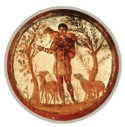

33rd Sunday of Year A
To work to bear fruit in the kingdom of God; this sentence sums up the liturgy of this Sunday. To allow the talents one has received to bear fruit, whatever their number, to fulfill the task which we shall have to account for later (Gospel). To work to do good in fear of God, like the good and industrious woman in the book of Proverbs (First Reading). To work, not to sleep, as we are children of the day and light (a time in which one can work), and not of the night or of darkness (Second Reading).
P. Antonio Izqeuirdo, L.C., Copyright © Dicastery for the Clergy
Not Doing Good is Not Good
15 November 2020 | Saint Peter’s Square
33rd Sunday of Year A
This parable applies to everyone but, as always, to Christians in particular. Today too, it is very topical: today is the Day of the Poor, in which the Church tells us Christians: “Stretch forth your hand to the poor. Hold out your hand to the poor. You are not alone in life: there are people who need you. Do not be selfish; hold out a hand to the poor”. We have all received from God a “patrimony” as human beings, a human richness, whatever it may be. And as disciples of Christ we have also received the faith, the Gospel, the Holy Spirit, the Sacraments, and so many other things. These gifts should be used to do good, to do good in this life, in service to God and to our brothers and sisters. And today the Church tells you, she tells us: “Use what God has given you and look at the poor. Look: there are so many of them; even in our cities, in the centre of our city, there are many. Do good!”.
At times, we think that to be Christian means not to do harm. And not doing harm is good. But not doing good is not good. We must do good, come out of ourselves and look, look at those who are more in need. There is so much hunger, even in the heart of our cities; and many times we enter into that logic of indifference: the poor person is there, and we look the other way. Hold out your hand to the poor person: it is Christ. Some say: “But these priests, these bishops who talk about the poor, the poor… We want them to talk to us about eternal life!”. Look, brother and sister, the poor are at the heart of the Gospel; it is Jesus who taught us to speak to the poor; it is Jesus who came for the poor. Hold out your hand to the poor. You have received many things, and you let your brother, your sister die of hunger?
Do Not Bury Your Talent
19 November 2017 | Saint Peter’s Square
33rd Sunday of Year A
This parable helps us understand how important it is to have a true concept of God. We must not think that he is a cruel, hard and severe master who wishes to punish us. If this mistaken image of God is within us our life cannot be fruitful, because we will live in fear and this will not lead us to anything constructive. On the contrary, fear paralyzes us; it causes our self-destruction. We are called to reflect in order to discover what our idea of God really is. Already in the Old Testament he revealed himself as “a God merciful and gracious, slow to anger, and abounding in steadfast love and faithfulness” (Ex 34:6). And Jesus always showed us that God is not a severe or intolerant master, but a father full of love, of tenderness, a father full of goodness. Therefore, we can and must have immense faith in him.
Jesus shows us God’s generosity and care in so many ways: with his words, with his gestures, with his welcome toward everyone, especially toward sinners, the little ones and the poor, as today — the first World Day of the Poor — also reminds us. But he also does so with his admonitions, which show his interest so that we do not pointlessly waste our life. Indeed, it is a sign that God has great esteem for us: this awareness helps us to be responsible people in all our actions. Therefore, the Parable of the Talents reminds us of a personal responsibility and of a faithfulness that even becomes the ability to continually set out anew, walking new paths, without “burying the talent”, that is, the gifts which God has entrusted to us, and for which he will call us to account.
SOURCE: The Holy See Archive at the Vatican Website © Libreria Editrice Vaticana
The Transience of Our Earthly Existence
6 November 2011
33rd Sunday of Year A
The word of God of this Sunday — the second to last Sunday of the liturgical year — warns us of the transience of our earthly existence and invites us to live it as a pilgrimage, keeping our gaze fixed on the destination for which God has created us. Moreover, since he made us for himself (cf. St Augustine, Confessions 1, 1), he is our ultimate destination and the meaning of our existence.
Death, followed by the Last Judgement, is an obligatory stage to pass through in order to reach this definitive reality. The Apostle Paul says: “the day of the Lord will come like a thief in the night” (1 Thess 5:2), that is, without warning. May knowledge of the glorious return of the Lord Jesus spur us to live in an attitude of watchfulness, waiting for his manifestation and in constant remembrance of his first Coming.
In the well known Parable of the Talents — recounted by the Evangelist Matthew (cf. 25: 14-30) — Jesus tells the story of three servants to whom their master entrusted his property, before setting out on a long journey. Two of them behaved impeccably, doubling the value of what they had received. On the contrary, the third buried the money he had received in a hole. On his return, the master asked his servants to account for what he had entrusted to them and while he was pleased with the first two he was disappointed with the third.
Indeed, the servant who had hidden his talent and failed to make it increase in worth, had calculated badly. He behaved as if his master were never to return, as if there would never be a day on which he would be asked to account for his actions. With this parable Jesus wanted to teach his disciples to make good use of his gifts: God calls every person and offers talents to all, at the same time entrusting each one with a mission to carry out. It would be foolish to presume that these gifts are an entitlement, just as failing to use them would mean failing to achieve our purpose in life.
In commenting on this Gospel passage St Gregory the Great noted that the Lord does not let anyone lack the gift of his charity, of his love. He wrote: “brothers, it is necessary that you pay the utmost attention to preserving love in everything you must do” (Homilies on the Gospel, 9, 6). After explaining that true charity consists in loving enemies as well as friends, he added: “if someone lacks this virtue, he loses every good he possesses, he is deprived of the talent he received and is cast out into the darkness” (ibid.).
Dear brothers and sisters, let us accept the invitation to be watchful, of which the Scriptures frequently remind us! This is the attitude of those who know that the Lord will return and that he will wish to see the fruits of his love in us. Charity is the fundamental good that no one can fail to bring to fruition and without which every other good is worthless (cf. 1 Cor 13:3). If Jesus loved us to the point of giving his life for us (cf. 1 Jn 3:16), how can we not love God with the whole of ourselves and love one another with real warmth? (cf. 1 Jn 4:11). It is only by practising charity that we too will be able to share in the joy of Our Lord. May the Virgin Mary teach us active and joyful watchfulness on our journey towards the encounter with God.
 Highlight text or double-click a paragraph anywhere on the site to ADD TO NOTES. You can also click ASK AI to copy your selection to the clipboard with a command prompt, ready for you to paste manually into the chat above.