FEB 9, 2025


Papal Homilies
TIP: You can rewind the livestream up to twelve hours, allowing you to catch up on any events or addresses you may have missed.

SOURCE: Vatican News – English
This livestream allows viewers to witness the Pope’s addresses during Papal Audiences, as well as other Vatican events and news. The livestream is part of the Vatican Media Center’s efforts to share the latest updates on Pope Francis, the Holy See, and the Church worldwide with a global audience.

Fr. Gaetano Piccolo (SI)
The Dicastery for the Clergy deals with everything that concerns the priests and deacons of the diocesan clergy with regard to their persons, their pastoral ministry and what is necessary for its fruitful exercise. In these matters it offers the Bishops appropriate assistance.

God’s Free and
Gratuitous Choice
5th Sunday of Year C
The mystery of God’s free and gratuitous choice pervades all three liturgical readings. Isaiah is chosen during a liturgical celebration in the temple of Jerusalem: “I then heard the voice of the Lord saying: Whom shall I send? Who will go for us?” (first reading). Peter, in turn, perceives that he has been chosen by God while carrying out his trade as fisherman: “Do not be afraid; from now on it is people you will be catching” (Gospel). Finally, Paul evokes the apparition of the risen Jesus on the way to Damascus: “For I am the least of the Apostles… but what I am now I am through the grace of God” (second reading).
P. Antonio Izqeuirdo, L.C., © Dicastery for the Clergy A | B | C
Doctrinal Messages
5th Sunday of Year C
VATICAN
DAILY
BULLETIN
The Vatican Daily Bulletin is the official news source for the Pope’s activities and statements, providing accurate and up-to-date information. Published daily, it keeps the public informed about the Church’s activities and decisions.
Pastoral Suggestions
5th Sunday of Year C
THE HOLY
FATHER
RELATED LINKS
THIS SUNDAY’S
QUOTES
On the encounter with God’s holiness (Isaiah 6:1-2a, 3-8)
“Just as Isaiah was struck by the vision of God’s holiness, we too are called to deepen our awareness of God’s presence in our lives. It is through personal encounters with the divine that we discover our mission and find the strength to respond with faith and humility.
On the universality of sin and the call to repentance (Isaiah 6:5):
“The acknowledgement of our sinfulness and the need for purification is a common thread that unites us as humans. In confessing our sins and seeking reconciliation, we open ourselves to God’s healing grace and embrace the journey of conversion.”
On the call to discipleship and the mission of evangelization (Luke 5:1-11):
“Christ’s invitation to ‘put out into the deep’ challenges us to leave behind our fears and embrace the mission of evangelization. By following in the footsteps of the first disciples, we become ‘fishers of men,’ sharing the Good News with those in need of God’s love and mercy.”
On the centrality of Christ’s resurrection (1 Corinthians 15:1-11):
“The resurrection of Christ is the cornerstone of our faith, as it proclaims the victory of life over death and the promise of eternal salvation. By bearing witness to the Risen Lord, we become ambassadors of hope and joy, bringing light into the darkness of the world.”
Please note that the quotes provided may not be verbatim transcriptions of pope’s homilies but rather summaries of the main points and insights that he shared
Pope Francis
5th Sunday of Year C

Simon’s Boat
6 February 2022 | Saint Peter’s Square
- TEXT
- DISCUSSION GUIDE
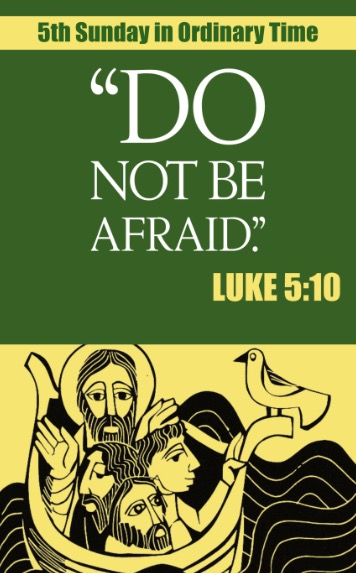
The Gospel of today’s Liturgy takes us to the banks of the Sea of Galilee. The crowd is gathering around Jesus, while some disappointed fishermen, among them, Simon Peter, are washing their nets after a night of fishing that had gone badly. And so it is that Jesus climbs into Simon’s boat; then he invites him to go out to sea and cast his nets again (cf. Lk 5:1-4). Let us pause on these two actions of Jesus: first he climbs into the boat and then, the second one, he invites him to put out to sea. It was a night that had gone badly, without fish, but Peter is trusting and puts out to sea.
First of all, Jesus gets into Simon’s boat. To do what? To teach. He asks for that very boat, which is not full of fish but rather has returned to the shore empty, after a night of toil and disillusionment. It is a beautiful image for us too. Every day the boat of our life leaves the shores of our home to sail out into the sea of daily activities; every day we try to “fish in the open sea”, to cultivate dreams, to pursue projects, to experience love in our relationships. But often, like Peter, we experience the “night of empty nets” — the night of empty nets — the disappointment of trying very hard and not seeing the desired results: “We toiled all night and took nothing” (v. 5), says Simon. How often, we too are left with a sense of defeat while disappointment and bitterness arise in our hearts. Two very dangerous seeds.
So what does the Lord do? He chooses to climb into our boat. He wants to proclaim the Gospel from there. It is precisely that empty boat, the symbol of our incapacity, that becomes Jesus’ “cathedra” , the pulpit from which he proclaims the Word. And this is what the Lord loves to do — the Lord is the Lord of surprises, of miracles in surprises — to climb into the boat of our lives when we have nothing to offer him; to enter our emptiness and fill it with his presence; to make use of our poverty to proclaim his richness, of our miseries to proclaim his mercy. Let us remember this: God does not want a cruise ship: a poor “ramshackle” boat is enough for him, as long as we welcome him. This yes, to welcome him; it does not matter on which boat, but to welcome him. But, I wonder, do we let him into the boat of our lives? Do we make available to him the little we have? Sometimes we feel unworthy of him because we are sinners. But this is an excuse that the Lord does not like, because it distances him from us! He is the God of closeness, of compassion, of tenderness, and he does not seek perfectionism: he seeks our welcome. He says to you too: “Let me get into the boat of your life”, “But Lord, look…” — “Like that, let me in, just as it is”. Let us think about this.
In this way, the Lord rebuilds Peter’s trust. When he climbs into the boat, after preaching, he says: “Put out into the deep” (v. 4). It was not a good time of the day for fishing, in broad daylight, but Peter trusts in Jesus. He does not base his trust on the strategies of fishermen, which he knows well, but rather he bases it on the newness of Jesus. That wonder that moved him to do what Jesus told him. It is the same for us too: if we welcome the Lord into our boat, we can put out to sea. With Jesus, we sail the sea of life without fear, without giving in to disappointment when one catches nothing, and without giving up and saying “there is nothing more that can be done”. Always, in personal life as well as in the life of the Church and society, there is something beautiful and courageous that can be done, always. We can always start over — the Lord always invites us to get back on our feet because he opens up new possibilities. So let us accept the invitation: let us chase away pessimism and mistrust, and put out to sea with Jesus! Our little empty boat, too, will witness a miraculous catch.
1. Introduction and Setting
– Discuss the setting of the Gospel story at the Sea of Galilee. How does the image of disappointed fishermen washing their nets relate to our own experiences of failure and disappointment?
– How do you interpret the significance of Jesus choosing Simon’s boat to preach from? What might this say about God’s presence in our lives, especially in times of emptiness or failure?
2. Jesus Climbing into the Boat
– Reflect on the symbolism of Jesus stepping into an empty boat. How can this image serve as a metaphor for our lives?
– The sermon mentions the “night of empty nets” experiences. Share personal stories where you felt a similar sense of defeat or unfulfilled desires. How did you respond to those situations?
3. Welcoming Jesus into Our Lives
– Discuss the idea that God does not need perfection but rather our openness. Why might we feel unworthy of letting Jesus into our lives, and how can we overcome these feelings?
– In what ways can we make space for Jesus in the “boat” of our lives today? What practical steps can be taken to be more welcoming and trusting?
4. Trust and Action
– Explore how Peter’s trust in Jesus led him to put out to sea at an unconventional time. What can we learn from Peter’s example about trusting and following God’s guidance, especially when it contradicts our own understanding or expectations?
– Identify areas in your life where you might need to cast your nets again. Discuss the challenges in doing so and how faith might play a role in overcoming these challenges.
5. Overcoming Pessimism and Embracing New Possibilities
– How does Jesus’ invitation to “put out into the deep” encourage us to break free from pessimism and mistrust? Share reflections on how faith can open up new opportunities and perspectives in seemingly hopeless situations.
– Discuss how this message can be applied to personal life challenges, within your community, and in society at large.
6. Conclusion and Reflection
– Summarize the key lessons from the sermon and how they can be integrated into daily living.
– End with a moment of personal or group reflection: What is one action step you will take this week to allow Jesus into your life and to “put out to sea” with renewed trust and courage?
This guide is designed to facilitate engaging and meaningful discussions, encouraging participants to reflect personally and collectively on the application of the sermon in their lives.
THIS SUNDAY’S
QUOTES
On the significance of the divine encounter:
“The vision of the divine that Isaiah experiences brings with it the realization of his own sin and that of his people. But even in the face of his unworthiness, the Lord purifies and equips him for his mission. So too, our encounters with God’s holiness can bring about a profound transformation, leading us to embrace our calling and serve a greater purpose.” (Pope Benedict XVI, Homily, 5th Sunday in Ordinary Time, Year C)
On the power of repentance and transformation:
“The purification of Isaiah’s lips with the burning ember symbolizes the transformative power of God’s grace in our lives. As Catholics, we are called to ongoing conversion and spiritual renewal, especially through the sacraments, which enable us to become faithful witnesses of Christ in the world.” (Pope Benedict XVI, Homily, 5th Sunday in Ordinary Time, Year C)
On answering the divine call:
“Isaiah’s prompt response to God’s call, ‘Here I am, send me,’ exemplifies the faith and obedience that characterized the first disciples in today’s Gospel. We, too, are invited to listen attentively to God’s voice and to embrace our unique vocations with courage and trust.” (Pope Benedict XVI, Homily, 5th Sunday in Ordinary Time, Year C)
Please note that the quotes provided may not be verbatim transcriptions of pope’s homilies but rather summaries of the main points and insights that he shared
Benedict XVI
5th Sunday of Year C

Call of First Disciples
10 February 2013 | Saint Peter’s Square
- TEXT
- DISCUSSION GUIDE
In today’s liturgy, the Gospel according to Luke presents the story of the call of the first disciples, with an original version that differs from that of the other two Synoptic Gospels, Matthew and Mark (cf. Mt 4: 18-22; Mk 1:16-20) . The call, in fact, was preceded by the teaching of Jesus to the crowd and a miraculous catch of fish, carried out by the will of the Lord (Lk 5:1-6). In fact, while the crowd rushes to the shore of Lake Gennesaret to hear Jesus, he sees Simon discouraged because he has caught nothing all night. First Jesus asks to get into Simon’s boat in order to preach to the people standing a short distance from the shore; then, having finished preaching, he commands Simon to go out into the deep with his friends and cast their nets (cf. v. 5). Simon obeys, and they catch an incredible amount of fish. In this way, the evangelist shows how the first disciples followed Jesus, trusting him, relying on his Word, all the while accompanied by miraculous signs. We note that, before this sign, Simon addresses Jesus, calling him “Master” (v. 5), while afterwards he addresses him as “Lord” (v. 7). This is the pedagogy of God’s call, which does not consider the quality of those who are chosen so much as their faith, like that of Simon that says: “At your word, I will let down the nets” (v. 5).
The image of the fish refers to the Church’s mission. St Augustine says in this regard, “Twice the disciples went out to fish at the Lord’s command: once before the Passion and the other time after the Resurrection. In the two scenes of fishing, the entire Church is depicted: the Church as it is now and as it will be after the resurrection of the dead. Now it gathers together a multitude, impossible to number, comprising the good and the bad; after the resurrection, it will include only the good” (Homily 248.1). The experience of Peter, certainly unique, is nonetheless representative of the call of every apostle of the Gospel, who must never be discouraged in proclaiming Christ to all men, even to the ends of the world. However, today’s text is a reflection on the vocation to the priesthood and the consecrated life. It is the work of God. The human person is not the author of his own vocation but responds to the divine call. Human weakness should not be afraid if God calls. It is necessary to have confidence in his strength, which acts in our poverty; we must rely more and more on the power of his mercy, which transforms and renews.
Dear brothers and sisters, may this Word of God revive in us and in our Christian communities courage, confidence and enthusiasm in proclaiming and witnessing to the Gospel. Do not let failures and difficulties lead to discouragement: it is our task to cast our nets in faith — the Lord will do the rest. We must trust, too, in the intercession of the Virgin Mary, the Queen of Apostles. Well aware of her own smallness, she answered the Lord’s call with total confidence: “Here I am”. With her maternal help, let us renew our willingness to follow Jesus, Master and Lord.
1. Context of the Passage
– Discuss how the story of the call of the first disciples in Luke differs from those in Matthew and Mark. What elements are unique in Luke’s account?
– Reflect on the significance of the miraculous catch of fish that precedes the call of the disciples.
2. The Symbolism of the Fishing Miracle
– What does the miraculous catch symbolize in terms of faith and trust in Jesus?
– Reflect on St. Augustine’s interpretation of the two fishing scenes representing the Church’s mission before and after the Resurrection.
Reflecting on God’s Call
3. The Call to Discipleship
– Discuss the transition in Simon’s understanding of Jesus, from “Master” to “Lord.” How does this reflect the deepening of his faith?
– Consider how the passage illustrates that God’s call prioritizes faith over ability. Why is this significant?
4. Application to Vocation and Ministry
– Discuss how this passage relates to vocations, particularly the priesthood and consecrated life. What encouragement does it offer?
– Reflect on the idea that human weakness should not deter one from answering God’s call. How does God’s strength manifest in our “poverty”?
Application to Modern Life
5. Mission and Evangelization
– How can this passage inspire us to overcome discouragement in proclaiming the Gospel in our own lives and communities?
– What role does faith play when facing challenges and setbacks?
6. The Role of Mary in Strengthening Faith
– Discuss how Mary’s response, “Here I am,” serves as a model of faith and trust. How can her intercession aid us in our journey?
– How can we emulate Mary’s willingness to follow God’s call without hesitation?
Closing
– Invite participants to share any personal reflections or experiences related to the themes of the study.
– Close with a prayer, asking for courage and confidence to trust in God’s call and to rely on His strength as we cast our nets in faith.