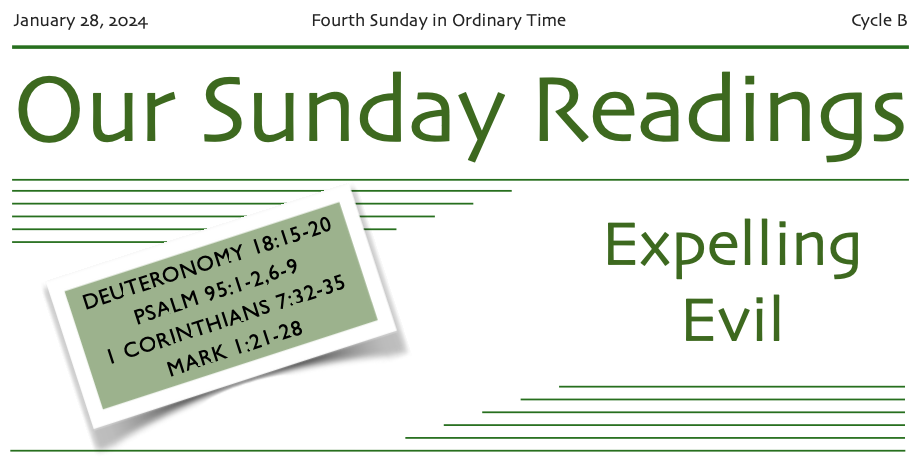
Jeff Cavins discusses the readings for the 4th Sunday in Ordinary Time Year B, emphasizing Jesus as the prophesied authority figure from Deuteronomy 18. He highlights Jesus' unique teaching style, which differed from contemporary rabbis, as Jesus spoke with personal authority, as the Word of God itself. Cavins connects this with the Gospel reading from Mark, where Jesus demonstrates authority over unclean spirits. He concludes with a reference to Paul's advice in 1 Corinthians about undivided devotion, urging listeners to give their full attention to Jesus' teachings, particularly during Mass, honoring Him as the authoritative prophet promised in the Old Testament.
Ancient people believed a face-to-face encounter with God would be overpowering, even deadly. So they welcomed the idea that a prophet, a single human being, could bear the brunt of that encounter for them. They did not always welcome what the prophet had to report from God. (Greg Warnusz)
OUTLINE
I. God promises to raise up a prophet like Moses from among the Israelites. II. This prophet will speak God's words and the people must listen to him. III. God will hold accountable anyone who does not listen to the prophet. IV. False prophets who speak in God's name without authorization will be punished. V. The test for a true prophet is whether their words come true.
What Happens Before
Deuteronomy 18 comes in the middle of a series of speeches given by Moses to the Israelites before they enter the Promised Land. This speech in particular is a reminder to the Israelites to not engage in the pagan practices of the nations around them.
Verse 1 of Deuteronomy 18 sets the context for the entire chapter. It says, The Levitical priests—all the tribe of Levi—shall have no inheritance with Israel; they shall eat the offerings of the LORD made by fire, and His portion. This verse is talking about the role of the priests, who were not given land or inheritance like the other tribes, but instead were to rely on God for their provision through the offerings given to the Lord. This sets the stage for the importance of following Gods laws, as they were the means by which the priests could provide for themselves.
Before the passage in question (Deuteronomy 18:15-20), Moses gives instructions for dealing with false prophets. He warns the Israelites not to follow any prophets who speak in the name of other gods, or who give false prophecies. The punishment for false prophets was death, serving as a strong warning for the Israelites to not be led astray by false teachings.
What Happens After
After the passage in question, in verses 21-22, Moses clarifies how the Israelites can discern a true prophet from a false one. He explains that a true prophet will only speak what God has commanded them to say, while a false prophet will speak in the name of other gods or give false prophecies. This serves as further reinforcement of the importance of following Gods laws and commandments.
Historical Context
At the time of Moses speech, the Israelites were on the brink of entering the Promised Land. They had been wandering in the desert for 40 years, and Moses role was to remind them of Gods laws and prepare them for their new life as a settled nation.
Cultural Context
The Israelites were surrounded by nations who often practiced divination and sorcery, seeking guidance and wisdom from other gods. These practices were strictly forbidden by God and were seen as a threat to the Israelites relationship with Him. In contrast, God promised to raise up prophets from among the Israelites to guide and speak on His behalf.
In verse 16, Moses also mentions the practice of divination, specifically through the use of throwing lots or casting spells. This was a common practice in ancient cultures for seeking guidance from the gods, but the Israelites were forbidden from engaging in these practices. Instead, they were to rely solely on God and His chosen prophets.
SOURCE: Content written in collaboration with OpenAI's GPT-3.5 model.
2nd Reading: 1 Corinthians 7:32-35
Saint Paul continues his teachings about how to be prepared for the imminent return of Jesus in glory. That coming should make people put their priorities in order.(Greg Warnusz)
OUTLINE
I. Paul advises that the unmarried devote themselves to the Lord's work. II. The married should prioritize their spouse's needs. III. An unmarried person is concerned about the things of the Lord. IV. A married person is concerned about the things of the world. V. Paul desires to spare believers from worldly anxieties and distractions.
What Happens Before
In the verses immediately preceding 1 Corinthians 7:32-35, Paul addresses various topics related to marriage and singleness. He encourages those who are married to stay married and those who are single to remain single, with the understanding that both states of life can bring about opportunities to serve and honor the Lord. Paul emphasizes that those who are single have a greater opportunity to focus on serving the Lord without the distractions of caring for a spouse or family.
What Happens After
After 1 Corinthians 7:32-35, Paul continues to address the topic of marriage, specifically emphasizing the temporary nature of marriage in light of the coming kingdom of God. He also addresses issues related to food sacrificed to idols and the role of spiritual gifts within the church. Overall, Pauls message is one of unity and selflessness, encouraging believers to use their freedom in Christ to glorify God and serve others.
Historical Context
In Greco-Roman culture, marriage was seen as a duty and expected of all adults. However, Corinth was known for its loose sexual morality, and extramarital affairs were commonplace. Therefore, Pauls instruction promoting singleness as a viable option for believers would have been counter-cultural and perhaps even shocking to the Corinthians.
Cultural Context
During this time, there was a strong emphasis on asceticism and celibacy in certain philosophical and religious circles. This could have influenced how some believers in Corinth viewed marriage and singleness. Additionally, the practice of arranged marriages was common, and marriage was often seen as a way to secure status and financial stability. However, Paul challenges this cultural mindset by emphasizing the spiritual benefits and opportunities for service that come with remaining single.
SOURCE: Content written in collaboration with OpenAI's GPT-3.5 model.
Gospel: Mk 1:21-28
This gospel recalls a time when people questioned Jesus' authority and right to teach, because of his modest origins.(Greg Warnusz)
OUTLINE
I. Jesus goes to the synagogue in Capernaum on the Sabbath. II. Jesus teaches with authority, astonishing the people. III. A man possessed by an evil spirit cries out, recognizing Jesus as the Holy One of God. IV. Jesus rebukes the spirit and casts it out. V. Everyone is amazed by Jesus' power and authority.
What Happens Before
The preceding verses (1:14-20) describe Jesus calling his first disciples, Simon, Andrew, James and John, and their initial interactions with him.
What Happens After
The following verses (1:29-45) recount Jesus healing of many people and his increasing popularity among the crowds.blic ministry by calling his first disciples.
Historical Context
In terms of historical context, this passage takes place in the region of Galilee, in the northern part of Israel, during the first century. At this time, Israel was under Roman occupation and there was a strong expectation for a messianic figure who would free the Jewish people from oppression. In this context, Jesus proclamation of the kingdom of God would have been a radical and controversial message.
Cultural Context
Culturally, the setting of this passage is a Jewish synagogue, where Jesus is teaching. Synagogues were the primary gathering places for Jews to worship and study the Torah, and they were typically led by a rabbi or teacher. As such, Jesus teaching in the synagogue would have been expected.
However, what was not expected was the dramatic demonstration of Jesus authority that followed. A man with an unclean spirit, believed to be a demonic force, enters the synagogue and disrupts the gathering. This would have been alarming and frightening to those present, as the Jewish understanding of unclean spirits was associated with sickness and madness. It was believed that only a powerful prophet or a messianic figure could have authority over such spirits.
In this context, Jesus exorcism of the unclean spirit and his teaching with authority would have been seen as a manifestation of his power and authority. The crowds were amazed and began to spread the news of these events, leading to Jesus growing fame throughout the region.
SOURCE: Content written in collaboration with OpenAI's GPT-3.5 model.
Explanation: As soon as Jesus entered the synagogue, the people were astonished at his teaching. They could sense a difference between Jesus words and the teachings of the scribes. The scribes were well-educated and knowledgeable in the law, but they did not have the authority that Jesus possessed. Jesus authority came from his divine nature as the Son of God.
Illustration: Think of a time when you have come across someone who spoke with incredible authority. How did you feel in their presence? Did you listen to and respect their words? Now imagine being in the presence of Jesus, who not only spoke with authority but also had the power to back up his words with actions.
Application: As Catholics, we have the words of Jesus in SCRIPTURE and the authority of the Holy Spirit in the MAGISTERIUM guiding us. The Church’s teaching authority is not to be taken lightly, and we should strive to live according to its teachings.
Main Point 2: The Authority of Jesus Over Evil
Explanation: In the synagogue, Jesus encountered a man with an unclean spirit. This spirit recognized Jesus as the Holy One of God and was afraid of him. Jesus commanded the unclean spirit to leave the man, and it obeyed. This demonstrates Jesus authority over evil and his power to drive it out.
Illustration: Imagine being in the midst of a situation where you feel helpless and oppressed by evil forces. Now imagine standing in front of Jesus, who has the power and authority to cast out that evil. How would you feel?
Application: We all face challenges and temptations in our lives that come from the evil one. But we must remember that Jesus and his SACRAMENTS are the ultimate authority over evil. We can turn to him in the sacraments for strength and protection, knowing that his presence is greater than any darkness we may face.
Main Point 3: The Authority of Jesus Spreading
Explanation: After witnessing Jesus authority over teaching and evil, the peoples amazement spread. His fame spread throughout the region of Galilee, and many began to believe in him. Jesus authority was not limited to his immediate presence but continued to spread to those who heard of his deeds.
Illustration: Think of a powerful leader or figure who has influenced not only their immediate community but also the world. Jesus authority has spread far and wide, impacting the lives of countless individuals throughout history.
Application: As believers, we are called to spread the authority of Jesus through our words and actions. By sharing the good news of Jesus authority in our lives, we can allow others to experience the transformative power of his love and grace.
Reference: NABRE (New American Bible, Revised Edition) Bible, USCCB (United States Conference of Catholic Bishops)
Moses predicts to the Israelites about to enter the Promised Land that there will someday arise after him a prophet like himself. What are the characteristics of this prophet, and how do they find their fulfillment in Jesus?
GOSPEL
Where did Jesus begin his public ministry? What two things about Jesus amazed the people?
How do imagine this scene unfolded? Was the demoniac part of the congregation, or did he burst in from the outside? What do you think was the reaction of the rest of the congregation: Compassion? Embarrassment? Anger? What would your reaction be?
What does it mean to teach “as one having authority” (verse 22)? What was the source of Jesus’ authority (see John 5:19-24)?
Did Jesus heal every person in Israel at that time, or even in every city he visited during his earthly ministry? Why do you think that Jesus healed the people that he did?
On a scale of 1 to 10, how much authority does Jesus have over your life?
1. Does God raise ordinary people from our midst to become prophets? Is there a cause for which you might become a prophet?
SECOND READING
2. What are the anxieties you feel most? Do you have a way to deal with them? What virtue do you think might help most in your attempts to control anxieties?
GOSPEL
3. Jesus “taught them as one having authority and not as the scribes.” Was there an incident that confirmed Jesus’ teaching and showed people its authenticity? If you can’t have absolute confirmation, as they did, will trust work for you? Explain.
1. What authority does the word of God have in your parish? Does it have first priority, second priority, or none at all? What could give the word of God more authority? What can you and your family (or group) do to grant more authority to the word of God? How can you enhance the word of the Gospel so that people will recognize it as the word of Christ who speaks through the Church?
2. What authority do the teachings of the Church (or doctrine) have in your life? Do you recognize the infallible teachings of the Church as coming from Christ himself? Do you recognize the teachings of the catechism as the official teachings of the Church? How do you distinguish between infallible teachings and everything else in the catechism? (If you don’t know the answer, ask the parish priest or the catechetical leader in your parish.)
3. Have you prayed over the word of God and over Church teachings, asking God to grant you discernment and understanding? Has prayer ever helped you to know what God wants from you? Do you think that God will leave you in the dark as to what his will is for you?