
Study | Preach | Teach
Bible Study
Bible Study
Matt Zemanek


SOURCE: St. Timothy Catholic Church, Laguna Niguel, CA
The Feast of Corpus Christi celebrates the gift of the Eucharist as a symbol of the new covenant relationship with God, and the importance of consuming the body and blood of Christ for eternal life.
- 00:00 The Feast of Corpus Christi celebrates the body and blood of Christ, originating from visions in the 13th century and established as a worldwide solemnity by Pope Urban IV with the assistance of St. Thomas Aquinas.
- Join the weekly Bible study at St Timothy Catholic Church and engage with the community online by liking, commenting, and subscribing to the channel.
- The upcoming Sunday is the Feast of Corpus Christi, a celebration of the body and blood of Christ, which originated from visions of Jesus appearing to Juliana of lege in the 13th century and was later established as a worldwide solemnity by Pope Urban IV with the assistance of St. Thomas Aquinas.
- Jesus celebrates the Last Supper with his disciples, instructing them to prepare for the Passover and then sharing bread and wine with them, symbolizing his body and blood.
- Jesus speaks to his disciples, sharing bread and wine as symbols of his body and blood, and instructs them to prepare for the Passover.
- Jesus speaks about the shedding of his blood and the establishment of the new covenant, and the passage also references the Passover feast.
- The significance of the unblemished lamb sacrifice in the Old Testament and its symbolism of deliverance and separation from Egypt.
- 11:44 Jesus transforms the Passover meal, foreshadowing the Last Supper and his crucifixion, and institutes a new covenant symbolizing deliverance from sin.
- The Feast of Passover was turned into an annual pilgrimage to Jerusalem to remember God's deliverance from slavery and death in Egypt and the fulfillment of the Covenant with Abraham.
- The Feast of Passover in Jerusalem was a pilgrimage with up to 2 million people, and Jesus, being a faithful Jew, observed it three times during his ministry.
- The youngest person asks the oldest person about the significance of the meal, and the oldest person recounts the story of the Hebrew people being delivered from slavery in Egypt through a series of meals and cups of wine.
- Jesus changes the words of the Passover meal, indicating something different is happening, and then abruptly ends the Passover, foreshadowing the Last Supper and his crucifixion.
- Jesus institutes a new Passover, where we consume him as the lamb, symbolizing deliverance from the slavery of sin.
- God is instituting a New Covenant with the Hebrew people, marked by sacrifices and the sprinkling of blood.
- 17:56 God promises a New Covenant fulfilled in the gift of the Eucharist, symbolizing the new covenant relationship with God and Jesus offering his own blood as a sacrifice to reconcile humanity with divinity.
- God promises a New Covenant with His people, where His law will dwell within them, fulfilled in the gift of the Eucharist.
- The celebration of Corpus Christi is a recognition of the new covenant relationship with God, symbolized by the exchange of persons and the self-offering and self-gift in marriage.
- To reconcile us with God, Jesus offers his own blood as a sacrifice to bridge the gap between humanity and divinity.
- The speaker highlights the significance of a specific verse in the context of the Most Holy Body and Blood of Christ.
- Blood was forbidden in the Old Testament because it represented loss of life, but Jesus prefigured the consumption of his blood in John chapter 6.
- 22:51 Jesus emphasizes the importance of consuming his body and blood for eternal life, blesses us in unexpected ways, and gave his body and blood as a sacrifice for us.
- Jesus emphasizes the importance of consuming his body and blood for eternal life, and reveals this to his disciples after they have already partaken.
- Jesus blesses us in unexpected ways, fulfills his promises, and desires to save us from sin and give us new life, even if it's not in the ways we expect.
- Prepare your life for the Lord to come in and work, declutter and make space for substantial things.
- Jesus gave his body and blood as a sacrifice, and every time we attend Mass, we are participating in the memorial service of his sacrifice.
- 27:15 Jesus refused wine during suffering, Last Supper preparation, John Mark's house, naked man in Gethsemane, Feast of Unleavened Bread, pilgrimage feasts linked to desert time.
- Jesus refused to drink wine during his suffering because he didn't want his pain lessened, and it may have been because there was more left to do before entering the kingdom.
- The speaker discusses the preparation for the Last Supper and the tradition surrounding it.
- Early church tradition suggests that the house of John Mark's mother in Jerusalem may have been the place where Jesus and his followers gathered, and while John Mark was not a long-time follower of Jesus, he may have had knowledge of him.
- The detail of the naked man in the Garden of Gethsemane in the Gospel of Mark may symbolize new life and initiation into following Jesus.
- The Feast of Unleavened Bread was originally separate from Passover but became linked to it, and it was a week-long feast where the first fruits of the wheat harvest were offered to the Lord.
- The pilgrimage feasts were closely linked to the time in the desert, serving as reminders of God's provision and leading to the Promised Land.
- 33:26 The blessing of bread and wine in the Mass is the same as the communion offering referenced in Exodus 24, and receiving the consecrated bread alone is the same as receiving the body, blood, soul, and Divinity of Jesus.
- Jesus is ushering in something new in the kingdom of God, indicating a change from the traditional Passover.
- The blessing of bread and wine in the Mass is the same as the communion offering referenced in Exodus 24, and the prayer Jesus prays in The Chosen is the same as the one said at Mass.
- The bread and wine in the Catholic mass are ancient Jewish prayers of consecration, and in the Latin church, they are considered to be the whole body and blood of Christ.
- Receiving the consecrated bread alone is the same as receiving the body, blood, soul, and Divinity of Jesus.
- During the Eucharistic prayer, the priest breaks off a piece of the precious body and drops it into the precious blood to signify the union between the body and blood under both species, so if you see a little chunk of the bread in your wine, don't freak out.
- 38:35 God made covenants with us, but we broke them all, so he came as Jesus Christ to bridge the gap caused by sin, and through him, we have the opportunity to restore our relationship with God through confession.
- The speaker explains that in the Old Testament, the Jewish people did not have a conception of Jesus, but God revealed himself to them in different supernatural ways and made a series of covenants with them.
- God made covenants with us, but we broke them all, so he had to come in human form as Jesus Christ to bridge the gap caused by sin.
- Consequences of not following God's law always come true, despite people's promises to obey.
- God remains faithful to his covenant with the Hebrew people, and through Jesus Christ, we have the opportunity to restore our relationship with him through confession.
- No matter the circumstances, recognize the profound gift of the Eucharist and don't let complaints affect your perception of Jesus' presence.
- Focus on the presence of Jesus during mass and worship with utmost excellence and participation.
- 43:48 Fully devote ourselves in preparation for receiving Jesus, focusing on entering into reverence and devotion, reconciling with others, and reflecting on the sacrifice Jesus made for us.
- Fully devote ourselves in preparation for receiving Jesus, building anticipation and yearning for his presence, just as we would for a loved one, and striving to keep our "house" in good condition.
- The Eucharist allows us to receive the person of Jesus and focus on entering fully into reverence and devotion, despite any shortcomings in the celebration of Mass.
- Belief in Jesus does not guarantee a great life, as suffering is a part of the human experience, but through suffering, God can redeem and transform it into something better.
- It's important to reconcile with others and with God before receiving the Eucharist, and the Mass is designed to help us do that through the confidor and the sign of Peace.
- Prepare ourselves for receiving Jesus in the Eucharist and reflect on our readiness to invite him into our lives.
- The Eucharist is a reminder of the sacrifice Jesus made for us, and we should not overlook its eternal significance and cosmic reality.
Fr. Geoffrey Plant

SOURCE: Fr. Geoffrey Plant’s Archives

SOURCE: Fr. Geoffrey Plant’s Archives
The Eucharist is not just a symbol, but a sacrament that embodies the reality of Christ’s body and blood, inviting believers to participate in the mystery of Jesus’ saving death and renew their commitment to the new covenant.
- 00:00 The homily discusses the significance of the Body and Blood of Christ, as described in the readings, and the command to partake in the Eucharist in remembrance of Jesus.
- The homily discusses the significance of the Body and Blood of Christ, as described in the readings from Exodus, Hebrews, and Mark.
- St. Paul and St. Luke both recount Jesus instructing his disciples to partake in the Eucharist in remembrance of him, a command the Church has followed for 2000 years.
- The consecrated bread and wine are referred to as the Body and Blood of Christ, Holy Communion, the Eucharist, and the Blessed Sacrament, signifying the oneness with Jesus and the act of giving thanks.
- 04:04 The word "sacrament" comes from Latin "sacramentum" and was used by early Christians for rituals like Baptism, Confirmation, and Eucharist, while "mystery" comes from Greek and refers to a place of silence or speechlessness.
- The word "sacrament" comes from the Latin word "sacramentum" which referred to the sacred oath that a Roman soldier took, and Christians in the early Church used this term to refer to the rituals of initiation such as Baptism, Confirmation, and Eucharist.
- Christian usage of the word "sacramentum" expanded and then became more restricted, eventually being applied only to the seven church rituals known as the seven sacraments.
- The word "mystery" comes from the Greek verb meaning to shut the mouth or eyes, and refers to a place of silence or speechlessness.
- 08:35 The Body and Blood of Christ are more than just symbols, they embody the reality they represent, reminding us that appearances can be deceiving.
- The Body and Blood of Christ as a sacrament goes beyond the meaning of both sign and symbol, as they are effective signs that convey information and have intrinsic power.
- Water and wedding rings are symbols of life and love, but the Body and Blood of Christ actually embody the reality they symbolize.
- Things are not always what they seem, as appearance does not necessarily reflect reality.
- 12:38 The Eucharist undergoes transubstantiation, maintaining the appearance of bread and wine while becoming the body and blood of Christ, inviting religious experiences and manifestations of the sacred.
- The church uses the term transubstantiation to explain how the consecrated bread and wine becomes the body and blood of Christ while still retaining the physical properties of bread and wine, with theologians in the 13th century adopting the Aristotelean categories of substance and accidents to explain this concept.
- The Eucharist maintains the appearance of bread and wine, but according to the Council of Trent, the substance is changed into Christ's body and blood.
- Sacraments are considered "doors to the sacred" and invite religious experiences, with hierophanies being manifestations of the sacred.
- The Eucharist is an ineffable experience that cannot be fully explained in words, but that doesn't mean we shouldn't try to understand the presence of Christ in the Blessed Sacrament.
- 19:08 Christ's perfect sacrifice is contrasted with the high priest's yearly sacrifice, and the significance of the Holy of Holies in relation to the Day of Atonement is explained.
- The author contrasts the yearly sacrifice of the high priest with Christ's perfect sacrifice of his own blood.
- The layout of the Tent of Meeting and the significance of the Holy of Holies in relation to the Day of Atonement and the high priest's role is explained.
- 21:20 Jesus becomes both the priest and the sacrifice, offering his own blood as a perfect, once-for-all sacrifice, absorbing and transforming the filth of the world in his Passion.
- The high priest offered a bull as a sacrifice for his own sinfulness and for that of his ‘house’, then he entered behind the veil to incense the mercy-seat and to sprinkle it with the bull’s blood, and Pope Benedict explains the significance of this sprinkling of blood.
- Jesus becomes both the priest offering the sacrifice and the sacrifice itself, offering his own blood as a perfect, final, once-for-all sacrifice that never needs to be repeated.
- In Jesus' Passion, the pure one absorbs and transforms the filth of the world, as seen in Mark's account of the institution of the Eucharist.
- 25:22 Jesus's choice of Passover for his death and the symbolism of the Passover meal in relation to his blood and the new covenant, capturing the heart of Israel's religious beliefs and God's covenant with his people at Mt Sinai.
- The significance of Jesus choosing Passover as the time of his death and the symbolism of the Passover meal in relation to his blood and the new covenant.
- A covenant is a formal contract between two parties, with mutual promises and obligations, and it captures the heart of Israel's religious beliefs.
- God makes a covenant with his people at Mt Sinai, symbolized by an altar and twelve standing stones, with Moses directing young Israelites to offer sacrifices to the Lord.
- 29:54 When we celebrate the Eucharist, we participate in the mystery of Jesus' saving death and renew our commitment to the new covenant established through his blood.
- Blood is a symbol of life and a covenant with God, as seen in the ancient ritual of casting blood on the altar and people to create a union.
- During the Last Supper, Jesus establishes a new covenant through his blood, and when we celebrate the Eucharist, we participate in the mystery of his saving death and resurrection and renew our commitment to this covenant.
Fr. Bryan Kujawa
SOURCE: Fr. Bryan Kujawa’s Archives. Switch videos using icon in the upper right corner.

SOURCE: Fr. Bryan Kujawa’s Archives Switch videos using icon in the upper right corner.
Fr. Paul Galetto, OSA

SOURCE: YouTube Video Playlist

SOURCE: YouTube Video Playlist
The Feast of Corpus Christi is a celebration of the New Covenant established by Jesus, and the importance of gathering to renew this covenant through the breaking of bread and drinking from the cup.
- 00:00 The Feast of Corpus Christi is discussed in the context of the Mosaic Covenant, which involved a meal and sacrifice to bind the people with God.
- 01:21 Moses completes the Covenant between the people and God by sprinkling blood on the altar and the people, which is why reverence is directed towards the altar during mass.
- 02:06 Jesus uses the words of the Covenant in the making of the New Testament.
- 02:28 The letter compares Jewish rituals to the sacrifice of Jesus, stating that Jesus is both the priest and the sacrifice, and his blood is the most effective for forgiveness of sins.
- 03:07 Jesus entered the sanctuary with his own blood, as the mediator of the New Covenant, to take away all our sins, and the Last Supper is depicted in Mark's gospel.
- 03:30 The speaker discusses the city of Corpus Christi in Texas.
- 03:31 Jesus used the words of the Covenant language to establish the New Covenant, which is why we gather every Sunday to renew it through the breaking of bread and drinking from the cup
Keith Nester
SOURCE: YouTube Video Playlist

SOURCE: YouTube Video Playlist
The Solemnity of the Most Holy Body and Blood of Christ is a significant celebration that emphasizes the fulfillment of the covenant between God and his people through Jesus’ body and blood, calling believers to love the Lord with all their heart, soul, mind, and strength.
- 00:00 The speaker discusses the significance of the Solemnity of the Most Holy Body and Blood of Christ, emphasizing its impact on faith and the importance of covenants.
- The speaker discusses the significance of the Solemnity of the Most Holy Body and Blood of Christ and the impact of Eucharistic processions in bearing witness to the faith.
- The speaker discusses upcoming travel opportunities and invites viewers to join them on an exciting trip.
- The speaker discusses the significance of the body and blood of Christ in reconciling and cleansing believers, and emphasizes the importance of remembering the Covenant made through them.
- A covenant is not a contract, but an exchange of persons.
- Marriage and faith are not contracts, but covenants where both parties give 100%, as exemplified by the solemnity of the body and blood of Christ.
- 05:39 The covenant between God and his people is fulfilled in the New Covenant of Jesus' body and blood, calling us to love the Lord with all our heart, soul, mind, and strength.
- The covenant between God and his people is made in blood, symbolizing the most valuable thing on Earth, which is life.
- Leviticus 1711 points to Jesus offering his body and blood for the remission of sins, fulfilling the prophecy in Genesis 3:15.
- The people of Israel fell into the trap of rule-keeping and contract-making, focusing on obedience to commands rather than loving God, prefiguring the New Covenant.
- We are not made righteous by the works of the law, but by the New Covenant in the blood and body of Jesus Christ, which calls us to love the Lord with all our heart, soul, mind, and strength.
- The Israelites repeatedly turned away from the Lord and pursued earthly kings and false gods, leading to punishment and the need for God to intervene.
- 11:12 Obedience without love leads to falling away, the purpose of the law is to point towards the gospel, and Gentile believers are grafted into the Covenant with the knowledge that all of Israel will be saved through Jesus Christ.
- Obedience without love and a covenant relationship with God leads to becoming a rule breaker and ultimately falling away, as God desires a covenant relationship, not just obedience to rules.
- The purpose of the law in the Old Testament was to point towards the gospel and show us our transgressions, leading us to realize our disobedience and the need for redemption.
- The Covenant is made with the people as a whole, symbolizing their participation as a nation, and as Gentile believers, we are grafted into this Covenant with the knowledge that one day all of Israel will be saved through Jesus Christ.
- 14:37 Jesus, as the high priest, entered the holy place with his own blood to secure eternal redemption and mediate a new covenant, as explained in St. Paul's writings.
- The idea of the Lamb of God is connected to the responsorial Psalm 116 and the concept of Salvation.
- Jesus, as the high priest, entered the holy place with his own blood to secure eternal redemption, purifying the conscience and mediating a new covenant.
- Jesus Christ, as the mediator and high priest, enters the actual holy of holies in heaven with his own blood, offering a sacrifice once and for all for reconciliation and forgiveness.
- The power of the mass lies in being sprinkled with the blood of Christ, who is the mediator of the New Covenant, as explained in St. Paul's writings.
- 19:11 The mass represents the blood of the Covenant and the Eucharist is the recognition of the transcendent reality of Jesus Christ in heaven, as Christ offers his body and blood to the apostles at the Last Supper before his sacrifice.
- The writer of Hebrews explains Jesus' actions at the Last Supper, as described in Mark 14, where Jesus instructs his disciples to prepare for the Passover.
- The mass represents the blood of the Covenant and the Eucharist is the recognition of the transcendent reality of Jesus Christ in heaven.
- Christ offers his body and blood to the apostles at the Last Supper before his sacrifice, and we participate in the same sacrifice at mass, as it becomes manifest to us.
- The Israelites are spared from the plague of the angel of death by applying the blood of a lamb to their doorposts and eating it.
- 23:11 Eating and drinking the flesh and blood of Jesus is how we enter into the Covenant, recognizing the significance of the body and blood of Christ in the Eucharist.
- Jesus is referred to as the Lamb of God, who has become our Passover sacrifice, setting us free from sin and offering himself to us in the mass.
- Eating and drinking the flesh and blood of Jesus is how we enter into the Covenant, which is not dependent on us but on him, and our role is to receive what he has done and give ourselves to him in return.
- Many people approach their faith as a contract, but it should be about living out one's identity as a member of the family of God.
- Recognize the significance of the body and blood of Christ in the Eucharist, and receive it with faith and love, not as mere symbols or for self-righteousness.
- 27:39 Receive the sacrament of Christ's body and blood by faith, understanding it as a miracle of God, and bring a revival of belief in the true presence of Jesus Christ.
- Receive the sacrament of Christ's body and blood by faith, understanding it as a miracle of God, and bring a revival of belief in the true presence of Jesus Christ.
- The Eucharist is a renewal of your Covenant with God, so give yourself to God as he has given himself to you, and engage in the worship experience with sincerity and passion.
- Recognizing that God has given himself for you and that you belong to him changes your perspective on life and work.
- Approach your faith with a covenant mindset, sanctifying every part of your life for God, rather than treating it as a checklist of tasks to complete.
- 32:03 Celebrating the most holy body and blood of Jesus Christ, thank you for joining and supporting the ministry.

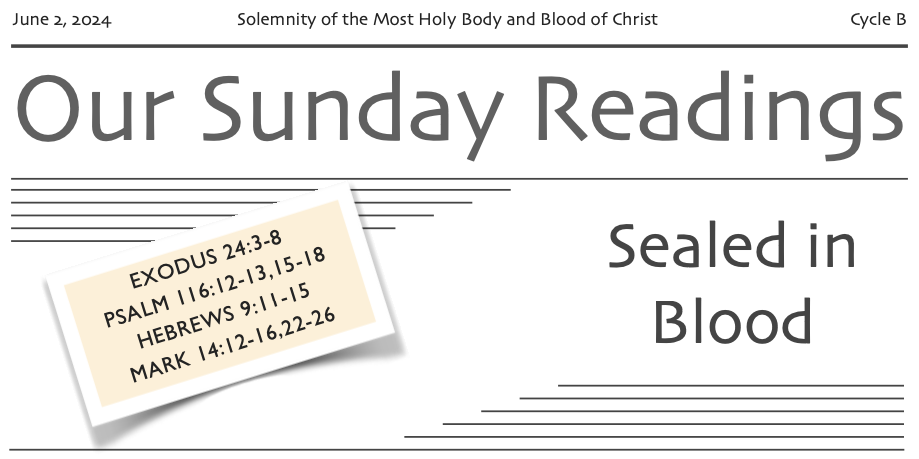

SOURCE: Cycle B Index
1st Reading: Ratifying the Covenant
2nd Reading: The Eternal Sacrifice
Gospel: Reflection on the Eucharist

Sharing in the life of Christ in the
Blood of the Covenant
Body and Blood of Christ
All the readings for this Solemnity are in the context of blood sacrifice and the Old Covenant feasts of Passover and Unleavened Bread.
The Ratification of the Sinai Covenant
The First Reading recalls the covenant ratification ceremony at Mt. Sinai after the first Passover in Egypt led to the children of Israel's liberation from slavery. In the Bible, covenant ratification ceremonies included oath swearing, sacrifice, and a sacred meal. At Sinai, the Israelites swore their allegiance to obey Yahweh's commands (Ex 24:3). They offered animals in communion sacrifices followed by sprinkling the animal's blood on the altar of sacrifice (representing God), repeating the oath of obedience, and then sprinkling the remaining blood on the people (Ex 24:5-8). Sprinkling the sacrificial blood on the altar and the people united the Israelites to God as one covenant family, sharing "one blood" like all families. Then there was a sacred communion meal of peace and thanksgiving in the presence of God that sealed the covenant (Ex 24:9-11). The name for the communion meal is Toda (Todah), meaning "thanksgiving" in Hebrew. The same elements are part of our New Covenant commitment. In the Mass, we swear an oath of allegiance to the Most Holy Trinity in our profession of faith. Then, Jesus transforms our offerings of bread and wine to become His Body and Blood and our sacrifice. Finally, we complete the covenant ceremony by eating the sacred communion meal of His Body and Blood in the Eucharist (a transliteration of Eucharistia, "thanksgiving," in Greek), the New Covenant communion Toda, in the Divine Presence of the Most Holy Trinity.
Michal E Hunt, Copyright © 2014; revised 2023 Agape Bible Study; used with permission
Jesus is the High Priest and Mediator of the New and Eternal Covenant
In the Second Reading, St. Paul writes about Jesus's role as the New Covenant High Priest in the heavenly Temple. As our New Covenant High Priest, He does not offer the blood sacrifice of bulls or goats like the Jewish high priests of the Sinai Covenant. Instead, He provides His precious Blood to ratify the New Covenant of God with a "new Israel," God's people of the Universal Church of Christ's eternal Kingdom (CCC 877).
Michal E Hunt, Copyright © 2014; revised 2023 Agape Bible Study; used with permission
The Sacred Meal of the Last Supper
The Gospel reading recalls the events on the night Jesus and His disciples ate the Passover victim in the sacred feast of the Last Supper. At the meal, Jesus repeated Moses' words at the ratification ceremony at Mt. Sinai (Ex 24:8) as He offered "the blood of the covenant" and passed the cup of His Precious Blood, becoming the covenant mediator of a new and eternal covenant promised by the prophet Jeremiah (Heb 9:13-15; Jer 31:31; 32:40; 50:5). Our sacred meal of the Eucharist not only looks back to Jesus's Last Supper, but it also looks forward in time. At every Eucharistic meal, the faithful look forward to eternal life in the Presence of the Most Holy Trinity and the communion of Saints in the heavenly banquet of the Wedding Supper of the Lamb and His Bride, the Church (Rev 19:6-9).
Michal E Hunt, Copyright © 2014; revised 2023 Agape Bible Study; used with permission

Discussion Questions
Body and Blood of Christ
- Read the other, parallel, accounts of the Last Supper found in the New Testament (Matthew 26:26-28; Luke 22:17-20; 1 Corinthians 11:23-26). What other interesting and enlightening details about the institution of the Eucharist do you find there?
- Why would secrecy be needed as this meal was planned? What risk was involved?
- How does the Last Supper relate to the Passover (see Exodus 12)? To this Sunday’s first reading
(Exodus 24:3-8)? - What new meaning does Jesus give to the unleavened Passover bread (see John 6:51-58)? The wine?
- How much do you think the disciples understood when Jesus spoke about his Body and Blood? What might they have been thinking? How would you have felt had you been there?
- What is your focus when you receive Holy Communion? What should it be?
In words identical to those he uses when he multiplied the loaves and fed the 5000 (Mark 6:41, CCC 1335), Jesus accomplishes three things: (1) He changes the Passover bread and wine into his Body
and Blood—the same Body and Blood that will be sacrificed for the sins of the world on the Cross. (2) Since a sacrifice requires priests, he establishes the priesthood. His apostles, and their successors the bishops, will comprise that priesthood. (3) He establishes the Holy Eucharist, so that in receiving Communion his people for all time and places may participate in his once-for-all sacrifice until he
comes again in glory
SOURCE: SundayScriptureStudy.com / used with permission