September 14, 2025
September 14, 2025


Featured Videos Homilies
Featured Videos Homilies
Bishop Robert Barron

Exaltation of the Holy Cross

Why was the Cross
Necessary?
The cross of Jesus was a necessary act of love, through which God invaded humanity’s darkest places to offer salvation, restore right order and harmony, and share His divine life with humanity.

Click to enlarge
Discussion Questions:
- How does thinking of the cross as a "journey" of love change your perspective, compared to seeing it as a "payment" for sin?
- The text says the "hound of heaven had to hunt us down even in the darkest places." What are some modern-day examples of "the muck" or the "darkest places" where people feel alienated or hopeless?
- What does it mean to you that because of Jesus, "God is present to death" and "God became sin on the cross"? Is this idea comforting or challenging? Why?
Click to enlarge
Discussion Questions:
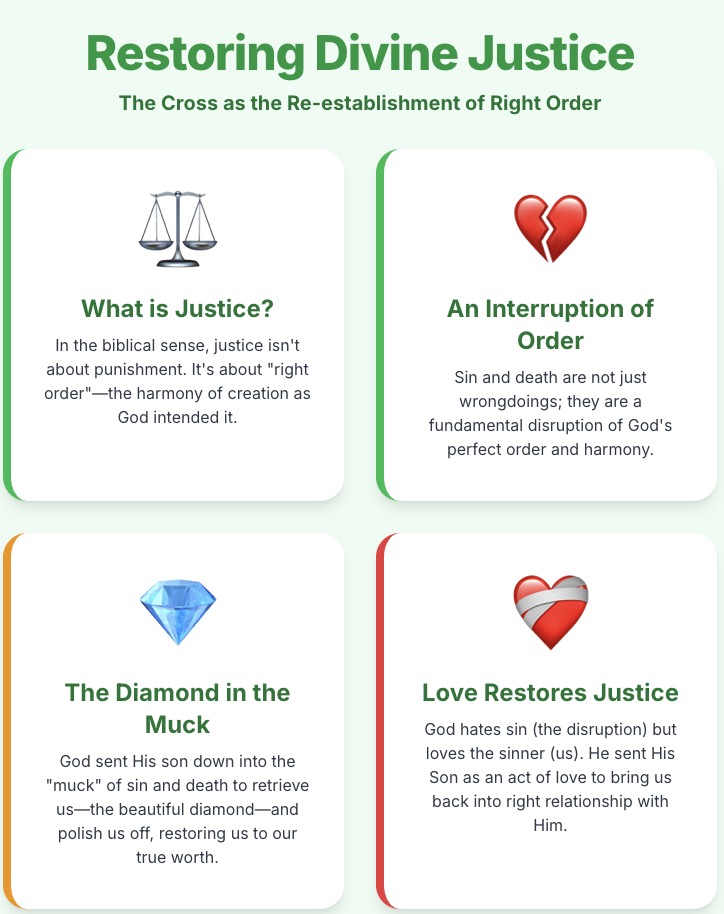
- How does defining justice as "restoring right order" differ from the common understanding of justice as "punishing wrongdoing"?
- The text says God hates sin, not the sinner. How does the cross perfectly illustrate both of these truths at the same time?
- Can you think of a time in your life when something felt "unjust" because it was out of order or harmony? How does the cross offer a response to that feeling on a cosmic scale?

Click to enlarge
Discussion Questions:
- What is the difference between simply being "forgiven" and being "elevated" to participate in the divine life? What does that "elevation" look like in a practical, day-to-day sense?
- The text refutes the image of God as a "dysfunctional father that demands this bloody sacrifice before his anger calms down." Why is this a crucial distinction to make for our own image of God?
- After this discussion, how would you explain the necessity of the cross to a friend who asks, "Why did Jesus have to die that way?"

Christ, and Him Crucified
Bishop Barron’s sermon explores the paradox of exalting the Holy Cross, once a brutal Roman instrument of terror. It contrasts Rome’s values of power with God’s siding with the victim. The Resurrection is presented as the only explanation for this transformation, showing God’s “divine descent” to heal humanity’s brokenness.

Click to enlarge
Key Theme 1: The Paradox of the Cross
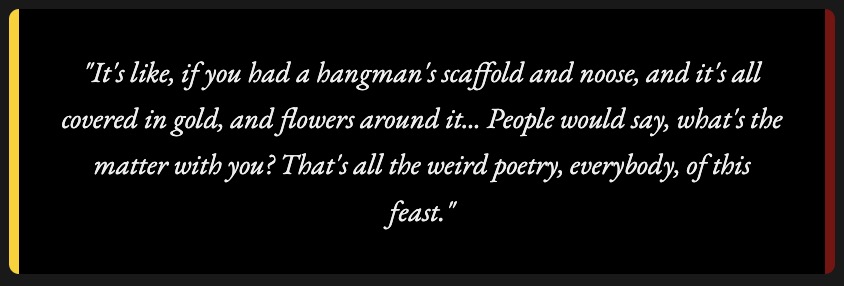
The sermon begins by contrasting the beautiful, golden, decorated cross in a chapel with the stark, brutal reality of what a Roman cross actually was: a horrific instrument of public execution designed to inspire terror.
Discussion Questions:
- Have you ever stopped to think about the brutality of the cross before? How does reflecting on its origins change your perception of it as a Christian symbol?
- Bishop Barron calls the exaltation of the cross "weird poetry." What do you think he means by that? Can something be both horrific and beautiful at the same time?
- Why do you think Christians through the ages have chosen to decorate the cross with gold and jewels, rather than always depicting it in its raw, historical form? What is the value in each approach?

Click to enlarge
Key Theme 2: The World's View vs. God's View
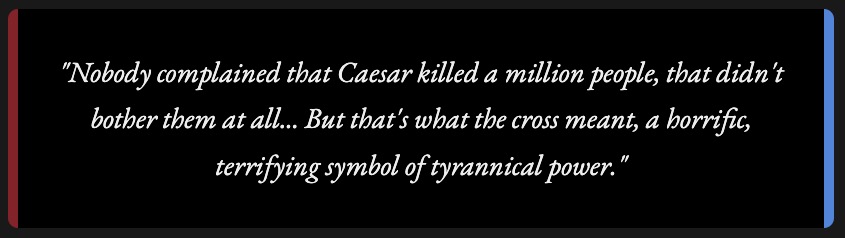
The sermon uses the example of Julius Caesar's conquest of Gaul and the HBO series Rome to illustrate the ancient world's mindset. Brutality, genocide, and crucifixion were accepted, even lauded, as effective tools of power and control. God's values are shown to be the complete opposite.
Discussion Questions:
- It is shocking to hear that Romans were not bothered by genocide or mass crucifixion. What does this tell us about how human morality can change over time?
- The sermon argues that our modern condemnation of such atrocities is a direct result of the Christian revolution. Do you agree? Why or why not?
- Where in our world today do we still see the values of "Caesar" (power, control, violence) clashing with the values of the Cross (love, sacrifice, siding with the victim)?

Click to enlarge
Key Theme 3: The Resurrection Changes Everything
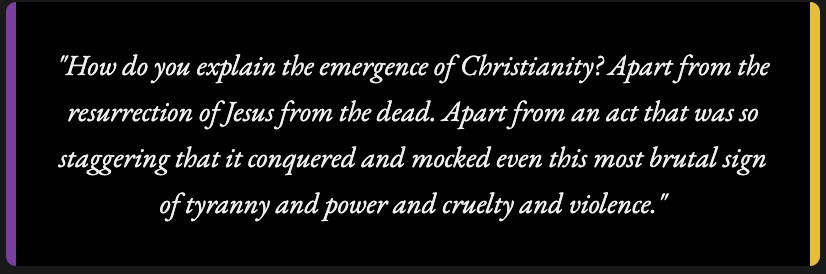
The core argument of the sermon is that the emergence of Christianity is historically inexplicable without the Resurrection. The first Christians proclaimed a crucified Messiah, which would have been seen as a complete contradiction—the ultimate sign of failure. Only an event as staggering as the Resurrection could turn the greatest symbol of shame into a symbol of glory.
Discussion Questions:
- Try to put yourself in the mindset of someone in the 1st century. Why would it be so difficult to believe that a man executed on a cross was the promised King and Messiah?
- Bishop Barron makes a historical, not just theological, argument for the Resurrection. How compelling do you find this argument?
- How does the Resurrection "turn the world upside down," as the speaker suggests? What values does it reverse?

Click to enlarge
Key Theme 4: The Divine Descent
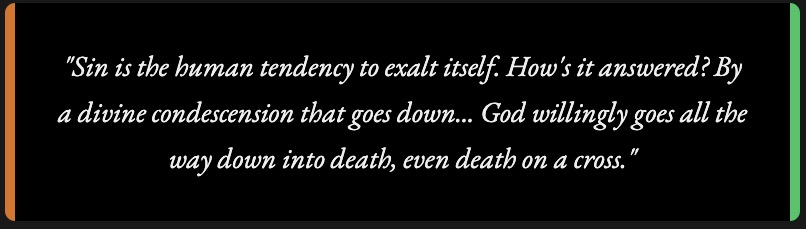
Using the beautiful hymn from Philippians 2, the sermon explains the theology behind the cross. Instead of grasping at power (like Adam), Jesus, who is God, "emptied himself," descending into the lowest, most broken parts of human existence—even death on a cross—in order to heal humanity from the inside out.
Discussion Questions:
- Bishop Barron uses the analogies of helping a misbehaving child or fixing a car to explain why God had to "go all the way down." How do these analogies help you understand the Incarnation and the Crucifixion?
- What does it mean for God to "empty himself"? In what ways are we, as followers of Christ, called to "empty ourselves" for the good of others?
- The cross is described as "God's descent into the very thing that is most wrong with us." How can this understanding bring hope when you are confronted with the cruelty, hatred, and dysfunction in the world or in your own life?
Father Geoffrey Plant
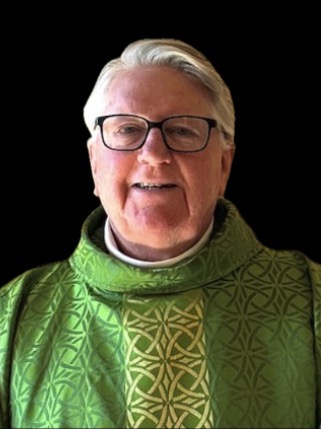
Exaltation of the Holy Cross

The Son of Man Must
be Lifted Up
The feast of the Exaltation of the Holy Cross celebrates the transformation of the cross from a symbol of shame and torture to a symbol of God’s boundless love and humanity’s salvation through Jesus’ sacrifice.

Click to enlarge
HOMILY TEXT (PDF)
The Shock of a Crucified God
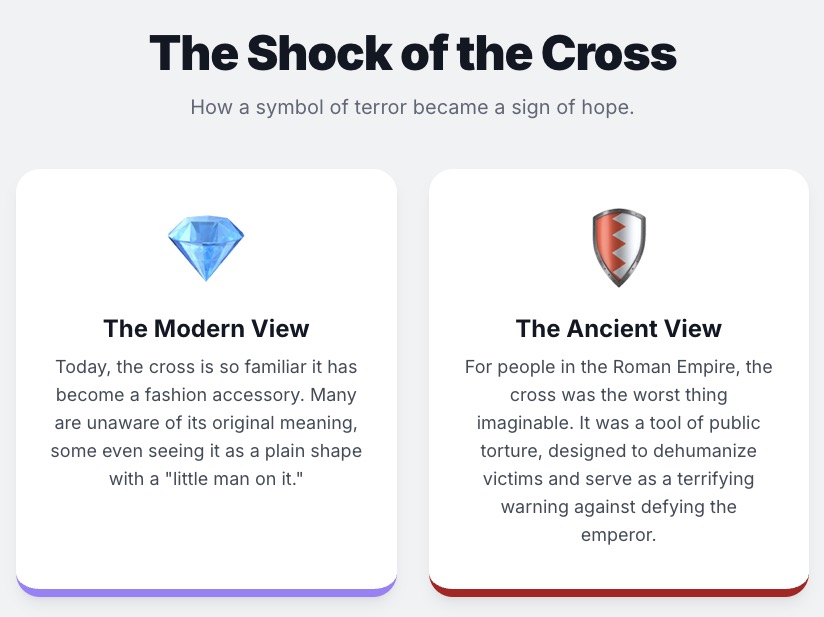
The homily begins by reminding us how sanitized the symbol of the cross has become, contrasting our modern view with the horror it represented in the ancient world.
Key Quotes:
- "If you don’t want a plain cross, we do have some with a little man on it."
- "Crucifixion was a method of displaying people in the most cruel circumstances possible, to demonstrate publicly the power of the empire... to dehumanise." (Fleming Rutledge)
- "That a man who had been crucified might be hailed as a god could not help but be seen... as scandalous, obscene, grotesque." (Tom Holland)
- "The cross [was] a stumbling block to the Jews and foolishness to the Gentiles." (1 Corinthians 1:23)
Discussion Questions:
- Before this homily, what were your immediate thoughts or feelings when you saw a cross or crucifix? Did the story of the sales assistant resonate with you at all?
- The homily describes crucifixion as a tool of dehumanization and terror. How does understanding this original context change your perception of Jesus's death?
- Why do you think it was so essential for St. Paul to address the cross as a "stumbling block" and "foolishness"? What does this tell us about the challenge of early Christian evangelization?
- The homily notes that it took the Church 400 years to dare to portray Christ on the cross. What does this long hesitation reveal about the early Christians' relationship with this symbol?
Click to enlarge
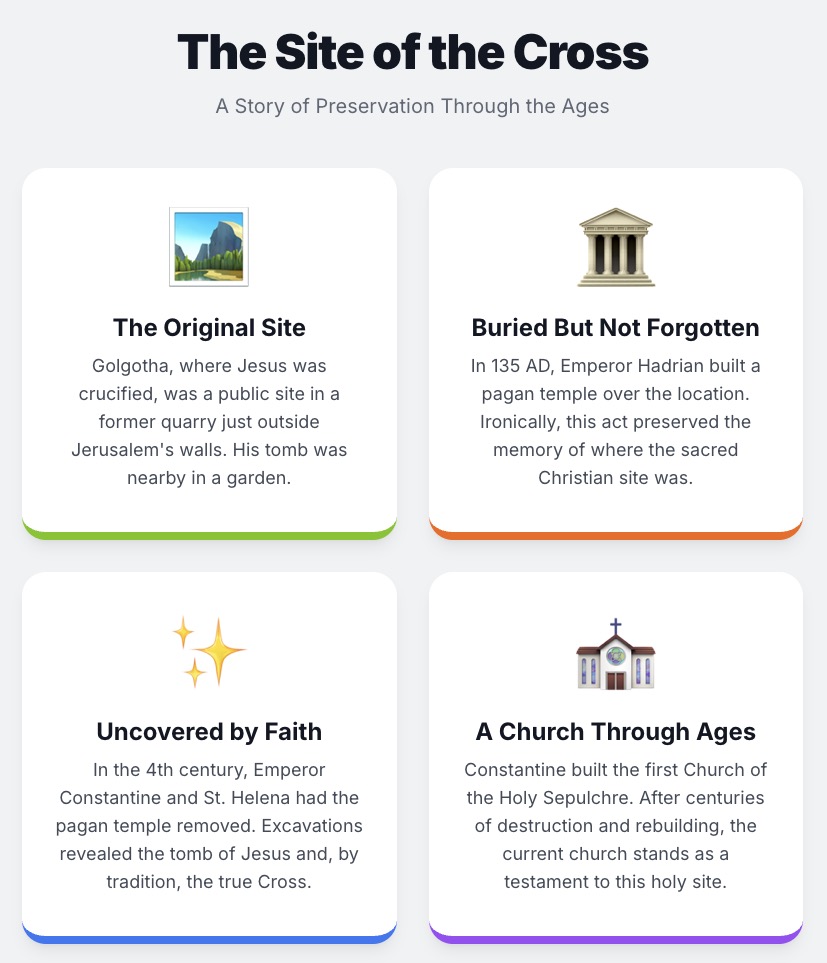
The "Fifth Gospel" - Uncovering Sacred History
A significant portion of the homily details the history of the actual sites of Golgotha and the tomb, and St. Helena's quest to find them. Pope Francis calls this physical location the "Fifth Gospel."
Discussion Questions:
- The Roman Emperor Hadrian tried to obliterate the site of Jesus's tomb by building a pagan temple over it. How did this plan ironically backfire and end up preserving the location's memory?
- Why do you think it was so important for Emperor Constantine and his mother, St. Helena, to find the physical location of the crucifixion and resurrection? What is the spiritual value of connecting our faith to a real, physical place?
- Have you ever been on a pilgrimage or visited a holy site? How did being physically present in a place of spiritual significance affect your faith?
- What do you think Pope Francis means by the "Fifth Gospel"? How can geography and history deepen our understanding of the written Gospels?
Click to enlarge
A Revolutionary Love
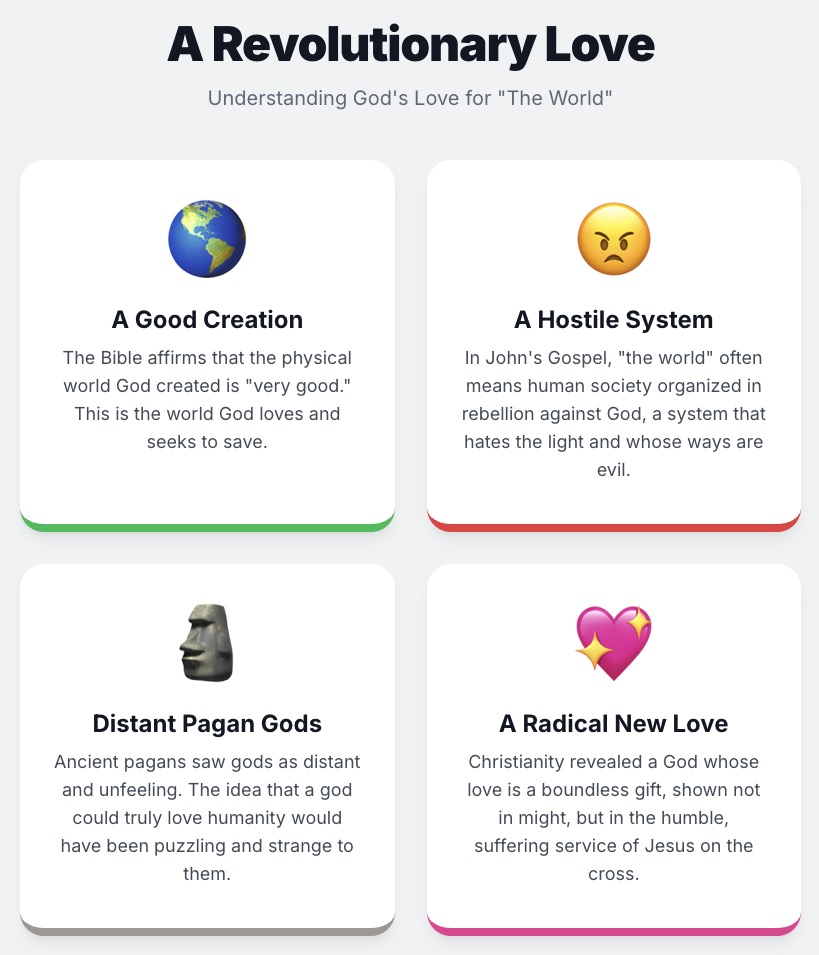
The final section contrasts the pagan world's view of distant, unemotional gods with the radical Christian claim that "God so loved the world."
Key Quotes:
- "The simple phrase ‘For God so loved the world’ would have puzzled an educated pagan." (Rodney Stark)
- "The God revealed in Jesus is a God whose love knows no bounds and who asks only that one receive the gift." (Gail O'Day)
- "The love of God is not manifested: In the might of armies, but in the suffering of the cross. Not by dominating others, but in loving service."
Discussion Questions:
- The homily explains that for Stoics, the idea of a god who "felt" anything for humanity was impossible, as it would imply humans had power over God. Why was the Christian message of a God who loves, suffers, and "empties himself" (Philippians 2) so revolutionary?
- John's Gospel uses the word "world" (kosmos) to often mean "human society alienated from and hostile to its creator." Why is it so powerful, then, that John 3:16 says God loved that world?
- How does the message of the cross challenge modern ideas of power, success, and self-fulfillment?
Father Kevin Rettig
Exaltation of the Holy Cross

A Thousand
Cranes
Summary

Click to enlarge
The Story and its Symbol
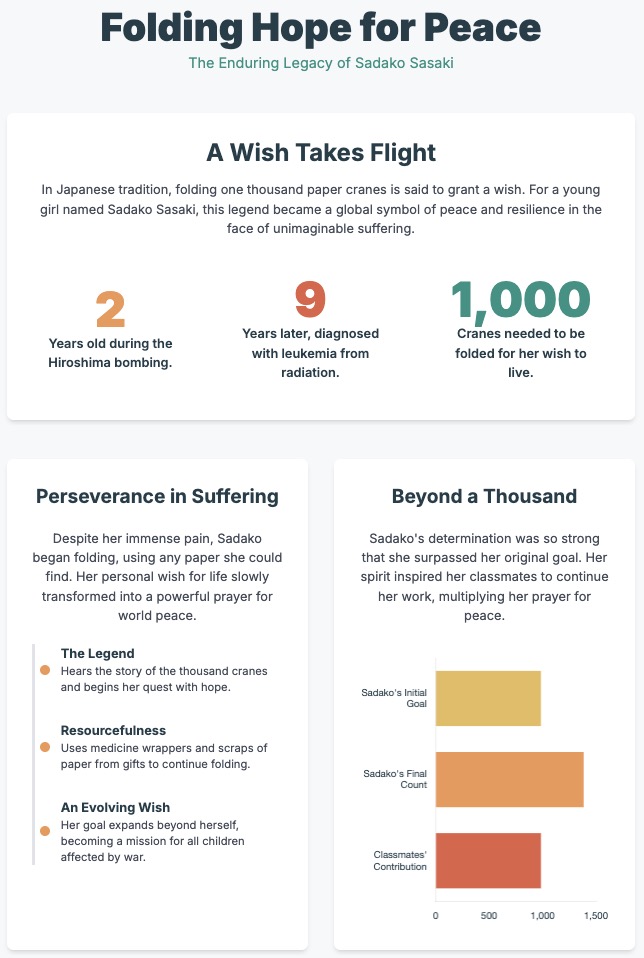
- The Symbol of the Crane: Before Sadako's story, what did the tradition of one thousand paper cranes represent in Japanese culture? How did Sadako's journey transform or deepen the meaning of this symbol for the world?
- Perseverance in Suffering: Fr. Ruttig vividly describes Sadako's determination, using "medicine wrappers" and begging for scraps of paper. What does her perseverance in the face of immense pain and fear teach us about the nature of hope?
- An Evolving Wish: Sadako begins folding cranes with a wish for her own life, but her mission continues even after she reaches her goal of 1,000. What do you believe her wish evolved into? Why was it so important for her to keep counting?
Click to enlarge
Counting the Cost
- A Haunting Contrast: Fr. Ruttig creates a stark contrast between "counting cranes" and "counting the cost of war." He says, "count to ten million and new faces of haunting hidden despair still continue to appear." What are some of the visible and invisible costs of conflict that he asks us to consider?
- An Urgent Plea: The inscription at the base of the monument reads, "This is our cry. This is our prayer for building peace in this world." Why do you think peace is described as something that must be "built"? What does that imply about our role?
- The Insanity of War: The homily references the "insane suicide of the planet" and the killing of one group for the "power and profit of a third group." How does Sadako's innocent, personal story serve as a powerful judgment on the impersonal and calculated nature of war?

Click to enlarge
Our Call to Action
- Continuing the Count: The story emphasizes that after Sadako's death, her classmates, and then the world, "took up the count." What does it mean for us, today, to "continue the count" and participate in her dream for peace?
- Folding Our Own Cranes: What are the "paper cranes" we can fold in our own lives? What are some small, tangible actions that, when done with intention, contribute to building a culture of peace in our families, workplaces, and communities?
- Daring to Dream: The homily ends with a challenge: "Dare to dream of a world without fear." In a world often filled with news of conflict and division, how can we cultivate and protect this dream? What gives you hope that such a world is possible?
Closing Reflection
Challenge for the Week: Take a few minutes this week to learn how to fold an origami paper crane (many tutorials are available online). As you fold it, pray for a specific person, region, or situation in the world that is in need of peace. Place the crane somewhere you will see it as a reminder of your prayer.

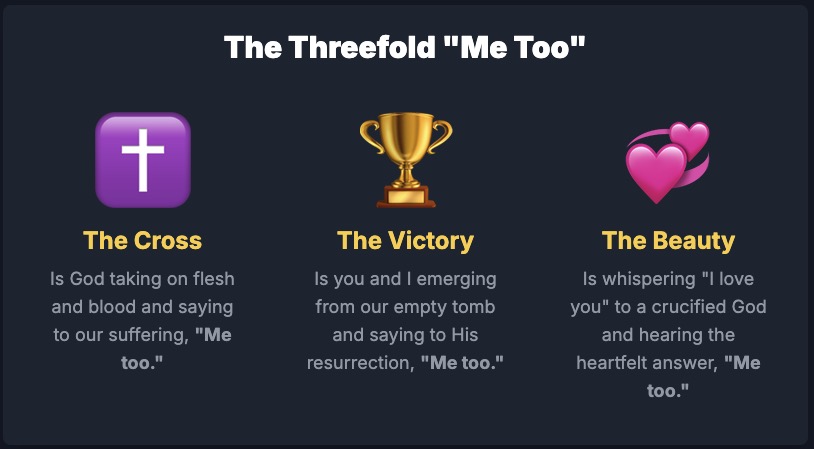
Me Too
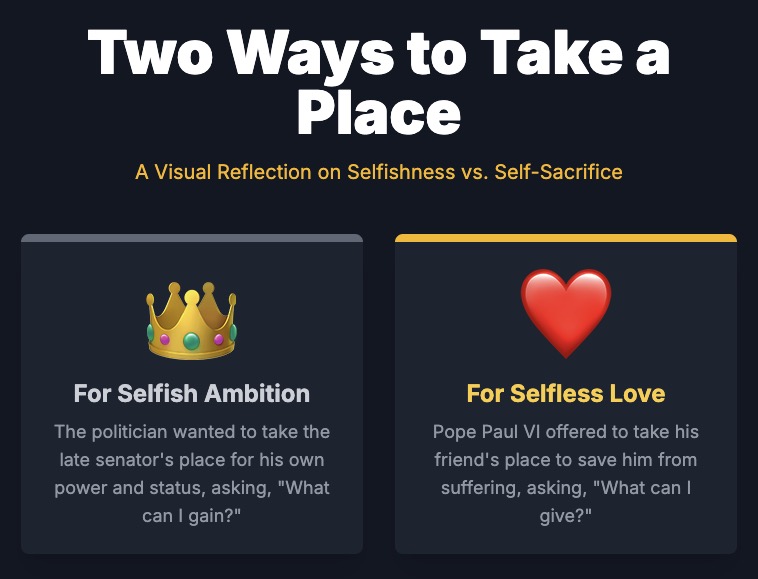
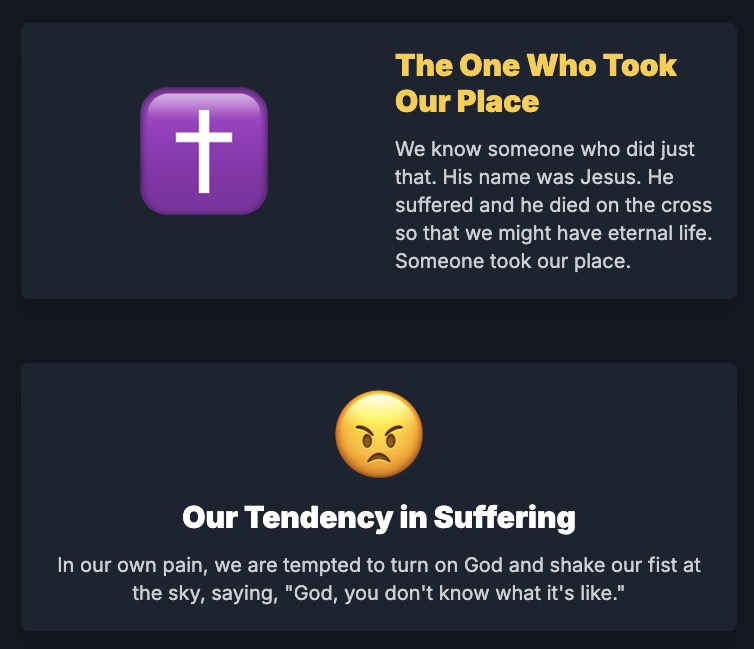
Fr. Ruttig’s homily explores sacrificial love through the Cross. It confronts our tendency to feel that God is distant in our pain and reveals the Cross as God’s definitive, empathetic answer: a powerful, flesh-and-blood “Me too.”

Click to enlarge
Discussion Questions:
- Fr. Ruttig begins with two contrasting stories: an ambitious politician wanting to take a dead senator's place and Pope Paul VI offering his life for his kidnapped friend. What do these stories reveal about the difference between selfish ambition and selfless love?
- Have you ever felt the sentiment of wanting to take on the suffering of a loved one? Why is this impulse so powerful and widely considered the mark of "true love"?
- How does Jesus’s sacrifice on the Cross take this human idea of "taking someone's place" to its ultimate, divine conclusion?
Click to enlarge
The Cross as God's "Me Too"
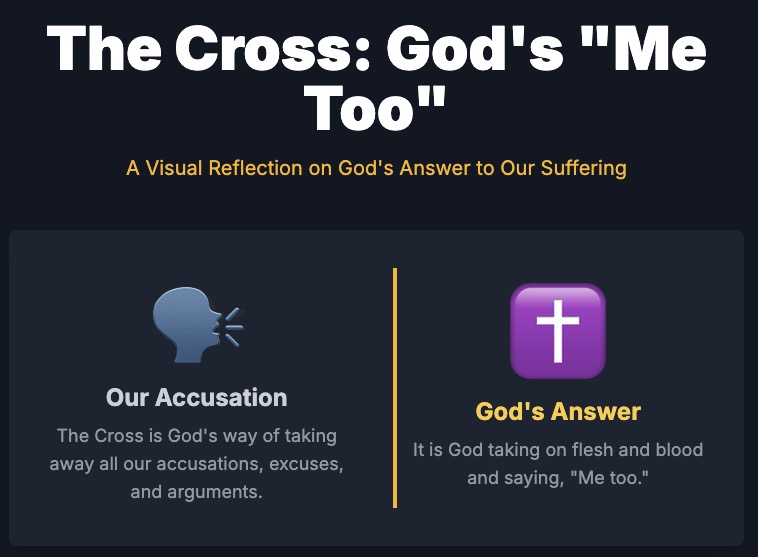
Fr. Ruttig says: "Our tendency in the midst of suffering is to turn on God... and say, 'God, you don't know what it's like'... And the cross is God's way of taking away all of our accusations, excuses, and arguments. The cross is God taking on flesh and blood and saying, 'Me too.'"

Discussion Questions:
- Is it a common human reaction to feel that God is distant or doesn't understand our specific pain? Why do we tend to feel this way?
- How does the image of God on a Cross answer the charge that He "doesn't have a clue" about human suffering? In what ways does this change your perception of God?
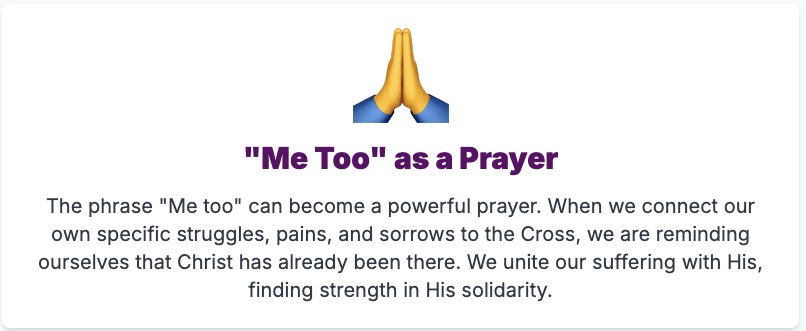
- How can the phrase "Me too" become a prayer, helping you to connect your own struggles with Christ's on the Cross?


Click to enlarge
Finding Room on the Cross
Fr. Ruttig says: "The challenge is not to find the cross, but to find room for ourselves upon that cross. To find that there is room on that cross for us to hang our sorrows, our pains, our worries and fears. Room enough to hang our excuses and our selfishness, our judgmentalness and pride... In short, to find that there is a place there for you and for me, just the way we are."
Discussion Questions:
- What is the difference between simply having a cross in your life and actively finding room for yourself upon Christ's Cross?
- Fr. Ruttig says there is room on the Cross for both our pains and our sins (selfishness, pride), as well as our hopes and loves. Why is it important to bring our entire selves—the good, the bad, and the human—to the Cross, not just our suffering?
- What do you think it means to be "absorbed into a death and rising that transcends time and transforms every part of us"? How does this happen at the Cross?
Monsignor Peter Hahn
Exaltation of the Holy Cross

No Homily Available
This Week

Frank Pavone
Exaltation of the Holy Cross

The War Between
Life and Death
There is an ongoing spiritual war between the culture of life, represented by selfless obedience to God, and the culture of death, represented by self-assertion and autonomy, and that true freedom and fulfillment can only be achieved by embracing the humble and selfless mindset of Christ.
Click on infographics to enlarge them
Two Paths
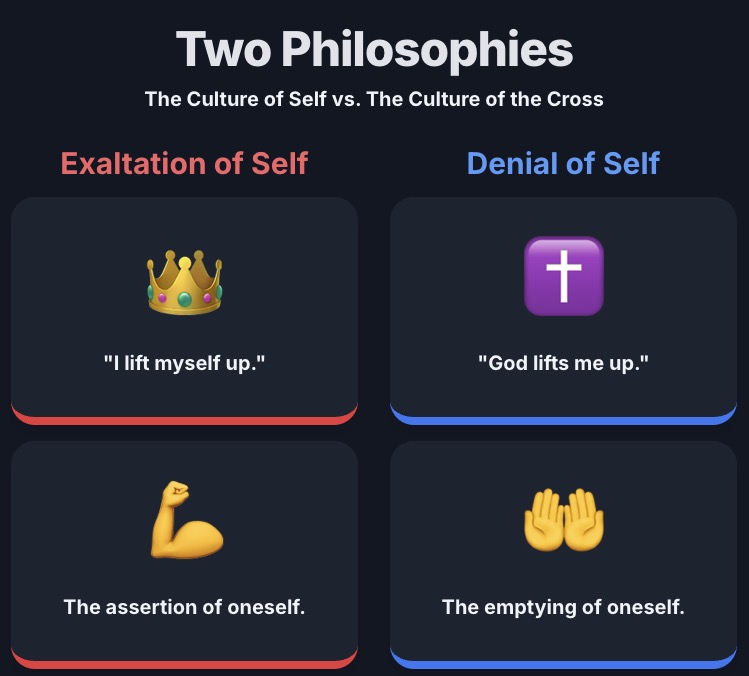
Frank Pavone begins by drawing a sharp contrast between the philosophy of "pro-choice" and the philosophy of the Cross. One is centered on the self, while the other is centered on self-giving love.
Key Quotes:
- “‘Pro-choice’ is an exaltation of self; the cross is the denial of self.”
- “‘Pro-choice’ says we can lift ourselves up; the cross says that we are obedient and that God lifts us up.”
Discussion Questions:
- Beyond the specific issue of abortion, where else in our culture do you see the mindset of "exaltation of self" being promoted as a virtue?
- The text describes the cross as "the emptying of oneself." What does this phrase mean to you in a practical, day-to-day sense? Can you think of a time you had to "empty yourself" for the good of another?
- How does society typically view "self-denial"? Is it seen as a weakness or a strength? How does the Cross challenge that perception?

The Origin of Pride
Frank Pavone explains that this conflict is ancient, rooted in the rebellion of the angels. The core mistake of Lucifer was the desire to be his own god, to set up his own throne.
Key Quote:
- "You said in your heart: 'I will scale the heavens... I will be like the Most High!'" (Is. 14:13-14)
Discussion Questions:
- The text identifies the Devil's mistake as thinking he could be God. In what subtle (or not-so-subtle) ways do we see this same temptation in our world today?
- The name "Michael" means "Who is like God?" and serves as a rebuke to Satan's pride. How can this question be a helpful guide in our own moral and spiritual decisions?
- Frank Pavone states the "war did not end there" but was "cast down to the earth." How does this idea of an ongoing spiritual battle change how you view struggles and temptations in the world and in your own life?

The Antidote - The Mind of Christ
The solution to the pride of the evil one is found in the humility of the Holy One. Christ's example in Philippians 2 provides the perfect counter-narrative to self-exaltation.
Key Quote:
- "Though he was in the form of God, Jesus did not deem equality with God something to be grasped at. Rather he emptied himself, taking the form of a slave... Therefore God highly exalted him." (Phil. 2:6-9)
Discussion Questions:
- What is the paradox presented in this passage? How does Christ's "emptying" lead to his "exaltation"?
- The text says our fulfillment comes from "obedience to a truth that we did not create." Why is this idea so counter-cultural today? What makes it difficult to accept?
- The guide redefines true freedom as "the power to choose what is right, and to love as Christ did, by embracing the cross and giving ourselves away for the good of the other person." How does this definition of freedom differ from the world's definition? Which one do you believe leads to greater joy and peace? Why?
TIP: To make the most of the resources on this page start a video and allow it to play as you explore the infographics and reflection questions which were generated using Google Gemini 2.5 AI tools (w/ Chart.js and Tailwind CSS). Feel free to use them in any non-profit ministry. A Link or shoutout to THE WORD THIS WEEK would be greatly appreciated.