
Fr. Tony’s 8-minute Homily
This Week’s
Theme
Fr. Tony
5th Sunday of Lent B
Fr. Tony started his homily ministry (Scriptural Homilies) in 2003 while he was the chaplain at Sacred Heart residence, applying his scientific methodology to the homily ministry. By word of mouth, it spread to hundreds of priests and Deacons, finally reaching Vatican Radio website. These homilies reach nearly 3000 priests and Deacons by direct email every week.
The clipart is from the archive of Father Richard Lonsdale © 2000. It may be freely reproduced in any non-profit publication.

Homily starter anecdotes:
# 1: ‘This was their finest hour!” During the plundering of Europe by the Third Reich, Winston Churchill encouraged the citizens of Great Britain with these words, “Let us therefore brace ourselves to our duty, and so bear ourselves that, if the British Empire and its Commonwealth lasts for a thousand years, men will still say, ‘This was their finest hour’.” (Speech, Hansard, 18 June, 1940, col. 60). Students of world history are, of course, aware of the fact that Europe was to suffer the bitterness and pain of war for the next several years but Churchill’s words concerning the “finest hour” were less about chronological time than they were about a significant moment in life, or purpose for which someone or something has been created. Churchill believed that during its most tortuous testing, England would prove itself and thereby enjoy its finest hour.
At this juncture in the fourth gospel, Jesus is about to embark on his finest hour, a moment in which he would be tortuously tested, and during which, he would prove himself, his purpose, and God’s saving plan to the fullest extent. Up to this point, the Johannine Jesus had frequently stated that his hour, or the hour had not yet come (2:4; 7:30; 8:20) and that the hour was indeed coming (4:21, 23; 5:25, 28-29). At this point in his ministry and on his final Passover in Jerusalem, Jesus makes the dramatic declaration, “the hour has come for the Son of Man to be glorified” (v. 23). From this moment on, events will accelerate because the reason for Jesus’ appearance in human flesh (Heb 5:7) is about to be fully realized. Glory will indeed be one aspect of Jesus’ hour, but it will be preceded and accompanied by scarring sufferings, rejection, and abandonment, ending in death and burial. Today’s Gospel challenges us to participate in Jesus’ hour, sharing in his suffering and death as well as in the glory of his resurrection and exaltation. (Sanchez Fles).
2) Hoc feci pro te: Quid fecit pro Me? When Count Nicholas Zinzendorf was a young man, he had an experience in an art gallery that changed his life forever. He was born an aristocrat, had always known wealth and luxury, and was an extremely gifted individual. Zinzendorf had been reared and trained for a diplomatic career in the Court at Dresden. Beyond all of this, it has been said of him that he was a child of God. One day, on a trip to Paris, he stopped for a rest in Dusseldorf; during his stay in the city, he visited the art gallery. There he caught sight of Sternberg’s “Ecce Homo,” a painting of the crucified Jesus. The artist had written two short lines in Latin beneath the painting: Hoc feci pro te: Quid fecit pro Me?(“This is what I did for you: what have you done for Me?”) As the story goes, when his eyes met the eyes of the thorn-crowned Savior, he was filled with a sense of shame. He could not answer that question in a manner which would satisfy his own conscience. He stayed there for hours, looking at the painting of the Christ on the cross until the light failed. And when the time arrived for the gallery to be closed, he was still staring at the face of Christ, trying in vain to find an answer to the question of what he had done for Christ. He left the gallery at nightfall, but a new day was dawning for him. From that day on, he devoted his heart and soul, his life, and his wealth – all that he had – to Christ, declaring, “I have but one passion; it is Jesus, Jesus only.” The sight of the crucified One “high and lifted up” on the Tree made a sudden and permanent change in his life, and the Resurrection bore fruit then and there in his heart and soul. [Leslie D. Key Weatherhead, Next Door – and Other London City Temple Sermons. (New York and Nashville: Abingdon Press, 1960).] — So it is, then, that the crucified Jesus “draws all people to himself” as promised in today’s Gospel because the cross concentrates the love and mercy of God the Father into one tremendous event, Jesus’ death and Resurrection. Fr. Tony (https://frtonyshomilies.com/).
3) Sacrifices of Olympic champions: When we watch the Olympics, what do we see but young athletes who have made enormous sacrifices over the years? They have sacrificed a normal childhood for countless hours of hard work and pain and solitary training, and they have done it all just for that moment when they would stand on the winner’s platform at the Olympic Games. If few of us are Olympians, many of us are parents, and what is parenthood but a whole slew of sacrifices? You sacrifice all of your privacy and a piece of your sanity. You sacrifice a neat, orderly environment in which to live, where things stay just where you left them. You make a huge financial sacrifice (between children and taxes, you’re lucky to have a dollar in your pocket at the end of the day), but you do it all for the sake of something which money can’t buy. In these and many other ways, we are perfectly used to the idea of losing one thing in order to gain something else. — It all makes me wonder: if we are so willing to sacrifice and even suffer for things which matter to us in our worldly lives, why shouldn’t we do even more for the sake of our spiritual lives? Why should we shy away from the full meaning of what Jesus said in today’s Gospel: “If you love your life, you will lose it, but if you hate your life in this world, you will gain it for eternal life.” Fr. Tony (https://frtonyshomilies.com/).
4) “Can’t you please stop all that yakking and get me a Coke?” A man is watching television. His wife is trying to engage him in conversation:
“Dear, the plumber didn’t come to fix the leak behind the water heater yesterday,
Husband: “Uh-huh.”
Wife: “The pipe burst today and flooded the basement.”
Husband: “Quiet. It’s third down and goal to go.”
Wife: “Some of the wiring got wet and almost electrocuted Fluffy.”
Husband: “Darn it! Touchdown.”
Wife: “The vet says he’ll be better in a week.”
Husband: “Can you get me a Coke?”
Wife: “The plumber told me that he was happy that our pipe broke because now he can afford to go on vacation.”
Husband: “Aren’t you listening? I said I could use a Coke!”
Wife: “And Stanley, I’m leaving you. The plumber and I are flying to Acapulco in the morning.”
Husband: “Can’t you please stop all that yakking and get me a Coke? The trouble around here is that nobody ever listens to me.” (John C. Maxwell, Be a People Person (USA: Victor Books, 1989).) Poor guy, nobody was listening, not even he! — Today’s Gospel says: “Then a Voice came from Heaven, ‘I have glorified it, and will glorify it again.’” Seemingly this was an audible Voice, a Voice which could be heard by anyone listening. But notice this: John tells us that some in the crowd that was there and heard the Voice coming down out of heaven dismissed it as thunder; others said an angel had spoken to Jesus. In response to their reaction, Jesus said, “This Voice was for your benefit, not mine . . .” That’s interesting, don’t you think? God spoke from the Heavens, but many of the people who heard the sound of God speaking simply dismissed it as thunder, while others thought it was a private communication to Jesus through an angel. Fr. Tony (https://frtonyshomilies.com/).
5) “They do come to you, but you do not hear them.” In George Bernard Shaw’s play St. Joan, (St. Joan of Arc), Joan tells of hearing God’s messages. She is talking to Charles, the Dauphin of France who doesn’t appreciate this crazy lady in armor who insists on leading armies. He’s threatened by her. He says, “Oh, your voices, your voices, always your voices. Why don’t the voices come to me? I am to be King, not you.” Joan replies, “They do come to you, but you do not hear them. You have not sat in the field in the evening listening for them. When the Angelus rings . . . you cross yourself and have done with it. But, if you prayed from your heart and listened to the trilling of the bells in the air after they stop ringing, you would hear the voices as well as I do.” [Bruce Larson, My Creator, My Friend(Waco: Word Books Publisher,1986).] — Joan heard the voice of God; the Dauphin, if he heard anything at all, heard only thunder. Why? Because she was listening for that Voice. Some people are so disconnected from God that they never hear God’s voice as described in today’s Gospel. Fr. Tony (https://frtonyshomilies.com/).
6) “Are you a philosopher?” Two men went up in a hot-air balloon one May morning. Suddenly they were enveloped by clouds and lost track of where they were. They drifted for what seemed like hours. Finally the cloud parted, and they spotted a man below them on the ground. “Where are we?” one of the passengers hollered down. The man on the ground looked around, looked up at the balloon, looked around some more and then yelled back, “You’re in a balloon.” The two balloonists looked at one another and then one of them yelled down again, “Are you a philosopher?” “Yes,” the man hollered up from below. The other balloonist said, “How did you know he was a philosopher?” His friend replied, “No one else could give an answer so quickly that’s so logical and yet tells you so little about where you are and where you want to be!” (“On Being Religious”, Donald J. Shelby, May 27, 1984). — Jesus was not a philosopher. He did deal in paradox which is a favorite tool of philosophers in seeking truth. Yet, he had a way of using the simplest examples from daily life to make plain the truth of his paradoxes. In today’s Gospel, Jesus uses the paradox: “We must die if we want to live.” Fr. Tony (https://frtonyshomilies.com/).
7) “Doctors’ dilemma: The ethics of not prolonging life.” A sign of our times appeared in recent newspaper headlines: Benjamin Weiser, a Washington Post reporter, wrote: “For eight weeks in 1979, Frederick Schwab, a 25-year-old medical student training in a Pennsylvania hospital cancer ward, braced himself each time he entered the rooms of his five dying patients. Especially Sarah’s.” Sarah was dying a slow, painful death. “Her tiny, darkened room smelled of decay. Her pain seemed the worst. Her cheeks were sunken. She lay motionless in her bed, staring at the ceiling, whimpering as Schwab gingerly searched for one more vein from which to draw blood.” Weiser says, “It wasn’t until the ninth week, Schwab recalls, that he saw a strip of yellow tape on her door.” It had been there all along, but Schwab had not noticed it. The nurse whom he asked about it told him that it was a “no code” sign, and that “no code” patients were not to be saved when their hearts stopped or their lungs failed. “A decision has been made by the patient and the family with the physicians in advance,” she said, “that the hospital resuscitation team, called the ‘code team,’ is not to be summoned.”1 No one had ever told him about that. Schwab, almost by accident, learned that not all patients choose to receive the full benefit of medical knowledge; if they choose, those who are terminally ill may be allowed to die. That is the patient’s, the family’s and the doctors’ dilemma: who should be kept alive and who should be permitted to die without employing extraordinary means to keep them alive a bit longer? — Jesus faced no such dilemma as described in today’s Gospel. The choice was his alone to make. Not Herod’s, not Caiaphas’, not the other priests’ – it was his to determine his own fate when he was in the very prime of life. Only by dying (there was no other way) could the Father’s purpose for him and his life be completed. Fr. Tony (https://frtonyshomilies.com/).
8) Lance Armstrong endured the pain by focusing on just completing each day’s journey. One hero who captured the attention of our world is cyclist Lance Armstrong. Armstrong who overcame great odds. He not only won his battle against cancer, but one year he won one of sport’s premier showcases of determination and endurance, the Tour de France bicycle race, for a record seventh time. But Armstrong is not alone among determined cyclists. Let me tell you about another man whose dedication equals that of Lance Armstrong. In the 2003 Tour de France, American cyclist Tyler Hamilton suffered a fractured collarbone when another cyclist slid and fell in front of the pack, causing a crash that involved thirty-five other riders. Collarbone injuries are notoriously painful, and they heal slowly because the collarbone cannot be isolated and immobilized by a cast. No one expected Hamilton to return to the race. But the following morning, Tyler Hamilton set out on the next leg of the Tour de France. Against all predictions, he finished the race. How tough was it? According to one report, the pain was so great that he destroyed eleven of his teeth from gritting them so hard. This feat of finishing with a broken collarbone was so unprecedented that competitors demanded proof of Hamilton’s injury. His doctors had to release his X-rays to the newspapers in order to prove that Hamilton really had ridden this grueling race with a broken collarbone. Hamilton explained that he endured the pain by focusing on just completing each day’s journey. [John Eliot, Ph.D. Overachievement (New York: Portfolio, 2004), pp. 129-130).] — Can you even imagine that? Hurting so bad that he destroyed eleven teeth from gritting them so hard! That reminds me of Jesus praying in the Garden of Gethsemane while sweat like great drops of blood rolled off him. Of course, Jesus was not trying to win a bicycle race. He was winning our souls. But we read about such determination as Tyler Hamilton’s, and it says to us, “This is what it takes to be successful in this world, whether you are building a career or a family or a life. Are you willing to give your all?” Then we come to these words of our Lord found in John’s Gospel, “The man who loves his life will lose it, while the man who hates his life in this world will keep it for eternal life.” And deep in our bones we realize that Jesus is talking about a way of life that doesn’t stop at the Mediocre Inn. Fr. Tony (https://frtonyshomilies.com/).
9) “Will I do?” In 1992, the Washington Redskins won the Super Bowl with an explosive victory over the Buffalo Bills. Seventy-five thousand people gathered on the mall between the Capitol and the Washington Monument to cheer their team and Coach. Four days later, Chuck Colson called the Redskins’ office to see if any football players could attend a rally at a prison the next day. Many of the players had given their life to Christ. Joe Gibbs the head coach answered the phone and told Colson that all the players had left the city for a well-deserved rest. With his characteristic humility, Joe Gibbs asked Colson, “Will I do?” Colson immediately accepted the offer by the coach of the championship Washington Redskins. Five days after winning the Super Bowl, Joe Gibbs could have opened any door in Washington DC but he was willing to walk behind the locked steel doors of the penitentiary for the District of Columbia to speak to men about his faith in Christ. Joe Gibbs stood up to speak to the cheers, whistles and applause of 500 prisoners five days after he had won the most prestigious event in pro sports. He told those men: “A lot of people in the world would probably look at me and say: ‘Man, if I could just coach in the Super Bowl, I’d be happy and fulfilled….’ But I’m here to tell you, it takes something else in your life besides money, position, football, power, and fame. The vacuum in each of our lives can only be filled through a personal relationship with our Lord and Savior Jesus Christ. Otherwise, I’m telling you, we’ll spend the rest of our lives in a meaningless existence. I’ve seen it in football players’ eyes, and I’ve seen it in men who are on their deathbed. There’s nothing else that will fill the vacuum.” [Chuck Colson, The Body, (Dallas TX: Word, 1992), 377.] Fr. Tony (https://frtonyshomilies.com/).
10) “Amazing Grace, how sweet the sound!” One man who learned what there is to lose and gain was an eighteenth-century slave trader named John Newton. Captain of a trans-Atlantic slaving ship, he had everything this world can offer as he made a lucrative living from the brutal business of buying and selling human cargo. Eventually, he was confronted with Jesus Christ, and he was converted to the Gospel truth which makes us free (Jn 8:32). He spent the rest of his life crusading to abolish the very business which had proven so enriching. He also wrote a number of great hymns, including a familiar one which begins:
“Amazing Grace, how sweet the sound!/That saved a wretch like me./I once was lost, but now I’m found,/Was blind, but now I see.” Once, John Newton thought that he was on top of the world, but in truth, he was wretched and blind. He lacked the moral clarity to see that he was nothing more than a cynical businessman making money in an evil enterprise; he was allowing the agnostic’s law of supply and demand to separate him from his Christian conscience. Then Jesus came along and the old John Newton died. A new John Newton was born. An old life was lost and a new one was found, a new life whose melodic fruit remains with us to this day. — What about us? What have we got to lose? We’ve got to die to ourselves in order to live with Christ! We’ve got to sacrifice and give up to gain! So what about it? What have we got to lose? What about selfishness? Shouldn’t we lose that narrow-minded little love which only extends to family and friends—or stops with our own selves? Fr. Tony (https://frtonyshomilies.com/).
11) Peace on earth for sale at Jesus’ shop: There was once a woman who wanted peace in the world and peace in her heart. But she was very frustrated– the world seemed to be falling apart. She would read the papers and get depressed. One day she decided to go shopping, and picked a store at random. She walked into the store and was surprised to see Jesus behind the counter. She knew it was Jesus, because he looked just like the pictures she’d seen on holy cards and in devotional paintings. At last she got up her nerve and asked, “Excuse me, are you Jesus?” “I am.” “Do you work here?” “No,” Jesus said, “I own the store.” “What do you sell?” “Oh, just about anything! Feel free to walk up and down the aisles, make a list of things you want, and when you come back and I will see what I can do for you.” The lady walked up and down the aisles and saw all sorts of things she wanted: peace on earth, no more war, no hunger or poverty, peace in families, no more drugs, clean air, and careful use of resources. She made a list of the things she wanted. By the time she got back to the counter, Jesus read through the list, looked at her and smiled. “No problem,” he said. Then he bent down behind the counter and picked up a number of small packets. “What are these?” she asked. “Seed packets,” Jesus replied. “This is a catalogue store.” In surprise, she said: “You mean I don’t get the finished product?” “No,” he answered. “This is a place of dreams. When you choose what you want, I give you the seeds. You plant the seeds and watch them grow. There is one catch, however: you will not receive the benefit of your good work. Others will.” “Oh,” she said with disappointment. “Then I’m not interested.” And she left the store without buying anything. — Today’s Gospel instructs us to bury ourselves in the soil of life by selflessly and sacrificially spending our lives for the temporal and spiritual welfare of others just as Jesus did. Fr. Tony (https://frtonyshomilies.com/).
12) “How could you pick up the sound of a cricket in all this noise?” There is a time-honored story about an old farmer who was persuaded by his nephew to visit the big city. The young man proudly took the farmer on a tour of the large metropolis. At one point as they walked down the street the old man suddenly stopped and asked, “Did you hear that?” The young man looked at the milling pedestrians and the traffic and replied, “Hear what?” “A cricket,” the old man said as he walked toward a little tuft of grass growing out of a crack next to a tall building. Sure enough, there tucked in the crack was a cricket. The young man was amazed. “How could you pick up the sound of a cricket in all this noise?” he asked. The old farmer didn’t say a word and just reached into his pocket, pulled out a couple of coins and dropped them on the sidewalk. Immediately a number of people began to reach for their pockets or look down at the sidewalk. The old man observed, “We hear what our ears are trained to hear.” — Psychologist Ellen Langer says that many people are so preoccupied with their daily tasks that they rarely listen to those around them. Today’s Gospel presents a few Greek visitors who came to the Apostles, eager to meet and listen to Jesus. Fr. Tony (https://frtonyshomilies.com/).
13) “The Four Immortal Chaplains:” Just after midnight on Feb. 3, 1943, an act of extraordinary unselfishness by a group of men became a legend of martyrdom and sacrifice. When the Army ship Dorchester was torpedoed by the Germans just south of Greenland that night, its passengers and crew had 25 minutes to get off the boat. As 902 people went for the life jackets, it quickly was discovered there weren’t nearly enough. Of the 13 lifeboats, only two functioned. In the ship’s final minutes, Methodist senior chaplain George Lansing Fox, Rabbi Alexander Goode, Dutch Reformed minister Clark V. Poling and John P. Washington, a Roman Catholic priest, were helping passengers leave the vessel. Then four men appeared all of them without life jackets. The chaplains quickly gave up their own vests and went down with the ship, perishing in the freezing water. Survivors saw them, locked arm in arm, praying and singing the Navy hymn, “Eternal Father, Strong to Save” just before the ship dove beneath the waves. — “The Four Immortal Chaplains,” as they are now known, have been honored many times, including on a stamp issued in their honor by the U.S. Postal Service. This world would have lost much if there had not been men prepared to forget their personal safety, security, selfish gain, and selfish advancement. The world owes everything to people who recklessly spend their lives for others. (Fr. Bobby Jose). Fr. Tony (https://frtonyshomilies.com/).
14) “How I would love to know you!” Once there was a salt doll who lived so far inland that she had never seen the sea. Consumed with a desire to see the sea she set out one day and walked hundreds of miles towards the ocean. At last she arrived and she stood by the seashore enraptured by the wonder of what she saw she cried out, “O Sea, how I would love to know you!” To her surprise and delight the sea responded to her, “To know me you must touch me.” So the little salt doll walked towards the sea and as she advanced into the oncoming tide she saw to her horror that her toes began to disappear. Then as her feet began to disappear she cried out, “O Sea, what are you doing to me?” The sea replied, “If you desire to know me fully you must be prepared to give something of yourself.” As the doll advanced further into the water her limbs and then her body began to disappear and as she became totally dissolved she cried out, “Now at last, I know the sea!”
(James a Feeban from Story Power; quoted by Fr. Botelho). Fr. Tony (https://frtonyshomilies.com/).
15) Facing One’s Fear: One of his biographers tells us that Dr. Martin Luther King knew many low moments. One night, for instance, his house was bombed. This literally plunged him into the deepest pit of despair; he hit rock bottom. In a state of utter exhaustion and desperate dejection he fell down on his knees and figuratively threw himself into the arms of God. This is how he prayed: “Lord I have taken a stand for what I believe is right. But now I’m afraid. The people are looking to me for leadership. If I stand before them without strength and courage, they too will falter. But I’m at the end of my powers. I have nothing left. I can’t face it any longer.” — In other words, that was Martin Luther King’s Gethsemane. But, like Jesus, he went on to add, “I experienced the presence of God in a way like I had never experienced before. And that was the only factor that enabled me to carry on regardless of the outcome.” (J. Valladares in Your Words are Spirit and They are Life; quoted by Fr. Botelho). Fr. Tony (https://frtonyshomilies.com/).
16) Unless a Grain Dies: Several years ago Catherine Marshall wrote an article called “When We Dare to Trust God”. She told how she had been bed-bound for six months with a serious lung infection. No amount of medication or prayer helped. She was terribly depressed. One day someone gave her a pamphlet about a woman missionary who had contracted a strange disease. The missionary had been sick for eight years and couldn’t understand why God let this tragedy happen to her. Daily she prayed for health to resume her work. But her prayers were unanswered. One day, in desperation, she cried out to God: “All right I give up. If You want me to be an invalid, that’s Your business!” Within two weeks that missionary was fully recovered. Catherine Marshall was puzzled by that strange story. It didn’t make sense. “Yet” she said, “I couldn’t forget that story.” Then one morning Catherine cried out to God: “God I’m tired of asking you for health. You decide if You want me sick or healthy.” At that moment, Catherine said later, her health began to return. — The story of that missionary woman and the story of Catherine Marshall illustrate what Jesus is talking about in today’s Gospel. “Unless a grain of wheat dies, it cannot bear fruit.” Or to put it another way, unless we die to our own will, we cannot bear fruit for God. (Mark Link in Sunday Homilies; quoted by Fr. Botelho).
17) Death to Life: In the movie, The Poseidon Adventure, a ship is turned upside down by a tidal wave. Under the leadership of a priest, played by Gene Hackman, a small group of passengers make an incredible struggle for survival. Several members of this group die during this adventure, including the priest himself. However, it was his heroism that inspired the passengers who did survive to persevere. His death became the source of their escape to life. — Death leading to life is one of the themes of today’s Gospel. Jesus says: “Unless a grain of wheat falls and dies, it remains just a grain of wheat. But if it dies, it produces much fruit.” (Albert Cylwicki in His Word Resounds; quoted by Fr. Botelho). Fr. Tony (https://frtonyshomilies.com/).
18) Dying for Another: The story of St. Maximilian Kolbe is well-known. He was a Conventual Franciscan priest in Poland, and he was in Auschwitz concentration camp during the Second World War. Three prisoners had escaped, and the authorities were determined that this should not happen again. For every prisoner that escaped they picked ten prisoners at random from the group, and those prisoners was condemned to die of starvation in isolation After one young man was picked, someone who had a wife and young family back home, Maximilian stepped forward and offered to take his place. The soldiers were shocked at this, but they took him up on his offer, and the young man returned to the group. Maximilian died in a horrible fashion, as they were all locked in and underground bunker and left there to starve to death. All during that time he encouraged others, and inspired them with his prayers. After two weeks, Father Maximillian and several others of the ten were still alive; the others had died of starvation and dehydration. The authorities, wishing to empty the bunker, executed Kolbe and the others by lethal injection. Father Maximillian was beatified by Pope St. Paul VI in 1971 and canonized as a martyr by Pope St. John Paul II in 1982, and the prisoner whose place Maximilian had taken, wept through the entire ceremony. [Citation: Pettinger, Tejvan. “Biography of Maximilian Kolbe”, Oxford, UK – www.biographyonline.net. 3rd August Saint 2014. Updated 2 March 2019.] — I like to think that he understood what real love is, and that death would no longer have any fear for him. (Jack McArdle in And That’s the Gospel Truth; quoted by Fr. Botelho). Fr. Tony (https://frtonyshomilies.com/).
19) The Grain of Wheat Must Die: In New Zealand there are more flightless birds than anywhere on earth. Among them are the kiwi and the penguin. Scientists tell us that these birds had wings but lost them. They had no use for them. They had no natural predators on those beautiful islands, and food was plentiful. Since there was no reason to fly they didn’t. Through neglect they lost their wings. Compare them to the eaglet that somehow ended up in a chicken barnyard. The eaglet was raised with the chickens, pecking at corn, and strutting around the chicken coop. One day a mountain man, passing by, recognized the bird, now a fully grown eagle, and asked the farmer if he could work to rehabilitate it. The farmer said, “Go ahead, but it’s useless. All that eagle knows is pecking corn like a chicken.” The mountaineer began weeks of rigorous training with the eagle, forcing it to run after him so that it had to use its wings. Many times, the eagle fell out of the limbs of trees onto its head. One day, finally, the mountaineer took the eagle to the top of a mountain and held it above his head on his wrist. Giving an upward thrust to his arm, he sent the eagle into the sky with a “Fly!” The eagle circled and wheeled upwards, straining, till it soon took off in a majestic sweep and looked directly into the sun. It was gone. It had regained its nature. It was an eagle once more. (Gerard Fuller in Stories for All Seasons; quoted by Fr. Botelho). Fr. Tony (https://frtonyshomilies.com/).
20) The Gain in Grain: “Hope for the Flowers” is a well-known parable written by Trina Paulus. It tells of two caterpillars, Stripe and Yellow, who are crawling in a caterpillar queue (rat-race) to reach the top. They see another caterpillar hanging upside down waiting to become a butterfly, who explains: “It looks like you will die, but, you will really live. Life is changed!” Convinced, Yellow surrenders and becomes a butterfly; Stripe continues crawling. — Am I ready to surrender and fly rather than crawl? To yield hundred-fold harvests rather than survive selfishly? (Francis Gonsalves in Sunday Seeds for Daily Deeds; quoted by Fr. Botelho). Fr. Tony (https://frtonyshomilies.com/).
21) “Sugaring season”: In many parts of the northeastern United States and southeastern Canada, this is “sugaring season.” For six weeks, usually from late February through mid-April, maple trees are “tapped” for their sap. During the annual “sap run,” the frozen sap in the maple tree thaws and begins to move and build up pressure within the tree. When the internal pressure reaches a certain point, sap will flow from any fresh wound in the tree. Farmers and producers collect the crystal-clear sap, then boil it down in an evaporator over a blazing hot fire. Nothing is added — only water is removed. The sap becomes more concentrated until it becomes maple syrup. The best thing that ever happened to stack of pancakes or French toast begins as a crystal-clear sap that thaws in the warmth of the long-awaited Spring. — Like the grain of wheat in today’s Gospel, maple syrup is a parable as to what it means to love God as God loves us. In letting our self-centeredness be boiled away, we can allow our lives to be filled with the grace and peace of God. May we possess the Faith of the grain of wheat, that we may die to ourselves in order to realize the fruit of God’s harvest of justice and forgiveness; may we embrace the Faith of the spring maple tree, that we may be willing to give of ourselves for the sake of others as Christ gave himself up for us, allowing ourselves to be transformed in the life and love of the Easter Christ. (Quoted by Fr. Kayala). Fr. Tony (https://frtonyshomilies.com/).
22) Written in their hearts: God chose the Israelites as His special people and revealed Himself and His law to them. Out of Israel came His divine Son, who revealed God even more fully, and gave us the law of love. But throughout human history there have been many wise men of every nation who have known neither the Old Testament nor the New, yet have taught many of the same truths. Take Confucius, the Chinese moralist who lived in 552-479 BC, and is still revered by the Chinese as a master counselor. A man of high intelligence and compassion, Confucius tried to reform society in China by teaching practical wisdom to a small group of men who were destined to hold high public office. Here are some of the ideas he passed on to them. “God is the creator of all men.” “There is the great God; does He hate anyone?” “The superior man exalts others and abases himself; he gives the first place to others and takes the last himself.” “The practice of right living is deemed the highest . . . complete virtue takes first place.” “Do not commence or abandon anything hastily.” “While his parents are alive, a son should not consider his wealth his own nor hold it for his use only.” “What you do not want done to yourself, do not do unto others.” “The body and the animal soul go downwards and the intelligent spirit is on high.” These were wise sayings, indeed, and Confucius had many admiring pupils who carried on his work as a teacher. One of them, Mencius, who lived in the third century BC, was the author of one axiom that was particularly discerning: “The great man is he who does not lose his child’s heart.” Try matching some of these statements with comparable passages in the Bible. — Of course, not all that the Confucianists or the other thoughtful pagan philosophers said would blend with Divine public revelation. But their efforts to teach goodness shows that God was calling them to Himself through the light of human reason, and they were listening. “… I will place My law within them, and write it upon their hearts.” (Jer, 31:33). Today’s first reading). -Father Robert F. McNamara. Fr. Tony (https://frtonyshomilies.com/).
23) “Self” on the cross and in Hollywood: The Academy awards were hosted on TV, and those who watched were treated to the same annual “display.” Was the inner motive of the participants an anticipation of “awards for achievement,” or was it an annual disease of human striving for glory and attention through opulence and skimpy attire? Hero-worship or heroine-worship seems to be rampant, and God seems to be totally absent in a way that only Hollywood could bring about. “SELF” dominates the entire scene. — We need to remember that we are approaching the end of the Lenten season, and that means that we are being led to the Cross. There is no room for “Self” at the Cross, only self-emptying. Jesus’ message is clear: if you want “to produce fruit” you must first “die to self.” It is only when the grain of wheat “dies” that it is transformed into an explosion of fruitfulness. This is what happened to Jesus; he freely accepted death on the Cross, fulfilling the will of his heavenly Father. And it is the Father that receives the glory, not the Hollywood heroes; glory belongs to God alone, not false idols. — Discipleship demands this same self-emptying of pride and ostentation. It demands a choice either for or against Jesus. The call to “lose our life” is a call to conversion, to change from our present ways that keep us from full discipleship. We all hide behind a “shell” – our Hollywood veneer, so to speak – and it is that shell of false reality that must be cracked and surrendered to Jesus. (Bishop Clarke). Fr. Tony (https://frtonyshomilies.com/).
24) “I fear they may be impressed by your scars and thereby be convinced to turn to your religion!” When the American Baptist missionary Adoniram Judson (1788-1850 C.E.) went to Burma to preach the good news, he encountered untold hardships. During his seven-year mission, he suffered hunger and privation; for seventeen months he was held in Ava Prison and was subjected to incredible abuse and torture. As a result, his body was scarred for life from the beatings and by the iron shackles and chains he was forced to wear. Throughout many sufferings he remained undeterred in his resolve. When he was finally released from prison, he asked the civil authorities for permission to resume his work for the sake of the Gospel. With indignation, the man in charge denied Judson’s request, saying, “My people are not foolish enough to listen to anything you say but I fear they may be impressed by your scars and thereby be convinced to turn to your religion!” — As the days of Lent ebb away, believers are led nearer and nearer to the culmination of this holy season. The Church, through the liturgical readings, has kept us alert to what Jesus is saying to humankind. At this point, the gathered community is also invited to be once again impressed by the scars of Jesus and, thereby, to be more deeply convinced of the saving, merciful love of God for all people. Both the second reading from Hebrews and the Johannine gospel focus attention on the suffering and death of Jesus on the cross as the means by which salvation has been effected. (Sanchez Files). Fr. Tony (https://frtonyshomilies.com/). L/24
FEATURED ANECDOTE:
All You have to Do
is Add Water
Years ago, when General Mills, Inc. first began selling Betty Crocker cake mixes, the company offered a product which only needed water. All you had to do was add water to the mix which came in the box, and you would get a perfect, delicious cake every time. It bombed. No one bought it and the company couldn’t understand why, so they commissioned a study which brought back a surprising answer. It seemed that people weren’t buying the cake mix because it was too easy. They didn’t want to be totally excluded from the work of preparing a cake; they wanted to feel that they were contributing something to it. So General Mills changed the Betty Crocker formula and required the customer to add an egg in addition to water. Immediately, the new cake mix was a huge success.
Unfortunately, many people make the same mistake when it comes to “packaging” or presenting the Christian religion. They try to make the call of Jesus Christ as easy as possible because they’re afraid that, if it seems too hard, people won’t “buy” it. You hear this fear operating all the time in popular religion, from well-known Gospel songs and best-selling books to earnest evangelists standing on your doorstep.
- “All you have to do is tell Jesus you love Him. All you have to do is accept Him as your Lord and Savior.
- All you have to do is pray to Saint Jude and put an ad in the newspaper classifieds.
- All you have to do is ask for what you want in the Name of Jesus and it will be done for you.”
Whenever you hear someone say “All you have to do is …” in relation to Christian Faith, all you have to do is walk away as fast as you can! You don’t want to buy a religion where you don’t even have to break an egg, where it’s all pre-mixed for you in the box. That kind of Faith has an immediate appeal, but it lacks the depth to sustain you over the long haul of Christian living.
Jesus did not “package” Himself in this way. Jesus said a number of things about the blessings of Faith, and He talked about asking in order to receive, but He never presented the overall Christian life as being particularly easy, as we hear in today’s Gospel.
Today’s readings focus on the approaching death of Jesus which Paul considers a priestly sacrifice and John considers the moment of Jesus’ “exaltation” and “glorification.” The readings offer us a challenge. Just as Jesus became the “Promised Messiah of Glory” and the “Conquering Son of Man” by offering his life for others, we, too, if we would come to Heaven, must die to self by loving obedience, spending our lives in self-giving, sacrificial service.
SOURCE: Fr. Tony’s Homilies / Used with permission
1st Reading Explained

The first reading, taken from the book of the Prophet Jeremiah, explains how God will replace the Old Covenant of Judgment with a New Covenant of Forgiveness of sins. This New or Renewed Covenant prophesied by Jeremiah was fulfilled, at least in part, through Jesus’ life, death and Resurrection.
First reading, Jeremiah 31:31-34 explained: Jeremiah lived from about 650 B.C. to perhaps 580 B.C. Most of his work was in Judah’s capital, Jerusalem. Called by God as a young man, Jeremiah lived through the tragic years preceding and succeeding the ruin of the kingdom of Judah. In 597 BC Nebuchadnezzar captured Jerusalem and deported part of its population to Babylon (Iraq). A second Judean revolt brought back the Chaldean armies once again, and in 587 BC Jerusalem was captured, its Temple burnt and more of its inhabitants deported. When Jerusalem fell, Jeremiah remained in Palestine with his friend Gedaliah whom the Chaldeans had appointed governor. When Gedaliah was assassinated, a party of Jews, fearing reprisals, fled to Egypt, taking Jeremiah with them. It is probable that he died there.
Jeremiah lived through these catastrophic events as God’s messenger, preaching, prophesying disaster, and vainly admonishing the incompetent, stubborn Davidic kings. He tried to keep the people, the priests, and the kings faithful to God amidst an atmosphere of political intrigue. As God’s true spokesman, Jeremiah was accurate and blunt in his words. When the Lord God wished to convey His love and mercy to His erring people, the prophet’s words are gentle, but when He confronts the evils His people, priests, and Kings have done and caused, the prophet’s language is always firm and strong. The Lord asked questions and supplied answers: Why was there a need for God to make a New Covenant? It was because the people, priests and kings had broken the original one. How would the New Covenant be different from the old? It would be written on the hearts of the people and hence could not be erased by cowardly leaders. Why would there be no need for teachers under the New Covenant? Because the present teachers — the priests and kings — had failed miserably, and God chose to take other measures. The passage reads as follows: “I will place My Law within them and write it upon their hearts.” This New Covenant does not abolish the earlier Covenants with Noah, Abraham, and Moses, for these earlier covenants are really the progressive stages of the history of the one Great Covenant between the one God and His people. Jeremiah’s prophecy of a New or Renewed Covenant has been fulfilled, at least in part, through Jesus’ life, death and Resurrection.
SOURCE: Fr. Tony's Homilies / Used with permission
2nd Reading Explained

In the second reading, St. Paul tells the Hebrews that it is by Jesus’ suffering and death, in obedience to his Father’s will, that Jesus established the New Covenant. Using metaphors of the “sown wheat grain”and the “spent life” in today’s Gospel, Jesus teaches the lessons St. Paul will repeat.
Second Reading, Hebrews 5:7-9 explained: This passage from Paul’s letter to the Hebrews is chosen because it fits with today’s Gospel which contains an ominous prediction of Jesus’ passion, and some details of Jesus’ prayer to his Father. The verses preceding these describe the priests of ancient Judaism, and then describe Jesus as the Priest of the New Covenant. Priests of the Sinai covenant were charged with: (1) interpreting the will of God for the people; (2) giving guidance as regards the law; and (3) offering sacrifice on behalf of the community. Jesus, Son of God and Son of Man, fulfilled all these functions by authoritatively teaching his contemporaries to know God’s will and to live according to the fullness of His Law and Covenant which had been lost over the centuries. In his own death, Jesus functioned as both priest and victim to offer the one perfect sacrifice to God for the deliverance of sinful humankind. Today’s verses expand on that theme of Jesus as God’s Son and at the same time emphasize his human nature (learning obedience through suffering, thus made perfect). They also indicate Jesus’ superiority to the priests of his day in that he “became the Source of eternal Salvation” to others. Since Jesus suffered and prayed with tears to be saved from death, he can sympathize with our sufferings. That Jesus’ prayer has been heard will be demonstrated on the third day with His Resurrection. Since Jesus knows our human condition and is touched by our anguish and distress, he pleads with God the Father on our behalf.
SOURCE: Fr. Tony's Homilies / Used with permission
Gospel Explained
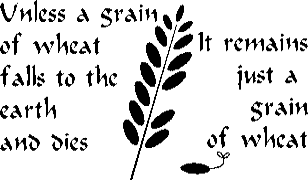
The Gospel hints at the inner struggle of Jesus in accepting the cup of suffering to inaugurate the New and Eternal Covenant. However, Jesus accepts the cross as his “hour,” meaning the stepping-stone to his passion, death, Resurrection, and exaltation. Jesus also considers his “hour” as the way of glorifying his Heavenly Father and of being glorified by his Father. In addition, it is the way by which all people will be drawn into the saving action of God. Finally, the “lifting up” of Jesus on the cross and later into Heavenly glory by Resurrection and Ascension is the assurance of our own exaltation and glorification, provided we accept our crosses.
Gospel Exegesis:
The Context: Some Greek pilgrims who were either new converts to Judaism or mere ‘truth-seekers’ were greatly impressed by the royal reception given to Jesus on Palm Sunday and by the subsequent cleansing of the Temple by Jesus. Hence, they approached the apostle Philip (who had a Greek name), and requested a private interview with the Master. Jesus uses the occasion to declare that he is the “Son of Man” prophesied by Daniel, and that his time of glorification is at hand. He immediately corrects the then-current and accepted false notion of a political messiah by stating that he will be glorified by his suffering, death and Resurrection.
The hour of glorification for the “Son of Man”: The “hour” Jesus refers to is his time for glorifying his Heavenly Father and of being glorified by his Father. It is also the way by which all people will be drawn into the saving action of God. Jesus’ being “lifted up” on the cross to glorify his Father reminds us that we too can glorify God by wholeheartedly accepting the crosses our loving Heavenly Father permits to enter our lives. Jesus’ hour can be described in three ways: (1) as a death that gives Life: Jesus’ death will yield a Life which nourishes and sustains others; (2) as a crisis situation: Jesus’ hour will occasion for believers a crisis (v. 31) which will free them from “the ruler of this world” (Satan), and the power of evil; and (3) as an access to Heaven. Jesus’ hour provides available access to eternal life for all of us, if we choose to have it. By being “lifted up” in his finest hour, Jesus will draw to himself (v. 32) everyone who chooses to be so drawn. We are invited to unite our personal struggles and their scars with those of Jesus and to follow him confidently to the glory that awaits.
The term “Son of Man” (translated as “a son of man” by the RSV), is taken from Dn 7:13. The seventh chapter begins with the description of a frightening vision of Daniel in which he sees the cruel, savage world powers — the Assyrians, the Babylonians, the Medes and the Persians — as wild beasts: a winged lion, a bear with three tusks, a four-headed leopard and a terrible, ten-horned wild beast. At last, Daniel sees a gentle, humane and gracious ruler in the form of a man. The Jews, under repeated foreign rules and bondages, dreamed of such a God-sent ruler and preferred to call this “promised Messiah” by the name “Son of Man.” In the apocryphal Book of Enoch, this Jewish dream of a world conqueror is clearly stated. It was but natural that the apostles shared this view and consequently saw Daniel’s “Son of Man” in Jesus. Jesus promptly corrected them, however, replacing their dream of conquest and political power with a vision of His cross and suffering.
The metaphors of the “dying grain of wheat” and of the “surrendered life”: Jesus explains to his apostles that it is by his suffering and death that he is bringing life and liberation to the sinful world, just as a grain of wheat sown in the field ceases to remain itself alone, “just a seed,” by germinating and then growing into a plant which produces many new grains of wheat. In the same way, it is by the self-sacrificial lives of holy men and women that life and salvation come to mankind. In other words, when we “die” to our selfishness, we “rise” to new life in Jesus Christ. To be “buried in the earth” means avoiding sin, accepting suffering and living for others.
SOURCE: Fr. Tony's Homilies / Used with permission
Fr. Tony’s
Life
Messages
5th Sunday of Lent B
Today’s Gospel teaches us that new life and eternal life are possible only by the death of the self through obedience, suffering, and service. Salt delivers its taste by dissolving in water; a candle gives light by having its wick burned and its wax melted. The oyster produces a priceless pearl by a long and painful process. Loving parents sacrifice themselves so that their children can enjoy a better life than they themselves have had. Let us pray for this self-sacrificial spirit, especially during Lent.
SOURCE: Fr. Tony’s Homilies / Used with permission
We know that the world owes everything to people who have spent their time and talents for God and for their fellow human beings. Mother Teresa, for instance, gave up her comfortable teaching career and, with just 5 rupees (17 cents) in her pocket, began her challenging life for the “poorest of the poor” in the crowded slums of Calcutta. Thus, she became, in the words of the Secretary General of the U.N., “the most powerful woman in the world.” We see similar cases in the history of great saints, scientists, and benefactors of mankind in all walks of life.
SOURCE: Fr. Tony’s Homilies / Used with permission
This is one of the repeated pieces of advice Jesus has given us (Mark 8:35; Matthew 16:25; 10:39; Luke 9:24; 17:33). Bernard Shaw in his play, Joan of Arc, shows the saint as praying: “Lord I shall last a year; use me as you can.” Many charitable foundations and research institutions are financed by generous millionaires who understood this great principle of life (e.g., The Rockefeller Foundation and the Bill Gates Foundation for AIDS Research), while so many others selfishly keep their God-given wealth and talents for themselves. Let us learn to live this Lenten period “burning out,” spending our time and talents for others around us by humble, selfless and self-giving service. “Do all the good you can, by all the means you can, in all the ways you can, in all the places you can, to all the people you can, as long as ever you can” (John Wesley).
SOURCE: Fr. Tony’s Homilies / Used with permission
HOME | QUESTIONS | TOPICS | CONNECTIONS
 Highlight text or double-click a paragraph anywhere on the site to ADD TO NOTES. You can also click ASK AI to copy your selection to the clipboard with a command prompt, ready for you to paste manually into the chat above.