October 5, 2025
October 5, 2025


Homilies
Homilies



27th Sunday of Year C

Passionately Catholic with Anthony Digmann (08:11)


Click on infographic to enlarge it
Infographics on this page have been created using AI generative tools (i.e. GOOGLE'S AI Gemini 2.5 Flash LLM, Chart.js and Tailwind CSS). They are free to use for any non-profit ministry. THE WORD THIS WEEK kindly requests that you show your appreciation by sharing a link to the website.

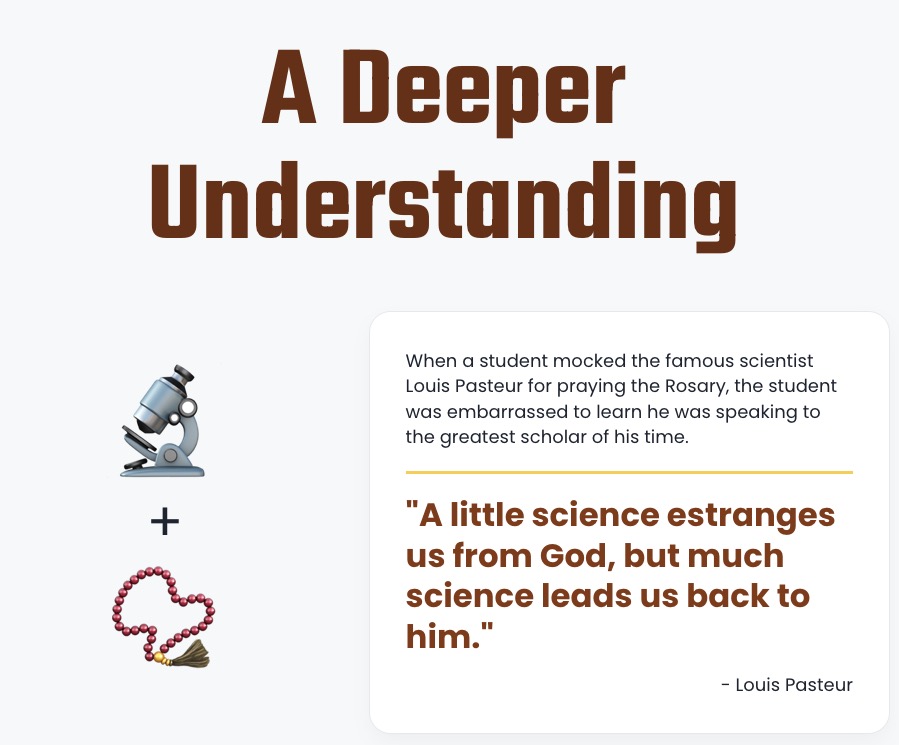
In the contexxt of the apostles’ request for increased faith which seems to imply a desire for immediate, concrete results, Deacon Peter’s homily explores the perceived conflict between faith and science. While the apostles’ plea might seem to contrast with the patient, observational nature of scientific inquiry, the homily argues that faith and science are not only compatible but historically intertwined. The readings remind believers that faith, like scientific understanding, often grows from small beginnings, evolving over time through steadfast trust and observation.
The homily distinguishes between the methods of science and theology. Since God created the universe, He exists outside of it. Therefore, the scientific method, which studies phenomena within the universe, cannot be used to prove or disprove God’s existence. Deacon Peter uses the analogy of an artist who exists outside her paintings; you can see her style in the work, but you will never find the artist herself within the canvas. This means theology and science use different, non-competing rational approaches to arrive at truth.

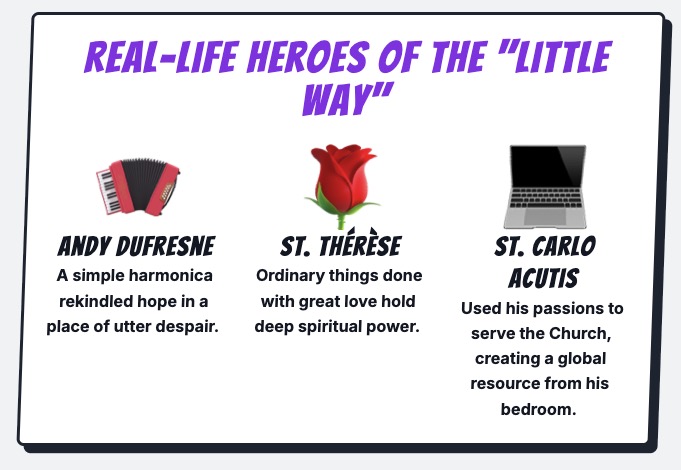
CYMFed (3:17) – Carlo had a deep faith from an early age. He had pure devotion to the Eucharist, a love of praying the rosary and a routine of weekly confession. He created a website which catalogued Eucharistic miracles recognised by the Church.

Click on infographic to enlarge it
Infographics on this page have been created using AI generative tools (i.e. GOOGLE'S AI Gemini 2.5 Flash LLM, Chart.js and Tailwind CSS). They are free to use for any non-profit ministry. THE WORD THIS WEEK kindly requests that you show your appreciation by sharing a link to the website.

Carlo Acutis, the Italian teenager who was canonised only last month, did a few small things that have since made a very big difference.
He loved computers and the Church. Putting the two together, he taught himself computer programming and started to help parishes by designing their websites. At the age of 14 he created a volunteering portal, and just before he died aged only 15, he launched an online catalogue of the world’s Eucharistic miracles.
This website soon became a global resource in dozens of languages, and resulted in an exhibition that has since toured thousands of parishes and over 100 universities. Carlo didn’t expect anything like this. He simply followed his heart and did what he loved, and now we can see how a small, faithful act, even online, can make a major difference.
Today he’s the patron saint of the Internet.
────── ⋆⋅☆⋅⋆ ──────

27th Sunday of Year C

Click to enlarge

Twenty-Seventh Sunday of the Year. Fr Richard Finn notes that the scriptures acknowledge the depth of human suffering before offering hope.
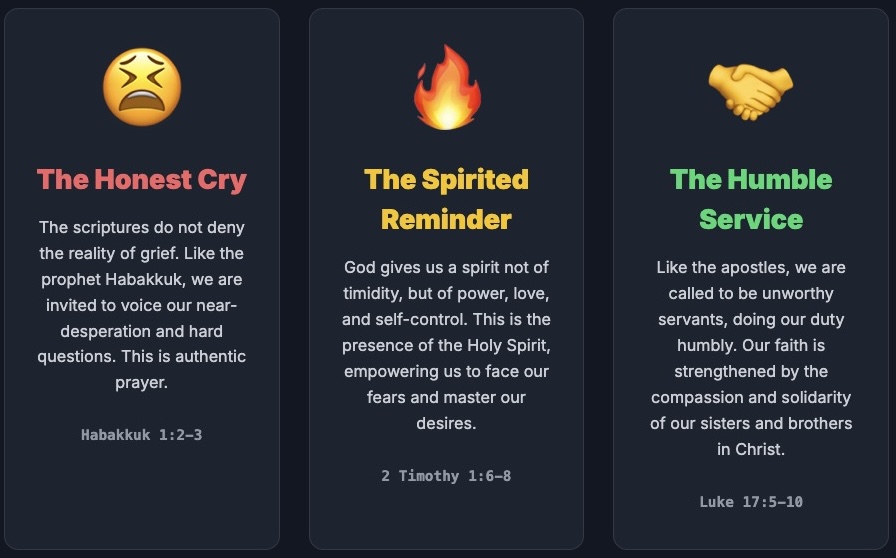
The apostles must serve Christ in all humility, thinking of themselves as merely ‘unworthy servants’ doing their duty. As Luke’s Gospel unfolds, they must learn how they will pick up and run with Christ’s challenging mission of proclaiming Good News to the poor, freedom for captives, the advent of God’s healing justice. It will frequently be a hard lesson in the sufferings that accompany such a mission. But in Acts, the sequel to that Gospel, they receive the gift of the Holy Spirit poured out on them at Pentecost to fulfil that mission. That gift which St Paul calls the spirit of power and love and self-control is of course not the gift of three separate things: it is the very presence within us of the Holy Spirit whose love empowers us to so love God, and others as God loves them, that we master and train our desires in self-control, serving Him and them as love requires and calls us to. For that gift, and by that gift, we may give heartfelt thanks.
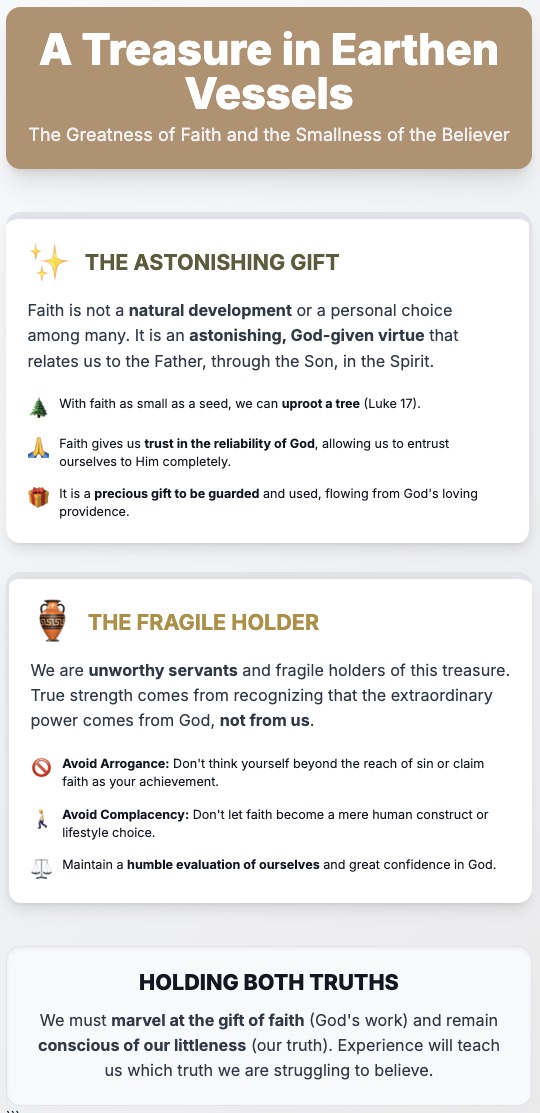
Twenty-seventh Sunday of the Year. Fr Robert Ombres preaches on the extraordinary gift of faith.
Two truths are given to us today, one about God and one about us, and we need to hold on to both of them because they are interconnected. We should marvel at the extraordinary gift of faith we have received from God, yet be conscious that we are only the fragile holders of something precious. Experience teaches us which of these two truths is proving hard to believe and accept.
────── ⋆⋅☆⋅⋆ ──────
Fr. Austin Fleming
27th Sunday of Year C

Habakkuk’s Lament
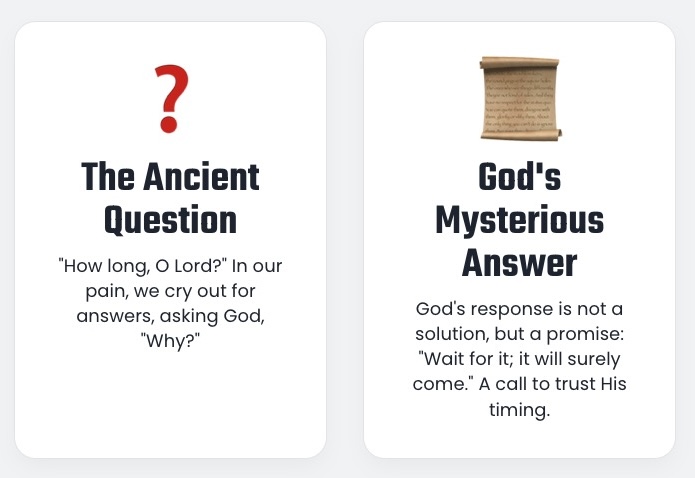
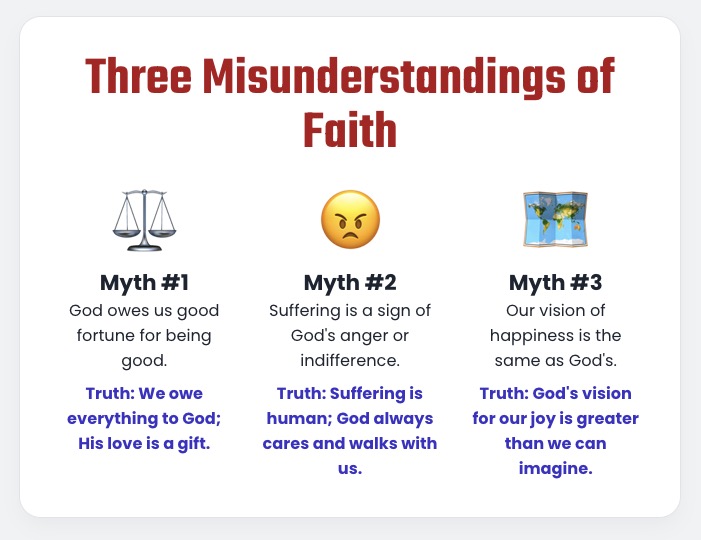
2016 — In today’s readings from Habakkuk and from Luke, the Hebrew and Greek words translated here as “faith” would be better translated as “steadfast loyalty” — that very brand of loyalty and love that stands firm even in the face of suffering and pain, in the face of dashed dreams and failed expectations.
God’s response to us is often not a solution, but rather a promise. We not often given quickly the solution we seek, but rather we receive a promise, the promise of God’s love and of ultimate victory for those who trust him – even while they suffer. The good news is that Jesus, our Lord, our Master, offers us much more than just the call to suffer while serving him.
────── ⋆⋅☆⋅⋆ ──────
Fr. Jude Siciliano, O.P.

27th Sunday of Year C


Where God’s Heart Lies
Habakkuk offers encouragement to those who are in dire straits and can’t help themselves. But what about the rest of us who hear God’s intentions to help those afflicted? Through the prophet we hear where God’s heart lies – with those who have no one on their side and can’t help themselves. So, hearing what God has promised these people, we are urged to do something for them, whether the victims of violence and injustice be local or across the globe. And for those already involved in efforts to help those suffering starvation, oppression, violence, plagues like AIDS, war, etc, the prophet’s vison can sustain us in our long efforts. The “vision” assures us that God is with us in our concern and labors with us to help us “keep on, keepin’ on.” People laboring to make a difference against seeming-impossible odds can succumb to discouragement and burn out. While the first part of the Habakkuk reading can serve as a prayer for those trapped by powerful and cruel forces; the second half is an encouragement to those who have heard the call to join in the struggle to free the oppressed and be hope for the hopeless.
────── ⋆⋅☆⋅⋆ ──────
Fr. Charles E. Irvin
27th Sunday of Year C


Click to enlarge
Faith Intertwined with Love

From Adam and Eve until now, human pride and human sin are the enemies of faith. Stated another way, our human propensity is to control, to demand proofs, to have certitude, and thus to control God. These are all detours that take us off the high road of faith. Each one of these things can prevent us from arriving at our final destination.
Human pride tries to control God and so a subtle feeling creeps in when we experience failure in our relationship with God. A little voice within us whispers to God: “If you don’t pay attention to me, I’m not going to pay attention to You. If you disappoint me, I’m not going to love You any more. If you don’t play by my rules, then the game’s over between You and me.” Habakkuk, whom we heard about in today’s first reading, was dealing with that temptation.
Fr. George Smiga
27th Sunday of Year C
Click to enlarge
The Faith of Honeybees

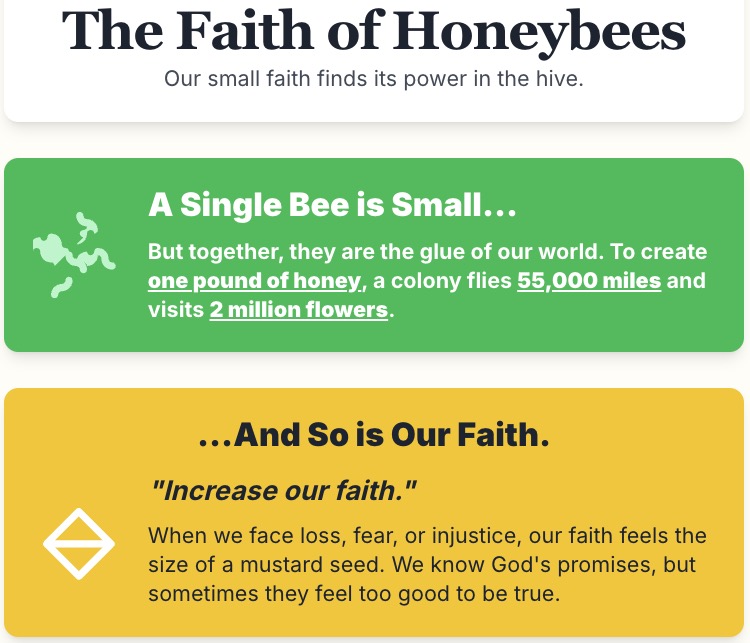
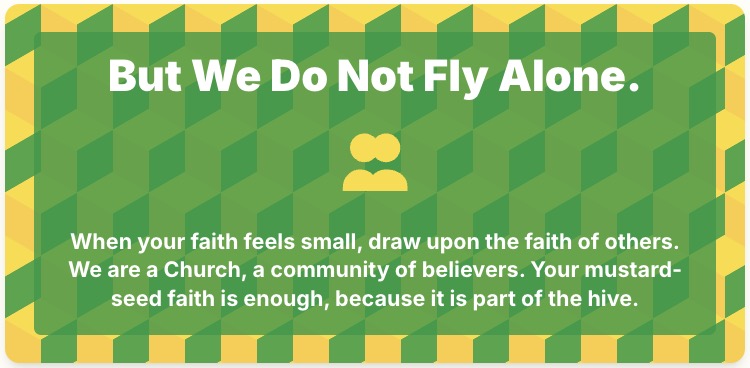
2013 HOMILY – Honeybees do not have power as individuals. But they are a part of a hive, and those hives together are the glue of our agricultural system. So too, when we look at ourselves as isolated creatures, our faith is small, very small. But Jesus tells us is that when we feel the smallness of our faith, then it is time that we draw upon the faith of others. When we become discouraged about the world around us, it is time to look at the people in our life who we love and who can give us energy and hope. If we lose our job or our health, it is not time to go it alone. It is time to draw upon the strength of the people who respect and support us. When we doubt whether there really is a heaven, it is time that we turn to the people around us whose faith is stronger than ours and draw on their strength.
Our faith might be the size of a mustard seed but we are not an isolated plant. We are a Church, a part of a community of believers. As a community of believers, we need to draw upon one another for faith and hope. That is why the honeybee is a useful image. Alone, our faith is much too small. But it is still sufficient. It still has power, because we do not fly alone.
27th Sunday of Year C

Click to enlarge

People of Integrity

Habakkuk’s society was not all that much different than ours, where violence and might are glorified and the weak are kept in their place. This is Respect Life Sunday. Yes, Roe vs Wade was reversed, but the Supreme Court merely removed abortion as a federal right. It was sent to the states to determine if abortion should be legal. At the present time, 13 states passed laws that it is never legal, 7 states passed laws limiting it to 6-8 weeks gestation, and 30 states still have abortion as completely legal. So most of our country still allows unique lives to be murdered before birth. Some Catholics who are adamantly opposed to abortion have no difficulty with capital punishment as though lowering ourselves to the level of the killer is acceptable. Violence is all around us. Our young people go to middle school, high school and college afraid that some of their classmates might turn on them, not just in the extreme cases of mass murder, but even in the everyday playground scuffles where turf wars are fought not just with fists but with weapons.
────── ⋆⋅☆⋅⋆ ──────
27th Sunday of Year C

Five Fundamentals for
a Firm Faith
The readings for this Sunday’s Mass richly describe some essential qualities of faith and living in this world as a Christian. There are five fundamentals that can be seen:
I. WANTING – The apostles said to the Lord, “Increase our faith” (Luke 17:5-6).
II. WAITING – The first reading speaks of our need to wait for the Lord’s action: How long, O LORD? I cry for help, but you do not listen! I cry out to you, (Hab 1:2-3; 2:2-4).
III. WITHSTANDING – The second reading counsels us, God did not give us a spirit of cowardice but rather of power and love and self-control...(2 Tim 1:6-8).
IV. WORKING – The Gospel teaches, Who among you would say to your servant who has just come in from plowing or tending sheep in the field... (Luke 17:6-10).
V. WINNING – We conclude with a reference back to the first reading: For the vision still has its time, it presses on to fulfillment and it will not disappoint. If it delays, wait for it, it will surely come, it will not be late (Hab 2:3).
────── ⋆⋅☆⋅⋆ ──────
Fr. Michael Chua
27th Sunday of Year C

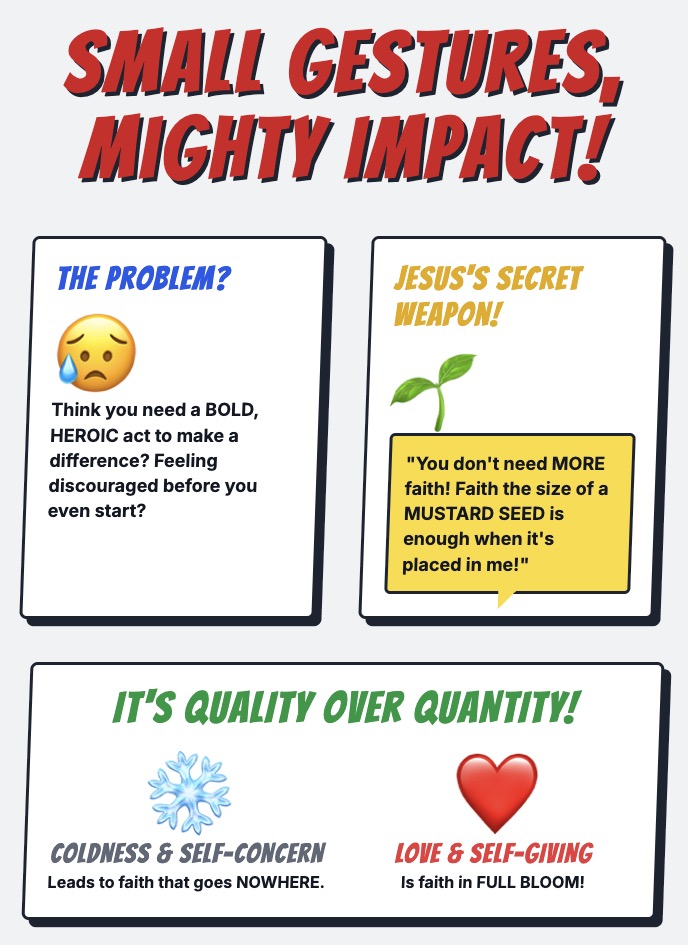
When the disciples learned more about the demands of discipleship, they feared they did not have the faith to meet the challenges that came with it. The heaviness of discipleship weights down on them. To that end, they beg, “increase our faith,” a frank admission their profound lack. But the problem is that faith is not quantifiable. Nevertheless, it is the power that inspires us, helps us to persevere, enables us to struggle and not lose heart, and keeps us ever mindful of God’s abiding presence. That is why our Lord uses the images of the mustard seed and the mulberry tree to graphically illustrate the power of faith, even the tiniest spark of it, can move the unmovable and accomplish what appears to be impossible.

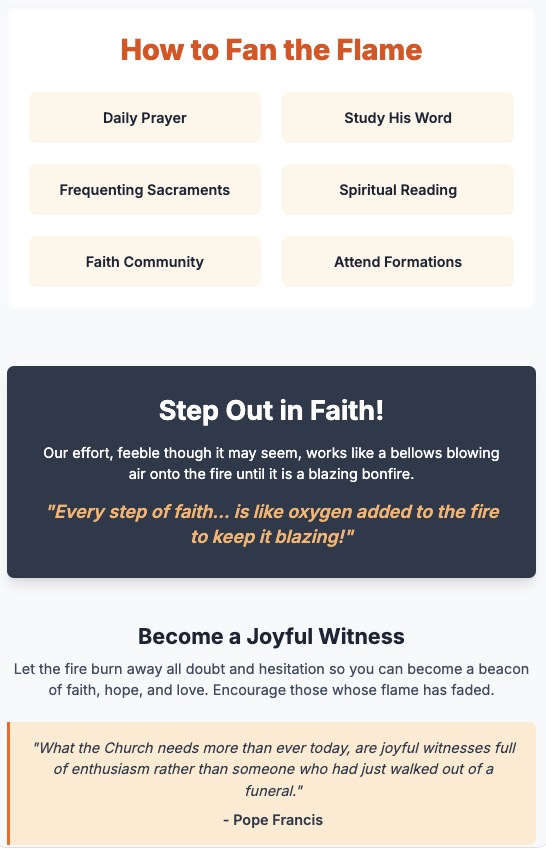
Our Christian faith can be likened to hot coals which would make a fire when fanned but become cold and useless if left alone. Many of us Catholics were baptised as infants, thus becoming Christians before we knew anything at all. Many of us grew up without properly tending that initial spark of faith that was given to us at baptism or we had allowed the pressures and distractions of life to reduce our faith to cold ashes. The result being so many have left the faith of our childhood, the faith of our parents, believing this is no longer relevant.
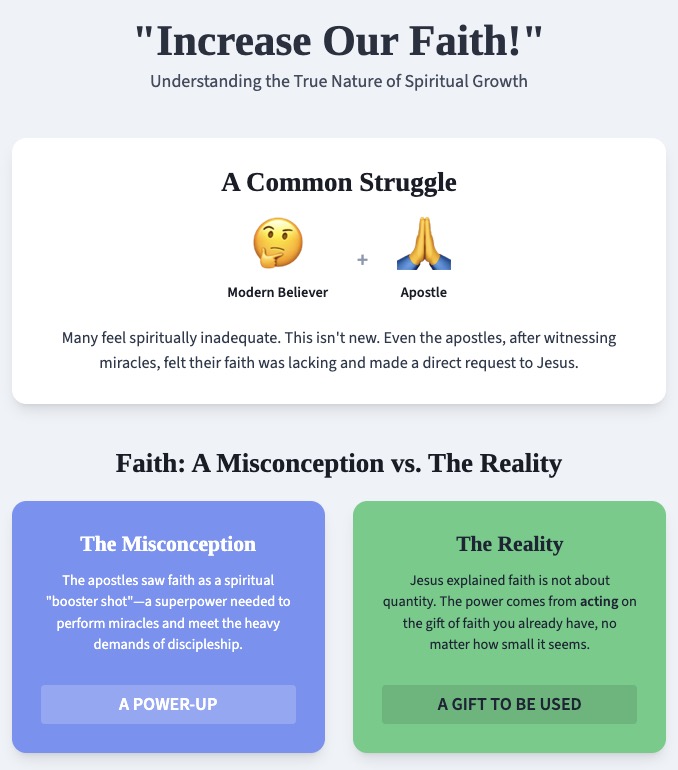

Increase Our Faith
Many Catholics feel spiritually inadequate, a sentiment echoed by the apostles who asked Jesus, “Increase our faith!” They mistakenly viewed faith as a spiritual power-booster for performing miracles. Jesus corrected them, explaining that even faith as small as a mustard seed is powerful when acted upon.
The prophet Habakkuk also struggled with faith amid injustice, learning that the righteous must live by perseverance. This reveals that struggling with faith is not a failure but a normal part of the journey. Faith, a gift from baptism, doesn’t grow from a magical infusion but through trials and tribulations. When we ask God to increase our faith, we are essentially asking for the challenges that build spiritual muscle. Therefore, these struggles are not a sign of weak faith, but rather the growing pains of a faith that is alive and active.

────── ⋆⋅☆⋅⋆ ──────
Fr. Jude Langeh, CMF

27th Sunday of Year C
Click to enlarge
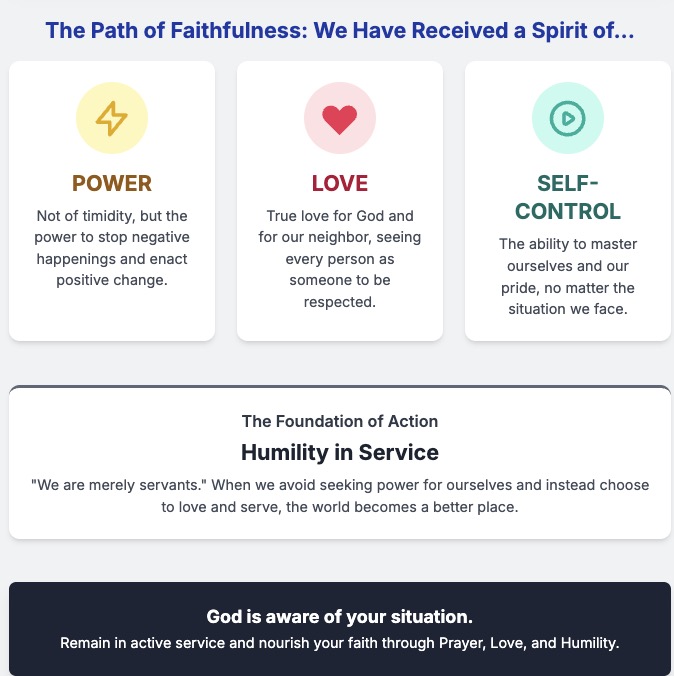
God is Aware of Your Situation, Just Remain Faithful
Despite the pervasive violence and injustices in the world, maintaining faith and humility in service can empower individuals to overcome challenges and foster positive change. Faith is essential for overcoming life’s challenges, and we must continually seek and pray for it to strengthen our trust in God.
More Videos & Homilies
Infographics & Discussion Questions
Bishop Barron | Fr. Kevin Rettig | Msgr. Peter Hahn
Fr. Geoffrey Plant | Priests for Life
The reflection questions and infographics featured in this section have been created with the help of Google Gemini 2.5 AI tools, using Chart.js and Tailwind CSS. THE WORD THIS WEEK is happy to offer these resources to any non-profit ministry for use, and kindly request that you provide credit to the website and the respective contributors whose content is illustrated.