24th Sunday of Year B

September 15, 2024 Introduction

INTRODUCTION

COMMENTARY

BRANT PITREFR. O'MAHONYFR. MARTINHECTOR MOLINA
YouTube player

SOURCE: The Mass Readings Explained

Jesus’ prediction of his own suffering and death as the Messiah is a crucial part of God’s plan for salvation, and any attempt to avoid or control this outcome would undermine God’s purpose.

KEY INSIGHTS w/ Timestamps
  • 00:00 Jesus predicts his passion, death, and resurrection to his disciples, emphasizing that he will be a suffering Messiah, not a triumphant one.
  • 01:24 Jesus will be a suffering and dying Messiah who will be crucified.
  • 01:33 Peter rebuked Jesus for predicting his own passion, not out of concern for Jesus' well-being, but rather to reprimand him.
  • 02:07 We never dare to tell God how things should be, but we often try to control the outcome of our lives.
  • 02:22 Peter's attempt to correct Jesus stems from his own misunderstanding of God's plan, despite his good intentions of concern for Jesus.
  • 02:53 ️ Jesus' harsh response to Peter's attempt to avoid suffering is because Peter's desire to spare Jesus from the cross would undo God's plan for salvation through the crucifixion.
YouTube player

SOURCE: Hearers of the Word

Jesus’ identity as the Messiah is explored through various perspectives, and following him requires a deep understanding of his true nature and a willingness to deny oneself and take up one’s cross.

KEY INSIGHTS w/ Timestamps
  • 00:00 Jesus asks his disciples to reflect on their faith and understanding of who he is.
    • Jesus asks his disciples "Who do people say I am?" and "Who do you say I am?" at Caesarea Philippi, inviting reflection on one's faith in Jesus.
    • The speaker presents a gallery of diverse portraits of Jesus to challenge traditional images and encourage reflection on one's personal understanding of Christ.
  • 03:24 Jesus' identity is explored through various artistic depictions and literary portraits in the New Testament, including Peter's answer to Jesus' question "Who do you say I am?"
    • The video discusses various depictions of Jesus, including a gory representation, a noble face from the Shroud of Turin, a laughing Jesus, and a reconstructed face from a 1st-century Palestinian skull.
    • Jesus was a Jewish man, not a white Western European Caucasian, and his identity is reflected in various artistic depictions.
    • The New Testament offers various literary portraits of Jesus, differing across books like Mark and John, and today's gospel story centers on Peter's answer to Jesus' question, "Who do you say I am?"
  • 07:50 Ancient Jewish texts reveal varied expectations of a coming Messiah, describing a righteous king or an anointed priest.
    • The concept of a Messiah is not clearly prophesied in the Hebrew Bible, but expectations of a Messiah do appear in non-biblical Jewish texts of the period.
    • Ancient Jewish texts, such as the Psalms of Solomon and the Dead Sea Scrolls, reveal varied expectations of a coming Messiah, with some describing a righteous king and others an anointed priest.
  • 10:26 The concept of a messiah evolved in Israel, with some writings, like Daniel 9:25-26, deviating from the traditional expectation of a Davidic king.
    • The concept of a messiah as a future anointed agent of God gradually emerged in Israel from the pre-exilic to post-exilic periods and continued to develop in Jewish and Christian writings.
    • Daniel 9:25-26 is an exception to the expectation of God's fidelity to the house of David, foretelling an anointed one who will be cut off and the destruction of Jerusalem.
  • 12:40 Jesus asks his disciples who people think he is, and after they respond with various answers, he asks them directly, with Peter identifying him as the Messiah, prompting Jesus to teach them about his impending suffering and resurrection.
  • 14:12 Jesus teaches that following him requires self-denial, taking up one's cross, and losing one's life to save it.
    • Jesus rebuked Peter for thinking humanly, then told the crowd that to follow him, one must deny themselves, take up their cross, and lose their life to save it.
    • The story of Mark 8:27-35 is significant, sandwiched between two healings of blind men, and symbolizes Peter's journey to understand Jesus' suffering as part of being the Messiah.
  • 16:13 Jesus asks his disciples who they think he is, and after Peter identifies him as the Messiah, Jesus predicts his suffering and death, but Peter rebukes him, revealing a flawed understanding.
    • Jesus asks his disciples who people think he is, and after they respond with various answers, he asks who they think he is, and Peter identifies him as the Messiah.
    • Peter correctly identifies Jesus as the Messiah, but his understanding of the title's meaning is inadequate.
    • Jesus predicts his suffering, death, and resurrection, but Peter rebukes him, prompting Jesus to rebuke Peter, calling him Satan for thinking humanly, not divinely.
  • 19:19 To follow Jesus, one must deny themselves, take up their cross, and lose their life for his sake and the gospel to ultimately save it.
    • To follow Jesus, one must deny themselves, take up their cross, and lose their life for his sake and the gospel, in order to ultimately save it.
    • Disciples must follow the master's path, where losing one's life for Christ's sake and the gospel leads to salvation.
    • The speaker reflects on Mark 8:27-35, exploring the question "Who is Jesus for me and for us as a community of faith?" and how embracing suffering as part of following Jesus can be a share in his saving suffering.
YouTube player

SOURCE: A Word Proclaimed

Jesus’ identity as the Son of Man and Messiah requires him to suffer and die, but ultimately leads to salvation, and his followers must be willing to face persecution and self-denial to follow him.

KEY INSIGHTS w/ Timestamps
  • 00:00 Jesus asks his disciples who people say he is, and Peter, moved by God's grace, correctly identifies him, marking a turning point in Mark's Gospel.
  • 01:58 Jesus is referred to as the Messiah and Son of Man, a mysterious figure rooted in Daniel 7:13, and he warns his disciples to keep his identity quiet.
  • 03:20 Jesus, as the Son of Man, embodies both humility and majesty, and his passion prediction reveals that he must suffer, be rejected, and killed, but ultimately rise again after three days.
  • 05:15 Jesus rebukes Peter, saying he's thinking like a human, not God, and then teaches the crowd and disciples that following him requires self-denial, taking up one's cross, and following him.
  • 06:33 Jesus predicts his passion, but his disciples' response reveals their misunderstanding, and Catholics must be willing to face persecution for their faith.
    • Jesus predicts his passion, but his disciples respond ineptly, revealing their fear of suffering, desire for power, and misunderstanding of his kingdom.
    • Jesus' suffering 2,000 years ago is not enough; Catholics must be willing to face contradiction and persecution for their faith, or risk being ashamed of by the Son of Man.
  • 08:46 Jesus' act of love in suffering and dying on the cross saves us by giving back to God the Father the love, respect, and obedience lost through Adam's sin.
  • 10:35 Jesus promises to be with us every step of the way, giving us the strength and words to face suffering, rejection, and persecution.
  • 11:44 Jesus predicts his passion, warning that losing one's life for his sake and the gospel will ultimately lead to eternal salvation.
    • Jesus predicts his passion, warning that those who try to save their life will lose it, but those who lose their life for his sake and the gospel will save it forever.
    • The gospel is not about personal gain, but about sharing the good news that the Trinity lives in us and provides a way back from sin, and it's time to spread this message amidst darkness and persecution.
YouTube player

SOURCE: A Walk in the Word

True discipleship requires embracing the cross, denying oneself, and following Jesus, surrendering to God’s will and prioritizing eternal life over personal plans and desires.
KEY INSIGHTS w/ Timestamps
  • 00:00 Jesus predicts his passion and teaches his disciples about true discipleship, self-denial, and the need to follow him, as recorded in Mark's Gospel.
    • This episode explores the 24th Sunday in Ordinary Time readings, focusing on Mark's account of Jesus' first passion prediction and the relationship between discipleship and self-denial.
    • Jesus predicts his passion, death, and resurrection, but the disciples react poorly, prompting him to teach them about true discipleship, self-denial, and the need to follow him.
    • Jesus' question to his disciples, "Who do men say that I am?", leads to Simon Peter's confession of Jesus as the Christ, prompting Jesus to declare Simon the rock upon which he will build his church.
    • The Gospel of Mark's simpler account of Jesus' life, lacking details about Peter's role, is attributed to Mark being a companion and secretary of Peter, rather than a firsthand eyewitness like Matthew.
    • The Gospel of Mark, written by Mark as a companion of Simon Peter, reflects Peter's humility and accentuates his weaknesses, unlike Matthew's Gospel, which highlights Peter's role as the chief of the apostles.
    • The Gospel of Mark reflects Simon Peter's perspective, accentuating his own weakness and Christ's mercy, love, and patience, according to the prevailing tradition that Mark was Peter's secretary.
  • 14:19 Jesus asks his disciples who people think he is, and after Peter declares him the Messiah, Jesus predicts his passion, death, and resurrection, which Peter refuses to accept.
    • Jesus asks his disciples who people think he is, and they respond with a list of prominent prophets, indicating that people believe Jesus to be a holy man, a teacher, and a prophet sent by God.
    • Simon Peter declares Jesus to be the Christ, the long-awaited Messiah, recognizing Him as the anointed one who would liberate and deliver His people.
    • Jesus' disciples and the crowds had a worldly view of the Messiah, expecting a conquering king who would liberate through politics and force, but Jesus was not that kind of Messiah.
    • Jesus kept his miracles and healings secret, known as the "messianic secret", to avoid being proclaimed king and to maintain freedom to minister, preach, and prepare for Holy Week.
    • Jesus predicts his passion, death, and resurrection, framing his suffering within the context of the paschal mystery, which culminates in his glorious resurrection.
    • Simon Peter rebuked Jesus, chastising him for predicting his own rejection, betrayal, torture, and death, showing Peter's refusal to accept Jesus' words.
  • 25:26 ️ Jesus rebukes Simon Peter for trying to impose his own plans, opposing God's will and behaving like an adversary.
    • We often respond to God's word and will like Simon Peter, thinking we know better and trying to impose our own plans.
    • Jesus rebukes Simon Peter, commanding him to "get behind" him, because Peter was trying to lead instead of follow, occupying a position that belongs to Jesus as the Lord.
    • Jesus calls Simon Peter "Satan" not because he is the devil, but because he is behaving like an adversary, opposing Jesus' will and God's plan.
    • Simon Peter's attempt to dissuade Jesus from suffering, motivated by love, was a temptation to abandon God's plan and his mission.
  • 30:56 Jesus teaches that true discipleship requires embracing the cross, denying oneself, and following him, a universal teaching that applies to all would-be disciples.
    • Jesus teaches that true redemption, salvation, and the kingdom of God can only be achieved through embracing the cross, not by avoiding suffering or seeking self-gratification.
    • Jesus teaches that true discipleship requires denying oneself, taking up one's cross, and following him, a universal teaching that applies to all would-be disciples, including us.
    • Jesus predicts his passion, but the disciples, led by Simon Peter, reject the idea of suffering and crucifixion, missing the promise of his resurrection.
    • Discipleship involves a decision to follow Jesus, which can be summarized by the "four d's" of desire, decision, and other essential building blocks.
    • Baptism makes one a Christian, but becoming a disciple of Jesus Christ requires a free will choice and action, as faith without works is dead.
  • 38:32 To follow Jesus, one must deny oneself, surrender to God's will, and prioritize seeking the kingdom of God above personal plans and desires.
    • To follow Jesus, one must deny oneself, subordinating one's will to God's will, and prioritize seeking the kingdom of God above personal plans and desires.
    • Surrendering to God's will is a difficult task because it requires subordinating our own plans and desires to the lordship of Jesus Christ.
    • Jesus requires his disciples to deny themselves, take up their cross, and be willing to give up everything, including their lives, to completely surrender to his lordship and perfect will.
    • To be a disciple of Jesus Christ means to belong to him utterly and completely, requiring a willingness to deny oneself, conform to his life, and surrender all, following in his footsteps of love, service, and self-giving.
    • Believing in Jesus requires more than just mental assent, it demands conforming one's life to Christ's example and imitating Him daily.
  • 46:29 Discipleship requires a radical "yes" to follow Jesus, abandoning one's own path and prioritizing eternal life over temporal life.
    • Discipleship involves four key elements: decision, denial, death, and direction, all of which require following Jesus and abandoning one's own path.
    • Jesus asks for a radical "yes" to follow him, meaning that whoever tries to save their physical life will lose their spiritual life, and whoever loses their life for his sake will save it.
    • True followers of Jesus have an eternal perspective, believing their citizenship is in the kingdom of heaven, and should not cling to their physical lives at all costs, lest they lose their souls.
    • Jesus teaches that living for him in an uncompromising way, prioritizing eternal life over temporal life, is the key to truly saving one's life.
    • The pursuit of preserving and prolonging one's life can lead to losing it, and instead, one should hold on to the Lord's unchanging hand, as life is fleeting and only God's word endures.
    • The passage from Isaiah 50:5-9 is part of the third "suffering servant song", a messianic text that describes a royal and priestly figure, corresponding to the life and suffering of Jesus.
  • 57:24 Jesus sets his face to go to Jerusalem, trusting in God's will and deliverance, despite suffering and death, setting an example for his disciples to trust in God's strength.
    • The passage from Isaiah describes the suffering servant's faith and trust in God, mirroring Jesus' own faith and trust in the Father during his passion, as he proclaims his suffering, death, and resurrection.
    • Jesus sets his face to go to Jerusalem, indicating his resolute determination to fulfill the Father's will, no matter the consequences, and suffer for the sins of the world.
    • The speaker reflects on the readings for the 24th Sunday in Ordinary Time, highlighting the themes of trust, confidence, and deliverance in the face of suffering and adversity.
    • Jesus' prayer in Psalm 116 expresses supreme confidence and trust in God's deliverance, setting an example for his disciples to embrace suffering and trust in God's strength.
    • Jesus sets his face to go to Jerusalem, prepared to die there, as he had previously announced his passion and resurrection three times.
  • 01:04:59 The video concludes with a call to action, encouraging viewers to subscribe, support the ministry, and continue to seek spiritual nourishment through the teachings shared.

Unpacking the Texts

Outlines of Readings

1ST READING: The Obedient Servant's Suffering and Vindication

The Obedient Servant's Suffering and Vindication

Introduction: The first reading is from the Book of Isaiah, and it speaks of a servant who suffers yet remains obedient to God.

I. Introduction

  • Prophecy from the Book of Isaiah* Focuses on a servant who suffers but remains obedient to God

II. The Servant's Unwavering Obedience (v. 5)

  • Servant's commitment to God
  • Willingness to face suffering

III. Description of Physical Abuse (v. 6)

  • Servant endures humiliation and pain
  • Symbolizes the persecution faced by the faithful

IV. Trust in God's Protection (v. 7)* Servant relies on God's help

  • Faces suffering with divine assistance

V. Confronting Adversaries with Faith (v. 8)

  • Servant confronts opponents confidently
  • Trusts in God's vindication

VI. Confidence in God's Vindication (v. 9a)

  • Servant expects ultimate justice from God
  • Servant's faithfulness is acknowledged
2ND READING: Faith, Works, and the Evidence of Genuine Belief
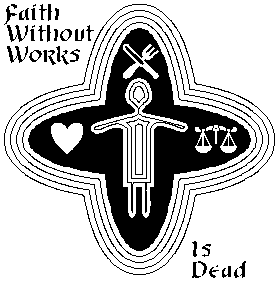
Faith, Works, and the Evidence of Genuine Belief

I. Introduction

  • Passage from the Epistle of James
  • Focuses on the relationship between faith and works

II. Faith Without Works Is Insufficient (v. 14-17)

  • Faith alone is not enough to save a person
  • Works are essential to demonstrate genuine faith
  • Works are the visible evidence of a person's belief

III. The Necessity of Both Faith and Works (v. 18)

  • Genuine belief leads to action
  • Emphasizes the interconnectedness of faith and works
GOSPEL: Peter's Confession of Faith and Jesus' Predictions of His Death

Peter's Confession of Faith and Jesus' Predictions of His Death

I. Peter's Confession (v. 27-29)

  • Peter acknowledges Jesus as the Christ
  • Jesus commends Peter for his understanding

II. Jesus Foretells His Death and Resurrection (v. 31-33)

  • Jesus predicts His suffering, death, and resurrection
  • Peter rebukes Jesus for speaking of His death* Jesus rebukes Peter in return

III. The Call to Discipleship (v. 34-35)

  • Jesus emphasizes self-denial and the importance of following Him
  • Losing one's life for Jesus' sake leads to salvation

Clipart by Fr. Richard Lonsdale

Gospel Greek Lexicon

Gospel Greek Lexicon

give a word study fo xxxxxxxxxxxxxx dividing analysis into Etymology, Definition, Key occurrences in the New Testament, and Theological Significance for Catholics
ὁδός (hodós) - WAY or PATH

ὁδός (hodós) - WAY or PATH

The term "hodos" (ὁδός) is an ancient Greek word that originated from the Proto-Indo-European root *sod-, meaning "course" or "way."

The word has been used since the time of Homer, appearing frequently in ancient Greek literature and philosophy.

Definition:

In a literal sense, "hodos" refers to a physical path, road, or way, which connects one place to another.

Figuratively, it represents a course of action, a method, or a manner of proceeding, often indicating a journey or a path in life.

Key Occurrences in the New Testament:

  • Matthew 7:13-14 - Jesus speaks of the narrow and wide gates and the difficult and easy ways (hodos) that lead to life and destruction.
  • John 14:6 - Jesus declares, "I am the way (hodos), and the truth, and the life; no one comes to the Father, but by me."
  • Acts 9:2 - Saul asks for letters to the synagogues in Damascus so that he may bring those who follow "the Way" (hodos) to Jerusalem for punishment.
  • 1 Corinthians 12:31 - Paul encourages the Corinthians to seek a more excellent way (hodos), emphasizing love as the highest virtue.

Theological Significance:

Catholics understand Jesus Christ as the embodiment of the Way (hodos) and believe that salvation is found through following Him.

The concept of hodos underscores the importance of living according to the teachings of Jesus and the Catholic Church, emphasizing spiritual growth and the pursuit of holiness.

The idea of hodos also highlights the communal aspect of the faith journey, as Christians are called to walk together on this path, supporting and encouraging one another along the way.

ψυχή (psychē) - LIFE or SOUL

ψυχή (psychē) - LIFE or SOUL

The Greek word "psychē" (ψυχή) comes from the ancient Greek term meaning "breath," "life," or "soul."

It is derived from the Proto-Indo-European root *bhes-, which means "to blow" or "to breathe."

Definition:

In ancient Greek literature and philosophy, "psychē" refers to the essence or soul of a living being, often viewed as the source of life, consciousness, and identity.

In the New Testament, "psychē" generally denotes the life, spirit, or soul of a person, encompassing one's inner self and the immortal aspect of human existence.

Key Occurrences in the New Testament:

  • Matthew 10:28 - Jesus warns that humans should fear God, who can destroy both body and soul (psychē) in hell.
  • John 12:25 - Jesus says that those who love their life (psychē) will lose it, but those who lose their life for His sake will keep it.
  • Romans 11:3 - Paul asks, "If God did not spare the natural branches, neither will he spare you," implying that everyone is subject to God's judgment on their lives (psychē).
  • 1 Corinthians 15:45 - Paul refers to the "first Adam" as a living being (psychē) and Jesus as a life-giving spirit (pneuma).

Theological Significance:

Catholics understand "psychē" as the spiritual and immortal component of human beings, distinct from the physical body.

The concept of "psychē" emphasizes the sacredness of human life and the intrinsic value of each individual, as every person possesses an eternal soul created in the image of God.

The idea of "psychē" also highlights the importance of spiritual growth and the pursuit of holiness, as Catholics are called to care for their souls and seek eternal salvation through faith in Jesus Christ.

ἀπαρνέομαι (aparneomai) - TO DENY

ἀπαρνέομαι (aparneomai) - TO DENY

The Greek word "aparneomai" (ἀπαρνέομαι) is a compound verb composed of the negative prefix "a-" (ἀ-), which means "not" or "un-," and "parneomai" (παρνέομαι), which means "to refuse" or "to deny."

The word "parneomai" originates from the Proto-Indo-European root *per- ("to traffic in, to sell"), which has a semantic connection to the idea of rejecting or denying something.

Definition:

The primary meaning of "aparneomai" is "to deny" or "to disown."

It can also mean "to reject," "to refuse," or "to renounce," indicating the act of distancing oneself from someone or something.

Key Occurrences in the New Testament:

  • Matthew 16:24 - Jesus tells His disciples that they must deny (aparneomai) themselves and take up their cross if they want to follow Him.
  • Mark 8:34 - Jesus emphasizes that those who want to follow Him must deny (aparneomai) themselves and take up their cross.
  • Luke 9:23 - Jesus teaches that self-denial (aparneomai) is essential for following Him and inheriting eternal life.
  • Titus 2:12 - Paul encourages believers to deny (aparneomai) ungodliness and worldly desires, instead living in a manner that reflects righteousness and self-control.

Theological Significance:

Catholics understand the concept of "aparneomai" as a call to reject sin and worldly temptations, focusing instead on following Jesus Christ and His teachings.

The idea of "aparneomai" emphasizes the importance of self-denial and self-sacrifice as essential aspects of the Christian life, reminding believers that authentic discipleship often requires a countercultural stance.

Catholics see self-denial as a way to grow in holiness and become more united with Christ, ultimately leading to the transformation of one's life and the attainment of eternal salvation.

Sunday Planner

by Fr. Lawrence Mick
2018 Column

The third Sunday of September is designated worldwide as Catechetical Sunday. It is a day to acknowledge and pray for those who serve as catechists for the parish and also a time to reflect on the breadth of the catechetical ministry itself. One aspect of that breadth is the role of parents in catechizing their children, so the materials from the national office for celebrating this day include an optional blessing of parents. If you ask catechists to come forward or to stand for their blessing, be sure to include catechists for Christian initiation, adult faith formation leaders and pre-school catechists along with the elementary and high school ministers.

The theme for 2024 is “Lord, when did we see you hungry” That theme reminds us of reflects our call to missionary discipleship.  As St John Paul II reminded us: The universal call to holiness is closely linked to the universal call to mission. Every member of the faithful is called to holiness and to mission. We are called to be eucharist by word and action to our brothers and sisters in Christ. Our times cry out for this kind of holiness, one inflamed by the ardent determination to bring as many of our brothers and sisters as possible to Christ.

The first reading reminds us faith begins with listening to God’s word but often leads to suffering that drives us to rely on God. The epistle insists faith is dead if it does not lead to good works. In the Gospel, Jesus makes it clear that professing faith in him must be lived out and will lead to suffering for his followers as it will for him.

The reason that suffering so often accompanies faith is that following Jesus requires us to work for justice and care for the needy in society. This always arouses enmity from those who live by greed and power, and they are usually the ones who have the money and power to impose their will on others. So, like the prophet Isaiah in ancient times, today’s prophets are often abused and even killed by those whose power is threatened by the truth.

Catechists, too, may experience opposition at times if they teach the fullness of the Catholic tradition, which includes a large body of social teaching calling us to work for justice and peace. Preachers may also find resistance to some aspects of Catholic teaching that disturb the rich and powerful in society. But this kind of opposition is not limited to church ministers. Every Catholic is called to spread Catholic teaching beyond the church walls and to witness to the truth of Christ’s teaching in our world. That will bring opposition in many situations, so good catechesis must provide both the knowledge and the commitment to follow Christ when it is convenient and inconvenient.

The above paragraphs might give preachers some thoughts for the homily today, and they might also provide a number of concerns to shape the general intercessions and the choice of hymns.

SOURCE: Fr. Mick’s column was originally published in CELEBRATION, the pastoral and worship planning resource which served readers from 1972 until 2019. 

Who Do You Say that I Am?

by Mary M McGlone, CSJ