

COMMENTARY

SOURCE: The Mass Readings Explained
Jesus’ prediction of his own suffering and death as the Messiah is a crucial part of God’s plan for salvation, and any attempt to avoid or control this outcome would undermine God’s purpose.

SOURCE: Hearers of the Word
Jesus’ identity as the Messiah is explored through various perspectives, and following him requires a deep understanding of his true nature and a willingness to deny oneself and take up one’s cross.

SOURCE: A Word Proclaimed
Jesus’ identity as the Son of Man and Messiah requires him to suffer and die, but ultimately leads to salvation, and his followers must be willing to face persecution and self-denial to follow him.

SOURCE: A Walk in the Word
True discipleship requires embracing the cross, denying oneself, and following Jesus, surrendering to God’s will and prioritizing eternal life over personal plans and desires.
Unpacking the Texts
Outlines of Readings
The Obedient Servant's Suffering and Vindication

Introduction: The first reading is from the Book of Isaiah, and it speaks of a servant who suffers yet remains obedient to God.
I. Introduction
- Prophecy from the Book of Isaiah* Focuses on a servant who suffers but remains obedient to God
II. The Servant's Unwavering Obedience (v. 5)
- Servant's commitment to God
- Willingness to face suffering
III. Description of Physical Abuse (v. 6)
- Servant endures humiliation and pain
- Symbolizes the persecution faced by the faithful
IV. Trust in God's Protection (v. 7)* Servant relies on God's help
- Faces suffering with divine assistance
V. Confronting Adversaries with Faith (v. 8)
- Servant confronts opponents confidently
- Trusts in God's vindication
VI. Confidence in God's Vindication (v. 9a)
- Servant expects ultimate justice from God
- Servant's faithfulness is acknowledged
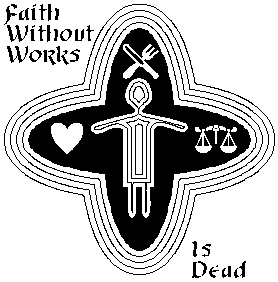
Faith, Works, and the Evidence of Genuine Belief
I. Introduction
- Passage from the Epistle of James
- Focuses on the relationship between faith and works
II. Faith Without Works Is Insufficient (v. 14-17)
- Faith alone is not enough to save a person
- Works are essential to demonstrate genuine faith
- Works are the visible evidence of a person's belief
III. The Necessity of Both Faith and Works (v. 18)
- Genuine belief leads to action
- Emphasizes the interconnectedness of faith and works
Peter's Confession of Faith and Jesus' Predictions of His Death
I. Peter's Confession (v. 27-29)
- Peter acknowledges Jesus as the Christ
- Jesus commends Peter for his understanding
II. Jesus Foretells His Death and Resurrection (v. 31-33)
- Jesus predicts His suffering, death, and resurrection
- Peter rebukes Jesus for speaking of His death* Jesus rebukes Peter in return
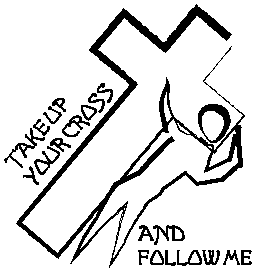
III. The Call to Discipleship (v. 34-35)
- Jesus emphasizes self-denial and the importance of following Him
- Losing one's life for Jesus' sake leads to salvation
Clipart by Fr. Richard Lonsdale
Gospel Greek Lexicon
Gospel Greek Lexicon

Sunday Planner
by Fr. Lawrence Mick
2018 Column
The third Sunday of September is designated worldwide as Catechetical Sunday. It is a day to acknowledge and pray for those who serve as catechists for the parish and also a time to reflect on the breadth of the catechetical ministry itself. One aspect of that breadth is the role of parents in catechizing their children, so the materials from the national office for celebrating this day include an optional blessing of parents. If you ask catechists to come forward or to stand for their blessing, be sure to include catechists for Christian initiation, adult faith formation leaders and pre-school catechists along with the elementary and high school ministers.
The theme for 2024 is “Lord, when did we see you hungry” That theme reminds us of reflects our call to missionary discipleship. As St John Paul II reminded us: The universal call to holiness is closely linked to the universal call to mission. Every member of the faithful is called to holiness and to mission. We are called to be eucharist by word and action to our brothers and sisters in Christ. Our times cry out for this kind of holiness, one inflamed by the ardent determination to bring as many of our brothers and sisters as possible to Christ.
The first reading reminds us faith begins with listening to God’s word but often leads to suffering that drives us to rely on God. The epistle insists faith is dead if it does not lead to good works. In the Gospel, Jesus makes it clear that professing faith in him must be lived out and will lead to suffering for his followers as it will for him.
The reason that suffering so often accompanies faith is that following Jesus requires us to work for justice and care for the needy in society. This always arouses enmity from those who live by greed and power, and they are usually the ones who have the money and power to impose their will on others. So, like the prophet Isaiah in ancient times, today’s prophets are often abused and even killed by those whose power is threatened by the truth.
Catechists, too, may experience opposition at times if they teach the fullness of the Catholic tradition, which includes a large body of social teaching calling us to work for justice and peace. Preachers may also find resistance to some aspects of Catholic teaching that disturb the rich and powerful in society. But this kind of opposition is not limited to church ministers. Every Catholic is called to spread Catholic teaching beyond the church walls and to witness to the truth of Christ’s teaching in our world. That will bring opposition in many situations, so good catechesis must provide both the knowledge and the commitment to follow Christ when it is convenient and inconvenient.
The above paragraphs might give preachers some thoughts for the homily today, and they might also provide a number of concerns to shape the general intercessions and the choice of hymns.
SOURCE: Fr. Mick’s column was originally published in CELEBRATION, the pastoral and worship planning resource which served readers from 1972 until 2019.
Who Do You Say that I Am?
by Mary M McGlone, CSJ