

SOURCE: The Jesuit Post

SOURCE: Archdiocese of Brisbane Homilies


SOURCE: Fr. Kevin’s Homilies
Moments of profound awareness in nature can transform our perspective on life, revealing the interconnectedness and beauty of existence amidst the routine of daily life.

Bishop Robert Barron


2024 HOMILY – Friends, “fools rush in where angels fear to tread”—and this week, I am going to go once more into the issue of faith and works, which has been dividing Western Christianity since the Reformation. Our second reading from the Letter of James is a key text on this issue, and its metaphor of healing—together with Paul’s forensic metaphor—orient us to the Catholic view of justification.
SOURCE: Word on Fire
Deacon Peter McCulloch
A Lively Faith
Is.35:4-7a; Jas.2:1-5; Mk.7:31-37
2024 EXCERPT: Have you ever tried to buy a drink from a vending machine, only to find the can empty?
Or bought another product at a supermarket, only to find the package contained nothing but air?
This is essentially what St James is talking about in our second reading today. He’s talking about people who claim to have faith, but never actually do anything about it. And he asks the question: is faith alone enough to get you into heaven? Or should that faith lead to good works of some kind?
On the Messianic Secret
2021 EXCERPT: Quite often in the Gospels, Jesus warns people not to tell anyone who he is. He does this after healing two blind men (Mt.9:30), after healing a leper (Mk.1:43-44), and after his Transfiguration (Mk.9:9).
He said it after healing the deaf man in last week’s Gospel (Mk.7.36).
And in today’s Gospel, near Caesarea Philippi, Jesus asks his disciples, ‘Who do people say that I am?’
Fr. Andrew Ricci
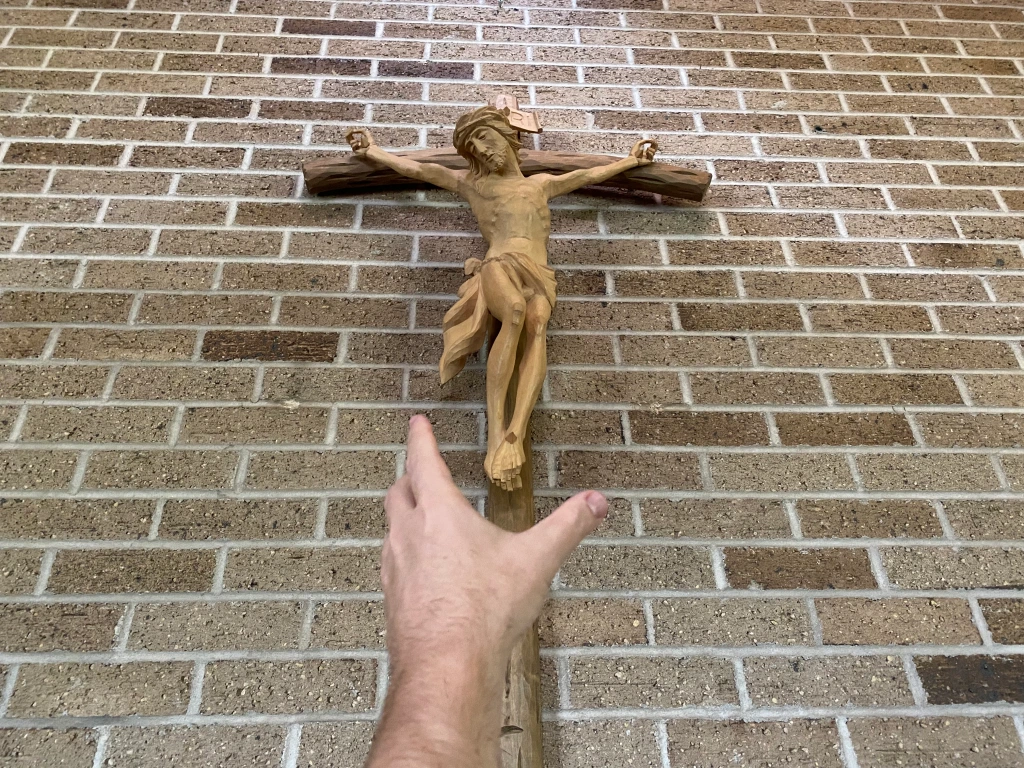
Take Up Your Cross
2021 PODCAST: Jesus makes it clear that to follow him means that we will carry a cross. As we confront whatever is hard and difficult in our lives today, may we open our hearts to God’s grace at work within us…trusting that the one who was victorious over his cross will transform our own as well.
Fr. Austin Fleming

Who is Jesus to You?
2015 EXCERPT: Truth is, many of us may have more than one answer to the question.
- Who I say Jesus is – on Sunday morning – might be different than who I say he is when I’m at work, in the middle of the week. On Sundays I might feel free sing his praise but on Wednesday I might be slow even to mention his name.
- Who I say Jesus is when I’m struggling with pain and loss might be different than who I say he is when all’s going well. The Lord is quick to point out in the gospel here that the weight of the cross will burden those who want to follow him. Sometimes our suffering deepens our faith in Jesus, but sometimes, in our pain, we feel he’s forgotten or abandoned us.
- Who I say Jesus is might change, a lot, as I grow older. As I grow from childhood into adolescence and from my teens into young adulthood, and on to shouldering life’s greater responsibilities, and in many ways , in every phase of my life my response to the Lord’s question, “Who do you say that I am?” will change and in many ways it should change as I change, and grow, and learn and deepen my faith and understanding.
Dominican Blackfriars


2021 EXCERPT: Today’s gospel is demanding. It is demanding because it makes us think about ourselves at a deep level, and because it makes demands on us.
As Christians we are disciples of Christ, we take our most fundamental identity from being in him. Baptism, we believe, can never be undone and it changes us at a level so fundamental that it can be described as ontological. By baptism we die to our former selves and enter a new, risen life. What we believe about Christ literally, that he died and rose, is to be believed about ourselves sacramentally.
It is a lifetime’s task to come to understand these truths about our identities, and to live them out daily and to the end. In today’s gospel, Peter begins confidently and correctly to acknowledge Jesus as the Christ – but he misunderstands the implications of this. When the identity of the Christ is revealed to him as involving Jesus’s suffering, death and resurrection, Peter does not accept this. He is firmly rebuked by Jesus.
Fr. Charles E. Irvin

Who Do You Think Jesus is for you Now

EXCERPT: Just who do you think Jesus is for you now? Is He just an interesting historical figure? A nice guy among a lot of other nice guys who throughout history have started religions? Is He, as the Muslims say, a great prophet? Is He one among many in a long line of Jewish rabbis?
Or is Christ Jesus God’s self-expression made human so that we can see Him, know Him, and love Him as one of us? And by “self-expression” I mean that Christ Jesus is God among us making Himself available to us. Christ Jesus is God the Son, the Second Person of the Blessed Trinity, made incarnate, made human flesh and blood for us so we can encounter Him in His Mystical Body, the Church.
As Christians we believe that God has made Himself available to us His children not just to our minds but available to in our humanity, in our whole persons, available to our minds, our hearts, our souls, and our bodies.
As Catholics we believe God has made Himself available to us in His Christ who comes to us following His resurrection in special ways in the seven sacraments of our Church. As Catholics we believe that God is especially present to us and within us in Holy Communion. The sixth chapter of St. John’s Gospel is especially dear and important to us. Quite simply I am a Catholic and a priest because of that chapter in St. John’s Gospel.
Fr. Joe Jagodensky, SDS
2021 EXCERPT: A friend of mine told me that he spends quiet time on a Sunday morning at Barnes and Noble. I looked the two of them up in my Catholic saints book but couldn’t seem to locate either one of them. It was enlightening to be enlightened by a personal response from him to a divine call. And it’s only a book store. One hour or three? Doesn’t matter when the quality is measured against evaluating the past week and renewing the new week to come.
It’s not the same as my rote ritual which was created to be such. The repeating of repeating words are intended to bring about that necessary future salvation.
Fr. George Smiga

The Man Who Played God

2012 EXCERPT: All of us have a cross, a difficulty, a pain that will not let us go. Now this cross can be in the area of our family, health, job, or finances. But in whatever area our cross is located, we want to put it down. We want our cross to go away. This is what is so discouraging about Jesus in today’s Gospel. Jesus says if we are to follow him, we have to take up our cross and carry it. We can understand why Peter argued with Jesus and tried to change his mind. But Jesus would not budge. Being a disciple means that our cross must be carried. So how do we do it? How do we find the strength to bear the burdens that are ours?
There is a very old movie called “The Man who Played God.” It is a story about an internationally-famous musician. He was very successful and accumulated a great deal of wealth. But was given a great cross to bear. He began to lose his hearing. No longer able to do the thing he loved, he became angry and embittered. He turned against his family and friends. He cursed God. He withdrew into his penthouse where he spent his time learning to lip-read, preparing for his deafness.
Fr. Anthony Ekpunobi, C.M.

2021 EXCERPT: Today the gospel spells out the manner in which Jesus Christ will save the world. It the reality of self-sacrifice: The Son of Man was destined to suffer. Sacrifice is a reality of life. It is the necessary struggle towards purification from the unnecessary attachments in life. Jesus Christ sets the example by tolling the path of sacrifice through self-donation. Self-sacrifice as donation implies that we be ready to make the substitution necessary to have peace and justice. The bitterness and resentment among us will reduce drastically if we adopt the example of Christ, namely, self-sacrifice.
Msgr. Joseph Pellegrino

Sacrificial Love

2024 EXCERPT: Peter said, “You are the Christ.” Then Jesus warned them not to tell anyone about Him. So why the secret? If Jesus was the Messiah as Peter proclaimed in today’s gospel from Mark, why be quiet about it? If Jesus healed people like He did throughout the Gospel of Mark, why keep it a secret? The reason is simple: you cannot understand Jesus’ Work or His Messianic mission, unless you understand and embrace the cross.
That’s where Peter went so wrong. It might seem reasonable at first. Jesus, Peter’s friend, said that he was going to Jerusalem where he would be killed. Peter, as a good friend had said, “Then don’t go. Don’t do this.” Peter did not yet understand the cross. He did not yet understand the depth of the sacrificial love of the Savior of the World. He was thinking in the way of the world.
Msgr. Charles Pope
Not Your Average Messiah
2021 EXCERPT: Jesus is Messiah and Lord, but He confounds every notion we have ever had about these titles. His power reaches perfection in “weakness” and He reigns from the cross. To the world this is utter absurdity, but the Lord insists that we meet Him at the cross. He chooses the foolish to shame the wise; He chooses the weak to shame the strong; He chooses the lowly and despised things of the world—and the things that are not—to nullify the things that are (cf 1 Cor 1:27-28). Let us journey to the cross and meet Him there; let us endure a little of His “folly.”
Our journey begins at Cesarea Philippi, a town “way up yonder” in pagan territory.
I. Confusion
II. Committee
III. Confession
IV. Clarification
V. The Cross
Bishop John Louis

2021 EXCERPT: If a double amputee athlete can run faster than millions of ‘physically’ able people, are the latter rather not the physically challenged? Again, most of us can see the black and white keys of the keyboard, but cannot play the organ; whereas, the blind Steve Wonder, for instance, who cannot see even the colour differentiation of the black and white keys, is wonderful on the keyboard. Who, then, is physically challenged: Steve Wonder or those who cannot play the keyboard?…
The music teacher of the blind Steve Wonder saw in him, not a physical challenge, but a talent. Similarly, in the blind who seek His healing by faith, Jesus sees not darkness or gloom, but the potential or ability to appreciate God’s glory. So, He heals them so that their potential of praising God flourishes. For example, in John 9, when people were debating why the man was born blind, Jesus said it was meant to reveal the glory of God. Thus, when Jesus eventually opened the eyes of the man, the latter praised God and His goodness.
Fr. Michael Chua

2021 EXCERPT: St Peter’s confession of faith is not only the turning point in St Mark’s gospel narrative but also a turning point in his relationship with the Lord. The disciple’s identity and mission pivots on the identity and mission of the Lord. To follow Him, which is to say to imitate Him, requires that they first know who He is. But to grasp that Jesus is the Messiah, is not the same as understanding what it means to be the Messiah. What the Lord does or must do, they must follow. Here, we see a breakthrough, a burst of light, a moment of enlightenment. But with every breakthrough there must be resistance, and with light, comes the shadow cast by darkness. On the one hand, Peter, the representative of all disciples, gets it but moments later we realise that he still has much to learn, to grow in both understanding and commitment.
Fr. Vincent Hawkswell
2024 EXCERPT: “Whoever wants to become my follower, let him deny himself and take up his cross and follow me,” Jesus says in this Sunday’s Gospel Reading. “Whoever wants to save his life will lose it, and whoever loses his life for my sake… will save it.”
Paradoxically, we have to die in order to live. If we try to live on our own, we will die.
Even Peter, who, inspired by God the Father, had just realized who Jesus was, did not understand this.
The Catholic faith is full of such paradoxes. For example, love runs counter to self-seeking: it is an exodus out of ourselves. Nevertheless, paradoxically, it is precisely the way in which we find ourselves, for love is what God made us for.
Fr. Tommy Lane
Taking up our cross after Jesus

EXCERPT: Recently I watched a video entitled Reconciliation: A Sacrament of Healing which is an interview with Sister Briege McKenna. During the interview, she relates an encounter she had with a young catholic woman at an airport…
That incident reminds me of today’s Gospel (Mark 8:27-35):
- The disciples had been with Jesus for a long time now, but they still did not really know him. The woman and her husband had been going to Mass but admitted it did not interfere in their lives.
- When Jesus told the disciples he would have to suffer and die, Peter objected (Mark 8:32). When Sr. Briege told the woman abortion is a sin and is murder, the woman said she was harsh.
- The disciples had a false understanding of Jesus so he corrected their false understanding by giving them sound teaching, telling them that anyone who wants to be a follower of his must renounce himself and take up his cross and follow him (Mark 8:34). The woman had a false understanding of sin and the Church’s teaching, and Sr. Briege corrected her false understanding.
Fr. John Kavanaugh, S.J.
Faith Doing Justice

EXCERPT: What good is it to profess faith without practicing it? Such faith has “no power to save.” The writer of the Epistle is very clear. Faith may be the central response in our relationship to God; but faith, like love, must find expression in our actions if it is to be real.
If I see someone starving and, making a quick getaway, bless that person with “Good-bye and good luck,” I have a faith problem. To say, “I hope you keep warm and well fed,” but to do nothing to help others in their bodily needs, is to have a thoroughly lifeless faith.
There are parts of scripture I may want to reject. “You cannot mean this. You will never demand this.” Yet faith does have its demands. It makes claims on us. Its implications are daunting.
The challenge faith puts to us in relating to the poor is no more scary than its challenge to the ways we relate to God. There is a pain in the heart of Christian faith itself, since its object is the mystery of God’s love revealed in Jesus’ death.
Bishop Frank Schuster
“Who Do You Say That I Am”
2021 EXCERPT: It seems like every Christmas or Easter a popular magazine or television show will make the claim that they can tell us who the historical Jesus was. Have you seen that? Next time you are at Barnes and Noble, here is a fun activity. Flip through any book or article about Jesus written by any contemporary author. It won’t take long before you notice that the Jesus depicted in the book or magazine looks a lot like the person writing it. If you are a democrat, clearly Jesus is a democrat. If you are a republican, clearly Jesus is a republican. If a zucchini wrote a book about Jesus, Jesus would be a zucchini. We sinners have a bad habit of only approaching Jesus in ways that makes us the most comfortable, listening the bits we like and discarding what makes us uneasy. We can all be guilty of it at times. Judging by our Gospel reading today, even the disciples often fell into that trap. It is amazing when you think about it. The disciples lived with Jesus, day in and day out. Some thought he was another John the Baptist, others thought he was another Elijah, and still others one of the prophets. They were all wrong, reading into Jesus what they themselves wanted to see.
Jesus asks the disciples “who do people say that I am?” And the disciples don’t know. Jesus then presses them with a more haunting question, “but who do you say that I am?” When it gets right down to it, this is perhaps the single most important question Jesus will ever ask us. What is your answer? Peter responded, “You are the Christ!”
Authenticity

2021 EXCERPT: For the most part, the youth I know are passionate. They want to make a difference. They do not want to be simply told to go to Church. They want a hands-on experience of feeling the power. They want authenticity.
Look at the youth day in Brazil a few years ago: three million of them flocked to Pope Francis. He stands for something they want, a hero who points the way. He shows us the real Jesus. The Jesus who is counterculture, brave, strong and determined, or He would never have endured His excruciating passion and death. And after His resurrection, He proudly wore His scars as a sign that the Kingdom of God is won with a lot of sweat.
Jesus is about a way of life. He is about the decisions we make in business and school. He is about honesty, caring, and concern for others. He is about ethics, fidelity, and the truth. He is about making relationships work, and about keeping one’s word.
