
Related Podcasts

Prayers of the
Faithful
The Church
Governing Authorities and Salvation of the World
Those Burdened by Adversity or Difficulties
The Local Community
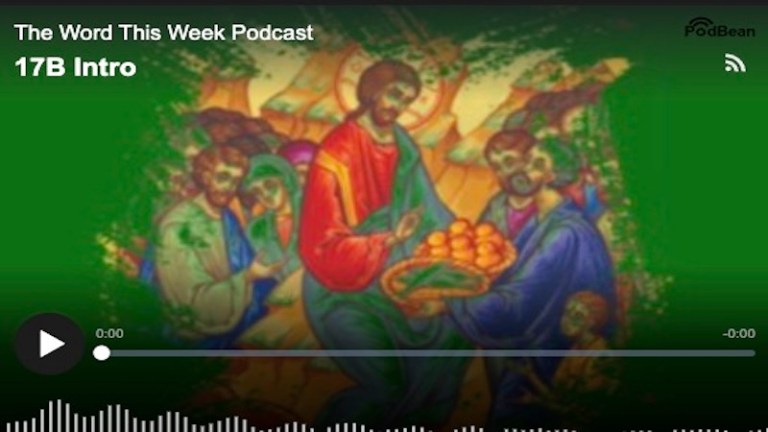
Jn 6:1-15 Wicker Baskets
TRANSCRIPT
TONYA: Good morning. Thanks for joining us again this week. We will be discussing the Gospel Reading from John 6:1-15. In this passage, we see Jesus performing a miracle by feeding a large crowd of people with just five loaves of bread and two fish. This miracle not only shows Jesus’ power and authority, but it also reveals his compassion and concern for the people’s physical needs.
FR. DON: Jesus, as the Bread of Life, not only satisfies our physical hunger but nourishes our souls. When we put our trust in Him, we experience abundance and joy, even when we feel like we don’t have enough. So if you are feeling spiritually hungry or dissatisfied, consider turning to Jesus as the Bread of Life. He is always ready to nourish and sustain you, no matter what challenges you may face.
TONYA: You mean like going to Mass? Receiving the Eucharist?
FR. DON: Yeah! That’s important. But we should also trust that God will provide for us everywhere at all times, not just Sunday morning when we walk up the aisle – even in seemingly impossible situations at home or at work. Like the boy who shared his five loaves and two fish, we’re called to share what we have and watch God multiply our resources.
TONYA: Okay. I get that. But, Father, if you don’t mind. Can we first talk about the Eucharist?
FR. DON: Sure. That would be proper. The Eucharist is, after all, the source and summit of the Christian life. And it definitely fits into this Sunday’s Gospel.
The multiplication of loaves and fishes is a powerful sign of the Eucharistic miracle that takes place during the Mass. Just as Jesus transformed the bread and fish to feed the multitude, He transforms the bread and wine into His Body and Blood during the consecration.
TONYA: That’s a beautiful parallel!
FR. DON: When Catholics receive the Eucharist, which is the real presence of Christ, during the Communion rite, they consume the consecrated bread and wine. It is the best spiritual nourishment that we can receive. It is through this sacrament that we are united with Christ and with one another, and it strengthens us to live out our faith in the world.
TONYA: This personal moment with Jesus, it’s kinda like when the crowd was hanging out with Him in the desert when He multiplied the bread and fish. And, get this, even when we’re done with communion, the priest gathers all the leftover pieces, like the Apostles did in the wicker baskets. That’s part of it too, right? Can you explain that a bit more?
FR. DON: Yes. But it more than that. We have to move beyond the wicker baskets. After Communion, any remaining consecrated hosts are collected, and the priest places them in the tabernacle. Although Catholics believe that the presence of Christ remains in the consecrated hosts, even after Mass, we do not remain in church after Mass. We go out into the world, back to our neighbors and families. Back to work. The tabernacle serves as a sacred space where the Eucharistic presence of Christ is reserved for the sick, homebound, or those who wish to return throughout the week to pray in the presence of the Blessed Sacrament. I am not denying that.
TONYA: Just as the loaves were multiplied and nothing was lost or wasted, similarly, the Eucharistic presence of Christ after communion is kept safe and secure in the tabernacle. I like that. Every host and crumb.
FR. DON: Okay. That is one way of saying it. I guess.
TONYA: I once heard a homily how the Gospel is not so much about Jesus’ power to perform a miracle as it is about generosity, and how it can spread. The homilist proposed that there was enough food among the crowd from the start, but the people needed to share it so that everyone could be fed.
FR. DON: I appreciate the message of generosity in that interpretation, Tonya, but I’m afraid it misses the point of the Gospel. This passage is indeed about a miracle, emphasizing Jesus’ divine power and his role as the Bread of Life. The narrative clearly indicates that the crowd was in a “desolate place” with only five loaves and two fishes available. This scarcity sets the stage for a miracle that surpasses human understanding and underscores Jesus’ role as the provider of both physical and spiritual nourishment.
TONYA: So, then how should we understand the role of generosity? I mean, that really speaks to me. I can put my teeth in it. No pun intended.
FR. DON: Generosity still plays a vital role, but it is God’s generosity providing for His people through Jesus, not just the generosity of the crowd.
TONYA: But it would still be a miracle, wouldn’t it, if because of the boy’s example people were inspired to be generous, too?
FR. DON: Let me finish.
TONYA: Sorry. Go ahead, Father.
FR. DON: It’s important to maintain the integrity of the miracle as it is presented. This story should not be reduced to a simple lesson in sharing or explained away through rationalistic or humanistic interpretations. It is about God’s generosity. Seeing the story this way, takes nothing away from the young boy. How he offers his meager provisions to Jesus exemplifies the trust and selflessness we are all called to demonstrate as followers of Christ. But here is the point. When we give what we have to Jesus, even if it seems insufficient, He can multiply it beyond our expectations.
TONYA: I agree. That’s what miracles are!
FR. DON: Miracles, whether we read about them in the Old or the New Testament, point to God. They demonstrate God’s power, God’s love for His people. Those who struggle to believe in these miracles may need to reexamine their understanding of God’s nature.
TONYA: God’s nature? Okay, let’s not get too deep. But what you have said so far makes sense. On some days, I have very little to give. I think I am not good enough for God, that God will not forgive my sins, or that I am so rotten that God wants no part of me.
FR. DON: And that is what they call stinking thinking.
TONYA: But when I give the little I have to Lord, he accomplishes so much. Only by the Grace of God, am I able to do ministry. It’s all about him.
FR. DON: But if you are looking for another interpretation, how about this one? As Catholics, we immediately recognize the Eucharistic symbolism contained in this miracle, but remember, the Mass has two parts: The Liturgy of the Eucharist, of course; but also the Liturgy of the Word. The Church Fathers interpreted the loaves and fish as symbols of the Word of God.
TONYA: That’s different. Can you say more?
FR. DON: People who are hungry for spiritual nourishment, sometimes avoid the Old Testament. They see it primarily as a historical narrative. But it has many symbols and hidden truths. Small fragments, if you will, that when looked at closely, contain much sustenance. Every verse. Every word. I suppose. But sometimes it requires a lot of study.
TONYA: What you are saying can be beneficial. That’s all find and dandy. But I don’t know Hebrew or Greek. But if we are going to move from talking about the Eucharist to the Word of God, then I suppose we can then explore other areas, too?
FR. DON: What are you suggesting?
TONYA: It’s kind of hard to explain. But I think Father Charles Irvin in his homily this week does a find job. He starts out by talking about the negative impact of the word “can’t” has on our lives. He says that this word deadens our spirit and limits our potential. In the context of the Gospel account of the multiplication of loaves and fishes, he then goes on and for the rest of his homily talks about how we can overcome the despair of thinking something is impossible, as the apostles initially did.
FR. DON: Father Irvin passed away in 2021. May he rest in peace. He was a highly regarded homilist in the Diocese of Lansing, who had a gift for touching people’s hearts. The Word This Week website showcases his homilies every week. In this Sunday’s homily, he speaks on an important aspect of our spiritual lives: our beliefs can shape our reality. In the Gospel account, Philip and the other apostles gave up before even attempting to find a solution, declaring that it was impossible to feed the multitude with the little they had. However, Jesus shows us that, with faith and trust in God’s providence, what seems impossible can become possible.
TONYA: So, how can we apply this lesson to the challenges we face?
FR. DON: Instead of focusing on what we think we can’t do, we should concentrate on what is possible through God’s grace and support from those around us. We may not be able to perform miraculous feats like Jesus, but we can accomplish far more than we imagine when we trust in God’s power and have faith in His plan.
Father Irvin also acknowledges that there are certain things we cannot do or control, just as Jesus experienced limitations during His life. How can we reconcile this with the idea of overcoming the word “can’t”?
It’s crucial to strike a balance between recognizing our limitations and maintaining hope. While it’s true that we cannot control every aspect of our lives, we can choose how we respond to challenges and obstacles. Even in the face of adversity, we can choose to remain faithful, resilient, and compassionate, just as Jesus did.
TONYA: I like how Father Irvin concludes his homily: “So what’s the worst four-letter word,” he says “that we can use when God is trying to reach us, asking us to do something for Him? What’s the worst response we can give Him? It’s to throw the word can’t at Him.” He continues “Just what are we going to give God? Our despair? Or are we going to give God our hope, our faith, our trust, and our love … and then let Him go to work in what we give Him? If we do, everything can change.”
FR. DON: Now that is a great way to end this segment of our podcast. May God, indeed, change all of our lives.
TONYA: We’ll be back.
 Highlight text or double-click a paragraph anywhere on the site to ADD TO NOTES. You can also click ASK AI to copy your selection to the clipboard with a command prompt, ready for you to paste manually into the chat above.