JAN 5, 2025


Epiphany - YEAR C
Impractical Gifts

The Maasai tribe’s deep cultural connection to cattle and their unique expressions of love through giving highlight the transformative power of generosity and the significance of relationships over material wealth.
Background and Context:
- The Maasai Tribe: Known for their fierce warriors and deep cultural connection to cattle, the Maasai people believe all cattle were divinely given to them.
- The Magi: Wise men from Persia who brought gifts to the newborn Jesus, symbolic of giving from the heart without expectation.
Discussion Points:
The Nature of Gift Giving:
- How does the concept of the Maasai tribe's gift of cows to America relate to the Magi's gifts?
- Discuss the perception and cultural differences in what constitutes a "valuable" or "practical" gift.
- How do these stories challenge or affirm your own views on giving?
Personal Reflection on Giving:
- Reflect on a time when you received a gift that was not practical but was memorable. Why did it stand out to you?
- What are the gifts or talents you possess that might not seem practical but carry deep meaning when shared?
- Share a personal experience where giving changed you as a person, regardless of the recipient's reaction.
Lessons from the Gifts of the Magi:
- What might have been the significance of the gifts of gold, frankincense, and myrrh for Mary and Joseph, and how does this relate to our own lives?
- Consider the idea that the act of giving changes the giver. How have you seen this at work in your life or community?
Contemporary Applications:
- Discuss the idea that everyone has something valuable to give, whether it is time, skills, or resources. How do you identify those gifts in yourself?
- In what ways can communities come together to give in times of need, taking inspiration from the Maasai's gesture?
- How can we ensure our acts of giving are rooted in love rather than obligation or expectation?
Closing Reflection:
- Reflect on the sermon’s assertion that in giving, we place our gifts into "the tiny hand of God." What does this metaphor mean to you in practical terms?
- How can these insights from the sermon be applied in the coming week in both personal life and community activities?

The video provides an opportunity to explore the topic of the reflection in greater depth. By offering additional perspectives and insights, the video enhances the understanding of the text, though it is not part of the original content.
JUSTICE

Epiphany - YEAR C
A Call to Search
and Respond
EXCERPT: Epiphany invites us to leave the familiar and search for Christ in unlikely places. What gifts will we bring when we find him?
- Instead of myrrh, we could visit the sick and dying.
- Instead of frankincense, we might advocate for poor families, especially single parents and newborns.
- Instead of gold, we could support shelters for homeless families, or international programs for children and the elderly.

The video provides an opportunity to explore the topic of the reflection in greater depth. By offering additional perspectives and insights, the video enhances the understanding of the text, though it is not part of the original content.
STEWARDSHIP

WHAT WOULD YOU DO? (7:47) — An atheist harasses a Christian family for praying in public before eating their meal.
Epiphany - YEAR C
Being a Visible Witness
Summary: The feast of the Epiphany of the Lord celebrates how God made himself known to all the nations, which is symbolized through the visit of the foreign Magi. As stewards, we are called to help the Church in her efforts to make Christ known to the ends of the earth and we can do this by simply being a visible witness of our faith. Let us strive to make small actions that display our love for Christ such as saying grace before meals in public, praying the rosary on the bus or saying “God bless you” when someone sneezes or we say goodbye.

ADDICTION AND
RECOVERY
1—Admission of Powerlessness
2—Recognition of a Higher Power
3—Decision to Turn Life Over to a Higher Power
4—Taking a Moral Inventory
5—Admission of Wrongdoings
6—Willingness to Remove Character Defects
7—Asking for Spiritual Help
8—List of Amends
9—Compensation for Past Harms
10—Continuing Inventory and Admissions
11—Seeking Prayer and Meditation
12—Carry the Message Forward
Epiphany - YEAR C
SUNDAY‘S READINGS
- Isaiah 60:1-6: Jerusalem is called to arise from darkness and shine with God’s glory.
- Ephesians 3:2-3a, 5-6: The mystery of Christ is revealed to the world.
- Matthew 2:1-12: The Magi follow the star to find the light of Christ.
The content below has been generated by THE WORD THIS WEEK Catholic Assistant, employing advanced AI technology.
Admission of Powerlessness (Is 60:1-6): Just as the Israelites acknowledge their need for God’s light in times of darkness, the first step of the 12-step program invites individuals to recognize their powerlessness over their addiction and seek help from a higher power.
Recognition of a Higher Power (Is 60:1-6): The second step aligns with the prophetic vision of God’s glory, as it encourages individuals to believe in a power greater than themselves, much like the Israelites seeking God’s light and guidance.
Decision to Turn Life Over to a Higher Power (Eph 3:2-3a): This step relates to St. Paul’s acknowledgement of God’s grace and calling in his life, which empowers him to share the Gospel. Similarly, those in the 12-step program commit to surrendering their will to their higher power.
Taking a Moral Inventory (Eph 3:2-3a): Paul reflects on his past actions and experiences as a persecutor of Christians before his conversion. This mirrors the fourth step, which asks individuals to reflect honestly on their past actions and character traits.
Admission of Wrongdoings (Eph 3:5-6): Paul speaks of the mystery of Christ being revealed to him, just as the fifth step calls for individuals to disclose their wrongdoings to themselves, their higher power, and another person.
Willingness to Remove Character Defects (Mt 2:1-12): The Magi’s journey to Jesus represents a quest for truth and a desire for transformation. This mirrors the willingness to change and be rid of personal shortcomings as seen in the sixth step.
Asking for Spiritual Help (Mt 2:1-12): The Magi sought divine guidance in their journey, following the star that led them to Jesus. Similarly, the seventh step encourages individuals to seek spiritual help in their quest for recovery.
List of Amends (Is 60:1-6): The prophetic vision of restoring relationships and healing connections resonates with the eighth step’s focus on creating a list of people one has harmed and the amends that need to be made.
Compensation for Past Harms (Eph 3:5-6): As St. Paul emphasizes the unity of Jews and Gentiles in Christ, the ninth step calls for individuals to make direct amends to those they have harmed, promoting healing and reconciliation in relationships.
Continuing Inventory and Admissions (Mt 2:1-12): The Magi’s journey reminds us of the importance of ongoing self-reflection and spiritual growth, which aligns with the tenth step’s emphasis on ongoing personal assessment and amends.
Seeking Prayer and Meditation (Eph 3:2-3a): St. Paul’s commitment to spreading the Gospel through God’s grace reflects the eleventh step’s call for daily prayer and meditation to strengthen one’s spiritual connection with their higher power.
Carry the Message Forward (Is 60:1-6): The prophet Isaiah’s vision of the nations walking in God’s light and bringing glory to the Lord corresponds with the twelfth step, which encourages individuals to share their experiences and support others in recovery.

CHRISTIAN
ART

Reflection on the Reliquary of the Journey and Adoration of the Magi
Made in Limoges, France, Circa 1200, Champlevé enamel on gilded copper; rock crystal; wood core © The Metropolitan Museum, New York
In our own search for the Lord, there will often be dark forces, like Herod, that try to deflect us from our search. Yet, the story of the magi assures us that the guiding light of the Lord shines in that darkness and will always conquer. Our enamel reliquary depicts on the cover the Magi from the East wearing crowns like European kings. The one who leads points confidently towards a star ahead, while the second ruler is more circumspect, keeping his arm in check. The third, unsure, points back in the direction from which they came. On the lower panel, the kings have just dismounted in Bethlehem, still wearing their spurs.
Epiphany - YEAR C
Adoration of the Magi (Fra Angelico and Filippo Lippi)
NATIONAL GALLERY OF ART (2:53)

PAINTINGS UP CLOSE (2:07)


Epiphany - YEAR C
Rise Up Shepherd and Follow
This spiritual draws a connection between the shepherds who were told by the angels to go and see the newborn Jesus, and the Magi who followed the star to Bethlehem.
The lyrics of “Rise Up, Shepherd, and Follow” encourage listeners to follow the path to Christ, just as the shepherds and the Magi did. The song speaks of the star in the east that led the Magi to the Savior, and its message resonates with the themes of faith, guidance, and the importance of responding to God’s call.
Incorporating this African American spiritual into a reflection on Matthew 2:1-12 can offer a meaningful perspective on the story of the Magi and the significance of their journey to find the newborn King.
SPIRITUALITY OF
CONFLICT
Epiphany - YEAR C
THE WORD THIS WEEK
PREACHING CONNECTION
The conflict in Matthew 2:1-12 can provide insights into a spirituality of conflict. The story highlights the tension between King Herod, who felt threatened by the wise men’s news of a newborn king, and the Magi, who were guided by the light of the star to seek Jesus.
Some key points to consider:
- Hope and trust: The wise men’s journey ultimately led them to Jesus, symbolizing hope and the importance of trusting in God’s plan.
- Fear of change: Herod’s fear of the wise men’s news can be seen as a metaphor for the fear of change that often underlies conflict. Embracing change and trusting in God’s guidance can help us navigate difficult situations.
- Overcoming obstacles: The wise men faced obstacles on their journey but were undeterred, continuing to follow the light of the star. This can inspire us to persevere through conflicts, trusting in our faith and seeking guidance from above.
- Discernment: The wise men’s decision to avoid returning to Herod demonstrated their discernment and wisdom. In times of conflict, it’s essential to seek wisdom and discernment to make the right choices.
Catholic Charities supports a vast network of soup kitchens and food pantries, emergency shelters, temporary and transitional housing and permanent affordable housing to help homeless families and individuals.
Epiphany - YEAR C
A Call to Search
and Respond
EXCERPT: Epiphany invites us to leave the familiar and search for Christ in unlikely places. What gifts will we bring when we find him?
- Instead of frankincense, we might advocate for poor families, especially single parents and newborns.
- Instead of gold, we could support shelters for homeless families, or international programs for children and the elderly.
- Instead of myrrh, we could visit the sick and dying.
Like the Magi, we are guided by grace, which acts as our star, leading us to the hidden places where Christ is found. The Magi brought gifts fit for royalty, but today Christ is found not in palaces, but among the poor.
Epiphany reminds us that each day Christ manifests himself in the world’s lesser places and among surprising people. These are the places to bring our gifts, starting with the most important one: ourselves.
Epiphany - YEAR C
Reading the Signs

EXCERPT: The contrast between the acceptance by the Gentile wise men and the rejection by the Jewish king underscores the message that Jesus is the “light of all peoples.” No one is excluded. The chosen Jews and the foreigners from “the ends of the earth are members of the same body and sharers of the promise.” Those who exclude others from the life of the human family are being unfaithful to the Son “revealed to the nations.” Those who accept only the rich and powerful are being unfaithful to the God who shall have pity for the lowly and the poor.
SOURCE: Sunday Website
LIFE ISSUES — TOPICAL LIBRARIES
Editor: Jerry Novotny OMI, LifeIssues.Net
Currently, 13511 articles organized into the following Topical libraries:
Epiphany - YEAR C

SOURCE: Priests for Life
LifeIssues.Net Homilies
Editor: Jerry Novotny OMI
Epiphany – the meaning is pervasive
Tom Bartolomeo
The story of the Christ-Savior, as God chose, would still have unwound from a wood cradle to a crucifixion tree. Christ, the light of the world and author of life itself came to conquer the darkness by his death. The Magi came to enlighten us, to seek Him, too, not hide from God’s law but defend his truth whatever danger we face as sojourners in this world. Each of our epiphanies will be linked to the Magi’s dangerous journey, believe me. The Magi, the three wise men, came to instruct us about this.
Defusing Unexploded Bombs (Epiphany)
Proclaim Sermons
Many forces in human life can shatter families and ruin friendships. But we can defuse explosive situations by showing gentleness and patience, speaking the truth in love, and forgiving others as Christ has forgiven us.
Let’s Make the Magi’s Journey for Ourselves (Epiphany)
Proclaim Sermons
The people we call the “wise men” were moved to make a difficult journey to discover divine truth. What they found when they finally made it past Jerusalem – and the lying king there – and got to Bethlehem was a different king: one who was, himself, the truth. We can search for the Christ child today and discover his eternal truth for ourselves and others.
Joining Humanity and Divinity
Douglas McManaman
It is fitting that we exchange gifts at Christmas, because our life in Christ is a gift exchange. He came among us precisely to exchange gifts. His Incarnation is an offer of exchange, and the exchange is: If you give me your humanity, I will give you my divinity.
STEWARDSHIP
RESOURCES
Coming Soon!
WHAT WOULD YOU DO? (7:47) — An atheist harasses a Christian family for praying in public before eating their meal.
Epiphany - YEAR C
Being a Visible Witness
Summary: The feast of the Epiphany of the Lord celebrates how God made himself known to all the nations, which is symbolized through the visit of the foreign Magi. As stewards, we are called to help the Church in her efforts to make Christ known to the ends of the earth and we can do this by simply being a visible witness of our faith. Let us strive to make small actions that display our love for Christ such as saying grace before meals in public, praying the rosary on the bus or saying “God bless you” when someone sneezes or we say goodbye.
As we continue along in this wondrous season of Christmas, we are invited to reflect on the Epiphany of the Lord this Sunday. The word epiphany means “to make manifest” or “to make known.” So on this feast day we are celebrating how God made himself known to all the nations, which is symbolized through the visit of the foreign Magi. As stewards, we are called to help the Church in her efforts to continue to make Christ known to the ends of the earth.
The way of stewardship is essentially a call to evangelization. The greatest gift we can share with others is not money or food, but the knowledge and love of Christ. Pope Francis says that “we cannot keep ourselves shut up in parishes, in our communities, when so many people are waiting for the Gospel!” We must go out of our comfort zone to bring others to Jesus.
One way we can evangelize others is by simply living as visible Catholic disciples in our world. In today’s secular culture, any act of religiosity is seen as a radical witness of our faith. For example, whenever we are eating in public, we can begin with the sign of the cross and our grace before meals. Moreover, St. John Paul II said that we should not be “ashamed to recite the Rosary alone, while you walk along the streets to school, to the university or to work, or as you commute by public transport.” Let us strive to be a sign of our faith to the world.
SOURCE: Archdiocese of Toronto / This resource may be reproduced without permission for non-commercial purposes by dioceses/eparchies, parishes and other religious organizations such as religious orders, etc.

Christopher and Wendy West answer questions about faith, life, love, and sexuality, in light of John Paul II’s Theology of the Body.
RELATED
Pope John Paul II’s
Theology of the Body
A Cliff Notes’ Version (PDF)
Epiphany - YEAR C
CONNECTION TO SUNDAY‘S READINGS
Rise and Shine: The Beauty of the Human Body
The content below has been generated by THE WORD THIS WEEK Catholic Assistant, employing advanced AI technology. It is important to note that it is not officially connected with Christopher West or the Theology of the Body Institute.
- Isaiah 60:1-6: Jerusalem is called to rise and shine, reflecting God’s glory.
- Ephesians 3:2-3a, 5-6: The mystery of Christ is revealed through the Church.
- Matthew 2:1-12: The Magi honor the physical presence of Jesus.
Today’s readings invite us to reflect on the beauty and sacredness of the human body, a theme emphasized by the late Pope John Paul II in his Theology of the Body. As we explore the wisdom of Isaiah, the letter to the Ephesians, and the Gospel of Matthew, we discover that the divine glory is revealed through Jerusalem, the Church, and Christ’s human form.
In the book of Isaiah, Jerusalem is called to “rise and shine” (Isaiah 60:1), for the glory of the Lord has risen upon her. This magnificent imagery highlights the transformative power of God’s presence in our lives. We, too, are called to rise and shine, reflecting God’s glory in all that we are and all that we do.
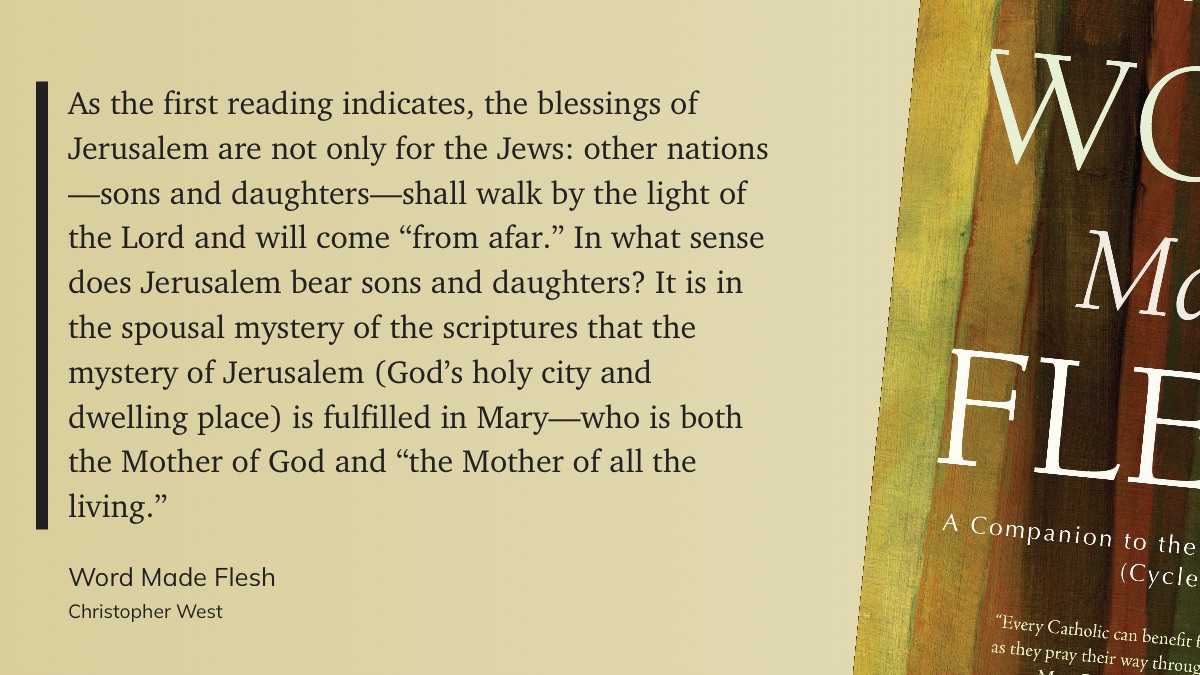
As Christopher West indicates, the blessings of Jerusalem are not only for the Jews, but for all nations. Jerusalem, as God’s holy city and dwelling place, becomes a beacon for all those who seek the divine light. Isaiah speaks of a time when “sons and daughters” shall walk by the light of the Lord and will come “from afar” (Isaiah 60:4). This prophetic vision invites us to recognize that God’s light and love extend far beyond any one people or place, calling all of humanity into a deep and abiding relationship with the divine.
Moreover, West underscores that the mystery of Jerusalem is fulfilled in the person of Mary, the Mother of God, who is also “the Mother of all the living.” Through her ‘yes’ to the divine will, Mary becomes the living embodiment of Jerusalem, bearing both the Son of God and, in a spiritual sense, all the sons and daughters who come to walk in the light of the Lord. In this way, Mary models for us the spousal mystery of the scriptures, inviting each of us to open our hearts to the divine presence and bear witness to the love of God in our own lives.
The letter to the Ephesians reminds us that the mystery of Christ is revealed through the Church (Ephesians 3:2-3a, 5-6). This revelation invites us to examine our own role within the Church and to consider how we contribute to the ongoing revelation of Christ’s presence in our world.
In the Gospel, we encounter the story of the Magi, who traveled far and wide to honor the physical presence of Jesus (Matthew 2:1-12). The Magi’s recognition of Christ’s divinity invites us to celebrate the gift of our own humanity, created in God’s image.
The Magi’s reverence for the Christ Child serves as a powerful example of how we, too, should honor and celebrate our own humanity. By acknowledging the divine presence within each of us, we embrace the truth that we are created in God’s image and likeness. This recognition invites us to treat our bodies with the dignity and respect they deserve, nurturing our physical and spiritual well-being as a unified whole.
Pope John Paul II’s Theology of the Body offers us a lens through which we can appreciate the profound beauty and dignity of our human bodies. We are not merely souls trapped within physical forms, but rather, we are ensouled bodies, fully human and fully alive. The human body, imbued with the divine spark of life, is a temple of the Holy Spirit, a reflection of God’s own glory.
As we journey through this life, let us embrace the call to rise and shine, allowing our bodies and our lives to become beacons of hope and love. May we celebrate the sacredness of the human body and recognize the divine presence that dwells within each of us. And may we, like the Magi, honor the physical presence of Jesus in the Eucharist and in our neighbors, remembering that each of us is created in the image of God.

VOCATIONS




Epiphany - YEAR C

THE WORD THIS WEEK
PREACHING CONNECTION
Vocations as a Journey of Illumination
- Isaiah 60:1-6: Darkness turns to light as the prophet speaks of Jerusalem’s glory.
- Ephesians 3:2-3a, 5-6: The mystery of Christ is revealed to the Ephesians.
- Matthew 2:1-12: The Magi follow the star to find the newborn King.
Preaching Idea: Just as the Magi were guided by a star, vocations to priesthood and religious life are journeys of illumination, where individuals discern their calling through reflection and prayer. Encourage your congregation to seek God’s light in their own lives and embrace the call to serve, as He guides them on their own paths to Christ.
Discerning One’s Calling for Service
- Isaiah 60:1-6: Nations gather to serve and worship the Lord.
- Ephesians 3:2-3a, 5-6: Paul and the apostles were called to preach the Gospel.
- Matthew 2:1-12: The Magi were called to honor and worship Jesus.
Preaching Idea: Highlight the importance of answering God’s call to serve, whether as a priest, religious, or deacon. By reflecting on the examples of the Magi and the apostles, encourage individuals to discern their unique calling and embrace the joy of serving God’s people through their vocations.
Vocations: Offering Our Gifts for God’s Glory
- Isaiah 60:1-6: Wealth and riches are brought to honor Jerusalem.
- Ephesians 3:2-3a, 5-6: The apostles’ mission is to spread the Good News to all nations.
- Matthew 2:1-12: The Magi present gifts of gold, frankincense, and myrrh to Jesus.
Preaching Idea: Discuss how the gifts of the Magi symbolize the diverse talents and skills individuals can offer through their vocations. Encourage congregants to discern their gifts and consider how they can serve God by using them to enrich the Church and the world, just as the Magi offered their gifts for God’s glory.
Faith and Trust in God’s Guidance
- Isaiah 60:1-6: The Lord’s light guides people toward Jerusalem.
- Ephesians 3:2-3a, 5-6: The Holy Spirit strengthens believers as they follow their calling.
- Matthew 2:1-12: The Magi trusted the star’s guidance to find Jesus.
Preaching Idea: Discuss the role of faith and trust in discerning one’s vocation, as exemplified by the Magi. Encourage your congregation to rely on God’s guidance, embrace the journey of faith, and follow where He leads them in their calling to serve the Church.
Spreading God’s Light to the World
- Isaiah 60:1-6: Jerusalem becomes a beacon of light for all nations.
- Ephesians 3:2-3a, 5-6: The apostles are called to share the Gospel with the world.
- Matthew 2:1-12: The Magi leave the stable to spread the news of Jesus’ birth.
Preaching Idea: Emphasize how vocations to priesthood, religious life, and the diaconate enable individuals to become bearers of God’s light to others. Encourage your congregation to consider how their own callings can help bring Christ’s love and hope to the world, just as the Magi and apostles did.Reply in a thread
WORK
Epiphany - YEAR C
Discovering Divine Presence in the Tapestry of Work: Lessons from the Magi
The story of the magi (or as the NRSV, translates it, “wise men”) is especially relevant to work. According to Daniel 1:20, 2:27, and 5:15 and Acts 8:9, and 13:6-8, magi were astrologers who observed the stars in order to interpret dreams and practice other magic. Both Daniel and Luke (in the book of Acts) take a dim view of their profession, seeing them as charlatans or false prophets. Nonetheless, going about their work of observing the stars, they glimpse the reality of God’s power in the world. Their work, flawed as it is, guides them to recognize Jesus as the son of God. Their response is to worship as best they are able. Note their generosity, a virtue God prizes highly throughout the Bible. Contrast them to Herod, who although being from the community of faith, reacts to the wise men’s discovery with hostility. It’s hard to imagine a more un-generous response than his. This contrast points out how God’s grace extends to all people and the entire cosmos, not only to believers. Conversely, the people of God continue to fall into sin, while non-believers morality may be exemplary.
Could it be that God is still drawing non-believers to himself through their work, including workers in science, nature, or the material world? As Paul puts it, “Ever since the creation of the world, God’s eternal power and divine nature, invisible though they are, have been understood and seen through the things he has made.” (Romans 1:20). This has applications when we talk about Christ in the workplace. Although we may think we are talking about Christ to people who don’t know him, it may actually be that God is already making himself known to them through their work, as he did with the magi. We might be more effective if we recognize that what we are actually doing is helping co-workers name and appreciate the presence of God that their work is already revealing to them. And we ourselves might do well to recognize God’s presence in our work. Christians often treat secular work with suspicion, as if the knowledge and skill employed there somehow undermines faith. Instead, what if we could recognize how all kinds of work reveal God’s handiwork and presence. Could recognizing God’s presence in ordinary work actually strengthen our faith?
SOURCE: Theology of Work Project