The Deacon, Deacon’s Digest, FREE resource bulletin
The Deacon, Deacon’s Digest, FREE resource bulletin
February 22, 2026
February 22, 2026
1st Sunday of Lent (A)



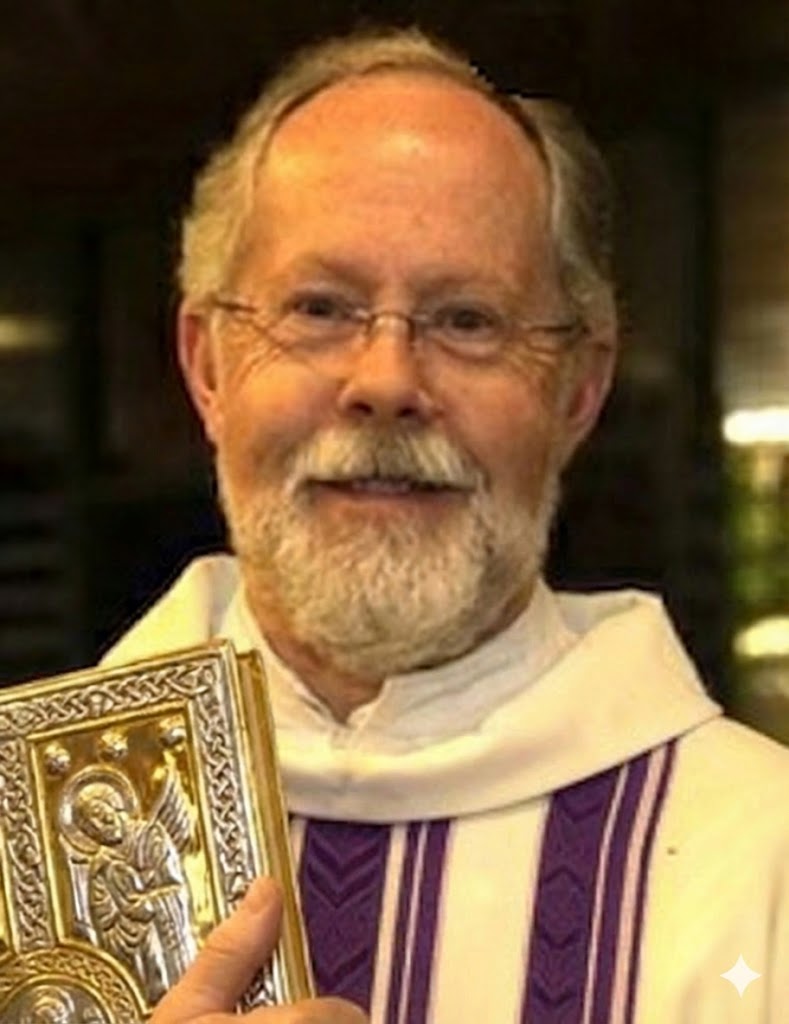
Deacon Peter
McCulloch
(Diocese of Broken Bay)
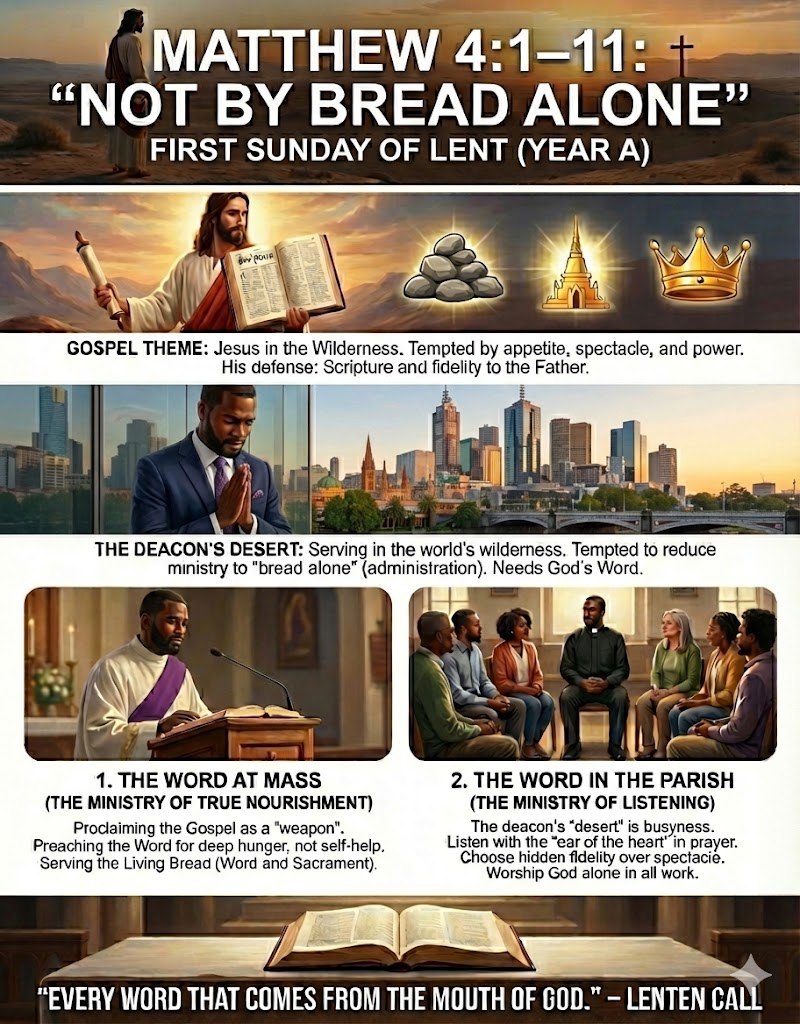
Lent begins in the stark, silent wilderness. Jesus, filled with the Holy Spirit, goes into the desert to prepare Himself for ministry. For forty days He fasts and during His physical hunger He confronts the three fundamental temptations of all ministry: the temptation of appetite (turning stones into bread), the temptation of spectacle (throwing yourself from the temple), and the temptation of power (all this will be yours).
To each, Jesus’s defence is not a display of divine power, but a word of human fidelity. Using Scripture as a weapon, His victory is assured because of His unfailing loyalty to His Father.
The deacon’s life and ministry mirror this desert journey. He is a man who serves in the wilderness of the world – in his family, his job, and at the margins. He is constantly tempted to reduce his ministry to “bread alone” – to mere administration or social work. Lent is the deacon’s call to return to his one true source of nourishment: “every word that comes from the mouth of God.”
The Word at Mass

AAt Mass, the deacon is the pre-eminent servant of the Word. This Lenten Gospel defines the primacy of that service.
Proclaiming the “Weapon”: When the deacon proclaims the Gospel of the Temptation, he is not just reading a story. He is revealing the very weapon that Christ Himself used. He is reminding the assembly that the “bread” of the Word is the only thing that can sustain them through their own deserts.
The Homily Beyond “Stones”: The deacon might be tempted to preach a homily of “stones to bread,” by offering simple self-help tips or practical, worldly solutions. Today’s Gospel calls his preaching to a higher standard: to offer the Word of God as the true answer to the people’s deepest hungers, and not just their superficial wants.
Serving the Living Bread: The deacon serves as a bridge between the Liturgy of the Word and the Liturgy of the Eucharist. He proclaims the Word by which we live, and then he ministers the Bread of Life,the Word-Made-Flesh. His service is a living witness that we are fed not by bread alone, but by Christ Himself, in Word and Sacrament.
The Word in the Parish

The deacon’s “desert” is the busyness of his dual vocation. The temptation to “make bread” – to do, fix, and achieve – can be overwhelming, leading to burnout and a service empty of God.
The Ear of the Heart: As St. Benedict wrote, the first act of a servant is to “listen… with the ear of your heart.” The deacon’s service in parish meetings, in his secular job, or in his own family must begin in the “desert” of silent, receptive prayer. He must listen to the Word before he can act.
Fidelity over Spectacle: The deacon, too, is tempted to “throw himself from the temple” – to seek visible results, praise for his programs or parish popularity. Today’s Gospel calls him back to the hidden and simple fidelity of Christ.
Worshipping God Alone: The deacon is tempted to worship the kingdoms of influence, efficiency, or success. His Lenten call is to “worship the Lord, your God, and him alone shall you serve,” ensuring that his ministry is always God’s work, and not his own.
The Word at the Margins

This theme gets to the heart of diakonia. The deacon is ordained to give “bread” to the hungry, but this Gospel provides the crucial clarification: “not alone.”
The Two Hungers: The deacon’s ministry to the poor is a constant balancing act. He must feed the physical hunger, and he does so through the food pantry, the crisis fund, the shelter. This is the bread he is commanded to give.
Service of the Word: But the deacon fails if he only provides material bread. His service must be seasoned by the Word. He must offer the bread of dignity, the bread of companionship, the bread of the Good News. He feeds the whole person, body and soul.
The Fullness of Service: When the deacon visits the sick or the homebound, this ministry becomes whole. He brings the Word in conversation and prayer and he brings the Living Bread of the Holy Eucharist. In this single act, he fulfills the Lenten call: he refuses to offer bread alone, but instead feeds the deepest hunger of the human heart with the Word made flesh.


The Three Temptations of the Permanent Deacon
This episode explores the First Sunday of Lent through the permanent deacon’s dual vocation, framing it as a modern wilderness. It examines ministerial temptations like reducing charity to social work, seeking influence, and desiring control. The conversation highlights how deacons combat these through obedience and proclaiming the Gospel, challenging all listeners to reject “bread alone” for the Word of God.
FEATURED: Deacon Peter McCulloch’s reflection and the National Directory for Permanent Deacons (USCCB)
A Louder, Messier Desert
TONYA (0:00 – 0:11) Welcome back to the Deep Dive. Today we are heading into the desert, but before you grab your canteen and sunscreen, I want you to scrap the image of, you know, sand dunes and silence.
ANDREW (0:11 – 0:17) Which is hard because when we talk about the desert in a biblical sense, that’s, that’s usually the default picture that comes to mind.
TONYA (0:17 – 0:38) Right. But today we’re looking at a much louder, much, uh, much messier desert. We are taking a deep dive into the first Sunday of Lent, Year A. And specifically we’re viewing that famous story of the temptation in the desert through the eyes of a very specific person you might see on the altar, the permanent deacon.
ANDREW (0:38 – 0:46) It’s a fascinating angle. I mean, usually when we hear Matthew chapter four, Jesus fasting for 40 days, battling the devil, we just think about our own personal struggles.
TONYA (0:46 – 0:48) We’re just Jesus’s victory.
The Deacon’s Operating System
ANDREW (0:48 – 0:55) Exactly. But we’ve got a stack of sources today that suggest if you want to really understand the diaconate, you have to understand the desert.
TONYA (0:55 – 1:05) We do have a great mix. We’re pulling from the liturgical readings themselves, Genesis, Romans, Matthew. We’ve got a reflection from a deacon, Peter McCulloch, on what he calls the deacon’s wilderness.
ANDREW (1:06 – 1:12) And we’re putting all of that up against the national directory for the formation, ministry, and life of permanent deacons.
TONYA (1:13 – 1:15) Which I have to say sounds incredibly dry.
ANDREW (1:16 – 1:30) It does. It’s a very government sounding title, but the national directory is, well, it’s basically the operating system for the diaconate in the United States. It’s the rule book, the theology, the training manual. It’s all wrapped into one document from the bishops.
TONYA (1:30 – 1:46) So the mission today is to sort of overlay that operating system onto the story of Jesus in the desert. We’re asking, how do the temptations of Christ-bred spectacle empower? How do they show up in the life of a modern guy with a mortgage, a job, and a stole?
ANDREW (1:46 – 1:55) And the answer is a little uncomfortable because it turns out the devil’s playbook really hasn’t changed much in a thousand years. He just adapted it for the parish office.
TONYA (1:55 – 1:57) And the family dinner table.
ANDREW (1:57 – 1:57) Yeah.
Adam vs. The New Adam
TONYA (1:57 – 2:10) All right. So let’s set the scene. First Sunday of Lent, the church always starts Lent with this story. Jesus goes into the wilderness, fasts for 40 days, and then when he is at his absolute weakest, he gets hammered by temptation.
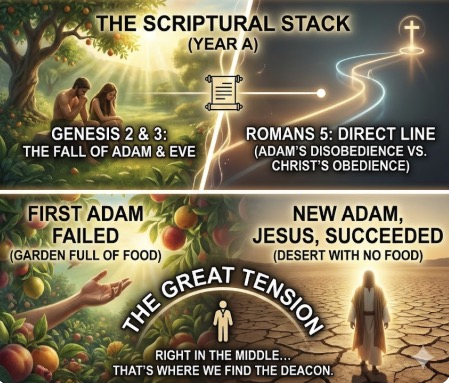
ANDREW (2:10 – 2:21) But the context here is everything. In year A, the church gives us this very specific scriptural stack to go with the gospel. We start with Genesis 2 and 3.
TONYA (2:21 – 2:22) The fall of Adam and Eve.
ANDREW (2:22 – 2:30) Right. Then we hit Romans 5, where St. Paul is drawing this direct line, comparing Adam’s disobedience to Christ’s obedience.
TONYA (2:30 – 2:34) So you’ve got the first Adam failing in a garden that’s full of food.
ANDREW (2:34 – 2:38) And the new Adam, Jesus, succeeding in a desert with no food at all.
TONYA (2:38 – 2:42) That’s the tension. And you’re saying right in the middle of that tension, that’s where we find the deacon.
The Deacon’s Wilderness
Dual Vocation and Fatigue
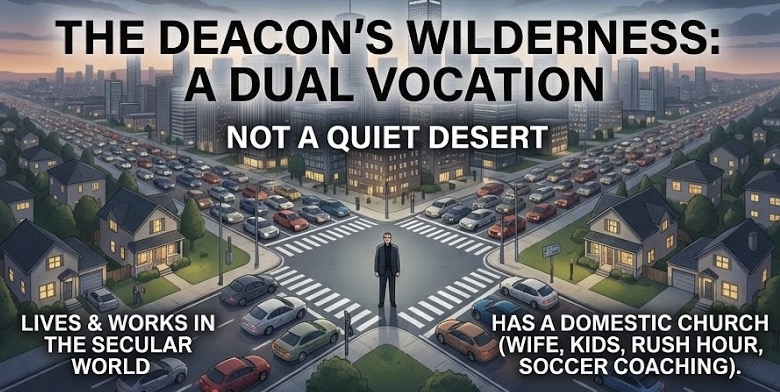
ANDREW (2:42 – 2:52) That’s the argument. Now, you mentioned this isn’t a quiet desert. Deacon McCulloch makes a really strong point about this. He says the deacon’s wilderness is unique because of his dual vocation.
TONYA (2:53 – 3:12) I found this part of the national directory really interesting. It emphasizes that unlike a priest who typically lives in the rectory and his job is the church, the permanent deacon usually lives and works right in the secular world. He has a domestic church. That means a wife and kids. He has a dealing with rush hour, coaching soccer.
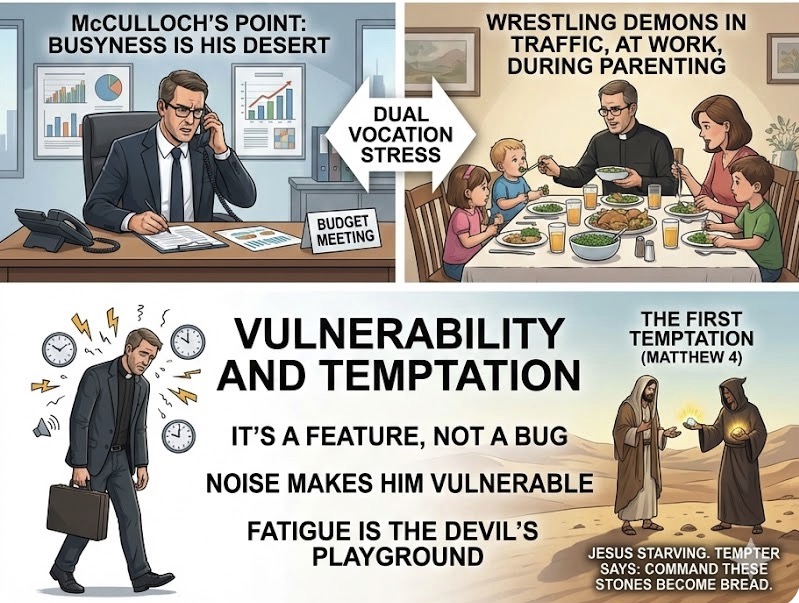
ANDREW (3:13 – 3:22) And that is his desert. McCulloch calls it the busyness of his dual vocation. He’s not wrestling with demons in some silent case.
TONYA (3:22 – 3:28) No, he’s wrestling with them in traffic or during a budget meeting at work, or while trying to get a toddler to eat their peas.
ANDREW (3:29 – 3:38) And the national directory is really clear that this isn’t a bug in the system. It’s a feature. The deacon is supposed to be in that mix, but all that noise, it makes him vulnerable.
TONYA (3:38 – 3:57) If you’re exhausted from a 50-hour work week and family stress, you are prime real estate for temptation. Fatigue is the devil’s favorite playground. And that leads us right to the first temptation in Matthew 4. Jesus is starving. The tempter comes and says, if you are the son of God, command that these stones become loaves of bread.
First Temptation
The Fixer and the Social Worker Trap
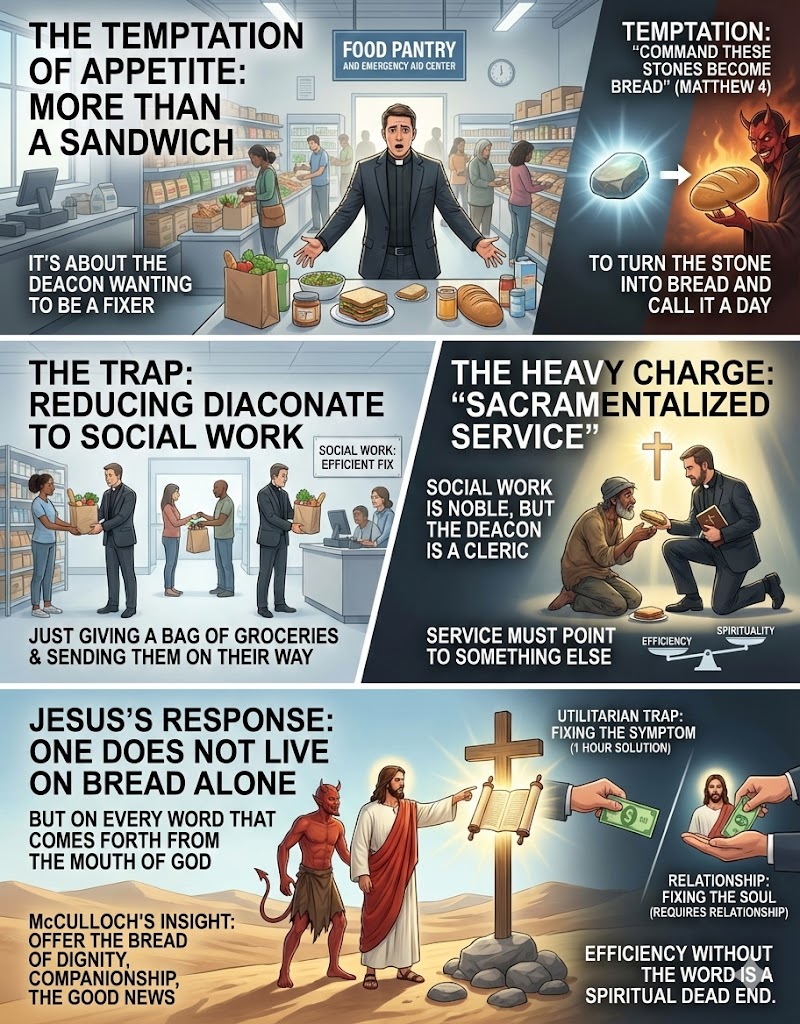
ANDREW (3:57 – 4:14) The temptation of appetite. Now on the surface, this just looks like it’s about physical hunger. But when I was reading the national directory section on the ministry of charity, it just, it clicked. This isn’t about the deacon wanting a sandwich. It’s about the deacon wanting to be a fixer. That is a crucial distinction.
TONYA (4:14 – 4:14) Yeah.
ANDREW (4:14 – 4:26) I mean, think about what a deacon does. He is ordained to the ministry of charity. He’s running the food pantry, managing the emergency fund, visiting the sick. He sees immediate material needs all day long.
TONYA (4:26 – 4:30) So the temptation is to think that the solution is just material.
ANDREW (4:30 – 4:45) To turn the stone into bread and call it a day. It’s a temptation to reduce the diaconate to social work, to become a very efficient NGO or a relief agency. If a deacon sees a hungry person, gives them a bag of groceries and just sends them on their way.
TONYA (4:45 – 4:47) He succumbed to the temptation of bread alone.
ANDREW (4:47 – 4:48) Exactly.
TONYA (4:48 – 4:56) That feels like a heavy charge though. I mean, feeding the hungry is a corporal work of mercy. I can hear people asking, so are we saying being a social worker is bad now?
ANDREW (4:56 – 5:12) Not at all. Not at all. Social work is noble and it’s necessary. But the deacon isn’t just a social worker. He’s a cleric. The national directory uses this amazing phrase, sacramentalized service. His service has to be a sign that points to something else.
TONYA (5:13 – 5:23) It connects right back to Jesus’s response to the devil. One does not live on bread alone, but on every word that comes forth from the mouth of God.
ANDREW (5:23 – 5:36) That is the absolute key. McCulloch writes that the deacon has to offer the bread of dignity, the bread of companionship, the bread of the good news. If he just hands out the sandwich but holds back the gospel because he thinks the person only needs calories.
TONYA (5:36 – 5:40) He’s failing his ordination. He’s fixing the symptom but ignoring the soul.
ANDREW (5:40 – 5:47) It’s a utilitarian trap, isn’t it? I mean, it is so much easier to give someone 10 bucks than it is to give them Jesus and 10 bucks.
TONYA (5:48 – 5:51) One solves the problem for an hour, the other requires a relationship.
ANDREW (5:52 – 6:04) And deacons, who are often very practical men with secular jobs, they’re wired to fix problems efficiently. But the gospel is warning us that efficiency without the word is just a spiritual dead end.
Second Temptation
Spectacle and the Desire for Influence
TONYA (6:04 – 6:09) Which actually leads right into the second temptation. Because if you get really good at fixing things.
ANDREW (6:09 – 6:11) You start wanting people to notice how good you are.
TONYA (6:11 – 6:11) Yep.
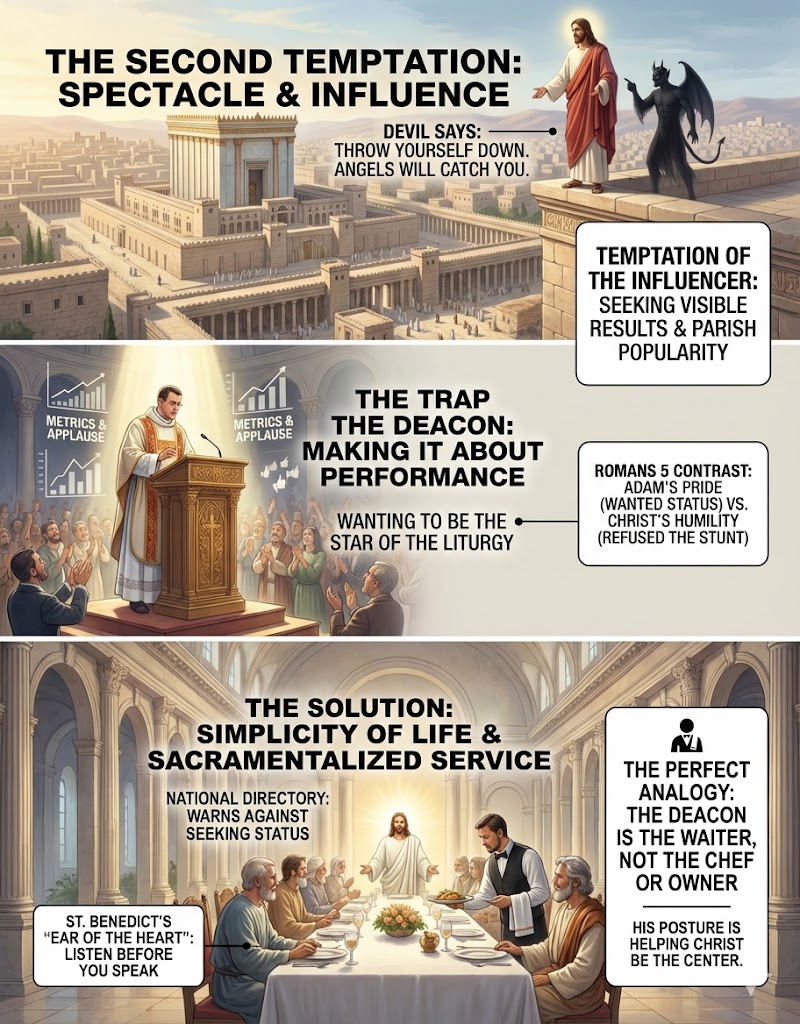
ANDREW (6:12 – 6:23) The devil takes Jesus to the holy city, stands him on the parapet of the temple and says, throw yourself down. He even quotes scripture back at him, saying the angels will catch him.
TONYA (6:23 – 6:27) The temptation of spectacle, or if we’re being modern about it.
ANDREW (6:27 – 6:28) The temptation of the influence.
TONYA (6:28 – 6:40) Wow, that’s good. It’s so dangerous for anyone in ministry, but especially for the deacon. You are literally up in front of people. You’re wearing the dalmatics and stoles. The spotlight is on you.
ANDREW (6:40 – 6:50) And Deacon McCulloch identifies this as that desire for visible results or parish popularity. You want your homily to be the one people are talking about at brunch.
TONYA (6:50 – 6:54) You want your youth program to have the biggest number. You want to be the star of the liturgy.
ANDREW (6:55 – 7:01) This is where we have to pull in that second reading from Romans 5 again. St. Paul makes that massive contrast between Adam and Christ. What was Adam’s big failure?
TONYA (7:02 – 7:05) Pride. He wanted to be like God. He wanted the status.
ANDREW (7:05 – 7:06) And Christ’s victory.
TONYA (7:07 – 7:18) Obedience. Humility. He refused the stunt. So for the deacon, standing there on the parapet of the ambo, the place where the readings are read, the temptation is to make it about his performance.
ANDREW (7:18 – 7:34) And the National Directory talks about simplicity of life here. It warns against seeking status. If a deacon is constantly checking his approval ratings with the parishioners, he’s testing God. He’s basically saying, look at how good I am at all this holy stuff.
TONYA (7:34 – 7:45) I think this has to be really hard for guys who are successful in their secular careers. I mean, if you’re a VP of sales or a business owner, you’re used to being the star. You’re used to metrics and applause.
ANDREW (7:45 – 7:47) How do you turn that off on Sunday morning?
TONYA (7:47 – 7:47) Exactly.
ANDREW (7:48 – 8:05) St. Benedict called it the ear of the heart. You have to listen before you speak. The National Directory reminds us that the deacon is an assistant. He assists the bishop. He assists the priest. His fundamental posture is helping someone else be the center of attention and ultimately helping Christ be the center.
TONYA (8:06 – 8:07) He’s the waiter, not the chef.
ANDREW (8:07 – 8:15) That is the perfect analogy. And if you’re the waiter, but you’re trying to act like the owner of the restaurant, you’ve got a serious problem. You’re disrupting the whole meal.
Third Temptation
Power, Control, and Obedience
TONYA (8:15 – 8:21) Which brings us to the third and honestly, probably the most seductive temptation for anyone with ambition.
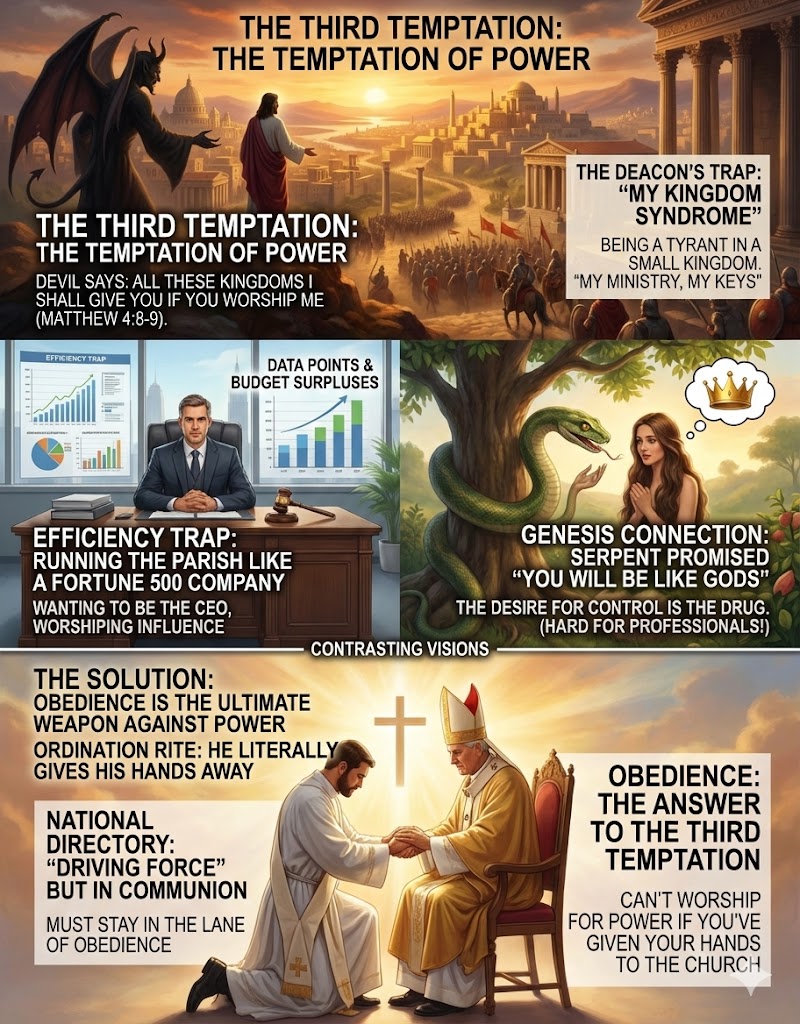
ANDREW (8:22 – 8:32) The temptation of power. The devil shows Jesus all the kingdoms of the world, Rome, the East, everything, and says, all these I shall give to you if you will prostrate yourself and worship me.
TONYA (8:33 – 8:41) Now, you might think, well, deacons aren’t running the world. They’re not bishops or popes. But power is relative, right? You can be a tyrant in a very small kingdom.
ANDREW (8:41 – 8:47) Exactly. It’s the my kingdom syndrome. My ministry, my program, my keys to the parish hall.
TONYA (8:48 – 8:56) And it links right back to that efficiency trap we talked about earlier. The temptation to worship the kingdoms of influence. We want to run the parish like a Fortune 500 company.
ANDREW (8:57 – 9:00) We want to measure success and data points and budget surpluses.
TONYA (9:00 – 9:02) And we want to be the CEO.
ANDREW (9:02 – 9:13) This just resonates so strongly with the Genesis reading again. The serpent promising Eve, you will be like gods. You’ll be the one in control. Control is the drug.
TONYA (9:13 – 9:25) And for a deacon who is often a successful professional in his secular life, maybe he’s a manager, a retired military officer, a lawyer, it has to be incredibly hard to come into the church and not be the boss.
ANDREW (9:25 – 9:33) To have to submit to a pastor who might be younger than him or less experienced in management, that is the crucible right there.
TONYA (9:33 – 9:43) The National Directory has this phrase that sounds contradictory at first. It describes the deacon as a driving force for the church’s service. And that sounds powerful, like, OK, let me drive.
ANDREW (9:43 – 9:54) But then it immediately handcuffs that phrase. It says that service must be in communion with the bishop. You can’t be a driving force off-roading on your own. You have to stay in the lane.
TONYA (9:54 – 9:55) The lane of obedience.
ANDREW (9:56 – 10:01) Obedience. That is such a tough word for modern ears. We value autonomy. We value being your own man.
TONYA (10:02 – 10:17) But in the theology of the diaconate, obedience is the ultimate weapon against power. There’s a physical moment in the ordination rite that just captures this perfectly. The candidate kneels before the bishop. He places his hands inside the bishop’s hands and he promises respect and obedience.
ANDREW (10:17 – 10:18) He literally gives his hands away.
TONYA (10:19 – 10:31) He gives up his agency to build his own kingdom. That is the answer to the third temptation. You can’t worship the devil for power if you’ve already given your hands to the church. You’ve already signed over the deed to your life.
The Weapon: Herald of the Gospel
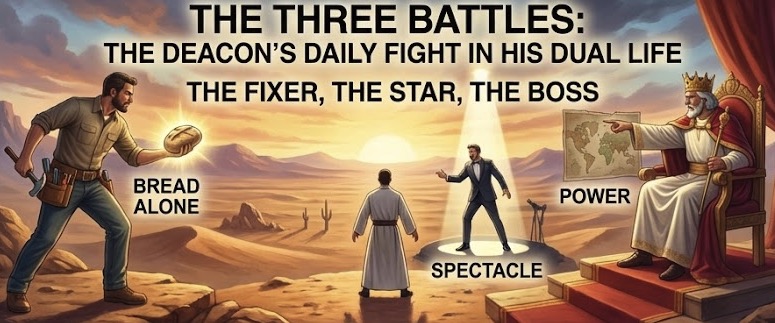
ANDREW (10:32 – 10:46) So we have these three battles. The fixer who offers bread alone. The star who wants the spectacle. And the boss who wants power. The deacon is facing these every single day in his dual life. So how does he fight back?
TONYA (10:47 – 10:49) Well, you just look at the text. How did Jesus fight?
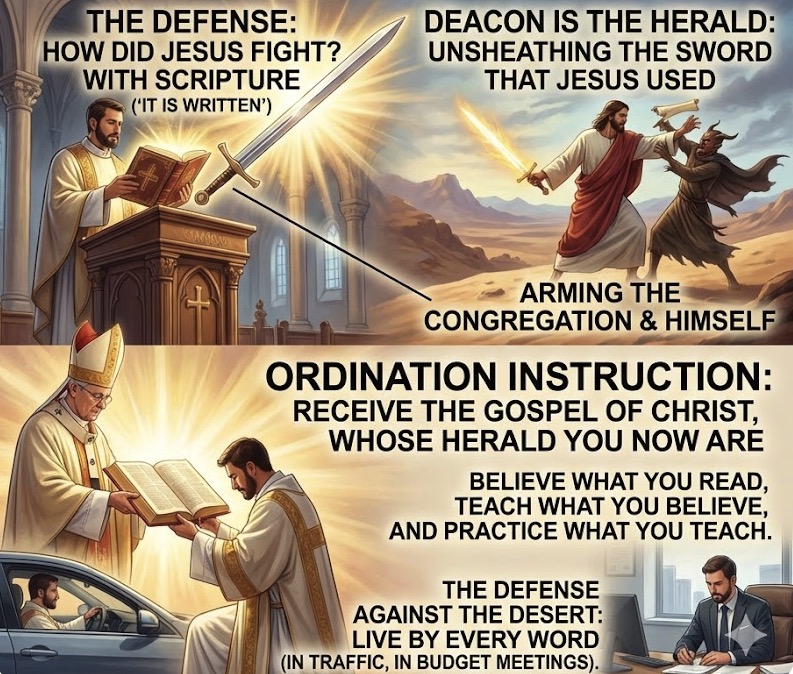
ANDREW (10:49 – 10:51) With scripture. It is written.
TONYA (10:51 – 10:57) And this is where the national directory gets really exciting about the deacon’s role in the Catholic mass, who is the one who reads the gospel.
ANDREW (10:57 – 11:04) The deacon. Always. Even if the pope is there celebrating mass, he sits down and the deacon reads the gospel.
TONYA (11:04 – 11:07) Why is that? I honestly always just assumed it was to give the priest a break.
ANDREW (11:07 – 11:18) No, no, it’s theological. The deacon is the herald. Deacon McCulloch calls the gospel a weapon. So when the deacon stands up this Sunday and reads Matthew 4, he isn’t just narrating a history lesson.
TONYA (11:18 – 11:21) He’s unsheathing the sword that Jesus used to kill the temptation.
ANDREW (11:22 – 11:28) That reframes the whole liturgy for me. He’s not just doing the reading. He’s arming the congregation.
TONYA (11:28 – 11:41) And he’s arming himself. The national directory quotes the instruction the bishop gives when he hands the book of the gospels to the new deacon at his ordination. It’s one of the most beautiful and frankly terrifying instructions in the church.
ANDREW (11:42 – 11:51) I have it here. Receive the gospel of Christ, whose herald you now are. Believe what you read, teach what you believe, and practice what you teach.
TONYA (11:52 – 11:58) Practice what you teach. That right there, that is the defense against the desert. You can’t just read the words. You have to believe them.
ANDREW (11:58 – 12:05) You have to live them in the traffic jam and in the budget meeting. You have to be the one living by every word that comes from the mouth of God.
Cycle of Grace: Word, Liturgy, and Charity
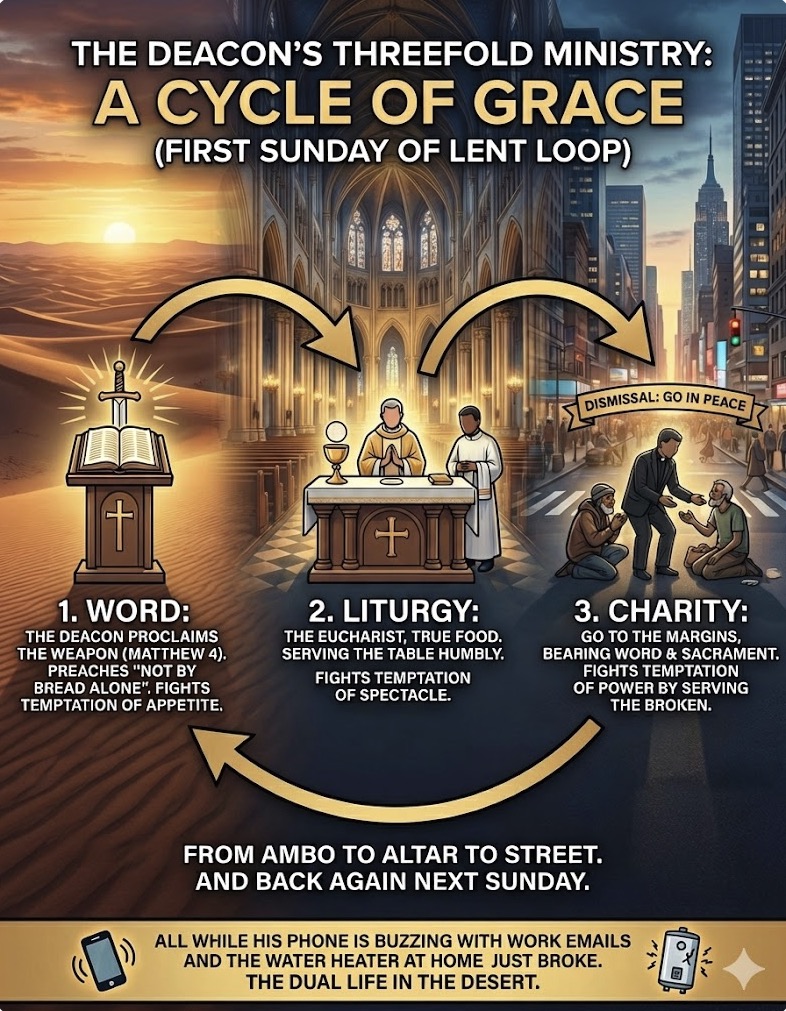
TONYA (12:05 – 12:19) So I want to zoom out and look at the whole picture. The national directory breaks the deacon’s job into three parts. Word, liturgy, and charity. It seems like this one Sunday, the first Sunday of Lent, brings all three of those into a single loop.
ANDREW (12:19 – 12:36) It really does. You can think of it as a cycle of grace that just repeats every week. First, the word. The deacon stands at the ambo and he proclaims the weapon, Matthew 4. He preaches that we don’t live by bread alone. He fights that temptation of ignorance and appetite.
TONYA (12:37 – 12:38) Then he moves to the liturgy.
ANDREW (12:38 – 12:51) Right. He goes to the altar, prepares the cup. He stands next to the priest. He witnesses that the true food isn’t the stone turned to bread, it’s the Eucharist. He fights the temptation of spectacle by serving the table humbly.
TONYA (12:51 – 12:52) He’s back to being the waiter.
ANDREW (12:53 – 12:55) He’s the waiter. And then finally, charity.
TONYA (12:55 – 12:57) The dismissal. Go in peace.
ANDREW (12:58 – 13:12) The deacon sends the people and himself back out into the desert. He goes to the margins, to the poor and the sick. But he doesn’t just go as a social worker. He goes bearing the word and the sacrament he just served. He fights the temptation of power by serving the broken.
TONYA (13:13 – 13:18) It’s a closed loop from the ambo to the altar to the street. And then you’re back again next Sunday.
ANDREW (13:18 – 13:23) All of that while his phone is buzzing with work emails and the water heater at home just broke.
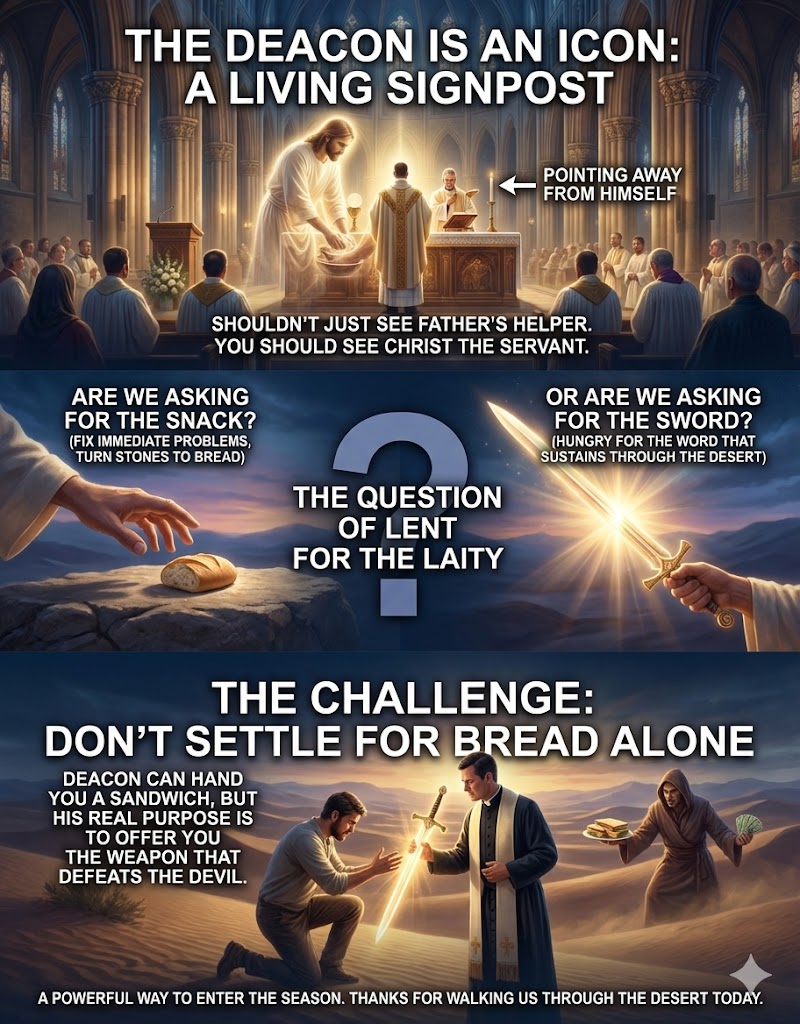
The Deacon as Icon and the Question for the Laity
TONYA (13:23 – 13:31) That brings us back to the listener. I mean, most of us aren’t deacons. We’re sitting in the pew. So why does this deep dive into the deacon’s rulebook matter to us?
ANDREW (13:31 – 13:43) Because the deacon is an icon. In the theology of the church, he’s a living signpost. When you see that guy in the vestments this Sunday, you shouldn’t just see Father’s helper. You should see a living sign of Christ the servant.
TONYA (13:43 – 13:46) So if he’s doing his job right, he’s pointing away from himself.
ANDREW (13:47 – 14:02) He is. But it also forces a question back on us, on the laity. The deacon is ordained to serve the word and the bread. But ask yourself, when you go to church or when you pray, what are you actually asking for?
TONYA (14:02 – 14:05) Are we asking for the snack or are we asking for the sword?
ANDREW (14:05 – 14:15) That’s the question of Lent, isn’t it? Are we just asking God to fix our immediate problems, to turn our stones into bread? God, fix my finances, fix my health. Just make me feel better.
TONYA (14:15 – 14:18) Or are we hungry for the word that actually sustains us through the desert?
ANDREW (14:18 – 14:29) Because the deacon can hand you a sandwich and he can organize a great parish picnic. But his real purpose, and the whole purpose of Lent, is to offer you the weapon that defeats the devil.
TONYA (14:29 – 14:32) That’s the challenge. Don’t settle for bread alone.
ANDREW (14:32 – 14:32) Exactly.
TONYA (14:33 – 14:37) A powerful way to enter the season. Thanks for walking us through the desert today.
ANDREW (14:38 – 14:38) It was a pleasure.
TONYA (14:39 – 14:40) We’ll catch you in the next Deep Dive.
The National Directory for the Formation, Ministry, and Life of Permanent Deacons in the United States of America

During the season of Lent, a deacon’s responsibilities shift to reflect the penitential and preparatory nature of the season. While the core ministry of Word, Liturgy, and Charity remains, specific liturgical and pastoral duties take on a different emphasis.
Here is a breakdown of the special duties and responsibilities of a deacon during Lent and Holy Week.
1. Liturgical Duties (The Mass)
The deacon’s role at Mass involves specific changes in posture, vestments, and tone to match the season.
- Vestments: You will wear violet (purple) vestments. On the Fourth Sunday of Lent (Laetare Sunday), rose vestments may be worn.
- Penitential Act: You may lead the invocations of the Kyrie (Lord, Have Mercy) if the Confiteor is not used. The Gloria is omitted (except on solemnities like St. Joseph or the Annunciation).
- The Gospel & Homily: If preaching, the homily should focus on Lenten themes: repentance, conversion, baptismal preparation, and the Passion.
- Dismissal of the Catechumens/Elect: If your parish has an RCIA process (OCIA), the deacon is often responsible for dismissing the Elect after the homily so they may reflect on the Word.
- The Dismissal: The Alleluia is strictly omitted from the dismissal. You would simply say, “Go in peace,” or “Go in peace, glorifying the Lord by your life.”
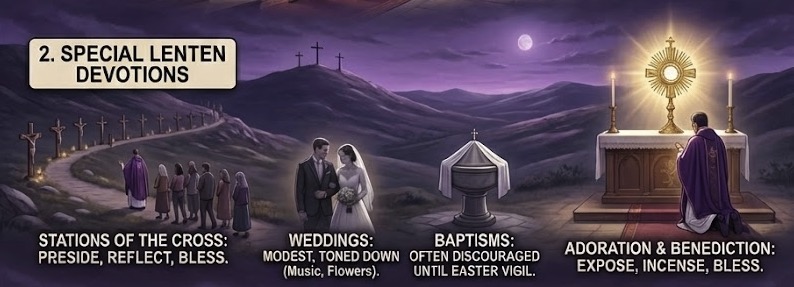
2. Special Lenten Devotions
Deacons often preside over para-liturgical devotions that are popular during Lent.
- Stations of the Cross: Deacons frequently lead the Stations of the Cross (Via Crucis). When presiding, you may give a brief reflection, lead the prayers, and conclude with a blessing.
- Note: If Benediction of the Blessed Sacrament follows Stations, you would expose the Sacrament, incensing (if used), and give the Benediction.
- Adoration & Benediction: Many parishes increase Adoration times during Lent; deacons often preside over Exposition and Benediction.
3. Sacramental Restrictions
- Weddings: While marriages can take place, the Church advises that they be modest. The deacon should ensure the couple understands that flowers and music should be toned down to respect the penitential season.
- Baptisms: In many dioceses, the celebration of Baptism is discouraged during Lent (except in emergencies) to preserve the anticipation of the Easter Vigil, where Baptism is the central focus.
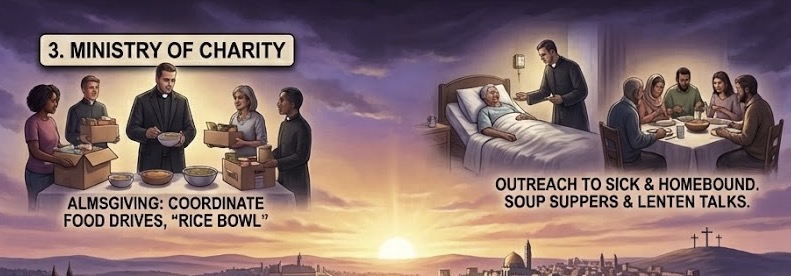
3. Ministry of Charity
Since Lent is a time of almsgiving, the deacon (as the minister of charity) often coordinates:
- Food drives or “Rice Bowl” collections.
- Outreach to the sick and homebound who cannot attend Lenten services.
- Soup suppers or community meals associated with Lenten talks.