Faith & Film
Faith & Film
February 22, 2026
February 22, 2026
1st Sunday of Lent (A)




The Devil Wears Prada (2006)
The Wilderness of the Runway
and the Three Temptations in Matthew 4:1-11
TWTW Deep Dive Podcast: Faith & Film Edition
💫 TWTW 2026 AI Generated
EDITORIAL NOTE: AI tools were utilized to help research, draft, and design the following commentary and infographics. This assistance condensed thirty hours of work into a focused three-hour process.
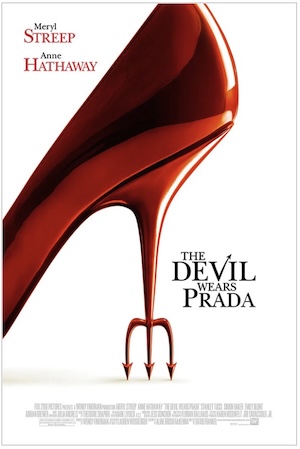
In the Gospel for the First Sunday of Lent (Year A), the Judean wilderness is a place of silence, hunger, and stark deprivation. The offices of Runway magazine, by contrast, are a kaleidoscope of noise, excess, and cerulean blue. On the surface, the fasting of Christ in Matthew 4 seems worlds away from the frantic coffee runs of Andy Sachs. Yet, the spiritual geography is identical. The Catechism reminds us that in this wilderness, Jesus is the new Adam, remaining faithful where the first Adam gave in to temptation (CCC 538). During Lent, the Church unites herself to this mystery of Jesus in the desert (CCC 540), inviting us to see our own daily landscapes—even glossy office towers—as places of spiritual testing.
In both the desert and the skyscraper, the enemy is not a monster with horns, but a voice offering a shortcut to glory. When we strip away the couture and the chaos, The Devil Wears Prada reveals itself as a modern retelling of an ancient test: what are you willing to worship to gain the kingdoms of the world?
We often imagine the Devil’s voice as frightening—a growl from the darkness intended to scare us away from God. But in Matthew 4, the Tempter sounds reasonable. He offers bread to the hungry. He offers safety to the vulnerable. He offers authority to the powerless.

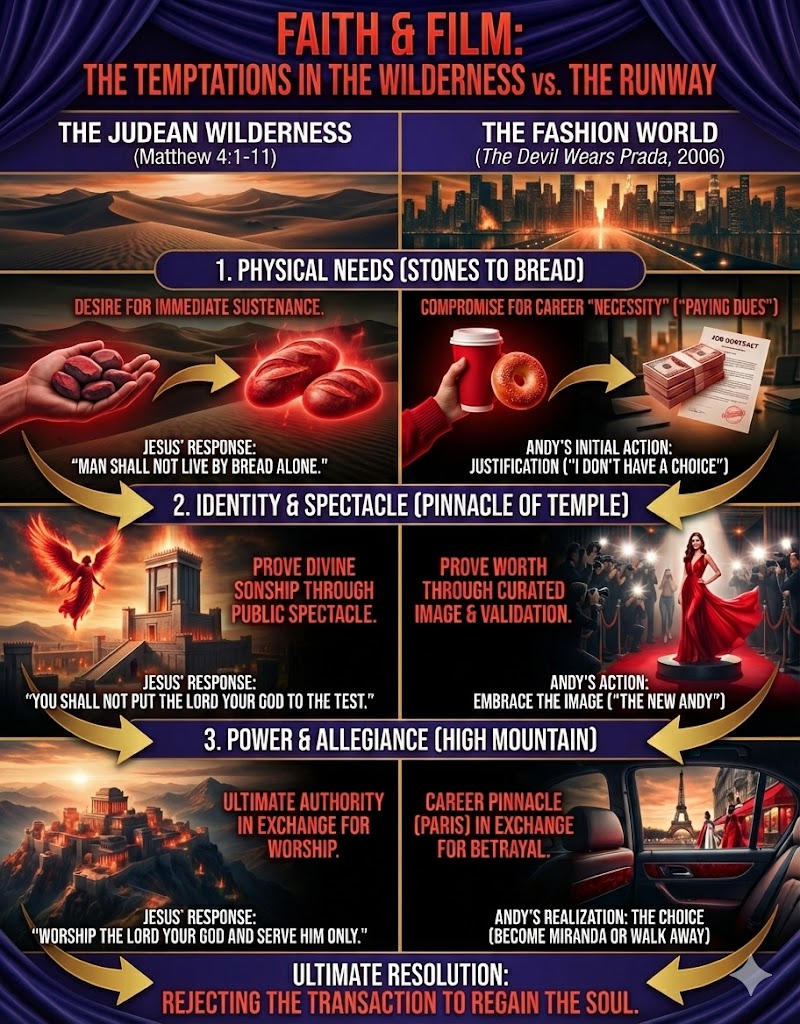
In The Devil Wears Prada, that reasonable voice speaks in a soft, icy monotone, and it belongs to Miranda Priestly. When Andy Sachs enters the high-stakes world of fashion journalism, she isn’t just battling a demanding boss; she is walking into her own forty days in the wilderness. The film provides a terrifyingly sharp illustration of how the three temptations of Christ—provision, identity, and power—manifest in our daily work.


Stones into Bread
The Temptation of Necessity
The first temptation is the most primal. After forty days of fasting, Jesus is physically starving. The Tempter approaches Him not with a request to do evil, but with a logical solution to a desperate problem: “If you are the Son of God, command these stones to become loaves of bread” (Matthew 4:3). Notice that the Devil does not ask Jesus to hurt anyone. He simply suggests that survival should be the highest priority. He appeals to the logic of pragmatism: You are hungry. You have the power to fix it. Why suffer when you can turn this stone into sustenance?
In The Devil Wears Prada, Andy Sachs faces this exact temptation the moment she walks through the doors of Elias-Clarke. She has no interest in fashion; she mocks the industry’s obsession with “this stuff.” Yet, she takes the job as Miranda’s assistant for one reason: Bread. She views the job purely as a means to an end. She tells herself (and her skeptical friends), “I just have to stick it out for a year.” She convinces herself that this compromising, soul-crushing environment is a “stone” she must turn into bread to feed her real ambition—a serious career in journalism.
The spiritual danger here is subtle. Andy isn’t tempted by vanity yet; she is tempted by necessity. She believes she has no choice. She has begun to idolize her career prospects. As the Catechism warns, idolatry isn’t just pagan worship; it consists in “divinizing what is not God,” including things like power, money, or in Andy’s case, professional survival (CCC 2113). By making the job her ultimate concern, she bows to a false god. throughout the first act, her refrain is constant: “I didn’t have a choice.” She justifies every small compromise—missing dinner with her father, ignoring her boyfriend, changing her ethics—under the banner of “paying her dues.”
Jesus counters this temptation by quoting Deuteronomy: “Man shall not live by bread alone, but by every word that comes from the mouth of God” (Matthew 4:4). He refuses to let His physical needs dictate His spiritual obedience. He establishes that survival is not the ultimate good; fidelity to God is. Andy fails this test because she believes that her “bread”—her career trajectory—is worth more than her daily integrity. She eats the bread, but as the film progresses, we see that while her resume is being fed, her spirit is beginning to starve.

The Pinnacle of the Temple
The Temptation of Identity & Spectacle
The second temptation moves from the desert floor to the heights of the Holy City. The Devil takes Jesus to the pinnacle of the temple—the religious center of the world—and dares Him: “If you are the Son of God, throw yourself down” (Matthew 4:6). He quotes Scripture (Psalm 91), promising that angels will catch Him. This is a temptation of presumption and spectacle. It is a challenge to prove one’s identity through a public display. The Tempter is essentially asking: Are you really who you say you are? If so, prove it. Put on a show. Make God catch you.
In The Devil Wears Prada, the “Temple” is the Elias-Clarke building, and the pinnacle is the closet of Runway magazine. Andy’s temptation comes when she realizes that hard work isn’t enough. To truly belong in this temple, she must change who she is. She turns to Nigel—the high priest of this sartorial cult—who dresses her in Chanel boots and Dolce & Gabbana. This is her “throw yourself down” moment. She casts aside her previous identity (the “smart, fat girl” from Ohio) and throws herself entirely into the image of a Runway girl, trusting that the “angels” of fashion (the clothes, the makeup, the accessories) will catch her.
And they do. She lands on her feet. Suddenly, she is accepted. She is admired. She has proved her worth through the spectacle of her appearance. But where Jesus answers, “You shall not put the Lord your God to the test” (Matthew 4:7), refusing to base His identity on a stunt, Andy fails. She begins to believe that the costume is the person. She confuses her job description with her soul. When her friends claim she has changed, she defends the mask, not realizing that by “throwing herself down” into the culture of vanity, she hasn’t been saved—she has been consumed. She has forgotten that true identity comes from being a beloved child of God, not from being the favored assistant of Miranda Priestly. Our dignity rests on something far more solid than a Chanel wardrobe: “The dignity of the human person is rooted in his creation in the image and likeness of God” (CCC 1700). When we forget this, we become vulnerable to the spectacle of the pinnacle.

The High Mountain
The Temptation of Power
The final temptation is the most terrifyingly direct. The Devil takes Jesus to a very high mountain and shows Him all the kingdoms of the world and their splendor. The subtlety is gone. The offer is a transaction: “All these I will give you, if you will fall down and worship me” (Matthew 4:9). This is the temptation of power. It is the promise that you can have it all—influence, authority, glory—if you are willing to make one small compromise. You must bow down. You must serve the system rather than God.
In The Devil Wears Prada, the “High Mountain” is Paris Fashion Week. It is the summit of the industry, the place where careers are made and broken. For Andy, the offer of the kingdom comes with a specific price tag. To go to Paris—to secure the golden future Miranda can offer—she must betray her colleague, Emily. She must step over her friend to ascend the mountain. And she does. She justifies it, of course (“I didn’t have a choice”), but the reality is that she bowed down. She chose the kingdom over her conscience. She falls into a classic moral trap, forgetting the foundational rule of conscience that “[o]ne may never do evil so that good may result from it” (CCC 1789). To gain Paris, she had to do evil to Emily.
The chilling climax of this temptation occurs in the backseat of a limousine in Paris. Miranda, the high priestess of this world, turns to Andy and says, “I see a great deal of myself in you.” She praises Andy for her ruthlessness, for doing what was “necessary” to get ahead. In that moment, the transaction is laid bare. Andy realizes that by gaining the world, she has forfeited her soul. She has become Miranda. She has worshipped the idol of success and been remade in its image.
Jesus responds to the Devil with absolute finality: “Be gone, Satan! For it is written, ‘You shall worship the Lord your God and him only shall you serve’” (Matthew 4:10). He rejects the kingdoms of the world because He knows their cost. Andy’s “Be gone, Satan” moment is silent but powerful. She steps out of the car, walks away from the flashing cameras, and throws her ringing phone—the symbol of her servitude—into the fountain. She rejects the kingdom to regain her humanity.

The Wilderness is Everywhere
In the end, The Devil Wears Prada is a redemption story, but it is a messy one. Andy Sachs fails the test in the desert. She eats the bread of necessity; she throws herself down from the pinnacle of image; she bows to the idol of power. She spends most of the film losing her soul by degrees.
But her final act—walking away from Miranda and casting that phone—the symbol of her servitude—into the fountain. It is a cinematic visualization of what the Catechism calls “interior repentance”—a radical reorientation of our whole life, a return to God with all our heart, and a breaking away from sin (CCC 1428). She rejects the kingdom to regain her humanity.
As we enter the season of Lent, this story reminds us that the wilderness is not just a geographic location in Judea. It is the office where we work, the ambitions we nurture, and the compromises we justify. The Tempter rarely appears with horns and a pitchfork. Most often, he arrives with a job offer, a compliment, or a promise of security, whispering that we can have it all if we just bend the knee a little.
Jesus resisted because He knew that life does not come from bread, identity does not come from spectacle, and power does not come from the kingdoms of this world. He knew that the only thing worth worshipping is the Father.
Whether we are in a desert or a skyscraper, the temptation is the same. And so is the way out: to recognize the voice for what it is, to refuse the transaction, and to walk away—even if it means walking away from everything the world calls success.
Discussion Questions
1: In most media, the Devil is portrayed as scary or repulsive. In The Devil Wears Prada, Miranda Priestly is elegant, successful, and highly respected. How does this change our understanding of how temptation actually works in our lives?
Answer: We often expect temptation to look like a “monster”—something obviously evil or repulsive. But in Matthew 4 and in the film, the Tempter’s voice is reasonable. Miranda doesn’t ask Andy to commit crimes; she asks her to be excellent, to be dedicated, and to do “what is necessary.” This mirrors the biblical truth that sin often disguises itself as virtue (hard work, loyalty, ambition). The most dangerous temptations are the ones that look like great career opportunities. Scripture and tradition refer to the devil as a “liar and the father of lies,” whose prime strategy is deception (CCC 392). Miranda is a perfect embodiment of this reasonable, deceptive voice.
2: Andy constantly justifies her behavior by saying, “I didn’t have a choice.” Do you agree with her? When have you felt like you had to compromise your values just to “pay the rent” or “pay your dues”?
Answer: This relates to the first temptation: Stones to Bread. The devil appeals to our survival instinct. Andy did have a choice—she could have quit or refused to compromise—but she felt that her career survival was more important than her integrity. The lie of this temptation is that our physical needs (money, security, career progression) are the ultimate reality. Jesus counters this by saying we do not live by bread alone; spiritual obedience is actually more vital than physical survival.
This relates to the Catholic understanding of human freedom. While pressure can reduce our culpability, it rarely removes it entirely. As CCC 1731 states, freedom is the power to act or not to act, and “by free will one shapes one’s own life.” Andy is tempted to abdicate that freedom to her boss, pretending she is a victim of circumstance rather than a moral agent making choices.
3: Why does Andy undergo her makeover? Is it just to look professional, or is something deeper happening? How does this relate to the temptation to “throw yourself down” from the temple?
Answer: Answer/Insight: Andy’s makeover is her attempt to force acceptance. In the temptation, the devil dares Jesus to create a spectacle to prove He is the Son of God. Andy changes her clothes to prove she belongs in the “temple” of Runway. The danger here is confusing our image (what people see, our job title, our clothes) with our identity (who we are in God). When we “throw ourselves down” into a culture to be accepted, we are asking that culture to define our worth, rather than letting God define it. We are called to remember that being in the image of God means the human individual “is not just something, but someone” (CCC 357). Andy tries to become a “something” (a fashion icon) to feel valuable.
4: The climax of the film happens in Paris when Miranda tells Andy, “I see a great deal of myself in you.” Why is this a terrifying moment for Andy? What was the “price” she paid to get to the top of the mountain?
Answer: This is the realization of the third temptation: Worship. To gain the “kingdom” (Paris, the future), Andy had to “bow down” by betraying her friend Emily. The terrifying moment is the realization that she has succeeded in the world’s eyes but failed in her own. She has become the idol she worships. (See again CCC 2113 on Idolatry). It illustrates that you cannot have the “kingdoms of the world” without serving the “ruler of this world.”
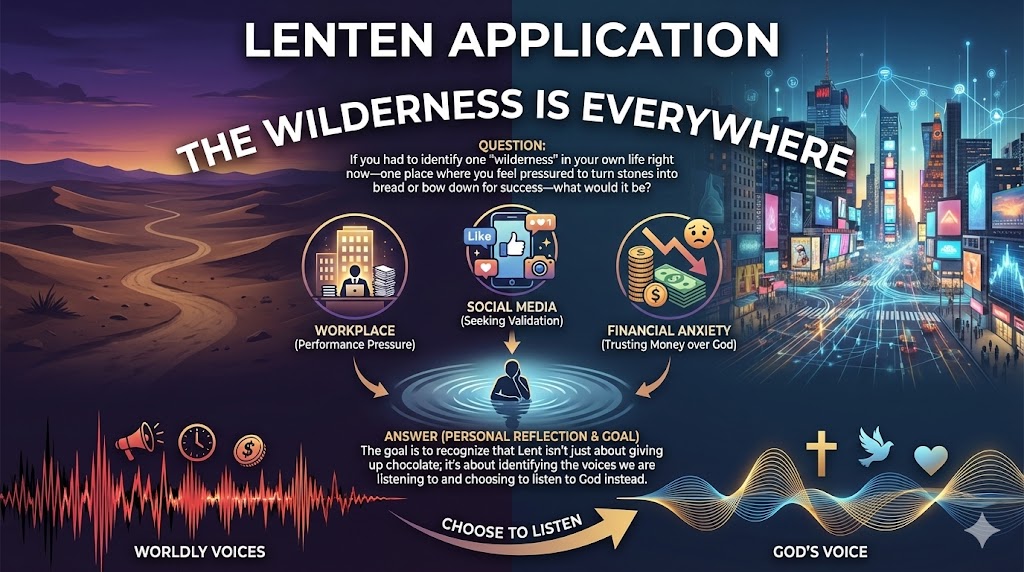
5: The essay concludes by saying “The Wilderness is everywhere.” If you had to identify one “wilderness” in your own life right now—one place where you feel pressured to turn stones into bread or bow down for success—what would it be?
Answer: (Personal reflection). This question invites readers to move from analyzing the movie to analyzing their own hearts. It might be their workplace, their social media presence (seeking validation/spectacle), or their financial anxiety (trusting money over God). The goal is to recognize that Lent isn’t just about giving up chocolate; it’s about identifying the voices we are listening to and choosing to listen to God instead.
THE FAITH & FILM section of THE WORD THIS WEEK website cultivates discernment and wonder by analyzing how the stories we watch interact with the Greatest Story ever told. Whether it’s a superhero grappling with sacrifice, a horror film exploring the reality of evil, or a drama depicting the beauty of forgiveness, we believe every frame offers a chance to engage with the Gospel. Movies are more than just entertainment; they are modern parables that reflect the deepest longings of the human heart—our desire for redemption, our struggle with sin, and our search for truth. We aren’t just looking for “safe” content or counting curse words; we are looking for God’s truth in unexpected places.