Faith & Film
Faith & Film
March 1, 2026
March 1, 2026
2nd Sunday of Lent (A)


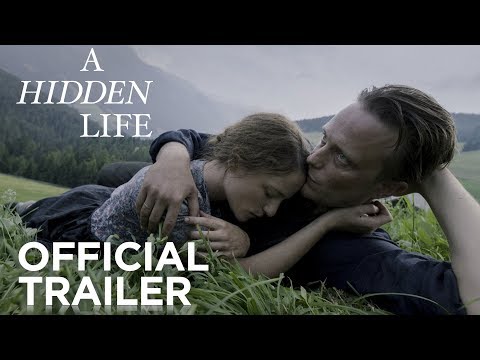


A Hidden Life (2019)
Carrying Tabor into the Cell: The Transfiguration of Blessed Franz Jägerstätter
TWTW Deep Dive Podcast: Faith & Film Edition
💫 TWTW 2026 AI Generated
EDITORIAL NOTE: AI tools were utilized to help research, draft, and design the following commentary and infographics. This assistance condensed thirty hours of work into a focused three-hour process.
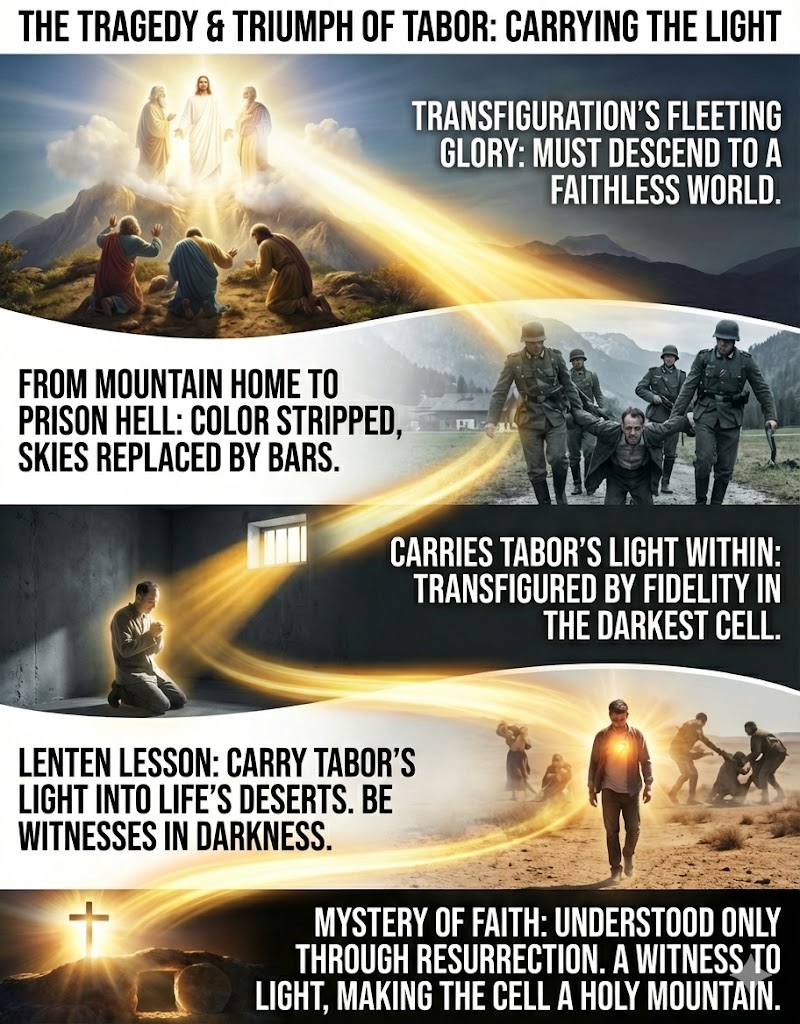
The Transfiguration of the Lord, recorded in the Gospel of Matthew (17:1-9), is arguably the most “cinematic” moment in the New Testament. It is a scene of overwhelming sensory overload: a high mountain, a dazzling white light, the appearance of ancient prophets, and the voice of God thundering from a cloud. Yet, it is notoriously difficult to capture on film. Most biblical epics reduce this Mystery to special effects—glowing auras or lens flares—that often cheapen the divine encounter into a mere magic trick.
But the Transfiguration was never just about a light show. Theologically, it was a preparation for suffering. It was a revelation of identity given to the disciples so they could endure the coming scandal of the Cross. To truly understand this mystery through the lens of cinema, we must look beyond literal depictions and find a film that captures the spirit of Tabor—the collision of the divine and the human, and the cost of witnessing to the Light.

Terrence Malick’s 2019 masterpiece, A Hidden Life, is not a “Bible movie,” but it may be the most profound commentary on the Transfiguration committed to film in the last decade. It tells the true story of Blessed Franz Jägerstätter, an Austrian farmer who refused to swear an oath of loyalty to Hitler. Structurally and visually, the film mirrors the journey of Peter, James, and John: an immersion in overwhelming beauty (Tabor), followed by a terrifying descent into the valley of death (Calvary), sustained only by a vision of the Truth that the world could not see.
The protagonist, Blessed Franz Jägerstätter, is haunted by a question that echoes from every corner of his world: “What good is it?”
His neighbors, his bishop, and his Nazi interrogators all press him with the same utilitarian logic: You think you can change the course of the war? You are doing no one any good. Your sacrifice is invisible. It is futile. In our modern world, ruled by materialist metrics of success, this is a crushing argument. Why tell the story of a “failed” defiance?
The answer lies in the theology of the Second Sunday of Lent. The Transfiguration (Matthew 17:1-9) was not a strategic military summit; it was a revelation of Being. It was a moment where the “utility” of the world was suspended, and the glory of God broke through. To understand A Hidden Life is to understand it not merely as history, but as hagiography—a “legendary” truth in the C.S. Lewis sense, where abstract truths become concrete. It is the story of a man who climbed the mountain of Transfiguration and refused to come down when the world turned dark.

The Structure
From Tabor to Calvary
The theological heart of the Transfiguration is preparation. Jesus does not reveal His glory to Peter, James, and John simply to impress them. He does so to fortify them. As the Catechism of the Catholic Church explains:
“Christ’s Transfiguration aims at strengthening the apostles’ faith in anticipation of his Passion: the ascent onto the ‘high mountain’ prepares for the ascent to Calvary.” (CCC 568)
This structure—from the dazzling white light of the mountain immediately down into the valley of demons and eventually to the hill of Golgotha—is the precise narrative arc of A Hidden Life.
Malick spends the entire first act of the film in the “Tabor” of the Austrian Alps. Through his signature use of wide-angle lenses and natural light, the village of St. Radegund is presented as a kind of Eden. We see Franz and his wife Fani scything wheat in golden fields, the mist rolling over green mountains, and a life of simple, rhythmic liturgy. It is a world saturated with God’s grandeur, lush with light, love, and almost unearthly beauty. Franz is living in “glory.”

Watching these scenes, we instinctively understand Peter’s impulse in the Gospel: “Lord, it is good that we are here. If you wish, I will make three tents here…” (Mt 17:4). Peter wants to freeze the moment. He wants to domesticate the divine encounter and remain in the safety of the light. We feel this in the film; the beauty of Radegund is so overpowering that we, like Franz, never want to leave. We want the “tent” of this peaceful life to last forever.
But the film, like the Gospel, forces a descent. The rest of the movie is a slow, agonizing drop into the valley: the gray concrete of the prison, the mockery of the guards, the silence of God, and finally, the execution.
Here is the essential essay angle for us as believers: We climb the mountain not to escape reality, but to gain the strength to face it. Franz’s life in the mountains was his Transfiguration. It was where he saw the goodness of God so clearly that when the darkness of the Third Reich descended, he could not deny the light. The memory of that “light”—his life in the mountains with Fani—is what sustains him in the darkness of the Nazi prison. He has “seen” the truth, and that vision allows him to endure the suffering.


The Voice from the Cloud
Conscience Amidst the Noise
In Matthew’s account, the vision is interrupted by a “bright cloud” and a voice declaring, “This is my beloved Son, with whom I am well pleased; listen to him” (Mt 17:5). This command—“Listen to him”—is the central tension of A Hidden Life. Throughout the film, Franz hears a voice that no one else seems to hear: the voice of a formed and courageous conscience.

The “cloud” that descends upon Franz is the creeping shadow of National Socialism. Suddenly, the village that was once a communion of neighbors becomes a place of fear and ostracization. The Mayor, the neighbors, and even the local Bishop tell Franz to come down from his moral high ground. They tell him his sacrifice will be useless, that he has a duty to his family, that God will forgive a coerced oath. They represent the noise of the world, the “easy victories” that Jesus rejected in the desert.
In this cacophony, Franz exemplifies the disciple who “listens to Him” even when it leads to a cross. The Transfiguration is about listening to the Divine Voice when the world is noisy, confusing, and threatening. Franz’s refusal to swear the oath is not stubbornness; it is obedience to the Voice he heard on the mountain. He embodies the “Promoter of Justice” perfectly—standing for the dignity of truth when every structure of power, even religious power, advises compromise.

The Visual Language
“Uncreated Light”
Cinematically, Malick is obsessed with natural light. He rarely uses artificial lighting, preferring to shoot only during the “golden hour” or in full sunlight. The way he films the sun breaking through the clouds, the wind in the grass, and the silent stares of the characters captures the mysterium—the mystery—of the Transfiguration better than perhaps any other film.

The Transfiguration is often described by theologians as a moment where the “veil” is pulled back. A Hidden Life feels like a film where the veil is thin. It suggests that the Divine is right there, hovering just behind the visible world. When Franz looks at the sun, or at his wife, he is seeing the “Uncreated Light” of God shining through creation.
This visual language reinforces the theological point: The glory of God is not somewhere else; it is here, if we have the eyes to see it. But once we have seen it, we are accountable to it. We cannot go back to sleep. As the Catechism reminds us:
“The Transfiguration gives us a foretaste of Christ’s glorious coming… But it also recalls that ‘it is through many persecutions that we must enter the kingdom of God’.” (CCC 556)
Malick captures this duality perfectly. The same light that shines on the wheat fields of Radegund shines through the high, barred window of Franz’s cell. It is the same God, present in the joy and present in the suffering.
Conclusion
The Mystery of the Return
The tragedy of the Transfiguration narrative, in a human sense, is that they must walk back down the mountain. Jesus touches the terrified disciples and says, “Rise, and do not be afraid” (Mt 17:7). They descend immediately to meet a possessed boy and a faithless generation.
In A Hidden Life, Franz is dragged from his mountain home to the hell of Tegel prison. Malick strips the color from the screen. The wide, open skies are replaced by bars and guillotines. Yet, the cinematography suggests that Franz carries the light of Tabor within him. Even in his cell, he is “transfigured” by his fidelity.
This is the lesson for us on the Second Sunday of Lent. We are given moments of “Tabor”—moments of clarity, prayer, and intense joy—not so we can stay there, but so we can carry that light into the “deserts” of our lives. We are called to be witnesses to the light in a world that often prefers the darkness.
Like the disciples, we are warned “not to tell the vision to anyone until the Son of Man has been raised from the dead” (Mt 17:9). There is a mystery to our faith that the world cannot understand until it sees the Resurrection. To the Nazis, Franz was a fool. To his neighbors, he was a traitor. But to us, seeing through the lens of Easter, he is a witness to the Light. He shows us that if we listen to the Beloved Son, even the darkest cell can become a holy mountain.
The Collective Glory
"Lord, It Is Good That We Are Here"
Theological critic Mark Cooprider observes that the first half of A Hidden Life is a brilliant celebration of the "collective." Before the darkness falls, Malick presents the village of St. Radegund as a kind of Tabor—a place where identity is found in harmony.
We see a functioning liturgy of life: the intergenerational family, the fruitful work of the fields, and the church bells that regulate the day. As Cooprider notes, these church spires extend skyward like the mountain of paradise, and the bells call the people to orient their lives toward heaven. Franz, notably, is the sexton who rings these bells.
In this idyllic opening, we understand Peter’s impulse in the Gospel: "Lord, it is good that we are here. If you wish, I will make three tents here..." (Mt 17:4). The disciples, like Franz and his wife Fani, are living in a "state of innocence." They want to freeze time. They want the "tent" of this communal harmony to last forever. But the Transfiguration is never a permanent dwelling place in this life; it is a fortification for what comes next.
The Inversion
When Bells Become Bullets
In the Gospel, the vision is interrupted by a cloud. In the film, the cloud is the "inversion" of the collective. The very community that gave Franz his identity begins to rot from the inside.
Cooprider points to a devastating line in the film where the bishop admits that the Nazis are "melting down the church bells for the making of bullets." This is the anti-Transfiguration. The instruments of worship are forged into instruments of death. The "cloud" of National Socialism turns neighbor against neighbor. The collective, which once pointed to God, now demands idolatry.
This is the "descent into the valley" described in Matthew 17. The disciples walk down the mountain into a world of demons and faithlessness. Franz must walk into a world where the church leadership has capitulated and the "functioning local economy" is now a machine of war. Because he has seen the true light on the mountain, Franz cannot accept the false light of the ideology. He becomes a singular figure standing against a corrupted collective.
The Uncomfortable Christ
"Listen to Him"
The Father’s command on the mountain is simple: "This is my beloved Son... listen to him" (Mt 17:5).
In a pivotal scene, Franz speaks with a church painter who is restoring a fresco. The painter laments, "I paint their comfortable Christ, with a halo over his head... Someday I’ll paint the true Christ." The film suggests that the world wants a Transfiguration without a Cross—a "comfortable Christ" who affirms their status quo.
Franz, however, becomes the icon of the "Uncomfortable Christ." By listening to the voice of the Beloved Son in his conscience, he becomes a mirror of Jesus. As hagiographical scholar St. Justin Popovich wrote, the lives of the saints are simply "the life of the Lord Christ repeated."
We see this repetition clearly in the film’s structure, which Cooprider identifies as a series of Christological parallels:
- The Trial: The judge who sentences Franz is framed clearly as a Pontius Pilate figure, washing his hands of the "innocent man."
- The Execution: Franz is executed alongside two other prisoners—one penitent, one hardened—mirroring the two thieves at Golgotha.
- The Temptation: Like Jesus in the desert, Franz is offered "easy victories" by Nazi officials if he will just sign a paper.
- The Bread: In prison, Franz shares his meager bread with a fellow prisoner, echoing the feeding of the multitude and the Last Supper.

Conclusion
The Successful Saint
A fellow prisoner mocks Franz, shouting about "20 centuries of failure" since Christ came. He demands a "successful saint." But if we view A Hidden Life through the lens of faith, we see that Franz is the successful saint. He does not change the outcome of World War II. He does not stop the war machine. But he preserves the image of God in a world determined to erase it.
As Cooprider concludes, Franz ends the film not in defeat, but in intercession: "I pray for you from the other side." He carries the light of Tabor into the darkest cell, proving that the shadows—no matter how terrifying—cannot overcome the Light.


Discussion Questions
1: According to this essay and the Catechism of the Catholic Church (CCC 568), what is the primary theological purpose of the Transfiguration?
Answer: The primary purpose is preparation for suffering. The Transfiguration is not just a display of glory for its own sake; it aims to strengthen the apostles’ faith in anticipation of Christ’s Passion. The ascent onto the “high mountain” (Tabor) prepares for the ascent to Calvary.
2: How does the narrative structure of A Hidden Life mirror the Gospel account of Matthew 17:1-9?
Answer: The film follows the precise arc of Tabor to Calvary.
The Descent: Just as the disciples must descend the mountain to face a faithless generation, Franz is dragged from his home into the “valley” of the gray, concrete Tegel prison, facing mockery and eventually execution.
Tabor: The first act is set in the Austrian Alps (St. Radegund), presented as an Eden-like world saturated with God’s grandeur, light, and love. This is Franz living in “glory.”
3: In the Gospel, Peter wants to build three tents to stay on the mountain. How is this impulse reflected in the film?
Answer: Peter’s desire to “freeze the moment” and domesticate the divine encounter is reflected in the overwhelming beauty of Franz’s early life with his wife, Fani. The audience, like Franz, instinctively wants that peaceful “tent” of life to last forever, resisting the necessary descent into suffering.
4: What is the significance of the “Voice from the Cloud” (“Listen to him”) in the context of the film?
Answer: The “cloud” in the film is represented by the creeping shadow of Nazism that infects the village. While the world around him (neighbors, mayor, bishop) becomes noisy with demands for compromise and “easy victories,” Franz exemplifies the disciple who “listens to Him” (the Beloved Son) through the voice of a formed conscience, even when it leads to a cross.
5: How does director Terrence Malick use natural light to reinforce the theological themes of the essay?
Answer: Malick’s use of natural light is presented as a visual language for “Uncreated Light.” The film suggests the “veil” between the divine and human is thin. Theologically, this emphasizes that God’s glory is not “somewhere else” but present here if one has eyes to see it. Furthermore, Malick shows the same light shining on the wheat fields also shining through the bars of Franz’s prison cell, indicating God’s presence in both joy and suffering.
6: Mark Cooprider analyzes the visual role of church bells in the film. What does he mean by the “inversion” of the collective?
Answer: Initially, the church spires and bells orient the village’s life toward heaven, representing a harmonious “collective glory.” The “inversion” occurs when the community rots from the inside due to Nazism. This is symbolized by the bishop admitting that the Nazis are melting down the church bells to make bullets—instruments of worship are forged into instruments of death.
MOVIE REVIEWS
National Catholic Register: ‘A Hidden Life’: A Cinematic Hymn of Love and Martyrdom
Catholic News Service: Movie Review: ‘A Hidden Life’
Pauline Press: A Hidden Life – The Mysticism of the Cross
The Jesuit Post: Review: Terrence Malick’s “A Hidden Life”
The Catholic Thing: Alone in the Clouds: Malick’s “A Hidden Life”
The Catholic Spirit: Archdiocesan filmmaker shares moral themes from film ‘A Hidden Life’
THE FAITH & FILM section of THE WORD THIS WEEK website cultivates discernment and wonder by analyzing how the stories we watch interact with the Greatest Story ever told. Whether it’s a superhero grappling with sacrifice, a horror film exploring the reality of evil, or a drama depicting the beauty of forgiveness, we believe every frame offers a chance to engage with the Gospel. Movies are more than just entertainment; they are modern parables that reflect the deepest longings of the human heart—our desire for redemption, our struggle with sin, and our search for truth. We aren’t just looking for “safe” content or counting curse words; we are looking for God’s truth in unexpected places.