Faith & Film
Faith & Film
March 8, 2026
March 8, 2026
3rd Sunday of Lent (A)

⬅️  ➡️
➡️



Dead Man Walking (1995)
Grace on Death Row: The Well of Truth and the Courage to Leave the Jar Behind
TWTW Deep Dive Podcast: Faith & Film Edition
💫 TWTW 2026 AI Generated
EDITORIAL NOTE: AI tools were utilized to help research, draft, and design the following commentary and infographics.

At the heart of the Christian narrative is an unlikely encounter: a weary Jewish rabbi, defying all social and religious norms, asks a disgraced Samaritan woman for a drink of water. This seminal moment in John’s Gospel (John 4:5-42) is not merely a historical footnote but a profound theological blueprint for how divine grace operates in a broken world. It is a story of radical inclusion, the painful necessity of truth-telling, and the transformative power of “living water” offered to the spiritually parched.
While few films explicitly retell this biblical narrative, Tim Robbins’ 1995 masterpiece, Dead Man Walking, stands as a striking cinematic parallel. Based on the non-fiction book by Sr. Helen Prejean, C.S.J., the film masterfully transposes the theological dynamics of the Woman at the Well into the stark, modern context of death row. Through the harrowing relationship between a Catholic nun and a convicted murderer, Dead Man Walking offers a powerful meditation on the Catholic understanding of grace, confession, and the arduous journey toward redemption, mirroring the scriptural encounter point by point.
Dead Man Walking is a difficult, searing film, but it is also a profoundly Catholic one. By echoing the structure of the Woman at the Well, it reminds us that the offer of “living water” is often a harrowing process that requires a radical crossing of boundaries and an unflinching confrontation with the truth. It is a testament to the belief that no one is beyond the pale of divine mercy, and that the most unlikely encounters can become springs of living water, gushing up to eternal life.
The Radical Crossing of Boundaries
John 4:7-9
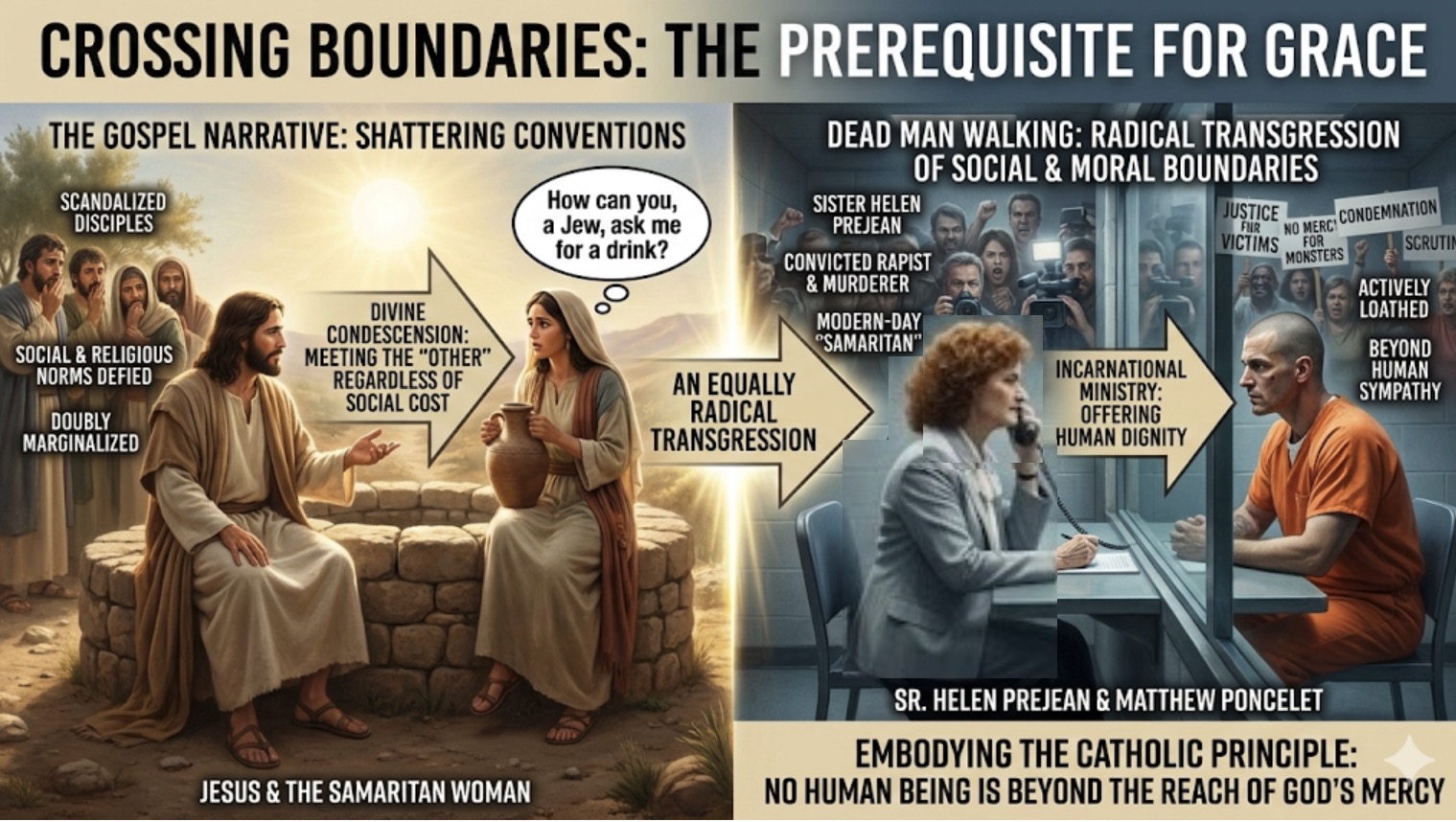
The Gospel narrative begins with a shattering of conventions. Jesus, a Jewish man, initiates a conversation with a Samaritan woman—a person doubly marginalized by her gender and her despised ethnicity. The disciples are scandalized, and the woman herself is incredulous: “How can you, a Jew, ask me for a drink?” This crossing of boundaries is the prerequisite for grace; it is an act of divine condescension that meets the “other” where they are, regardless of social cost.
Dead Man Walking opens with an equally radical transgression of social and moral boundaries. Sister Helen Prejean, a vowed religious woman dedicated to the poor, begins a correspondence with Matthew Poncelet, a convicted rapist and murderer awaiting execution. Poncelet is the modern-day “Samaritan”—a figure not just marginalized but actively loathed, a man whose crimes have placed him beyond the pale of human sympathy. Just as the disciples questioned Jesus, Sr. Helen faces intense scrutiny and condemnation from the public, the media, and even her own community for daring to offer human dignity to a “monster.” Her journey to death row is a profound act of incarnational ministry, embodying the Catholic principle that no human being, regardless of their sin, is beyond the reach of God’s mercy.

Physical Thirst vs. Spiritual Thirst
John 4:13-15
When the woman arrives at Jacob’s Well, her focus is entirely practical: she needs water. Jesus, however, uses her physical thirst to speak of a deeper reality: “Everyone who drinks this water will be thirsty again, but whoever drinks the water I give them will never thirst.” He is offering “living water”—a metaphor for the Holy Spirit and eternal life—but she initially interprets it only on a material level, desiring a magical water that will save her the daily drudgery of coming to the well.
Poncelet’s initial interactions with Sr. Helen are similarly transactional and focused on immediate, physical survival. He sees her not as a spiritual guide but as a useful tool—someone to secure him a better lawyer, to file appeals, and to help him “get off.” He is manipulative, racist, and deeply unrepentant, his “thirst” entirely focused on escaping his physical fate. Sr. Helen, like Christ, recognizes this but refuses to operate solely on his terms. While she works diligently for his legal defense, her primary mission is his soul. She recognizes that his true thirst is not for a pardon, but for the “living water” of truth and reconciliation before he faces God.

The Confrontation with Truth
John 4:16-18
The turning point in the Gospel narrative is abrupt and unsettling. Jesus directs the woman, “Go, call your husband and come back.” When she replies that she has no husband, he reveals her history: “You are right when you say you have no husband. The fact is, you have had five husbands, and the man you now have is not your husband.” This is not an act of shaming, but a necessary confrontation with reality. The “living water” cannot be received by a heart walled off by deceit. The woman attempts to deflect with theological abstract questions, but Jesus gently holds her to the truth of her life.+2
This dynamic is the central tension of Dead Man Walking. For most of the film, Poncelet maintains his innocence, blaming his co-conspirator and a corrupt system for his predicament. He wears his victimhood like armor, deflecting Sr. Helen’s gentle probes with bravado and lies. Sr. Helen, acting in the persona of Christ, becomes the unwavering voice of truth. She does not judge him, but she refuses to accept his fabrications. In scene after agonizing scene, she pushes him to confront the reality of his crime. “The truth, Matt,” she urges him. “You have to own it. You can’t ask for forgiveness for something you won’t admit you did.” This is the Catholic understanding of confession: that redemption requires a full and honest accounting of one’s sin. Like the woman at the well, Poncelet tries to deflect, to talk about the unfairness of his trial, but Sr. Helen, like Jesus, keeps bringing him back to the hard, necessary truth.
The Recognition of the Divine
John 4:19-26
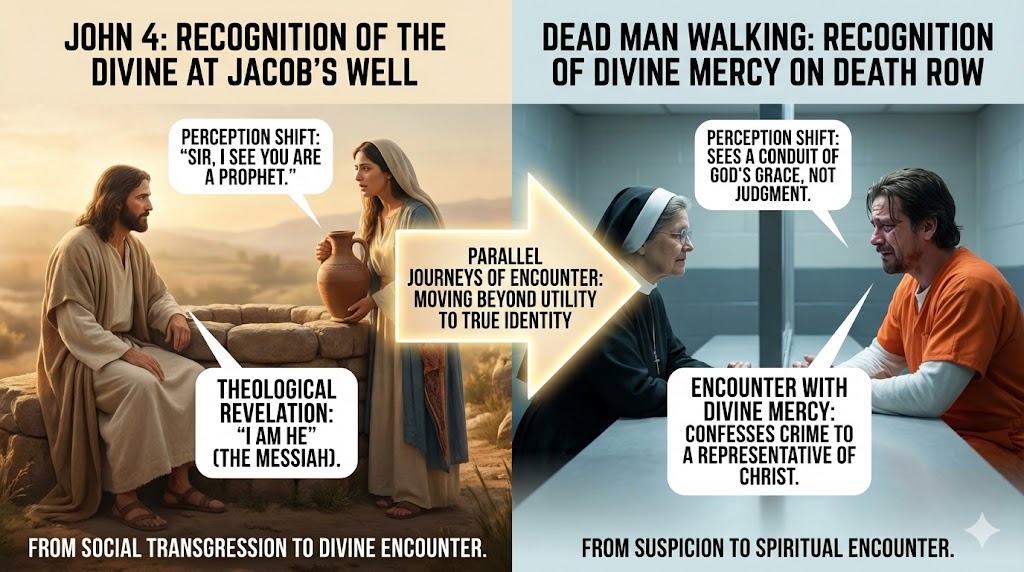
It is only after being confronted with the truth of her life that the woman’s perception of Jesus shifts. “Sir,” she says, “I can see that you are a prophet.” This recognition opens the door for Jesus to reveal his true identity as the Messiah, the “I Am.” The encounter moves from a social transgression to a theological revelation.
Poncelet’s journey mirrors this progression. Initially viewing Sr. Helen with suspicion and utility, he is gradually disarmed by her relentless, unsentimental love. He begins to see that she is not there to use him or judge him, but to offer him a kind of love he has never known—a love that sees his horrific acts but still affirms his humanity. In the film’s powerful climax, just hours before his execution, Poncelet finally breaks down and confesses his crime to Sr. Helen. In that moment of horrific truth-telling, he encounters the divine mercy mediated through her presence. He is no longer just a convict manipulating a nun; he is a broken man confessing to a representative of Christ. He sees her not just as a woman, but as a conduit of God’s grace.

The Transformation
John 4:28-29
The Gospel account concludes with a profound image of transformation: “Then, leaving her water jar, the woman went back to the town and said to the people, ‘Come, see a man who told me everything I ever did. Could this be the Messiah?'” The water jar, the symbol of her daily burden and her old life, is left behind. She who was the outcast becomes the evangelist, her testimony born from the liberating power of being fully known and fully loved.
When she encounters Jesus and tastes the “living water” of being fully known and fully loved without condemnation, the jar suddenly becomes obsolete. She no longer needs the heavy burden of her past defenses or her purely transactional view of life. Leaving the jar behind is an act of spiritual liberation; she is unburdened, free to run back to the very community that ostracized her. Her evangelization is simple and rooted in personal experience: “Come, see a man who told me everything I ever did.” She doesn’t preach theology; she witnesses to the fact that she was seen to the core of her being and was not rejected.
Poncelet’s transformation is equally profound, though it ends not in evangelism but in a final, redeemed act. Having confessed his sin and received final communion, he walks to the execution chamber a changed man. He has left his “water jar” of lies and bravado behind. His final words are not of defiance, but of sorrow and repentance directed at the parents of his victims. “I just want to say I think killing is wrong, no matter who does it,” he says, acknowledging his own guilt. His last request to Sr. Helen—”I want the last thing I see in this world to be your face”—is a final testament to the incarnational love he has received. In looking at her face, he is looking into the face of the Christ who sought him out across the chasm of his sin, offered him the hard truth, and walked with him to the end.
Obviously, a man on his way to the electric chair cannot run back to society to preach. His “town” is the witness gallery at his execution—specifically, the parents of the teenagers he murdered, who hate him with a righteous fury. It is not a happy ending, nor does it undo the terrible damage he caused. But it is a profound testimony to the transformative power of grace. The man who enters the execution chamber is not the same man who entered prison. Like the woman at the well, his encounter with divine love empowered him to face the truth of his life and, in his final moments, offer a genuine, contrite witness to the community that justly condemned him.
Discussion Questions
1: How does the initial interaction between Jesus and the Samaritan woman in John 4 mirror the relationship between Sister Helen Prejean and Matthew Poncelet in Dead Man Walking?
Answer: Both interactions begin with a radical crossing of social and moral boundaries. Jesus, a Jewish rabbi, speaks to a marginalized Samaritan woman, while Sister Helen, a Catholic nun, reaches out to Matthew Poncelet, a convicted murderer on death row. Both acts of engagement defy societal norms and face scrutiny, yet they are essential prerequisites for the offer of grace and the possibility of redemption.
2: What is the significance of the distinction between “physical thirst” and “spiritual thirst” in both the biblical narrative and the film?
Answer: In both stories, the initial focus is on immediate physical needs: the woman wants water from the well, and Poncelet wants legal assistance to avoid execution. However, both Jesus and Sister Helen recognize a deeper spiritual thirst in their counterparts—a need for truth, repentance, and reconciliation. They both guide the conversation toward this “living water,” emphasizing that true fulfillment and redemption lie beyond mere physical survival.
3: How does the confrontation with truth play out in the encounter between Jesus and the woman at the well, and how is this echoed in Dead Man Walking?
Answer: Jesus confronts the woman with the truth of her past, revealing her multiple marriages and current living situation. This is not to shame her but to break down her defenses and open her to the possibility of grace. Similarly, Sister Helen persistently urges Poncelet to acknowledge his guilt and take responsibility for his crimes. She recognizes that true repentance and the reception of forgiveness require an honest confrontation with the truth.
4: Describe the transformation that occurs in both the Samaritan woman and Matthew Poncelet as a result of their encounters.
Answer: Both individuals undergo a profound transformation. The Samaritan woman, after recognizing Jesus as the Messiah, leaves behind her water jar—symbolizing her old life and burdens—and becomes an evangelist, sharing her experience with her community. Poncelet, after confessing his crimes and receiving God’s mercy through Sister Helen, experiences a change of heart. He faces his execution with remorse and a newfound sense of peace, offering a final testament to the transforming power of love and truth.
5: What is the central message conveyed by both the biblical narrative of the Woman at the Well and the film Dead Man Walking regarding divine grace?
Answer: Both stories emphasize that divine grace is available to everyone, regardless of their past actions or societal standing. They highlight the importance of encountering others with compassion and truth, even across deep divides. Ultimately, both narratives offer a powerful testament to the transformative power of God’s love and the possibility of redemption for even the most broken individuals.
THE FAITH & FILM section of THE WORD THIS WEEK website cultivates discernment and wonder by analyzing how the stories we watch interact with the Greatest Story ever told. Whether it’s a superhero grappling with sacrifice, a horror film exploring the reality of evil, or a drama depicting the beauty of forgiveness, we believe every frame offers a chance to engage with the Gospel. Movies are more than just entertainment; they are modern parables that reflect the deepest longings of the human heart—our desire for redemption, our struggle with sin, and our search for truth. We aren’t just looking for “safe” content or counting curse words; we are looking for God’s truth in unexpected places.