Papal Homilies, Pope Francis, Pope Benedict, Pope John Paul II, Pope Leo
October 4, 2026
⭐⭐⭐ Pope Leo XIV



Holy See
- The Bible
- Catechism of the Catholic Church
- Codes of Canon Law
- Ecumenical Councils
- Official Acts of the Holy See
- Social Doctrine of the Church
- Abuse of Minors, the Church’s Response
- Press Office
- Vatican News – Radio Vaticana
- L’Osservatore Romano
- Vatican Websites
- Vatican City State
- Basilicas and Papal Chapels – Virtual Tours
- Liturgical Celebrations
- Tickets for Papal Audiences and Celebrations
27th Sunday of Year A


Coherence/Incoherence
FROM THE ARCHIVES (1999)
The theme of coherence/incoherence serves as a thread unifying this Sunday’s texts: being what one is and acting in accordance with one’s nature. The vineyard, to be a true vineyard, must produce fine grapes and not wild ones (First Reading). He who has leased land from the landowner, must behave as a tenant and pay the sum established with the landowner at the proper time (Gospel). Those that act in a stable and constant way will live in God’s peace, which is beyond our understanding (Second Reading).
P. Antonio Izqeuirdo, L.C., Copyright © Dicastery for the Clergy
Doctrinal Messages
God is coherent with and faithful to his people Israel, from their origins and throughout the long journey of salvation history
Why did Israel, and the Church, a people so privileged by God, not respond with the same consistent attitude? God placed his confidence in humanity and in his people, and at the peak of his coherence sent his Son, expecting people to recognize, respect and obey him. But on the contrary, the people take advantage of the situation to kill him. Why? How is such a degree of incoherence, or perversity and malice, possible? What dwells in our hearts to allow us to act in such an unworthy and wretched way? The heart is an abyss, we are told by one of the Psalms. Yes, a possible abyss of greatness and coherence, but also of wickedness. Let us recall that all serious sins are, in a certain way, a crime against the very Son of God.
O Christian, know that you are a Christian, act like a Christian
God created the person to be a person in all fullness, according to what a person is called to be; God has made the Christian a Christian through baptism in order to be a Christian, to act like a Christian. What are the ways proper to Christian conduct?
a) The Christian will be what he is called to be if he bears good fruit, like the vine which yields an excellent wine (First Reading). Fruits of judgment and discernment in the light of the history of salvation, and fruits of justice, in other words, of those that have been justified and saved by the redeeming grace of God.
b) The Christian will be what he is called to be if, as tenant, he gives the landowner what is due according to what was established (Gospel), according to the covenant established between God and his people, between God and the baptized. As tenants, let us not believe that we are landowners. As tenants, let us allow the land of our existence to bear fruit. As tenants, let us thank the landowner for his benevolence towards us and let us show him our gratitude by delivering him the produce that he is due
Coherence and peace
Paul recognizes himself as coherent and faithful through the grace of Jesus the Lord, which is why he says to the Philippians, “Keep doing everything you learned from me and were told by me and have heard or seen me doing.” As a result of this consistent life, “…the God of peace will be with you” (Second Reading). It is the peace of those who in any circumstance will present their wishes to God in prayer, petition and thanksgiving; it is the peace of those who hold in high regard everything that is true, everything that is honorable, everything that is upright and pure, everything that we love, everything that is good, virtuous and praiseworthy in the world and in the environment in which we live (Second Reading).
Pastoral Suggestions
The difficult coherence of the Christian
Without exaggerating, it should be pointed out that in contemporary society it is more difficult to be a true Christian than in past times, because in the environment around us there is a lot of indifference to and even disdain for the Christian Faith
a) It is difficult to confess integral faith in Christ, true God and true man; faith in the Church, human and divine at once, institutional and charismatic, holy and comprised of sinful members; faith in Catholic moral doctrine, with all of the implications and needs that this entails in the social arena, in the area of life and sexuality, in the family and professional sphere.
b) It is difficult to live and decide in a Christian way on something so important as who should be given the vote in municipal or regional administrative elections or in general political elections, or whether or not to marry a girl that is not a practicing Catholic or not a Catholic at all, or whether or not to engage in “dirty” business that goes against one’s moral principles …
P. Antonio Izqeuirdo, L.C., Copyright © Dicastery for the Clergy
Coherence is the source of peace in one’s conscience, while inconsistency breeds a lack of tranquility
When a person lives coherently, he feels gratified when he has done his job. When one is inconsistent, the conscience is filled with remorse day after day, while coherence brings serenity. When there is no coherence, often one does not do things well, one does things with very little will and only to fulfill a task. Without coherence, the life of a person ceases to be a history, and in the case of the Christian, it ceases to be a holy life and becomes a series of unconnected events, with no union or substance, often meaningless. When a person is coherent both with the human condition and the Christian Faith, he lives in a state of great equanimity, psychological and spiritual stability, and especially, in peace with God and with his own conscience.
SOURCE: YEAR A DICASTERY NOTES (1999)
P. Antonio Izqeuirdo, L.C., Copyright © Dicastery for the Clergy, The header image is an AI-generated visual concept illustrating the central themes, scripture quotes, and visual motifs from this week’s Mass readings.

27th Sunday of Year A
Parable of the
Murderous Vintners
27 October 2020 | Saint Peter’s Square
Context and the Parable of the Murderous Vintners
In today’s Gospel passage (cf. Matthew 21:33-43) Jesus, foreseeing his passion and death, tells the parable of the murderous vintners, to admonish the chief priests and elders of the people who are about to take the wrong path. Indeed, they have bad intentions towards him and are seeking a way to eliminate him.
The allegorical story describes a landowner who, after having taken great care of his vineyard (cf. v. 33), had to depart and leave it in the hands of farmers. Then, at harvest time, he sends some servants to collect the fruit; but the tenants welcome the servants with a beating, and some even kill them. The householder sends other servants, more numerous, but they receive the same treatment (cf. vv. 34-36). The peak is reached when the landowner decides to send his son: the vinegrowers have no respect for him; on the contrary, they think that by eliminating him they can take over the vineyard, and so they kill him too (cf. vv. 37-39).
Meaning of the Allegory and the Response of the Leaders
The image of the vineyard is clear: it represents the people whom the Lord has chosen and formed with such care; the servants sent by the landowner are the prophets, sent by God, while the son represents Jesus. And just as the prophets were rejected, so too Christ was rejected and killed.
At the end of the story, Jesus asks the leaders of the people: “When the owner of the vineyard comes, what will he do to those tenants?” (v. 40). And, caught up in the logic of the narrative, they deliver their own sentence: the householder, they say, will severely punish those wicked people and “let out the vineyard to other tenants who will give him the fruits in their seasons” (v. 41).
The Ever-Present Call to Bear Fruit and the Nature of Authority
With this very harsh parable, Jesus confronts his interlocutors with their responsibility, and he does so with extreme clarity. But let us not think that this admonition applies only to those who rejected Jesus at that time. It applies to all times, including our own. Even today God awaits the fruits of his vineyard from those he has sent to work in it—all of us.
In any age, those who have authority, any authority, also in the Church, in the People of God, may be tempted to work in their own interests instead of those of God. And Jesus says that true authority is when one performs service; it is in serving, not exploiting others. The vineyard is the Lord’s, not ours. Authority is a service, and as such should be exercised for the good of all and for the dissemination of the Gospel. It is awful to see when people who have authority in the Church seek their own interests.
Commitment to Holiness in Daily Life
Saint Paul, in the second reading of today’s liturgy, tells us how to be good workers in the Lord’s vineyard: that which is true, noble, just, pure, lovely and honored; that which is virtuous and praiseworthy, let all this be the daily object of our commitment (cf. Philippians 4:8). I repeat: that which is true, noble, just, pure, lovely and honored; that which is virtuous and praiseworthy, let all this be the daily object of our commitment.
It is the attitude of authority and also of each one of us, because every one of us, even in a small, tiny way, has a certain authority. In this way we shall become a Church ever richer in the fruits of holiness; we shall give glory to the Father who loves us with infinite tenderness, to the Son who continues to give us salvation, and to the Spirit who opens our hearts and impels us towards the fullness of goodness.

October 4, 2020
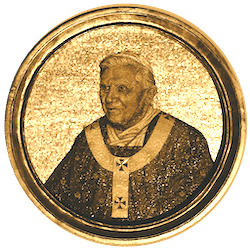
27th Sunday of Year A
A Warning to the Chief Priests
2 Octpober 2011 | Saint Peter’s Square
The Severe Warning and the Responsibility of Authority
This Sunday’s Gospel ends with a particularly severe warning from Jesus, addressed to the chief priests and the elders of the people: “The kingdom of God will be taken away from you and given to a nation producing the fruits of it” (Matthew 21:43). These are words that call to mind the great responsibility of those in every epoch who are called to work in the Lord’s vineyard, especially in roles of authority, and they press for a renewal of full fidelity to Christ.
He is “the very stone which the builders rejected” (cf. Matthew 21:42), because they judged him to be hostile to the law and a danger to public order; but he himself, rejected and crucified, is risen, to become the “corner stone” on which the foundations of every human life and of the whole world may rest in total safety.
The Parable of the Unfaithful Tenants and Human Infidelity
The truth of this is the subject of the Parable of the Unfaithful Tenants to whom a man entrusted his vineyard so that they might cultivate and harvest the produce. The owner of the vineyard symbolizes God himself, while the vineyard symbolizes his people, as well as the life he gives, so that with his grace and our hard work, we may do good. Saint Augustine comments: “God does also cultivate us… as a field, that he may make us better” (cf. Sermo 87, 1, 2: PL 38, 531). God has a project for his friends, but unfortunately the human response is often oriented to infidelity which is expressed in rejection. Pride and selfishness prevent us from recognizing and welcoming even God’s most precious gift: his Only-Begotten Son.
The Rejection of the Son and God’s Fidelity
When, in fact, “he sent his son to them”, the Evangelist Matthew wrote, “[the tenants] took him and cast him out of the vineyard, and killed him” (Matthew 21:37, 39). God puts himself in our hands, agrees to make himself an unfathomable mystery of weakness and manifests his omnipotence in his faithfulness to a plan of love which, in the end, also provides for the proper punishment of the wicked (cf. Matthew 21:41).
Abiding in Christ, the Living Cornerstone
Firmly anchored in faith to the cornerstone which is Christ, let us abide in him, like the branch that can bear no fruit unless it remains attached to the vine. The Church, the People of the New Covenant, is built only in him, for him and with him.
On this, the Servant of God Paul VI wrote: “The first benefit which We trust the Church will reap from a deepened self-awareness, is a renewed discovery of its vital bond of union with Christ. This is something which is perfectly well known, but it is supremely important and absolutely essential. It can never be sufficiently understood, meditated upon and preached” (Encyclical Ecclesiam Suam, 6 August 1964: AAS 56 [1964], 622).

27th Sunday of Year A
The Lord’s Vineyard
Tuesday, 16 December 1997 | STUDENTS OF THE ROMAN STATE UNIVERSITIES
The Cosmic Vineyard and the Mystery of the Incarnation
The Word of God refers to the Lord’s vineyard, an evocative allegory that occurs frequently in the Gospels and serves as the central theme of this passage. Following the Gospel texts, the vineyard represents the whole created cosmos, which, through Christ’s coming, becomes God’s property in a special way. Through Christ’s redemption, both creation and humanity belong to God in an entirely renewed manner.
In this sense, Christmas marks the holy day when both the visible and the inanimate assume a profound and unexpected significance. As the Evangelist John reminds us, “God so loved the world that he gave his only Son, that whoever believes in him should not perish but have eternal life” (Jn 3:16). These words capture the deep meaning of the vineyard image to which Jesus repeatedly points. Through the mystery of the Incarnation of the Word, humanity and the entire cosmos discover with joy that they are the Lord’s vineyard—the direct object of God’s saving love.
The Call to the Vineyard: Concrete Action over Words
“Go and work in my vineyard!” (cf. Mt 21:28), the father commands his two sons in the Gospel parable. He expects an answer, yet he is never satisfied with mere words; he requires actual commitment. The two sons respond in fundamentally different ways: the first professes willingness but does nothing, while the second initially refuses his father’s invitation, yet reconsiders and fulfills what was asked of him.
The Evangelist Matthew presents here a typology of human responses to God throughout history. The Gospel invitation to labor in the Lord’s vineyard echoes in the heart and life of every person, summoning each to dedicate themselves actively to the divine vineyard and engage in the mission of salvation. In this parable, each of us can recognize the reality of our own personal experience.
Academic Life, Human Progress, and Moral Temptations
The university community represents a particularly fertile ground for cultivating the talents the Lord entrusts to each person for the common good. Through disciplined study and rigorous research, those who develop these gifts are equipped to lead initiatives that advance the authentic progress of society.
Yet, as the Second Vatican Council cautions in Gaudium et spes (n. 37), the advantages of human progress carry grave temptations. When the hierarchy of values becomes disordered, good and evil intermingle, and individuals or groups focus solely on self-interest rather than the common good. Consequently, earthly achievements alone have not forged true brotherhood; instead, unchecked power poses severe risks to humanity itself.
Cultural Renewal, True Wisdom, and the Light of Faith
Authentic human progress is realized only when individuals, guided by the Holy Spirit, commit to directing temporal affairs toward the Kingdom of God (cf. Gaudium et spes, n. 72). By fostering an encounter with the Son of the living God, the Spirit purges intellectual presumption, guiding the human heart toward true wisdom—a gift that must always be sought and received with humility.
Young scholars and students are called to listen to the Spirit of the Lord, unleashing generous cultural energies to serve the broader mission of faith in society. Knowledge grounded in faith possesses genuine cultural dignity. Rather than diminishing inquiry, faith illuminates intellectual pursuits and makes them fully human. As the Second Vatican Council teaches, it is only in the mystery of the Word made flesh that the mystery of the human person truly becomes clear: Christ, the new Adam, in revealing the mystery of the Father and his love, fully reveals man to himself and discloses his supreme calling (cf. ibid., n. 22). us. Amen.

Matthew 21:33-43
Search Engine created by Jeff Pinyan
27th Sunday of Year A
Isaiah 5:1-7
Search Engine created by Jeff Pinyan
27th Sunday of Year A
Philippians 4:6-9
Search Engine created by Jeff Pinyan
27th Sunday of Year A