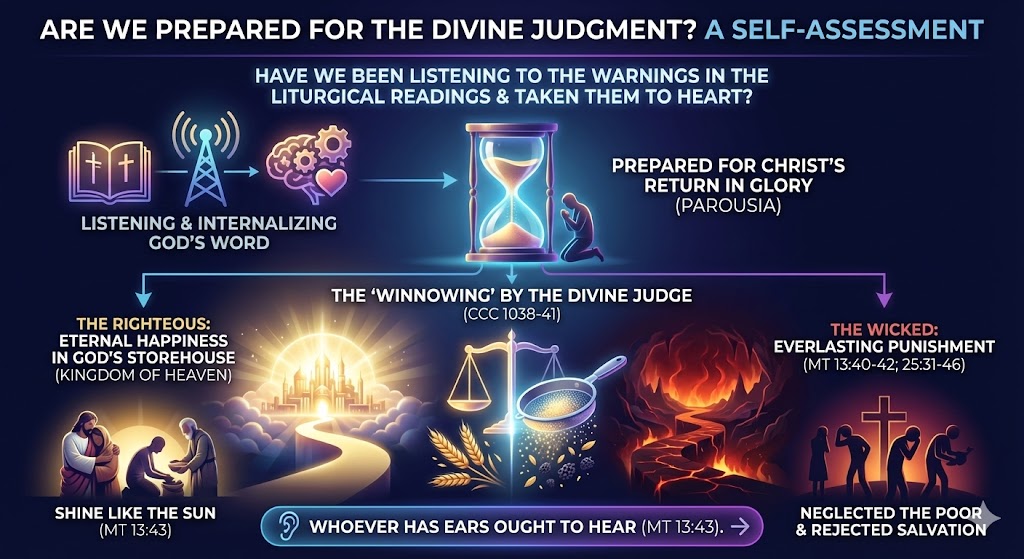
Commentary Intro to Mass Readings for Sunday
CommentaryIntro to Mass Readings for Sunday
December 7, 2025
December 7, 2025
2nd Sunday of Advent (A)


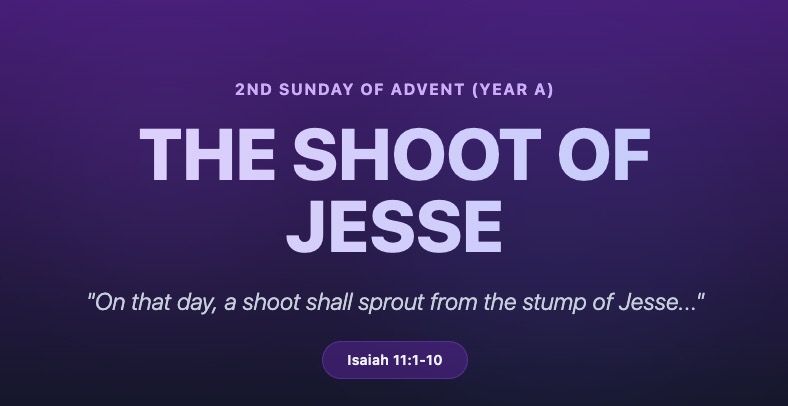
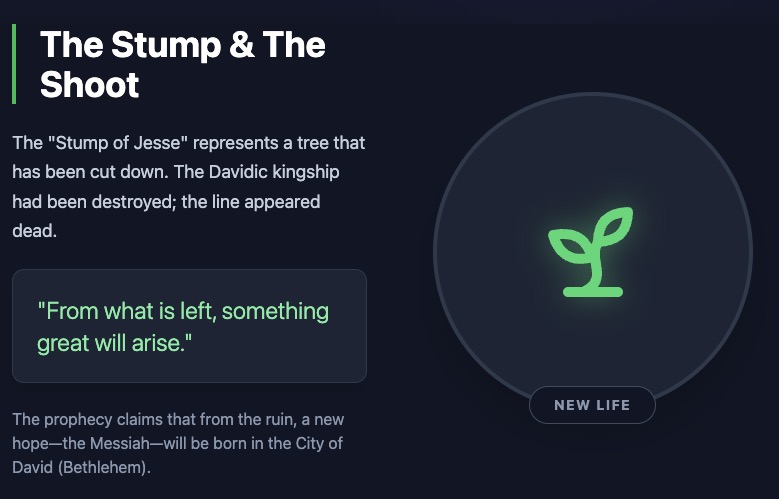
Navarre Bible Commentary

Infographics were created using Nano Banana Pro with Gemini 3.0. They draw inspiration from the Navarre commentary but are not officially associated with or endorsed by the publisher. They may be copied for personal use or for use in any non-profit ministry. Please show your support by promoting this website.

The summary (right) and the infographic (click on the banner above) have been AI generated using content found in Major Prophets, pp 52–54
The Vision of Hope and
the Centrality of Zion
The Faculty of Theology of the University of Navarre highlights a vision of hope amidst the dire circumstances faced by the people of Judah, emphasizing the significance of Zion, or Jerusalem, as the focal point of global salvation. Despite the people’s sins, the text presents a prophetic promise that all nations will come to Jerusalem, not to exploit it, but to seek peace and learn from the Lord’s teachings. This message of hope is strategically placed at the beginning and end of the book, underscoring its importance.
The Law, the Temple, and
the Foundations of Peace
The prophecy connects the Law with the temple, which serves as the spiritual heart of Jerusalem following the return of the exiles from Babylon. In stark contrast to the chaos and destruction caused by sin, the author asserts that true peace arises from reverence for God, adherence to His commandments, virtuous living, and love for one’s neighbor.
Transforming Conflict:
The Fulfillment in Christ
The transformation of weapons into agricultural tools symbolizes the potential for humanity to overcome sin and violence through love and unity. The commentary references Isaiah’s words, which foretell a time when nations will no longer engage in warfare, a vision that is ultimately fulfilled with the birth of Christ, heralding an era of peace and reconciliation.
Liturgical Echoes: Advent and
the Promise of Peace
This prophetic message is echoed in the Church’s liturgical practices, particularly during Advent, as believers prepare to celebrate Christ’s first coming while anticipating His second coming. The author effectively conveys that the promise of divine intervention and the establishment of peace is central to the Christian faith and the hope for a future free from conflict.
Word-Sunday.com

TWTW Infographics with images created using Nano Banana Gemini AI generator. Permission is granted to non-profits to use them in their ministry. Please give credit to TWTW website and Larry Broding’s commentary on which the graphic is based.


The Ideal King
by Larry Broding
What is your vision of the ideal ruler?
How do the traits Isaiah described apply to Jesus?
Fear is a powerful silencer, but in the face of the terrifying Assyrian war machine, the prophet Isaiah spoke a word of defiance: Hope. This Sunday’s first reading takes us back to the 6th Century B.C., where the Kingdom of Judea trembled on the brink of destruction.
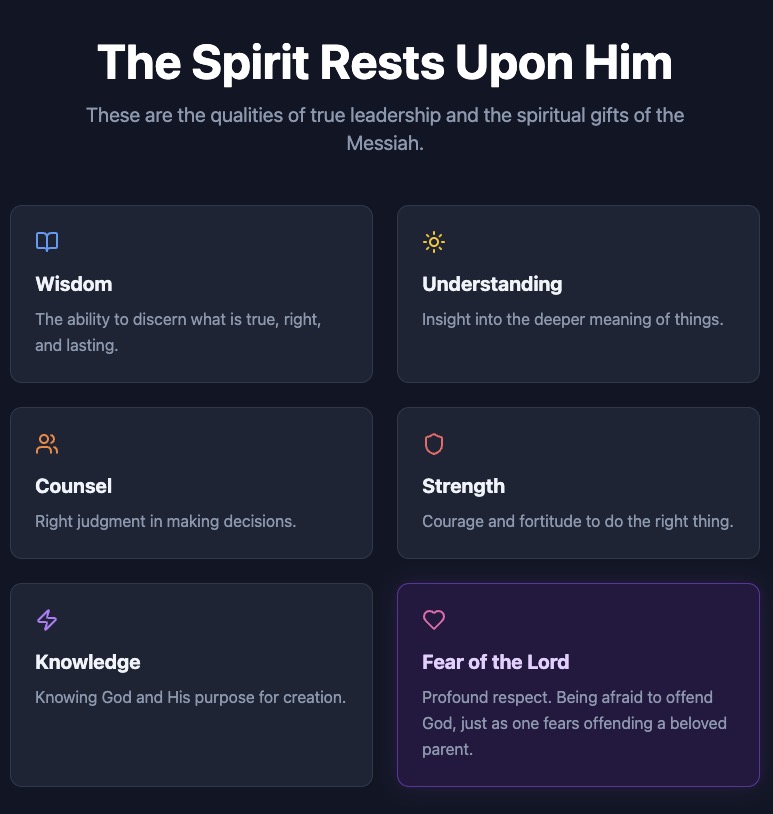
Larry Broding’s commentary on Isaiah 11:1-10, titled "The Ideal King," transports preachers into this atmosphere of desperation to reveal the power of Isaiah’s prophecy. Broding masterfully outlines the profile of the coming Messiah—a ruler from the "stump of Jesse" who rules not by military might, but by the very Spirit of God.
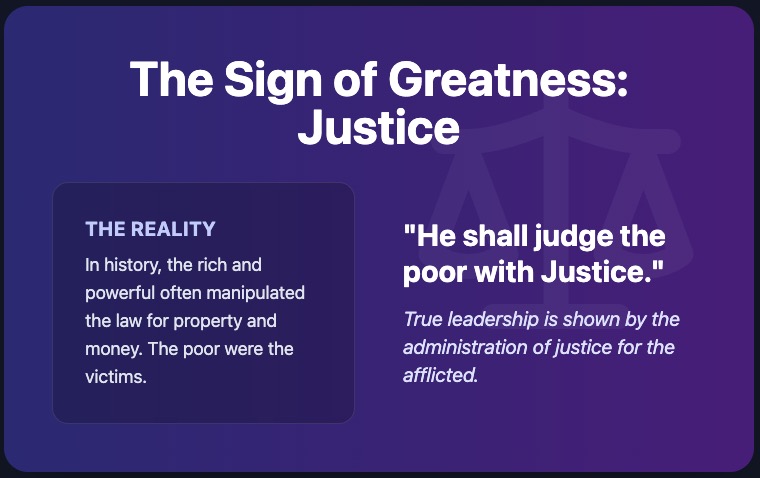
This resource is essential for connecting the ancient longing for a political savior with the Christian understanding of Jesus. Broding highlights how the gifts of the Spirit and the vision of the "Peaceable Kingdom"—where the wolf lies with the lamb—are not merely poetic imagery, but a definition of divine justice. He challenges homilists to ask how the traits of this ancient "Ideal King"—fairness, impartiality, and faithfulness—are embodied in Jesus of Nazareth today.
For those looking to preach on peace in a time of conflict, Broding summarizes the prophet's intent with this poignant observation:
"The prophet did paint the ideal Jewish king. The righteous ruler who would bring true peace to the world. Because he possessed the wisdom and power of God's Spirit."
Read this commentary to explore how the "Root of Jesse" offers a vision of leadership that transforms not just human politics, but the very order of nature itself.
Father Tim Peters
Deep Dives

The Word Proclaimed
Click on timestamp links to watch different sections of the video.

Jesus Christ, the Son of David, is the eternal King of Israel and the whole earth, whose kingship was fulfilled through his sacrifice and resurrection, and through whom all creation can be restored and have a direct connection to God.
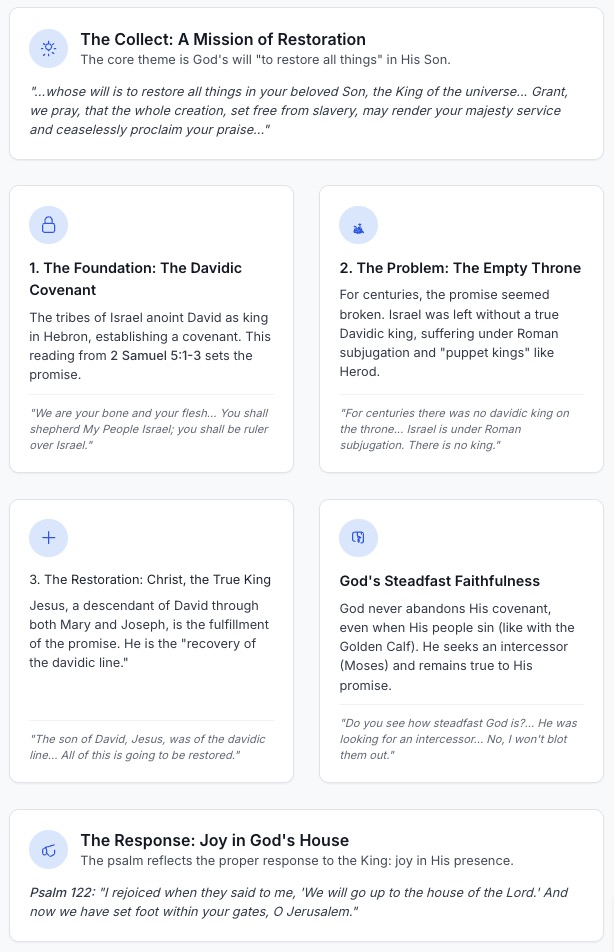
- 00:00 Almighty God seeks to restore all things through Jesus Christ, his beloved Son, and prays that creation, set free from slavery, may serve and praise Him.
- 01:30 The tribes of Israel anoint David as their king, forming a covenant with him, recognizing him as their relative and leader chosen by God to shepherd His people.
- 03:32 God’s promise to David of a perpetual throne was fulfilled in Jesus, the son of David, who restored the kingship despite centuries of non-Davidic rulers and foreign domination.
- 06:37 God seeks an intercessor, like Moses, who stands in the breach to spare His people from punishment, mirroring Christ’s role.
- 07:32 Jesus is the recovery of the Davidic line, and the pretenders to the throne, including those installed by occupying forces, will have a reduced existence but not be completely eliminated.
- 08:50 We should be as proud to be part of the church as the Jews are of Jerusalem, since we have a direct connection to Heaven through the daily Eucharist.
- 09:47 The kingship of the Son of David is fulfilled as Jesus, the king, lays down his life for his people and the world, then rises to eternal kingship.
- 11:11 The 34th Sunday in Ordinary Time focuses on Jesus as the eternal King of Israel and the whole earth, previewing His judgment on all humanity.
- The 34th Sunday in Ordinary Time is the last Sunday of the year, focusing on the last day of existence.
- The church celebrates Jesus as the eternal King of Israel and the whole earth, whose kingship is being portrayed on this last Sunday of the year as a preview of the time when He will exercise judgment on all humanity.

Navarre Bible Commentary

Infographics were created using Nano Banana Pro with Gemini 3.0. They draw inspiration from the Navarre commentary but are not officially associated with or endorsed by the publisher. They may be copied for personal use or for use in any non-profit ministry. Please show your support by promoting this website.

The summary (right) and the infographic (click on the banner above) have been AI generated using content found in Saint Paul’s Letters to the Romans & Galatians, pp 126–127
The Multifaceted Coming of Christ
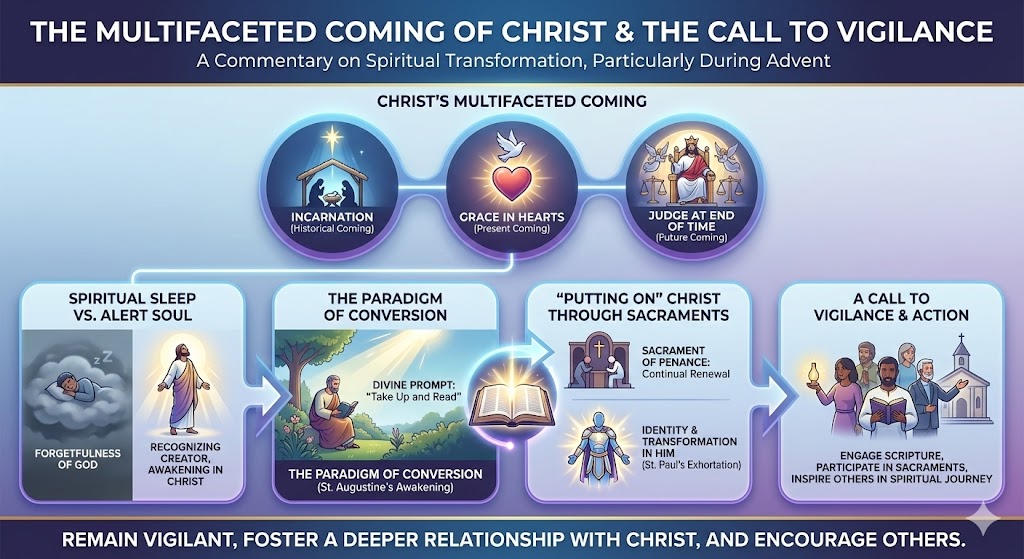
The Faculty of Theology of the University of Navarre emphasizes the significance of spiritual vigilance and transformation in the life of a Christian, particularly during the Advent season. The commentary highlights that Christ’s coming is multifaceted: through his Incarnation, through grace in the hearts of believers, and ultimately as the Judge at the end of time.
Spiritual Sleep vs. The Alert Soul
The author references St. Augustine’s notion of spiritual sleep, which is characterized by a forgetfulness of God, contrasting it with the alertness of a soul that recognizes its Creator. This awareness is crucial, as Christians are called to live in a manner that reflects their awakening in Christ, thereby inspiring others who may be spiritually lethargic.
The Paradigm of Conversion:
St. Augustine's Awakening
The text also discusses the ongoing need for conversion among baptized individuals, illustrating this with St. Augustine’s personal experience of awakening through Scripture, which led him to a profound transformation. His encounter with a divine prompt to “take up and read” catalyzed a significant change in his life, dispelling his previous doubts.
"Putting On" Christ
Through the Sacraments
Furthermore, the commentary underscores the importance of the sacrament of Penance as a means for Christians to continually “put on” Christ, reinforcing their identity and transformation in Him. The author cites St. Paul’s exhortation to “put on the Lord Jesus Christ,” indicating that this process is essential for spiritual growth and renewal.
A Call to Vigilance and Action
Overall, the commentary serves as a reminder of the necessity for Christians to remain vigilant, engage with Scripture, and participate in the sacraments to foster a deeper relationship with Christ and to encourage others in their spiritual journeys.
Word-Sunday.com

TWTW Infographics with images created using Nano Banana Gemini AI generator. Permission is granted to non-profits to use them in their ministry. Please give credit to TWTW website and Larry Broding’s commentary on which the graphic is based.



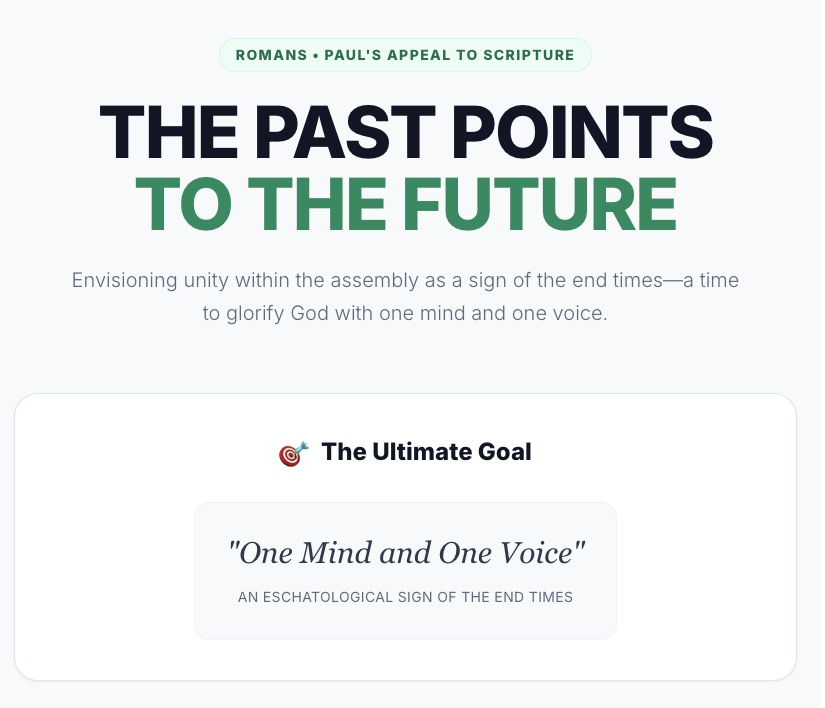
The Past Points To the Future
by Larry Broding
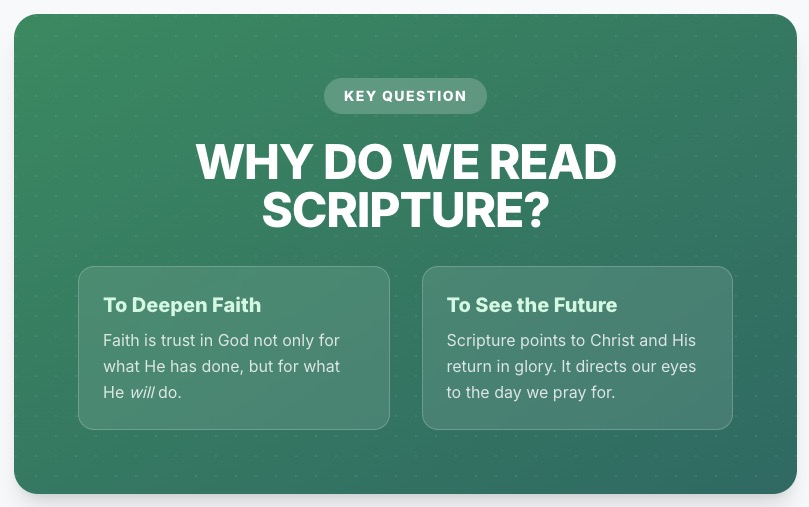
How does reading the Bible help you?
How many times have you been struck by the teaching of Christ's return in Scripture? How have those times changed your outlook on faith?
In a polarized world, the call to "think in harmony with one another" can feel like an impossible ideal. Yet, this Sunday’s reading from Romans suggests that unity isn't just a nice social goal—it is a sign of the end times and the glory of God.
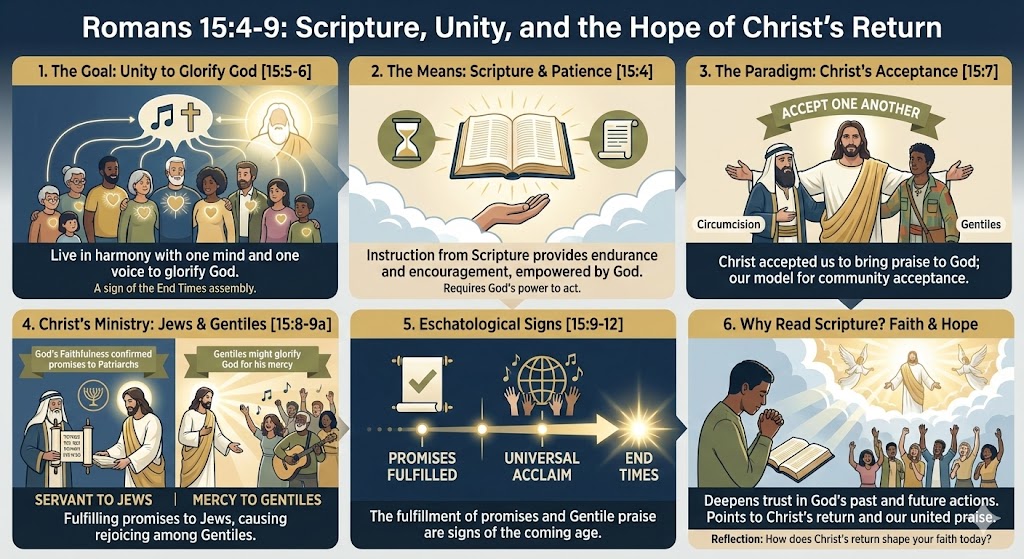
Larry Broding’s commentary on Romans 15:4-9, titled "The Past Points To the Future," provides preachers with a theological blueprint for understanding this unity. Broding moves beyond a simple call for "getting along" to examine the deep, structural requirements Paul lays out for the assembly: patience, scriptural instruction, and the power of God.
The commentary is particularly helpful in unpacking Christ’s dual role as the paradigm for acceptance. Broding explains the tension and resolution in Christ becoming a "servant to the circumcised" (confirming God's faithfulness to the past) so that the Gentiles might glorify God for His mercy (opening the future). It frames the act of welcoming one another not merely as hospitality, but as an imitation of Jesus that fulfills ancient prophecy.
For the homilist looking to connect the act of reading the Bible with the anticipation of the Second Coming, Broding offers this powerful perspective on the function of Scripture:
"Why do we read Scripture? Obviously we study and pray over Scripture to feed and deepen our faith. But, faith is trust in God not only for what he has done, but what he will do. Scripture points to Christ and to his return in glory. That is the day we pray for, the time when we will praise him in union with all other believers."
Use this commentary to help your congregation see that their unity in the pews today is actually a rehearsal for the final, universal chorus of praise at the end of time.
Father Tim Peters
Deep Dives

The Word
Proclaimed
Click on timestamp links to watch different sections of the video.

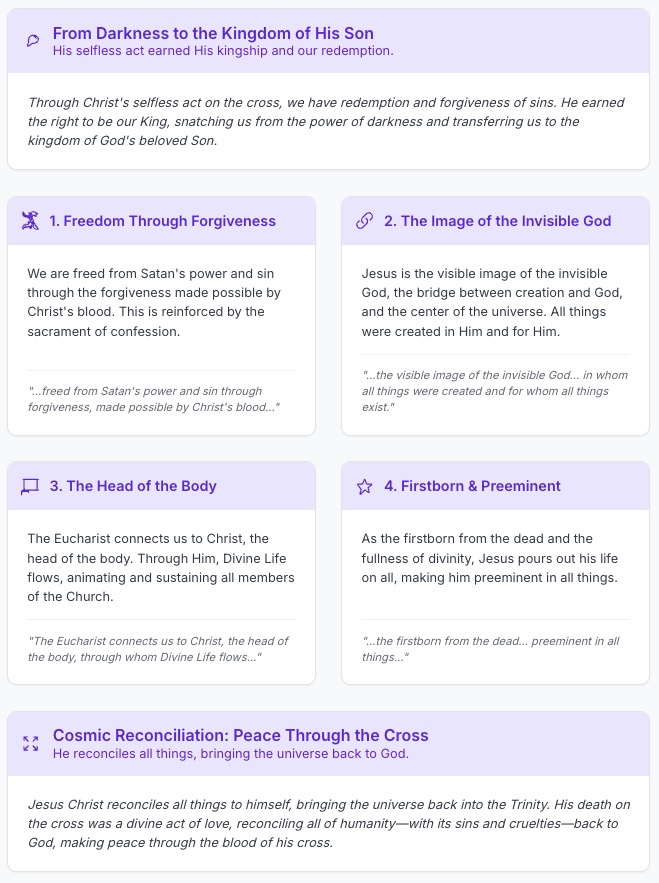
Through Jesus Christ’s selfless act of love on the cross, we are redeemed, forgiven, and transferred from the kingdom of darkness to the kingdom of God’s beloved Son, and that He is the center of the universe who reconciles all things to Himself.
- 00:00 Through Christ, we have redemption and forgiveness of our sins, and have been transferred from the power of darkness to the kingdom of God’s beloved Son.
- 02:41 Through his selfless act of love on the cross, Jesus Christ earned the right to be our King, snatching us from darkness and transferring us to his kingdom, where we have redemption and forgiveness of sins.
- 04:06 We are freed from Satan’s power and sin through forgiveness, made possible by Christ’s blood, and reinforced by the sacrament of confession, which allows us to repent and return to God’s kingdom.
- 05:26 Jesus Christ is the visible image of the invisible God, the bridge between creation and God, and the center of the universe, in whom all things were created and for whom all things exist.
- 07:31 The Eucharist connects us to Christ, the head of the body, through whom Divine Life flows, animating and sustaining us.
- 08:23 Jesus Christ, as the firstborn and fullness of divinity, reconciles all things to himself through his crucifixion, bringing the universe back into the Trinity.
- 09:54 Jesus, the firstborn from the dead, pours out his life on all, making him preeminent in all things, and through him, all things are reconciled to God.
- 11:23 Jesus Christ’s death on the cross was a divine act of love, reconciling all of humanity with its sins and cruelties back to God, making peace through the blood of his cross.


Navarre Bible Commentary

Infographics were created using Nano Banana Pro with Gemini 3.0. They draw inspiration from the Navarre commentary but are not officially associated with or endorsed by the publisher. They may be copied for personal use or for use in any non-profit ministry. Please show your support by promoting this website.

The summary (right) and the infographic (click on the banner above) have been AI generated using content found in Saint Luke’s Gospel, pp 192–194.
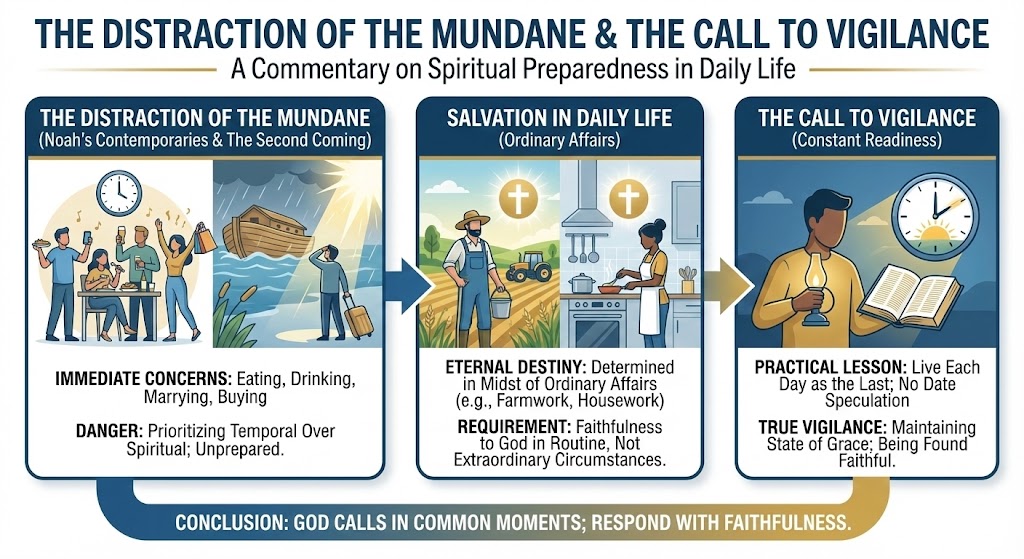
The Distraction of the Mundane
Jesus highlights humanity’s tendency to become absorbed in the immediate concerns of life—eating, drinking, and marrying—at the expense of the eternal. Just as the flood caught Noah’s contemporaries unaware, the Second Coming will be sudden and unexpected. The danger lies not in daily activities themselves, but in an attitude that prioritizes the temporal over the spiritual, leaving the soul unprepared.
Salvation in Daily
Eternal destiny is determined in the midst of ordinary affairs, such as farmwork or housework. Salvation does not require extraordinary circumstances or special social status; rather, it requires faithfulness to God within the routine of everyday life. It is in these common moments that God calls and the human heart responds.
The Call to Vigilance
The practical lesson is one of constant readiness. Instead of speculating about dates or signs, a Christian is called to live each day as if it were the last. True vigilance means maintaining a state of grace, ensuring that whenever the Lord arrives, He finds us faithful.
Word-Sunday.com

TWTW Infographics with images created using Nano Banana Gemini AI generator. Permission is granted to non-profits to use them in their ministry. Please give credit to TWTW website and Larry Broding’s commentary on which the graphic is based.


by Larry Broding
How are your Christmas preparations coming? Lists and shopping and cards? How have you prepared for the season in a spiritual sense?
When do you take "desert" time to reflect on this hurried and harried season? How do you reform in a culture that gives us so many choices, moral and otherwise? What does it mean to wait for the coming of Jesus even when you celebrate his arrival on December 25th?
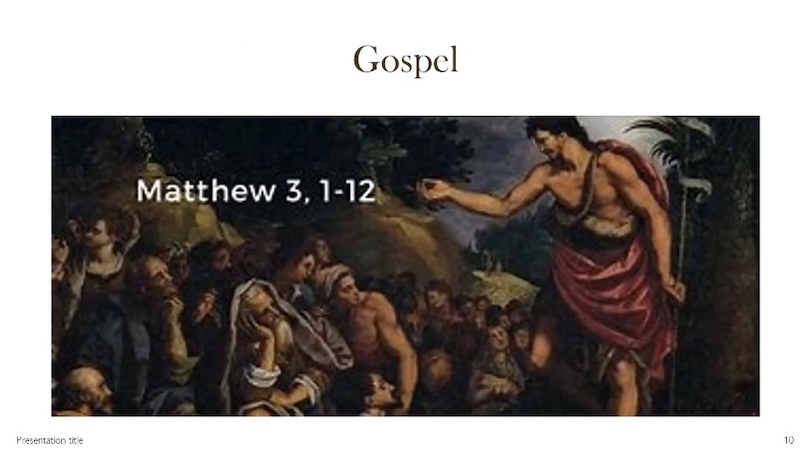
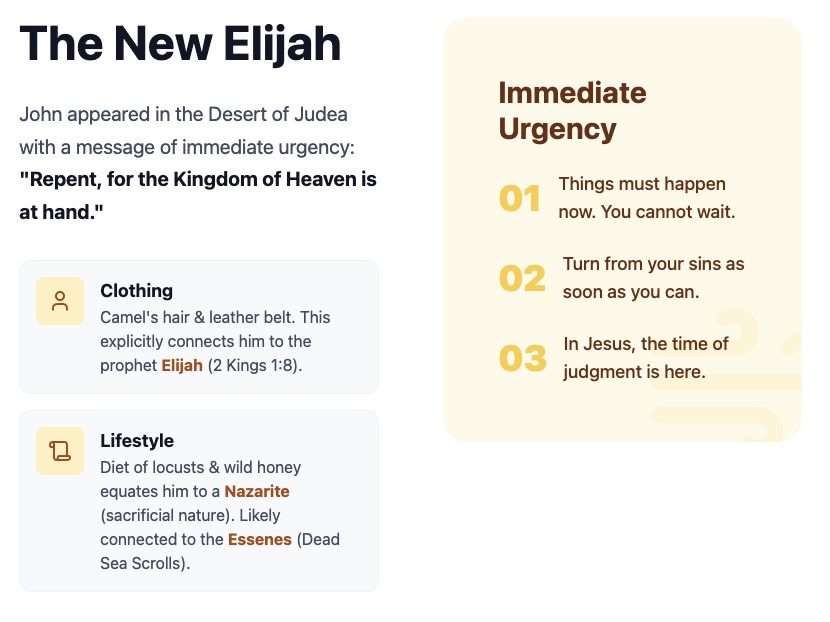
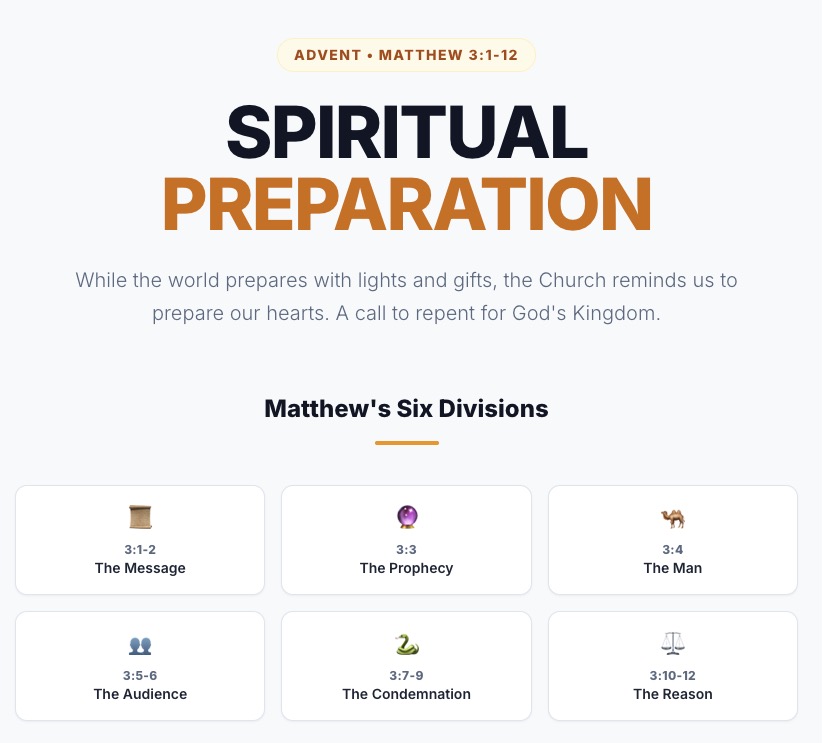
While our culture prepares for the holidays with twinkling lights, gift exchanges, and manufactured cheer, the Church invites us into the desert. This Sunday, the Gospel of Matthew confronts us with John the Baptist—a figure who trades comfortable traditions for a radical demand of the heart.
Larry Broding’s commentary on Matthew 3:1-12 offers preachers a vital roadmap for navigating this intense passage. Broding expertly dissects the text into six distinct sections, moving beyond the surface-level image of the "wild man" of the wilderness to reveal a sophisticated confrontation with the religious establishment.
This resource is particularly valuable for understanding the cultural shock of John’s message. Broding explains how John’s demand for repentance disrupted a conservative, survival-focused society that viewed social change with suspicion. He draws a powerful parallel between the Israelites’ physical journey from Babylon and John’s call for a spiritual return to God—a journey that required bypassing the corrupt mediation of the Temple elite to stand nakedly before the Lord in baptism.
For the homilist seeking to bridge the gap between ancient Palestine and the modern holiday rush, Broding offers this striking insight on how our spiritual preparation must differ from John's original audience:
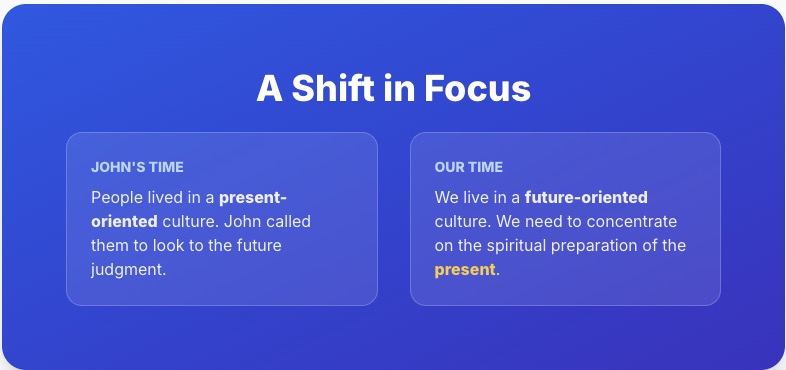
"Unlike first century Palestine, we live in a future-oriented culture that lives for the moment; during the holidays we intensely prepare for that special Christmas event. Unlike John's contemporaries, we do not need to focus on the future; we need to concentrate on the present."
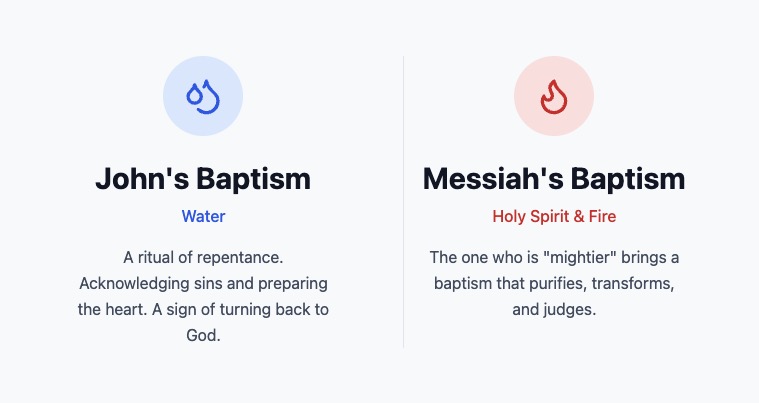
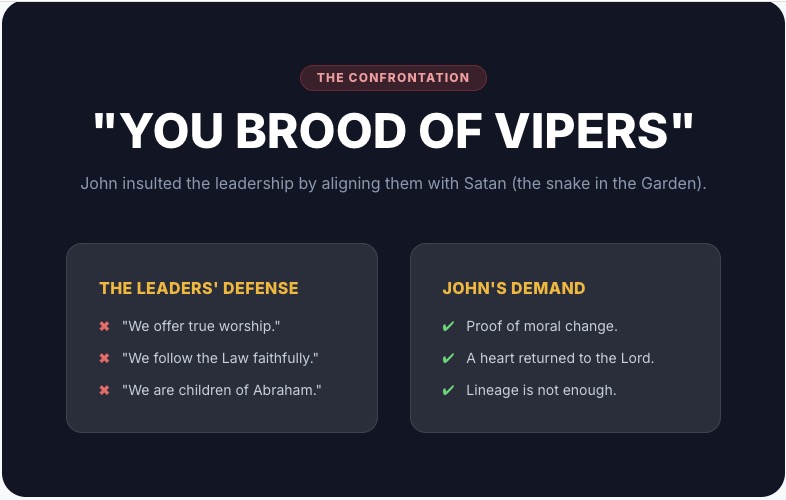
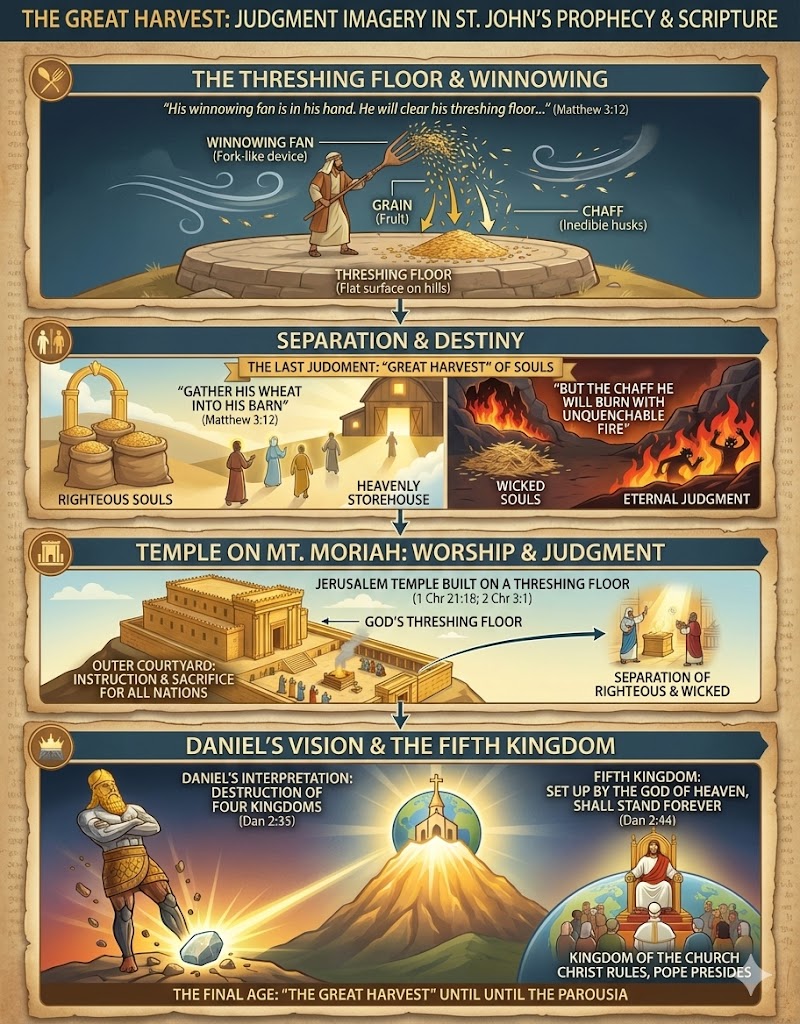
Read this commentary to discover how John the Baptist’s challenge to the "brood of vipers" isn't just a history lesson, but a blueprint for clearing the "fruitless trees" from our own lives to make way for the One who brings the fire.
friarmusings.com
John the Baptist
- Jesus and John
- Branch and Fruit
- John the Baptist
- John’s Baptism
- John’s Understanding of Himself
- Prophet and Herald
- Repent
- The Kingdom of Heaven is at Hand
PDF COMMENTARY | INDEX
(Matthew 3:1-12))
A Walk in the Word

FIRST SUNDAY OF ADVENT (A): THE COMING OF THE SON OF MAN
Advent calls believers to watchful, repentant, and faithful readiness for the unexpected return of Christ, the Son of Man, who brings judgment and salvation.
More Deep Dives

The Word
Proclaimed
Click on timestamp links to watch different sections of the video.

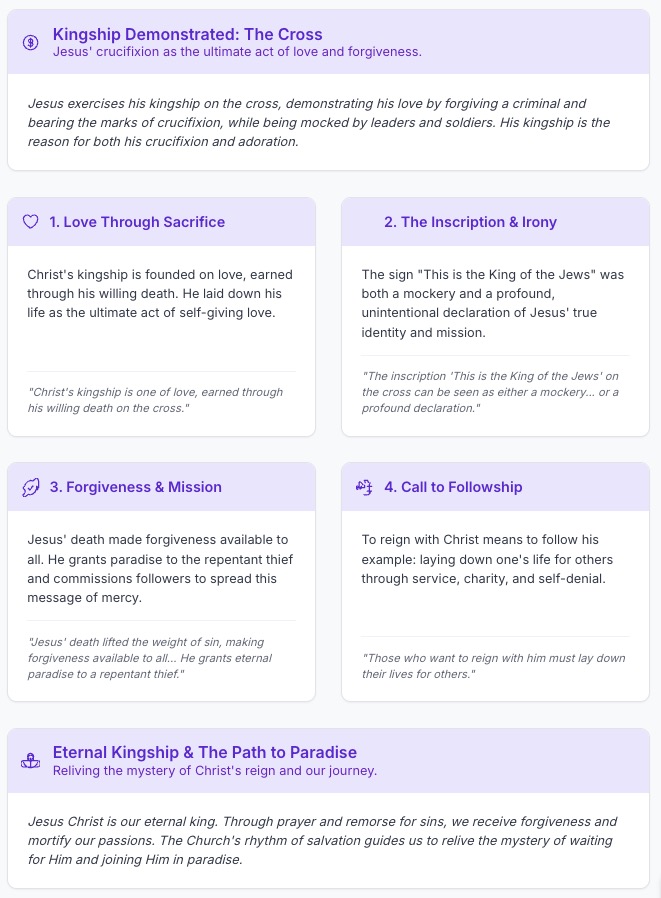
Jesus exercises his unique kingship through his crucifixion, demonstrating love, forgiveness, and sacrifice, and inviting others to follow his example by laying down their lives for others.
- 00:00 Jesus exercises his kingship on the cross, demonstrating his love by forgiving a criminal and bearing the marks of crucifixion, while being mocked by leaders and soldiers.
- 01:53 Jesus, crucified as the “King of the Jews,” forgives those mocking him, highlighting the irony that his kingship is the reason for both his crucifixion and adoration.
- 03:11 Christ’s kingship is one of love, earned through his willing death on the cross, and those who want to reign with him must lay down their lives for others.
- 04:37 The inscription “This is the king of the Jews” on the cross can be seen as either a mockery of Jesus’ claim to kingship or a profound declaration of his true identity and mission.
- 05:49 Jesus’ death lifted the weight of sin, making forgiveness available to all, and he asked followers to spread this message.
- When that man, Jesus, died, the weight of sin was lifted from the world, making forgiveness available to all, and he asked his followers to spread this message and bring others to baptism and faith.
- One criminal on the cross rebukes the other for mocking Jesus, acknowledging their own just condemnation, while noting Jesus has done nothing criminal.
- 08:10 Jesus grants eternal paradise to a repentant thief, and the speaker prays for forgiveness, to serve God, and care for the poor.
- The crucified Jesus, as the divine king, grants eternal paradise to a repentant thief crucified with him, saying “Today you’ll be with me in paradise” when the thief asks to be remembered in his kingdom.
- The speaker prays to be forgiven, to serve God with their whole heart, and to be with Him in His kingdom, caring for the poor and proclaiming Him to others.
- 10:17 Recalling Jesus through prayer and acknowledging sins with remorse allows one to receive forgiveness and mortify their passions under His mercy and kingship.
- The resurrection of Jesus initiates a new order of being, and recalling Him through prayer, such as the publican’s prayer, helps one mortify their passions by calling on His mercy and kingship.
- To receive forgiveness, one only needs to sincerely acknowledge their sins to God, express remorse, and accept forgiveness, which can be repeated if one sins again.
- 12:34 Jesus Christ is our eternal king, and the Church’s rhythm of salvation helps us relive the mystery of waiting for Him and joining Him in paradise.


Scroll to Read More


Infographics were created using Nano Banana Pro with Gemini 3.0. They draw inspiration from the commentary above from Agape Bible Study, but are not officially associated with or endorsed by Michal Elizabeth Hunt. They may be copied for personal use or for use in any non-profit ministry. All works on the Agape Bible Study were licensed under a Creative Commons Attribution 3.0 Unported License.