SOURCE: Cycle B Index
1st Reading: Peter to the People
2nd Reading: The Measure of the Christian Walk
Gospel: A New Context

The Bible Timeline®: The Story of Salvation
Setbacks and imperfections should not discourage us, as God has a plan for us and can renew and repair our souls.
- 00:00 Don't let setbacks discourage you, God has a plan for you.
- 00:45 My car got dinged and scratched, but I still wanted it back.
- 01:05 We can go back to God's body shop through confession to be renewed from our sins.
- 01:43 Embrace imperfection and allow God to work on your heart.
- 02:01 God is not done with you, even if your soul is damaged.
- 02:12 Trust in Jesus as our advocate and keep his commandments, for God will repair our souls and fill us with joy.

SOURCE: A Word Proclaimed
Jesus reassures his disciples of his resurrection and instructs them to go out and witness to all nations, with the promise of the Holy Spirit.
- 00:00 Two men on the way to Emos, possibly imas, and the signs of an early church commemorating where the Lord broke the bread.
- 02:15 Jesus has risen from the dead, appeared to Simon, and greeted his disciples with "Shalom," symbolizing restoration between humanity and God.
- 04:31 Jesus reassures his disciples that he is not a ghost, showing them his hands and feet as proof of his resurrection and full humanity, bringing them from fear to joy.
- 06:22 Jesus eats fish in front of his disciples to show his transformed body and then starts speaking to them.
- 07:00 Understanding the scriptures is the light by which we understand the face of Christ Jesus in the Hebrew Bible.
- 09:16 Jesus taught that the Messiah would suffer, rise from the dead, and that repentance for the forgiveness of sins would be preached to all nations, starting from Jerusalem, as written in the scriptures.
- 11:15 You are witnesses of all these things, and you have to go out and witness to all of this and behold.
- 12:35 The promise of the father is the Holy Spirit, which is why the coming of the Holy Spirit at Pentecost is so significant.

SOURCE: A Walk in the Word
Jesus fulfills the Old Testament scriptures and empowers his followers to boldly declare the good news of his resurrection, connecting the Old Testament to Christ and emphasizing the mission of the church to announce salvation.
- 00:00 Jesus fulfills the scriptures by appearing to his disciples, explaining his suffering and resurrection, and preaching repentance and forgiveness of sins to all nations.
- Jesus appears to his disciples, shows them his hands and feet, eats with them, and explains how he fulfills the scriptures.
- Jesus fulfills the scriptures by suffering, rising from the dead, and preaching repentance and forgiveness of sins to all nations.
- Luke's gospel recounts Jesus's post-resurrection appearance to the disciples in the upper room, with significant and rich details.
- Two disciples encounter Jesus on the road to Emmaus and are heartbroken by the events in Jerusalem.
- Jesus appears to the disciples after his resurrection, but they are initially incredulous and refuse to believe.
- Jesus appears to the women and two men on the road, rebuking them for their lack of faith and ignorance of scripture.
- 07:04 Jesus fulfills the Old Testament scriptures, revealing himself to the disciples through biblical typology and the breaking of the bread, demonstrating his bodily presence and proving his resurrection.
- Ignorance of scripture is ignorance of Christ, as Christ is revealed in and through the Sacred Scriptures, and this is seen in the pattern of biblical typology in today's Gospel.
- Jesus reveals to two disciples how the Old Testament scriptures pointed to his coming, and they recognize him in the breaking of the bread, paralleling the story of Adam and Eve.
- The disciples' eyes were opened to the reality of the Resurrection, redemption, and salvation, in contrast to the reality of sin in the Book of Genesis.
- Jesus addresses the disciples' lack of faith and shows them his hands and feet to prove he is not a spirit, mirroring the text from John chapter 20.
- Jesus shows his disciples that he is not a ghost but present in his glorified and resurrected flesh, bearing the marks of his crucifixion, but they still struggle to fully embrace the truth of his resurrection.
- Jesus, in his glorified state, demonstrates his bodily presence to the disciples with patience, tenderness, and mercy, showing that he is not a disembodied spirit but truly present to them.
- 15:41 Jesus, in his glorified state, fulfills the scriptures, opens the minds of his disciples to understand them, and demonstrates his presence with supernatural qualities.
- The Risen Jesus establishes direct contact with his disciples to verify that his body is the same as before but now possesses new properties of a glorious body, no longer confined to Earth.
- In his glorified state, Jesus demonstrates supernatural qualities, such as passing through walls and veiling his appearance, while still bearing the wounds of his passion.
- Jesus humbly asks his disciples for food to show them that he is truly present with them, not just a vision or ghost.
- Jesus declares that everything written about him in the law of Moses, the prophets, and the Psalms must be fulfilled.
- Jesus opens the minds of his disciples to understand the scriptures, addressing their ignorance and emphasizing the importance of knowing the scriptures.
- Jesus's sufferings fulfilled the scriptures and his redemptive death freed men from the slavery of sin, as explained by St. Paul and Jesus himself, fulfilling Isaiah's prophecy and opening the disciples' minds to understand the scriptures.
- 23:16 Biblical typology reveals the unity of God's plan in Christ, connecting Old Testament scriptures to the fulfillment in the New Testament, as demonstrated in the Acts of the Apostles with the healing of a lame man and Peter's preaching of the gospel.
- Biblical typology involves discerning and interpreting Old Testament passages that prefigure and foreshadow the fulfillment of God's plan in the person of Christ.
- The science of similitude allows us to interpret Old Testament scriptures in light of Christ's crucifixion and resurrection, discerning various types and foreshadowings found in the scriptures.
- Biblical typology is the discernment of Old Testament events and figures that prefigured the fulfillment of God's plan in Christ, demonstrating the unity of the divine plan of Salvation.
- The Old Testament and New Testament are interconnected, with the Old Testament revealing the New Testament and both pointing to Christ as the fulfillment of scripture.
- The Old Testament scriptures should be read through a Christological lens, and the first reading from the Acts of the Apostles celebrates the aftermath of the Resurrection and the birth of the church.
- Peter and John heal a lame man at the temple, causing a stir and giving Peter the opportunity to preach the gospel.
- 32:50 Jesus fulfilled the scriptures and empowered his followers to boldly declare the good news of his resurrection, connecting the Old Testament to Christ and emphasizing the mission of the church to announce salvation.
- Jesus fulfilled the scriptures and opened the minds of his followers to an authoritative interpretation of the scriptures in light of Christ.
- Simon Peter, empowered by the Holy Spirit, boldly declares the good news of Jesus' resurrection and references the God of Abraham, Isaac, and Jacob.
- God reveals himself through the Old Testament scriptures and connects them to Christ, referencing Messianic titles and the denial of Jesus.
- Simon Peter addresses the ignorance of the people and points to the Jewish scriptures, engaging in biblical typology.
- Simon Peter fulfills Jesus's command by preaching repentance and forgiveness of sins, echoing the Gospel and emphasizing the mission of the church to announce the good news of Salvation.
- 39:05 The disciples find joy in seeing the resurrected Jesus, who reassures and fills us with peace, while the readings reflect on the impact of Jesus' resurrection on our lives.
- The disciples experienced joy and jubilation when they beheld the face of the resurrected Jesus, and in moments of weakness, doubt, trial, and tribulation, Christ reveals himself to us in his mercy.
- The Lord wishes to reassure us and fill us with his perfect peace, even in the midst of trials and tribulations.
- The first reading addresses ignorance as St. Peter confronts the religious authorities for their ignorance of Jesus' identity, while the responsorial Psalm emphasizes the joy and safety found in the Lord.
- The progression from ignorance to trust to understanding and belief is beautifully harmonized in the readings, reflecting on the impact of Jesus' resurrection on our lives.
- Immerse yourself in the study of God's holy word to deepen your communion with Christ, as revealed by Jesus in the gospel.
- 44:58 The liturgy reveals the truth of the Scriptures and the typological connections between the Old and New Testaments, emphasizing the importance of Bible study and proper disposition to encounter the Living God in the Eucharist.
- Every Sunday, in the sacred liturgy, we encounter the Risen Lord who reveals the truth echoed in the Sacred Scriptures, and the preacher draws out typological connections between the Old Testament and the New Testament.
- The Holy Eucharist allows us to gather together, experience longing for Jesus, and be satisfied by his glorified flesh in the breaking of the bread.
- Prepare yourself to encounter the Living God in the Liturgy by being properly disposed and having eyes to see and ears to hear.
- The importance of Bible study in preparing to encounter and recognize Jesus in the breaking of the bread is emphasized.
- The Catholic Church urges Christians to read the scriptures to gain knowledge of Jesus Christ, and calls for repentance and reform for ignorance.
- The speaker encourages listeners to be refreshed by the gospel, to share the podcast, and to support the evangelization initiative.
- 51:58 Jesus fulfills the scriptures and the speaker offers blessings and prayers for support and generosity.
- Support the ministry by becoming a patron or making a one-time donation on buy meac coffee.com.
- The speaker offers blessings and prayers for continued support and generosity, ending with a declaration of Christ's resurrection.

SOURCE: Hearers of the Word
The physical reality of the risen Jesus in Luke’s gospel emphasizes the continuity of scripture and the fulfillment of Jesus’ ministry, death, and resurrection, while also emphasizing fellowship and communion through the act of eating.
- 00:00 Jesus physically demonstrates his resurrection to his disciples, reassuring them of his presence and fulfilling the scriptures.
- 03:41 Jesus opened their minds to understand the scriptures, foretelling his suffering, rising from the dead, and proclaiming repentance and forgiveness of sins to all nations.
- 05:48 The teaching of scripture fulfillment in Jesus' ministry and resurrection is similar but contrasts in Jesus' self-presentation and recognition process, emphasizing the bodily resurrection and denying Jesus' humanity.
- 09:33 Jesus' suffering and sacrifice for believers is discussed, with early Christian opinion denying his real humanity, but Luke's gospel opposes this by insisting on the physical reality of the risen Jesus.
- 13:21 The disciples were joyful at seeing the risen Lord eating with them, with discussions on the differences between the stories in Luke 24 and John 21.
- 16:33 Jesus appears to disciples, commands them to receive Holy Spirit, Thomas doubts; similarities between stories suggest common tradition, highlighting affirmation of identity and bodily reality of resurrection in Luke and John.
- 20:13 The scripture foretells the sufferings and resurrection of Jesus, with the proclamation of repentance and forgiveness of sins to all nations.
- 23:02 Jesus' resurrection is a unique gift, showing continuity with his crucifixion and emphasizing the concept of a spiritual body.

Matt Zemanek

SOURCE: St. Timothy Catholic Church, Laguna Niguel, CA
Encountering the risen Lord and recognizing his presence can transform our lives and empower us to share the faith with confidence.
- 00:00 Encounter the Risen Lord, explore post-resurrection appearances in Luke's gospel, and reflect on the disciples' experiences.
- 09:04 After encountering Jesus on the road to Emmaus, the disciples invite him to stay with them, he reveals himself to them while breaking bread, and they run back to Jerusalem to tell the other disciples, with some scholars believing that the figures mentioned in the gospels may actually be a married couple and the 12 disciples being part of a smaller, interconnected community.
- 15:02 Jesus appears to disciples, shares bread and fish, opens their minds to scriptures, fulfilling Old Testament prophecies and defying expectations as the promised Messiah.
- 21:47 Trusting in God's blessings and recognizing his presence can be hindered by narrow expectations, but the power of the resurrection confirms the transformation of bread and wine into the body and blood of the Lord.
- 27:27 God's intervention in the Old Testament is contrasted with the New Testament, emphasizing the physical presence of Jesus after his resurrection and the accuracy of Luke's account.
- 35:35 Jesus emphasizes his physical resurrection to prove his existence, opens the apostles' minds before Pentecost, and the Holy Spirit gives unique gifts for sharing and defending the Catholic faith.
- 41:39 Proper formation and continuous learning from scripture and the teachings of the church are essential for being soldiers for Christ in the world, as well as constantly discerning the gifts of the Spirit and taking a charism assessment to identify your talents.
- 45:33 The disciples are prepared to spread the message of the Lord and we are called to use our unique gifts to serve and share the faith with confidence in the power of Jesus' resurrection.
Fr. Geoffrey Plant

SOURCE: Fr. Geoffrey Plant’s Archives

SOURCE: Fr. Geoffrey Plant’s Archives
Christianity offers hope for life after death through the concept of bodily resurrection and eternal life, leading to a re-enchantment of the disciples’ understanding and a deeper appreciation of Jesus’ teachings and actions.
- 00:00 Christianity offers hope for life after death, a new concept in the pagan world, where the belief was in life after death but not in resurrection.
- Death is inevitable for everyone, but Christianity offers hope for life after death, which was a new concept in the pagan world at the time.
- In Homer's Illiad, Achilles tells Priam that there is no resurrection of the body, and in Aeschylus' play Eumenides, Apollo states that once a man has died, there is no resurrection.
- Plato and Cicero viewed the soul as superior to the body, with the soul being immortal and existing before and after the body.
- The ancient Greco-Roman belief was that the body is a prison, and resurrection of the body was not an option, as they believed in life after death but not in resurrection.
- 05:36 The risen Lord appeared to the disciples, emphasizing bodily resurrection and eternal life, reflecting on the imperfections of the church and the need to contribute to it.
- The risen Lord appeared to the disciples in a physical body, emphasizing the bodily resurrection and the promise of eternal life in Christianity.
- The rhythm of human life involves enchantment, followed by disenchantment, and then re-enchantment, as seen in relationships and encounters with the risen Lord.
- The speaker reflects on the imperfections of the church and the need to work within and contribute to it.
- 10:51 The Hopi people teach their young about the rhythm of Enchantment, Disenchantment, and Re-enchantment as part of their initiation ceremonies, with kachinas playing a role in their society, leading to an important lesson about the nature of their ancestral spirits.
- The Hopi people teach their young about the rhythm of Enchantment, Disenchantment, and Re-enchantment as part of their initiation ceremonies, with kachinas playing a role in their society.
- The Hopi people believe that the kachinas they see in their religious rituals are the ancestral spirits of their people, and the initiation rites take place in an underground ceremonial chamber known as a kiva.
- The children are initially enthralled by the ancestral spirits of their people, but when they discover that the kachinas are actually members of their own village impersonating the gods, they undergo a death experience and their secure world is shattered, teaching them an important lesson.
- 15:11 Disenchantment with symbols leads to deeper exploration of reality as the disciples initially do not recognize the risen Lord on the road to Emmaus.
- Symbols are like signs that point us in the right direction, and if we identify the sacred with the symbols, we will become disillusioned, so disenchantment is a summons to venture more deeply into the mystery of reality.
- The risen Lord appears to the disciples on the road to Emmaus, but they do not recognize him at first.
- 17:44 The disciples failed to understand the deeper meaning behind Jesus' miracles and teachings, leading to their disenchanted state after his crucifixion, but their eyes were opened to re-enchantment as they realized their mistake.
- People were enchanted by Jesus' miracles, but failed to see the deeper meaning behind them.
- Jesus predicts his death and resurrection to his disciples, but they fail to understand and instead argue about who is the greatest, leading to Jesus being crucified.
- The disciples were disenchanted after Jesus' crucifixion, but their eyes were opened to re-enchantment as they realized they were looking for the wrong kind of messiah.
- 22:30 Inattentional blindness causes people to miss unexpected things, as demonstrated in a video where viewers fail to notice a person in a gorilla suit walking through a basketball game while they focus on counting passes.
- Inattentional blindness causes people to miss unexpected things, as demonstrated in a video where viewers fail to notice a person in a gorilla suit walking through a basketball game while they focus on counting passes.
- Many people fail to notice a gorilla in an experiment due to inattentional blindness, where we see what we expect to see and overlook anything that goes against our expectations.
- Bunnings Warehouse had to hire security guards due to increased shoplifting, and suspicions arose that staff members might be involved.
- A security guard repeatedly checks a staff member's box for stolen goods, only to find it filled with wood chips, until he realizes that the stolen merchandise is actually the wood chips themselves.
- 27:41 Jesus opened the disciples' minds to understand the scriptures and preached repentance for the forgiveness of sins to all nations, showing that his teachings and actions are the continuation and climax of the ancient biblical story.
- Jesus opened the disciples' minds to understand the scriptures and realize that the Christ would suffer and rise from the dead, preaching repentance for the forgiveness of sins to all nations.
- The earliest Christian communities interpreted Jesus' life, death, and resurrection in relation to the biblical stories of God's dealings with the people of Israel.
- Jesus opens the minds of his disciples to understand the Scriptures in a new way, showing that his teachings and actions are the continuation and climax of the ancient biblical story.
- Cleopas is no longer afraid of speaking out because the worst that can happen is death.
- 33:06 We were only half alive, but now we are really alive because Jesus is alive.
Fr. Bryan Kujawa

SOURCE: Fr. Bryan Kujawa’s Archives. Switch videos using icon in the upper right corner.

SOURCE: Fr. Bryan Kujawa’s Archives Switch videos using icon in the upper right corner.
The Easter season brings renewed hope and joy through the Gospel of Jesus Christ, leading to repentance, conversion, and the power of being a witness to the resurrection.
FIRST READING
- 00:00 The Catholic Bible study channel aims to help people understand the readings before mass, emphasizing the encounter with Jesus in the Holy Eucharist.
- The goal of the Catholic Bible study channel is to help people understand the readings from the Bible before going to mass, as many people are unfamiliar with the stories and dependent on the preacher to make sense of it.
- The reading of the word of God during mass is primarily for worship, and while it may not be for personal benefit, it still allows for encountering the Lord and can lead to a deeper encounter with Jesus in the Holy Eucharist.
- 01:40 Rejoice in the Easter season with renewed spirit and hope, finding joy in the present and anticipation of the future through the Gospel of Jesus Christ.
- The speaker prays for renewed spirit and hope in the resurrection before diving into the readings for the third Sunday of Easter.
- God's people should rejoice in the Easter season with renewed youthfulness of spirit, celebrating the gift of Jesus rising from the dead.
- Youth brings energy and hope rooted in the Gospel of Jesus Christ, leading to rejoicing in the present and anticipation of the future.
- We can experience the joy of heaven in the present by taking time to rest in the word of God and in prayer, and by seeking moments of quiet and peace with Jesus.
- 04:42 Peter preaches repentance and conversion after Jesus' resurrection, leading to 3,000 baptisms and the early church's interaction with the world.
- Peter tells the people that they denied Jesus, but God raised him from the dead, and they should repent and be converted.
- Peter preaches effectively after Pentecost, leading to 3,000 baptisms and the early church's interaction with the world, including the healing of a lame man by Peter.
- 06:48 Peter and the church heal people through Jesus' power, Peter preaches about Jesus' death, Pilate is let off the hook for handing Jesus over.
- Peter and the church are able to heal people miraculously through the power of Jesus, and Peter preaches to the people about how they denied and put Jesus to death.
- Pilate is let off the hook, despite being the one who handed Jesus over to death, and the people demanded the release of a murderer instead of Jesus.
- 08:48 Peter preaches about the resurrection of Jesus and the power of being a witness, acknowledging the people's ignorance.
- Peter preaches about the resurrection of Jesus and the power of being a witness to it, and the church skips over a verse in the reading to keep it shorter.
- Peter preaches the message of the Gospel and acknowledges that the people acted out of ignorance.
- 10:18 Peter and Paul both speak about the ignorance of those who crucified Jesus, but God has fulfilled the prophecies and enlightened them to understand the truth.
- Paul mentions in 1 Corinthians that the people who crucified Jesus were ignorant of his divinity.
- Peter preaches about how both he and the leaders acted out of ignorance, but God has fulfilled the prophecies about Christ's suffering, and he has been enlightened to understand the truth.
- 12:16 Repent, receive forgiveness, and seek God's presence for grace and resurrection.
- Repent and be converted so that your sins may be forgiven, and the Lord will grant you times of refreshment and send Jesus to give you grace and resurrection.
- Repent, receive forgiveness, and seek God's presence to understand and believe in Him.
- 14:04 Trust in the Lord for security and peace.
SECOND READING
Through Jesus, we have the power to avoid sin and have fellowship with the Holy Trinity, and keeping God's commandments is the way to know and love Him.
- 00:00 The purpose of John's letter is to share what he has seen and heard so that others can have fellowship with the Trinity and with each other.
- 00:59 Keep God's commandments to show that you truly know Him and the love of God is perfected in you.
- 02:11 We are all sinners, but through baptism, we have the power to avoid sin and fellowship with the Holy Trinity.
- 03:02 Jesus is our advocate, defending us in times of trouble.
- Jesus is our advocate with the Father, similar to the Holy Spirit, and will defend and stand up for us in times of trouble.
- Jesus is our advocate, standing in the gap and defending us.
- 04:23 The word "experation" in the New Testament points to the Old Testament concept of sacrifice of atonement, which reconciles sinners to God, and Jesus is the ultimate sacrifice of atonement.
- 05:28 Jesus is the expiation for our sins, reconciling us with the Father, and his sacrifice is extended to all people, offering them grace and reconciliation.
- 06:28 Keeping God's commandments is the way to know and love Him, seeking after His glory and the salvation of souls.
- 07:50 Living in union with Jesus means imitating his life, made possible through the graces of Easter and the Holy Eucharist.
GOSPEL READING
Jesus appeared to his disciples after his resurrection to show them his physical body, open their minds to the scriptures, and emphasize the importance of understanding his resurrected form, repentance, and forgiveness of sins.
- 00:00 Jesus appears to disciples, shows hands/feet, eats with them, opens minds to scriptures; gospel discusses resurrection, repentance, and encounter with Jesus on road to Emmaus.
- The disciples recount how Jesus was made known to them in the breaking of bread, Jesus appears to them, shows them his hands and feet, eats with them, and opens their minds to understand the scriptures.
- The gospel reading discusses the resurrection, repentance, and the encounter of two disciples with Jesus on the road to Emmaus.
- 02:10 Jesus appears to disciples, breaks bread, opens their eyes, and explains scriptures, emphasizing the importance of understanding his resurrected form for Catholic Christians discussing the Eucharist.
- Jesus can appear in different forms in his resurrected body, which is important to understand as Catholic Christians when discussing the Eucharist.
- Jesus appears to the disciples, they urge him to stay, he breaks bread, their eyes are opened and they see Jesus, and he explains the scriptures to them.
- Jesus gives the disciples a Bible study that the speaker wishes they could have heard.
- 04:23 Jesus appears to disciples, says "peace be with you" multiple times, they are startled and terrified, thinking they are seeing a ghost.
- The disciples ran back to Jerusalem to tell the apostles that they had seen Jesus and he had explained the scriptures and broke bread with them.
- Jesus appears to his disciples, says "peace be with you" multiple times, and they are startled and terrified, thinking they are seeing a ghost.
- 05:50 Jesus reassures the apostles after his resurrection, showing them he has the same body and can see into their hearts.
- The apostles saw Jesus after his death and were afraid, thinking they were seeing a ghost, but Jesus reassured them.
- Jesus can see into people's hearts, and after his resurrection, he showed his disciples that he had the same body as before, telling them to touch him to prove he was not a ghost.
- 07:14 Jesus appeared to his disciples to show them his physical body by eating in front of them, despite their disbelief and wonder.
- They were joyful but still disbelieved and wondered, unable to believe something so incredible even though they were touching him.
- Jesus appeared to his disciples to show them that he has a real, physical body by eating in front of them.
- 08:39 Jesus references the entire Tanakh to show he is fulfilling all of it, emphasizing the importance of studying both the New and Old Testaments, and fulfilling prophecies from the Old Testament was convincing for people to start believing the gospel.
- Jesus is reminding his disciples of how he explained everything written about him in the law of Moses, the prophets, and the Psalms, and the word "Tanakh" is used to refer to the Hebrew Bible.
- Jesus references the entire Tanakh to show that he is fulfilling all of it, emphasizing the importance of studying both the New and Old Testaments.
- Jesus fulfills prophecies from the Old Testament, which was convincing for people to start believing the gospel, especially for Jewish people, and this is something remarkable that is often missed due to a lack of literacy in the Bible.
- 11:03 Peter preaches about Jesus' suffering and rising from the dead, emphasizing the need for repentance and forgiveness of sins to be preached to all nations.
- He prays for understanding of the scriptures and asks the Lord to open his mind to discover the meaning and to break down any barriers.
- Peter preaches about the necessity of Jesus' suffering and rising from the dead, and the need for repentance and forgiveness of sins to be preached to all nations.
- 12:54 The passage references Pentecost and the Ascension, and the speaker looks forward to sharing the second reading.
Fr. Paul Galetto, OSA

SOURCE: YouTube Video Playlist

SOURCE: YouTube Video Playlist
Jesus is the author of life and the Savior, and following him means keeping the Commandments and acting upon them, as knowledge of God comes through better behavior, not just words.
- 00:00 Peter and John use a miracle to turn the crowd's attention to God and proclaim the message of God.
- 01:11 Jesus, the servant of God, has been glorified by the god of our fathers in a miracle.
- 01:17 Peter urges the community to turn away from ignorance and realize that Jesus is the author of life and the Savior.
- 01:53 Some people didn't see Jesus as a spiritual Messiah, but just a good teacher, focusing on knowledge over service, and John's letters emphasize that Jesus is God and rose from the dead, disputing the idea that superior knowledge is all that's needed, emphasizing the importance of moral behavior.
- 02:47 Following Jesus means keeping the Commandments and acting upon them, as knowledge of God comes through better behavior, not just words.
- 03:17 Sin can be forgiven, and the disciples recognize Jesus in the breaking of the bread.
- 03:55 Jesus appeared to the disciples, proving his bodily resurrection, commissioning them to preach repentance, forgiveness, and witness to the fulfillment of scriptures.
Keith Nester

SOURCE: YouTube Video Playlist

SOURCE: YouTube Video Playlist
Through faith in Jesus and repentance, we can find rest, peace, and transformation, and it is our duty to share this message with others.
- 00:00 Jesus empowers the apostles with the Holy Spirit to spread the gospel, Peter urges repentance and emphasizes the fulfillment of faith in Jesus.
- Keith Nester discusses the upcoming Sunday readings for the Catholic church, emphasizing the impact of the truth on the apostles and the world.
- Jesus equipped the apostles with the Holy Spirit to bring the gospel to the world, as seen in the first reading from Acts chapter 3.
- Peter boldly preaches to the Israelites, urging them to repent and turn to God, emphasizing that they acted in ignorance when they disowned Jesus, but now they have the opportunity for their sins to be wiped out and for times of refreshing to come from the Lord.
- The speaker passionately connects the gospel to the Old Testament and emphasizes the fulfillment of faith in Jesus.
- 03:48 Christianity Catholicism is the fulfillment of the only true religion, and through faith in Jesus, we are all children of the promise.
- Christianity Catholicism is not a new religion, but the fulfillment of the only true religion, and Jesus is the fulfillment of everything people have been looking for.
- The kingdom will be taken from those who reject Jesus and given to others, as without the son, there is no father.
- The New Testament emphasizes moving forward in the New Covenant and recognizing Christ, rather than reverting to the old ways of doing things.
- Christ is the fulfillment of the old covenant, and through faith in him, we are all children of the promise.
- 07:48 Following Jesus brings refreshing grace, restoration, strength, and reconciliation, especially for those who have lived far from God, emphasizing the concept of repentance and finding rest and peace with God.
- The speaker discusses the concept of repentance and the promise of times of refreshing, emphasizing the idea of finding rest and peace with God through turning from sin.
- Following Jesus is hard but also refreshing, as it unlocks grace and brings restoration, strength, and reconciliation, especially for those who have lived far from God and focused on practicing religion rather than having a relationship with Jesus.
- The Lord hears when I call to him and brings peace and safety.
- 11:01 Salvation is available to all through repentance, obedience, and faith in Jesus Christ as our advocate and atonement for sin.
- St. John emphasizes the importance of not sinning, but acknowledges that if we do sin, Jesus Christ is our advocate and has made atonement for our sins and the sins of the whole world.
- Salvation is available to everyone, but it requires repentance and obedience, not just belief.
- Obedience is necessary, repentance is an act we do, and faith in God is a gift that requires a response.
- 14:01 Faith dictates our actions and obedience to God's commands is necessary; Jesus speaks through his church and confession helps us get back on track.
- Faith must dictate our actions and obedience to God's commands is necessary, despite the temptation to downplay it.
- Jesus speaks to us through his church, and if we fail, the sacrament of confession is there to help us get back on our feet.
- 15:41 Jesus walks with disciples, opens their eyes to his presence through Eucharist, reassures them of his physical presence, and explains the Gospel message of repentance and forgiveness, despite some people trying to hijack it with their own agendas and denying the physical Resurrection.
- After Jesus is resurrected, he walks with disciples who don't recognize him until he celebrates the Eucharist with them, opening their eyes to his presence.
- Jesus reassures his disciples of his physical presence, eats with them, and explains how the scriptures must be fulfilled.
- The message of the Gospel is about repentance and forgiveness of sins, but some people try to hijack it with their own agendas, and some even deny the physical bodily Resurrection because they struggle to believe it's too good to be true.
- 18:22 Jesus proves his resurrection, teaches disciples, and brings joy; understanding Scripture leads to recognizing Jesus' power, repentance, and transformation through God's grace, living into God's plan brings refreshing, faith allows us to endure difficulties and sufferings while trusting in the Lord for transformation.
- Jesus physically proves his resurrection to his disciples and teaches them, leading to disbelief and joy.
- Understanding the message of the Scriptures leads to recognizing the power of Jesus' resurrection, the need for repentance, and the possibility of transformation through God's grace.
- Living into God's plan and letting your own plan disappear will draw others to Him and bring refreshing.
- Our faith allows us to experience both difficulties and sufferings while being refreshed by the power of God, and we should not compare ourselves to others but trust in the Lord to transform us.
- 21:52 Turn to the Lord for refreshment and share the message of the mass with others.
- Experience the incredible time of refreshment and turn to the Lord, as God is doing something amazing in unpacking the mass.
- Study the scriptures, praise the Lord, and share the message to unpack The Mask with others.

History,
Culture &
Theology
IN 100 WORDS

Historical Context

In the historical context of Acts 3:13-15, 17-19, we find Peter addressing a crowd in Jerusalem shortly after the crucifixion of Jesus Christ. The passage highlights Peter's sermon, where he emphasizes the Jewish leaders' role in Jesus' death, while also proclaiming Jesus as the Messiah and calling for repentance. This event took place during a time of political and religious upheaval in Jerusalem, with tensions running high between the Jewish authorities and followers of Jesus. Peter's message of repentance and faith in Jesus as the promised Savior was revolutionary and challenged the status quo of the time.
Cultural Context

In the cultural context of Acts 3:13-15, 17-19, we see Peter addressing a predominantly Jewish audience in Jerusalem. The Jewish people at that time were deeply rooted in their religious traditions and beliefs, with a strong emphasis on the Law of Moses and the teachings of the prophets. Peter's message of Jesus as the fulfillment of these prophecies would have resonated with his audience, yet also challenged their existing beliefs about the Messiah. The call to repentance and faith in Jesus would have been a significant cultural shift, as it required a reevaluation of their religious practices and a new understanding of their faith.
Theological Significance

In the Catholic theological context of Acts 3:13-15, 17-19, the passage holds significant importance as it highlights the early Christian belief in Jesus as the Messiah and Savior. For Catholics, this passage underscores the role of Peter as the first Pope and leader of the early Church, proclaiming the central tenets of the Christian faith. The call to repentance and conversion emphasized in these verses aligns with Catholic teachings on the sacrament of reconciliation and the importance of seeking forgiveness for sins. Acts 3:13-15, 17-19 serves as a foundational text for Catholic theology, emphasizing the core beliefs of redemption, repentance, and faith in Christ.
SOURCE: Content written in collaboration with OpenAI's GPT-3.5 model.

Historical Context

In the historical context of 1 John 2:1-5a, the passage reflects the challenges faced by the early Christian community in the first century. Written to address issues of false teachings and moral conduct, the author emphasizes the role of Jesus Christ as the advocate and atoning sacrifice for sins. The call to obedience and keeping God's commandments was crucial in combating heresies and maintaining the integrity of the Christian faith. In the midst of persecution and internal strife, 1 John 2:1-5a provided guidance and assurance to believers, reminding them of the need to remain faithful to the teachings of Christ in a challenging historical period.
Cultural Context

In the cultural context of 1 John 2:1-5a, the passage reflects the influence of Greco-Roman philosophical thought prevalent during the time of the writing. The idea of Jesus Christ serving as an advocate and mediator between God and humanity would have resonated with a culture familiar with the concept of intermediary figures. The emphasis on obedience and keeping God's commandments also aligns with the moral values of the society, highlighting the importance of ethical behavior and adherence to established norms. 1 John 2:1-5a addresses these cultural dynamics, presenting Christian teachings in a way that would have been understood and accepted within the cultural milieu of the time.
Theological Significance

In the Catholic theological context of 1 John 2:1-5a, the passage holds significant importance in the understanding of Christ's role as the advocate and the propitiation for sins. The concept of Jesus as the divine intercessor aligns with Catholic teachings on the priesthood of Christ and the sacrament of reconciliation. The call to obedience and keeping God's commandments reflects the Catholic emphasis on living a life in accordance with the teachings of Christ and the moral precepts of the Church. 1 John 2:1-5a underscores the Catholic belief in the redemptive power of Christ's sacrifice and the necessity o
SOURCE: Content written in collaboration with OpenAI's GPT-3.5 model.

Historical Context

In the historical context of Luke 24:35-48, the passage takes place shortly after the resurrection of Jesus Christ. The disciples are still grappling with the reality of Jesus' return from the dead and the implications of his teachings. The appearance of Jesus among them serves to confirm his resurrection and reinforce his earlier teachings about the fulfillment of Scripture. This event marks a pivotal moment in the establishment of the early Christian community, solidifying the disciples' belief in Jesus as the Messiah and commissioning them to proclaim his message of repentance and forgiveness to all nations.
Cultural Context

In the cultural context of Luke 24:35-48, the passage reflects the Jewish background of the early Christian community. The disciples' initial disbelief at Jesus' resurrection aligns with the Jewish skepticism towards bodily resurrection. Jesus' act of eating broiled fish with them serves to emphasize his physical presence and continuity with his pre-resurrection life, addressing cultural beliefs about the nature of the afterlife. The reference to the Scriptures and the fulfillment of prophecies highlights the importance of Jewish scripture in shaping the understanding of Jesus' identity as the promised Messiah. This cultural backdrop enriches the significance of Jesus' resurrection and mission in the narrative.
Theological Significance

In the Catholic theological context of Luke 24:35-48, the passage holds profound significance in the understanding of the Eucharist and the sacramental life of the Church. The disciples' recognition of Jesus in the breaking of bread foreshadows the institution of the Eucharist at the Last Supper, emphasizing the real presence of Christ in the consecrated elements. Jesus' commissioning of the disciples to preach repentance and forgiveness aligns with the sacramental ministry of the Church, particularly the sacrament of reconciliation. This passage underscores the continuation of Jesus' redemptive work through the Church and the importance of the sacraments in fostering spiritual growth and unity with Christ.
SOURCE: Content written in collaboration with OpenAI's GPT-3.5 model.
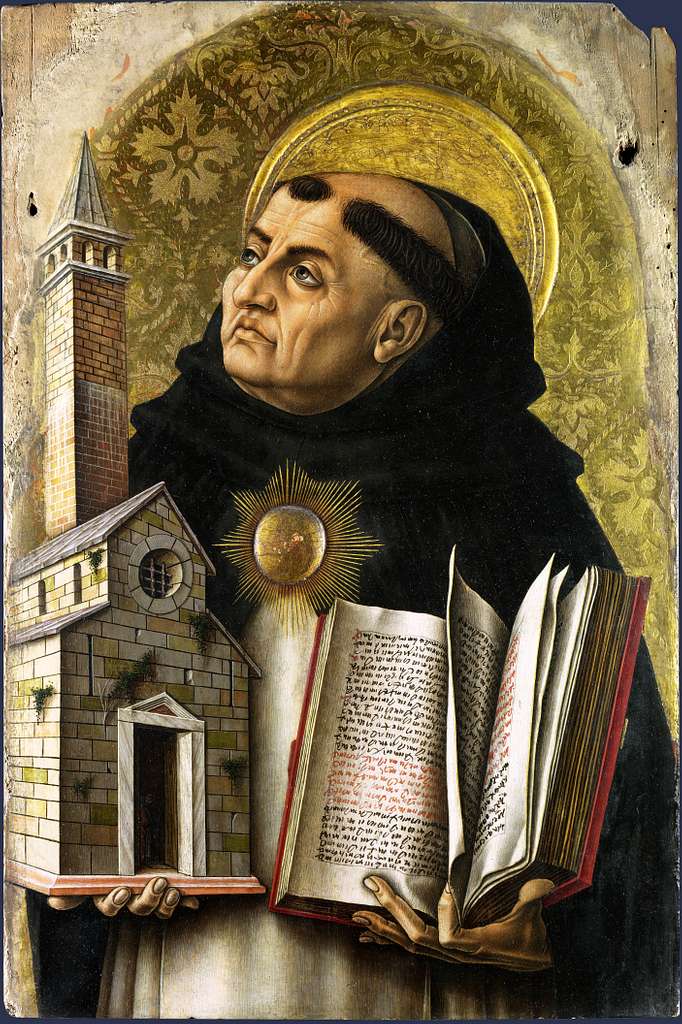
Compiled by
St. Thomas
Aquinas
Thomas Aquinas compiled this opus from sermons and commentaries on the Gospels written by the early Church Fathers, arranging their thoughts in such a way that they form a continuous commentary on each Gospel.
Luke 24:36-40
36. And as they thus spake, Jesus himself stood in the midst of them, and saith unto them, Peace be unto you.
37. But they were terrified and affrighted, and supposed they had seen a spirit.
38. And he said unto them, Why are ye troubled? and why do thoughts arise in your hearts?
39. Behold my hands and my feet, that it is I myself: handle me, and see; for a spirit hath not flesh and bones, as ye see me have.
40. And when he had thus spoken, he shewed them his hands and feet.
CHRYSOSTOM. The report of Christ’s resurrection being published every where by the Apostles, and while the anxiety of the disciples was easily awakened to see Christ, He that was so much desired comes, and is revealed to them that were seeking and expecting Him. Nor in a doubtful manner, but with the clearest evidence, He presents Himself, as it is said, And as they thus spake, Jesus himself stood in the midst of them.
AUGUSTINE. (de Con. Ev. l. iii. c. 25.) This manifestation of our Lord after His resurrection, John also relates. But when John says that the Apostle Thomas was not with the rest, while according to Luke, the two disciples on their return to Jerusalem found the eleven gathered together, we must understand undoubtedly that Thomas departed from them, before our Lord appeared to them as they spoke these things. For Luke gives occasion in his narrative, that it may be understood that Thomas first went out from them when the rest were saying these things, and that our Lord entered afterwards. Unless some one should say that the eleven were not those who were then called Apostles, but that these were eleven disciples out of the large number of disciples. But since Luke has added, And those that were with them, he has surely made it sufficiently evident that those called the eleven were the same as those who were called Apostles, with whom the rest were.
But let us see what mystery it was for the sake of which, according to Matthew and Mark, our Lord when He rose again gave the following command, I will go before you into Galilee, there shall ye see me. Which although it was accomplished, yet it was not till after many other things had happened, whereas it was so commanded, that it might be expected that it would have taken place alone, or at least before other things.
AMBROSE. Therefore I think it most natural that our Lord indeed instructed His disciples, that they should see Him in Galilee, but that He first presents Himself as they remained still in the assembly through fear.
GREEK EXPOSITOR. Nor was it a violation of His promise, but rather a mercifully hastened fulfilment on account of the cowardice of the disciples.
AMBROSE. But afterwards when their hearts were strengthened, the eleven set out for Galilee. Or there is no difficulty in supposing that they should be reported to have been fewer in the assembly, and a larger number on the mountain.
EUSEBIUS. For the two Evangelists, that is, Luke and John, write that He appeared to the eleven alone in Jerusalem, but those two disciples told not only the eleven, but all the disciples and brethren, that both the angel and the Saviour had commanded them to hasten to Galilee; of whom also Paul made mention, saying, Afterwards he appeared to more than five hundred brethren at once. (1 Cor. 15:6.) But the truer explanation is, that at first indeed while they remained in secret at Jerusalem, He appeared once or twice for their comfort, but that in Galilee not in the assembly, or once or twice, but with great power, He made a manifestation of Himself, shewing Himself living to them after His Passion with many signs, as Luke testifies in the Acts. (Acts 1:3.)
AUGUSTINE. (ut sup.) But that which was said by the Angel, that is the Lord, must be taken prophetically, for by the word Galilee according to its meaning of transmigration, it is to be understood that they were about to pass over from the people of Israel to the Gentiles, to whom the Apostles preaching would not entrust the Gospel, unless the Lord Himself should prepare His way in the hearts of men. And this is what is meant by, He shall go before you into Galilee, there shall ye see him. But according to the interpretation of Galilee, by which it means “manifestation,” we must understand that He will be revealed no more in the form of a servant, but in that form in which He is equal to the Father, which He has promised to His elect. That manifestation will be as it were the true Galilee, when we shall see Him as He is. This will also be that far more blessed transmigration from the world to eternity, from whence though coming to us He did not depart, and to which going before us He has not deserted us.
THEOPHYLACT. The Lord then standing in the midst of the disciples, first with His accustomed salutation of “peace,” allays their restlessness, shewing that He is the same Master who delighted in the word wherewith He also fortified them, when He sent them to preach. Hence it follows, And he said to them, Peace be unto you; I am he, fear not.
GREGORY NAZIANZEN. (Orat. 22.) Let us then reverence the gift of peace, which Christ when He departed hence left to us. Peace both in name and reality is sweet, which also we have heard to be of God, as it is said, The peace of God; (Phil. 4:7.) and that God is of it, as He is our peace. (Eph. 2:14.) Peace is a blessing commended by all, but observed by few. What then is the cause? Perhaps the desire of dominion or riches, or the envy or hatred of our neighbour, or some one of those vices into which we see men fall who know not God. For peace is peculiarly of God, who binds all things together in one, to whom nothing so much belongs as the unity of nature, and a peaceful condition. It is borrowed indeed by angels and divine powers, which are peacefully disposed towards God and one another. It is diffused through the whole creation, whose glory is tranquillity. But in us it abides in our souls indeed by the following and imparting of the virtues, in our bodies by the harmony of our members and organs, of which the one is called beauty, the other health.
BEDE. The disciples had known Christ to be really man, having been so long a time with Him; but after that He was dead, they do not believe that the real flesh could rise again from the grave on the third day. They think then that they see the spirit which He gave up at His passion. Therefore it follows, But they were terrified and affrighted, and supposed that they had seen a spirit. This mistake of the Apostles was the heresy of the Manichæans.
AMBROSE. But persuaded by the example of their virtues, we can not believe that Peter and John could have doubted. Why then does Luke relate them to have been affrighted. First of all because the declaration of the greater part includes the opinion of the few. Secondly, because although Peter believed in the resurrection, yet he might be amazed when the doors being closed Jesus suddenly presents Himself with His body.
THEOPHYLACT. Because by the word of peace the agitation in the minds of the Apostles was not allayed, He shews by another token that He is the Son of God, in that He knew the secrets of their hearts; for it follows, And he said to them, Why are ye troubled, and why do thoughts arise in your hearts?
BEDE. What thoughts indeed but such as were false and dangerous. For Christ had lost the fruit of His passion, had He not been the Truth of the resurrection; just as if a good husbandman should say, What I have planted there, I shall find, that is, the faith which descends into the heart, because it is from above. But those thoughts did not descend from above, but ascended from below into the heart like worthless plants.
CYRIL OF ALEXANDRIA. Here then was a most evident sign that He whom they now see was none other but the same whom they had seen dead on the cross, and lain in the sepulchre, who knew every thing that was in man.
AMBROSE. Let us then consider how it happens that the Apostles according to John believed and rejoiced, according to Luke are reproved as unbelieving. John indeed seems to me, as being an Apostle, to have treated of greater and higher things; Luke of those which relate and are close akin to human. The one follows an historic course, the other is content with an abridgment, because it could not be doubted of him, who gives his testimony concerning those things at which he was himself present. And therefore we deem both true. For although at first Luke says that they did not believe, yet he explains that they afterwards did believe.
CYRIL OF ALEXANDRIA. Now our Lord testifying that death was overcome, and human nature had now in Christ put on incorruption, first shews them His hands and His feet, and the print of the nails; as it follows, Behold my hands and my feet, that it is I myself.
THEOPHYLACT. But He adds also another proof, namely, the handling of His hands and feet, when He says, Handle me and see, for a spirit hath not flesh and bones as ye see me have. As if to say, Ye think me a spirit, that is to say, a ghost, as many of the dead are wont to be seen about their graves. But know ye that a spirit hath neither flesh nor bones, but I have flesh and bones.
AMBROSE. Our Lord said this in order to afford us an image of our resurrection. For that which is handled is the body. But in our bodies we shall rise again. But the former is more subtle, the latter more carnal, as being still mixed up with the qualities of earthly corruption. Not then by His incorporeal nature, but by the quality of His bodily resurrection, Christ passed through the shut doors.
GREGORY. (Mor. 14. c. 55.) For in that glory of the resurrection our body will not be incapable of handling, and more subtle than the winds and the air, (as Eutychius said,) but while it is subtle indeed through the effect of spiritual power, it will be also capable of handling through the power of nature. It follows, And when he had thus spoken, he shewed them his hands and his feet, on which indeed were clearly marked the prints of the nails. But according to John, He also shewed them His side which had been pierced with the spear, that by manifesting the scar of His wounds He might heal the wound of their doubtfulness. But from this place the Gentiles are fond of raising up a calumny, as if He was not able to cure the wound inflicted on Him. To whom we must answer, that it is not probable that He who is proved to have done the greater should be unable to do the less. But for the sake of His sure purpose, He who destroyed death would not blot out the signs of death. First indeed, that He might thereby build up His disciples in the faith of His resurrection. Secondly, that supplicating the Father for us, He might always shew forth what kind of death He endured for many. Thirdly, that He might point out to those redeemed by His death, by setting before them the signs of that death, how mercifully they have been succoured. Lastly, that He might declare in the judgment how justly the wicked are condemned.
Luke 24:41-44
41. And while they yet believed not for joy, and wondered, he said unto them, Have ye here any meat?
42. And they gave him a piece of a broiled fish, and of an honeycomb.
43. And he took it, and did eat before them.
44. And he said unto them, These are the words which I spake unto you, while I was yet with you, that all things must be fulfilled, which were written in the Law of Moses, and in the Prophets, and in the Psalms, concerning me.
CYRIL OF ALEXANDRIA. The Lord had shewn His disciples His hands and His feet, that He might certify to them that the same body which had suffered rose again. But to confirm them still more, He asked for something to eat.
GREGORY OF NYSSA. (Orat. 1. de Res.) By the command of the law indeed the Passover was eaten with bitter herbs, because the bitterness of bondage still remained, but after the resurrection the food is sweetened with a honeycomb; as it follows, And they gave him a piece of a broiled fish, and a honeycomb.
BEDE. To convey therefore the truth of His resurrection, He condescends not only to be touched by His disciples, but to eat with them, that they might not suspect that His appearance was not actual, but only imaginary. Hence it follows, And when he had eaten before them, he took the remnant, and gave to them. He ate indeed by His power, not from necessity. The thirsty earth absorbs water in one way, the burning sun in another way, the one from want, the other from power.
GREEK EXPOSITOR. But some one will say, If we allow that our Lord ate after His resurrection, let us also grant that all men will after the resurrection take the nourishment of food. But these things which for a certain purpose are done by our Saviour, are not the rule and measure of nature, since in other things He has purposed differently. For He will raise our bodies, not defective but perfect and incorrupt, who yet left on His own body the prints which the nails had made, and the wound in His side, in order to shew that the nature of His body remained the same after the resurrection, and that He was not changed into another substance.
BEDE. He ate therefore after the resurrection, not as needing food, nor as signifying that the resurrection which we are expecting will need food; but that He might thereby build up the nature of a rising body. But mystically, the broiled fish of which Christ ate signifies the sufferings of Christ. For He having condescended to lie in the waters of the human race, was willing to be taken by the hook of our death, and was as it were burnt up by anguish at the time of His Passion. But the honeycomb was present to us at the resurrection. By the honeycomb He wished to represent to us the two natures of His person. For the honeycomb is of wax, but the honey in the wax is the Divine nature in the human.
THEOPHYLACT. The things eaten seem also to contain another mystery. For in that He ate part of a broiled fish, He signifies that having burnt by the fire of His own divinity our nature swimming in the sea of this life, and dried up the moisture which it had contracted from the waves, He made it divine food; and that which was before abominable He prepared to be a sweet offering to God, which the honeycomb signifies. Or by the broiled fish He signifies the active life, drying up the moisture with the coals of labour, but by the honeycomb, the contemplative life on account of the sweetness of the oracles of God.
BEDE. But after that He was seen, touched, and had eaten, lest He should seem to have mocked the human senses in any one respect, He had recourse to the Scriptures. And he said unto them, These are the words which I spake unto you, when I was yet with you, that is, when I was yet in the mortal flesh, in which ye also are. He indeed was then raised again in the same flesh, but was not in the same mortality with them. And He adds, That all things must be fulfilled which were written in the Law of Moses, and in the Prophets, and in the Psalms, concerning me.
AUGUSTINE. (de Con. Ev. lib. i. c. 11.) Let those then who dream that Christ could have done such things by magical arts, and by the same art have consecrated His name to the nations to be converted to Him, consider whether He could by magical arts fill the Prophets with the Divine Spirit before He was born. For neither supposing that He caused Himself to be worshipped when dead, was He a magician before He was born, to whom one nation was assigned to prophesy His coming.
ORIGINAL: e-Catholic 2000
Gospel Reading

Luke 24:36b-48
RICHARD NIELL DONOVAN was a Disciples of Christ clergyman who published SermonWriter, for a paid subscription, from 1997-2020. After he died, his family has generously provided his resources without subscription.