Homilies
Homilies
January 18, 2026
January 18, 2026
2nd Sunday of Year A


────── ⋆⋅☆⋅⋆ ──────
Bishop Robert Barron

Permission granted for non-profits to use in ministry
The infographic was created using Nano Banana, Google's Revolutionary AI Image Generator. Infographic may not be sold or used for personal financial gain. Please show your appreciation by letting others know about TheWordThisWeek.NET.
2nd Sunday of Year A
Behold, the
Lamb of God

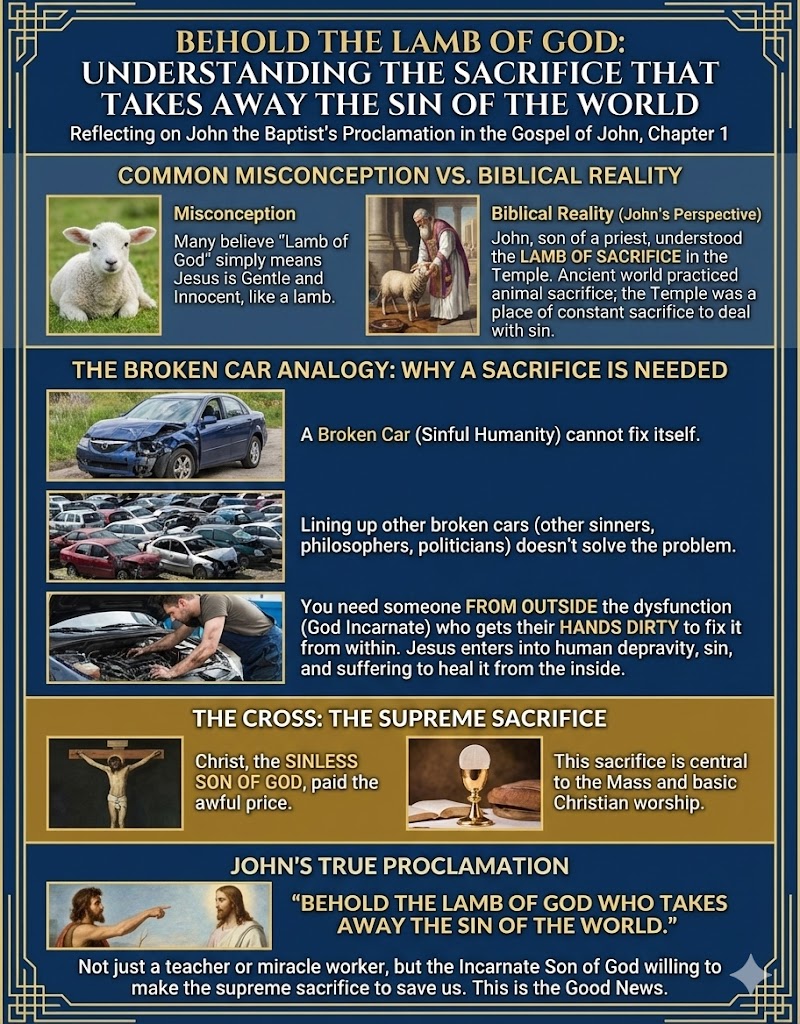
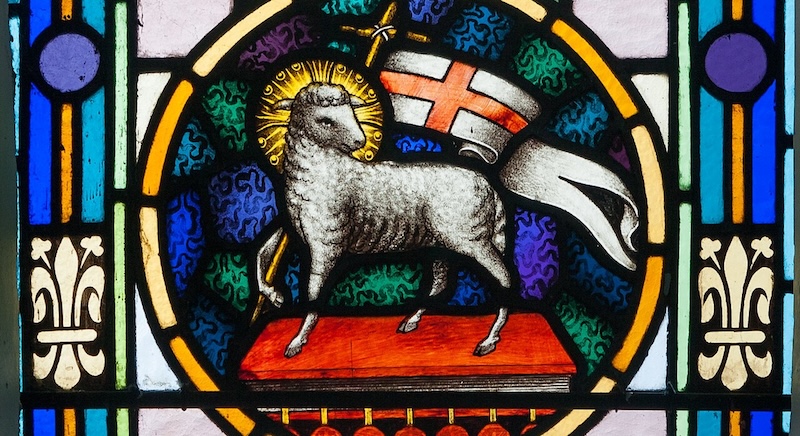
As the Church transitions into Ordinary Time, the Gospel presents John the Baptist’s defining declaration regarding Jesus: “Behold the Lamb of God who takes away the sin of the world.”
While many Christians interpret this title merely as a reference to Jesus’ gentleness or innocence, Bishop Barron argues that John is pointing to something far more radical: the reality of sacrifice. Drawing on the ancient Jewish context of the Temple, where animal sacrifice was central to worship, the title identifies Jesus as the ultimate offering who deals with the reality of sin.
To explain how this sacrifice functions, Bishop Barron uses the analogy of a broken car:
- The Dilemma: Just as lining up other broken cars cannot fix a specific mechanical failure, broken humanity cannot save itself through politics, philosophy, or psychology.
- The Solution: We require a “mechanic”—someone who not only understands the machine because He created it but is also willing to get His hands dirty.
This is the essence of the Incarnation. God did not remain at a distance offering advice; He entered the “muck and mud” of human existence. Jesus is the Lamb of God because He dove into the heart of human dysfunction, sin, and death to repair us from the inside out. He is not merely a moral teacher, but the Divine Physician who pays the ultimate price to effect our healing.

2nd Sunday of Year A
The Lamb Who Takes Away the Sin of the World
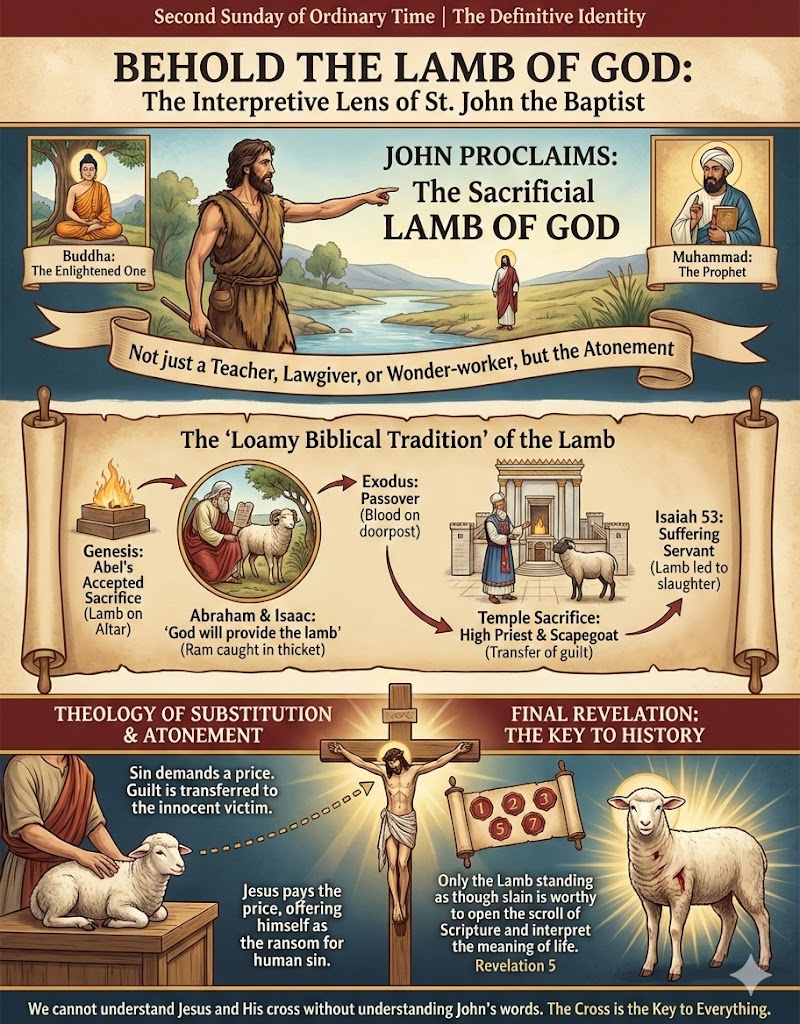
Friends, we return now to Ordinary Time, and the Church asks us again to think about the baptism of the Lord, this time in light of Saint John’s distinctive account. John the Baptist sees Jesus coming toward him on the banks of the River Jordan, and the Baptist says, “Behold, the Lamb of God, who takes away the sin of the world.” You recognize that line from the Mass, when the priest holds up the consecrated elements and repeats John the Baptist’s words. This declaration is of absolutely decisive significance, for John is giving us the interpretive lens by which we see and understand Jesus.
────── ⋆⋅☆⋅⋆ ──────
Fr. Michael Chua

Permission granted for non-profits to use in ministry
The infographic was created using Nano Banana, Google's Revolutionary AI Image Generator. Infographic may not be sold or used for personal financial gain. Please show your appreciation by letting others know about TheWordThisWeek.NET.
2nd Sunday of Year A
Behold the
Lamb of God

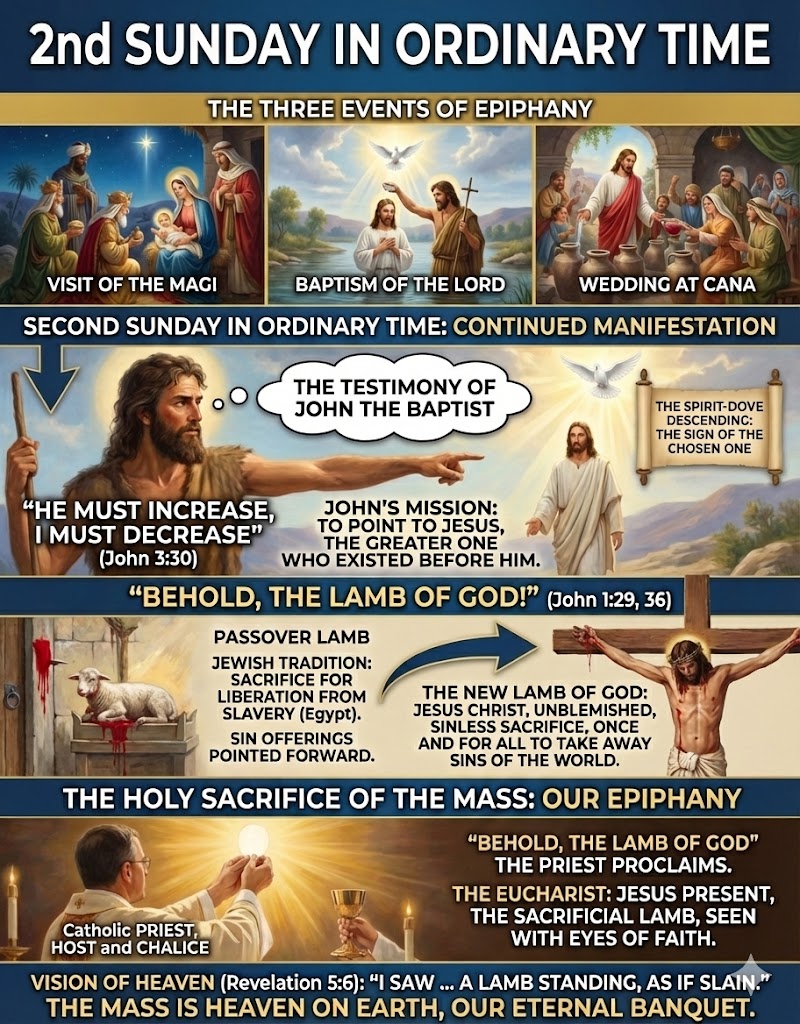
The new Lamb of God to be sacrificed once and for all had to be an unblemished sacrifice, a spotless sacrifice, a sinless sacrifice. Only then could this Lamb have power to release us from the slavery of sin. Jesus was holy. He was without sin. No original sin. And the reason He was without sin is that He was God. And now we see the connexion between the old sacrifice and the new: just as the lamb was sacrificed in Jewish homes, so too Jesus, the Lamb of God, was sacrificed. They drained its blood; likewise Jesus lost His Blood during His Passion. Just as the blood of the lamb on the door-posts was a sign of salvation from death in Egypt, so too the Blood of the Lamb of God is a sign of salvation from sin. But there was something very important about the lamb of the Jewish rite of Passover: it had to be eaten! Likewise Jesus now is ‘eaten’ in Holy Communion. No ordinary human being can be “the Lamb of God that takes away the sins of the world.” Only Jesus, the Chosen One of God, the One who existed before John, in fact, before any of us, was capable of taking away the sins of the world.
Permission granted for non-profits to use in ministry
The infographic was created using Nano Banana, Google's Revolutionary AI Image Generator. Infographic may not be sold or used for personal financial gain. Please show your appreciation by letting others know about TheWordThisWeek.NET.
2nd Sunday of Year A
Dreaming and Believing
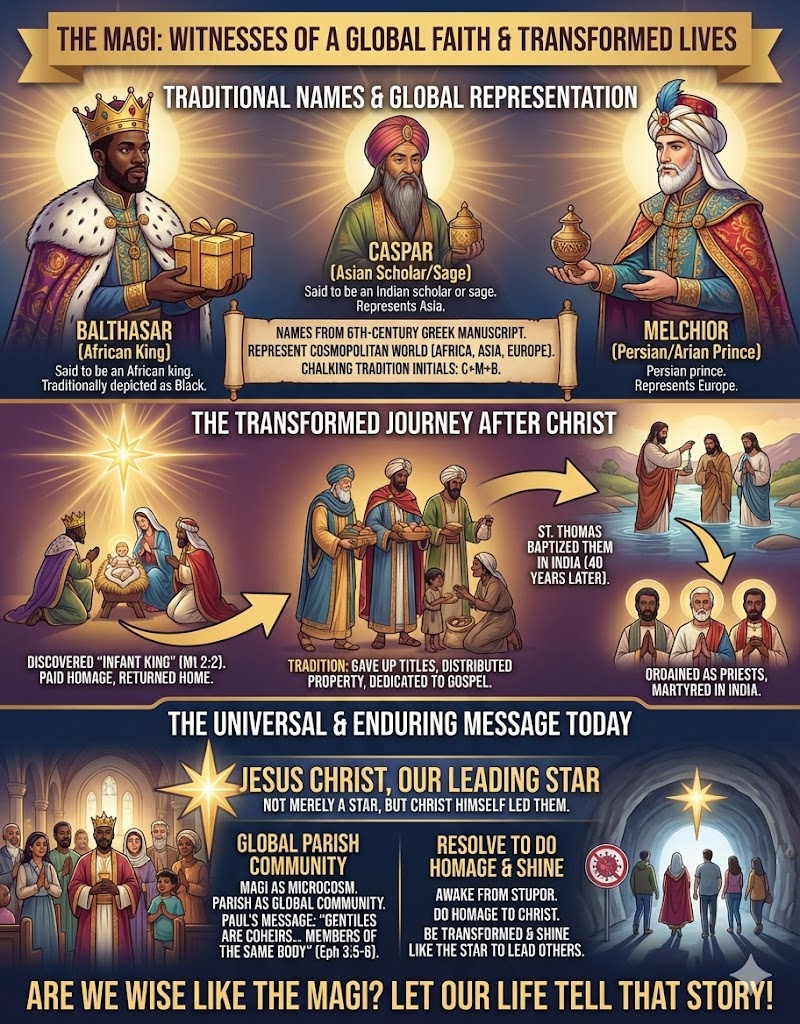
The impact that the Christ-child had on the Magi is deeply touching. This event completely transformed their lives. According to all these traditions, it was not merely a star that led them from that moment on, but rather, Jesus Christ. Jesus consumed their life and existence. The Magi are an invitation today to let Christ have the same impact on us. Are we wise like the Magi? Let our life tell that story! The depiction of the Magi as people of different colours and races helps us imagine a parish community as a global community. The Magi are the microcosm of a parish community. No one should ever feel unwelcome in a worshipping community. We know that this clearly was a problem in the early Church. In his Letter to the Ephesians, Paul struggles to convince the Jewish Christians that, “Gentiles are coheirs, members of the same body, and copartners in Christ Jesus through the gospel” (Eph 3:5-6). The Magi bear witness to a global nature, indeed, the catholicity of the Catholic faith.
The Magi did homage to the Divine Child and then their lives became a witness to Him. Today, after we have woken up from the stupor of sleep and dreams, from two years of pandemic lockdowns and online Masses, let us resolve with excitement and new vigour to do homage to the same Christ, so that our lives too can be transformed and shine like the star that will lead others to Christ.
Permission granted for non-profits to use in ministry
The infographic was created using Nano Banana, Google's Revolutionary AI Image Generator. Infographic may not be sold or used for personal financial gain. Please show your appreciation by letting others know about TheWordThisWeek.NET.
2nd Sunday of Year A
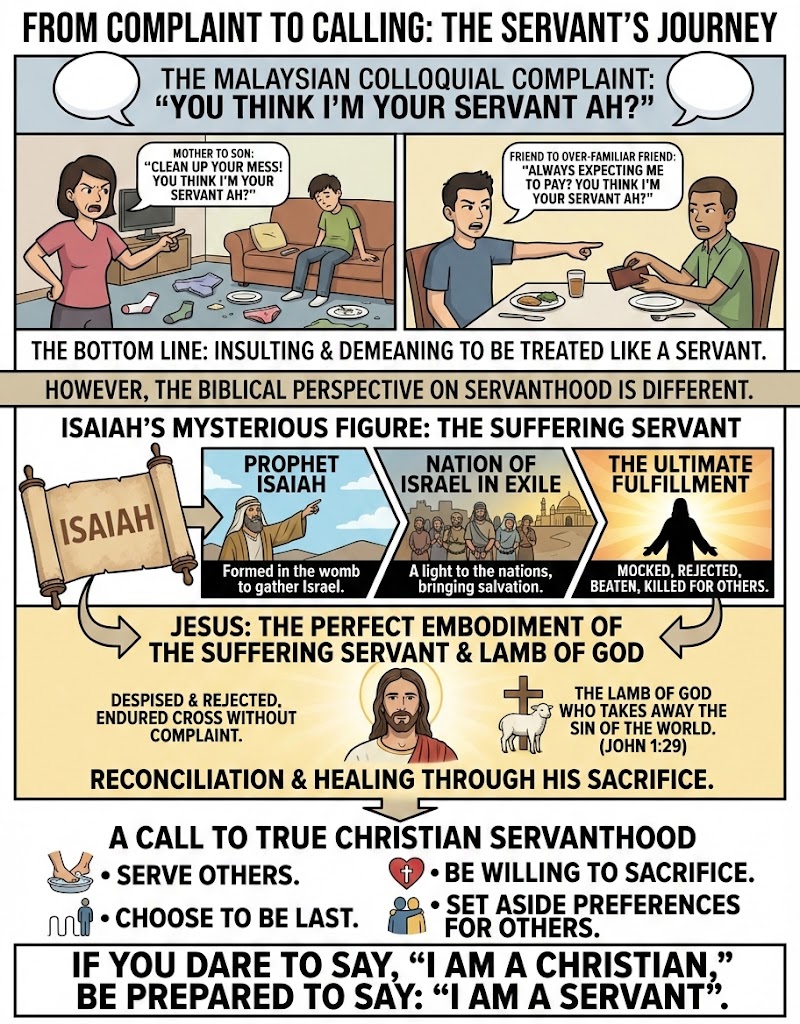
I am a Servant
One of the most common come back lines in Malaysian colloquial speech when you feel that the other person is taking advantage of your good nature is “you think I’m your servant ah?” It’s used by mothers to sons who litter the floor with their unwashed socks and underwear and who don’t wash their own plates after a meal; “you think I’m your servant ah?” To a friend who seems to treat you with contemptuous over-familiarity who expects you to always pay when you go out for a meal or by ordering you around to do things which he could have easily done on his own: “you think I’m your servant ah?” The bottom line is this – it is insulting and demeaning to be treated like a servant. A real servant deserves better.
However, the first reading introduces us to this anonymous character of the Servant (which would be expanded in chapters 52 and 53). This mysterious figure is often described as the Suffering Servant, because Isaiah sets out in detail the suffering he has to endure at the hands of his enemies – he will be mocked, rejected, beaten and even killed. Who could this person be? Prophecies, being deliberately ambivalent, often tend to work on more than one level. From the passage we had just heard in the first reading, it would seem that Isaiah is referring first to himself – the prophet is the servant of God “who formed [him] in the womb to be his servant, to bring Jacob back to him, to gather Israel to him.”
────── ⋆⋅☆⋅⋆ ──────
Dicastery for the Clergy


Homily Notes for Clergy
Pope Leo XIV – HEADLINES
Francis Homily
Benedict XVI Homily
────── ⋆⋅☆⋅⋆ ──────
Dominican Blackfriars
Dominican Blackfriars
Permission granted for non-profits to use in ministry
The infographic was created using Nano Banana, Google's Revolutionary AI Image Generator. Infographic may not be sold or used for personal financial gain. Please show your appreciation by letting others know about TheWordThisWeek.NET.
2nd Sunday of Year A
Jesus’ Solidarity
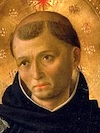
Second Sunday in Ordinary Time (A) | Fr John O’Connor reflects on Christ’s solidarity with us, not only in great moments of human suffering but even in the small daily challenges that can diminish and embitter us.
When people think of Jesus’s solidarity with us imperfect human beings, they tend to focus on the extreme moments, when Jesus’s humanity was pushed to its limits. These were times when Jesus was most vulnerable, when his self-sacrifice out of love for us was most apparent. We think, for example, of Jesus being tempted by Satan in the desert when experiencing the greatest imaginable hunger. More terrible still, we remember Jesus’s agonising fear in the Garden of Gethsemane before he was to endure the pain and indignity of the cross.
We rightly see these as particularly powerful examples of Jesus’s solidarity with us because in these events he freely and out of love for us embraced the most terrifying and painful parts of human experience: levels of temptation, fear, and pain that can overwhelm. And the depth of Jesus’s solidarity strikes us with such great force because it did not come cheap. His solidarity and his self-sacrifice go together.
So when we experience serious difficulties ourselves, we have the comfort of knowing that the Lord was there before us – we are not alone in our temptation, fear, and pain. And we also know that despite his terrible suffering, Jesus was vindicated by the Father by being raised from the dead on the third day – this is a message of the greatest hope.

Permission granted for non-profits to use in ministry
The infographic was created using Nano Banana, Google's Revolutionary AI Image Generator. Infographic may not be sold or used for personal financial gain. Please show your appreciation by letting others know about TheWordThisWeek.NET.
2nd Sunday of Year A
True Autonomy
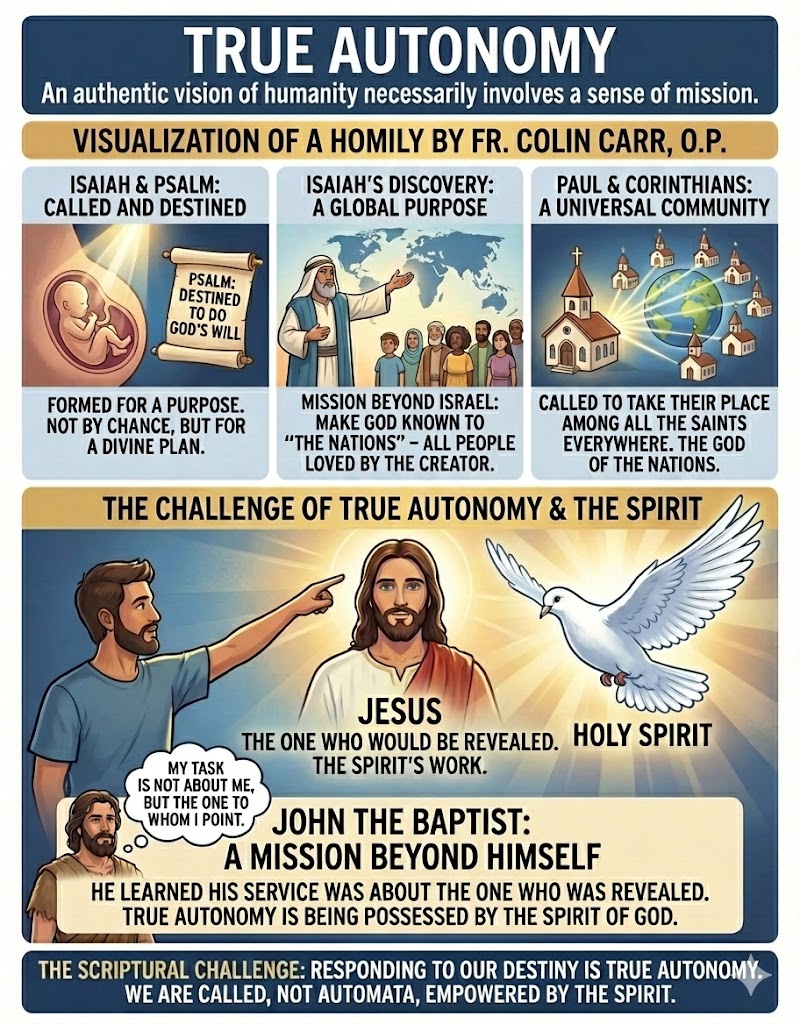
Second Sunday of the Year. Fr Colin Carr notes that an authentic vision of humanity necessarily involves a sense of mission.
We are not just creatures who happen to have landed up in the world by chance. Isaiah speaks of being formed in the womb to serve a purpose. The psalmist sees himself as destined to do God’s will. Paul writes to the Corinthian Christians that they are called to take their place among the saints, and a lot of the rest of his letter shows what a challenge that is. In the Gospel John the Baptist speaks of himself as having been sent to baptise so that Jesus would be revealed, which is what last Sunday’s feast was all about.
Some people might object to the idea that we are formed for a purpose, destined, called, commanded. Many people would prefer to think of themselves as autonomous, creating their own destiny as they encounter life’s challenges. And some people would prefer to call themselves automata who are simply the product of their environment and shouldn’t be held to account for their actions. But the Scriptures are consistent in using the language of destiny, calling, challenge and response, with the implication that a true response to our destiny is real autonomy, and that being called does the very opposite of turning us into automata.

Permission granted for non-profits to use in ministry
The infographic was created using Nano Banana, Google's Revolutionary AI Image Generator. Infographic may not be sold or used for personal financial gain. Please show your appreciation by letting others know about TheWordThisWeek.NET.
2nd Sunday of Year A
Behold, the Lamb!
Second Sunday of the Year. Fr Peter Harries preaches on the figure of the Lamb of God.
What did John the Baptist mean when he tells us ‘Behold the Lamb of God who takes away the sins of the world’? Previously he had baptised Jesus amongst the crowds who were baptised as a sign of their repentance. John the Baptist had known that there was something inappropriate about baptising Jesus. Now, inspired by God, with a developing understanding of who Jesus is, John the Baptist can teach us.
John the Baptist had preached to the people of Israel that judgement was coming, calling them to repentance, as we have heard through Advent as a reminder that we too need to turn away from sin and turn towards God. The then-contemporary Jewish apocalyptic literature of John the Baptist’s time had often talked of a Lamb who would conquer evil at the end time.
────── ⋆⋅☆⋅⋆ ──────
Fr. Austin Fleming
Permission granted for non-profits to use in ministry
The infographic was created using Nano Banana, Google's Revolutionary AI Image Generator. Infographic may not be sold or used for personal financial gain. Please show your appreciation by letting others know about TheWordThisWeek.NET.
2nd Sunday of Year A
Some Good Points About Pointing
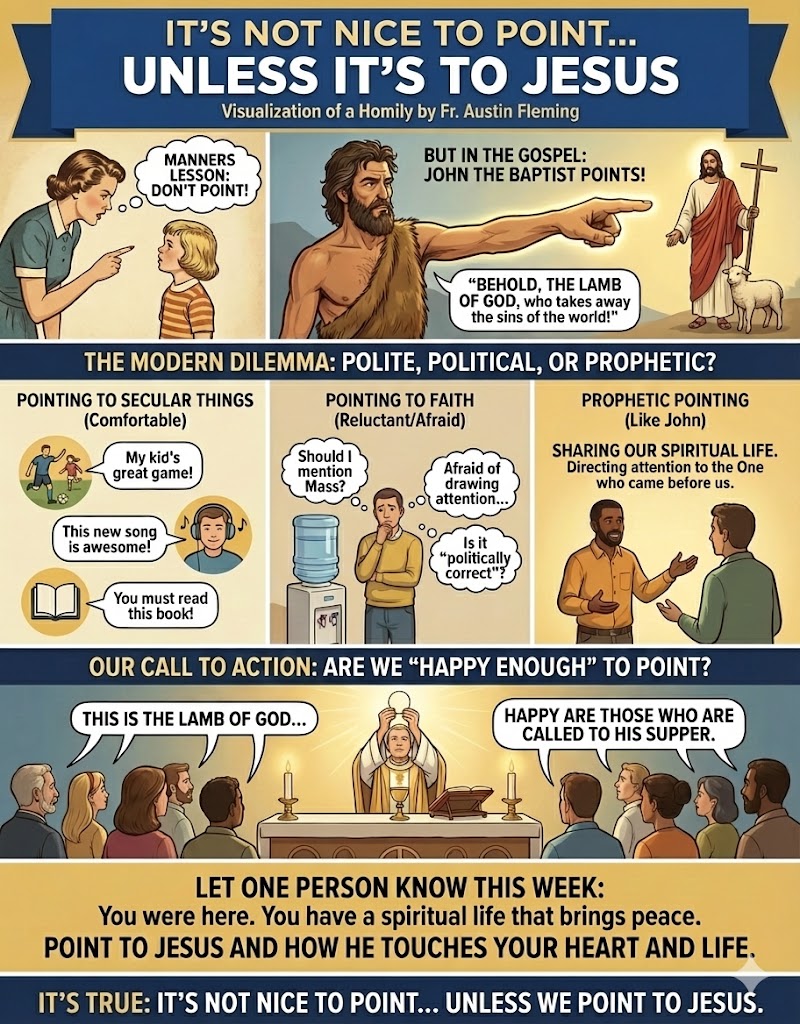
Do you remember being taught: It’s not nice to point! I wonder if children are still taught that lesson in manners. But right here in the gospel we find John the Baptist in a serious breach of good manners: John saw Jesus coming toward him and said, “Behold, the Lamb of God, who takes away the sins of the world!”
You can just see John’s finger pointing towards Jesus!
The question of whether or not it’s polite to point, and in particular to point to Jesus, is very much alive today. It’s interesting that the words polite and political derive from the same root and it’s interesting to watch politicians pointing impolitely to Jesus in hopes of winning voters to their side. (John, of course, points to Jesus not to advance his own cause but to direct all attention to the One who came before him.)
How about us? Do we find ways to point to Christ in our daily lives? Maybe not so much. Pointing to Jesus to others is not politically correct but even those who don’t worry about being politically correct may feel uncomfortable pointing to Jesus in public, fearing that doing so might draw too much attention to themselves.
But there are ways we point to others that are acceptable.
────── ⋆⋅☆⋅⋆ ──────
Monsignor Peter Hahn

Permission granted for non-profits to use in ministry
The infographic was created using Nano Banana, Google's Revolutionary AI Image Generator. Infographic may not be sold or used for personal financial gain. Please show your appreciation by letting others know about TheWordThisWeek.NET.

2nd Sunday of Year A
God in the Routine
2023 HOMILY – We gather this weekend in the liturgical year of the church, having just completed the seasons of Advent and Christmas. Now, we enter Ordinary Time, which lasts about five and a half weeks until Lent begins on February 18th (2026), and then resumes after the Easter season on May 24th (2026). The term “Ordinary Time” comes from the Latin word “ordinalis,” which means “numbered.” The Church simply counts the number of Sundays and successive weeks throughout the year. However, when we hear the word “ordinary,” it may bring a negative connotation that suggests uneventful or unimportant. Yet, we must remember that through the Incarnation, God has entered human history, uniting His divine nature with our human nature. He has made everything extraordinary, so there can be nothing ordinary. Even the short and seemingly “ordinary” Gospel reading holds significance.
────── ⋆⋅☆⋅⋆ ──────
Fr. Charles E. Irvin
Permission granted for non-profits to use in ministry
The infographic was created using Nano Banana, Google's Revolutionary AI Image Generator. Infographic may not be sold or used for personal financial gain. Please show your appreciation by letting others know about TheWordThisWeek.NET.
2nd Sunday of Year A
Spiritual Sinkholes and Our Need for Rescue

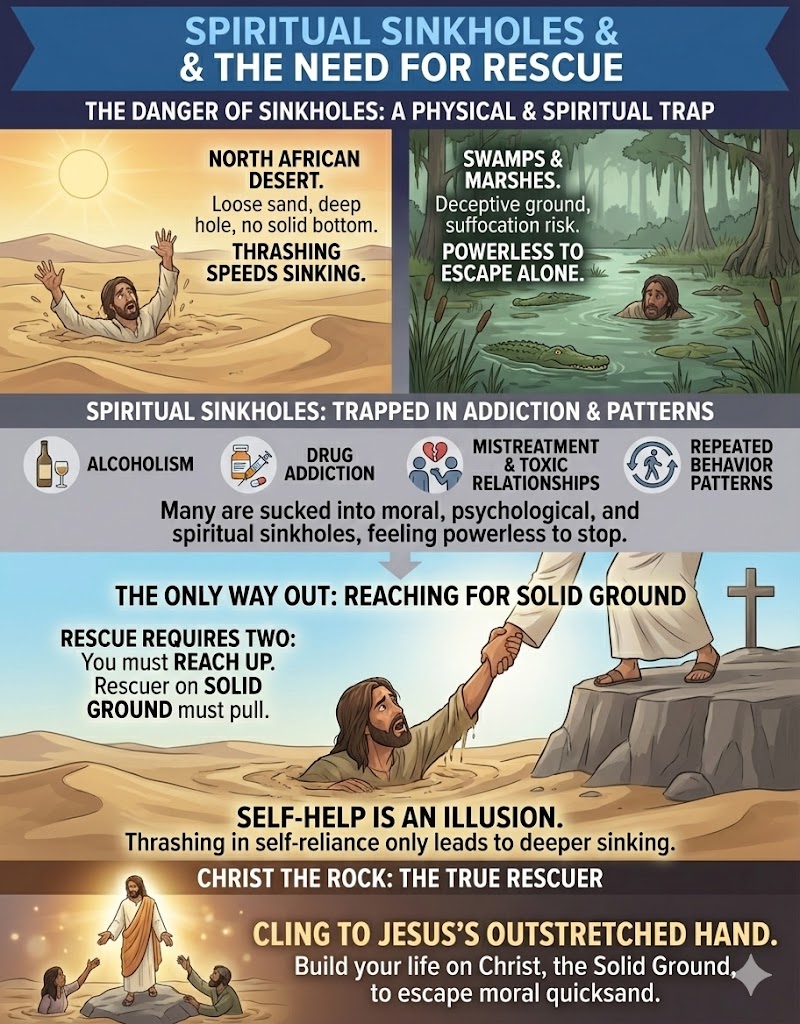
If you go out into the North African desert with its rolling and shifting hills of sand, you will likely come upon quicksand. You can also encounter quicksand in our North American swamps, in our Florida Everglades, and even in some of our own inland lakes. Nearer to us you’ll find it in the marshy, reed-filled edges of Michigan’s inland lakes.
Sometimes these spots are called sinkholes. They are pockets of loosely packed sand that has collected in a hole with a really deep bottom. There’s nothing solid at the bottom of these sinkholes. When you step into one you immediately begin to sink down and the more you thrash around the more it sucks you down until you are under the sand and then die of suffocation.
Many people find themselves in spiritual sinkholes. They are being sucked down into alcoholism, drugs, sex, mistreatment of others, and other sorts of addictions. They are caught in behavior patterns that are repeated over and over and over again. Such unfortunates are powerless to stop themselves.
The only way out of quicksand or sinkhole is to reach up and grasp the hand of someone who is standing on solid, rock-hard ground. It takes the two of you to get out. Your rescuer can’t pull you up all by himself, and you, all by yourself, cannot get yourself out.
────── ⋆⋅☆⋅⋆ ──────
Fr. Joe Jagodensky, SDS
Fr. Joe Jagodensky, SDS
Permission granted for non-profits to use in ministry
The infographic was created using Nano Banana, Google's Revolutionary AI Image Generator. Infographic may not be sold or used for personal financial gain. Please show your appreciation by letting others know about TheWordThisWeek.NET.
2nd Sunday of Year A
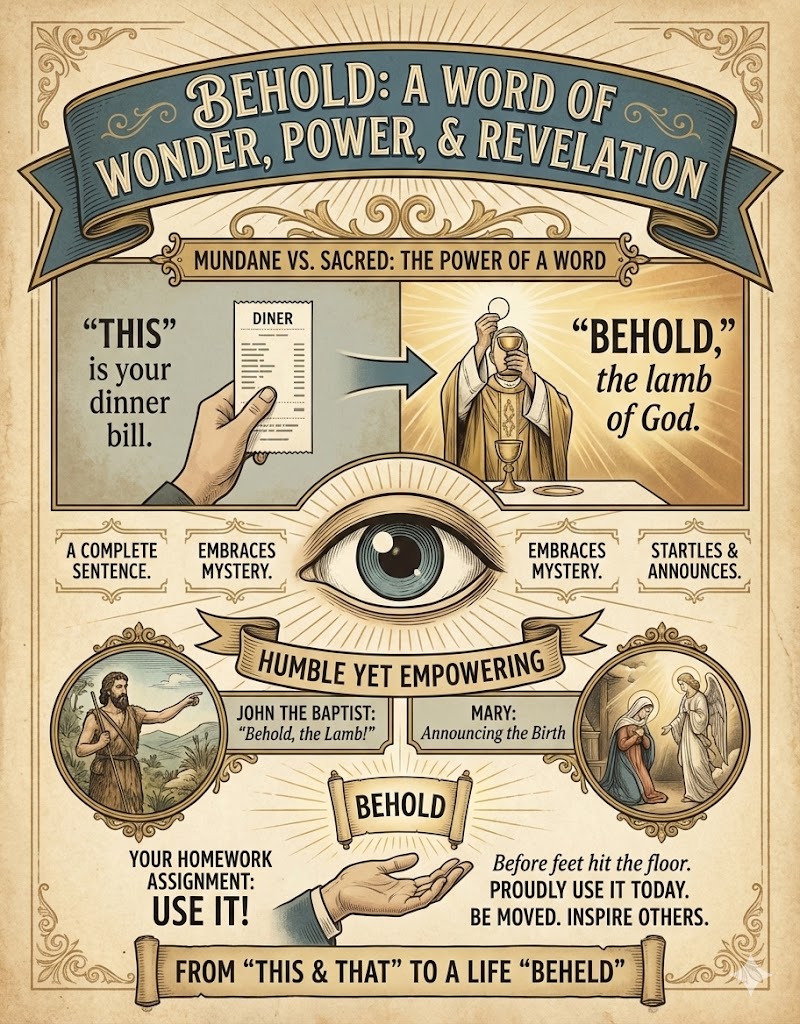
“Behold,” No Exclamation Mark Needed

We go to sleep at night filled with an abundance of worries and fears and then awake to a new day filled with hope and joy….
“Behold.” What a beautiful, colorful, strong word. It’s a sentence in itself. Just saying that one word writes a complete paragraph. We don’t hear it said in the middle or the end of a sentence. “Behold” is always the first word to express something wonderful, scary, or a feeling needing to say that one word – “Behold.”
“The curtain’s been lifted.” What was not known is now known. In faith, it also means embracing the unknown while the unknown remains a mystery. “Behold.” It startles you to say it and it startles those around you.


────── ⋆⋅☆⋅⋆ ──────
Fr. Jude Thaddeus Langeh, CMF

2nd Sunday of Year A
God’s Chosen One

Feast of the baptism of Jesus today’s celebration marks the end of the Christmas season and opens the new season. The ordinary season of the church’s liturgical year. Baptism is a sacrament which cleanses us from original sin makes us Christians children of God and heirs of heaven. It is a sacrament of regeneration by water in the word by nature. We are born from Adam children of Wrath but by baptism we are regenerated in Christ as children of Mercy for Christ give power to us to be made sons and daughters of God because for those of us who believe he has given us this power in his name because we are born not of blood nor of the will of the flesh nor of the will of man but the will of God. The word baptism is derived from the Greek word baptism to wash to dip or to immerse. It signifies. Therefore that washing is the essential idea of the sacrament the related word washing of baptizing but this mosque refers to the act of dipping or immersing an object in water as part of a purification ritual.
It is accepted as a necessary doorway to salvation. Baptism is the first sacrament and gives assets to the others. Jesus himself was baptized and this is attested by all four Gospels Matthew chapter 3 verse 13 to 17 mark chapter 1 verse 9 to 11 Luke chapter 3 verse 21 and 22 and John chapter 1 verse 29 to 34. Surprisingly Jesus was baptized by John.
────── ⋆⋅☆⋅⋆ ──────
Deacon Peter McCulloch
Permission granted for non-profits to use in ministry
The infographic was created using Nano Banana, Google's Revolutionary AI Image Generator. Infographic may not be sold or used for personal financial gain. Please show your appreciation by letting others know about TheWordThisWeek.NET.
2nd Sunday of Year A
The Lamb of God
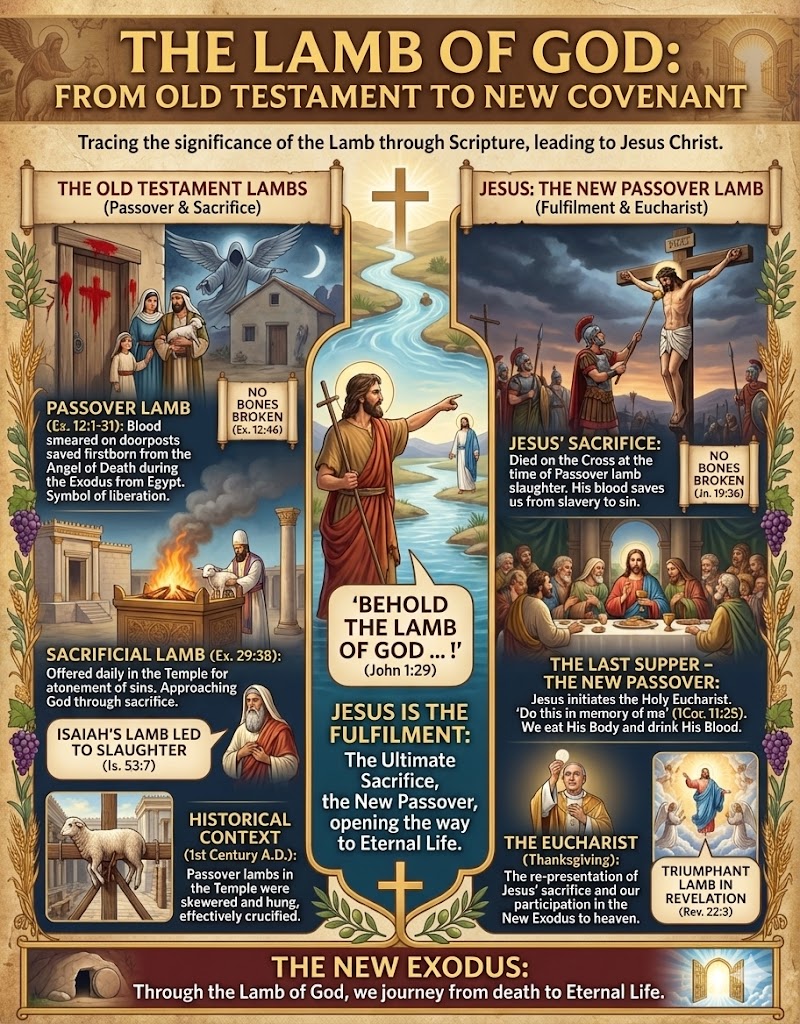
The Bible is full of lambs. In fact, they’re mentioned over 200 times.
There’s the paschal lamb (Lk.22:7), the sacrificial lamb (Ex.29:38), Isaiah’s lamb led to the slaughter (Is.53:7) and the triumphant lamb in Revelation (Rev.22:3).
And in today’s Gospel, when John the Baptist sees Jesus, he cries out: ‘Behold the Lamb of God … !’
What does he mean by that? And what’s the significance of all these lambs? To answer that, we need to go back into history…
Permission granted for non-profits to use in ministry
The infographic was created using Nano Banana, Google's Revolutionary AI Image Generator. Infographic may not be sold or used for personal financial gain. Please show your appreciation by letting others know about TheWordThisWeek.NET.
2nd Sunday of Year A
Saint Maria Goretti
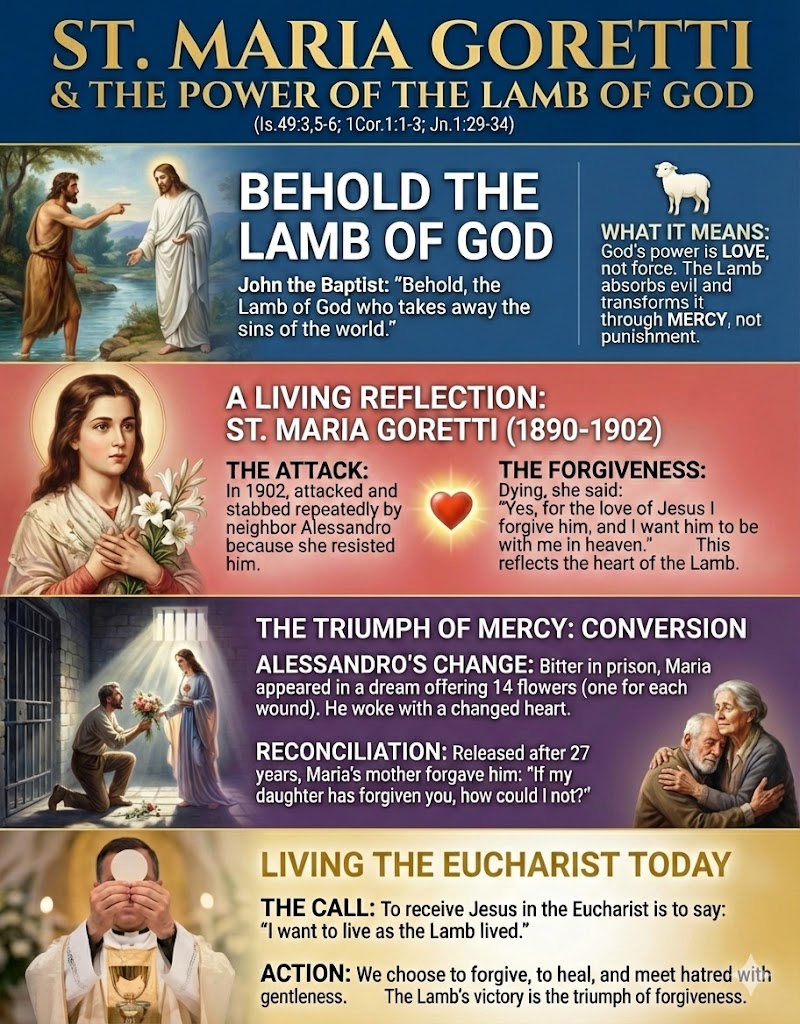
In today’s Gospel, John the Baptist is standing by the River Jordan; people are all around. He sees Jesus coming and then he says something that we still hear today: ‘Behold, the Lamb of God who takes away the sins of the world.’
It’s one of the most familiar lines in all of Scripture, and we hear it at every Mass. But what does the Lamb of God really mean? And why is Jesus called a Lamb, rather than a lion, a warrior or a king?
It’s because the Lamb reveals the deepest truth about God’s power. God’s power is love, not force. The Lamb does not conquer by killing, but by being gentle and forgiving. Jesus takes away the sins of the world not by punishment, but by mercy…
Over the years, many saints have shown us what this Lamb-like love looks like. One very good example is a young girl named Maria Goretti.
────── ⋆⋅☆⋅⋆ ──────
Fr. Carmen Mele, O.P.
Permission granted for non-profits to use in ministry
The infographic was created using Nano Banana, Google's Revolutionary AI Image Generator. Infographic may not be sold or used for personal financial gain. Please show your appreciation by letting others know about TheWordThisWeek.NET.
2nd Sunday of Year A
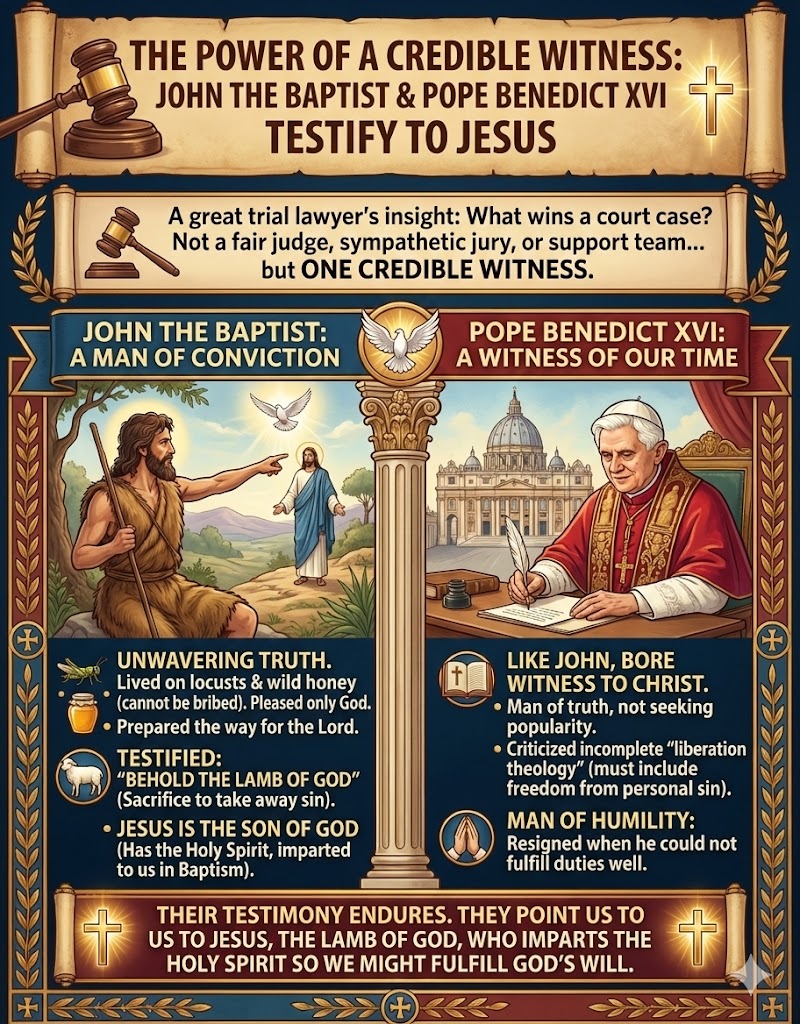
John the Baptist as Credible Witness
When Mary greeted Elizabeth at the beginning of Luke’s gospel, the evangelist said, “…the infant leaped in her womb.” The infant in her womb, of course, was John the Baptist who “leaped for joy” in the presence of Jesus.
Matthew’s gospel does not report a visit by Mary to Elizabeth when both are pregnant. However, in today’s gospel something roughly similar takes place. John, the fiery prophet attracting Jewish leaders to the desert of Judea, recognizes the superiority of Jesus. When Jesus comes to him for Baptism, John tells him that he (i.e., John) should be baptized by Jesus.
The event indicates Jesus’ humility as well as John’s. Jesus knows at least something of his divine origin, yet he submits to John’s baptism. He tells John to allow the baptism “’to fulfill all righteousness.’’’ The righteousness of God calls one to be humble before another. We are always to respect other people and never to arbitrarily impose our will upon them. When Pope Francis went to Canada last year to apologize to the indigenous peoples for the abuses of Church officials, he was “fulfill(ing) righteousness.”
────── ⋆⋅☆⋅⋆ ──────
Msgr. Joseph Pellegrino
2nd Sunday of Year A
Lamb of God

What was so significant in the title, “Lamb of God,” that John uses when he points to Jesus? Certainly, the lamb is among the meekest of animals. John could have called Jesus the Lion of Judah, but no, he calls Him the lamb of God. Why? John looks back at the Prophet Isaiah’s Fourth Song of the Suffering Servant, Isaiah 53, “He was oppressed and afflicted, Yet He did not open His mouth; Like a lamb that is led to slaughter, And like a sheep that is silent before its shearers, so He did not open His mouth.” John also looks forward to the lamb in the Book of Revelation chapter 5 who is slain yet risen. God’s scroll containing His plan for mankind is held out, but it is sealed. “Who is worthy to unseal the scroll,” a voice cries out. There are a great many tears because no one is found worthy to initiate God’s plan. And them the Lamb that was slain appears. He opens the scroll.”
────── ⋆⋅☆⋅⋆ ──────
Msgr. Charles Pope
Permission granted for non-profits to use in ministry
The infographic was created using Nano Banana, Google's Revolutionary AI Image Generator. Infographic may not be sold or used for personal financial gain. Please show your appreciation by letting others know about TheWordThisWeek.NET.
2nd Sunday of Year A
Who is Jesus Christ?

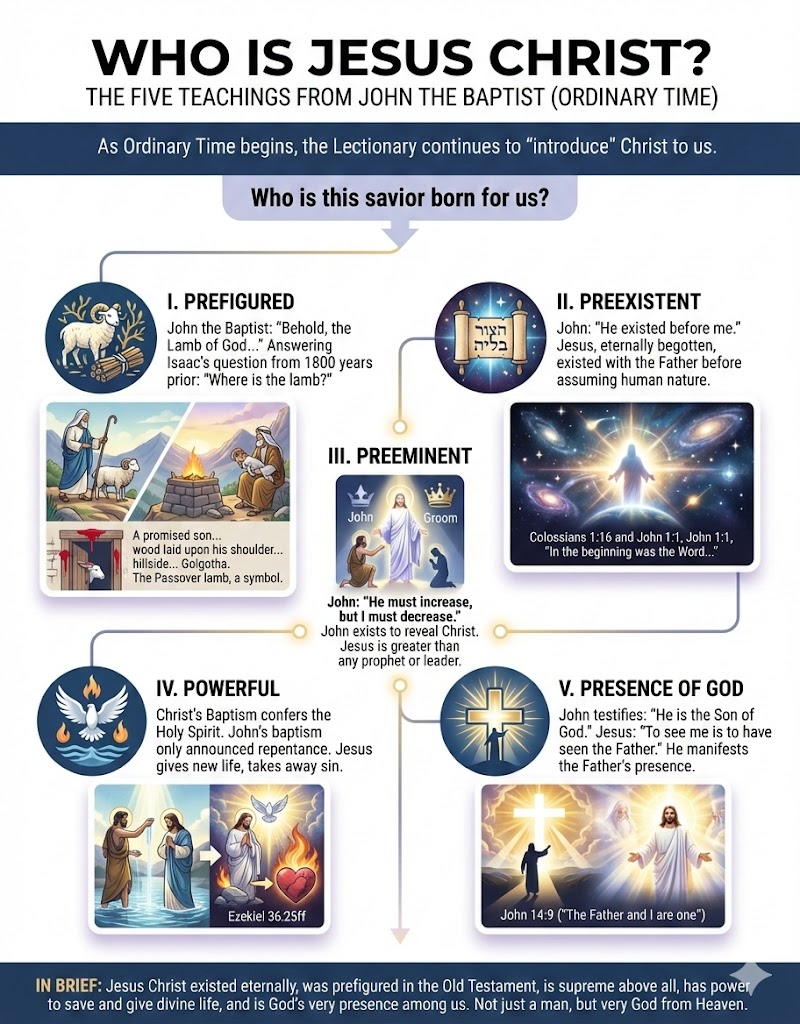
As Ordinary Time (tempus per annum) opens up, the lectionary continues to “introduce” Christ to us. The Christmas cycle now done, we must ask, “Who is Jesus Christ? Who is this savior who has been born for us?”
In today’s Gospel, John the Baptist elaborates on this. John’s words are brief, but they are packed with Christological teaching. In this Gospel we learn at least five things about Jesus. We learn that He is prefigured, preexistent, preeminent, powerful, and is the presence of God. Let’s look at each one.
I Prefigured
II Preexistent
III. Preeminent
IV Powerful
V. Presence of God
────── ⋆⋅☆⋅⋆ ──────
Father Kevin Rettig

Permission granted for non-profits to use in ministry
The infographic was created using Nano Banana, Google's Revolutionary AI Image Generator. Infographic may not be sold or used for personal financial gain. Please show your appreciation by letting others know about TheWordThisWeek.NET.
2nd Sunday of Year A
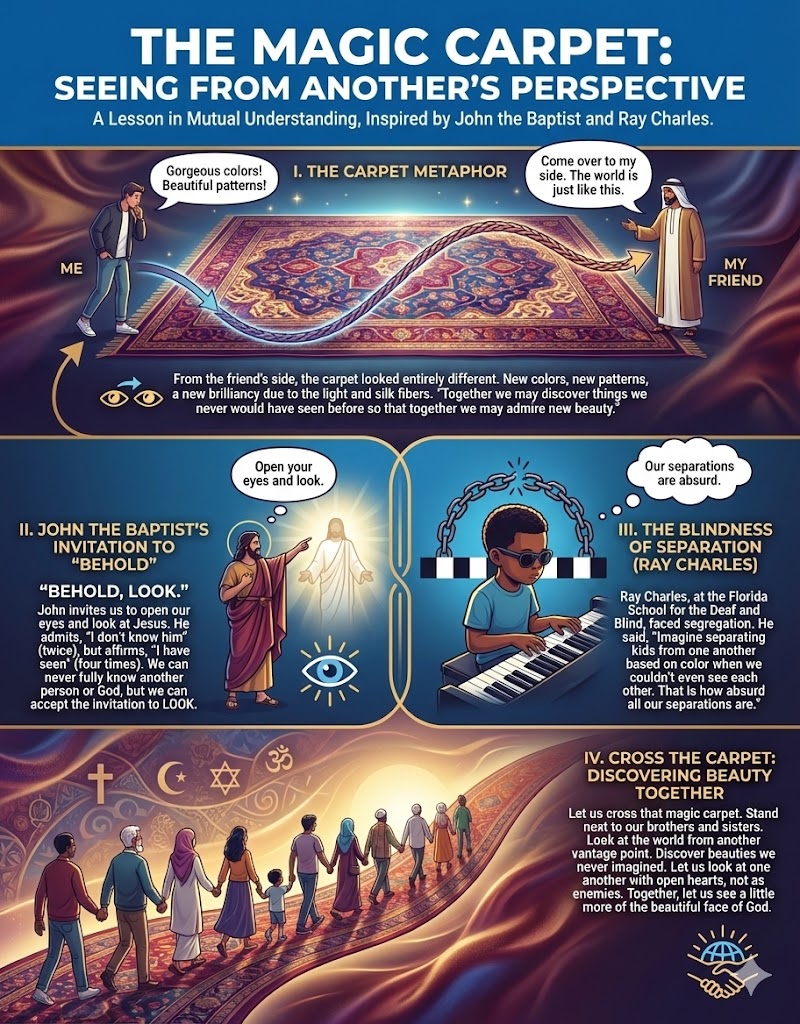
Cross the Carpet
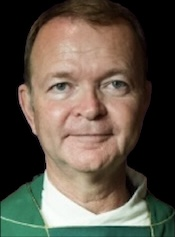
A Canadian couple plans a Hawaiian getaway to escape winter. The husband arrives first, accidentally emails a widow in California, whose minister husband just died. She mistakenly receives his loving message, causing shock and fainting. The story reflects on God’s presence, questioning if He’s truly hidden or silent, citing nature’s beauty, life’s wonders, and human emotions as evidence of His existence and communication. It concludes that God is always present, speaking through creation and our inner selves.

2nd Sunday of Year A
The Sin of Not Noticing
Fr. Ruttig’s homily explores sacrificial love through the Cross. It confronts our tendency to feel that God is distant in our pain and reveals the Cross as God’s defin
────── ⋆⋅☆⋅⋆ ──────
Fr. George Smiga
Permission granted for non-profits to use in ministry
The infographic was created using Nano Banana, Google's Revolutionary AI Image Generator. Infographic may not be sold or used for personal financial gain. Please show your appreciation by letting others know about TheWordThisWeek.NET.
2nd Sunday of Year A
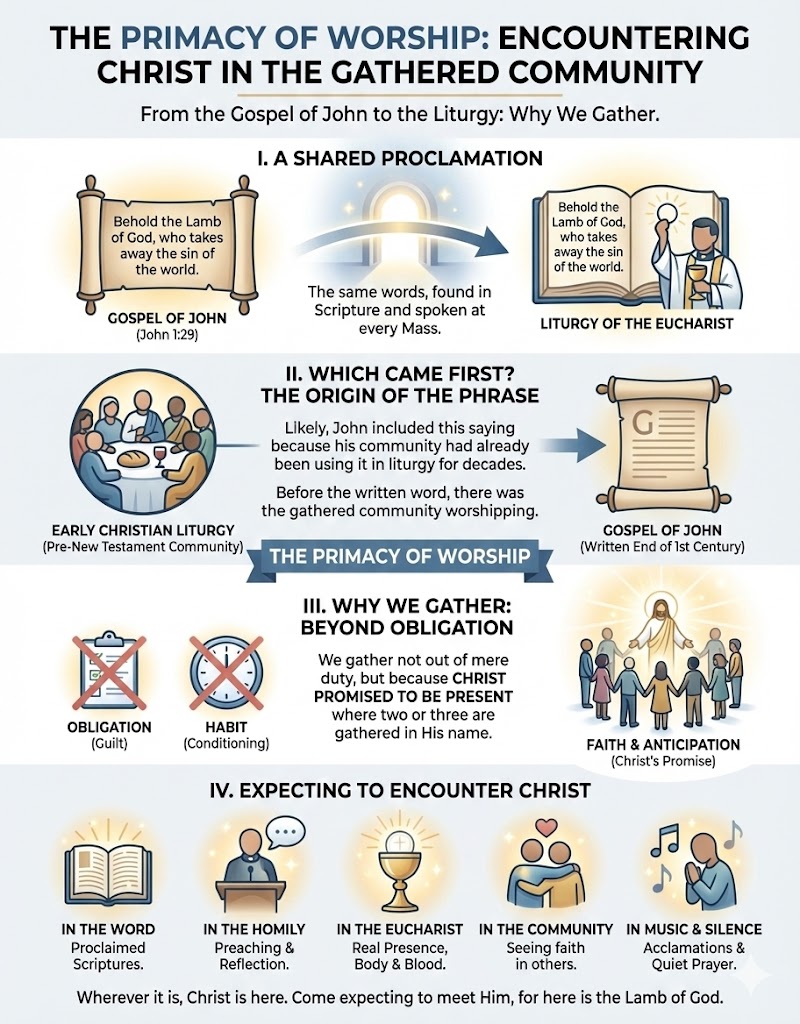
Worship and the Lamb of God

2005 HOMILY – This homily connects Jesus’ Baptism to the Tsunami. This homily follows last Sunday’s homily, which was Fr. Smiga’s first impressions following the devastating tsunami.
Why did God not stop the tsunami disaster? The answer is, we don’t know. But we desperately want to know and here is where things become dangerous. In our desire to know, in our desire to make sense, we can create a false god. Again you have heard these attempts to make sense out of this disaster in the media and in people’s conversation. They will say, “The tsunami happened because God was angry, because God wanted to punish us or the people of Indonesia. God did this to teach a lesson. God did this to reduce the overpopulation on the earth.”
All these so-called explanations of this disaster attempt to make sense out of the tsunami, but they are blasphemous. They are idolatry because they set up as God something that is not God. They are idolatry because they create a false god, a god of vengeance, a god who does not care about the death of innocents, a god who has no compassion for human beings and their lives. Moreover, these explanations contradict the things that we know for sure about God. We know that God cares for us, that God sees us as God’s own children. We know this because God has revealed this to us.
────── ⋆⋅☆⋅⋆ ──────