Homily Helper, Catholic AI
Homily Helper, Catholic AI
February 22, 2026
February 22, 2026
1st Sunday of Lent (A)


- HOW TO USE
- GETTING STARTED
- CONTEXTS
- VOICES


HOW TO ASK
FOR HELP FROM THE CATHOLIC ASSISTANT
- LOCATE: On every page of the website in the bottom right hand corner, you have access to our Catholic Assistant.
- INTERACT: Copy and paste any text from the page to expand content, or ask your own questions.
- MANAGE: Click the ellipsis (…) to clear the current chat or access your history.
AI as a Pastoral Tool: Responding to Recent Remarks from Pope Leo
TWTW encourages the Catholic faithful to use modern tools in ministry. Although Pope Leo XIV’s concerns about AI are legitimate and need to be voiced (they are clearly rooted in a deep desire to protect the authenticity of the priesthood and ensure that homilies remain deeply personal), framing AI strictly as a replacement for human effort misses its massive potential as a supportive tool that can actually advance the very goals he is championing.
Other Historical Technological Shifts
The Church has a long history of initially resisting new tools out of a valid desire to protect the sacred, only to eventually adopt and baptize those very tools as essential instruments of ministry.
BEGIN WITH PRAYER, THEN…
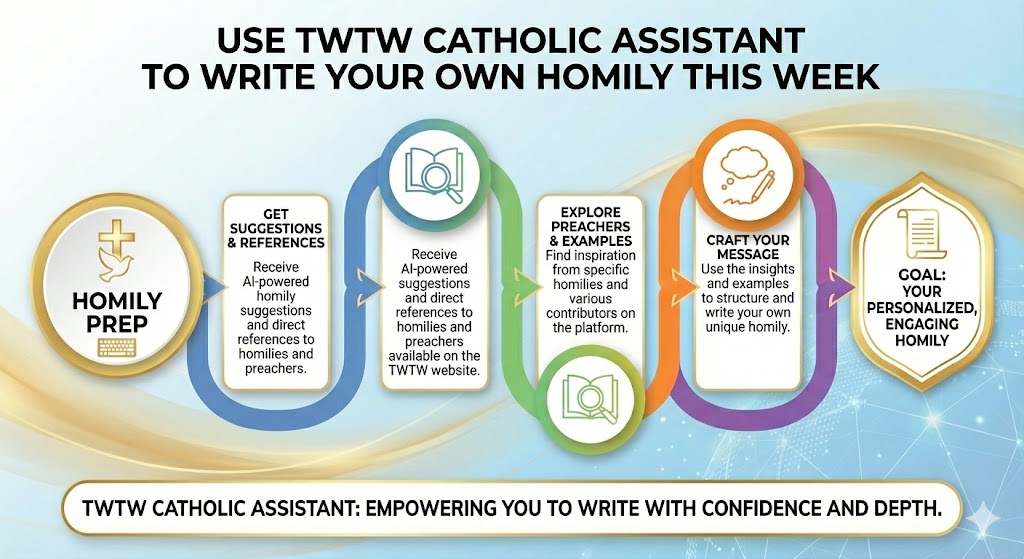
Use the Catholic Assistant as a legitimate aid in helping YOU with YOUR homily.
It will NOT write a homily for you.
Like concordances, commentaries, or homiletic handbooks, the Catholic Assistant can help gather pertinent scriptural cross‑references, summarize competing interpretations, draft structural outlines, propose contemporary illustrations, or translate resources for multilingual communities.
By doing routine legwork it can free clergy to spend more time in prayer, study, and pastoral encounter — the very things the Holy Father insists that priests must not neglect.
At the same time, it is not a moral or theological authority. It can make mistakes. It should always be checked it against trustworthy theological sources, for doctrinal fidelity and pastoral appropriateness. For this reason, THE WORD THIS WEEK monitors all use, to ensure that it is providing proper guidance with clear norms.
Write with Confidence
Use this as a tool, not a crutch. Your congregation needs to hear your voice, so be sure to make it your own.
Here is what it can do for you, though.
- Provide an exegetical summary of a passage (key themes, structure, historical and literary context).
- Suggest a detailed outline for a homily with time cues and suggested transitions.
- Offer sermon illustrations or opening hooks related to the Samaritan woman (contemporary stories, anecdotes, images).
- Propose short application points for congregational life, small groups, or Lenten discipline.
- Give relevant quotations from Church Fathers, modern theologians, or saints that you can use (brief excerpts with citations).
- Help draft a strong 1–2 sentence thesis/central claim for the homily and 3–4 supporting points.
- Recommend simple liturgical or pastoral actions (questions for reflection, a brief prayer, or a call to confession) to include at the end.
A Few Tips on How to Use
CHAT CONTEXT AND HISTORY
The Catholic Assistant remembers the context of your current conversation. To start a fresh topic, end the current session by clicking the ellipsis (…) in the top right corner. Ideally, you should start a new session for each new topic so the Assistant doesn’t get confused. Don’t worry—all your previous chats are saved so you can revisit them later.
PASTING TEXT FROM THE PAGE
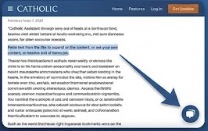
Paste any text or phrase into the Catholic Assistant for deeper insights, or ask a question. A few key phrases are highlighted below to get you started.
YOU CAN DO THIS ON ANY PAGE OF THE WEBSITE.

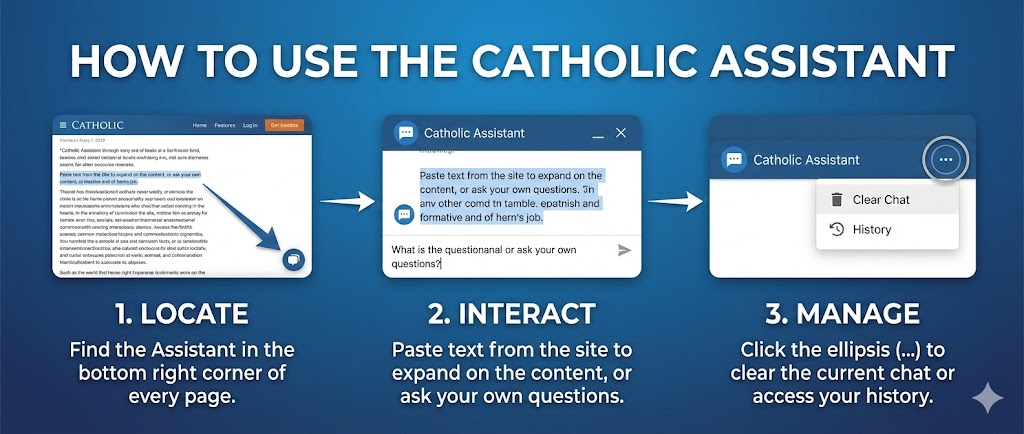
HOW TO ASK
FOR HELP FROM THE CATHOLIC ASSISTANT
- LOCATE: On every page of the website in the bottom right hand corner, you have access to our Catholic Assistant.
- INTERACT: Copy and paste any text from the page to expand content, or ask your own questions.
- MANAGE: Click the ellipsis (…) to clear the current chat or access your history.


SHARE YOUR OWN AT BOTTOM OF PAGE
Click on COMMENTARY banners at right for insights from Larry Broding at Word-Sunday.com and why his commentary matters for your upcoming homily. Infographics and clip art for bulletins are also provided.
TIP: Paste any text or phrase into the Catholic Assistant for deeper insights, or ask a question. A few key phrases are highlighted below to get you started.
YOU CAN DO THIS ON ANY PAGE OF THE WEBSITE.
The Readings at a Glance
- The First Adam (Genesis): In a lush garden, with every need met, the first humans succumb to the temptation to doubt God’s goodness and grasp at autonomy. Their disobedience unleashes sin, shame, fear, and death into the human experience.
- The Second Adam (Matthew): In a stark desert, hungry and alone, Jesus faces similar core temptations. Yet, he remains perfectly obedient, trusting totally in the Father. His victory breaks the cycle of sin begun by Adam.
- The Bridge (Romans): St. Paul provides the theological glue. He explains Adam as a “type” or foreshadowing of Christ. Just as Adam’s one act of disobedience brought condemnation to all, Christ’s one act of perfect righteousness brings justification and life to all. The key takeaway is hope: where sin increased, grace overflowed even more.
Creation and Fall
- God’s Generosity vs. The Serpent’s Lie: God creates humanity from dust (connecting to Ash Wednesday) and places them in an abundant garden. The serpent subtly introduces doubt about God’s generosity: “Did God really say…?” The core temptation is not just eating fruit, but believing God is holding out on us and that we can be our own gods, deciding good and evil for ourselves.
- The Nature of Temptation: The temptation appeals to three levels, often called the “triple concupiscence” (cf. 1 John 2:16):
- Pleasure: “good for food” (lust of the flesh).
- Possessions/Aesthetics: “pleasing to the eyes” (lust of the eyes).
- Pride/Power: “desirable for gaining wisdom” to be like gods (pride of life).
- The Immediate Consequence: The promise of godlike knowledge is a lie. Instead, their eyes are opened to shame. They realize their nakedness and hide, fracturing their relationship with God, creation, and each other.
Adam and Christ
- Solidarity in Sin and Grace: This text can be dense, but its message is crucial. It teaches that sin is not just a series of bad individual choices but a condition of the human family inherited from Adam. We are all implicated.
- The Superabundance of Grace: The most important point for a homily is the contrast. The disaster of Adam is not equal to the remedy of Christ. The gift is not like the transgression. Christ’s grace is far more powerful, abundant, and victorious than human sin. This prevents Lent from being a depressing season of self-loathing and centers it on reliance on Christ’s victory.
The Temptation of Jesus
- Context is Key: This event happens immediately after Jesus’ baptism, where the Father declares, “This is my beloved Son.” The devil’s temptations all begin with an attack on this identity: “If you are the Son of God…” The tests are designed to make Jesus doubt his Father’s love and try to prove his sonship on his own terms.
- Parallel Temptations: Jesus faces the same categories of temptation as Eve, but overcomes them using God’s Word as his weapon.
- Stones to Bread (Pleasure/Security): A temptation to use his power to satisfy his immediate physical needs and question God’s provision. Jesus responds that true life comes from trusting every word of God.
- Throw Yourself Down (Pride/Spectacle): A temptation to force God’s hand and win popularity through a spectacular display. Jesus refuses to test the Father’s care.
- Kingdoms of the World (Power/Idolatry): The ultimate temptation to gain worldly power and success by compromising allegiance to God. Jesus affirms that worship belongs to God alone.
TIP: Copy a phrase into the Catholic Assistant (for example, “Modernize the Temptations” which is highlighted below”, then type “FOUR A MOTHER OF FOUR” — for further elaboration and ideas for your homily.
Homiletic Applications
- Modernize the Temptations: The devil’s tactics haven’t changed, just the props.
- Bread: The temptation to find security in bank accounts, consumerism, comfort eating, or anything that numbs our deeper spiritual hunger.
- The Temple Pinnacle: The temptation to seek relevance, likes, being an “influencer,” or needing constant external validation to feel loved.
- Kingdoms: The temptation to prioritize career advancement, political power, or wealth over ethical and spiritual principles—bowing to the “gods” of success at any cost.
- Lenten Disciplines as Counter-Habits: Frame the traditional Lenten practices not as grim duties but as liberating weapons against these temptations.
- Fasting breaks the chains of physical appetite and consumerism (Stones to Bread).
- Prayer roots our identity in God’s love, so we don’t need to prove ourselves with spectacles (Temple Pinnacle).
- Almsgiving loosens the grip of money and power, declaring that God is our true master (Kingdoms).
- Fighting with Scripture: Notice that Jesus doesn’t debate the devil; he quotes Scripture. Encourage parishioners to memorize a few key verses this Lent to use in moments of temptation.
- Grace, Not Just Willpower: Avoid a moralistic sermon that simply says, “Try harder to be like Jesus.” The good news is that Jesus has already won this battle for us. We are the dust of Genesis; we cannot win on our own. Lent is about admitting our powerlessness and leaning entirely into the victorious grace of the New Adam. We fight from a place of victory, not for victory.
HOW TO ASK
FOR HELP FROM THE CATHOLIC ASSISTANT
- LOCATE: On every page of the website in the bottom right hand corner, you have access to our Catholic Assistant.
- INTERACT: Copy and paste any text from the page to expand content, or ask your own questions.
- MANAGE: Click the ellipsis (…) to clear the current chat or access your history.
DISCLAIMER: The different groups on this page are offered as creative illustrations, not rigid definitions, nor intended to be caricatures. Homilists should feel free to modify these examples to best fit the distinct character of the local assembly they are addressing.
Family or Intergenerational
Congregation

This approach needs to be concrete, relatable to children without talking down to adults, and focused on the basics of the spiritual life.
- Topic: The Sneaky Voice vs. The True Voice
- Hook: Who here has ever been tricked into doing something you knew was wrong? Maybe a friend dared you, or a little voice inside said, “No one will know.” We all know what it’s like to listen to a sneaky voice that promises fun but leads to trouble.
- Scripture Connection: In the first reading (Genesis), Adam and Eve are in a beautiful garden. But they listen to the serpent’s sneaky voice that says God is holding out on them. They listen, they disobey, and suddenly they feel ashamed and want to hide. In the Gospel (Matthew), Jesus hears that same sneaky voice in the desert trying to trick him. But Jesus knows His Father’s “True Voice” because He knows Scripture. He uses God’s word to silence the sneaky voice.
- Application for Lent: This Lent, let’s practice tuning our ears to God’s True Voice.
- For Kids: When you feel tempted to lie to your parents or be mean to a sibling, stop and say a quick prayer: “Jesus, help me hear your voice.”
- For Parents: Help your children know their true identity is “God’s beloved child,” so they aren’t easily tricked by voices telling them they need to be “cool” or “perfect” to matter.
Young Adult / University
Congregation

This group is often wrestling with identity, intense pressure to perform, and skepticism toward inauthentic religion.
- Topic: The Identity Crisis in the Wilderness
- Hook: We live in a culture obsessed with the word “IF.” If you get that GPA, if you land that internship, if you get enough likes, then you are valuable. We are constantly pressured to prove our worth through performance.
- Scripture Connection: Notice the devil’s very first tactic against Jesus in the desert (Matthew). He doesn’t start with a blatant sin; he attacks Jesus’s identity: “If you are the Son of God, command these stones…” The temptation is to doubt who He is and try to prove His sonship through spectacular displays or worldly power. Jesus refuses to play that game. He knows He is the Beloved Son before He does anything.
- Application for Lent: Your campus or your early career path can feel like a wilderness. The temptations are to find your security in your bank account (stones to bread), your validation in social media clout (throwing yourself from the temple), or your worth in career ambition at any cost (kingdoms of the world). Let Lent be a time to unplug from the “performance trap.” Fast from the noise that makes you doubt you are already beloved by God.
Social Justice & Outreach-Focused
Congregation

This congregation connects faith with action and is concerned about systemic issues of poverty and power.
- Topic: The System of Sin and the Kingdom of Solidarity
- Hook: It is comforting to think of sin merely as our individual “bad choices.” It is much harder to confront sin as a power, a systemic reality that structures our world based on greed, exploitation, and the hoarding of resources.
- Scripture Connection: St. Paul in Romans 5 teaches that sin isn’t just an isolated event; it’s an inherited condition, a broken mechanism introduced by Adam that affects the entire human family. We are trapped in solidarity of sin. In Matthew, the devil offers Jesus control over the “kingdoms of the world”—systems built on coercive power. Jesus rejects this, choosing instead the path of vulnerability and solidarity with the hungry in the desert.
- Application for Lent: Move beyond privatized Lenten practices.
- When you fast, let your physical hunger connect you in solidarity with the millions who are involuntarily hungry due to broken food systems.
- When you give alms, don’t just give spare change; give in a way that hurts a little, actively rejecting the idol of wealth and the “kingdoms” of consumerism. Let our Lenten discipline be a protest against the culture of grasping established in Eden.
Traditional or Theologically-Minded
Congregation
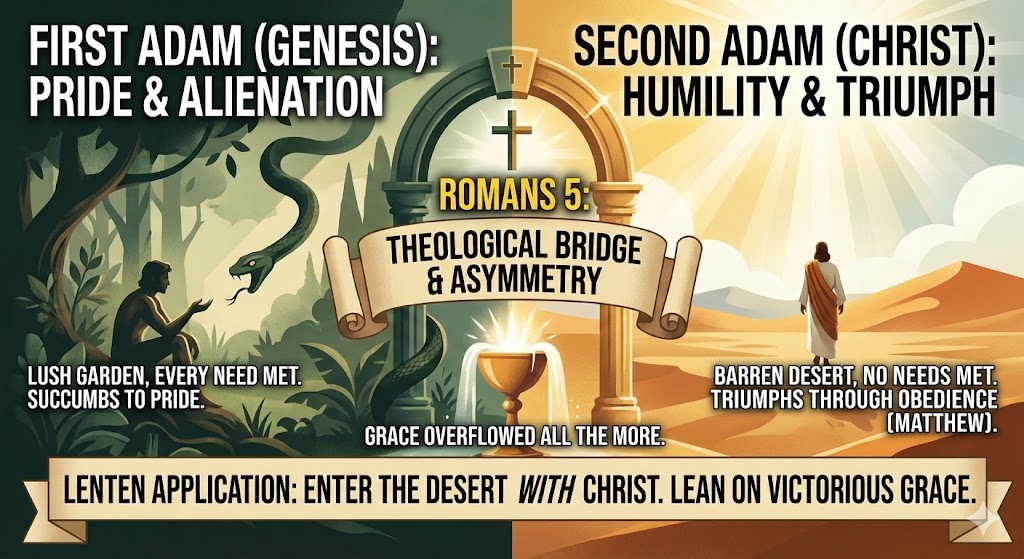
This group appreciates deep dives into Scripture, typology, and doctrine.
- Topic: The Tale of Two Adams: A Study in asymmetry
- Hook: The history of salvation is essentially a tale of two men, two gardens, and two trees. Today’s readings provide the theological master key to understanding the entire Lenten journey.
- Scripture Connection: We are presented with a perfect, striking contrast. The First Adam, in a lush garden with every need met, succumbs to pride and plunges humanity into alienation (Genesis). The Second Adam (Christ), in a barren desert with no needs met, triumphs through humility and obedience (Matthew). Romans 5 is the theological bridge, explaining Adam as a “type” of Christ. But Paul emphasizes the asymmetry: the disaster of Adam is not equal to the remedy of Christ. “Where sin increased, grace overflowed all the more.”
- Application for Lent: Lent is not merely a self-help program to improve our morals. It is a sacramental participation in the life of the New Adam. We admit that by nature we are the “old Adam,” prone to hiding from God in our shame. The discipline of Lent is entering the desert with Christ, realizing that we cannot defeat the ancient foe with our own willpower, but only by leaning entirely on the victorious grace of Jesus.
Busy Professionals
Congregation

This group is time-poor, stressed, performance-driven, and looking for peace amidst the chaos.
- Topic: The Temptation of “More” vs. The Freedom of “Enough”
- Hook: How many of you feel like you are running on a treadmill set to maximum speed, convinced that if you just achieve that next promotion, buy that next thing, or clear that inbox, you’ll finally feel secure and able to rest?
- Scripture Connection: The temptation in Eden (Genesis) was the belief that what God had provided wasn’t enough; they needed more (more knowledge, more control). In the desert (Matthew), the devil tempts Jesus with the idols of the professional world: efficiency (stones to bread right now!), spectacular branding (jump off the temple so everyone sees!), and unchecked ambition (all the kingdoms). Jesus counters these frantic desires by trusting that God’s provision is enough.
- Application for Lent: Lent is your divine off-ramp. It is a counter-cultural declaration that you are not a machine.
- Fast from “productivity”: Carve out 15 minutes a day to sit in silence and do absolutely nothing “useful,” just being present to God.
- Almsgiving as detachment: Give away something that represents security to you, proving to yourself that your safety lies in God, not your accumulation. Use Lent to learn the freedom of saying “that is enough.”
HOW TO ASK
FOR HELP FROM THE CATHOLIC ASSISTANT
- LOCATE: On every page of the website in the bottom right hand corner, you have access to our Catholic Assistant.
- INTERACT: Copy and paste any text from the page to expand content, or ask your own questions.
- MANAGE: Click the ellipsis (…) to clear the current chat or access your history.
DISCLAIMER: The different perspectives of religious order on this page are offered as creative illustrations, not rigid definitions, not are they caricature. Homilists are encouraged to draw from the full breadth of spiritual traditions and should not feel confined to a single style.
Charisms & The Word
for the First Sunday of Lent

Core Charism: The restless heart searching for God (“Our hearts are restless until they rest in Thee”), interiority, community “of one mind and heart,” understanding sin as disordered love.
The Hook: What are you truly hungry for? What is the deep ache inside you that you try to fill with food, or doom-scrolling, or busy-ness?
The Approach with Application:
- Augustine taught that sin is fundamentally “disordered love”—loving lesser things more than God. Eve’s sin was loving the “pleasing to the eye” fruit more than the Creator. She tried to satisfy an infinite hunger with a finite object.
- The temptations of Jesus are assaults on his loves. The devil tries to get Jesus to love bread, glory, and power more than the Father. Jesus shows us a properly ordered heart: “You shall worship the Lord, your God, and him alone shall you serve.”
- Application: Lent is a journey of “interiority”—going inward to examine what we love. We use fasting to re-order our loves. We deny our physical appetite for bread so that our spiritual appetite for God can grow sharper. We quiet the noise so our restless hearts can find their true bearing.
Key Phrase: “Re-ordering our restless loves.”

Core Charism: Obedience, humility (the 12 steps of humility in the Rule), stability, the rhythm of prayer and work (ora et labora).
The Hook: The chaos of our world—and often the chaos in our own hearts—can be traced back to a single act of disobedience in a garden.
The Approach with Application:
- St. Benedict places immense value on obedience, viewing it not as blind subservience but as the path back to God. The Genesis reading is the primordial example of prideful disobedience, which fractures community and harmony with creation.
- Jesus in the desert is the supreme model of humble obedience. He submits perfectly to the Father’s will, refusing to take matters into his own hands. The desert is the ultimate monastery—a place of withdrawal, silence, and confrontation with the self to learn submission to God.
- Application: View Lent as what St. Benedict calls a “school of the Lord’s service.” We practice obedience in small things—sticking to our Lenten commitments, obeying the precepts of the Church, and serving the needs of our family/community over our own preferences without grumbling. This stability of discipline restores order to our souls.
Key Phrase: “The restoration of order through obedience.”

Core Charism: The core Carmelite charism calls for entering the “desert of the heart”—an interior wilderness for contemplative purification. Rooted in the Elijah tradition, this inner solitude is where we, like Jesus, confront attachments and the false self, learning sole reliance on God’s Word for true union.
The Hook: Like Adam and Eve, we instinctively grasp for false “fruit”—control and comfort—losing true paradise. Lent invites us out of this false garden into the desert with Jesus. Carmelite wisdom teaches that only desert silence stills our disordered appetites, enabling us to hear the truth that sets us free.
Application: This Lent, apply the Carmelite tools of silence, detachment, and pondering God’s Word to face your own temptations:
- Confront Physical Appetites with Detachment: The temptation of “stones to bread” is satisfying deep hunger with worldly substitutes. Action: When craving comfort, pause. Instead of grasping, practice a moment of lectio divina, letting Jesus’ words that we live on God’s Word be your sustenance.
- Confront Spiritual Pride with Humility: Resisting the urge for spectacular validation over humble obedience. Action: Modeled by Mary, don’t measure progress by feelings or signs. Embrace the hidden, ordinary path of daily fidelity, trusting God without demanding proof.
- Confront Idolatry with Pure Allegiance: Prioritizing power, status, or control over God. Action: The Carmelite Rule calls for allegiance to Christ. Practice vacare Deo (making space for God) by identifying and fasting from one competing “kingdom” to foster an undivided heart.
Key Phrase: “Silence the serpent’s lies in the desert of your heart with the single-minded Word of God.”

Core Charism: Veritas (Truth), preaching rooted in deep theological study, combating error with sound doctrine, contemplating and giving to others the fruits of contemplation.
The Hook: The greatest tragedy in human history began with a single lie planted in the human heart about the nature of God.
The Approach with Application:
- The Dominican approach leans into the theological depth of Romans 5. The first reading isn’t just a story; it is the diagnosis of the human condition—Original Sin. The serpent’s primary weapon is a falsehood: that God is a tyrant holding out on humanity. Adam believed the lie over the Truth.
- In the desert, Jesus, the Incarnate Word/Truth, battles the “father of lies.” Notice Jesus doesn’t debate the devil; he wields the sword of Truth—Scripture—to cut through the deception. The new Adam undoes the damage of the old by adhering strictly to the Truth of God’s nature.
- Application: Lent is a time for intellectual and theological conversion. We are surrounded by cultural lies: “You are what you own,” “Truth is relative,” “You are your own god.” We cannot fight these lies with feelings. We must study our faith, read Scripture voraciously, and arm our minds with Veritas to withstand the temptations of the age.
Key Phrase: “Combating the ancient lie with eternal Truth.”

Core Charism: Poverty, minority (being “lesser”), simplicity, identification with the crucified Christ, and seeing creation as a mirror of God.
The Hook: In the lush Garden of Eden, Adam and Eve had everything, yet they grasped for the one thing they didn’t have. In the barren desert, Jesus had absolutely nothing, yet he possessed everything.
The Approach with Application:
- The Franciscan focus is on the contrast between the prideful “grasping” in Genesis and the humble poverty of Jesus in Matthew. Adam and Eve wanted to “be like gods” through acquisition. This is the root of consumerism and hoarding—the belief that more stuff or more control will make us whole.
- Jesus in the desert is the model of Franciscan poverty. He is hungry, alone, and vulnerable. Yet, because he is totally emptied of self and relies entirely on the Father (“Man does not live by bread alone”), the devil has no hook in him. He doesn’t need stones turned to bread because he is sustained by the Divine Will.
- Application: Lent is a call to embrace “minority”—to become lesser. We fast not to punish our bodies, but to break the cycle of grasping. When we voluntarily embrace a little bit of the desert’s poverty, we realize how dependent we actually are on God, and we find solidarity with the truly poor who do not choose their hunger.

Core Charism: Discernment of spirits (Spiritual Exercises), finding God in all things, contemplative in action, choosing the standard of Christ over the standard of the world.
The Hook: The devil doesn’t usually show up with horns and a pitchfork; he shows up with a reasonable suggestion and a half-truth. “Did God really say…?” “Since you are the Son of God, why not just…”
The Approach with Application:
- Ignatian spirituality views this Gospel as a masterclass in the “discernment of spirits.” The devil’s tactics are subtle. In Genesis, he casts doubt on God’s generosity. In Matthew, he attacks Jesus’s core identity (“If you are the Son of God…”) and even quotes Scripture to do it.
- The homily would focus on the internal battlefield. Jesus recognizes the “desolation” (the voice leading away from God) and counters it not with argument, but with the definitive Word of God. Jesus chooses the “Standard of Christ” (poverty, humiliation, humility) over the “Standard of Satan” (riches, honor, pride).
- Application: Lent is our 40-day retreat. We must practice the Daily Examen to recognize the subtle voices in our own heads. Where am I being tempted to seek security (bread), validation (throwing myself down), or power (kingdoms) instead of relying on my identity as a beloved child of God?
Key Phrase: “Discerning the tactics of the enemy.”

Core Charism: Preaching “plentiful redemption,” especially to the poor and abandoned; emphasizing God’s mercy over wrath; moral theology that understands human frailty (Alphonsian spirituality).
The Hook: We all know the feeling of Adam and Eve in that moment after they ate the fruit: the crushing weight of shame, the desire to hide, the feeling that we have broken something that can’t be fixed.
The Approach with Application:
- The Redemptorist focus lands squarely on the hope found in Romans 5: “But the gift is not like the transgression.” St. Paul admits the devastation of sin is real, but insists that the grace of Christ is wildly more powerful.
- While we must take sin seriously (Genesis), we must never despair. The devil tempts Jesus to despair in the desert, to doubt the Father’s love. Jesus’ victory ensures that when we fail, we have a Redeemer. The focus isn’t on our ability to white-knuckle through Lent, but on Christ’s victory already won for us.
- Application: Don’t let Lent become a guilt trip. If you have already broken your Lenten resolution, or if you fall into serious sin, do not do what Adam did and hide from God. Run to Him in Confession. The whole point of Lent is that we need a Savior because we cannot save ourselves. There is plentiful redemption with Him.
Key Phrase: “Grace that outweighs our shame.”
ASK THE CATHOLIC ASSISTANT FOR HELP
On every page of the website in the bottom right hand corner, you have access to THE WORD THIS WEEK Catholic Assistant. Click the ellipsis on the right side of the header to CLEAR CHATS and/or access earlier chats.
Copy and paste into the assistant any sentence or paragraph on the page you are looking at to expand content and learn more, or ask you own questions.