September 28, 2025
September 28, 2025


Homily Videos Bishop Barron
Homily Videos Bishop Barron
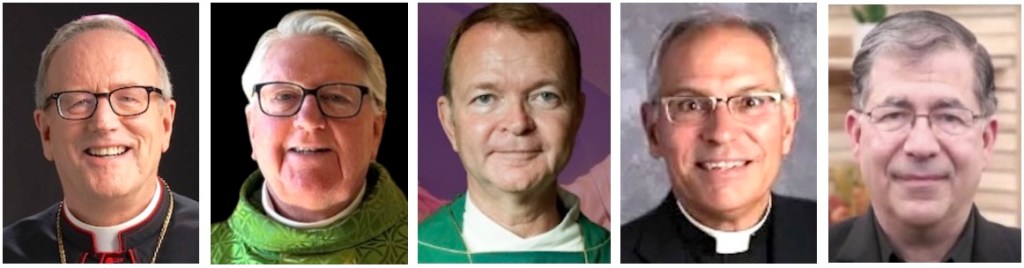
Sunday Visual Summaries and Questions
through five distinct viewpoints.
Bishop Robert Barron

26th Sunday of Year C

How are You Caring for the Poor?
This week’s readings compel us to reevaluate our dedication to assisting those in need. The prophetic words of Amos and Jesus’ parable of Lazarus provoke introspection: Are we actively engaged in the lives of the impoverished? Do our self-centered tendencies overshadow the hardships endured by our fellow human beings?
TWTW Visual Summary and Discussion Questions

Click to enlarge
Part 1: Understanding the Foundation
The goal of this section is to ensure everyone understands the core theological and scriptural points Bishop Barron establishes as the foundation for his message.
- The Three Pillars: Bishop Barron begins by outlining Pope Benedict XVI’s three essential functions of the Church: evangelizing, worshipping God, and caring for the poor. He suggests the last three popes have each emphasized one of these. In your own words, how do these three functions relate to and reinforce one another? Why is it essential that the Church does all three?
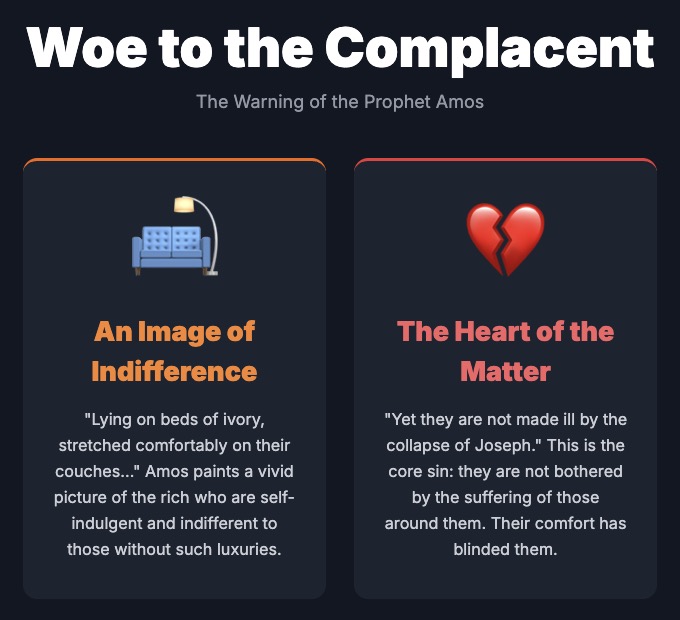
- The Voice of the Prophet: The sermon highlights the Prophet Amos’s critique of the "complacent in Zion." What specific behaviors and attitudes does Amos condemn? How do his words about "beds of ivory" and "drinking wine from bowls" translate to the comforts and luxuries of modern life in the 21st century?
- The Gospel Reversal: In the parable of Lazarus and the rich man, Bishop Barron points out a significant "reversal": the poor man is named (Lazarus), while the rich man is anonymous. What is the spiritual significance of this detail? What was the rich man's specific sin? Was it an act of aggression, or something else?

Click to enlarge
Part 2: Personal Reflection and Conviction
This section encourages participants to move from understanding the concepts to internalizing the message and allowing it to challenge them personally, as Bishop Barron suggests it should.
- Letting it "Bug You": Bishop Barron admits the story of Lazarus and the rich man has "bugged me ever since" he was a child. He calls this feeling the "grit inside the oyster" that can lead to the pearl of compassion. What part of this sermon or the scriptures cited "bugs" you the most? Be honest about what makes you uncomfortable and why.
- The Man at the Gate: The rich man's failure was his daily indifference to the suffering person right at his gate. Who is the "Lazarus at the gate" in your own life, community, or city? In what ways have you, perhaps unintentionally, grown accustomed to "walking past" or "walking over" the needs of others?
- A Necessary Relationship: Discuss Cardinal George's powerful statement: "The poor need you to stay out of poverty, but you need the poor to stay out of hell." What does this mean? How does it reframe our understanding of charity from a simple act of giving to a necessary act for our own salvation?

Click to enlarge
Part 3: From Conviction to Concrete Action
The goal of this final section is to move from reflection to resolution, transforming the "grit" of conviction into the "pearl" of concrete, practical action.
- Evaluating the Suggestions: Bishop Barron lists several concrete actions:
- Practicing the Corporal Works of Mercy.
- Tithing (giving 10% of your income).
- Keeping cash in your pocket for those in immediate need.
- Keeping a "poor box" by your door.
- Individual and Communal Brainstorm: Beyond Bishop Barron's list, what is one new, concrete practice you could personally adopt this week to be more attentive to the poor? Furthermore, what is one thing this group (or your parish/family) could do together to serve the poor in your community?
- Sustaining Compassion: The rich man's brothers were warned they had "the prophets" and still might not listen. We have the prophets, the Gospel, and the Risen Christ. How can we hold ourselves and each other accountable to ensure that the conviction we feel today doesn't fade, but becomes a lasting habit of compassion and generosity?
Closing Suggestion: End your discussion with a prayer, perhaps the Prayer of St. Francis ("Lord, make me an instrument of your peace..."), asking for the grace to put these convictions into loving action.
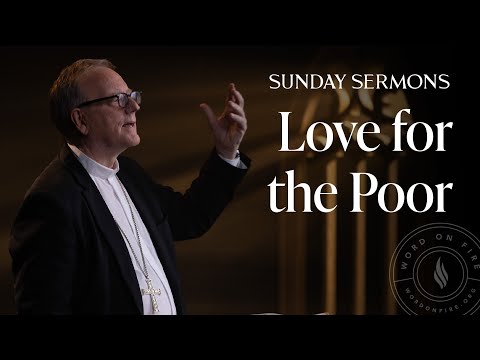
Love for the Poor
Friends, Pope Benedict XVI memorably told us that the Church does three essential things: It worships God, it evangelizes, and it serves the poor. This week, the first reading from the prophet Amos and the Gospel parable of the rich man and Lazarus bring that third task vividly to mind—and they are meant to bother us. Are you indifferent to the sufferings of the poor? What are you doing, concretely, to help them?
TWTW Visual Summary and Discussion Questions
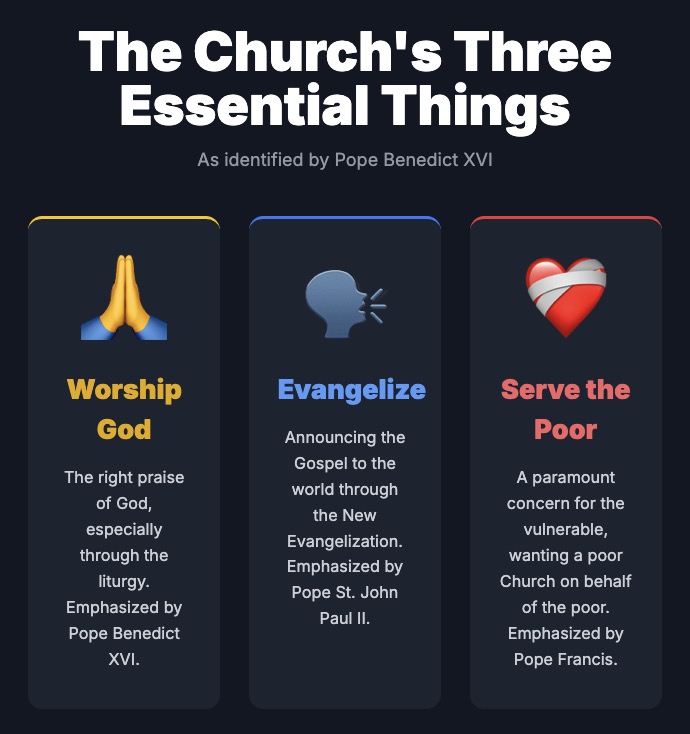
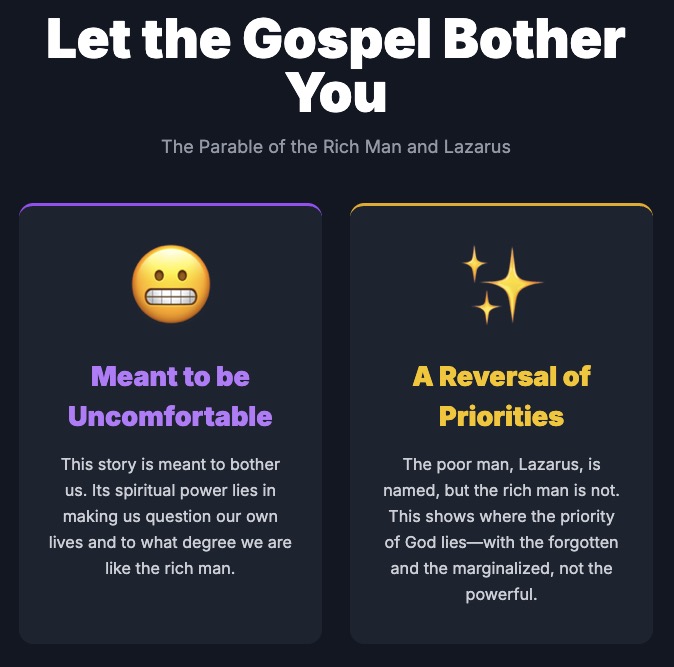
Click to enlarge
Bishop Barron says the story of the Rich Man and Lazarus "is meant to bother us" and that he doesn't want to lessen that effect.
Discussion Questions:
The "Collapse of Joseph": The prophet Amos condemns the wealthy who are "not made ill by the collapse of Joseph," meaning they were indifferent to the suffering of their nation.
- What might be the modern-day "collapse of Joseph" that we, in our comfort, might be tempted to ignore (e.g., local poverty, global crises, moral decay)?
- How do our daily routines and media consumption make it easy to remain comfortable and unaware?
Seeing Lazarus at the Gate: The homily emphasizes that the Rich Man's primary sin was a failure to see Lazarus. It wasn't just about money; it was about acknowledgement.
- Who are the "invisible" people in our own communities or daily lives whom we might walk past without truly seeing?
- What practical barriers (fear, busyness, prejudice) prevent us from truly "seeing" the Lazarus at our own gate?
No More Excuses: The rich man in hell is told his brothers won't be persuaded even by someone rising from the dead, because they already have "Moses and the prophets."
- Bishop Barron applies this to us, saying, "We have them. We read from them all the time." What does this teach us about our responsibility to act on the Word we hear every Sunday, rather than waiting for a more dramatic or convenient sign from God?
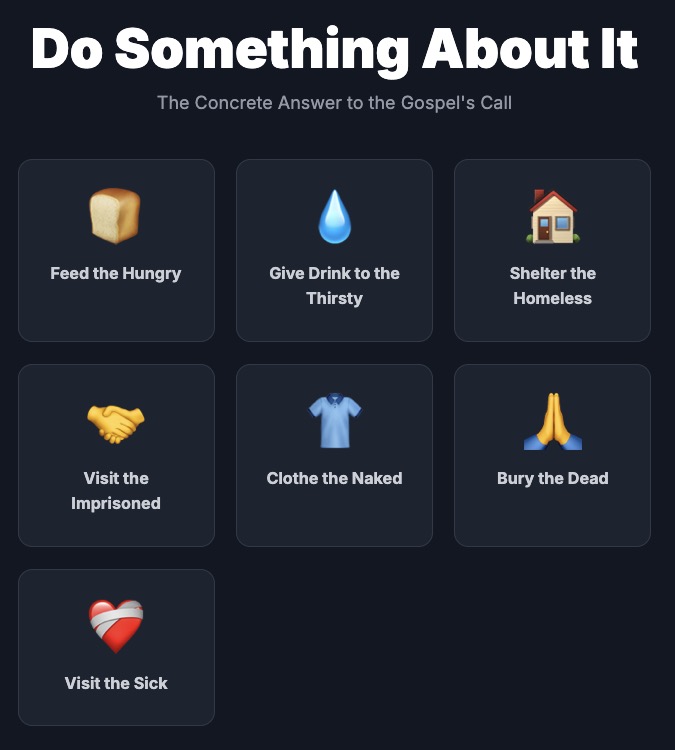
Click to enlarge
Discussion Questions:
From Abstract to Concrete: Bishop Barron challenges listeners to move beyond simply agreeing with "social justice" and to engage in the concrete Corporal Works of Mercy.
- (Feed the hungry, give drink to the thirsty, clothe the naked, shelter the homeless, visit the sick, visit the imprisoned, bury the dead.)
- Looking at this list, which of these works seems most challenging for you to engage in personally? Why?
- Which one feels most achievable for you to act on this week, even in a small but meaningful way?
A Change of Heart: The ultimate goal of these readings is not to make us feel guilty, but to invite us into a deeper relationship with God through our actions.
- How does shifting our focus from our own comfort and self-indulgence to the needs of the poor change our perspective on what truly matters in life?
- How can serving "Lazarus" help us better understand the heart of God?
Father Geoffrey Plant
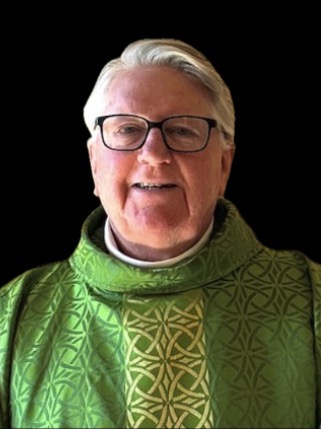
26th Sunday of Year C

Lazarus at the Gate
Luke’s unique parable contrasts the wealthy, self-indulgent man with Lazarus, highlighting indifference to suffering. The rich man faces consequences not for his actions, but for his failure to aid Lazarus, revealing the significance of compassion towards those in need, right at our doorstep.
TWTW Visual Summary and Discussion Questions


Click to enlarge
The Great Reversal - God's Concern for the Poor
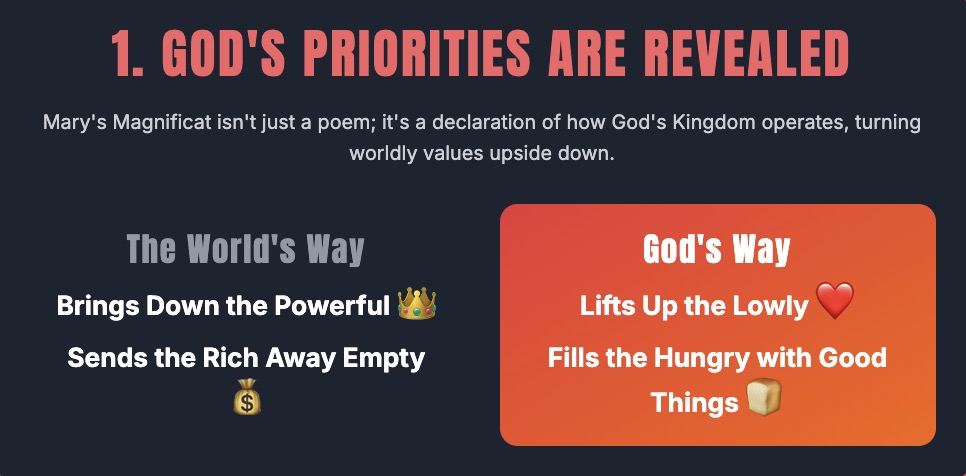
The presentation establishes that a central theme throughout the Gospel of Luke is the "great reversal," where God lifts up the lowly and brings down the powerful. This isn't just a social rearrangement but a revelation of God's priorities. The parable of Lazarus and the rich man is a stark illustration of this divine principle in action.
Discussion Questions:
- Fr. Plant begins by referencing Mary's Magnificat: "He has brought down the powerful from their thrones and lifted up the lowly. He has filled the hungry with good things, and sent the rich away empty." Why do you think this theme is so fundamental to Jesus's mission?
- In the parable, the poor man is given a name, Lazarus (meaning "God is my help"), while the rich man remains anonymous. What is the spiritual significance of this reversal?
- Lazarus is saved not simply because he was poor, but because his name implies he trusted in God through his suffering. How does this challenge the simple idea that poverty itself is a guarantee of holiness?


Click to enlarge
The Sin of Indifference
The presentation powerfully argues that the rich man's sin was not an evil action, but a failure to act. He was condemned for his indifference—for failing to see, acknowledge, and care for the suffering person at his own gate. This "sin of omission" is presented as a profound spiritual danger.
Discussion Questions:
- Fr. Plant uses the term hamartia (missing the mark) to define sin. How does this concept help you understand why the rich man was condemned for what he didn't do?
- Elie Wiesel is quoted as saying, "The opposite of love is not hate, but indifference." Discuss this statement in the context of the story of the "spectator" watching Jews being herded onto death trains. Where do you see this kind of indifference in the world today?
- Fr. Plant mentions Dante's Inferno, where the "fence-sitters" who lived with "no blame and with no praise" are punished for their lack of commitment. Why is refusing to choose between good and evil considered such a serious offense?
- Consider the story of the photographer Kevin Carter, who won a Pulitzer Prize for his photo of a starving child stalked by a vulture. He was heavily criticized for being a "detached spectator." Do you think this criticism was fair? What is the moral responsibility of those who witness suffering?


Click to enlarge
Recognizing Our Place
The final section of the presentation turns the parable directly onto the listener. Using stark global statistics, it makes the case that by global standards, many of us in the developed world are in the position of the rich man. The challenge is to recognize this reality and find our own "Calcutta" right on our doorstep.
Discussion Questions:
- Fr. Plant points out that a person earning the minimum wage in Australia is in the richest 4.6% of the world's population. How does hearing statistics like this, or the "village of 100 people" analogy, affect your perception of your own wealth and status?
- Mother Teresa's advice was, "Find your own Calcutta." What does this mean in a practical sense? Who is the "Lazarus at your gate" in your own life, neighborhood, or community?
- The homily ends with the story of St. Carlo Acutis, who began serving the homeless in Milan at just nine years old, and a final quote from Mother Teresa: "We ourselves feel that what we are doing is just a drop in the ocean. But the ocean would be less because of that missing drop." How do these examples combat the feeling that global problems are too big for any one person to make a difference?
- What is one concrete, practical action you can take this week to be less indifferent and more attentive to the needs of others around you?
Father Kevin Rettig
26th Sunday of Year C

Crumbs of Lazarus
Using a personal story of eating restaurant scraps, Fr. Kevin’s homily connects to the parable of Lazarus. He argues our deepest hunger isn’t for food, but for love and acceptance. Recognizing our own inner “Lazarus” helps us cherish these small “crumbs” of kindness and share them to transform the world.
TWTW Visual Summary and Discussion Questions


Click to enlarge
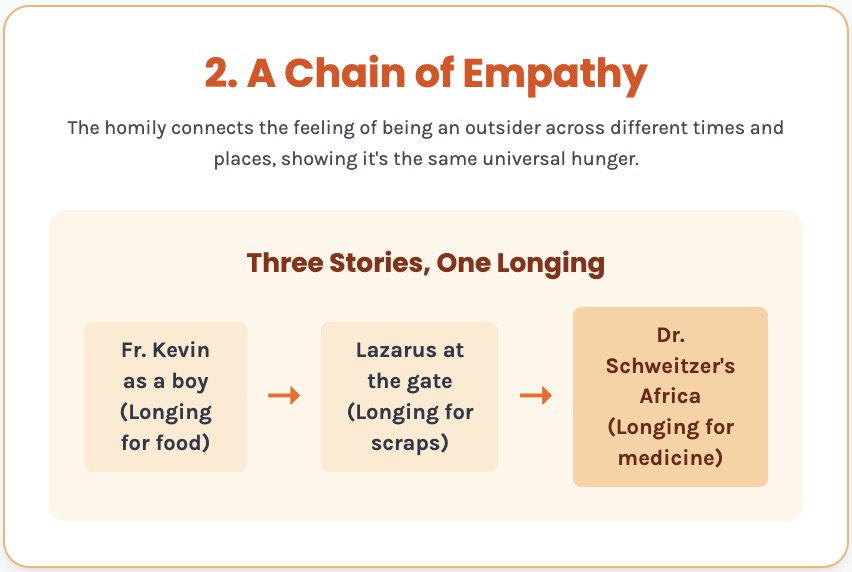
Focus: This section explores the literal and physical experience of being an outsider and the tangible needs of the world.
Discussion Questions:
- Fr. Kevin begins with a personal story about being a hungry 12-year-old boy in a fancy restaurant. How did this story make you feel? Have you ever had a similar experience of feeling out of place or like an "outsider looking in"?
- The homily draws a direct line from Fr. Kevin's experience to Lazarus at the gate and then to Dr. Albert Schweitzer's mission in Africa. In what ways were all three "longing for crumbs"?
- Dr. Schweitzer saw the rich man as European society and Lazarus as Africa, in need of food and medical supplies. In our world today, who are the individuals or groups longing for these literal "crumbs" of survival (e.g., food, shelter, safety, medicine)?
- Why do you think the busboy in Fr. Kevin's story smiled and helped the boys get scraps, while the rich man in the parable ignored Lazarus completely? What does this tell us about who is more likely to see the hungry?


Click to enlarge
Focus: This section shifts from physical hunger to the deeper, spiritual hunger for love, acceptance, and understanding.
Discussion Questions:
- Fr. Kevin quotes Mother Teresa: "The hunger for love is much more difficult to remove than the hunger for bread." Do you agree with this statement? Why or why not?
- The homily makes a powerful claim: "Most of us go through life feeling like Lazarus... not quite an insider, not quite accepted." In what areas of your own life have you felt "outside the gates"? What are the "crumbs of understanding and love" that you have longed for in those moments?
- Discuss the paradox presented in the homily: that those who hunger for love (like Lazarus) often end up experiencing a greater fullness of life, while "those inside the gates who seem to have everything are the ones left empty." What does the phrase "none are so empty as those who are full of themselves" mean to you?
- How does a hunger for acceptance protect us from becoming "full of ourselves"?


Click to enlarge
Focus: This final section reflects on the immense value of small acts of kindness and our role in sharing them.
Discussion Questions:
- Fr. Kevin states, "There is no such thing as a small crumb of love not in the hand of a Lazarus." Think about a time when a small, simple act of kindness from someone else felt enormous and deeply meaningful to you. Share what you are comfortable with.
- How does recognizing our own "inner Lazarus"—our own need for love and acceptance—make us better at giving love and acceptance to others?
- Fr. Kevin concludes with a call to action: "Let us cherish the morsels of love that come our way and in our hands allow that love to transform the world." What is one practical, concrete "crumb" of love, understanding, or encouragement you can offer to someone in your life this week?
- How can we, as a group or individually, become more like the busboy—slowing down to make sure the scraps of kindness reach those who need them?

The Sin of Not Noticing
Fr. Ruttig’s homily explores sacrificial love through the Cross. It confronts our tendency to feel that God is distant in our pain and reveals the Cross as God’s definitive, empathetic answer: a powerful, flesh-and-blood “Me too.”
TWTW Visual Summary and Discussion Questions
Click to enlarge
The Practice of Noticing
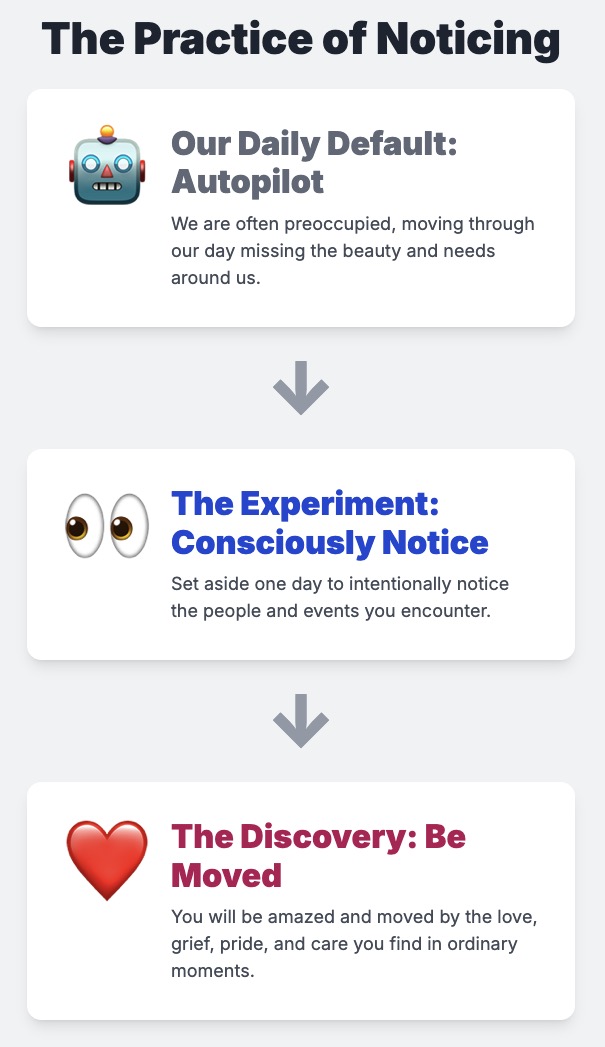
Fr. Rettig's personal experiment reveals that noticing is a spiritual practice. These questions explore what it means to cultivate this virtue in our own lives.
Discussion Questions:
Fr. Rettig begins with a story about a tombstone that read, "I told you I was sick," highlighting the deep human need to be noticed. Think of a time you felt truly "seen" and understood by someone. What did that feel like? Conversely, have you ever felt overlooked or invisible? How did that impact you?
Fr. Rettig undertook a personal project to "consciously notice things all day." He was amazed at how moved he was by the ordinary people and events he encountered (parents at school, nurses in a hospital, a young woman's pride in her first home).
- What do we often miss when we are preoccupied or moving through our day on autopilot?
- If you were to set aside one day to "consciously notice," what are someof the things or people you would focus on? What do you think you might discover?
Click to enlarge
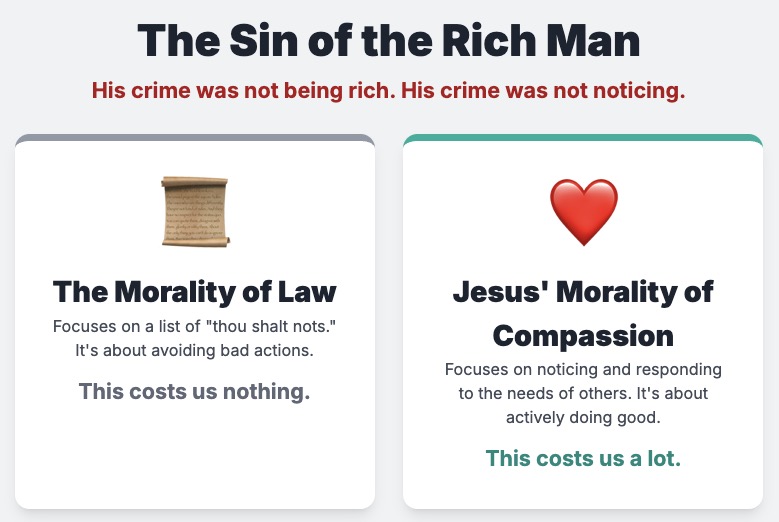
The Sin of the Rich Man
Fr. Rettig offers a challenging reinterpretation of the parable of Lazarus and the Rich Man. The following questions delve into this new perspective on sin and morality.
Discussion Questions:
The homily defines the Rich Man's sin not as being wealthy or mean, but as the "crime of not noticing."
- Do you agree with this interpretation? Why is simply "not noticing" a serious sin?
- Fr. Rettig contrasts Jesus' morality of compassion with a morality of law (obeying a list of "thou shalt nots"). He says the morality of law "costs us nothing," while the morality of compassion "costs us a lot." What does he mean by this? What is the "cost" of compassion?

Click to enlarge
The Blinders of Our Age
Fr. Rettig identifies modern technology as a significant obstacle to being present. These questions ask us to consider the specific challenges of our time.
Discussion Questions:
Fr. Rettig identifies the "two screens" (television and computer) as the primary tools that put blinders on us, monopolizing our attention and fostering a culture of not noticing.
- In what specific ways do our screens (phones, computers, TVs) prevent us from noticing the people and world around us?
- The homily suggests the person we fail to notice might even be "in your own house." How can we be more present and attentive to our own family members and loved ones?
Click to enlarge
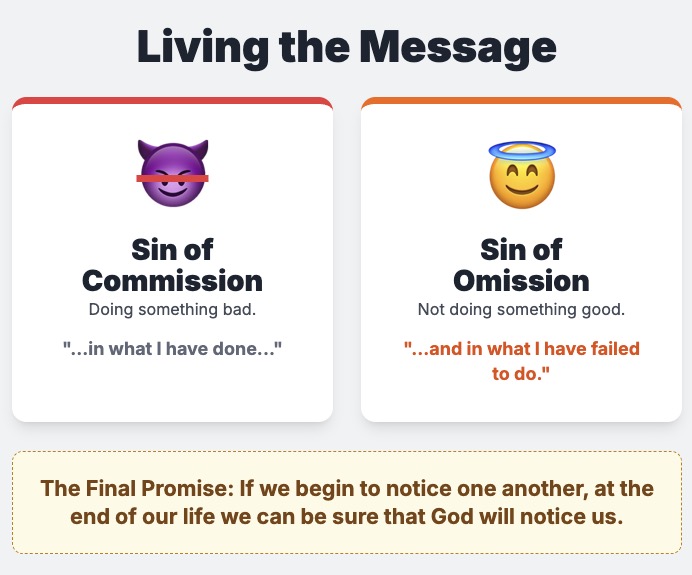
Living the Message
Ultimately, reflection must lead to action. This final set of questions is designed to help translate the homily's message into concrete steps and a deeper understanding of our relationship with God.
Discussion Questions:
The homily states, "Sin is not necessarily doing something bad. Sin is far more often not doing something good." This refers to sins of omission, which are included in the Mass when we pray, "...in what I have done, and in what I have failed to do."
- Why do you think it's often easier to avoid doing wrong than it is to actively do good?
- What is one practical, concrete step you can take this week to "look up from your screen" and notice someone who might need "an understanding word, a smile, or an ear to listen"?
The homily concludes with a powerful promise: "If we begin to notice one another, at the end of our life we can be sure that God will notice us."
- What does this final thought mean to you? How does our compassion for others relate to how we are received by God?
Monsignor Peter Hahn
26th Sunday of Year C

Our Habitual Attitudes
Msgr. Hahn’s homily warns against the spiritual danger of becoming “set in our ways,” where selfish habits lead to complacency. Citing the Prophet Amos and the parable of the rich man, he shows how both nations and individuals face destruction when they ignore God’s call. The homily urges an immediate and urgent response to Christ’s resurrection, using the passage of time and the reality of death as motivation to replace stubborn self-centeredness with a stubborn pursuit of holiness, love, and mercy.
TWTW Visual Summary and Discussion Questions


Click to enlarge
Part 1: The Danger of Being "Set in Our Ways"
Focus: This section explores the homily's central theme of spiritual stubbornness, its roots in selfishness, and its contrast with a holy stubbornness for Christ.
Discussion Questions:
- Msgr. Hahn says we all get "set in our ways." In what areas of your spiritual life, personal habits, or opinions do you notice this tendency in yourself?
- He distinguishes between being stubborn for our own way and being "stubborn in the love of Christ." What do you think is the difference? How can a person be "stubborn" for God in a positive way?
- The homily links the complacency of ancient Israel to their desire to be "like everybody else." How does societal pressure or the desire to fit in lead to spiritual complacency today?
- Amos warned that this path of assimilation would lead to weakness and collapse. Where do you see this principle at work, either in individuals or in society?


Click to enlarge
Part 2: The Complacency of the Rich Man
Focus: This section analyzes the Gospel parable of the rich man and Lazarus as a powerful, individual example of the destructive nature of self-centered indifference.
Discussion Questions:
- The rich man's sin was not an evil action, but a failure to act—he didn't even notice Lazarus. Why is this kind of indifference so spiritually dangerous?
- The homily parallels the nation of Israel ignoring Amos with the rich man ignoring the prophets. How does ignoring God's "prophetic voice" today (through Scripture, the Church, our conscience) lead to personal spiritual peril?
- Abraham's final words in the parable are chilling. Why wouldn't the brothers be convinced, even by a resurrection? What does this say about the hardness of a complacent heart?
- Msgr. Hahn asks, "Someone has risen from the dead... how have we been persuaded?" How does the reality of the Resurrection challenge your own moments of spiritual complacency or waning faith?


Click to enlarge
Part 3: The Urgency of Holiness
Focus: This final section shifts to the practical and urgent call to reform our lives now, using the passage of time as a catalyst for spiritual growth.
Discussion Questions:
- Msgr. Hahn uses the end of the parish's fiscal year and the memory of funerals to create a "sense of urgency." How does reflecting on the passage of time and the reality of your own mortality affect your spiritual priorities?
- He states that the "most important activity" we can undertake is to grow in holiness. Do your daily actions and priorities reflect this truth? What practical things get in the way?
- How can we, like St. Paul urges Timothy, "compete well for the faith"? What does "hard work" in the spiritual life look like for you?
- The final call is to "make sure that our ways are His ways." What is one concrete, habitual attitude in your life that you could intentionally work on this week to align more closely with God's "ways of love, generosity, and mercy"?

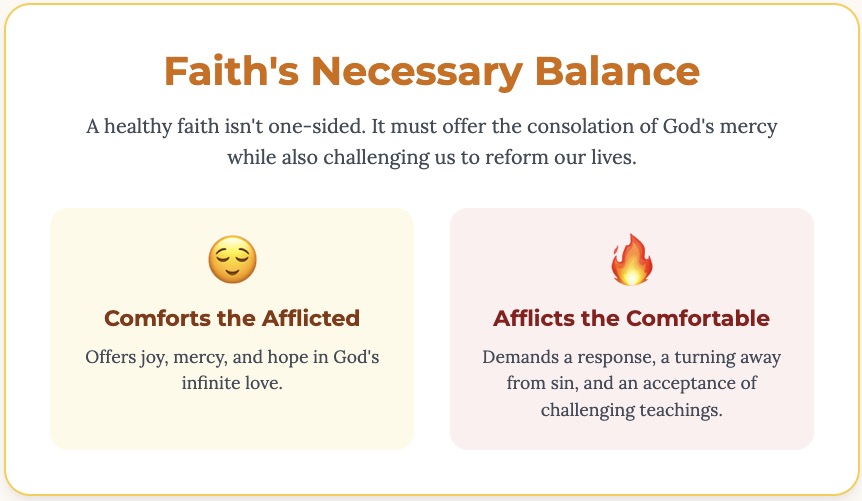
Our Faith is Meant to Afflict the Comfortable
Faith challenges complacency and calls for personal reform and stewardship of God’s gifts, emphasizing the importance of caring for others and adhering to the Church’s teachings to avoid societal and spiritual downfall.
TWTW Visual Summary and Discussion Questions
Click to enlarge
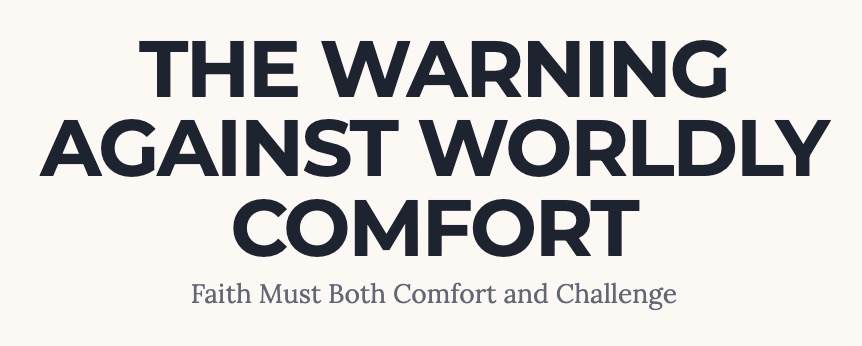
Part 1: The Warning Against Worldly Comfort
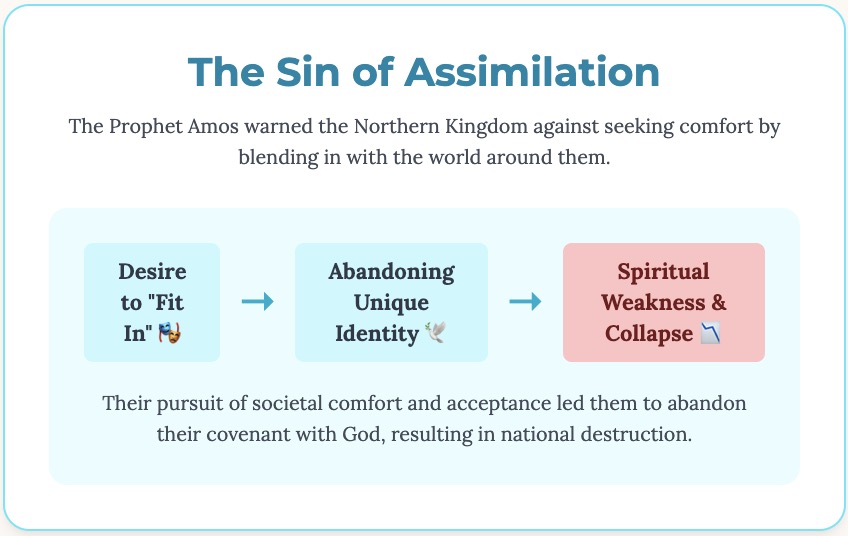
Focus: This section explores the homily's opening theme: that faith must both comfort and challenge us. It examines the historical example of the Prophet Amos warning Israel against the spiritual danger of seeking comfort through cultural assimilation.
Discussion Questions:
- Msgr. Hahn begins with the saying that faith is meant to "comfort the afflicted, but sometimes to afflict the comfortable." Can you recall a time when your faith was a great comfort? Can you recall a time when a teaching or scripture reading made you feel "afflicted" or challenged in your comfort? Why is this balance important?
- The people of the Northern Kingdom wanted to be "assimilated" and not seem different from the cultures around them. In what specific ways do we, as modern Catholics, feel pressure to "blend in" with secular society?
- Amos warned that this desire for comfort would lead to weakness and collapse. Where do you see this principle at work today? How does abandoning our unique Catholic identity in favor of societal acceptance make our faith weaker?

Click to enlarge
Part 2: The Individual Face of Complacency
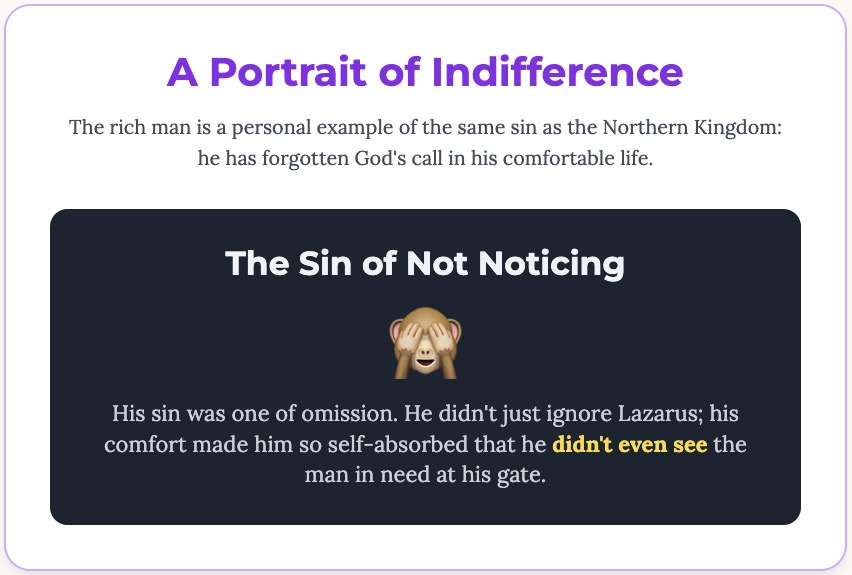
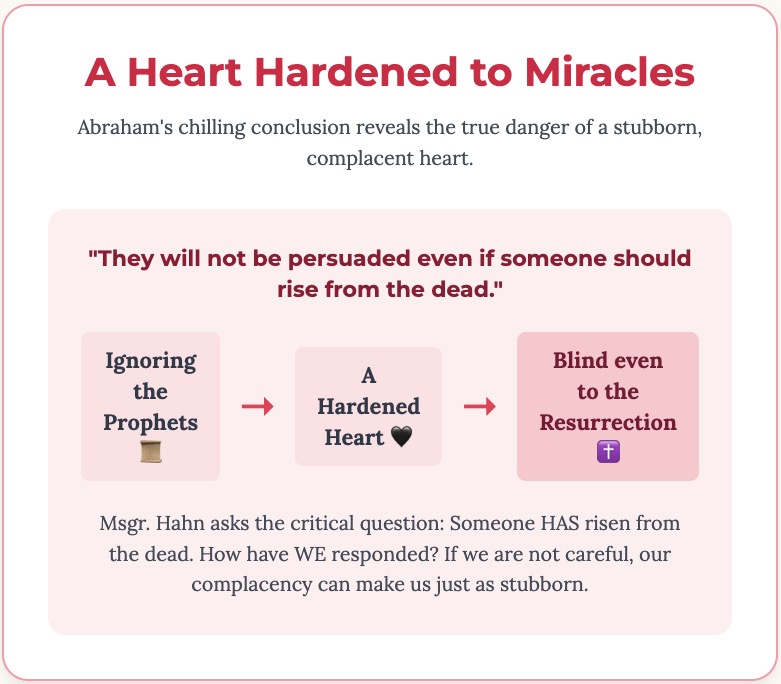
Focus: This section analyzes the Gospel parable of the rich man and Lazarus as a powerful, individual example of the destructive nature of self-centered indifference and the hardness of a complacent heart.
Discussion Questions:
- The homily emphasizes that the rich man's sin was a failure to notice. Why is this type of indifference, born from being overly comfortable, so spiritually dangerous? Who is the "Lazarus" at the gate of our society (or our own lives) that we might fail to notice?
- Abraham says the brothers have "the benefits of all the law and the prophets." What are the "prophetic voices" God gives us today to warn us against complacency (e.g., Scripture, Church teaching, the words of the Pope, our conscience)?
- Msgr. Hahn connects Abraham’s final words directly to us: "Someone has risen from the dead... and yet how do we respond?" If the Resurrection is the ultimate sign, why do we still fall into the trap of complacency? What does this say about the stubbornness of the human heart?

Click to enlarge
Part 3: The Urgent Call to Stewardship and Holiness
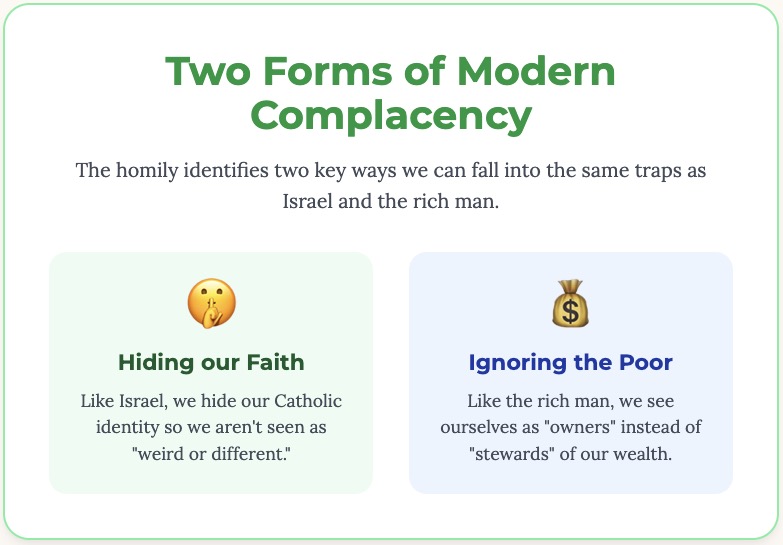
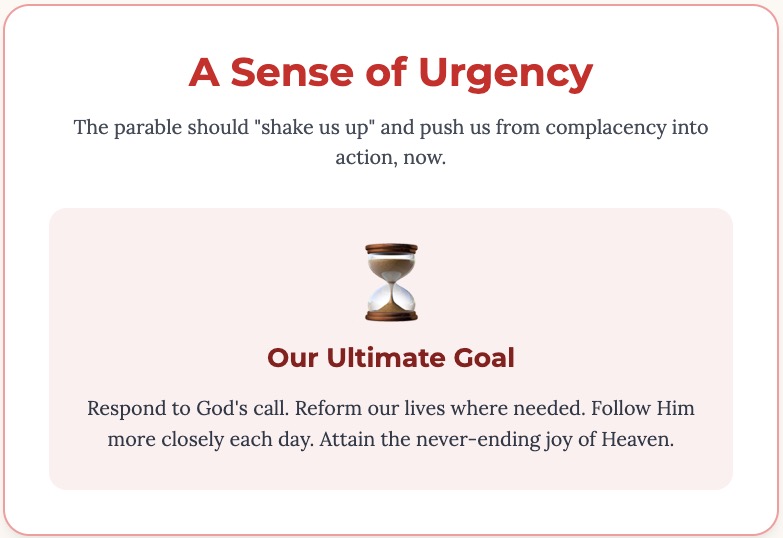
Focus: This final section applies the warnings to our modern lives, identifying contemporary forms of complacency and issuing an urgent call to reform our lives by embracing our role as stewards and actively pursuing holiness.
Discussion Questions:
- The homily presents two modern forms of complacency: hiding our faith to fit in, and failing to share our resources. Which of these two temptations do you find more challenging in your own life? Why?
- Discuss the concept of being "stewards" rather than "owners" of God's gifts. How does this shift in perspective change your view of your time, talents, and money?
- The readings are meant to give us a "sense of urgency." What is one practical area of your life (e.g., prayer, a specific sin, a relationship, an act of charity) where you feel God is calling you to move from complacency to urgent action?
- The homily concludes by calling us to "follow him more closely each day." What is one concrete step you can take this week to respond to that call and break out of a comfortable spiritual routine?
Frank Pavone
26th Sunday of Year C

The Lazarus of Our Time: The Unborn Child
The following is a reflection linking today’s Gospel passage to the theme of abortion, and it can be helpful in shaping today’s homily. Some have made a spiritual comparison between the “Lazarus” of this passage and the Lazarus that Jesus raised from the dead in John 11. In that latter account, Jesus is deeply disturbed as he approaches the tomb – a disturbance not simply caused by his death, but by the injustice of his death, since it could have been so easily avoided.
TWTW Visual Summary and Discussion Questions


Click to enlarge
Part 1: The Sin of Not Seeing
Focus: This section analyzes the core reason for the rich man's condemnation: his failure to act, born from a failure to recognize the value and dignity of the person at his gate.
Discussion Questions:
- Frank Pavone states the rich man was condemned for "what he did not do." This is often called a "sin of omission." In our spiritual lives, do we tend to focus more on the wrong things we have done, or the good things we have failed to do? Why do you think that is?
- The reflection argues the rich man equated lesser possessions with lesser value. In what ways does our modern society judge a person's value based on their wealth, status, abilities, or appearance?
- Can you think of a time you felt "invisible" to someone else? Conversely, have you ever realized after the fact that you failed to truly "see" someone in need right in front of you? What creates this spiritual blindness??



Click to enlarge
Part 2: Identifying the Lazarus of the 21st Century
Focus: This section examines Pavone's central claim: that the parable is not just an ancient story, but a present reality, and that the pre-born child is the primary "Lazarus" of our time.
Discussion Questions:
- Pavone draws a direct parallel between the ignored Lazarus and the "pre-born brother or sister." Do you find this to be a powerful comparison? What are the key similarities he is highlighting (e.g., helplessness, dependency, being rejected or seen as a problem)?
- Besides the unborn, who else in our society might fit the description of a modern-day Lazarus—someone who is "in our midst" but often ignored or considered less valuable?
- The reflection uses the familial terms "brother" and "sister" to describe the unborn. How does using this language, instead of more clinical or abstract terms, change the moral weight of the issue?


Click to enlarge
Part 3: The Call to Interfere
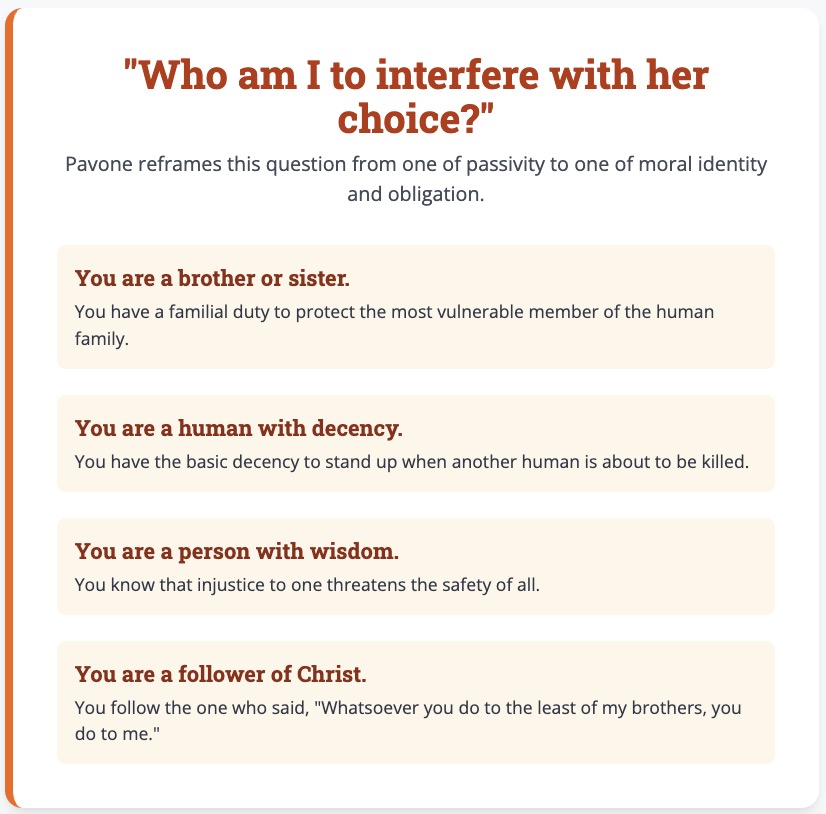
Focus: This final section directly confronts the argument of non-interference ("Who am I to interfere with a woman's choice?") and reframes it as a moral obligation to act, rooted in our identity as human beings and followers of Christ.
Discussion Questions:
- The question "Who am I to interfere?" is a common argument for staying silent on abortion. Which of the four answers provided by Pavone do you find most compelling, and why?
- Pavone argues that "your life is only as safe as the life of the pre-born child." What does he mean by this? How does injustice to the most vulnerable threaten everyone?
- The reflection makes the powerful claim that when a child in the womb is destroyed, "Christ is ripped apart, burned, crushed, and thrown away." How does this theological framing change the abortion debate from a political issue to a spiritual one?
- If we accept the call to "interfere," what are some practical, compassionate, and effective ways we can stand up for our "pre-born brother or sister"?
Non-profit ministries have permission to copy/paste any infographics on this website into bulletins, presentations, or class/home school worksheets. A link and/or shoutout to THE WORD THIS WEEK and respective contributors would be greatly appreciated.