
Lectors Tips Guidelines Sunday Mass
Lectors Tips Guidelines Sunday Mass
Lectors Tips Guidelines Sunday Mass
Lectors Tips Guidelines Sunday Mass
Lectors Tips Guidelines Sunday Mass
National Shrine
Washington D.C.
TBD

The Catholic
Lector
TBD

THIS WEEK: Curb Appeal Not Needed
Lector Training
Videos
TBD
Lisa Bellecci-st.romain


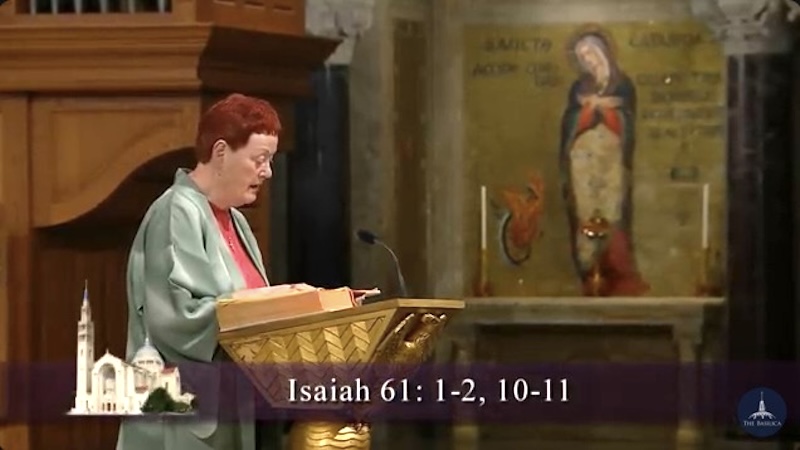
FIRST READING
Such a personal love coming at us in this reading. Can you put such love in your voice so it comes through to your listeners? Practice reading it thinking of those you love who are poor, broken-hearted, and imprisoned emotionally or spiritually. And for the 2nd stanza, appreciation and admiration for God. Lead your listeners in awe of God! God bless.

Enhancing
Your Delivery
TBD
LECTOR TIPS & NOTES

First Reading Tips

When reading Isaiah 61:1-2A, 10-11 from the lectionary (NAB) during Mass, here are some specific tips to help enhance the delivery:
Emphasize the anointed mission:
- In verse 1, emphasize “The spirit of the Lord God is upon me” to highlight the divine authority and anointing of the speaker.
- In verse 1, emphasize “to bring glad tidings to the poor” and “to heal the brokenhearted” to emphasize the message of hope and restoration.
Pause before emphasizing pivotal phrases:
- Before saying, “The spirit has sent me,” pause to allow the congregation to grasp the significance of the speaker’s divine mission and the authority behind it.
- Before saying “a day of vindication,” pause slightly to let the weight of the words sink in, emphasizing God’s justice and deliverance.
Express joy and exultation:
- In verse 10, emphasize “I rejoice heartily in the Lord” to convey the exultant spirit of the speaker.
- Emphasize “My soul exults” and “My God has clothed me” to highlight the personal experience of joy and the sense of divine provision.
Vary your pace for expressive effect:
- Slow down when emphasizing phrases like “bind up the brokenhearted” or “proclaim liberty to captives” to give importance to these actions of healing and liberation.
- Speed up slightly in sections that contain lists, such as “the oil of gladness instead of mourning, a mantle of praise instead of a faint spirit” in verse 3. Maintain a steady pace to ensure clarity and coherence.
Pause for reflection between verses:
- Pause briefly after verse 2A to allow the listeners to absorb the message of God’s favor and the proclamation of the year of the Lord’s favor.
- Pause briefly after verse 11 to give the congregation a moment to reflect on the image of the earth bringing forth its growth, symbolizing God’s transformative work.
Second Reading Tips

When reading 1 Thessalonians 5:16-24 from the lectionary during Mass, here are specific tips to enhance the delivery:
Emphasize the exhortations:
- In verse 16, emphasize “Rejoice always” to convey the call to continual joy.
- In verse 17, emphasize “Pray without ceasing” to highlight the importance of constant prayer.
- In verse 18, emphasize “Give thanks” to emphasize the significance of gratitude in all circumstances.
Pause for reflection:
- Pause briefly after each exhortation (verses 16, 17, and 18) to allow the congregation to consider the impact and implications of each instruction.
- Pause after the phrase “For this is the will of God” in verse 18 to give time for contemplation on God’s will for a thankful spirit.
Vary your pace:
- Slow down when emphasizing important phrases that carry weight, such as “Rejoice always,” “Give thanks,” and “Pray without ceasing,” allowing the congregation to absorb the significance of these statements.
- Speed up slightly in the transitional parts of the passage (between verses 19-20, and 22-24) that contain series of related instructions, maintaining a steady pace to maintain coherence and flow.
Emphasize the theme of holiness:
- In verse 23, place emphasis on the phrases “sanctify you entirely,” “spirit, soul, and body,” and “be preserved complete” to highlight the desire for holiness and the comprehensive nature of God’s work in our lives.
Highlight the role of God’s faithfulness:
- In verse 24, emphasize “He who calls you is faithful” to emphasize the trustworthiness and dependability of God’s promises and guidance.
General Notes
As a lector, it is an important responsibility to effectively convey the Word of God to the congregation during the Mass. Here are some practical tips:
1. Although tips on what words and phrases to emphasize and when to pause can be helpful, your delivery should ultimately depend on your own prayerful interpretation of the passage. From the series of tips given each week on this page, reader should choose which verses and words they want to emphasize. It’s important to find a balance that helps communicate the message effectively.
2. Familiarize yourself with the text: Read and study the Scripture passage several times before the Mass. Understand the context, the message it conveys, and the emotions it evokes.
3. Practice pronunciation and enunciation: Ensure that you know how to properly pronounce the words and names mentioned in the passage. Practice enunciating clearly and maintaining a steady pace throughout.
4. Use appropriate intonation and emphasis: Experiment with different ways to emphasize certain words or phrases that carry significant meaning. This can help in conveying the depth and impact of the message to the congregation.
5. Maintain a calm and confident demeanor: Approach the ambo with a serene presence and a sense of confidence. Maintain good posture, make eye contact with the congregation, and avoid rushing through the reading.
6. Speak slowly and clearly: Take your time while reading, ensuring that the words are clearly audible to everyone present. However, avoid artificially elongating words or sentences, as it may sound unnatural.
7. Pause when necessary: Pause at appropriate intervals, particularly at natural breaks in the text, such as commas or full stops. Pausing can help listeners absorb the message and reflect on its meaning.
8. Use nonverbal cues: Employ body language and gestures to effectively convey the emotions and ideas expressed in the passage. However, be mindful that gestures do not distract from the message or become exaggerated.
9. Maintain a respectful tone: Isaiah 61:1-2A, 10-11 is a text of hope and joy. Let the tone of your voice reflect the reverence and beauty of the passage. Be mindful of the emotions conveyed in the words and try to transmit them genuinely to the congregation.
10. Breathe and relax: Take a deep breath before beginning the reading to calm any nerves or anxiety. Remember, you are called to facilitate a meaningful encounter with the Word of God, and the Holy Spirit will guide you.
11. Pray before and after your reading: Seek God’s guidance and ask for His grace to effectively convey His message to the congregation. Offer a prayer of thanksgiving after the reading, asking for a blessing on the listeners and yourself.
By following these practical tips, you will be better equipped to deliver a clear, engaging, and spiritually uplifting reading during Mass.
Lector Prep
Greg Warnusz
TBD