






Related
Pages







PETITIONS
December 6, 2026
The Church
Governments and Salvation of the World
Those Burdened by Adversity
Local Parish / Faith Community
THE WORD
IN SONGS
THIS WEEK
December 6, 2026


Jeff Cavins

Ascension Press (YEAR B)
In this week's Encountering the Word video for the Second Sunday of Advent, Jeff Cavins encourages us to prepare for the coming of Christ by remembering our baptism and going to confession.
Archdiocese of Brisbane
Second Sunday of Advent (B)

Archdiocese of Brisbane (2026)
Two-Minute Homily by Fr John Fowles gives a Two-Minute homily that focuses on serving the suffering and marginalized. By loving and caring for the hungry, thirsty, stranger, naked, sick, and imprisoned, we honor Christ the King. When we turn faith into charitable action, it reveals Christ's kingdom.

Archdiocese of Brisbane (2023)
Two-Minute Homily by Fr Ihemelandu Uzuegbu for the Second Sunday of Advent 2023. "To become the people God wants us to be, we need to open our hearts to Jesus, to be transformed and filled with grace."

Fr. Aidan Rooney, C.M.
Second Sunday of Advent (B)

St. John's University (2026)
Fr. Rooney CM urges us to turn inward during the season’s quiet, examine our own hopes and priorities, and transform that self‑reflection into concrete love for our neighbors—especially the vulnerable and marginalized—by turning personal faith into actionable service for all.

St. John's University (2023)
Fr. Rooney's CM - This Sunday: Celebrating is a prophetic act
Catholic Women Preach
Second Sunday of Advent (B)

Catholic Women Preach (2026)
Svea Fraser preaches for the Second Sunday of Advent, offering a reflection on preparing the way for a future known only to God, and on the God who prepares the way for us: “Looking back, I see that all along God has been preparing the Way for me! God prepares the Way for us! … There is comfort in accepting this and letting go of my need to know the outcome of my efforts!”

Catholic Women Preach (2023)
Preaching for the Second Sunday of Advent, Sarah Hansman offers a reflection on "preparing the way" together: "There are so many ways for each one of us to prepare the way. Big and small. And yet knowing the arc is long, we cannot do it alone. It must be communal work. Who are your communities? Who do you turn to when the arc is long? And how do you uplift others in return?"
Bishop James Golka
Second Sunday of Advent (B)

Diocese of Colorado Springs (2023)
Bishop Golka's core message is how Advent is a call to actively prepare our lives now—through faithful deeds, reshaped habits, and vigilant anticipation—to welcome Christ both in His imminent return and in His incarnation.
Know Before You Go
Second Sunday of Advent (B)
Coming Soon!
Dominican Friars (2026)
TBD

Dominican Friars (2023)
Br. Joe Trout, OP breaks open the readings for the Second Sunday of Advent, pointing out that the readings challenge us to try to become whole and holy, and to allow God to heal us.

Dominican Friars (2020)
Fr. James Marchionda, OP breaks open the word for this Sunday's readings, reminding us that we, like John the Baptist, must decrease so that Christ, living in us, can increase.
1-Minute Homily
Second Sunday of Advent (B)
The Jesuit Post (2023)
The Gospel of Mark doesn’t have an Infancy Narrative, but instead gets right into the action. Fr. Eric Immel, SJ, reflects on the urgency of this gospel and reminds us that we don’t need to wait to prepare for the Lord.
Cardinal Luis Tagle
Second Sunday of Advent (B)

Jescom TV (2023)
This is the Second Sunday of Advent, and today’s Gospel introduces us to John the Baptist—the messenger sent ahead of the Messiah to “prepare the way of the Lord.” How did he do it? By “proclaiming a baptism of repentance for the forgiveness of sins.” Friends, we need to hear John the Baptist’s call to repentance especially during Advent. The pandemic is an invitation to conversion or the renewal of minds, relationships, decisions and actions to God’s ways. Repentance is the straight path we must prepare for the Lord.
SOLT Liturgy Prep
Second Sunday of Advent (B)

SOLT (2024)
Sister Caritas of the Child Jesus offers a reflection for the 2nd Sunday of Advent.
The Word on the Word
Second Sunday of Advent (B)

EWTN (2023)
2 Peter 3:8 “But do not ignore this one fact, beloved, that with the Lord one day is as a thousand years, and a thousand years as one day.” Do you have too much time in your day or not enough? Veronica and Melissa dive into the topic of time.
Liturgy Notes

Courtesy of The Sunday Mass—2024 Cycle B
Second Sunday of Advent (B)
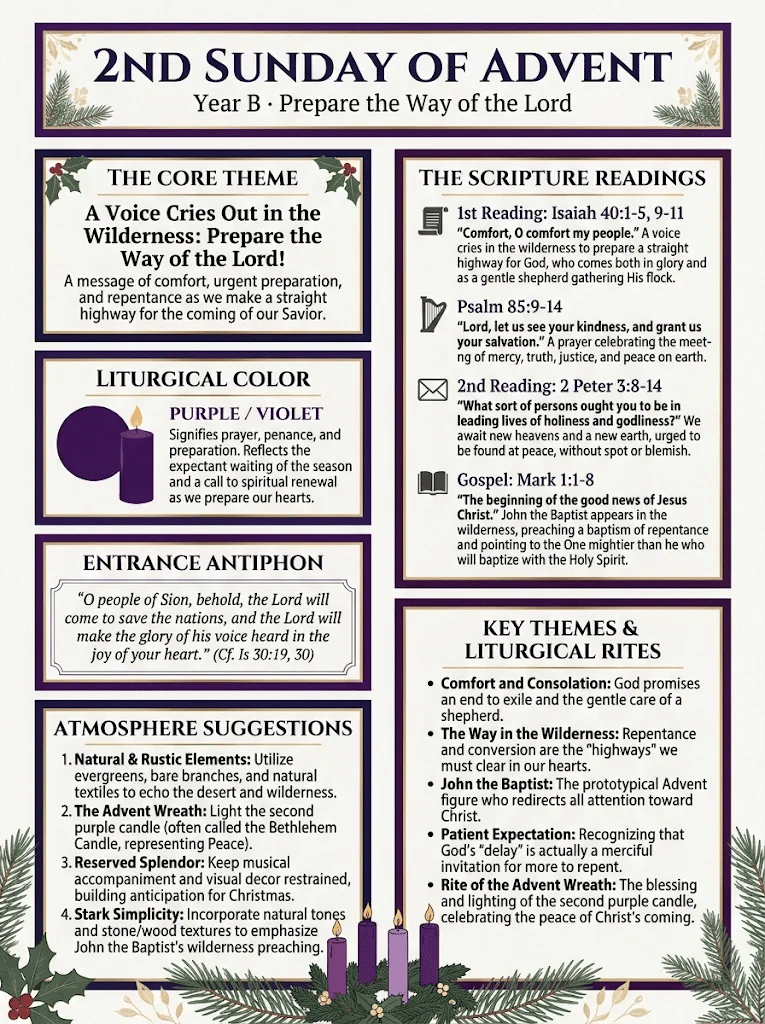
Second Sunday of Advent (B)
BULLETIN BLURB: On this Second Sunday of Advent, the Church echoes the urgent cry of John the Baptist: “Prepare the way of the Lord, make straight his paths!” Amid the rush of December, today’s readings invite us to pause, find comfort in God’s promises, and clear away the clutter in our hearts that blocks Christ from entering. As we light the second violet candle of peace on our Advent wreath, we are reminded that God is patient, calling us to renewal and holiness. Let this week be a time of quiet repentance, reconciliation, and hopeful expectation as we await the coming of our Savior.
Second Sunday of Advent (B)
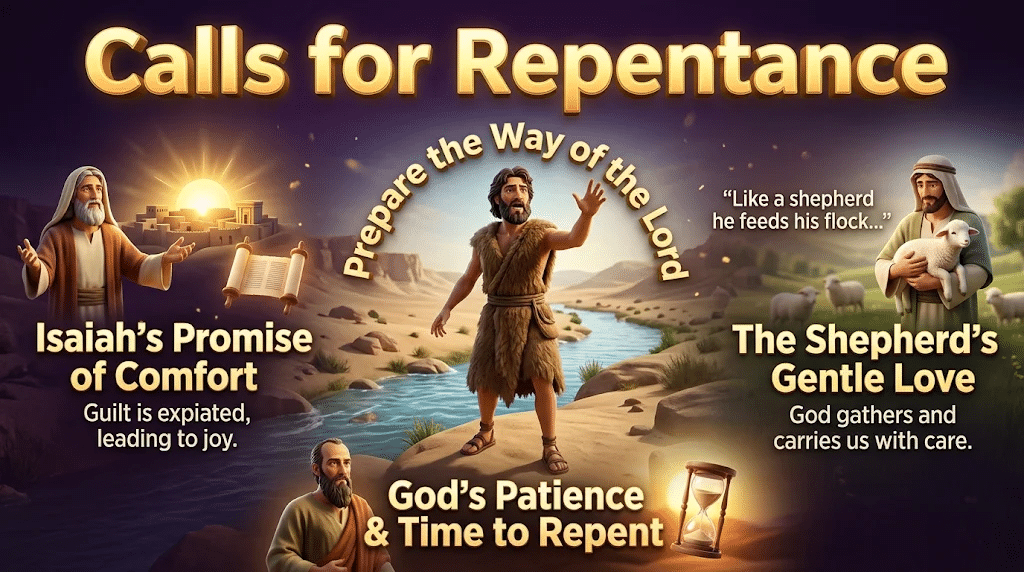
Today’s readings seem to continue last week’s themes. John the Baptist calls for repentance and echoes Isaiah’s call to prepare the way of the Lord. But Isaiah begins by proclaiming God’s comfort for Jerusalem, for her guilt is expiated. Once again, repentance leads to joy. In other strong passages, St. Paul proclaims that God is patient with us so that we have time to repent, and Isaiah reminds us of God’s gentle love: “Like a shepherd he feeds his flock; in his arms he gathers the lambs, carrying them in his bosom, and leading the ewes with care.” That quote will lead many musicians to choose “Like a Shepherd” for Masses this weekend, while the Baptist’s call is echoed in several Advent songs.
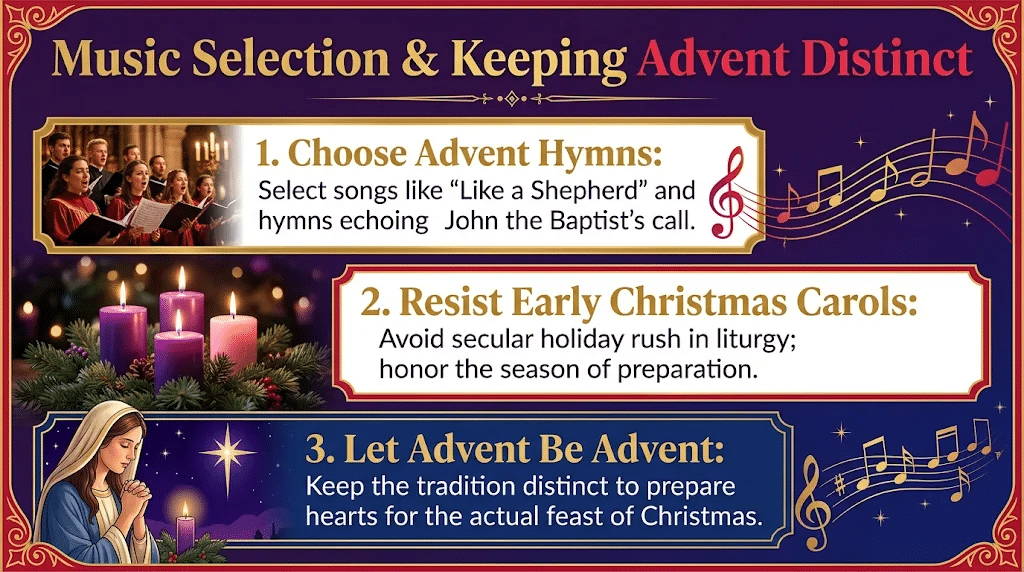
Music Selection and Keeping Advent Distinct
Planners should resist the temptation to use Christmas songs during Advent, even though they are being played in malls and street corners and on the radio and in Christmas concerts throughout December. We cannot control secular society (there is no point in berating people for commercializing Christmas), but we should be faithful to our own tradition in keeping Advent as a time to prepare. Let Advent be Advent! We need the time to prepare for the actual feast of Christmas.
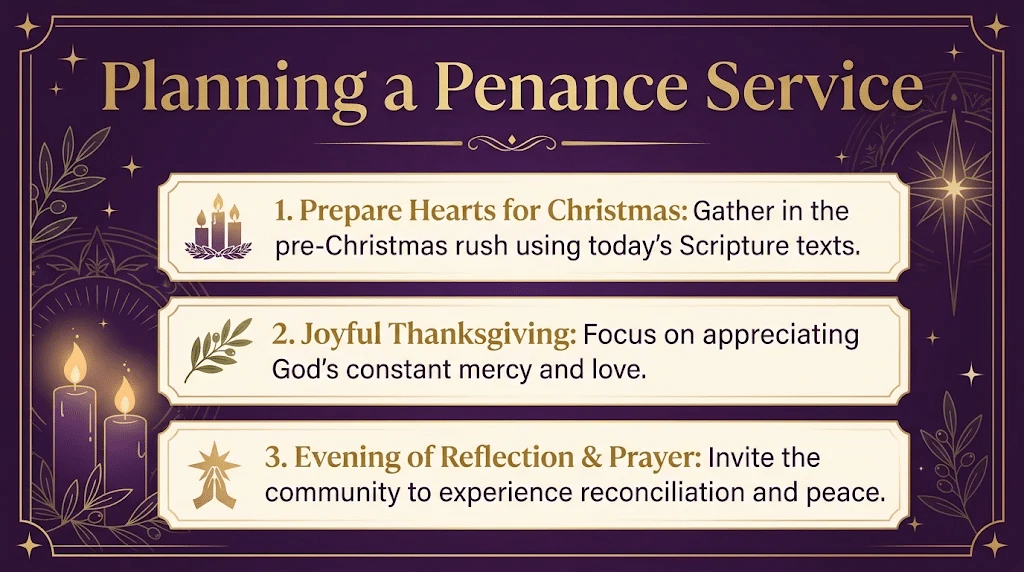
Planning a Penance Service
If you didn’t have a penance service last week, today’s Scripture texts could be used to shape one for this week. Try to find ways to invite people to gather for reconciliation, as a time to prepare their hearts for Christmas but also as a time for joyful thanksgiving for God’s constant mercy. I suspect that our success in helping people appreciate this sacrament properly will advance in direct proportion with people coming to really appreciate God’s constant mercy and love. In the midst of all the pre-Christmas rush, invite them to gather for an evening of reflection and prayer leading to reconciliation and peace.
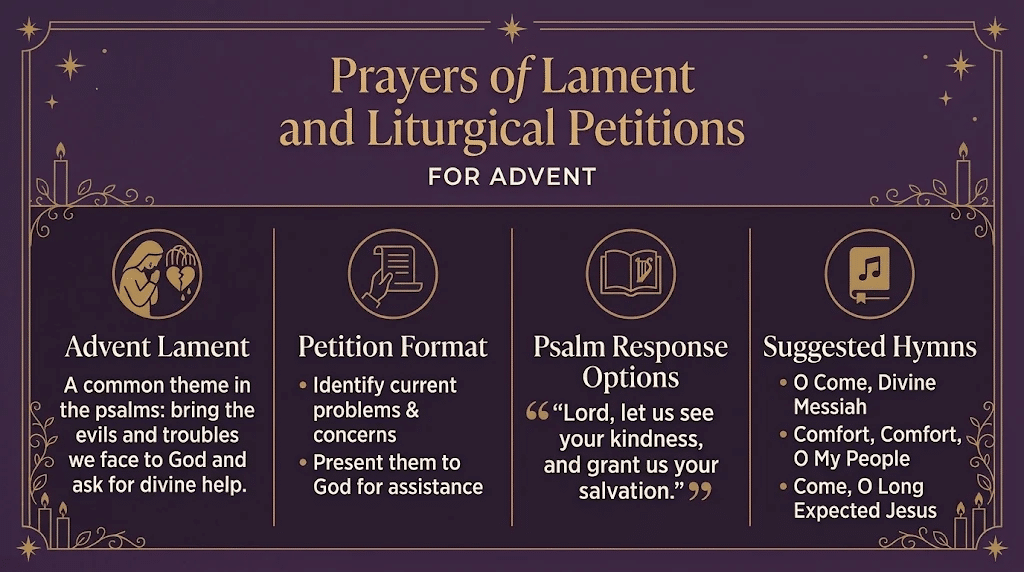
Prayers of Lament and Liturgical Petitions
Planners might remember that Advent is a good time for lament. Lament is a common theme in the psalms. Prayers of lament complain to God about the evils and troubles we face and then ask God for help in dealing with them. That could be a simple format for the petitions this weekend. Identify current problems and concerns and present them to God to seek divine assistance.
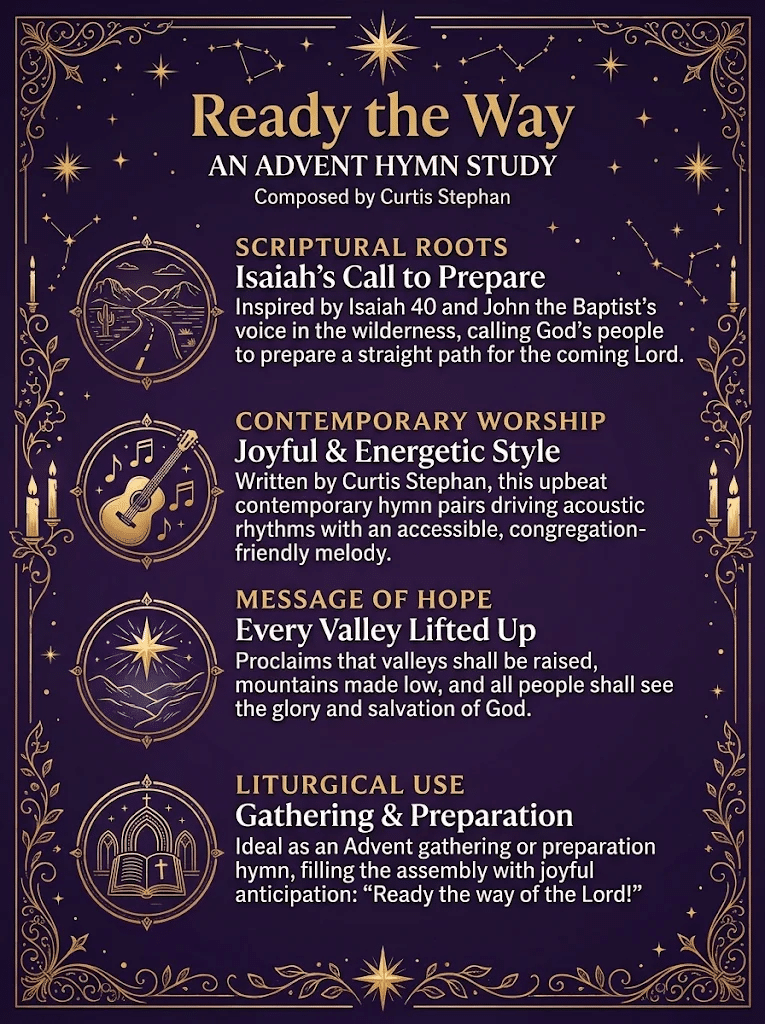
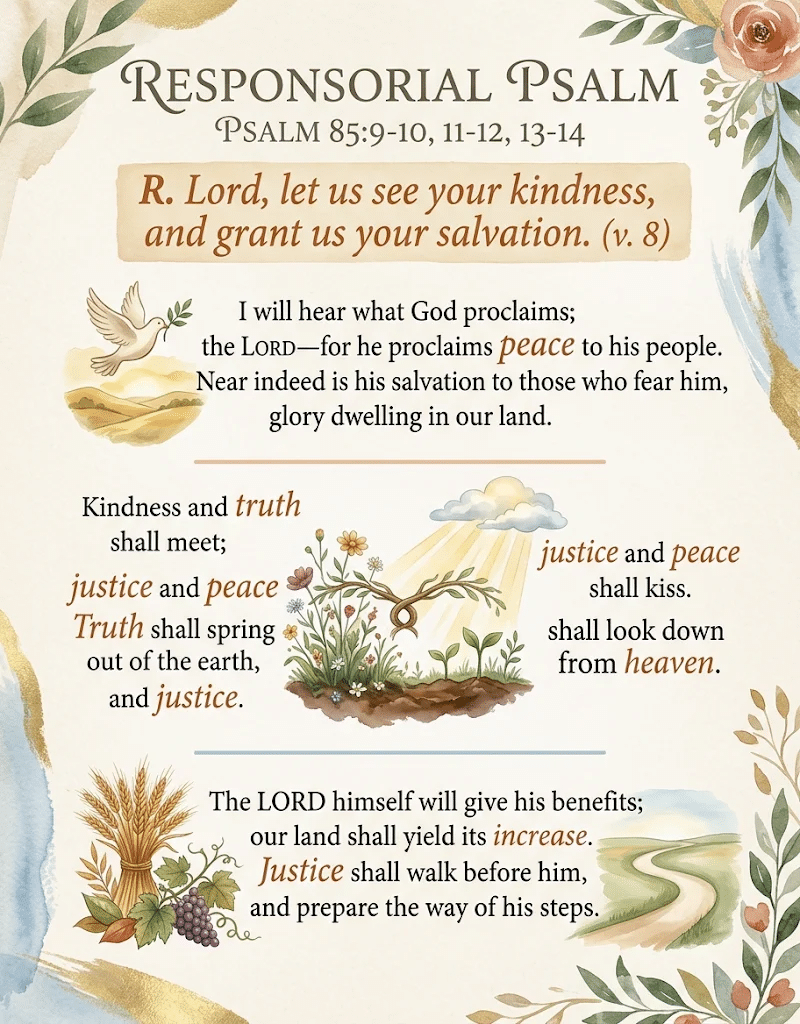
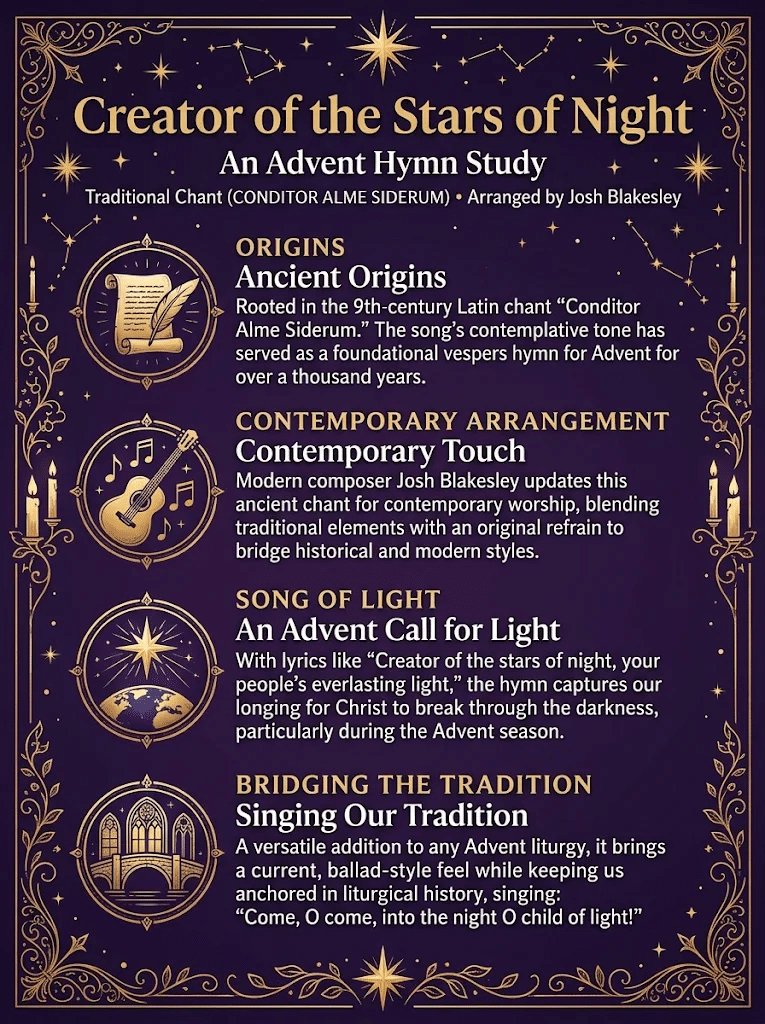
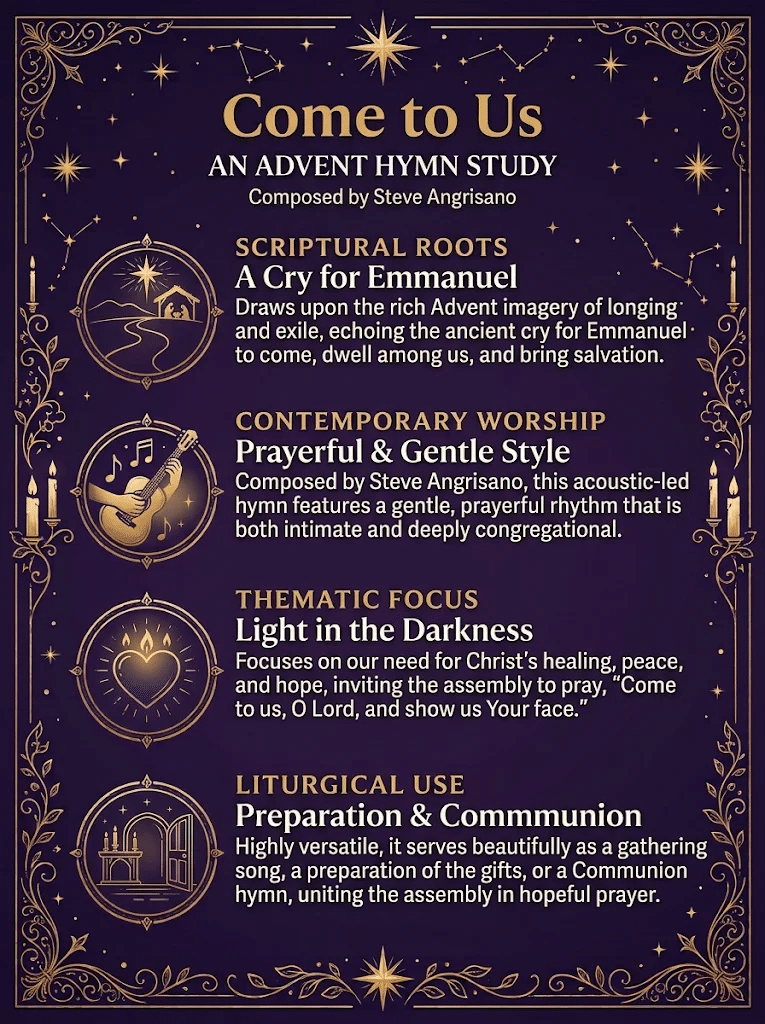
If your community is used to varying responses to the petitions, either half of today’s psalm response might work well: “Lord, let us see your kindness, and grant us your salvation.” You could even sing the whole refrain as a response. Musicians might also look for songs that cry out for God’s justice and peace, like “O Come Divine Messiah” or “Comfort, Comfort, O My People” or “Come, O Long Expected Jesus.”
Full Series: Cycle B Resources
OCP Music—Entrance

Response & Acclaim
OCP Music—Responsorial
Second Sunday of Advent (B)
Josh Blakesley - Psalm 85


2027 PLAYLIST (158 S&P VIDEOS)
Owen Alstott - Psalm 85


2027 PLAYLIST (158 R&A VIDEOS)
Second Sunday of Advent (B)
Sarah Hart - Gospel Acclamation

2027 PLAYLIST (158 S&P VIDEOS)
Owen Alstott - Gospel Acclamation

2027 PLAYLIST (158 R&A VIDEOS)
Presentation & Preparation
OCP Music—Presentation
Second Sunday of Advent (B)

Communion
OCP Music—Communion
Second Sunday of Advent (B)

Sending Forth
OCP Music—Sending Forth
Second Sunday of Advent (B)

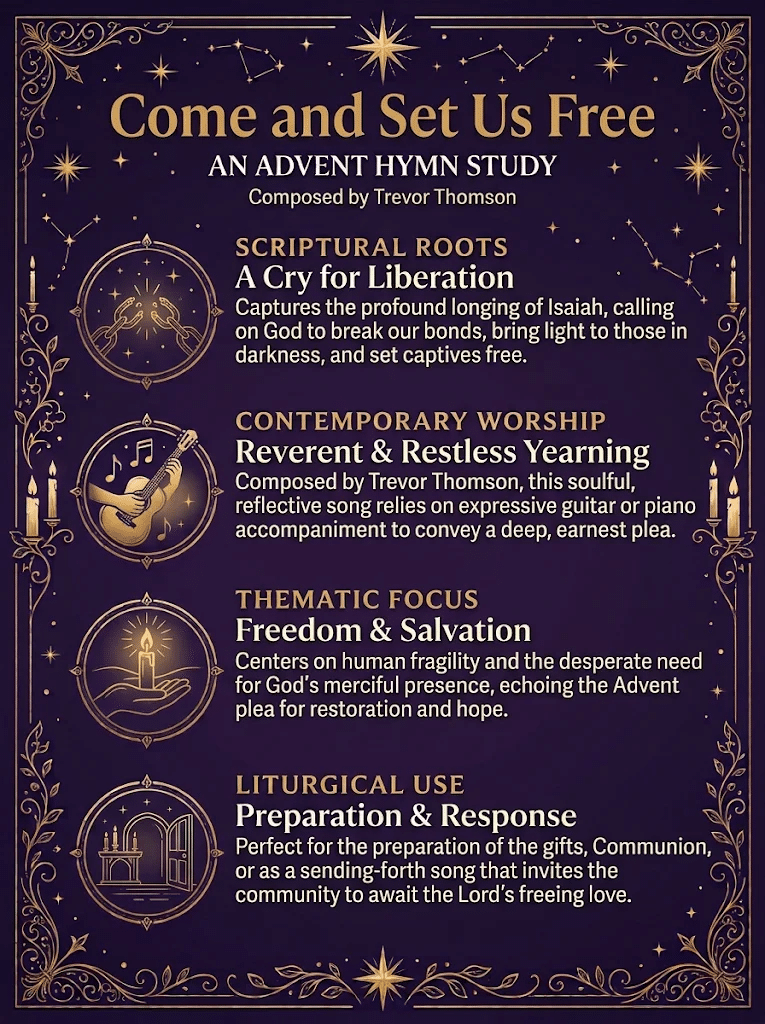
Liturgy Blog is a weekly liturgy planning resource for musicians, liturgists, homilists, youth groups, faith sharing groups, and all who look to the liturgical readings for inspiration and nourishment. Join Ken Canedo as he breaks open the Scripture and suggests tracks from the Spirit & Song contemporary repertoire.
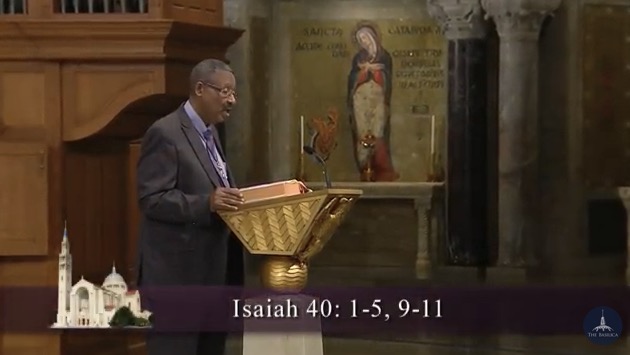

2023 video courtesy of Lector with Lisa

1st Reading—Delivery Blueprint
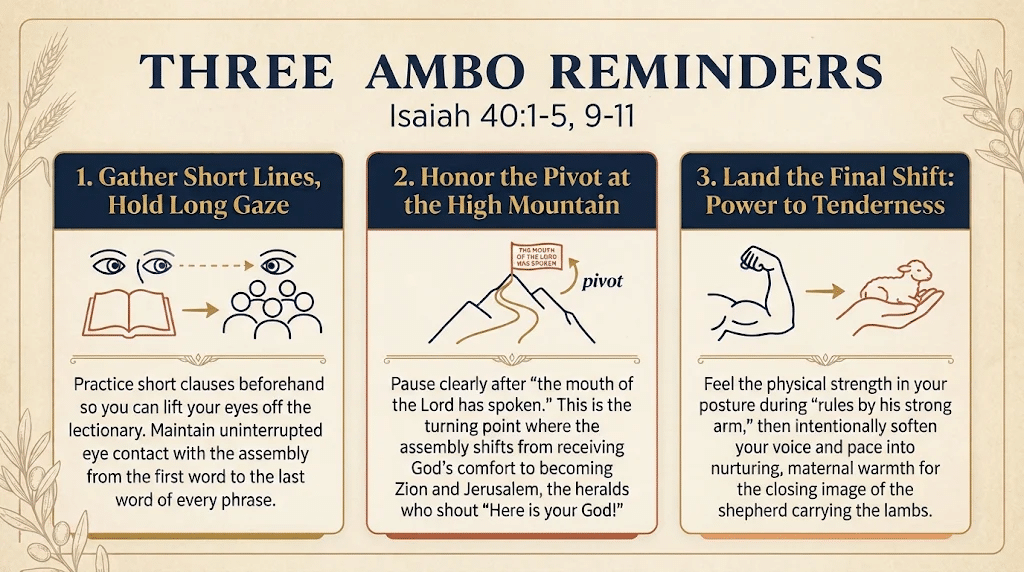
Overarching Pacing Theme: Gather & Deliver. Because the clauses are short and emotionally rich, gather the entire phrase with your eyes before speaking so you can maintain sustained eye contact throughout the whole line.
Core Concept vs. Story Reminder: Receive Comfort, Then Proclaim. First, God comforts Jerusalem (not “come foutiner”—fooling around—as heard in Handel’s Messiah, but genuine divine solace); second, comforted Jerusalem is commissioned to become the bold herald of good news.
Vocal Emotional Profile: Tender → Commanding → Maternal. Open with deep, consoling warmth; shift to authoritative prophetic proclamation and strong-armed majesty; close with gentle, nurturing maternal care.
Text Segment | Vocal Tone | Pacing & Ambo Actions |
"A reading from the Book of the Prophet Isaiah." | Clear, grounded, inviting | Mandatory Pause after the title before beginning the scripture text. |
"Comfort, give comfort to my people, says your God." | Deeply tender, warm, consoling | Gather the short phrase; deliver with sustained eye contact across the assembly. |
"Speak tenderly to Jerusalem, / and proclaim to her that her service is at an end, / her guilt is expiated;" | Gentle, reassuring, liberating | Gather each short line individually; hold eye contact through the whole phrase. (Definition: expiated = completely wiped out—proclaim it as joyful news). |
"indeed, she has received from the hand of the Lord / double for all her sins." | Empathetic, resolved, comforting | Maintain continuous eye contact; let the emotional warmth of forgiveness land. |
"A voice cries out: / In the desert prepare the way of the Lord!" | Urgent, resonant, declarative | Gather the entire phrase first; look directly at the assembly while proclaiming the call. |
"Make straight in the wasteland a highway for our God!" | Bold, purposeful, expansive | Drop eyes briefly to collect the line, then look up to deliver the complete thought. |
"Every valley shall be filled in, / every mountain and hill shall be made low;" | Steady, authoritative, vivid | If you only catch "Every mountain", glance back down to gather the rest before speaking. |
"the rugged land shall be made a plain, / the rough country, a broad valley." | Sweeping, wide, cinematic | Stretch your voice out on "broad valley"; visualize God bulldozing the rough terrain flat. |
"Then the glory of the Lord shall be revealed, / and all people shall see it together; / for the mouth of the Lord has spoken." | Majestic, triumphant, certain | Look at the people through the entire phrase; Mandatory Pause afterward to mark the major structural shift. |
"Go up onto a high mountain, / Zion, herald of glad tidings; / cry out at the top of your voice, / Jerusalem, herald of good news!" | Commissioning, urgent, ringing | Shift focus: Comfort has been received—now it is our turn to proclaim. Address the assembly directly as Zion and Jerusalem right in front of you. |
"Fear not to cry out / and say to the cities of Judah: / Here is your God!" | Fearless, joyful, climactic | Project with bold confidence; lift energy on "Here is your God!" |
"Here comes with power / the Lord God, / who rules by his strong arm;" | Mighty, awe-inspiring, grounded | Vocal shift: God is arriving. Feel the physical strength in your shoulders as you say "rules by his strong arm." |
"here is his reward with him, / his recompense before him." | Assured, generous, resolute | Deliver with warm certainty. (Definition: recompense = making amends; God saying, "I’ve got you"). |
"Like a shepherd he feeds his flock; / in his arms he gathers the lambs," | Soft, intimate, deeply maternal | Dramatic vocal softening: Transition from royal power to tender, nurturing care. |
"carrying them in his bosom, / and leading the ewes with care." | Loving, protective, unhurried | Embrace the maternal warmth—carrying the lambs and gently leading the mothers (ewes). |
"The word of the Lord." | Warm, heartfelt, loving | Long Pause after "with care." Look directly at the assembly and speak with all the love you just proclaimed. |
Isaiah 40:1-5, 9-11
Greg Warnusz


The Historical Situation: The people of Israel spent a couple of generations in exile, captives of the Babylonians, from about 600 B.C.E. to 540 B.C.E. The second major part of the book of Isaiah, chapters 40-55, concerns the end of this Exile and the return of the captives to their homeland. Today's first reading begins that section.
The Theological Background: Isaiah says that God has told him to tell Jerusalem (that is, the exiled citizens of Jerusalem and their fellow Jews) "that her service is at an end." He means, in effect, that her "sentence" is at an end. The King James Version puts it more strongly: "Cry unto her that her warfare is accomplished, that her iniquity is pardoned." However weak or strong the translation, the meaning is that the Exile is over. Isaiah is not shy about saying the Exile was a punishment for sin, but all is forgiven now.
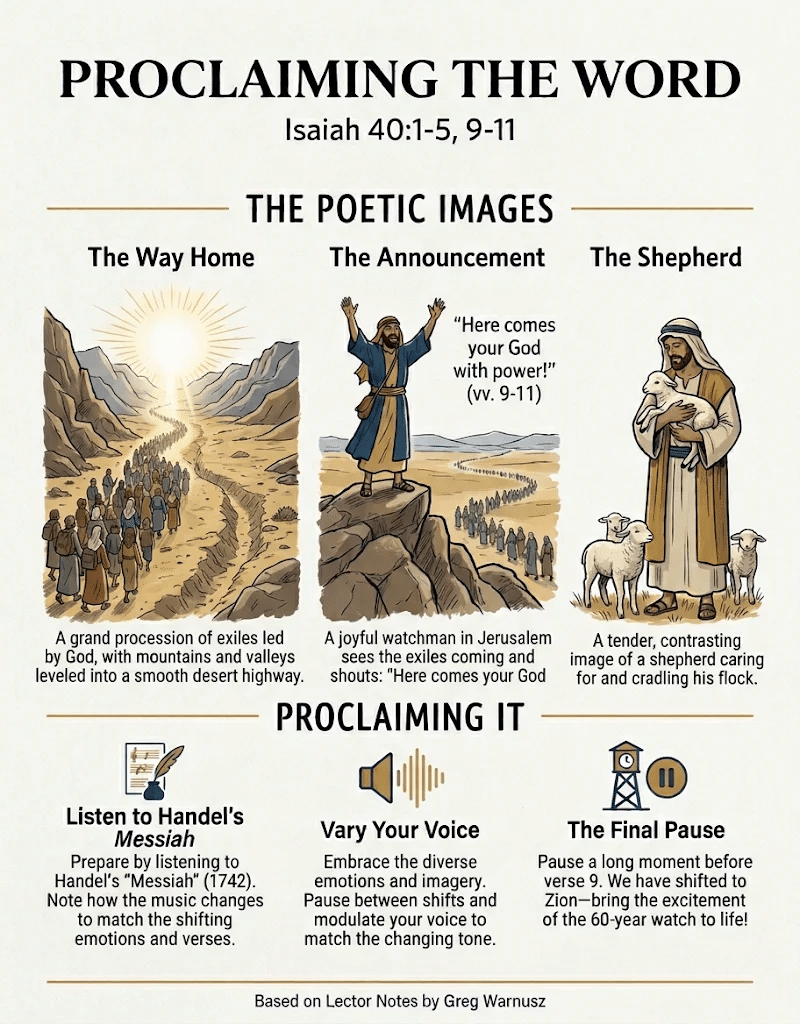
The Poetic Images: The next few sentences describe how the exiles are to return home. The first image is of a grand religious procession from Babylon to Jerusalem. It's not just people who are making the procession, but God as well. (Other ancient people carried idols of their gods on floats in solemn processions; Isaiah, no idolator, imagines God leading the people.) To pave the way, valleys and mountains are to be leveled, and a highway created in the wilderness.
The goal of the exiles is the region known as Judah, and within Judah the city Jerusalem, and within Jerusalem the hill Zion, where their Temple had stood. The last paragraph depicts a lonely sentry who never went to Babylon but waited in Jerusalem, always looking out for the return of the exiles. He finally sees the approach of the procession described above, and he can't contain his joy. He shouts it from the highest hill, "Here comes your God with power!" Then there follows an image in startling contrast, the tender picture of a shepherd cradling lambs.
Proclaiming It: An excellent way to prepare to proclaim this is to listen to the same verses as interpreted by George Frederick Handel, in his oratorio Messiah (1742). Within the first nine short "pieces" of the Messiah, you'll hear all these verses, set to various kinds of music, each appropriate to the text of the verses.
However you prepare, reckon with the rich array of emotions and images. Pause when there's a change in emotion or image. Modulate your voice. To revisit the classical music metaphor, note that Handel didn't render these verses in a single recitative. You shouldn't either. Rather imitate the composer, who wrote several different melodies and assigned them to a wide variety of voices.
Pause a long moment before beginning the last paragraph (verse 9), because the scene has changed. Now we're in Jerusalem, or on a hill overlooking it. The character is a sentinel who, after about sixty years of waiting, sees the returning exiles come over the horizon, God marching at their head. The watchman cannot contain his excitement!
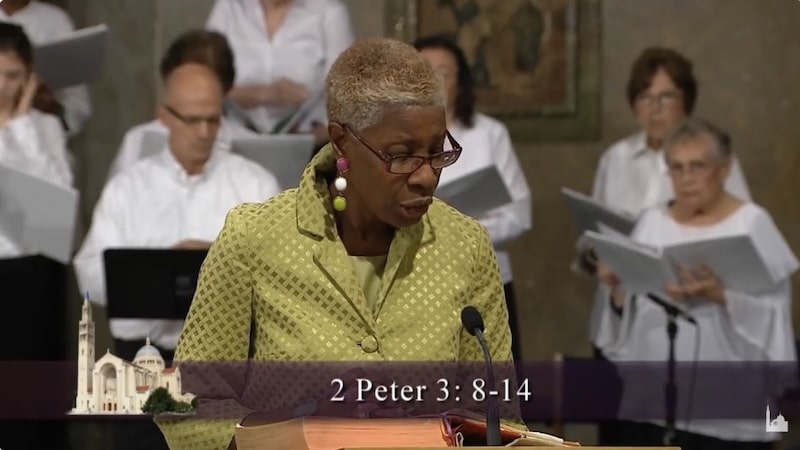

2023 video courtesy of Lector with Lisa
2nd Reading—Delivery Blueprint
Overarching Pacing Theme: Loving Urgency & Strategic Pauses. An unusually long, intense reading from St. Peter—maintain solid eye contact through dramatic imagery and use deliberate pauses to let warnings and promises land.
Core Concept vs. Story Reminder: Don't Delay Repentance. People are growing impatient asking if God will keep his promise; Peter’s answer is "Get a clue"—God’s apparent delay is actually divine patience giving everyone time to repent before everything dissolves.
Vocal Emotional Profile: Affectionate & Urgent → Awe-Struck Intensity → Hopeful Consolation. Balance stern warnings ("yikes" realizations of cosmic fire) with genuine pastoral warmth ("beloved").
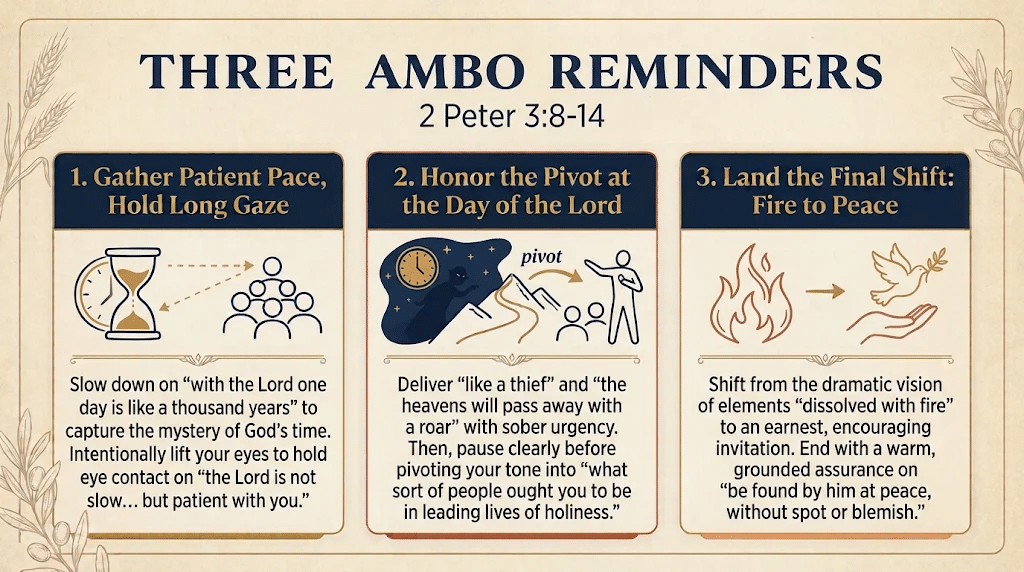
Text Segment | Vocal Tone | Pacing & Ambo Actions |
"A reading from the second Letter of Saint Peter." | Clear, steady, grounded | Mandatory Pause after the title before starting the reading. |
"Do not ignore this one fact, beloved," | Loving, urgent, earnest | Speak to the assembly as people you deeply care about—strong yet affectionate urgency. |
"that with the Lord one day is like a thousand years / and a thousand years like one day." | Measured, expansive, authoritative | Establish God’s perspective on time for an impatient crowd. |
"The Lord does not delay his promise, / as some regard 'delay,'" | Clarifying, subtly skeptical | Do not use air quotes—instead, pause slightly before "delay" and shift your vocal inflection to highlight the word. |
"but he is patient with you, / not wishing that any should perish / but that all should come to repentance." | Warm, pleading, sobering | Deliver "come to repentance" with gentle conviction—God is buying time for us to get a clue. |
"But the day of the Lord will come like a thief," | Sudden, intense, alerting | Strong emphasis on "will come"—shift the energy in the room immediately. |
"and then the heavens will pass away with a mighty roar / and the elements will be dissolved by fire," | Urgent, intense, awe-struck | Gather the lines beforehand; deliver with solid eye contact—urgent and vivid, not theatrical or scary. |
"and the earth and everything done on it will be found out." | Serious, penetrating, reflective | Long Pause after "done on it"—look at the assembly and let the suspense hang before landing "will be found out." |
"Since everything is to be dissolved in this way, / what sort of persons ought you to be," | Direct, challenging, inquisitive | Put a clear, rising question mark in your voice on "ought you to be?" |
"conducting yourselves in holiness and devotion, / waiting for and hastening the coming of the day of God," | Purposeful, encouraging, active | Answer your own question with clear, steady conviction. |
"because of which the heavens will be dissolved in flames / and the elements melted by fire." | Vivid, astonished, intense | Let your voice convey the sheer magnitude ("yikes") of the cosmic transformation. |
"But according to his promise we await / new heavens / and a new earth / in which righteousness dwells." | Consoling, hopeful, triumphant | Major vocal shift to consolation: Give three separate, distinct emphases—1) new heavens, 2) new earth, 3) righteousness dwells. |
"Therefore, beloved, since you await these things," | Warm, pastoral, affectionate | Return to the loving tone of "beloved" as you draw the reading to its personal call. |
"be eager to be found without spot or blemish before him, at peace." | Earnest, motivating, peaceful | Emphasize "be eager" as a direct call to repentance, softening into calm assurance on "at peace." |
"The word of the Lord." | Warm, sincere, grounded | Long Pause after "at peace" to let the call to repentance settle before proclaiming the closing. |
2 Peter 3:8-14
Greg Warnusz

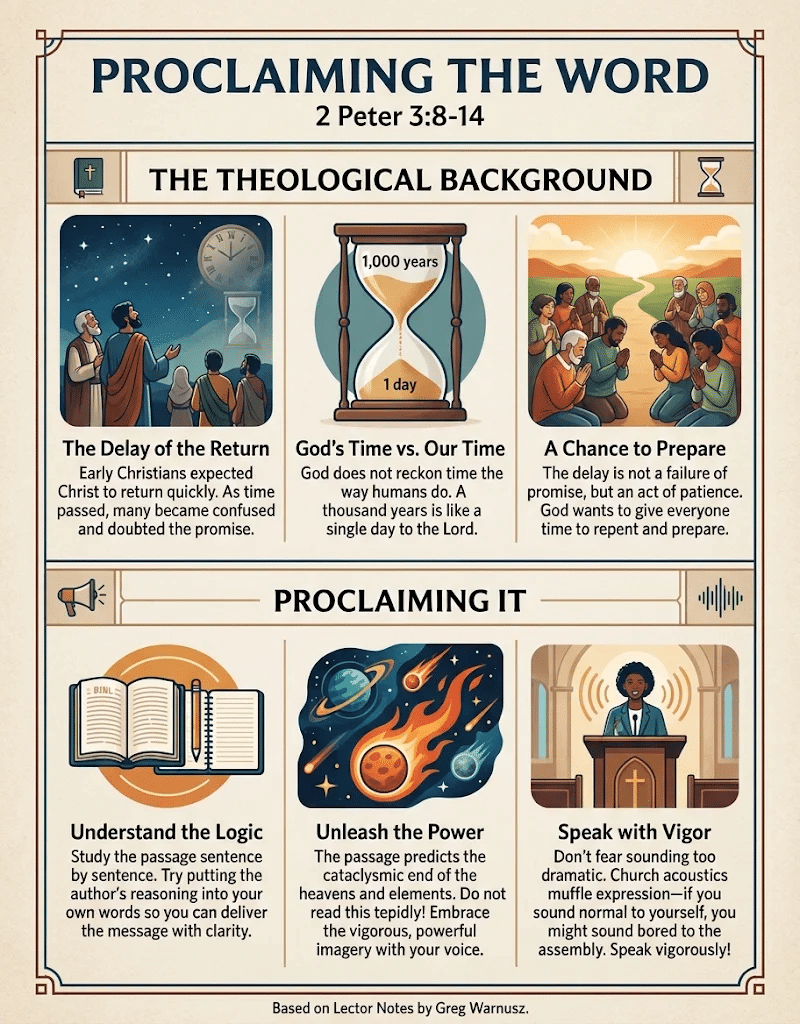
The Theological Background: Christ will come again. We say so every Sunday. But how soon? Early Christians believed it would be very soon. The longer that expectation went unfulfilled, the more confused some Christians became. Was God failing to keep a promise? The author of 2 Peter explains that God doesn't reckon time the way we do, and that God wants to give some people a chance to prepare for the end by repenting. (Saint Paul uses a similar argument in Romans, chapters 9-11, as we saw on the 21st Sunday or Ordinary Time, year A.)
Proclaiming It: Study the passage sentence by sentence so you understand the author's reasoning. Try expressing the message in your own words, even writing out your explanation if that will help. Then, if you read this slowly to the congregation, at least some members will be able to follow the logic, too.
Secondly, speak as vigorously as the author writes. There are powerful images here. Not once but twice does he predict the cataclysmic destruction of the heavens and the elements. This is not tepid prose, and the lector need not sound tepid. Afraid you'll sound like an irreverent ham? Well, know that the acoustics and PA systems in most churches muffle most of your expressiveness. What sounds exaggerated in your own ears sounds expressive to the congregation, and that's just right. If to yourself you sound "normal," you probably sound bored and boring to the assembly. Do it vigorously. Try it once and take note of the compliments you receive after mass. You won't go back to the old way.
 Highlight text or double-click a paragraph anywhere on the site to ADD TO NOTES. You can also click ASK AI to copy your selection to the clipboard with a command prompt, ready for you to paste manually into the chat above.