Papal Homilies
March 8, 2026
April 12, 2026
2nd Sunday of Easter (A)



Theme of the Readings
If Easter Sunday highlighted the mystery of the resurrection, this Sunday presents to us in particular the human response to this mystery: joyful faith. Thomas is at times a paradigm of all human people: he switches from disbelief to faith in the risen Christ, from seeking proof to joyous and deeply-felt confession (Gospel). The community of Jerusalem proclaims its faith in the resurrection when it gathers on Sundays to hear the Apostles’ preaching and to celebrate in fraternal communion the breaking of bread, a sign of the mystery of the death and resurrection of Jesus Christ (first reading). Peter’s words still sound fresh to our ears: “Still without seeing him, you are already filled with a joy so glorious that it cannot be described, because you believe and you are sure of the end to which your faith looks forward, that is, the salvation of your souls” (second reading).
SOURCE: YEAR A DICASTERY NOTES (2004-05)
Doctrinal Message
Faith in the resurrection of Jesus Christ is the fundamental pillar of Christian belief. “If Christ has not been raised from the dead then … your believing … is useless … and we are the most unfortunate of all people,” St. Paul writes to the Corinthians (1 Cor 15:12-19). Further, if Christ has not risen we are shown to be false witnesses before God, because we testified before God that Jesus Christ had been raised. However, continuing, Saint Paul exclaims: “But Christ has in fact been raised from the dead, the first-fruits of all who have fallen asleep.” With the resurrection of Jesus Christ, God the Father confirms the truth of his whole life and mission, all his teaching, all his deeds and all his work of revelation and redemption. Resurrection comes to be God’s “yes” to his Son Jesus Christ, Redeemer of the whole human race.
In commenting on the text of Paul’s Letter to the Corinthians, we can say that since Christ has been raised, we Christians are the most fortunate of all people on earth. The first Christian community that gathered with the Apostles and with Mary, the Mother of Jesus Christ, to celebrate the “breaking of bread”, testifies to this intense happiness of believers. The reason is obvious: Christ’s resurrection is the first-fruits of the Christian’s resurrection; even more, the genuine Christian already here on earth, takes part in the new life with the risen Christ. How can we not live in eternal joy? This is what Peter sings in what is probably a baptismal hymn: “Blessed be God, the Father of our Lord Jesus Christ, who in his great mercy has given us a new birth as his sons, by raising Jesus Christ from the dead, so that we have a sure hope and the promise of an inheritance that can never be spoilt or soiled and never fade away” (second reading).
In commenting on Paul again, we can say: “Our witness to the resurrection of Jesus Christ pays homage to the truth and fidelity of God the Father to us his children.” God is faithful, and for this reason did not abandon his Son to the power of death; nor will he abandon any of us, his children through adoption and mercy. Jesus’ attitude to Thomas, the “doubting” Apostle, beautifully reflects the fidelity of God who complies with man’s “disbelief” in order to lead him to faith, a faith that is sound and forever free from any shadow of doubt: “My Lord and my God!” (Gospel). The Church’s uninterrupted confession of the resurrection of Jesus Christ down through the twenty centuries of her history has ratified and continues to ratify God’s truth and fidelity, day after day.
SOURCE: YEAR A DICASTERY NOTES (2004-05)
Pastoral Suggestions
Man’s response to mystery is always surprising, whether he accepts it by a “miracle” of grace or rejects it, guided by the feeble light of his finite intelligence. Whatever his response may be, the mystery of the resurrection “is there,” with no chance of being forgotten or obliterated. We should not find it strange, as priests and pastors, that on the one hand various responses can be made to this immense mystery. On the other hand, we must not cease to preach it, witness to it, and point it out as of the utmost importance for all human existence, rejoicing with those of our brothers and sisters who accept and are spiritually vibrant with the mystery of Christ risen.
We must preach unambiguously that faith in the resurrection is a gift, a “miracle” of God’s grace and love. We receive this gift in baptism, but we must nurture it, protect it, and appreciate it, so that nothing and no one can uproot it from the believer’s heart. How do our parishioners, those with whom we exercise our pastoral ministry, nurture, protect and appreciate the gift of faith, especially faith in the resurrection of Jesus Christ? What can I do, as a priest, to help my brothers and sisters nurture, protect and appreciate this faith?
We must explain to the faithful that faith in the resurrection is not absurd, contradictory to the laws of human reason or foreign to man’s daily life. How many realities are there in human life that people cannot see and yet believe without batting an eyelid? It is neither absurd nor irrational to believe in someone who “knows” about something, so it follows that we must believe in God who is infinite wisdom. If human life could be equated with animal life, then the resurrection would lack importance. But doesn’t man feel in his heart that he cannot die? Doesn’t a pagan like Horace say “non omnis moriar” (I shall not die altogether)? Not only is the resurrection of Jesus Christ not foreign to man’s life, but it constitutes the unshakable foundations of its true meaning. Christ has been raised, and “death has been swallowed up in victory” (1 Cor 15: 54).
SOURCE: YEAR A DICASTERY NOTES (2004-05)
Infographics (visual aids) on this page were designed using Nano Banana Pro with Gemini 3.0. They draw inspiration from the 2004-05 Dicastery for the Clergy Notes (YEAR A | B | C cf. text above), but are not officially associated with or endorsed by the Holy See. They may be copied for personal use or for use in any non-profit ministry (e.g. parish bulletin inserts, classroom or group presentation, posters on community bulletin boards, etc.)
16 April 2023 – Saint Peter’s Square
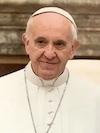
Today, Divine Mercy Sunday, the Gospel recounts two apparitions of the Risen Jesus to his disciples, and in particular, to Thomas, the “doubting Apostle” (cf. Jn 20:24-29).
In reality, Thomas is not the only one who struggles to believe. In fact, he represents all of us a little bit. Indeed, it is not always easy to believe, especially when, as in his case, one has suffered a tremendous disappointment. After a huge disappoint, it is difficult to believe. He had followed Jesus for years, running risks and enduring discomforts. But the Teacher was put on a cross like a criminal, and no one freed him. No one did anything! He is dead and everyone is afraid. How can he trust again? How can he trust the news saying He is alive? There was doubt inside him.
Thomas, however, shows that he is courageous. While the others are closed up inside the Upper Room out of fear, he goes out, running the risk that someone might recognize, report and arrest him. We could even think that, with his courage, he would have deserved more than the others to meet the Risen Lord. Instead, precisely because he is away, Thomas is not there when Jesus appears to the disciples for the first time, on Easter evening, thus missing that opportunity. He had distanced himself from the community. How could he get [the opportunity] back? Only by going back to the others, returning there, to that family he had left behind, scared and sad. When he does so, when he returns, they tell him that Jesus had come, but he struggles to believe. He wants to see his wounds. And Jesus satisfies him: eight days later, he appears again in the midst of his disciples and shows them his wounds, his hands, his feet, these wounds that are the proof of his love, that are the ever-open channels of his mercy.
Let us reflect on these facts. In order to believe, Thomas wants an extraordinary sign — to touch the wounds. Jesus shows them to him, but in an ordinary way, coming in front of everyone, in the community, not outside. As if saying to him: if you want to meet me, do not search far away; remain in the community, with the others, and don’t go away. Pray with them. Break bread with them. And he says this to us as well. That is where you will find me; that is where I will show you the signs of the wounds impressed on my body: the signs of the Love that overcomes hatred, of the Pardon that disarms revenge, the signs of the Life that conquers death. It is there, in the community, that you will discover my face, as you share moments of doubt and fear with your brothers and sisters, clinging even more strongly to them. Without the community, it is difficult to find Jesus.
Dear brothers and sisters, the invitation given to Thomas is valid for us as well. We, where do we seek the Risen One? In some special event, in some spectacular or amazing religious manifestation, only in our emotions and feelings? Or rather in the community, in the Church, accepting the challenge of staying there, even though she (the Church) is not perfect? Despite all of her limitations and failures, which are our limitations and failings, our Mother Church is the Body of Christ. And it is there, in the Body of Christ, that, still now and forever, the greatest signs of his love can be found impressed. Let us ask ourselves, however, if in the name of this love, in the name of Jesus’ wounds, we are willing to open our arms to those who are wounded by life, excluding no one from God’s mercy but welcoming everyone, each person like a brother, like a sister. God welcomes everyone. God welcomes everyone.

Divine Mercy Sunday – BEATIFICATION OF THE SERVANT OF GOD JOHN PAUL II
1 May 2011 | St Peter’s Basilica

Six years ago we gathered in this Square to celebrate the funeral of Pope John Paul II. Our grief at his loss was deep, but even greater was our sense of an immense grace which embraced Rome and the whole world: a grace which was in some way the fruit of my beloved predecessor’s entire life, and especially of his witness in suffering. Even then we perceived the fragrance of his sanctity, and in any number of ways God’s People showed their veneration for him. For this reason, with all due respect for the Church’s canonical norms, I wanted his cause of beatification to move forward with reasonable haste. And now the longed-for day has come; it came quickly because this is what was pleasing to the Lord: John Paul II is blessed!
I would like to offer a cordial greeting to all of you who on this happy occasion have come in such great numbers to Rome from all over the world – cardinals, patriarchs of the Eastern Catholic Churches, brother bishops and priests, official delegations, ambassadors and civil authorities, consecrated men and women and lay faithful, and I extend that greeting to all those who join us by radio and television.
Today is the Second Sunday of Easter, which Blessed John Paul II entitled Divine Mercy Sunday. The date was chosen for today’s celebration because, in God’s providence, my predecessor died on the vigil of this feast. Today is also the first day of May, Mary’s month, and the liturgical memorial of Saint Joseph the Worker. All these elements serve to enrich our prayer, they help us in our pilgrimage through time and space; but in heaven a very different celebration is taking place among the angels and saints! Even so, God is but one, and one too is Christ the Lord, who like a bridge joins earth to heaven. At this moment we feel closer than ever, sharing as it were in the liturgy of heaven.
“Blessed are those who have not seen and yet have come to believe” (Jn 20:29). In today’s Gospel Jesus proclaims this beatitude: the beatitude of faith. For us, it is particularly striking because we are gathered to celebrate a beatification, but even more so because today the one proclaimed blessed is a Pope, a Successor of Peter, one who was called to confirm his brethren in the faith. John Paul II is blessed because of his faith, a strong, generous and apostolic faith. We think at once of another beatitude: “Blessed are you, Simon, son of Jonah! For flesh and blood has not revealed this to you, but my Father in heaven” (Mt 16:17). What did our heavenly Father reveal to Simon? That Jesus is the Christ, the Son of the living God. Because of this faith, Simon becomes Peter, the rock on which Jesus can build his Church. The eternal beatitude of John Paul II, which today the Church rejoices to proclaim, is wholly contained in these sayings of Jesus: “Blessed are you, Simon” and “Blessed are those who have not seen and yet have come to believe!” It is the beatitude of faith, which John Paul II also received as a gift from God the Father for the building up of Christ’s Church.
Our thoughts turn to yet another beatitude, one which appears in the Gospel before all others. It is the beatitude of the Virgin Mary, the Mother of the Redeemer. Mary, who had just conceived Jesus, was told by Saint Elizabeth: “Blessed is she who believed that there would be a fulfilment of what was spoken to her by the Lord” (Lk 1:45). The beatitude of faith has its model in Mary, and all of us rejoice that the beatification of John Paul II takes place on this first day of the month of Mary, beneath the maternal gaze of the one who by her faith sustained the faith of the Apostles and constantly sustains the faith of their successors, especially those called to occupy the Chair of Peter. Mary does not appear in the accounts of Christ’s resurrection, yet hers is, as it were, a continual, hidden presence: she is the Mother to whom Jesus entrusted each of his disciples and the entire community. In particular we can see how Saint John and Saint Luke record the powerful, maternal presence of Mary in the passages preceding those read in today’s Gospel and first reading. In the account of Jesus’ death, Mary appears at the foot of the cross (Jn 19:25), and at the beginning of the Acts of the Apostles she is seen in the midst of the disciples gathered in prayer in the Upper Room (Acts 1:14).
Today’s second reading also speaks to us of faith. Saint Peter himself, filled with spiritual enthusiasm, points out to the newly-baptized the reason for their hope and their joy. I like to think how in this passage, at the beginning of his First Letter, Peter does not use language of exhortation; instead, he states a fact. He writes: “you rejoice”, and he adds: “you love him; and even though you do not see him now, you believe in him and rejoice with an indescribable and glorious joy, for you are receiving the outcome of your faith, the salvation of your souls” (1 Pet 1:6, 8-9). All these verbs are in the indicative, because a new reality has come about in Christ’s resurrection, a reality to which faith opens the door. “This is the Lord’s doing”, says the Psalm (118:23), and “it is marvelous in our eyes”, the eyes of faith.
Dear brothers and sisters, today our eyes behold, in the full spiritual light of the risen Christ, the beloved and revered figure of John Paul II. Today his name is added to the host of those whom he proclaimed saints and blesseds during the almost twenty-seven years of his pontificate, thereby forcefully emphasizing the universal vocation to the heights of the Christian life, to holiness, taught by the conciliar Constitution on the Church Lumen Gentium. All of us, as members of the people of God – bishops, priests, deacons, laity, men and women religious – are making our pilgrim way to the heavenly homeland where the Virgin Mary has preceded us, associated as she was in a unique and perfect way to the mystery of Christ and the Church. Karol Wojtyła took part in the Second Vatican Council, first as an auxiliary Bishop and then as Archbishop of Kraków. He was fully aware that the Council’s decision to devote the last chapter of its Constitution on the Church to Mary meant that the Mother of the Redeemer is held up as an image and model of holiness for every Christian and for the entire Church. This was the theological vision which Blessed John Paul II discovered as a young man and subsequently maintained and deepened throughout his life. A vision which is expressed in the scriptural image of the crucified Christ with Mary, his Mother, at his side. This icon from the Gospel of John (19:25-27) was taken up in the episcopal and later the papal coat-of-arms of Karol Wojtyła: a golden cross with the letter “M” on the lower right and the motto “Totus tuus”, drawn from the well-known words of Saint Louis Marie Grignion de Montfort in which Karol Wojtyła found a guiding light for his life: “Totus tuus ego sum et omnia mea tua sunt. Accipio te in mea omnia. Praebe mihi cor tuum, Maria – I belong entirely to you, and all that I have is yours. I take you for my all. O Mary, give me your heart” (Treatise on True Devotion to the Blessed Virgin, 266).
In his Testament, the new Blessed wrote: “When, on 16 October 1978, the Conclave of Cardinals chose John Paul II, the Primate of Poland, Cardinal Stefan Wyszyński, said to me: ‘The task of the new Pope will be to lead the Church into the Third Millennium’”. And the Pope added: “I would like once again to express my gratitude to the Holy Spirit for the great gift of the Second Vatican Council, to which, together with the whole Church – and especially with the whole episcopate – I feel indebted. I am convinced that it will long be granted to the new generations to draw from the treasures that this Council of the twentieth century has lavished upon us. As a Bishop who took part in the Council from the first to the last day, I desire to entrust this great patrimony to all who are and will be called in the future to put it into practice. For my part, I thank the Eternal Shepherd, who has enabled me to serve this very great cause in the course of all the years of my Pontificate”. And what is this “cause”? It is the same one that John Paul II presented during his first solemn Mass in Saint Peter’s Square in the unforgettable words: “Do not be afraid! Open, open wide the doors to Christ!” What the newly-elected Pope asked of everyone, he was himself the first to do: society, culture, political and economic systems he opened up to Christ, turning back with the strength of a titan – a strength which came to him from God – a tide which appeared irreversible. By his witness of faith, love and apostolic courage, accompanied by great human charisma, this exemplary son of Poland helped believers throughout the world not to be afraid to be called Christian, to belong to the Church, to speak of the Gospel. In a word: he helped us not to fear the truth, because truth is the guarantee of liberty. To put it even more succinctly: he gave us the strength to believe in Christ, because Christ is Redemptor hominis, the Redeemer of man. This was the theme of his first encyclical, and the thread which runs though all the others.
When Karol Wojtyła ascended to the throne of Peter, he brought with him a deep understanding of the difference between Marxism and Christianity, based on their respective visions of man. This was his message: man is the way of the Church, and Christ is the way of man. With this message, which is the great legacy of the Second Vatican Council and of its “helmsman”, the Servant of God Pope Paul VI, John Paul II led the People of God across the threshold of the Third Millennium, which thanks to Christ he was able to call “the threshold of hope”. Throughout the long journey of preparation for the great Jubilee he directed Christianity once again to the future, the future of God, which transcends history while nonetheless directly affecting it. He rightly reclaimed for Christianity that impulse of hope which had in some sense faltered before Marxism and the ideology of progress. He restored to Christianity its true face as a religion of hope, to be lived in history in an “Advent” spirit, in a personal and communitarian existence directed to Christ, the fullness of humanity and the fulfillment of all our longings for justice and peace.
Finally, on a more personal note, I would like to thank God for the gift of having worked for many years with Blessed Pope John Paul II. I had known him earlier and had esteemed him, but for twenty-three years, beginning in 1982 after he called me to Rome to be Prefect of the Congregation for the Doctrine of the Faith, I was at his side and came to revere him all the more. My own service was sustained by his spiritual depth and by the richness of his insights. His example of prayer continually impressed and edified me: he remained deeply united to God even amid the many demands of his ministry. Then too, there was his witness in suffering: the Lord gradually stripped him of everything, yet he remained ever a “rock”, as Christ desired. His profound humility, grounded in close union with Christ, enabled him to continue to lead the Church and to give to the world a message which became all the more eloquent as his physical strength declined. In this way he lived out in an extraordinary way the vocation of every priest and bishop to become completely one with Jesus, whom he daily receives and offers in the Church.
Blessed are you, beloved Pope John Paul II, because you believed! Continue, we implore you, to sustain from heaven the faith of God’s people. You often blessed us in this Square from the Apostolic Palace: Bless us, Holy Father! Amen.
23 April 1995 | Holy Spirit Church, the Shrine of Divine Mercy in Rome
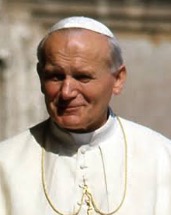
1. “Peace be with you!” (Jn 20:19).
The risen Jesus said these words twice on appearing to the Eleven in the Upper Room, on the evening of the very day when he rose from the dead. The Lord, as the Evangelist John testifies, showed them His hands and His side, to confirm in their presence the identity of His body, as if to say: this is the same body that two days ago was nailed to the cross and then laid in the tomb; the body that bears the wounds of the crucifixion and the stab of the lance. It is the direct proof that I have risen and am alive.
From the human point of view, this observation was difficult to accept as Thomas’ reaction shows. On the evening of the first appearance in the Upper Room, Thomas was absent. And when the other Apostles told him they had seen the Lord, he firmly refused to believe them: “Unless I see the mark of the nails in His hands and put my finger into the nailmarks and put my hand into His side, I will not believe” (Jn 20:25). From these words it can be seen how important Christ’s physical identity was for the truth of the Resurrection.
When the Lord Jesus, on the eighth day — like today — entered the Upper Room, he addressed Thomas directly, as if to satisfy his request: “Put your finger here and see My hands, and bring your hand and put it into My side, and do not be unbelieving, but believe” (Jn 20:27). Faced with such proof, the Apostle not only believed but drew the ultimate conclusion of what he had seen and expressed it in the highest and briefest profession of faith: “My Lord and my God!” (Jn 20:28). In the presence of the Risen One, the truth both of His humanity and of His divinity became clear to Thomas. The One who had risen by His own power was the Lord: “The Lord of life does not know death” (from a Polish Easter hymn).
Thomas’ confession ends the series of witnesses to Christ’s Resurrection which the Church presents during the Octave of Easter. “My Lord and my God!”Replying to these words, Jesus, in a certain sense, discloses the reality of his Resurrection to the future of all human history. In fact, he says to Thomas: “Have you come to believe because you have seen me? Blessed are those who have not seen and have believed” (Jn 20:29). He was thinking of those who would not see him risen, nor eat and drink with him as the Apostles had (cf. Acts 10:41), and yet would believe on the basis of eye-witnesses’ accounts. They are the ones, in particular, to be called “blessed” by Christ.
I live forever that man may share in immortal life.
2. “Do not be afraid. I am the first and the last, the one who lives” (Rv 1:17).
There is a certain analogy between the appearance in the Upper Room especially that of the eighth day, in Thomas’ presence — and the eschatological vision St. John speaks of in the second reading from Revelation. In the Upper Room Christ shows the Apostles, and especially Thomas, the wounds in His hands, His feet and His side, to confirm the identity of His risen and glorious body with the one that was crucified and laid in the tomb. In Revelation, the Lord introduced Himself as the First and the Last, as the One from whom the history of the cosmos begins and with whom it ends, the One who is “the firstborn of all creation” (Col 1:15), “the firstborn from the dead” (Col 1:18), the beginning and the end of human history.
His identity, which endlessly pervades the history of men, is formulated with the words: “Once I was dead, but now I am alive for ever and ever” (Rv 1:18). It is as if he had said: In time I was dead. I accepted death to remain faithful to the very end to the Incarnation through which, remaining the Son of God consubstantial with the Father, I became true man in everything except sin (cf. Heb 4:15). The three days of my Passion and Death, necessary for the work of Redemption, remain in me and in you. And now I live forever and, with my Resurrection, show forth the will of God who calls every man to share in my own immortal life. I have the keys of death with which I must open earthly tombs and change cemeteries from places where death reigns into vast spaces for the Resurrection.
3. “Do not be afraid!”
When on the island of Patmos Jesus addresses this exhortation to John, He reveals His victory over the many fears that accompany man in his earthly existence and especially when He is faced with suffering and death. The fear of death also concerns the great unknown which it represents. Could it be a total annihilation of the human being? Do not the severe words: “For you are dust, and to dust you shall return” (Gn 3:19) fully express the harsh reality of death? Thus man has serious reasons to feel afraid when he faces the mystery of death.
Contemporary civilization does all it can to distract human attention from the inescapable reality of death and tries to induce man to live as though death did not exist. And this is expressed practically in the attempt to turn man’s conscience away from God: to make him live as through God did not exist! But the reality of death is obvious. It is impossible to silence it; it is impossible to dispel the fear associated with it.
Man fears death as he fears what comes after death. He fears judgement and punishment, and this fear has a saving value: it should not be eliminated in man. When Christ says: “Do not be afraid!”, He wants to respond to the deepest source of the human being’s existential fear. What he means is: Do not fear evil, since in my Resurrection good has shown itself stronger than evil. My Gospel is victorious truth. Life and death met on Calvary in a stupendous combat and life proved victorious: “Dux vitae mortuus regnat vivus!”:“Once I was dead, but now I am alive for ever and ever” (Rv 1:18).
4. “The stone which the builders rejected has become the cornerstone” (Ps 117 [118]: 22).
The verse of the responsorial psalm in today’s liturgy helps us to understand the truth about Christ’s Resurrection. It also expresses the truth about Divine Mercy, revealed in the Resurrection: love gained the victory over sin, and life over death. In a certain sense, this truth is the very essence of the Good News. Therefore Christ can say: Do not be afraid!” He repeats these words to every man, especially to those who are suffering physically or spiritually. He can justifiably repeat them.
Sr. Faustina Kowalska heralded God’s mercy. Sr. Faustina Kowalska, whom I had the joy of beatifying two years ago, especially understood this. Her mystical experiences were all focused on the mystery of the merciful Christ and are a remarkable commentary as it were on the word of God presented to us in this Sunday’s liturgy. Sr. Faustina not only recorded them, but sought an artist who could paint the image of the merciful Christ just as she saw him. An image which, together with the figure of Blessed Faustina, is an eloquent testimony to what theologians call “condescendentia divina.” God makes himself understandable to his human interlocutors. Sacred Scripture, and especially the Gospel, confirm this.
Dear brothers and sisters, Sr. Faustina’s message follows these lines. But was it only Sr. Faustina’s, or rather, was it not at the same time a testimony given by all those who were encouraged by this message in the cruel experiences of the Second World War, in the concentration and extermination camps, and in the bombings? The mystical experience of Blessed Faustina Kowalska and her cry to the merciful Christ belong to the harsh context of our century’s history. As people of this century which is now coming to an end, we would like to thank the Lord for the message of Divine Mercy.
5. Today in particular, I am pleased to be able to give thanks to God in this Church of the Holy Spirit, “in Sassia” attached to the hospital of the same name and now a specialized center for the pastoral care of the sick as well as for the promotion of the spirituality of divine mercy. It is very significant and timely that precisely here, next to this very ancient hospital, prayers are said and work is done with constant care for the health of body and spirit. As I express again my satisfaction to the Cardinal Vicar, I also address a grateful thought to the titular, Cardinal Fiorenzo Angelini. I greet the Bishop of the western sector, the rector and the other priests, the sisters and all of you, dear faithful, who are present here. I would also like to convey fraternal wishes to the patients of Santo Spirito Hospital, as well as to the doctors, nurses, sisters and all those who help them every day. I would like to say to all: trust in the Lord! Be apostles of divine mercy and, following the invitation and the example of Blessed Faustina, take care of those who suffer in body and especially in spirit. Let each one feel the merciful love of the Lord who comforts and instills joy.
May Jesus be your peace!
“Jesus Christ is the same yesterday, today and forever!” (Heb 13:8)
Contemplating him in the mystery of the Cross and the Resurrection, let us repeat together with this Sunday’s liturgy:
“Give thanks to the Lord, for He is good, for His mercy endures forever!”