APR 6, 2025


Papal Homilies
TIP: You can rewind the livestream up to twelve hours, allowing you to catch up on any events or addresses you may have missed.

SOURCE: Vatican News – English
This livestream allows viewers to witness the Pope’s addresses during Papal Audiences, as well as other Vatican events and news. The livestream is part of the Vatican Media Center’s efforts to share the latest updates on Pope Francis, the Holy See, and the Church worldwide with a global audience.

Fr. Gaetano Piccolo (SI)
The Dicastery for the Clergy deals with everything that concerns the priests and deacons of the diocesan clergy with regard to their persons, their pastoral ministry and what is necessary for its fruitful exercise. In these matters it offers the Bishops appropriate assistance.

Novelty
5th Sunday of Lent C
“Look, I am doing something new”(Is 43,19). Novelty is undoubtedly one of the salient points of today’s liturgical texts. Using poetic language full of surprising and bold images, the prophet evokes a new Exodus and a new liberation (first reading). The adulterous woman, whom the Gospel tells us about, discovers in Jesus’ attitude something new that she has never seen, which frees and transforms her. Paul of Tarsus is faced with the absolute novelty of the mystery of Christ; this is why he looks on all other things as filth if he can gain Christ and be given a place in him (second reading).
P. Antonio Izqeuirdo, L.C., © Dicastery for the Clergy A | B | C
Doctrinal Messages
5th Sunday of Lent C
VATICAN
DAILY
BULLETIN
The Vatican Daily Bulletin is the official news source for the Pope’s activities and statements, providing accurate and up-to-date information. Published daily, it keeps the public informed about the Church’s activities and decisions.
Pastoral Suggestions
5th Sunday of Lent C

Pope Francis
5th Sunday of Lent C

The Adulterous Woman
7 April 2019 | Saint Peter’s Square
- TEXT
- DISCUSSION GUIDE
On this Fifth Sunday of Lent, the liturgy presents us the episode of the adulterous woman (cf. Jn 8:1-11). In it, there are two contrasting attitudes: that of the scribes and the Pharisees on the one hand, and that of Jesus on the other. The former want to condemn the woman because they feel they are the guardians of the Law and of its faithful implementation. Jesus, on the other hand, wants to save her because he personifies God’s mercy which redeems by forgiving and renews by reconciling.
Let us thus look at the event. While Jesus is teaching in the Temple, the scribes and the Pharisees bring him a woman who has been caught in adultery. They place her in the middle and ask Jesus if they should stone her as the Law of Moses prescribes. The Evangelist explains that they asked the question in order “to test him, that they might have some charge to bring against him” (v. 6). One might think that this was their purpose: behold the iniquity of these people — a ‘no’ to the stoning would have been a pretext to accuse Jesus of disobeying the Law; a ‘yes’ instead, to report him to the Roman Authority which had reserved such sentences to itself and did not permit lynching by the people. And Jesus must respond.
Jesus’ interrogators are confined to narrow legalism and want to oblige the Son of God to conform to their perspective of judgment and condemnation. However, he did not come into the world to judge and condemn, but rather to save and offer people a new life. And how does Jesus react to this test? First of all, he remains silent for some time and then he bends down to write on the ground with his finger, almost as if to remind them that the only Legislator and Judge is God who had inscribed the Law on stone. And then he says: “Let him who is without sin among you be the first to throw a stone at her” (v. 7). In this way, Jesus appeals to the conscience of those men: they felt they were the ‘champions of justice’, but he reminds them of their own condition as sinners, due to which they cannot claim the right to life or death over one of their fellow human beings. At that point, one after the other, beginning with the eldest — that is, those who were more fully aware of their own failings — they all went away, and desisted from stoning the woman. This episode also invites each of us to be aware that we are sinners, and to let fall from our hands the stones of denigration, of condemnation, of gossip, which at times we would like to cast at others. When we speak ill of others, we are throwing stones, we are like these people.
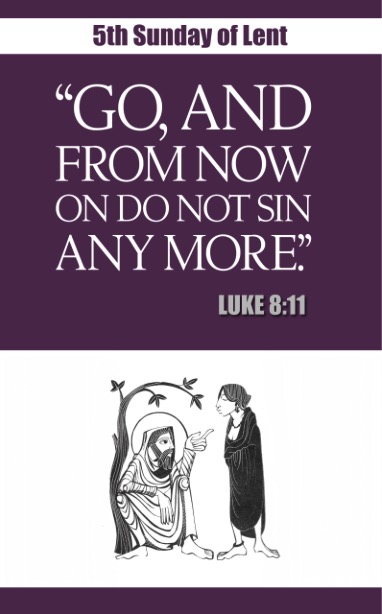
And in the end only Jesus and the woman are left there in the middle: “misery with mercy”, as Saint Augustine says (In Joh 33:5). Jesus is the only one without fault, the only one who could throw a stone at her, but he does not do so, because God “does not want the death of the wicked but that the wicked convert and live” (cf. Ez 33:11). And Jesus sends the woman on her way with these wonderful words: “Go and do not sin again” (Jn 8:11). And thus Jesus opens a new path to her, created by mercy, a path that requires her commitment not to sin again. It is an invitation that applies to each one of us. When Jesus forgives us, he always opens a new path on which to go forward. In this Lenten Season, we are called to recognize ourselves as sinners and to ask God for forgiveness. And, in its turn, while forgiveness reconciles us and gives us peace, it lets us start again, renewed. Every true conversion is oriented toward a new future, a new life, a beautiful life, a life free from sin, a generous life. Let us not be afraid to ask Jesus for forgiveness because he opens the door to this new life for us. May the Virgin Mary help us to bear witness to all of the merciful love of God, who through Jesus, forgives us and renders our lives new, by always offering us new possibilities.
Overview and Context
Reflect on the Fifth Sunday of Lent and the episode of the adulterous woman from John 8:1-11. Discuss the contrasting attitudes of the scribes and Pharisees versus Jesus. Explore themes of judgment, mercy, forgiveness, and new beginnings.
Discussion Questions
1. Contrasting Attitudes
– What are the key differences between the attitudes of the scribes and Pharisees and that of Jesus in this episode?
– How do these differences inform our understanding of justice and mercy?
2. Motivations and Intentions
– What motivates the scribes and Pharisees to bring the woman to Jesus?
– How does their attempt to test Jesus reflect their understanding of the law and their intentions?
3. Jesus’ Response and Actions
– Why do you think Jesus remained silent initially and wrote on the ground?
– Explore the significance of Jesus’ statement: “Let him who is without sin among you be the first to throw a stone at her.” What impact did this have on the crowd?
4. The Call to Self-Reflection
– How does Jesus’ approach challenge the crowd’s understanding of sin and self-righteousness?
– Discuss the importance of self-awareness and acknowledging one’s own sins in our daily lives.
5. Message of Mercy
– How does the interaction between Jesus and the woman encapsulate the theme of “misery with mercy”?
– Reflect on the promise and challenge in Jesus’ words: “Go and do not sin again.” How does this personalizes the call to repentance?
6. Transformative Forgiveness
– How does Jesus’ forgiveness create a new path for the woman?
– In what ways does forgiveness lead to reconciliation, peace, and a renewed life? Discuss the implications for our personal spiritual journey during Lent.
7. Application to Daily Life
– How can we emulate Jesus’ example of mercy and forgiveness in our interactions with others?
– What “stones” do we need to let fall from our hands, such as judgment, condemnation, or gossip? How can we focus on building a more generous and compassionate life?
Reflections and Personal Commitments
– Encourage group members to reflect on their own experiences of forgiveness and renewal.
– Invite participants to share personal commitments they wish to make in light of this discussion, particularly as a Lenten observance.
Prayer and Contemplation
– Conclude with a prayer, asking for the intercession of the Virgin Mary to help us witness God’s merciful love and to live out the call to forgiveness and new life made possible through Jesus.
– Spend a few moments in silent contemplation, considering how to integrate the lessons from the sermon into daily life.

Benedict XVI
5th Sunday of Lent C

“To Test Him”
21 March 2010 | Saint Peter’s Square
- TEXT
- DISCUSSION GUIDE
We have reached the Fifth Sunday of Lent in which the Liturgy this year presents to us the Gospel episode of Jesus who saves an adulterous woman condemned to death (Jn 8: 1-11). While he is teaching at the Temple the Scribes and Pharisees bring Jesus a woman caught in the act of adultery for which Mosaic law prescribed stoning. Those men ask Jesus to judge the sinful woman in order “to test him” and impel him to take a false step. The scene is full with drama: the life of that person and also his own life depend on Jesus. Indeed, the hypocritical accusers pretend to entrust the judgement to him whereas it is actually he himself whom they wish to accuse and judge. Jesus, on the other hand, is “full of grace and truth” (Jn 1: 14): he can read every human heart, he wants to condemn the sin but save the sinner, and unmask hypocrisy. St John the Evangelist highlights one detail: while his accusers are insistently interrogating him, Jesus bends down and starts writing with his finger on the ground. St Augustine notes that this gesture portrays Christ as the divine legislator: in fact, God wrote the law with his finger on tablets of stone (cf. Commentary on John’s Gospel, 33,5).Thus Jesus is the Legislator, he is Justice in person. And what is his sentence? “Let him who is without sin among you be the first to throw a stone at her”. These words are full of the disarming power of truth that pulls down the wall of hypocrisy and opens consciences to a greater justice, that of love, in which consists the fulfilment of every precept (cf. Rom 13: 8-10). This is the justice that also saved Saul of Tarsus, transforming him into St Paul (cf. Phil 3: 8-14).
When his accusers “went away, one by one, beginning with the eldest”, Jesus, absolving the woman of her sin, ushers her into a new life oriented to good. “Neither do I condemn you; go, and do not sin again”. It is the same grace that was to make the Apostle say: “One thing I do, forgetting what lies behind and straining forward to what lies ahead. I press on toward the goal for the prize of the upward call of God in Christ Jesus” (Phil 3: 13-14). God wants only goodness and life for us; he provides for the health of our soul through his ministers, delivering us from evil with the Sacrament of Reconciliation, so that no one may be lost but all may have the opportunity to convert. In this Year for Priests I would like to urge Pastors to imitate the holy Curé d’Ars in the ministry of sacramental pardon so that the faithful may discover its meaning and beauty and be healed by the merciful love of God, who “even forces himself to forget the futureso that he can grant us his forgiveness!” (Letter to Priests for the Inauguration of the Year for Priests, 16 June 2009).
Dear friends, let us learn from the Lord Jesus not to judge and not to condemn our neighbour. Let us learn to be intransigent with sin starting with our own! and indulgent with people. May the holy Mother of God, free from all sin, who is the mediatrix of grace for every repentant sinner, help us in this.
1. Contextual Overview
– Read John 8:1-11. What stands out to you about this passage?
– Discuss the cultural and legal context of the story, specifically the Mosaic law concerning adultery.
– How do the Scribes and Pharisees use this situation to challenge Jesus?
2. Jesus’ Response
– Reflect on Jesus’ decision to write on the ground. Why do you think he chose to respond this way?
– Discuss the significance of Jesus as the “divine legislator” according to St. Augustine’s commentary.
– How does Jesus redefine justice in this scenario?
3. The Power of Jesus’ Words
– Analyze the sentence “Let him who is without sin among you be the first to throw a stone at her.” What impact does this have on the accusers?
– What does this reveal about Jesus’ understanding of sin and grace?
– How does this challenge our understanding of judgment and mercy?
4. Transformation and New Life
– How does Jesus’ interaction with the woman change her life?
– What parallels can be drawn between the woman’s experience and St. Paul’s transformation as described in Philippians 3: 8-14?
5. The Role of Grace and Reconciliation
– Discuss the significance of the Sacrament of Reconciliation as mentioned in the sermon.
– Why is the Year for Priests highlighted, and how does the holy Curé d’Ars serve as a model for sacramental pardon?
– Reflect on the idea that God offers goodness and life, inviting conversion and renewal.
6. Application to Our Lives
– How can we apply the principles of Jesus’ teaching on judgment and mercy to our own relationships?
– Discuss ways to be vigilant against sin in our own lives while showing compassion and grace to others.
– What role does the example of the holy Mother of God, as mediatrix of grace, play in offering forgiveness and love?
7. Prayer and Reflection
– Spend time in prayer asking for the grace to be more like Jesus in offering forgiveness and refraining from judgment.
– Reflect on personal experiences where you felt either judged or forgiven, and consider how these moments impacted your faith journey.