June 1, 2025


Papal Homilies
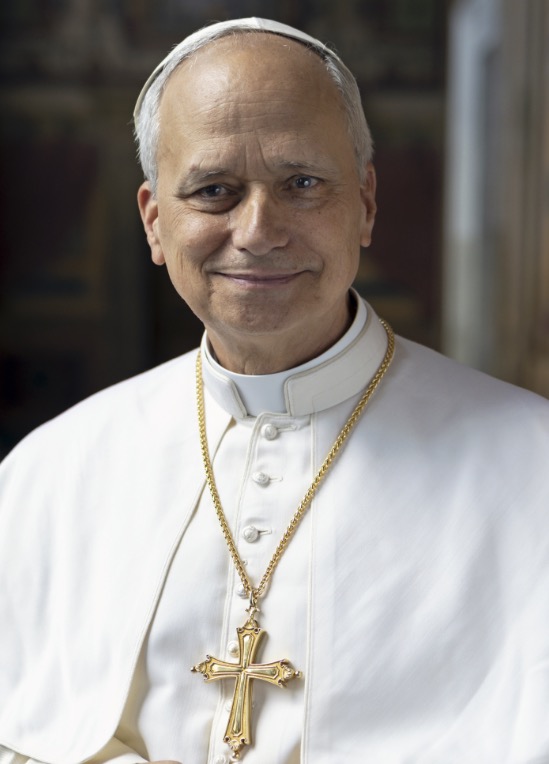

ROME REPORTS (1:00) – Papal coat of arms of Leo XIV combines Marian symbols (blue and lily) with Augustinian elements. His motto, “In the one Christ we are one,” reflects the call for unity and dialogue within the Church.

Vatican Livestream
This livestream allows viewers to witness the Pope’s addresses during Papal Audiences, as well as other Vatican events and news. The livestream is part of the Vatican Media Center’s efforts to share the latest updates on Pope Leo XIV, the Holy See, and the Church worldwide with a global audience.


Homiletic Suggestions (2025)
edited by Father Gaetano Piccolo (SI)
FROM THE ARCHIVES
Mission Accomplished
but Not Concluded
Ascension of the Lord (Year C)
On the Solemnity of the Ascension, the entire liturgy seems to be saying to us, “Mission accomplished but not concluded”. In the Gospel, Luke emphasizes the accomplishment of the mission: the Paschal mystery and universal evangelization. The account in the Acts of the Apostles focuses precisely on the task that is yet to be completed: “You will be my witnesses… to the ends of the earth; this Jesus… will come back…” Finally, the Letter to the Hebrews summarizes the mission that has been accomplished in the glorious Christ, High Priest of the heavenly sanctuary (“he has made his appearance once and for all”) but not concluded (“so that he now appears in the presence of God on our behalf… he will manifest himself a second time… to those who are waiting for him, to bring them salvation”).
P. Antonio Izqeuirdo, L.C., © Dicastery for the Clergy A | B | C
Doctrinal Messages
Pastoral Suggestions
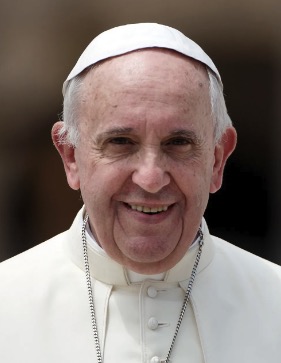
Francis
Ascension of the Lord (Year C)
The Ascension
8 May 2016 – St Peter’s Square
Today, in Italy and in other countries, we are celebrating the Ascension of Jesus into Heaven, which occurred 40 days after Easter. Let us contemplate the mystery of Jesus who leaves our earthly space to enter the fullness of the glory of God, taking our humanity with him. In other words, our humanity enters heaven for the first time. The Gospel of Luke describes the reaction of the disciples before the Lord who “parted from them and was carried up into heaven” (24:51). They had no sorrow nor dismay, but “they worshiped him, and returned to Jerusalem with great joy” (v. 52). It was the return of those who no longer feared the city that had rejected the Master, who had seen Judas’ betrayal and Peter’s denial; who had seen the dispersion of the disciples and the brutality of a power that felt threatened. Since that day, the Apostles and every disciple of Christ have been able to live in Jerusalem and in all cities of the world, even in those most afflicted by injustice and violence, because above every city there is the same heaven and every inhabitant can lift his or her gaze with hope. Jesus, God, is true man, with his human body, he is in heaven! This is our hope, it is still ours, and we are firm in this hope if we look to heaven.
In this heaven lives that God who revealed himself so closely as to take on the face of a man, Jesus of Nazareth. He remains for us always the God-with-us — let us remember this: Emmanuel, God with us — and he never leaves us alone! We can look to heaven in order to recognize our future before us. In the Ascension of Jesus, Crucified and Risen, there is the promise of our participation in the fullness of life with God.
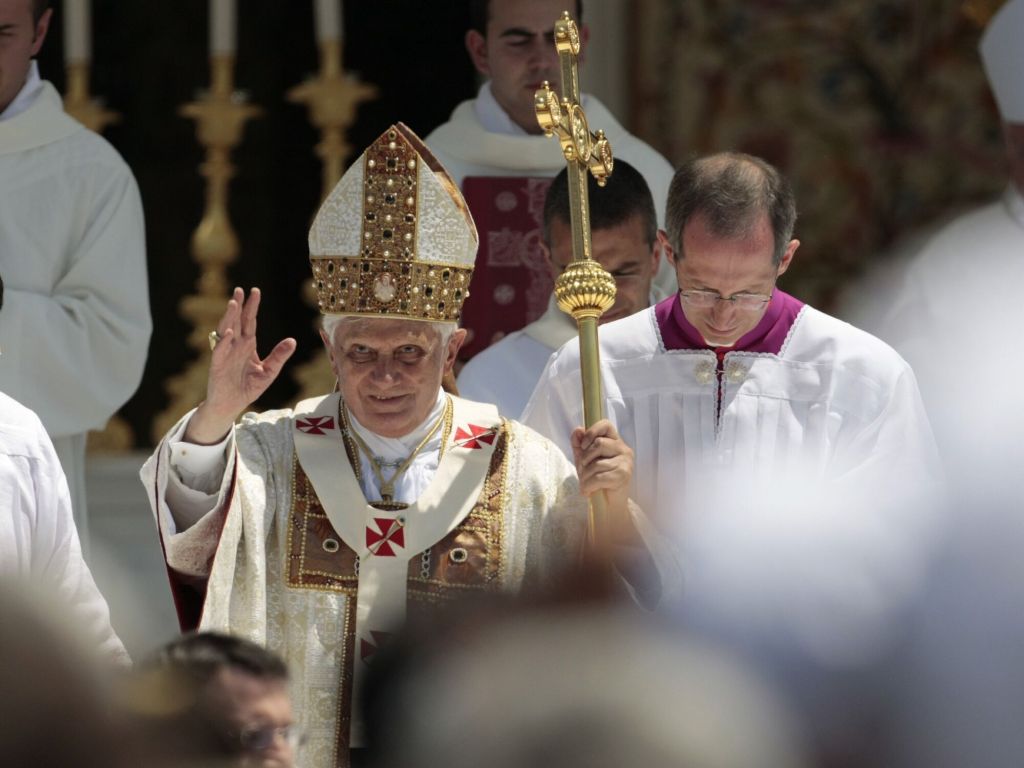
Benedict XVI
Ascension of the Lord (Year C)
“Man Henceforth Finds
Room in God Forever”
24 May 2009 | Cassino, Piazza Miranda
“You shall receive power when the Holy Spirit has come upon you; and you shall be my witnesses in Jerusalem and in all Judea and Samaria and to the end of the earth” (Acts 1: 8). With these words, Jesus took his leave of the Apostles, as we heard in the First Reading. Immediately afterwards the sacred Author adds that “as they were looking on, he was lifted up, and a cloud took him out of their sight” (Acts 1: 9).
This is the mystery of the Ascension that we are celebrating today. But what do the Bible and the Liturgy wish to tell us by saying that Jesus “was lifted up”? We cannot understand the meaning of these words from a single text or from a single book of the New Testament but rather by listening attentively to the whole of Sacred Scripture. In fact the verb “to lift up” was originally used in the Old Testament and refers to royal enthronement. Thus Christ’s Ascension means in the first place the enthronement of the Crucified and Risen Son of Man, the manifestation of God’s kingship over the world.
However, there is an even deeper meaning that is not immediately perceptible. In the passage from the Acts of the Apostles it is said first that Jesus was “lifted up” (v. 9) and then it says “taken up” (v. 11). The event is not described as a journey to on high but rather as an action of the power of God who introduces Jesus into the space of closeness to the Divine. The presence of the cloud that “took him out of their sight” (v. 9), recalls a very ancient image of Old Testament theology and integrates the account of the Ascension into the history of God with Israel, from the cloud of Sinai and above the tent of the Covenant in the desert, to the luminous cloud on the mountain of the Transfiguration.
SOURCE: The Holy See Archive at the Vatican Website © Libreria Editrice Vaticana If you are unable to access the Vatican website, click here to check if it is down.

Saint John Paul II
Ascension of the Lord (Year C)
The Ascension of Our Lord
24 May 1979 | Solemnity of the Ascension
ON THIS SOLEMNITY of the Ascension of our Lord, the Pope is happy to offer the Eucharistic Sacrifice with you and for you. I am happy to be with the students and staff of the Venerable English College in this year in which you are celebrating your fourth centenary. And today, in a special way, I feel spiritually close to you, to your parents and families, and to all the faithful of England and Wales – to all who are united in the faith of Peter and Paul, in the faith of Jesus Christ. The traditions of generosity and fidelity that have been exemplified in the life of your College for four hundred years are present in my heart this morning. You have come to give thanks and praise to God for what has been accomplished by his grace in the past, and to find strength to go forward – under the protection of our Blessed Lady – in the fervour of your forefathers, many of whom laid down their lives for the Catholic faith.
A cordial word of welcome goes also to the new priests from the Pontifical Beda College. For you too this is a moment of special challenge to keep alive the ideals manifested in your patron, Saint Bede the Venerable, whom you will commemorate tomorrow. Welcome also to the staff and to your fellow studente.
With joy then and fresh resolves for the future, let us reflect briefly on the great mystery of today’s liturgy. In the Scripture readings the whole significance of Christ’s Ascension is summarized for us. The richness of this mystery is spelled out in two statements: Jesus gave instructions, and then Jesus took his place.
In the providence of God – in the eternal design of the Father – the hour had come for Christ to go away. He would leave his Apostles behind, with his Mother Mary, but only after he had given them his instructions. The Apostles now had a mission to perform according to the instructions that Jesus left, and these instructions were in turn the faithful expression of the Father’s will.
SOURCE: The Holy See Archive at the Vatican Website © Libreria Editrice Vaticana If you are unable to access the Vatican website, click here to check if it is down.

Ascension of the Lord (Year C)