June 8, 2025
June 8, 2025


Papal Homilies
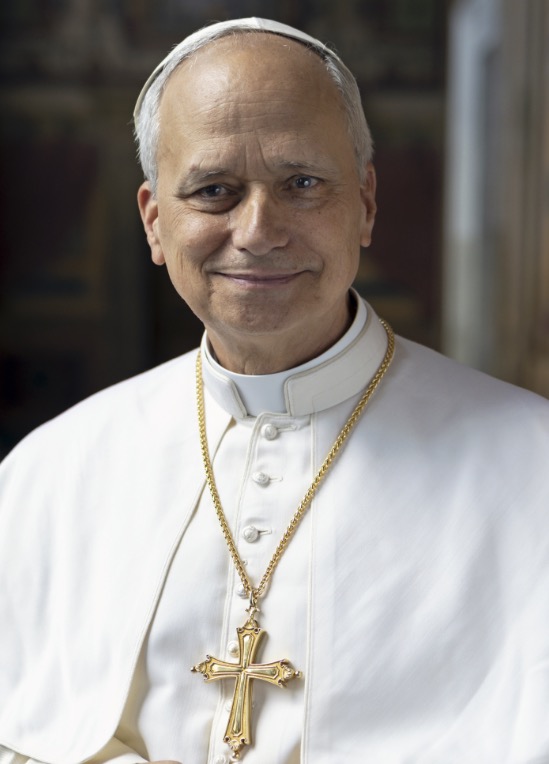

ROME REPORTS (1:11) – Pope Leo XIV met with Italian Americans to discuss immigration and Catholic culture.

This livestream allows viewers to witness the Pope’s addresses during Papal Audiences, as well as other Vatican events and news. The livestream is part of the Vatican Media Center’s efforts to share the latest updates on Pope Leo XIV, the Holy See, and the Church worldwide with a global audience.
Pope Leo’s Calendar
TRANSCRIPTS – Pope’s Speeches


Homiletic Suggestions (2025)
edited by Father Gaetano Piccolo (SI)

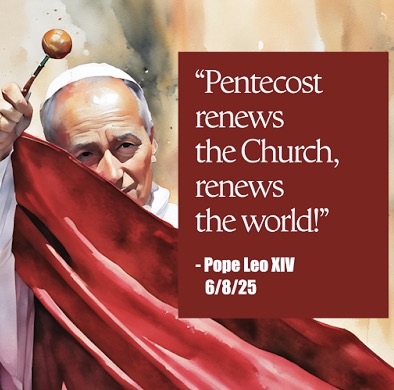
Dicastery for the Clergy Homily Notes
The Spirit
Pentecost Sunday (Year C)
On this solemnity of Pentecost, let us focus our attention on the tasks of the Spirit within the consciences and in the whole of the community of believers.
First of all, the Spirit performs the task of consoling and protecting the Christian, combining this task with that of the teacher of consciences (Gospel).
In the first reading, with the image of the wind and fire, the Spirit fulfills his task of being a power that transforms man and promotes the Gospel in all nations.
Finally, he is the life-giving power and the witness and creator of our divine sonship (second reading).
© Dicastery for the Clergy A | B | C
Doctrinal Messages
Pastoral Suggestions
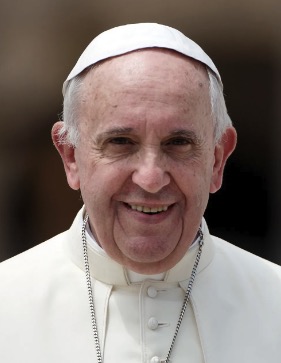
Francis
Featured Homilies
Pope Francis
Pentecost Sunday (Year C)
The Spirit Teaches and Reminds
5 June 2022 – Saint Peter’s Square
In today’s Liturgy, the Gospel recounts one of these promises, when Jesus said to the disciples: “He will teach you all things, and bring to your remembrance all that I have said to you” (Jn 14: 26). This is what the Spirit does: he teaches and reminds us of what Christ said. Let us reflect on these two actions, to teach and to remind, because this is how he makes the Gospel of Jesus enter into our hearts.
First of all, the Holy Spirit teaches. In this way he helps us overcome an obstacle that presents itself to us in the experience of faith: that of distance. He helps us overcome the obstacle of distance in the experience of faith. Indeed, the doubt may arise that between the Gospel and everyday life there is a great distance: Jesus lived 2,000 years ago. They were other times, other situations, and therefore the Gospel seems to be outdated, it seems inadequate to speak to our current moment, with its demands and its problems. The question also comes to us: what does the Gospel have to say in the age of the internet, in the age of globalization? What impact can its word have?
We can say that the Holy Spirit is a specialist in bridging distances, he knows how to bridge distances; he teaches us how to overcome them. It is he who connects the teaching of Jesus with every time and every person. With him Christ’s words are not a memory, no: Christ’s words, by virtue of the Holy Spirit, come alive today! The Spirit makes them alive for us: through Sacred Scriptures he speaks to us and guides us in the present. The Holy Spirit does not fear the passing of the centuries; rather, he makes believers attentive to the problems and events of their time. Indeed, when the Holy Spirit teaches, he updates: he keeps faith ever young. We run the risk of making a museum piece out of faith: it is a risk! He, on the other hand, brings it up to date, always up to date, the faith up to date: this is his job. For the Holy Spirit does not bind himself to passing epochs or trends, but brings into today the relevance of Jesus, risen and living.
And how does the Spirit do this? By reminding us. Here is the second verb, to remind. What does remind mean? To remind means to restore to the heart [Lat.: re-cordari from cordis meaning heart]. The Spirit restores the Gospel to our heart. It happens as it did for the Apostles: they had listened to Jesus many times, yet they had understood little. The same thing happens to us. But from Pentecost forth, with the Holy Spirit, they remember and they understand. They welcome his words as made especially for them, and they go from an outward knowledge, an awareness of memory, to a living relationship, a convinced, joyful relationship with the Lord. It is the Spirit who does this, who moves from “hearsay” to personal knowledge of Jesus, who enters the heart. Thus, the Spirit changes our lives: he makes Jesus’ thoughts become our thoughts. And he does this by reminding us of his words, bringing Jesus’ words to our heart, today.
Benedict XVI
Pope Benedict XVI
Pentecost Sunday (Year C)
Veni, Sancte Spiritus!
23 May 2010 | Saint Peter’s Basilica
With special intensity, let us make our own the Church’s invocation: Veni, Sancte Spiritus! It is such a simple and spontaneous invocation, yet also extraordinarily profound, which came first of all from the heart of Christ. The Spirit is indeed the gift that Jesus asked and continues to ask of his Father for his friends; the first and principal gift that he obtained for us through his Resurrection and Ascension into heaven.
Today’s Gospel passage, which has the Last Supper as its context, speaks to us of this prayer of Christ. The Lord Jesus said to his disciples: “If you love me, you will keep my commandments. And I will pray the Father, and he will give you another Counsellor, to be with you for ever” (Jn 14: 15-16). Here the praying heart of Jesus is revealed to us, his filial and fraternal heart. This prayer reaches its apex and its fulfilment on the Cross, where Christ’s invocation is one with the total gift that he makes of himself, and thus his prayer becomes, so to speak, the very seal of his self-gift out of love of the Father and humanity. Invocation and donation of the Holy Spirit meet, they permeate each other, they become one reality. “And I will pray the Father, and he will give you another Counsellor, to be with you for ever”. In reality, Jesus’ prayers that of the Last Supper and that on the Cross form a single prayer that continues even in heaven, where Christ sits at the right hand of the Father. Jesus, in fact, always lives his intercessional priesthood on behalf of the people of God and humanity and so prays for all of us, asking the Father for the gift of the Holy Spirit.
The account of Pentecost in the Book of the Acts of the Apostles we listened to it in the First Reading (cf. Acts 2: 1-11) presents the “new course” of the work that God began with Christ’s Resurrection, a work that involves mankind, history and the cosmos. The Son of God, dead and Risen and returned to the Father, now breathes with untold energy the divine breath upon humanity, the Holy Spirit. And what does this new and powerful self-communication of God produce? Where there are divisions and estrangement the Paraclete creates unity and understanding. The Spirit triggers a process of reunification of the divided and dispersed parts of the human family. People, often reduced to individuals in competition or in conflict with each other, when touched by the Spirit of Christ open themselves to the experience of communion, which can involve them to such an extent as to make of them a new body, a new subject: the Church. This is the effect of God’s work: unity; thus unity is the sign of recognition, the “business card” of the Church throughout her universal history. From the very beginning, from the Day of Pentecost, she speaks all languages. The universal Church precedes the particular Churches, and the latter must always conform to the former according to a criterion of unity and universality. The Church never remains a prisoner within political, racial and cultural confines; she cannot be confused with States nor with Federations of States, because her unity is of a different type and aspires to transcend every human frontier.
SOURCE: The Holy See Archive at the Vatican Website © Libreria Editrice Vaticana If you are unable to access the Vatican website, click here to check if it is down.

St. John Paul II
Saint Pope John Paul II
Pentecost Sunday (Year C)
Full of the Holy Spirit
3 June 2001 | Mass of Pentecost
1. “And they were all full of the Holy Spirit” (Acts 2,4).
Thus it happened at Jerusalem on Pentecost. Today, gathered in this square, heart of the Catholic world, we relive the climate of that day. Even in our own day, as in the Upper Room at Jerusalem, a “strong wind” blows through the Church. She experiences the divine breath of the Spirit who opens her for the evangelization of the world.
By a happy coincidence, in our solemnity today we have the joy of hosting, beside the altar, the venerated relics of Bl. John XXIII, whom God formed with his Spirit making him a wonderful witness of his love. My venerable predecessor passed to the better life on 3 June 1963, 38 years ago, while in St Peter’s Square a great crowd of the faithful were praying for him, spiritually gathered around him as he lay on his death bed. Our present celebration rejoins that prayer and, while we commemorate the Blessed Pope, we give praise to God who gave him to the Church and to the world.
As Priest, Bishop and Pope, Bl. Angelo Roncalli was docile to the action of the Holy Spirit who guided him on the way of holiness. And so with the living communion of saints, I want to celebrate the Solemnity of Pentecost, particularly attuned to him, and guided by some of his spiritual reflections.
2. “The light of the Holy Spirit breaks forth from the first words of the Book of the Acts of the Apostles…. The intense movement of the divine Spirit precedes and accompagnies the evangelizers and breaks into the souls of those who listen, while extending the confines of the Catholic Church to the ends of the earth, allowing her to traverse all the centuries of history” (Discorsi Messaggi Colloqui del S. Padre Giovanni XXIII, II, p. 398).
With these words, spoken on Pentecost 1960, Pope John helped us to grasp the unlimited missionary impulse proper to the mystery we celebrate on this solemnity. The Church is born as missionary, because she is born of the Father who sent Christ into the world, she is born of the Son who, dead and risen, sent the Apostles to all nations, and she is born of the Holy Spirit, who pours out on them the necessary light and force to accomplish their mission.
Even in her distinctive missionary dimension, the Church is the icon of the Holy Trinity: for she reflects in history the superabundant fruitfulness proper to God himself, the subsisting fount of love who generates life and communion.
With her presence and action in the world, the Church propagates among men this mysterious dynamism, spreading the kingdom of God that “is justice, peace and joy in the Holy Spirit” (Rom 14,17).
3. The Second Vatican Council, announced, summoned and opened by Pope John XXIII, was aware of the missionary vocation of the Church.
We can say that the Holy Spirit was the protagonist of the Council, from the time the Pope convoked it, declaring that he had received the idea as an interior voice from on high that resounded in his spirit (cf. Apostolic Constitution Humanae salutis, 25 December 1961, n. 6). That “light breeze” became a “strong wind” and the conciliar event took the form of a renewed Pentecost. “It is in the doctrine and spirit of Pentecost”, Pope John affirmed, “that the great event of the Ecumenical Council takes its substance and life” (Discorsi Messaggi Colloqui, cit., p. 398).
If today, brothers and sisters, we remember that singular ecclesial season, it is because the Great Jubilee of the Year 2000 was placed in continuity with the Second Vatican Council. It reproposed many aspects of conciliar doctrine and method. And the recent Extraordinary Consistory reproposed its ongoing value and richness for new Christian generations. All this is for us a further motive of gratitude to Bl. Pope John XXIII.
SOURCE: The Holy See Archive at the Vatican Website © Libreria Editrice Vaticana If you are unable to access the Vatican website, click here to check if it is down.

Pentecost Sunday (Year C)