The Deacon, Deacon’s Digest, FREE resource bulletin
The Deacon, Deacon’s Digest, FREE resource bulletin
January 11, 2026
January 11, 2026
Baptism of the Lord (A)



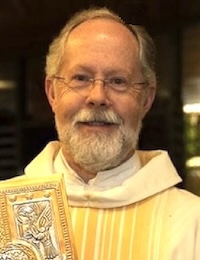
Deacon Peter
McCulloch
(Diocese of Broken Bay)
THE BAPTISM OF THE LORD is the conclusion of the Christmas Season. At the banks of the Jordan River, the sinless Word made flesh, does something astonishing: He takes His place in the line of sinners, waiting to be baptized by John. He stands with them, not apart from them.
As He rises from the water, the heavens are torn open, the Spirit descends, and the Father’s voice names Him: “This is my beloved Son, with whom I am well pleased.” This is His anointing, His commissioning for public ministry. That same voice once spoke over each of us at our own baptism, naming us “beloved” and sending us on mission.
As St. John Paul II said,
“Before any vocation or ministry, there is baptism — the source of our dignity and the root of all service.”
For the deacon, this feast is the very source of his identity. His ordination flows from his baptism. His entire ministry is an extension of that one moment: being named “beloved” and being “sent” to serve.
AT THE FONT
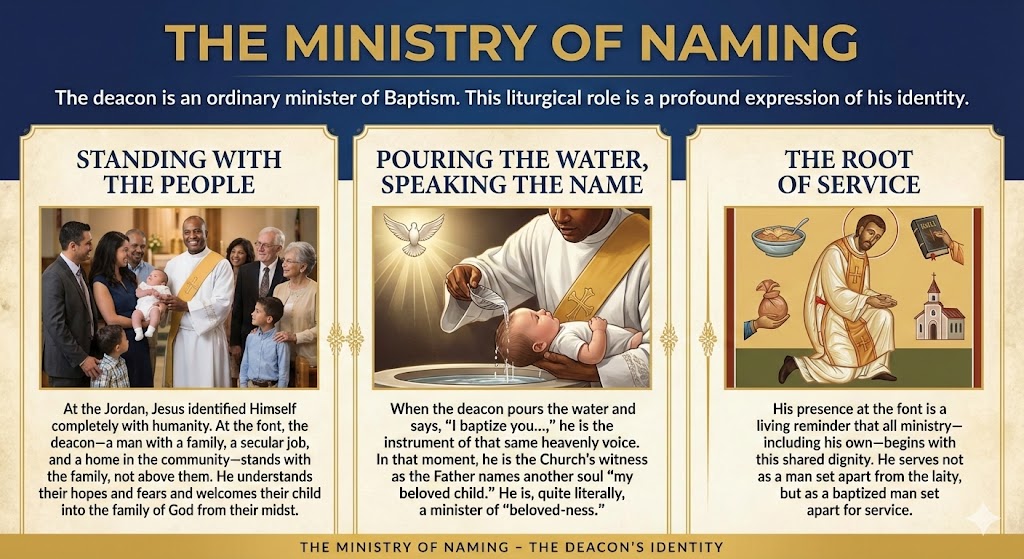
The deacon is an ordinary minister of Baptism. This liturgical role is a profound expression of his identity.
Standing With the People: At the Jordan, Jesus identified Himself completely with humanity. At the font, the deacon—a man with a family, a secular job, and a home in the community—stands with the family, not above them. He understands their hopes and fears and welcomes their child into the family of God from their midst.
Pouring the Water, Speaking the Name: When the deacon pours the water and says, “I baptize you…,” he is the instrument of that same heavenly voice. In that moment, he is the Church’s witness as the Father names another soul “my beloved child.” He is, quite literally, a minister of “beloved-ness.”
The Root of Service: His presence at the font is a living reminder that all ministry— including his own—begins with this shared dignity. He serves not as a man set apart from the laity, but as a baptized man set apart for service.
IN THE PARISH
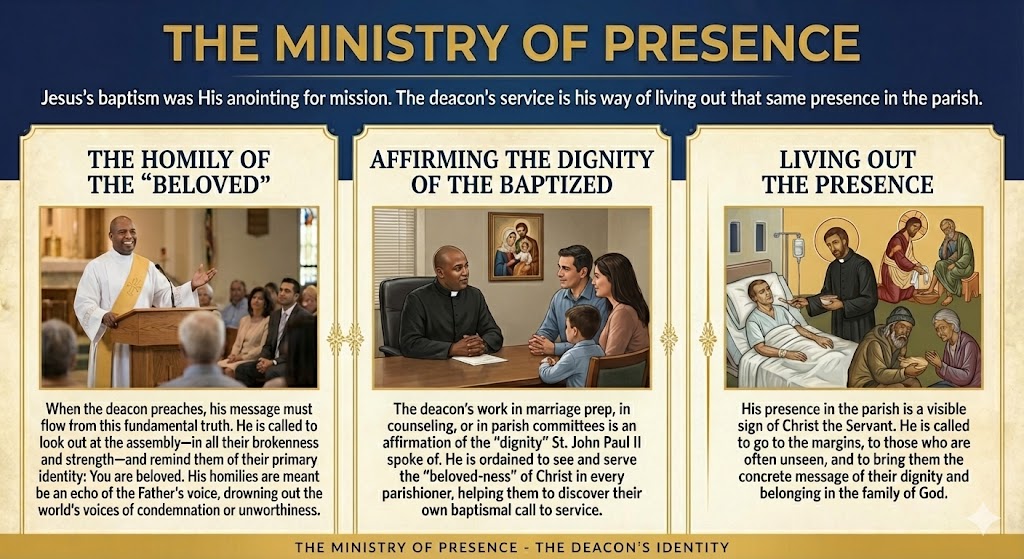
Jesus’s baptism was His anointing for mission. The deacon’s service is his way of living out that same mission in the parish.
The Homily of the “Beloved”: When the deacon preaches, his message must flow from this fundamental truth. He is called to look out at the assembly—in all their brokenness and strength—and remind them of their primary identity: You are beloved. His homilies are meant to be an echo of the Father’s voice, drowning out the world’s voices of condemnation or unworthiness.
Affirming the Dignity of the Baptized: The deacon’s work in marriage prep, in counseling, or in parish committees is an affirmation of the “dignity” St. John Paul II spoke of. He is ordained to see and serve the “beloved-ness” of Christ in every parishioner, helping them to discover their own baptismal call to service.
AT THE MARGINS
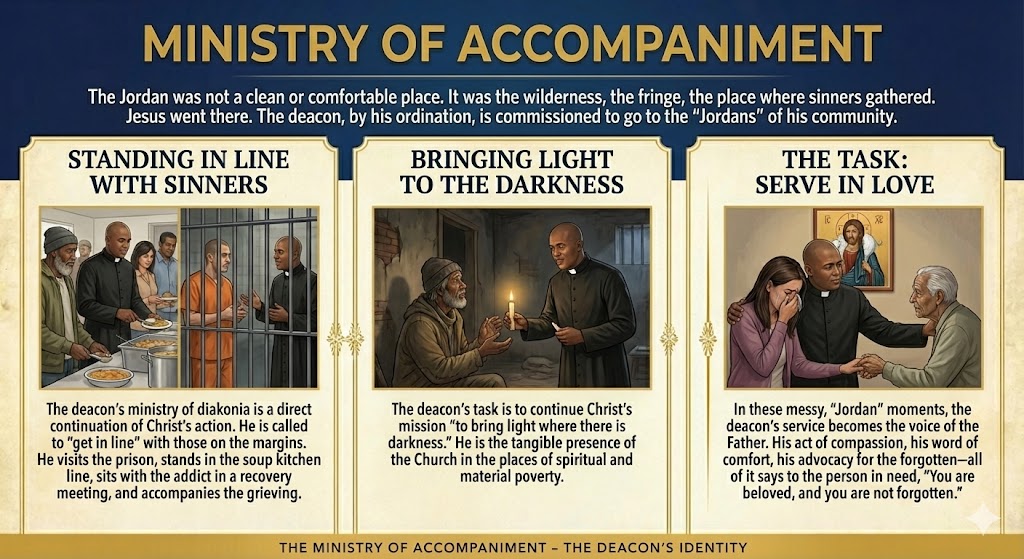
The Jordan was not a clean or comfortable place. It was the wilderness, the fringe, the place where sinners gathered. Jesus went there. The deacon, by his ordination, is commissioned to go to the “Jordans” of his community.
Standing in Line with Sinners: The deacon’s ministry of diakonia is a direct continuation of Christ’s action. He is called to “get in line” with those on the margins. He visits the prison, stands in the soup kitchen line, sits with the addict in a recovery meeting, and accompanies the grieving.
Bringing Light to the Darkness: The deacon’s task is to continue Christ’s mission “to bring light where there is darkness.” He is the tangible presence of the Church in the places of spiritual and material poverty.
The Task: Serve in Love: In these messy, “Jordan” moments, the deacon’s service becomes the voice of the Father. His act of compassion, his word of comfort, his advocacy for the forgotten—all of it says to the person in need, “You are beloved, and you are not forgotten.”
The Feast of the Baptism gives the deacon both his name and his task. His name is Beloved. His task is to serve in love, empowered by the Spirit, to reveal to all the world that they, too, are the Father’s “beloved” children.