
Theology of Work
Theology of Work
Theology of Work

Different
Perspectives
on the Sunday
Readings
Theology of Work
First Reading | Second Reading | Gospel
VERSE BY VERSE COMMENTARY
TOP OF PAGE First Reading | Second Reading | Gospel

FOCUS: Theology of Work
Verse 3b: "The lamp of God was not yet extinguished, and Samuel was sleeping in the temple of the LORD where the ark of God was."
The lamp of God symbolizes the presence of God and his guidance. Even though Samuel was asleep in the temple, he was still close to the divine presence.
This highlights the importance of maintaining spiritual awareness in our place of work or the workplace. Just as Samuel remained attentive to God's presence despite being physically present in the temple, we should carry our faith into our workplace and be conscious of God's guidance.
Verse 4: "The LORD called to Samuel, who answered, 'Here I am.'"
God calls out to Samuel, who responds wholeheartedly by saying, "Here I am."
This verse emphasizes the importance of attentiveness and openness to God's call, even in our work and professional lives. When God calls, we must be ready to respond, seeking to discern his will and obediently following it. Saint John Paul II, in his encyclical "Laborem Exercens," emphasizes that work is a way through which we fulfill our vocation and participate in God's creative and redemptive work. Samuel's response reflects this understanding, as he is aware of his calling and actively engages in his work within the service of God.
Verse 5: "Samuel ran to Eli and said, 'Here I am. You called me.' 'I did not call you,' Eli said. 'Go back to sleep.' So he went back to sleep."
Samuel mistakenly assumed that Eli, his mentor, was calling him, showing that he was still learning to discern God's voice clearly.
The workplace sometimes presents us with various voices and distractions that can hinder our ability to discern God's will. This verse reminds us of the importance of discernment and seeking wise counsel in making decisions related to our work and workplace ethics.
Verses 6-10: "Then the LORD called Samuel again, who rose and went to Eli. 'Here I am,' he said. 'You called me.' But Eli answered, 'I did not call you, my son. Go back to sleep.' At that time Samuel was not familiar with the LORD, because the LORD had not revealed anything to him as yet. The LORD called Samuel again… Then Samuel answered, 'Speak, for your servant is listening.'"
After multiple attempts, Samuel finally recognizes that it is God calling him, and he is ready to listen.
This passage highlights the importance of prayerful discernment, patience, and persistence in recognizing and responding to God's voice. As we navigate our work and workplace realities, we must continually cultivate a disposition of prayerful listening to God's call. In our workplace, prayer can transform our minds and hearts, helping us discern God's will and make ethical decisions. The Catechism of the Catholic Church states, "Prayer is a vital necessity. It is a pure and transforming intimacy with God (CCC 2567)."
Verse 19: "Samuel grew up, and the LORD was with him, not permitting any word of his to be without effect."
Samuel's faithfulness to God's call and his willingness to listen led to his spiritual and professional growth.
This verse emphasizes the importance of integrating faith and work, as Samuel's words and actions were guided by God's presence. When we align our work with God's principles, seeking his guidance in decision-making, our efforts bear fruit, both spiritually and professionally. Saint John Paul II wrote in Laborem Exercens: "Work is a good thing for man – a good thing for his humanity – because through work, man not only transforms nature, adapting it to his own needs but also achieves fulfillment as a human being and indeed, in a sense 'becomes more a human being'. (LE 24)" This highlights the transformative nature of work when it is undertaken in accordance with God's will and values.
SOURCE: Content written in collaboration with OpenAI's GPT-3.5 model. If you find an error or would like to add content or edit page, don't hesitate to use contact button below. Excerpts from the Lectionary for Mass for Use in the Dioceses of the United States of America, second typical edition © 2001, 1998, 1997, 1986, 1970 Confraternity of Christian Doctrine, Inc., Washington, DC. Used with permission.
TOP OF PAGE First Reading | Second Reading | Gospel

FOCUS: Theology of Work
Verse 13c-15a: "The body, however, is not for immorality, but for the Lord, and the Lord is for the body; God raised the Lord and will also raise us by his power. Do you not know that your bodies are members of Christ?" (1 Corinthians 6:13c-15a, NAB)
These verses remind us that our bodies are not merely instruments for pursuing our own desires, but they belong to the Lord.
As Catholic Christians, we are called to view our bodies as gifts from God and to align our lives and work with His divine purpose. Saint John Paul II in his encyclical Laborem Exercens stated, "Work is a good thing for man - a good thing for his humanity - because through work man not only transforms nature, adapting it to his own needs, but he also achieves fulfillment as a human being" (LE 9). From a theological perspective, work takes on a deeper meaning when we understand it as an opportunity to participate in God's creative and redemptive work in the world.
Verse 17: "But whoever is joined to the Lord becomes one spirit with him."
This verse reminds us of the spiritual unity we have with the Lord when we surrender our lives, including our work, to Him.
When we align our work with God's plan and seek to serve Him in all that we do, we become united with Him in purpose and mission. The Compendium of the Social Doctrine of the Church teaches, "In work, thanks to the subjection of the whole physical and mental potential of man to man himself and to the needs of others, man exercises and fulfills the dignity of his being made in the image of God" (CSDC 264). Our work, when undertaken with the right intention and oriented towards the common good, becomes a means for us to express our dignity as co-creators with God.
Verse 18-20: "Avoid immorality. Every other sin a person commits is outside the body, but the immoral person sins against his own body. Do you not know that your body is a temple of the Holy Spirit within you, whom you have from God, and that you are not your own? For you have been purchased at a price. Therefore, glorify God in your body."
These verses emphasize the connection between our bodies, our actions, and our spiritual lives.
In the context of work, these words call us to ethical behavior and integrity. Our bodies, temples of the Holy Spirit, should be respected in every aspect of our lives, including our professional endeavors. Pope Benedict XVI affirms this perspective, stating, "The relationship between labour and the veneration of the person acquires special importance in the context of work. Man's productivity, his achievements…all this is collected and safeguarded in the vital context of work" (CV 41). When we recognize the dignity of our own bodies and the bodies of others in the workplace, we are inspired to practice ethical business practices, fair treatment of employees, and just compensation.
SOURCE: Content written in collaboration with OpenAI's GPT-3.5 model. If you find an error or would like to add content or edit page, don't hesitate to use contact button below. Excerpts from the Lectionary for Mass for Use in the Dioceses of the United States of America, second typical edition © 2001, 1998, 1997, 1986, 1970 Confraternity of Christian Doctrine, Inc., Washington, DC. Used with permission.
TOP OF PAGE First Reading | Second Reading | Gospel

FOCUS: Theology of Work
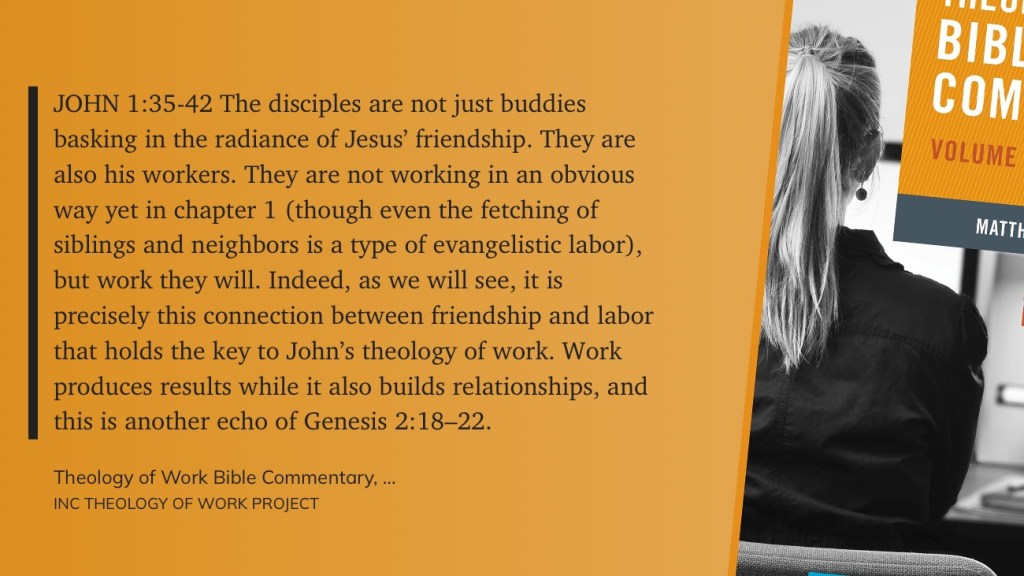
Verse 35: "The next day John was there again with two of his disciples."
John the Baptist, a significant figure in the Gospel of John, is with his disciples, who have been following him and learning from him.
This verse reminds us of the importance of discipleship and the role of mentorship in the context of work. Just as John guides his disciples, mentors can provide guidance, support, and teachings to those embarking on a professional journey. In his book "Work Matters: Connecting Sunday Worship to Monday Work," Tom Nelson writes, "Work becomes a sacred calling when we look beyond the mundane exterior and see the spiritual value and significance, the noble attributes, noble purpose, and intrinsic goodness of work."
Verse 36: "When he saw Jesus passing by, he said, 'Look, the Lamb of God!'"
John the Baptist recognizes Jesus and points him out to his disciples. This verse emphasizes the importance of discerning and acknowledging the presence of Christ in our work and professional lives. When we recognize Jesus in our vocations, we can approach our work with a sense of purpose, calling, and dedication. Dorothy Sayers, a Christian writer, once said, "Work should be a calling, a vocation in which we recognize our own dignity and respond with joy."
Verse 37: "When the two disciples heard this, they followed Jesus."
The disciples, upon hearing John's recognition of Jesus as the Lamb of God, decide to leave John and follow Jesus.
This verse illustrates the transformative power of encountering Christ in our work. When we encounter Jesus in our professional lives, we may be prompted to make significant changes, redirect our efforts, or follow a new path that aligns more closely with our faith and convictions. In his book "Every Good Endeavor," Timothy Keller states, "A Christian understanding of work sees it as a means to serve others, to advance community, and to bring glory to God."
Verse 38: "Jesus turned and saw them following him and said to them, 'What are you looking for?' They said to him, 'Rabbi' (which translated means Teacher), 'where are you staying?'"
Jesus recognizes the disciples' presence and engages them in conversation, asking them what they are seeking.
This verse highlights the importance of intentionality and purpose in our work. Jesus's question invites the disciples to clarify their intentions and desires, prompting them to reflect on their reasons for following him. Similarly, in our own work, it is essential to regularly examine our motivations, ensuring that they align with our values and God's calling. Frederick Buechner, an American writer and theologian, said, "The place God calls you to is the place where your deep gladness and the world's deep hunger meet."
Verse 39: "He said to them, 'Come, and you will see.' So they went and saw where he was staying, and they stayed with him that day."
Jesus invites the disciples to join him and see for themselves where he is staying. When they accept his invitation, they have the opportunity to spend time with him and learn from him.
This verse emphasizes the significance of spending time in the presence of Christ through prayer, meditation, and reflection. Similarly, in our work, it is crucial to carve out dedicated time to be in God's presence, seeking wisdom, guidance, and inspiration. Vatican II teaches in Gaudium et Spes, "For without the Creator, the creature would disappear. For their work, prayers, and apostolic endeavors, their ordinary married and family life, their daily labor, their mental and physical relaxation, if carried out in the Spirit, and even the hardships of life, if patiently borne—all of these become spiritual sacrifices acceptable to God through Jesus Christ."
Verses 40-42: "Andrew, the brother of Simon Peter, was one of the two who heard John and followed Jesus. He first found his own brother Simon and told him, 'We have found the Messiah,' which is translated Christ. Then he brought him to Jesus. Jesus looked at him and said, 'You are Simon the son of John; you will be called Cephas,' which is translated Peter."
Andrew, upon experiencing the presence of Jesus, is eager to share this revelation with his brother Simon.
This passage highlights the importance of evangelization and sharing the good news in our workplaces. When we encounter Christ in our work, we have an opportunity to invite others to experience his transformative power. In his apostolic exhortation "Evangelii Gaudium," Pope Francis reminds us that evangelization is a responsibility for all Christians, stating, "In virtue of their baptism, all the members of the People of God have become missionary disciples."
SOURCE: Content written in collaboration with OpenAI's GPT-3.5 model. If you find an error or would like to add content or edit page, don't hesitate to use contact button below. Excerpts from the Lectionary for Mass for Use in the Dioceses of the United States of America, second typical edition © 2001, 1998, 1997, 1986, 1970 Confraternity of Christian Doctrine, Inc., Washington, DC. Used with permission.
HOME | COMMENTARY | BIBLE STUDY | CONNECTIONS
