Fr. Tony’s Homily starters, anecdotes and life messages with infographics for use in parish bulletins, presentations, bible studies, and teaching @ Fr. Tony’s Homilies. Easter Sunday Acts 10:34a, 37-43 Colossians 3:1-4 or 1 Cor 5:6b-8 John 20:1-9

Fr. Tony’s Homily, Life Messages, Homily Starters, Anecdotes

Homily Starters, Fr. Tony’s Homily

Homily Starters, Fr. Tony’s Homily

March 8, 2026

April 5, 2026

Easter Sunday

Text header reading 'Fr. Tony's Homily' in bold, uppercase letters.

⬅️ ➡️

  • ANECDOTES
  • EXEGESIS
  • LIFE MESSAGES

Easter Sunday

History and Faith

YouTube player
VISUAL AID

Cape of Good Hope

You may remember a geography lesson from elementary school in which you learned that the southernmost point of Africa is a point which for centuries has experienced tremendous storms. For many years no one knew what lay beyond that cape, for no ship attempting to round that point had ever returned to tell the tale. Among the ancients it was known as the “Cape of Storms,” and for good reason. But then a Portuguese explorer in the sixteenth century, Vasco De Gama, successfully sailed East around that very point and found beyond the wild raging storms, a great calm sea, and beyond that, the shores of India. The name of that cape was changed from the Cape of Storms to the Cape of Good Hope. Until Jesus Christ rose from the dead, death had been the “cape of storms” on which all hopes of life beyond death had been wrecked. No one knew what lay beyond that point until, on Easter morning, Jesus arose. The ancient visions of Isaiah were really foretelling the victory of Jesus over our last great enemy.

Like those sixteenth century explorers, we can see beyond human death to the hope of Heaven and eternal life with the Father. More than that, we dare to believe that we shall experience in our own human lives exactly what the Son of God experienced in His, for the Risen Christ says to us, “Because I live, you shall live also.” This is the heart of our Faith.


Easter Sunday

Black Holes

YouTube player
VISUAL AID

From Deep Darkness to Easter Hope

Have you ever heard of a “black hole”? If you have ever watched movies or TV programs about travelling in outer space, like the TV series Star Trek, you will know what a black hole is. Roughly speaking, it is a spot in the vastness of space, which astronomers believe is like a giant vacuum or whirlpool sucking everything around it into the hole. Using Newton’s laws, scientists first theorized black holes in the 1790s but it wasn’t until 1994 that the Hubble Space Telescope discovered a massive supersized black hole – fortunately a long way from our own galaxy. There is also a black hole in our galaxy, the Milky Way. What if scientists said that it was not beyond the realms of possibility that one day our sun and everything around it would be sucked into this “black hole,” and everything would be gone?

“Black holes” are symbols of hopelessness, but the message of Easter tells us that there is something beyond those “black holes.” Maybe our personal   “black hole” includes grief for a loved one, anxiety over a work situation or what is happening in our family. Maybe it is a “black hole” of depression and stress, and we feel there is nothing we can do to change what is happening. Maybe it’s the “black hole” of sickness and pain. Maybe it’s the “black hole” of guilt and failure. Whether those “black holes” are right here and now or show up at some time in the future, Easter tells us there is hope, there is a living Saviour and Friend who will help us when we feel as if we have been sucked into the deepest darkness. Easter tells us that there is nothing to fear. We have a Risen Saviour who promises never to leave us, to love us always, always to brighten our darkest paths, and to guide us from death to eternal life in Heaven. Even when we are in the middle of something deep and dark, our Risen Saviour is, and will always be, there — with us. “I am the Living One! I was dead, but now I am alive forever and ever. I have authority over death and the world of the dead” (Rv 1:8). 


Easter Sunday

Standing Up for God

YouTube player


Cassie Bernall

A day after the terrible tragedy at Columbine High, CNN journalist Larry King did a live interview with a teenage girl named Mickie Cain, a student who had witnessed the massacre. Mickie was having a difficult time maintaining her composure and was able to blurt out only a few words before lapsing into uncontrollable sobs. Larry King was patient and gave her plenty of time to regain her composure. Mickie recounted the chilling story: “Let me tell you about my friend Cassie,” she said. “[Cassie] was amazing . . . She completely stood up for God when the killers asked her if there was anyone [in the classroom] who had faith in Christ. She spoke up [and said she did] and they shot her for it.” [Franklin Graham, The Name (Nashville, TN: Thomas Nelson, Inc., 2002), pp. 14-15].

Such a testimony as Cassie made that day makes our witness look pretty pathetic, doesn’t it? The critical question is, would you make such a sacrifice for something that you knew was patently untrue? Of course not. And neither would those early disciples of Christ. They had met Christ, risen from the grave, and they would not testify otherwise, even while being tortured. The witnesses are so credible, the change in their lives so dramatic, that their testimony cannot be disregarded.

Significance of Easter

“Easter” literally means “the feast of fresh flowers.” Easter is the greatest and the most important feast in the Church for four reasons:

1) The Resurrection of Christ is the basis of our Christian Faith. It is the greatest of the miracles, for it proves that Jesus is God. That is why St. Paul writes: “If Christ has not been raised, then our preaching is in vain; and your Faith is in vain” (I Cor 15:14). “Jesus is Lord!, He is risen!” (Rom 10:9), was the central theme of the kerygma (or “preaching”), of the Apostles

2) Easter is the guarantee of our own resurrection. Jesus assured Martha at the tomb of Lazarus: “I am the resurrection and the life; whoever believes in me will live even though he dies…” (Jn 11:25-26).

3) Easter is a feast which gives us hope and encouragement in this world of pain, sorrows and tears. It reminds us that life is worth living. It also gives us strength to fight against temptations and freedom from unnecessary worries and fears.

4) Easter gives meaning to our prayers: It supports our belief in the Real Presence of the Risen Jesus in and around us, in His Church, in the Blessed Sacrament, and in Heaven, hearing our prayers, and so gives meaning to our personal as well as our communal prayers.


15 Logical Reasons to Believe in the Resurrection

by Mark Hart

Many people will tell you that “based on human logic” the Resurrection makes no sense. The first thing we need to remember is that “human logic” is not omnipotence. God makes it very clear that “(His) ways are not our ways, nor are His thoughts our thoughts” (Isaiah 55:8-9).

What is illogical is to think that “man” is the center of the universe. The truth is that Christianity is far more logical than many people give it credit for, certainly more logical than atheism or agnosticism.

The second thing we should remind people of is that any conversation about God is going to necessitate a degree of Faith. If people are not willing to humbly admit that they don’t have all the answers, then the conversation will go nowhere. God’s Truth and human pride do not co-exist in the same space; that is the nature of sin. Humility and grace go hand-in-hand, as do pride and sin. So, let’s remember that any conversation about the existence of God or the truth about Christ’s resurrection necessitates a humble admission that “it is possible that God exists” and that “we are not God.”

When it comes to Easter Sunday, however, and the glorious truth about the Resurrection, to say that there is no logical truth to this belief, is not only ignorant, it is absurd. Here are 15 very quick facts that point to the truth of the Resurrection. These are not exhaustive or highly detailed; they are quick points that further strengthen what humble-hearted believers take on Faith:

1. There was an empty Tomb

The founders of other “faiths” are buried in tombs or had their ashes sprinkled over foreign lands. Not Jesus. Modern scholars and directors can claim what they want on their cable specials . . .  the truth is that the tomb was empty.

2. The Tomb had a Roman seal

Clay was affixed to a rope (stretched across a rock) and to the tomb, itself. The Roman seal was pressed into the clay. Break the seal, you break the law; break the law – you die.

3. The Tomb had a Roman guard stationed there

The “guard” was at least four men, possibly more, of highly trained soldiers. These soldiers were experts in torture and in combat, not easily frightened off by a band of fishermen and tax collectors. Had they fallen asleep or left their post they would have violated the law, resulting in their own execution.

4. The Tomb had a stone in front of it

Most scholars put the weight of the stone at about 2 tons (4000 pounds), probably at least seven or eight feet high. This was definitely a “team lift” or “team roll,” not movable by just one or two men.

5. There were post-resurrection appearances, to hundreds

Over a span of six weeks, He appeared to a variety of groups of various sizes in different locations. He appeared to over 500 at one point – a huge number to be an outright fabrication. Not to mention, the people whom He appeared to didn’t just see Him, but ate with Him, walked with Him, touched Him. Jesus even made breakfast (John 21:9) at one point.

6. The martyrdom of witnesses offers proof

Would people leave their businesses, careers, homes and families, go to the ends of the earth, die horribly gruesome and painful deaths and forsake their previous religious beliefs about salvation all to protect a lie? Not one of them, while being beheaded, fed to lions, boiled in oil, crucified upside down or burned alive changed their story. Instead, they sang hymns of trust and praise, knowing that the Lord who defeated death would raise them up, too.

7. There is still a Church

If the Resurrection were a lie it would have died off centuries ago. The Christian Church is the largest institution of any kind in the history of humanity. This Church began with the apostles following Pentecost, the year Christ rose. It has conquered empires, withstood attacks (inside and out) and grown in spite of the sinfulness of its members, because it was founded by Christ, Himself, and is guided and protected by the Holy Spirit. The Church, like Christ, is both human and divine.

8. Jesus prophesied that it was going to happen

Jesus told people that it was going to happen. It didn’t take Him by surprise. And He didn’t just say “I’m going to be killed” (which others might have seen coming) but also that “I’m going to rise on the third day.” Those details aren’t ironic, coincidental or fortune-telling — they’re called prophecy and true prophecy comes from God, Himself.

9. It was prophesied in the Old Testament

It was foretold centuries before Christ Himself was born or lived it out. Hundreds of prophecies about the Messiah, what He would say, do, live like and how He would die… were offered centuries apart by people God selected (most of whom never met one another, by the way). Isaiah, Jeremiah, Zechariah, Hosea, and Micah (just to name a few) all pointed to Christ’s death and Resurrection hundreds of years before these occurred.

10. The day of worship changed

Following the Resurrection, tens of thousands of Jews (almost overnight) abandoned the centuries old tradition of celebrating the Sabbath on the last day of the week and began worshipping on the first day of the week the day on which the Lord, the Christ, beat death sealing the new and final covenant with God.

11. The practices of sacrifice changed

Jews were always taught (and taught their children… Deuteronomy 6) that they needed to offer an animal sacrifice once a year, to atone for their sins. After the Resurrection, the Jewish converts of the time, throngs of them, stopped offering animal sacrifices to God.

12. It is unique among other world religions

No other religious leader of any consequence ever actually claimed to be God, except Jesus. No other religious leader ever did the things Christ did. No other religious leader ever backed up his “religious voice” with Resurrection. Confucius died. Lao-tse died. Buddha died. Mohammed died. Joseph Smith died.  Christ rose from the dead.

13. The message is self-authenticating

This proof goes back to the original point, namely, that a humble heart is enlightened and illuminated by far more than logic or reason. A true believer doesn’t need all the facts to believe in the Resurrection, because the Holy Spirit reveals Christ to us, intimately and powerfully. St. Paul talks about this in 2 Corinthians 4. Blind and hardened hearts will never see God, not until they acknowledge that they are not God.

14. The miraculous ending fits a miraculous life

You want logic? Christ healed the blind, the deaf and the dumb. He fed the masses, cured the lepers, and forgave the sinners. He made the lame walk and brought others back to life. He multiplied food, walked on water, calmed storms, and exorcised demons with His mere voice. The miracle of Good Friday is that He didn’t call on a miracle. He died. The miracle of Easter Sunday is that He rose from the dead – a miraculous “end” to a miraculous life. What else should we expect?

15. (and the only answer we really need) . . .  Jesus is still the answer

The world cannot offer any cure for suffering. The world can ignore it, berate it, debate it, bomb it, and medicate it . . .  but there is no cure or point to suffering separated from Jesus Christ. In Christ, our suffering has a point and it has worth. Apart from Christ, suffering is pointless and fruitless. There is no fountain of youth. There is no miracle drug. There is no cure for death except Jesus Christ. What is illogical is to think that the God of life would not want us to live eternally.

The only reason to think the Resurrection is illogical is if you believe this life is your only one. This blog is not intended to begin debates or tear people apart. This is a very quick reminder to all of us Christians who might get too “logical” from time to time (myself included), that the Resurrection is not illogical. That being said, all of us who do tend to be too logical might want to take a deep breath in contemplative prayer this weekend and really lean back in to the beautiful truth and reality of the crucifixion and Resurrection.

” How can some among you say there is no Resurrection? If Christ has not been raised, then empty is our preaching; empty, too, your Faith; if Christ has not been raised than your Faith is in vain; you are still in your sins.” (1 Corinthians 15:12-18)

Brothers and Sisters, because of what happened in that Upper Room, on that cross, and in that tomb 2000 years ago, we know God the Father intimately, we walk with Christ daily, and we are guided by the Holy Spirit eternally. That’s the truth, and what a beautiful truth it is. (John 8:32)

1st Reading | 2nd Reading | Gospel

i need something grand that is visually appealing. create 8.5×11 infographic with large sweeping photo realistic images that span the page either vertically or horizontally and with large bold arial fonts.

[Overall Constraint]: Create a photorealistic infographic on an 8.5×11 inch page with a grand, sweeping, cinematic design.

[Main Title]: The title at the top in massive, bold, gold and white Arial font is: “[YOUR MAIN TITLE HERE]”.

[Top Section – Full Width]: Below the title, a dramatic, full-width photorealistic image captures [DESCRIBE THE EPIC TOP SCENE – e.g., a mountain peak at sunrise with blinding light]. A large, transparent banner across this section reads in bold Arial text: “[YOUR TOP SECTION SUMMARY OR THEOLOGICAL POINT]”.

[Middle Section – Split Panel]: The middle section is a sweeping image split vertically down the center by a subtle divider.

Left Panel: On the left, a photorealistic scene shows [DESCRIBE SCENE A – e.g., Moses at the burning bush]. A banner above/below it reads: “[TITLE FOR SCENE A]”. Below that, bold text overlay states: “[DESCRIPTIVE TEXT FOR SCENE A]”.

Right Panel: On the right, a contrasting photorealistic scene shows [DESCRIBE SCENE B – e.g., Elijah in the cave with wind and fire]. A banner above/below it reads: “[TITLE FOR SCENE B]”. Below that, bold text overlay states: “[DESCRIPTIVE TEXT FOR SCENE B]”.

(Optional Central connector): A central banner connects the two panels reading: “[TEXT LINKING THE TWO CONCEPTS]”.

[Bottom Section – Full Width]: The bottom section is another sweeping, emotional photorealistic image showing [DESCRIBE THE FINAL SCENE – e.g., modern people walking towards a light, or a biblical conclusion]. A large banner reads: “[YOUR FINAL THEOLOGICAL CONCLUSION OR CALL TO ACTION]”. Below it, bold text overlay reads: “[SUPPORTING SCRIPTURE REFERENCE OR FINAL THOUGHT]”.

[Style Summary]: All text must be in large, bold, clear Arial font, using a color palette of gold, white, and deep rich tones (blues, purples, earth tones) against atmospheric backgrounds. The entire image must have a cinematic, epic quality with dramatic lighting, vast landscapes, and high detail.

SHOW/HIDE TEXT

In the middle section of the book of the prophet Isaiah, chapters 40-55, there are four short passages which scholars have called the Songs of the Suffering Servant.  Today’s first reading is the third Servant Song. These four songs are about a mysterious figure whose suffering brings about a benefit for the people.  In the original author’s mind, the servant was probably a figure for the people of Israel, or for a faithful remnant within the people. The Songs portrayed the antithesis of Israel’s messianic expectations, because Israel expected a triumphant Messiah while the prophet foresaw a “suffering servant” Messiah. Jesus saw aspects of his own life and mission foreshadowed in the Servant Songs, and the Church refers to them in this time of solemn meditation on the climax of Jesus’ earthly life. These songs foretell Jesus’ conscious, active choice to remain faithful to his saving mission no matter what the cost: “I have not … turned back” and “I gave my back to those who beat me.” The kingship of Jesus was to mean suffering and humiliation, not just publicity and grandeur. In today’s Responsorial Psalm, (Ps 22), the Psalmist puts his trust in Yahweh for deliverance and salvation.  The context of this day’s worship also conveys Jesus’ confidence in God’s protection in the midst of His trial and crucifixion. The passage encourages us to be companions of Jesus in suffering by offering our own sufferings in union with the redemptive sufferings of Christ, so that we may become collaborators in that suffering. The passage also challenges us to accept what we cannot change, so that we may endure the difficulty for as long as it is necessary, just as Christ did.

Personal application of the suffering servant prophecy: This prophecy is  speaking to you and me on at least two levels. First, we meditate on the prophet’s words, and recognize how much suffering  Jesus went through for our salvation. Such meditation can only lead us to love him more and to desire that our will accord with his will at all times. Now at another level, we put ourselves into that prophetic scene. Wherever we see the word “I” or “me” we change that by inserting our own first name. In this way we will see that the Lord is calling us to imitate him. It can be an “aha” moment for us, a sudden understanding and a sudden call for a decision.

Acts 10:34a, 37-43


1st Reading | 2nd Reading | Gospel

Easter Sunday

SHOW/HIDE TEXT

This section of  Paul’s Letter to the Philippians is an ancient Christological hymn representing a very early Christian understanding of Who Jesus is  and how his mission saves us from sin and death.  It is a message that Paul received from those who had been converted to Christ, summarizing ‘the great mysteries of our redemption,’ and it rightly serves as a preview for the events of Holy Week. It describes how Jesus, though Son of God, emptied himself’” of divine glory and “took the form of a slave”—a man like us in all things except sin. Out of love and obedience, he willingly accepted his death, “even death on a cross.” Because Jesus humbled himself and did not cling to any of his special privileges as God’s Son, “God greatly exalted him and bestowed on him the Name which is above all names.”

We are called to have the same attitude of humility and obedience that Christ, our Lord, had. Christians reading this passage today are joining the first people who ever pondered the meaning of Jesus’ life and mission.  We’re singing their song and reciting their creed during this special time of the year, when we remember the most important things Our Lord did. God humbled himself for us! Jesus’ triumph was his self-giving on the cross to open for us the road to the Father. All we can do in response is to bow our heads in awe, and present our loving, contrite hearts to God, begging for mercy. God wants our  heart to be humbled, contrite, and truly repentant because only is that condition is it open,  and so able, to receive His Mercy and His Love.


1st Reading | 2nd Reading | Gospel

Easter Sunday

SHOW/HIDE TEXT

The first part of today’s Gospel describes the royal reception which Jesus received from His admirers, who paraded with Him for a distance of two miles:  from the Mount of Olives to the city of Jerusalem.  Two-and-a-half million people were normally present to celebrate the Jewish feast of Passover.  Jesus permitted such a royal procession for two reasons: 1) to reveal to the general public that He was the promised Messiah, and 2) to fulfill the prophecies of Zephaniah (3:14-19): “Shout for joy, O daughter Zion, …. The King of Israel, the Lord, is in your midst, you have no further misfortune to fear;” and of Zechariah (9:9): “Say to daughter Zion, ‘Behold, your king comes to you, meek and riding on an ass….” The traditional “Palm Sunday Procession” at Jerusalem began in the fourth century AD when the Bishop of Jerusalem led the procession from the Mount of Olives to the Church of the Ascension.

In the second part of today’s Gospel, we listen to/participate in the reading of the Passion of Christ according to Matthew. Jesus’ passion, death, and resurrection constituted the most important aspect of his life and ours. According to Fr.  Raymond E. Brown, “Theologically, Christians have interpreted the death of Jesus on the cross as the key element in God’s plan for the justification, redemption, and salvation of all. Spiritually, the Jesus of the passion has been the focus of Christian meditation for countless would-be disciples who take seriously the demand of the Master to take up the cross and follow him. Pastorally, the passion is the centerpiece of Lent and Holy Week, the most sacred time in the liturgical calendar.” [The Death of the Messiah, Vol. I, (New York: Doubleday1994).] Taking into account the Jewish heritage as well as the increasingly Gentile complexion of his Church, Matthew presents Jesus as the Messiah, foretold in Hebrew Scripture, and as the universal Savior of all peoples.

We are challenged to examine our own lives in the light of some of the characters in the story — like Peter who denied Jesus, Judas who betrayed Jesus, Pilate who acted against his conscience, Herod who ridiculed Jesus, and the leaders of the people who preserved their position by getting rid of Jesus.  God humbled himself for us! All we can do in response is to bow our heads in awe, and present our loving, contrite hearts to God, begging for mercy. God wants a humbled, contrite heart as the sign of our true repentance.


SHOW/HIDE TEXT

Notes on Palm Sunday Events

1) Jesus rides on a lowly donkey:  Doesn’t it seem odd that Jesus would walk 90 miles from the Galilee to Bethany and then secure a donkey for the final two miles to Jerusalem? In those days, Kings used to travel in such processions on horseback during wartime, but preferred to ride a donkey in times of peace.  I Kgs 1:38-41 describes how Prince Solomon used his father David’s royal donkey for the ceremonial procession on the day of his coronation.  Jesus entered the Holy City as a King of Peace, fulfilling the prophecy of Zechariah.  The Gospel specifically mentions that the colt Jesus selected for the procession was one that   had not been ridden before, reminding us of a stipulation given in I Samuel 6:7 concerning the animal that was to carry the Ark of the Covenant.

2) The mode of reception given:   Jesus was given a royal reception usually reserved for a king or military commander.  I Mc 13:51ff describes such a reception given to the Jewish military leader Simon Maccabaeus in 171 BC.  II Mc 10:6-8 refers to a similar reception given to another military general, Judas Maccabaeus, who led the struggle against the Greek Seleucid Emperor, Antiochus IV Epiphanes, and liberated the Temple from pagan control in 163 BC.

3) The slogans used: The participants sang the “Hallel” psalm (Psalm 118), and shouted the words of Psalms 25 and 26.  The Greek word “hosiana” originally meant “save us now” (II Sm 14:4).  The people sang the entire Psalm 118 on the Feast of the Tabernacles when they marched seven times around the Altar of the Burnt Offering.  On Palm Sunday, however, the people used the prayer “Hosanna” as a slogan of greeting.  It meant “God save the king of Israel.”

4) The symbolic meaning of the Palm Sunday procession: Nearly 25,000 lambs were sacrificed during the feast of the “Pass Over,” but the lamb which was sacrificed by the High Priest was taken to the Temple in a procession four days before the main feast day.  On Palm Sunday, Jesus, the true Paschal Lamb, was also taken to the Temple in a large procession.

5) Reaction of Jesus:  Before the beginning of the procession, Jesus wept over Jerusalem (Lk 19:41-42), and when the procession was over, he cleansed the Temple (Lk 19:45-46).  On the following day, he cursed a barren fig tree. Jesus cursed a fig tree for lying with its leaves. It looked good from the outside, but there was nothing there. Surely, he must have intended a reference to the Temple. The religious folk of his day were impotent and infertile. They had taken a good thing, religion, and made it into a sham.


Message #2


Message #3

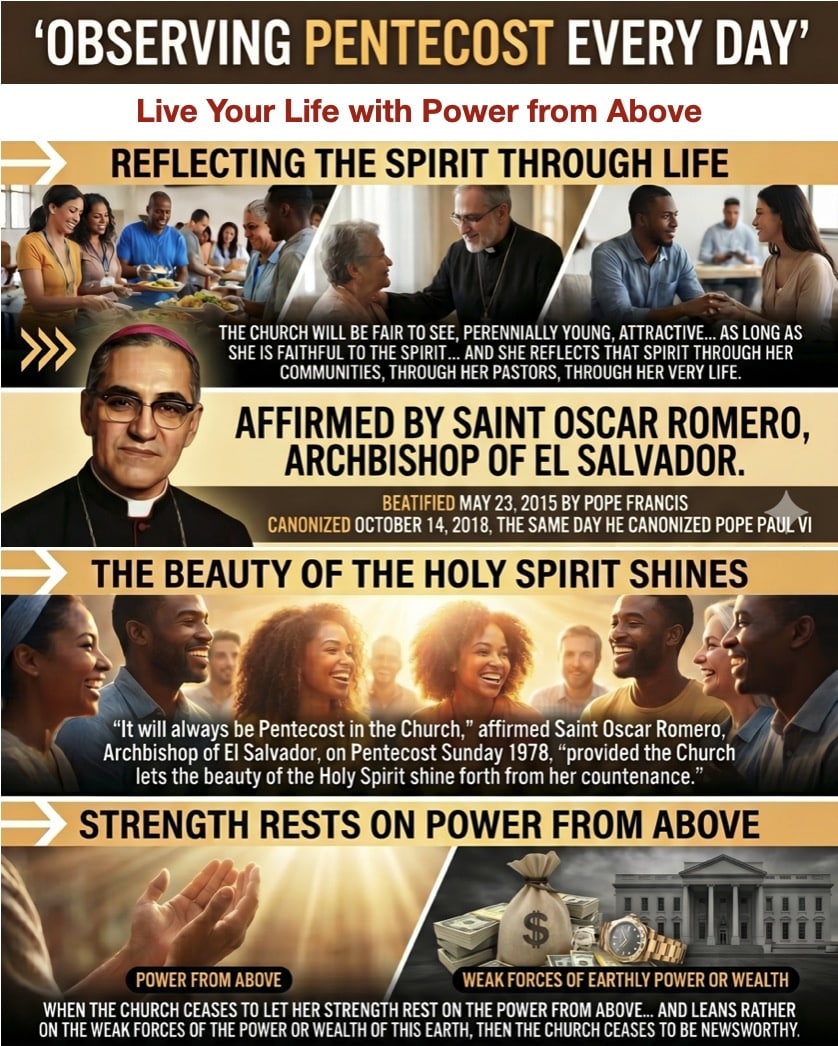
Infographics were created using Google Gemini 3 and Nano Banana Pro. Inspiration take from Fr. Tony’s Homilies; Non-profits may freely use this infographic in their publications and/or ministry. Please give credit or a shout out to TheWordThisWeek.NET.