June 16, 2024

Study | Preach | Teach

Bible Study

Bible Study

COMMENTARYBIBLE STUDYTIPS FOR LECTORS

Matt ZemanekFr. Geoffrey PlantFr. Bryan KujawaKeith Nester

Matt Zemanek

YouTube player

SOURCE: St. Timothy Catholic Church, Laguna Niguel, CA

Living an ordinary life with extraordinary faith can lead to sainthood, as the Holy Spirit works through us in ways we may not understand.

SUMMARY w/ Timestamps
  • 00:00 Jesus performs signs and miracles, teaches through Parables to address misconceptions and opposition, and explains unique parables to his disciples and followers.
    • Join us for our weekly bible study on the upcoming Sunday Gospel reading, and connect with our community by liking, commenting, and subscribing to our channel for new Bible study videos.
    • Prayer for guidance and healing, and a request for prayers for a work conference in Arizona.
    • Jesus quickly gathers his disciples and starts performing signs and miracles, and then shifts into teaching through Parables to address misconceptions and opposition.
    • Jesus teaches parables unique to the gospel of Mark, explaining them to his disciples and others seeking to follow him.
  • 04:25 The kingdom of God is like a seed that grows on its own and becomes something much larger, prompting reflection on our image of God and the importance of spreading the good news of the Gospel.
    • The kingdom of God is like a seed that grows on its own and becomes something much larger.
    • Jesus spoke to the people in parables, but explained everything to his disciples in private, inviting listeners to reflect on what stands out to them personally and bring it to prayer and reflection.
    • The kingdom of God is like a seed that grows on its own and becomes something much larger.
    • Jesus spoke to the people in parables, but explained everything to his disciples in private, inviting the audience to reflect and discuss the passage.
    • Jesus challenges the traditional image of a powerful king by comparing the kingdom of God to a humble farmer scattering seed, prompting reflection on our own image of God.
    • Our image of God can distort our relationship with Him, so it's important to have an accurate image of Jesus and focus on spreading the good news of the Gospel.
  • 11:09 Living an ordinary life with extraordinary faith can lead to sainthood, as the Holy Spirit works through us in ways we may not understand.
    • Living a faithful and ordinary life, being faithful to what God has placed before you, is the modern and universal path to sainthood.
    • Most saints in history were priests, brothers, and sisters, but there are also lay saints like Louis and Z Martin.
    • Live ordinary lives with extraordinary faith, as small actions can manifest the kingdom of God and the Holy Spirit works through us in ways we may not understand.
    • Be receptive to the Holy Spirit, be patient, and things will grow automatically without anxiety.
  • 14:44 Trust in God's plan, have patience, and be faithful in small matters to be entrusted with great responsibilities and opportunities.
    • The growth and development of things take time, and we need to have patience and trust in God's plan.
    • God's goodness is beyond our understanding, but if we have faith and are faithful in small matters, we will be entrusted with great responsibilities and opportunities.
  • 17:06 Jesus aggressively roots out sin and evil, judgment will come for our sins, we will be judged on love alone, trust in God's plan, be faithful, patient, and spread the good news.
    • Jesus is aggressive and intentional in his pursuit to root out sin and evil, and the word "immediately" in the Gospel of Mark signifies the fast-paced nature of his actions and the purpose behind them.
    • The time for judgment of our sins will come, likened to wielding a sickle for the ripe Harvest, as described in Revelation 14 verse 15.
    • We will be judged on love alone and should focus on being faithful and charitable in our current roles, rather than dwelling on the past or worrying about the future.
    • God has already redeemed us, so we should trust in His plan, be faithful in our responsibilities, and be patient for growth, while also spreading the good news to others.
  • 21:11 The mustard seed grows into a large plant, referencing Old Testament prophecies and teaching about the growth of the kingdom of God.
    • The mustard seed, though small, grows into a large plant, reaching heights of 8 to 12 feet.
    • The language used in the Old Testament is invoked in the parable of the Eagles in the vine, reminding people of prophesied events and the coming of the Lord.
    • Small birds will nest under the branches of a cedar, as mentioned in the Gospel reading and in the book of Ezekiel and Daniel.
    • Daniel interprets King Nebuchadnezzar's dream about a tree representing the king's majesty, and Jesus uses the analogy of a mustard seed to teach about the growth of the kingdom of God.
  • 25:09 Pay attention to small invitations in life and seek out the will of God, as they can bear abundant supernatural fruit and give us courage in moments of trial.
    • Every small invitation bears abundant supernatural fruit, so pay attention to the small invitations in life and seek out the will of God in the small ways.
    • Jesus spoke to the crowd but explained everything in private to his disciples, specifically the 12, because they knew who he was.
    • Jesus invites and instructs those who have expressed faith, but withholds some information out of respect for our free will, so that we still have the choice to believe in him.
    • God doesn't want to force us to believe in him, but rather invites us to have faith in the smallest signs, which can then grow into something abundant and give us courage in moments of trial.
  • 28:47 Embrace your role in spreading the good news, prioritize family and faithfulness in marriage, and be faithful in everyday responsibilities to counteract attacks on the family and church.
    • The Parables invite us to fulfill God's mission by spreading the good news and addressing the decline in family and church, including divorce, abuse, single parent households, and neglect of children.
    • The enemy seeks to attack the family and the church, but we can counteract this by promoting the true teachings of the church and embracing our roles in procreation and evangelization.
    • As Catholics, our vocation to marriage should prioritize being open to life and faithful to our family, and by evangelizing and expressing our faith, we can be surprised by the abundant fruit God can bring.
    • The kingdom of God is upside down, and Jesus can make even the smallest, weakest, and most sinful people into faithful saints, including you.
    • Be faithful in your everyday responsibilities and relationships, as they are paths toward evangelization and the supernatural presence of God.

Fr. Geoffrey Plant

YouTube player

SOURCE: Fr. Geoffrey Plant’s Archives

The Kingdom of God is like a mustard seed, starting small and growing through God’s work, challenging us to trust in Jesus and see the value in small actions.

SUMMARY w/ Timestamps
  • 00:00 Jesus teaches parables about the Kingdom of God in the Galilee region, emphasizing its importance to a large crowd near the Sea of Galilee.
    • The gospel of St Mark describes the opposition Jesus faced during his ministry in the Galilee region.
    • Jesus teaches the parables of the sower, the measure, the seed growing, and the mustard seed, emphasizing the importance of the Kingdom of God.
    • Jesus teaches on the northern shore of the Sea of Galilee, with a large crowd gathered around him, possibly at the Bay of Parables, near Capernaum and Tabgha.
    • Jesus may have told the parable of the sower from a boat on the Bay of Parables, which provided a natural amphitheater with perfect acoustics, and it is likely that there was a farmer sowing seeds in the fields above as he spoke.
  • 06:45 The parable of the Kingdom of God is like seeds being sown, with different results based on the type of soil, and Jesus used nature to convey his message in a specific way.
    • The parable of the Kingdom of God is like seeds being sown, with some falling on different types of soil and yielding different results.
    • Jesus used objects from nature in his parables to convey his message in a specific and grounded way.
    • A parable is a metaphor or simile drawn from nature or common life that seeks to illuminate one reality by appealing to something better known, arresting the hearer by its vividness or strangeness, and leaving the mind in sufficient doubt about its precise application to tease it into active thought.
  • 12:15 The Kingdom of God is the power and sovereignty of God, seen in the Lord's Prayer and the clash between God's dominion and Satan's dominion in Mark's gospel.
    • Jesus explains that the Kingdom of God is not a physical place, but rather the power and sovereignty of God, as seen in the Lord's Prayer.
    • Hebrew poetry uses parallelism to express an idea in one line and then repeat the same idea in different words in the next line.
    • God's kingdom comes when His will is done on earth as it is in heaven, and Mark's gospel shows the clash between God's dominion and the dominion of Satan, with the disciples facing opposition and hostility while Jesus works to free human captives from Satan's dominion.
  • 17:36 The Kingdom of God is like a mustard seed, growing beyond human control and starting in small, ordinary ways.
    • The Kingdom of God is compared to a man scattering seed, emphasizing the growth beyond the farmer's control and the negative impact of constant disturbance on seed germination.
    • The growth of God's kingdom is not the result of human effort, but rather a result of faith in God's universal rule, as illustrated by the parable of the mustard seed.
    • God's kingdom begins in small ways and is present in the ordinary and commonplace events of life, symbolized by the mustard bush.
  • 22:03 Trust in Jesus and your small actions can have a big impact, just like a mustard seed.
    • Pope John Paul II preached on the miracle of the loaves and fishes, emphasizing the significance of the smallness of the seed.
    • Place your life in the hands of Jesus, even if you feel inadequate, and remember that even small actions can have a big impact, just like a mustard seed.
  • 24:26 The Kingdom of God is like a mustard seed, starting small and growing through God's work, not ours.
    • God's strength is displayed through our weakness, as seen in the story of a missionary working with the Dalits in India.
    • The Kingdom of God is like a mustard seed, starting small and growing inexorably through God's work, not ours.
  • 28:10 Richard Rich is disappointed at the idea of being a teacher, but Sir Thomas More encourages him to see the value in it.
  • 30:22 St. Thérèse of Lisieux's "little way" and the mustard seed parable show how God's power works in different ways, challenging us to apply their lessons to our lives and the Church.
    • Mother Teresa, founder of the Missionaries of Charity, was known internationally and had a spiritual journey that was different from St. Thérèse of Lisieux.
    • St. Thérèse of Lisieux's "little way" of fidelity in ordinary things, likened to a mustard seed, had a great impact on spirituality and was recognized by Pope John Paul II.
    • St. Thérèse of Lisieux and the mustard seed parable illustrate how God's power works in different ways, challenging us to apply their lessons to our own lives and the Church.

Fr. Bryan Kujawa

SOURCE: Fr. Bryan Kujawa’s Archives. Switch videos using icon in the upper right corner.

YouTube player

SOURCE: Fr. Bryan Kujawa’s Archives Switch videos using icon in the upper right corner.

Studying the scriptures and deepening our roots in the kingdom of God helps us bear good fruit as disciples of Jesus. The Kingdom of God is present on Earth in mystery, and it requires patience, investment, and faithfulness to grow and spread, attracting both saints and sinners.

SUMMARY w/ Timestamps

FIRST READING AND PSALM

  • 00:00 📖 Prepare for Sunday mass by studying the readings and becoming familiar with the word of God.
  • 01:10 🙏 God provides spiritual strength to help us resist temptation and please him with our actions.
  • 03:10 🌲 God will plant a cedar on a mountain and it will bear fruit, symbolizing the restoration and renewal of Israel.
  • 04:28 📖 The people of Israel were taken into exile by Babylon, and the king's betrayal of Babylon and turning to the Egyptians will result in punishment for breaking the covenant, as the Lord will take from the crest of the cedar.
  • 05:58 🌱 Jesus fulfills a Messianic prophecy by bringing forth the grace of God and establishing the kingdom, despite appearing lowly and unexpected.
  • 08:52 📖 The 1st reading and Psalm discuss the Messianic prophecy of a tree bearing fruit, applied to Jesus and the cross as the fulfillment of scriptures.
  • 10:38 🌴 The just person who lives in righteousness will flourish and build the kingdom of God, growing more rooted in the house of God as they age.
  • 12:41 🌱 Being a disciple of Jesus requires discipline and studying the scriptures helps us deepen our roots in the kingdom and bear good fruit.

GOSPEL READING

  • 00:00 🌱 Jesus uses parables to teach about the kingdom of God, comparing it to a growing seed and a mustard seed that becomes a large plant.
  • 01:43 📖 Jesus speaks in parables to reveal and conceal aspects of the Kingdom of Heaven, requiring us to seek his understanding and not rely on our own.
  • 05:04 🌱 The Kingdom of Heaven grows slowly and requires patience and investment, just like a farmer who scatters seed and waits for it to grow.
  • 07:01 📖 The parable of the earth producing of itself shows the growth of the kingdom of God without human power, and Mark's gospel contains unique stories considered the word of God.
  • 08:17 📖 The Kingdom of God is present on Earth in mystery, illustrated by the Parable of the Mustard Seed, showing that it is not always what it seems.
  • 10:47 🌱 The parable of the Mustard Seed teaches that the kingdom of God is meant to spread and attract people, even those who resist it, representing both saints and sinners within the church.
  • 12:57 🌿 Embrace the frustrations of living in the church and find rest in Jesus, remaining faithful amidst imperfection.
  • 14:58 📖 Reflecting on the Gospel and looking forward to sharing the second reading.

Keith Nester

YouTube player

SOURCE: YouTube Video Playlist

The parables in the gospel of Mark convey important truths about the kingdom of God and life, emphasizing the need for understanding, personal transformation, and faith in God’s plan.

SUMMARY w/ Timestamps
  • 00:00 🙏 Parables are used by Jesus and God to convey truths about the kingdom of God and life, with a prayer for understanding the message of the first reading.
    • The podcast discusses the use of parables by Jesus and God to convey truths about the kingdom of God and life.
    • The speaker prays for the ability to hear and understand the message of the first reading.
  • 02:14 🌱 God can humble the proud and elevate the humble, fulfilling promises and missions in ways and times we may not see, but it's about God's purpose.
    • God will take a sprig from a Cedar and plant it on a high mountain, where it will grow and provide shelter for animals and birds, showing that God can humble the proud and elevate the humble.
    • The Parables in the Book of Ezekiel are a prophecy about the coming of Jesus and the creation of an Everlasting Kingdom, which may not make sense to us in the present but will be fulfilled in the future.
    • God's promises and missions may be fulfilled in ways and times we may not see, but it's not about us, it's about God's purpose.
  • 05:41 🌱 Trust in the Lord's plan, have courage to please God, and wait for His plan to come to fruition in our lives.
    • It is good to give thanks to the Lord and trust in His plan, as His truth will flourish and grow in our lives.
    • St. Paul encourages us to have courage and aim to please God, even in the midst of adversity.
    • We must have good courage to follow Jesus in this life, as we are waiting for God's plan to come to fruition.
  • 09:11 🙏 Your actions matter and you will be judged accordingly, so have courage and stand firm in your faith, and understand the importance of reading the Bible and the Parables in the gospel of Mark.
    • Christ has paid our sin debt, but we will be judged and rewarded based on our actions in the body, so don't believe the idea that you don't contribute anything good as a Christian.
    • Your actions matter and you will be judged accordingly, so have courage and stand firm in your faith.
    • The speaker discusses the importance of reading the Bible and understanding the Parables in the gospel of Mark.
  • 11:43 🌱 Faith grows in the heart over time, the Kingdom of God is about heart change, not just intellectual ascent or information.
    • The parable of the mustard seed and the kingdom of God illustrates how faith grows and develops in a person's heart over time.
    • The idea of the kingdom of God coming into a person goes far deeper than just intellectual ascent, it takes root, grows, and bears fruit, which is what theologians often miss when discussing faith.
    • Jesus speaks in parables to reveal the secrets of the Kingdom of Heaven to his disciples, while keeping it hidden from others.
    • Jesus speaks in parables because the message of the Gospel is about heart change, not just the deposit of information.
    • Reformers talk about imputed righteousness, but it's not just about believing the right thing, it's about being covered and changed by the righteousness of Christ.
  • 16:40 🙏 To receive God's grace, understand the meaning behind words, pray in secret, and allow the gospel to take root in your heart.
    • To properly receive God's grace, one must be disposed to understand the meaning behind the words and not just listen to the words themselves.
    • People often try to twist Jesus' words for their own purposes, such as using his teachings on prayer to criticize others.
    • Pray in secret and focus on the true meaning behind the words, rather than using them as a weapon against others.
    • The gospel is not just about acquiring information, but about allowing it to take root in your heart and bear fruit, rather than turning it into a transactional piece of information.
    • Some Christians focus on converting people through a quick sales pitch without considering the impact on the person's life.
  • 21:04 🌱 Jesus communicated the Gospel through parables, emphasizing the importance of deeper understanding and personal transformation.
    • Jesus didn't preach by giving immediate answers, but instead spoke in parables to show that understanding takes time.
    • Jesus communicated the truth of the Gospel through parables, which require deeper thinking and a desire to understand, separating those who truly listen from those who do not.
    • The importance of understanding the deep meaning of Jesus' parables and how they relate to the transformation of the heart.
    • Parables help us see things from different perspectives and invite us to relate to the stories on a personal level.
  • 25:10 🌱 Having an open heart and a willingness to understand is key, as Jesus challenges people to receive grace and repent, emphasizing the importance of eliminating sin and weeds from the heart.
    • The key to understanding is having an open heart and a desire to understand, as those who refuse to move and are unwilling to hear from Jesus have hardened hearts.
    • Jesus tells stories to challenge people to open their hearts and be ready to receive grace and repent.
    • The unforgivable sin is attributing the work of God to Satan, and having an open heart and willingness to understand Catholicism is more important than thinking you know everything.
    • We need to embrace the truth, allow ourselves to be pruned, and continue to bear more fruit in different areas of our lives.
    • The speaker emphasizes the importance of eliminating sin and weeds from the heart in order to prevent them from overtaking and choking out the fruit of faith.
    • Pay attention, open your ears, hearts, and eyes, and God will speak to you, even through the messages of priests during Mass.

Catholic Sunday Scriptures In Context

by Fr. Paul
Galetto, OSA

SOURCE: YouTube Video Playlist

SUMMARY w/ Timestamps
  • 00:00 The Prophet Ezekiel's scripture passage discusses the failure of King Hezakiah.
  • 00:41 God will replant a branch from the top of the Cedar and the people will return to Jerusalem because what God desires to do will happen.
  • 01:25 Paul addresses the problems in the church in Corinth, which was filled with sailors and had issues with pagan rituals and prostitution, in his second letter to the Corinthians.
  • 01:59 The contrast is between temporary and permanent dwellings, and the way to get to heaven is to walk by faith and not by sight.
  • 02:25 Believe in the next world, not this one, and Jesus is on a boat in the Sea of Galilee in the Gospel of Mark.
  • 02:53 The speaker discusses the parables of the sower and the lamp, relating them to different aspects of the kingdom.
  • 03:28 The Kingdom of Heaven is mysterious and everyday, where the insignificant can become powerful and sheltering, much like the mustard plant.
FIRST READING
SECOND READING
GOSPEL

Bulletin
Inserts

by Edrianne Ezel

Michal
Hunt

Agape Bible Study

The Kingdom of Jesus Christ is
the Fruit of the Tree

of Hope and Life

11th Sunday of Year B

The First Reading and the Gospel Reading define the total phenomenon of evil as the Satan (ha satan, “the adversary” in Hebrew), also known as the devil (diabolos, “false accuser” in Greek), the serpent, and Beelzebul.  The Book of Revelation describes this entity of evil as, The huge red dragon, the ancient serpent, who is called the Devil and Satan who deceived the whole world, was thrown down to earth, and its angels thrown down with it (Rev 12:9).

FIRST READING

The Parable of the
Shoot from the Cedar Tree

In the First Reading, God's 6th-century-BC prophet Ezekiel gave a cryptic message of hope to the Jews living in exile in Babylon. He had a prophetic vision and told a parable of the day Yahweh planted a "tender shoot" on a high mountain in Israel. God destined the shoot to become a mighty tree of hope, bearing fruit and offering sanctuary to every kind of bird and winged creature. Centuries later, the faithful came to recognize that the fulfillment of Ezekiel's vision was the wooden tree of the Cross of Jesus Christ, the tree of hope raised high on a mountain and "planted" near the summit of Mt. Moriah in Jerusalem. The people of every nation under Heaven came to receive the gift of salvation under the shadow of the Cross, to find shelter in Christ's New Covenant Kingdom of the Church, and to bear the fruit of righteousness in service to the Lord. 

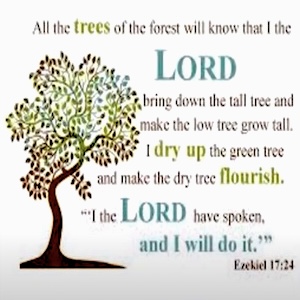
The symbolic imagery in Ezekiel's parable:

  1. The cedar tree is the House of David (verse 22a).
  2. The "tender shoot" is the Davidic Messiah (verse 22b).
  3. The "tender shoot" planted on a high mountain in Israel is Jesus on the Cross outside the gates of Jerusalem, a city 2,500 feet above sea level, located on Mt. Moriah (verse 23a).
  4. The "tree" that grew from the "shoot" is the Church of Jesus Christ (verse 23b).
  5. The "trees of the field" are all the people of the earth (verse 24a).
  6. To bring low the "high" and "green tree" is the humbling of the wealthy, proud, and arrogant, while the lifting up of the "lowly" and "withered tree" is the salvation of the humble and dispossessed (verse 24b).
  7. God's divine plan is for the Church of Jesus Christ to surpass the Kingdom of David and become a new Kingdom of a new creation that will offer shelter to the peoples of all nations and have dominion over all the earth (verse 24c).

READ MORE

Michal E Hunt, Copyright © 2014; revised 2023 Agape Bible Study; used with permission

SECOND READING

Have Courage as
you Prepare to Join the Lord

In today's Second Reading, Paul's message is about the tension between the present and the future. He reminds Christians that the world is not our home, and we are like those living in exile. He tells Christians to persevere in faith courageously. The day will come when everyone will face the Lord's divine judgment. For the faithful, our hope, after a just judgment, is our reunion with the Lord Jesus when He welcomes us as citizens of His heavenly Kingdom.

READ MORE

Michal E Hunt, Copyright © 2014; revised 2023 Agape Bible Study; used with permission

GOSPEL

The Parables of the Seed
that Grows Itself and the Mustard Seed

In the Gospel Reading, Jesus tells two parables to explain the growth of His Kingdom: the Parable of the Seed that Grows Itself (only found in Mark's Gospel) and the Parable of the Mustard Seed. From a small beginning, Jesus's Kingdom of the Universal Church grew to cover the earth, providing shelter, refuge, and comfort to peoples from all nations and allowing them to have a part in God's Divine Plan for humanity. We come to realize that the Cross of Jesus Christ is the true Tree of Life prefigured by the life-giving tree in the sanctuary of the Garden of Eden. What began as a seed of hope planted by the merits of Christ Jesus on the altar of the Cross has grown to become Jesus's sanctuary of the Kingdom of the Universal Church that offers refuge and the hope of a future beyond the present earth-bound life in His heavenly Kingdom. 

Concerning the part God offers faithful Christians to fulfill in His divine plan, the Church's Catechism teaches: "God is the sovereign master of his plan. But to carry it out, he also makes use of his creatures' cooperation. This use is not a sign of weakness but rather a token of almighty God's greatness and goodness. For God grants his creatures not only their existence, but also the dignity of acting on their own, of being causes and principles for each other, and thus cooperation in the accomplishment of his plan" (CCC 306).

Symbolism in the Parable of the Seed that Grows Itself
The landThe Kingdom of God (the Church).
The seedThe word of God "planted" in the fertile hearts of the children of the Kingdom.
The fruit of the seedThe good works of Christians that will develop and bear "fruit" through the process of spiritual growth and maturity.
The harvestThe gathering of souls into God's "storehouse" of Heaven after applying the "sickle" of divine judgment.
Michal E. Hunt Copyright © 2014
Symbolism in the Parable of the Mustard Seed
The tiny mustard seedThe small beginnings of the Kingdom (Church) of Jesus Christ
The mustard seed planted in the earthJesus plants the seed of the Gospel in the hearts of all who accept His message
The amazing growth of the mustard plantThe tremendous growth of the Kingdom of the Church nurtured by the Holy Spirit
The large branches and the creatures that dwell in its shadeThe spread of the Church across the face of the earth, forming many communities (branches) and calling all men and women of every ethnicity to salvation in Christ Jesus
Michal E. Hunt Copyright © 2014

READ MORE

Michal E Hunt, Copyright © 2014; revised 2023 Agape Bible Study; used with permission

Vince
Contreras

Scripture Study

Discussion Questions

11th Sunday of Year B

  • In the 1st Reading, what similarities can you see between this reading and the parable of the mustard seed? What differences can you see (Mk 4:24) and what do you think it means?
  • In the 2nd Reading, St. Paul says his highest desire is to be with the Lord in heaven (Mk 4:8). How great is your love of your earthly life, and how great is your desire to be with the Lord in heaven? Which of these two loves is greater? Whom do you aim to please with the way you live your life?
  • In the Gospel reading, Mk 4:26-29, what part (if any) do people play in the growing Kingdom? How does this parable complement the one in Mark 4:3-20?
  • In Mk 4:30-32, what does the contrasting seed and bush teach about the Kingdom?
  • Does knowing that the growth of the Kingdom is ultimately in God’s hands cause you to rest or to work more? Why?
  • At what stage is the Kingdom in your life now: Still a seed? Sprouting? Outgrowing the weeds? Producing a harvest?

DOWNLOAD PDF

SOURCE: SundayScriptureStudy.com / used with permission