Bible Study Discussion Questions
Bible Study Discussion Questions
Bible Study Discussion Questions
January 25, 2026
January 25, 2026
3rd Sunday of Year A



DOWNLOAD (PDF)

Edrianne Ezell
OUR SUNDAY READINGS offers a weekly PDF handout that can be used in various settings, including church bulletins, Bible study groups, homeschooling, and small group discussions. This resources is provided courtesy of Edrianne Ezell who has a Master of Divinity, Weston Jesuit School of Theology.
Isaiah 8:23—9:3
Reading Closely
1. How do you imagine life in this region? Based on the text, life in the regions of Zebulun and Naphtali (Galilee) appears bleak, oppressive, and heavy. Isaiah describes a people living in "gloom" and "anguish," experiencing a time of being brought into "contempt." They are characterized as walking in "darkness" and dwelling in a "land of deep darkness."
Crucially, the text indicates they are suffering under political or military oppression. They are carrying a physical and psychological weight, described as a "yoke of their burden" and a "bar across their shoulders," suffering under the "rod of their oppressor." Life seems dominated by fear, subjugation, and a lack of hope.
2. What imagery does Isaiah use? Isaiah uses powerful, contrasting imagery to convey his message of future deliverance:
- Light vs. Darkness: This is the central image. The current state of the people is "darkness," "gloom," and "deep darkness." The coming salvation is described as seeing a "great light" that "has shined" upon them.
- Agricultural Joy: He uses the imagery of the harvest—a time of intense relief and celebration after hard labor—to describe their future happiness: "they rejoice before you as with joy at the harvest."
- Military Victory/Liberation from Slavery: Isaiah uses strong imagery related to breaking free from captivity. He speaks of shattering the tools of oppression: the "yoke," the "bar across their shoulders," and the "rod." He references the "day of Midian," recalling a historical, surprising victory by God against overwhelming odds, suggesting a sudden, divine intervention rather than human effort.
3. Do you think people believed Isaiah? It is highly likely that the reaction was mixed. When people have been living in "deep darkness" under a heavy "yoke" for a long time, a sudden prophecy of glorious light and total liberation can sound too good to be true—perhaps even cruel to get their hopes up. Many might have been cynical, hardened by years of suffering.
However, in times of great desperation, the human heart craves hope. Some people likely clung to Isaiah's words as a vital lifeline, choosing to believe that their current suffering was not the end of their story.
4. How might this prophecy have changed people? For those who accepted it, the prophecy offered the gift of endurance. Knowing that light was coming could give them the strength to survive the present darkness without falling into total despair. It might have shifted their perspective from merely surviving day-to-day oppression to actively looking for signs of God’s intervention. It reoriented them toward the future, offering a promise that God had not forgotten them despite their current misery.
Living the word
5. What are you hoping for? (This is a question for personal reflection. Here are ways to think about the answer based on the text.) Isaiah’s audience hoped for the yoke of oppression to be broken. Today, you might be hoping for a similar lifting of a burden. This could be:
- Personal: Healing from an illness, reconciliation in a broken relationship, freedom from an addiction, or financial stability.
- ** communal/Global:** Hope for peace in a war-torn region, justice for marginalized communities, or a return to societal harmony during divisive times. Identify the area in your life where you feel you are currently "walking in darkness" to know what kind of "light" you are hoping for.
6. Have you ever experienced a glorious change? (A question for personal recollection of past grace.) Isaiah describes the change as sudden and overwhelming, like stepping out of a cave into bright sunlight, or the immense relief of a completed harvest. Reflect on a time in your life when a heavy weight was suddenly lifted. Perhaps it was receiving good news after a long period of dread, finally forgiving someone, or overcoming a significant personal hurdle. Remembering that feeling of "harvest joy" and relief can strengthen your faith that change is possible again in current struggles.
7. In what ways can you inspire hope in others? (A question for application and action.) Just as Isaiah brought a word of light to those in darkness, we are called to do the same. Inspiring hope rarely requires grand gestures; it often happens in small, concrete ways:
- Presence: Simply sitting with someone in their "gloom" without trying to fix it immediately shows them they are not alone in the dark.
- Alleviating Burdens: Looking for practical ways to lift a "yoke" someone is carrying—helping with a task, offering financial assistance, or advocating for them when they have no voice.
- Speaking Light: Reminding people of their value when they feel "brought into contempt," and pointing out positive changes when they can only see the negative.
Matthew 4:12-17
1. How might Jesus feel about the arrest of John the Baptist? Jesus likely felt a complex mix of emotions. On a human level, he probably felt deep grief and sadness over the persecution of his cousin and partner in ministry. Tiringly, it was also a clear signal of the danger ahead; the political and religious authorities were threatened by this movement of repentance. However, it also seemed to act as a divine signal that John’s preparatory work was finished and the time for Jesus's own active ministry had fully arrived.
2. Why might Jesus like Capernaum for his home base? Unlike his hometown of Nazareth, which was small and isolated in the hills, Capernaum was a bustling town right on the Sea of Galilee. It sat on a major international trade route (the Via Maris). This location was strategic; it allowed his message to spread quickly through travelers and traders. Furthermore, its mixed population of Jews and Gentiles perfectly suited the "light to the nations" theme Isaiah prophesied.
3. What effect might the quotation from Isaiah have on Matthew’s hearers? Matthew’s primary audience was Jewish Christians. Hearing this ancient prophecy applied to Jesus would have provided powerful validation that he was indeed the long-awaited Messiah. It explained why the Messiah started in the backwater, often-despised region of Galilee rather than Jerusalem. It offered hope that God had a plan to bring light specifically to those in the deepest spiritual darkness.
4. What all might Jesus be thinking and feeling as he begins his own ministry? He likely felt an intense sense of resolve and mission. The baton had been passed from John, and he knew exactly what he was there to do: proclaim the Kingdom of Heaven. There may have been a sense of urgency, knowing his time was short. Yet, beneath the determination, there was likely deep compassion for the "people living in darkness" he was about to encounter.
Matthew 4:18-23
5. What do you think life is like for fishermen? Life was physically demanding, repetitive, and prone to the whims of the weather. It involved hard labor—hauling heavy, wet nets, rowing boats, and the tedious work of mending nets on shore. It was a smelly, earthy existence meant for tough people with patience and resilience. They were respectable tradesmen, but certainly not part of the educated elite.
6. Why do you think Jesus chooses these particular men as disciples? Jesus chose ordinary, working-class men rather than religious scholars. Fishermen already possessed traits necessary for ministry: patience, the ability to work together as a crew, courage to face storms, and the tenacity to keep casting nets even when catching nothing. They were "blank slates," unburdened by the rigid traditions of the Pharisees, and ready to learn a new way of life.
7. How might each of the men react when Jesus calls him? The text says they moved "at once" and "immediately." This suggests a reaction of shock combined with an irresistible magnetic pull. They were likely stunned that this dynamic new teacher was speaking to them. They may have felt a sudden, overwhelming clarity that their current lives were too small and that following him was the only option that mattered, even if it was terrifying.
8. Why do you think these men are willing to follow Jesus? They were likely spiritually hungry. Perhaps the daily grind of fishing felt meaningless, and Jesus offered them a transcendent purpose ("fishers of men"). Furthermore, Jesus must have radiated an authority and presence they had never encountered before—a divine charisma that made the risks of leaving everything behind seem worth it.
9. What all might the men’s family and friends think about their decision to leave? Their departure would have caused significant disruption. Zebedee was left standing in the boat without his sons/workers; he was likely angry, confused, or worried about the family business. Friends might have thought they had gone mad to abandon their livelihood for an itinerant preacher. Wives and children (Peter was married) would have been deeply anxious about their future security.
10. Do you think anyone else wants to follow Jesus, too, but doesn’t? Yes, almost certainly. Throughout the Gospels, we see crowds attracted to Jesus, but few willing to pay the cost of discipleship. Many surely felt the pull but were held back by fear of the unknown, financial obligations, family pressure, or an unwillingness to give up their comfortable routines.
11. What do you think it’s like for the fishermen to see Jesus heal people? It must have been mind-blowing. These men were used to fixing torn nets—physical objects. To watch Jesus mend broken bodies, restore sight, and cast out demons would have been terrifying and awe-inspiring. It would have confirmed to them that they had made the right choice and that the Kingdom of Heaven had truly arrived in power.
12. What must you leave behind in order to keep following Jesus? What will you miss? What will you be glad to leave behind? (This is a personal reflection based on the text's themes.) To follow Jesus today often means leaving behind the need for total control over one’s life, certain ambitions that don't align with His Kingdom, or habits that are comfortable but destructive.
What I will be glad to leave behind: Anxiety about the future, the endless pressure to "perform" for others' approval, guilt, and a lack of ultimate purpose.
What I might miss: The illusion of security, fitting in easily with cultural norms, or the freedom to do whatever I want whenever I want.
Create an 8.5×11 infographic with a clean, modern design and large images. Title: [Insert Title Here]. Layout: Three vertical panels with a large header and footer. Style: Colorful, high-contrast, professional, and easy to read.
Footer text: ‘2026 TheWordThisWeek.NET infographic based on commentary from Edrianne Ezell | oursundayreadings.wordpress.com’
Content: [Paste the First Reading/Gospel/Meditation text here]”

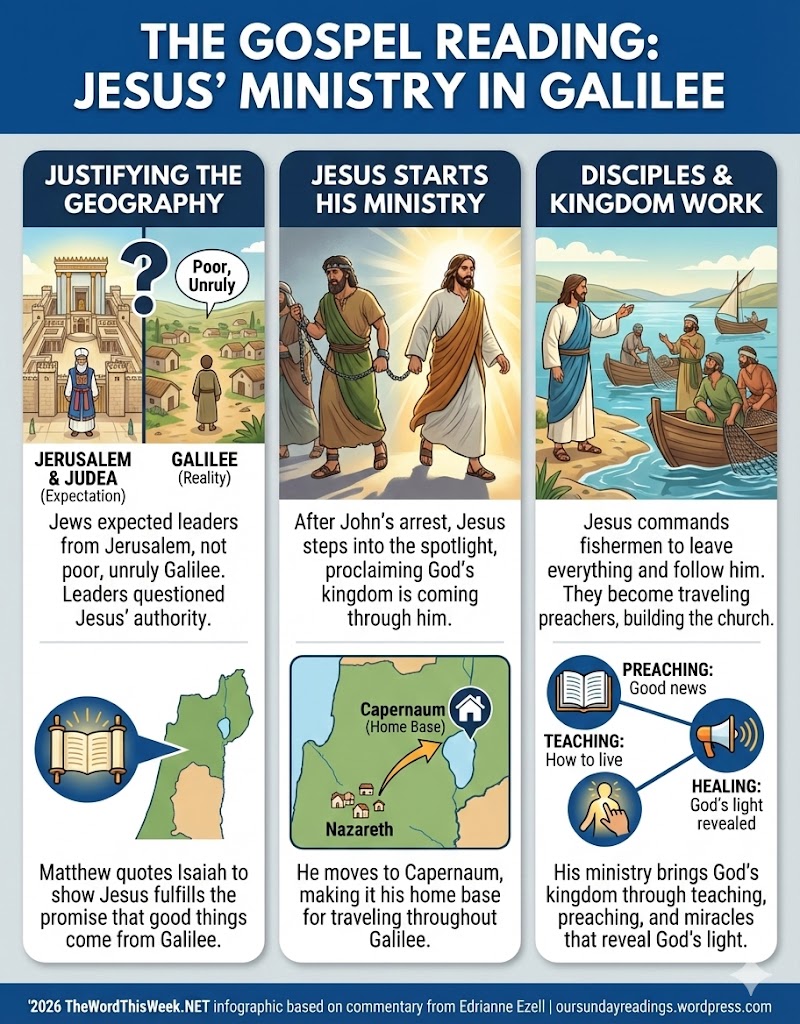
Feel free to use TWTW‘s AI generated visual summaries of Edrianne Ezell ‘s commentary. They are not intended to replace it. Please use them in conjunction with her guide. You can cut, copy and paste any portion of them to use as clip art for your bulletin, or use them as is. When using above infographics please give credit to TWTW and Our Sunday Readings.





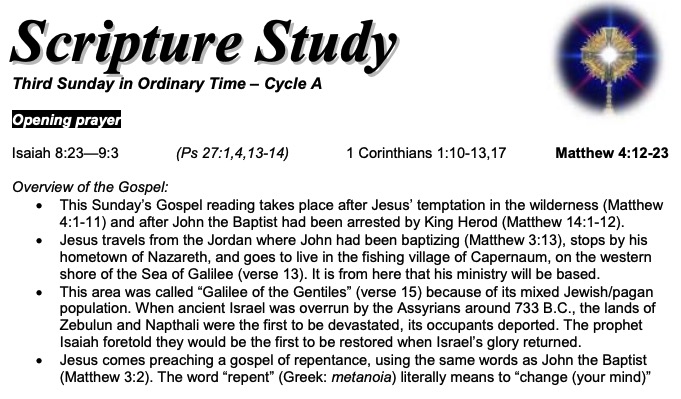
Vince Contreras
SUNDAY SCRIPTURE STUDY FOR CATHOLICS offers a weekly PDF handout that can be used in various settings, including church bulletins, Bible study groups, homeschooling, and small group discussions.
Here are answers to the questions based on the provided readings from Isaiah, 1 Corinthians, Matthew, and the Catechism of the Catholic Church.
• In the 1st reading, Isaiah prophesies a time when those who historically bore the brunt of enemy oppression, will be the first to see “a great light” of deliverance. How might this translate to spiritual terms? Who is in the best position to recognize that they need a Savior?
Spiritually, this translates to the idea that those deeply aware of their own brokenness, sin, or despair—those living in "spiritual darkness"—are often the most receptive to God’s grace. The self-sufficient, the arrogant, or those comfortable in their worldly status often fail to see the need for "a great light" because they do not perceive the darkness surrounding them.
Therefore, the "poor in spirit," those who know they cannot save themselves and are facing situations beyond human aid, are in the best position to recognize their need for a Savior. Just as the oppressed regions of Zebulun and Naphtali desperate for relief were the first to receive Jesus' ministry, the spiritually desperate are often the first to welcome the Gospel.
• In the 2nd Reading, how do rivalries among believers impede the spread of the Kingdom of God? According to Saint Paul, what core message of the Gospel should we be focusing on?
Rivalries impede the Kingdom because they shift the focus from Christ to human personalities ("I belong to Paul," "I belong to Apollos"). This fractures the essential unity of the Body of Christ. When outsiders see division, bickering, and "party spirits" within the Church, it obscures the universal saving mission of Christ (cf. CCC § 878) and makes the faith look like merely another human philosophical club rather than divine revelation.
According to Saint Paul, we should focus solely on "the cross of Christ" (1 Cor 1:17). He emphasizes that the power of the Gospel lies not in human eloquence, wisdom, or charismatic leaders, but in the redeeming reality of Jesus’ crucifixion and resurrection.
• In today’s Gospel, how does Jesus react to John’s imprisonment?
Matthew 4:12 states: "When Jesus heard that John had been arrested, he withdrew to Galilee." Jesus’ reaction was to strategically move away from the center of religious and political power (Jerusalem/Judea) where John was taken, and travel north to Galilee. This marked the end of the preparatory phase of John the Baptist and the beginning of Jesus' own public ministry.
• How had the land been “sitting in darkness” (verse 16, Isaiah 8:22—9:1)? What was Jesus’ message? What is the relation between repentance, the kingdom of heaven, and the light?
Historically, this land (Zebulun and Naphtali) had sat in darkness because it was the first area ravaged and deported by the Assyrian empire. It became known as "Galilee of the Gentiles," a region viewed with suspicion by religious purists in Jerusalem due to its mixed population and distance from the Temple. Spiritually, it represents a place distant from God's revealed glory.
Jesus’ message was concise: "Repent, for the kingdom of heaven is at hand" (Mt 4:17).
The relationship between the three concepts is this:
- The Light is Jesus himself arriving in the darkness of human history and sin.
- The Kingdom of Heaven is what the Light reveals—the reality of God’s reign breaking into the world.
- Repentance (metanoia, a change of heart and mind) is the necessary human response to seeing the Light, allowing a person to enter and live within that Kingdom (cf. CCC § 1720, 1989).
• What invitations does Jesus give to the fishermen? What seems unusual about their response? What prior knowledge of Jesus do you think they had (verses 13, 17; John 1:35-42)? How might Zebedee (verse 21, 22) have felt?
Jesus gives them the invitation: "Come after me, and I will make you fishers of men."
What seems unusual is the immediacy and totality of their response: "At once they left their nets and followed him," and James and John "immediately left the boat and their father and followed him." They abandoned their livelihood and family instantly.
While Matthew’s account makes it seem instantaneous, other Scriptures suggest prior knowledge. Matthew 4:13 notes Jesus had moved to Capernaum (their base of operations) and had been preaching there (v. 17). Furthermore, John 1:35-42 reveals that Andrew was originally a disciple of John the Baptist and had already been introduced to Jesus, and then brought his brother Peter to meet him. The call by the sea was likely the decisive moment of commitment after a period of getting to know him.
Zebedee likely felt a complex mix of emotions: shock at the sudden departure of his sons, anxiety about the future of the family business without their labor, confusion about this new Rabbi, and perhaps even a grudging awe at the authority of Jesus that could command such loyalty.
• From how far away are the crowds coming (verses 23-25; refer to a Bible map)? What needs do they have? What are they learning about God’s kingdom?
A Bible map shows these locations cover a vast area: Galilee (the north), the Decapolis (a region of ten Greek cities mostly east of the Jordan River), Jerusalem and Judea (the deep south, the religious center), and "from beyond the Jordan" (Perea, on the east bank). People were coming from Jewish and Gentile territories alike.
Their needs were desperate and varied: they were suffering "various diseases and racking pain," were "possessed by demons, epileptics, and paralytics."
They were learning that God’s kingdom is not just a philosophical idea, but a reality of power and compassion. They learned that the Kingdom brings restoration to the whole person—body, mind, and spirit—and liberates humanity from the grip of evil and suffering.
The following questions are for personal reflection based on the texts:
• How has coming to know Jesus been like moving from darkness to light for you? In what ways does God’s kingdom seem present for you? In what ways does it seem “not yet”?
(Personal reflection): Moving from darkness to light often feels like moving from confusion to clarity, or from guilt to forgiveness. The Kingdom feels present in the Eucharist, in moments of genuine charity, and when grace helps overcome a habitual sin. It feels "not yet" when witnessing the immense suffering in the world, societal injustice, or dealing with personal grief and persistent struggles.
• Spiritually, are you still preparing the nets? Leaving the boat? Following hard after Jesus? Feeling left behind? What exactly does it mean to you to “repent”?
(Personal reflection):
- Preparing nets might mean you are learning about the faith but haven't committed to action.
- Leaving the boat might mean you are currently in the process of giving up a worldly attachment or habit to make space for God.
- Following hard means you are actively seeking His will daily and prioritizing the Kingdom.
To "repent" (metanoia) means more than just feeling sorry for doing something wrong. It means a fundamental shift in the direction of one's life—changing the way I think so that my life aligns with God’s reality rather than my own self-interest. It is a continuous turning away from shadow and turning toward the Light.
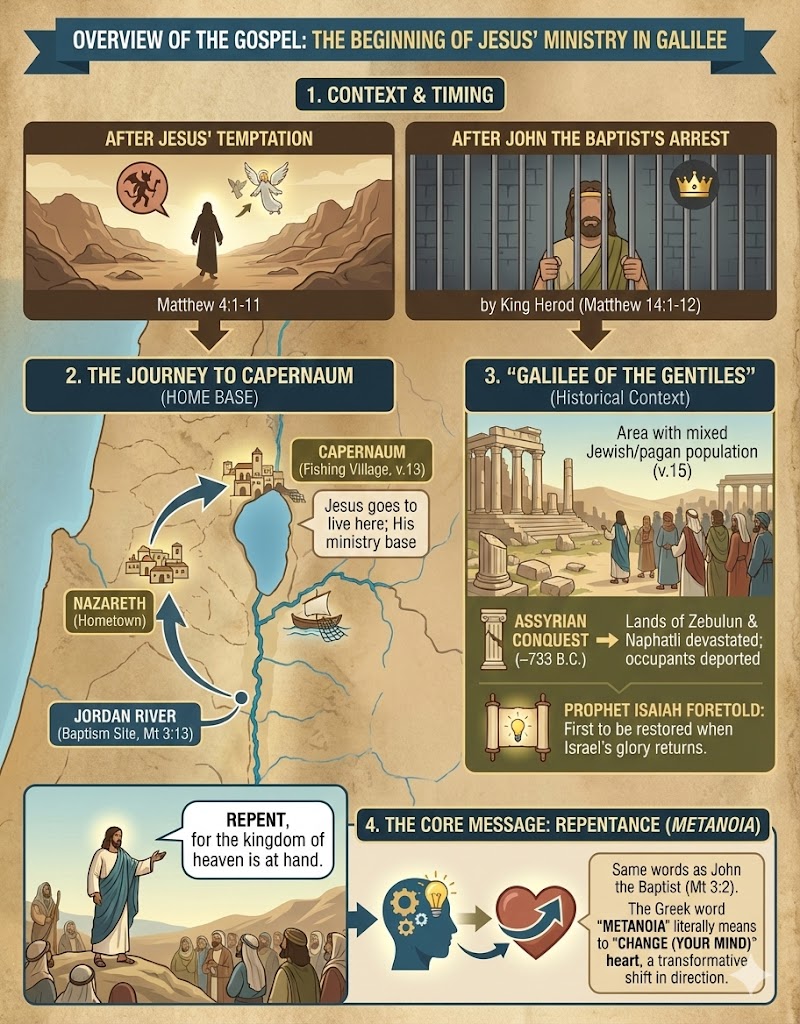

Fr. Kieran O’Mahony, OSA
TWTW infographics below were created using core concepts from the PDF above
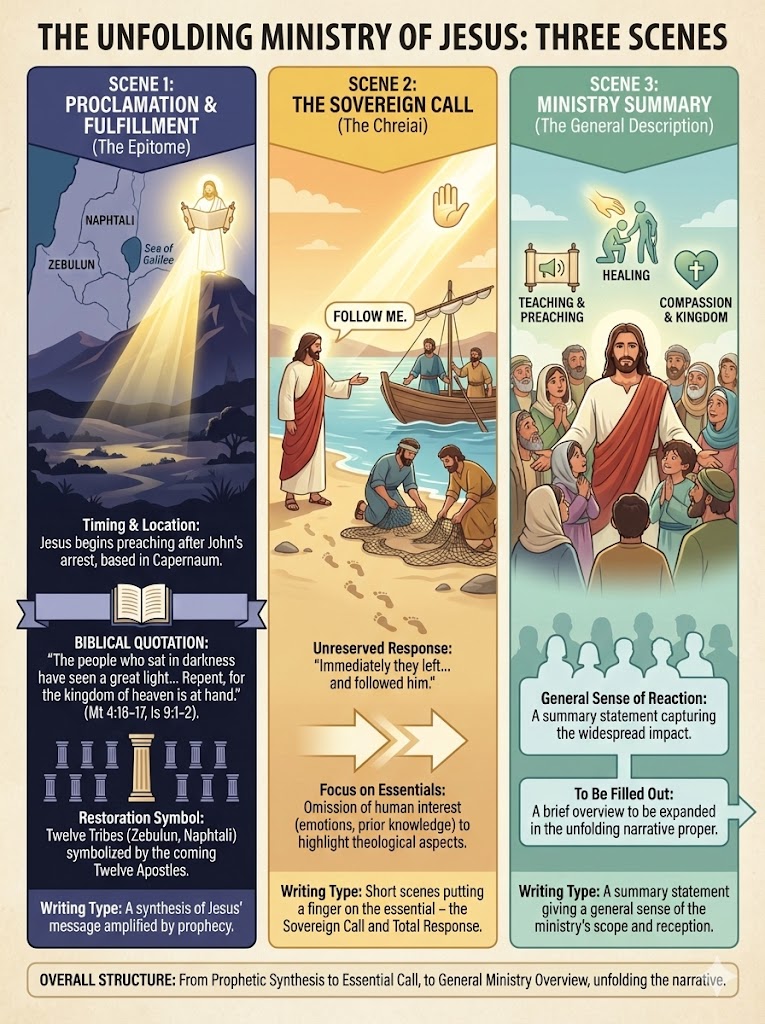

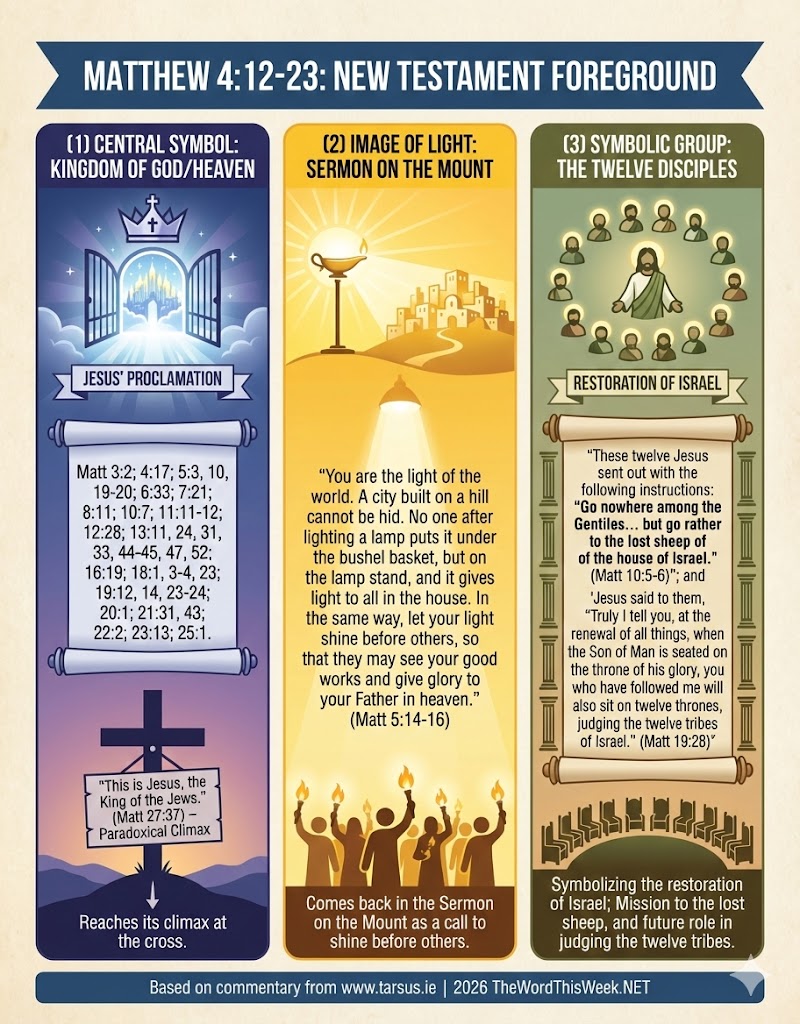
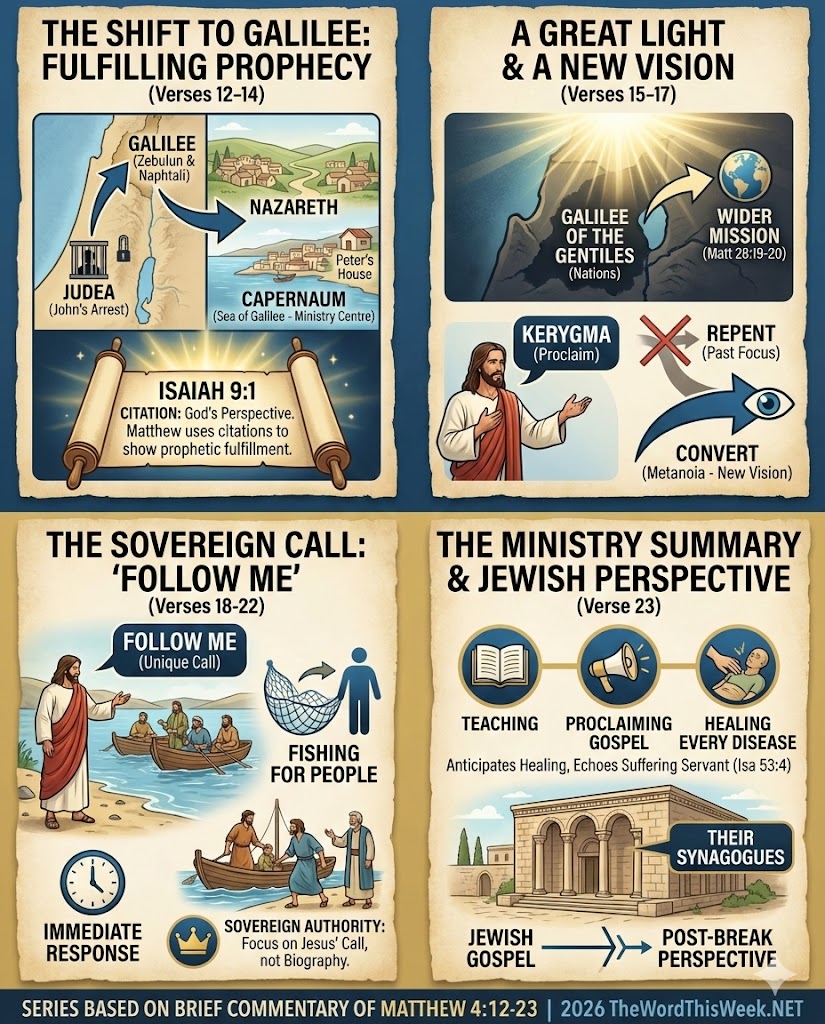

TWTW infographics on this page present Fr. Kieran’s “GOSPEL COMMENTARY” and “POINTER FOR PRAYER” which are presented after each reading’s commentary. Please cross-reference the slides with the PDF if you notice any errors. Non-profits are welcome to utilize the provided graphics in their materials and presentations. Please acknowledge Fr. Kieran O’Mahony, OSA, and his website, taurus.ie. The graphics were designed by TheWordThisWeek.net using Gemini Pro 3 and Nano Banana. Proper attribution is appreciated.

Fr. Clement D. Thibodeau
Echoing God’s Word – Portland Diocese | Download (PDF)
Based on the reflections provided about Jesus' move to Capernaum and the start of His ministry, here are answers designed to guide personal reflection or group discussion.
1. Finding a Secure Base
“Jesus moved to Capernaum to establish a home there… a home that would be secure and give him a base for his future ministry.”
Where have you found a secure base for your life and work?
- The Physical Base: For many, this is a literal home where the chaos of the world is shut out—a place of family and rest. It might also be a specific parish community where you feel "at home" spiritually.
- The Spiritual Base: A secure base is often found in routine and ritual. Just as Capernaum was a strategic center, a daily prayer life, regular Mass attendance, or a specific adoration hour acts as the "center" from which all other activity flows.
- The Relational Base: Sometimes, a "secure base" is a person—a spouse, a mentor, or a spiritual director—who provides the stability needed to take risks in ministry and life.
2. Being a Source of Light
“The people who sat in darkness have seen a great light… Who have been the Jesus people who have been a source of light to you?”
Who have been the "Jesus people" for you?
- The Encouragers: People who saw potential or goodness in you when you couldn't see it yourself.
- The Steady Presences: Those who remained faithful during a personal crisis (illness, grief, job loss) when others drifted away.
- The Truth-Tellers: Those who loved you enough to speak hard truths that pulled you out of the "darkness" of bad decisions.
Have you been such a light for others?
- This often happens without us knowing. By simply listening to someone who feels ignored, forgiving someone who expects retaliation, or maintaining hope in a cynical situation, we reflect Christ's light. It requires asking daily: “Lord, let me be a window, not a wall, for your light today.”
3. Turning Points
“From that time Jesus began to proclaim… This marks a turning point… Can you recall turning points in your life after which the future became more clear?”
Reflecting on Turning Points:
- Moments of Crisis: Often, a health scare, the loss of a job, or the death of a loved one forces a re-evaluation of priorities, making it clear what actually matters (faith, family) and what doesn't (status, accumulation).
- Moments of Encounter: A specific retreat (like Cursillo or ACTS), a powerful confession, or a moment in prayer where the "fog lifted" and a vocation or path became undeniable.
- The "Slow" Turn: Sometimes the turning point isn't a lightning bolt, but a realization after years of drifting that "I cannot continue living this way," leading to a deliberate, quiet decision to change course toward God.
4. The Call to Repentance (Fear vs. Love)
“His message was a call to repentance… from seeing God as one to be feared to seeing God as a God of love.”
When have you heard that call? What was it like?
- The Shift in Motivation: Many believers start their journey out of fear (fear of hell, fear of punishment). The true call to repentance is often heard when we realize God is a Father, not a policeman. Repenting changes from "I need to stop breaking rules" to "I need to stop hurting the One who loves me."
- The Experience of Relief: Repentance often feels like a burden beforehand (admitting fault is hard), but afterward, it feels like a physical weight being lifted. It is the transition from hiding (darkness) to being known and loved (light).
- A Continuous Call: We hear this call not just once, but every time we become complacent. It is the gentle tug to "come up higher" and abandon a grudge, a habit, or an attitude that is keeping us small.
create an 8.5x11 inch infographic with images based on an essay of Fr. Clement D. Thibodeau.
create an 8.5x11 inch infographic with images on a white background based on an essay of Fr. Clement D. Thibodeau.

The above bulletin insert was created using Nano Banana Pro with Gemini 3.0. The infographics draw inspiration from the content found in Fr. Clement Thibodeau's Echoing The Word weekly column which was published nearly a decade ago. It may be used by any non-profit ministry.