Homilies
Homilies
January 25, 2026
January 25, 2026
3rd Sunday of Year A


Bishop Robert Barron
3rd Sunday of Year A
The Irresistable Call

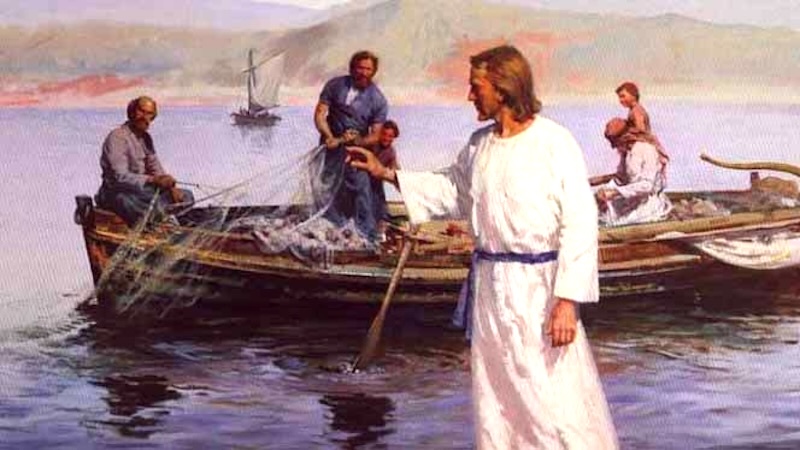
PODCAST—When Jesus calls his first disciples, he stirs the “imago Dei,” the image of God, in them. They realize that they will find themselves only in surrendering to the one who will make them fishers of men. We hear the same call from the same Christ.

3rd Sunday of Year A
A Great Light in the Darkness
PODCAST—This week’s reading from the prophet Isaiah emphasizes God’s tendency to bring the best from the worst situations, light from the darkness. Throughout the Bible we see wonderful things come from the most unexpected places, and this is reflected in our own lives as well. Often our greatest goodness can come from the darkest places of our beings.

3rd Sunday of Year A
In the Land of Zebulon and Naphtali
PODCAST—Our first reading from the prophet Isaiah and our Gospel are tightly linked, for St. Matthew, in articulating the meaning of Jesus, cites (as is his wont) an Old Testament text—namely, our reading from the eighth and ninth chapters of Isaiah. The prophet speaks of conflict in the land of Zebulon and Naphtali, and then of a great light that shines in that area, signaling the victory of God.

3rd Sunday of Year A
Join Your Life to the Light
Friends, this liturgical year, we are reading from the Gospel of Matthew, and Matthew is written precisely for a Jewish audience. This is why, over and over again, we find Matthew putting Jesus within an Old Testament context. And in our readings for this weekend, the Church juxtaposes a prophecy from Isaiah with its fulfillment in Matthew: “Land of Zebulun and land of Naphtali, the way to the sea, beyond the Jordan, Galilee of the Gentiles, the people who sit in darkness have seen a great light, on those dwelling in a land overshadowed by death light has arisen.” This may not mean much to us today, but Matthew’s audience of first-century Jews knew exactly what he meant.

3rd Sunday of Year A
Unity in Christ
Friends for this Third Sunday in Ordinary Time, our first reading from the prophet Isaiah and our Gospel from Matthew both have a section that’s a little weird. While most preachers skip over these sections to get to the better-known and understandable parts, I want to dwell, on purpose, on the strange parts—and they have to do with the lands of Zebulun and Naphtali.
Fr. Michael Chua

Permission granted for non-profits to use in ministry
The infographic was created using Nano Banana, Google's Revolutionary AI Image Generator. Infographic may not be sold or used for personal financial gain. Please show your appreciation by letting others know about TheWordThisWeek.NET.
3rd Sunday of Year A
Light Shines Brightest in the Darkest Nights
The darkness seems to be a scary place. Whether we like to admit a true fear or not, there are things that are scary about the dark: we can’t see where we are going, and we can’t identify hazards that might be surrounding us. Darkness feels empty. But the truth is that just because we can’t see what’s in a dark place, it doesn’t mean that there is nothing there. Darkness does not necessarily mean absence, and it certainly does not mean the absence of God. In fact, Saint John of the Cross would tell us that God is more certainly present in the darkness of our experiences, to the point that he could even call it “holy darkness”, “holy night.” Darkness is a part of life, a backdrop for the stars at night, the space between what you know. Darkness has a way of reminding you of the light you’ve been given on all those other days. You have to know the darkness before you can truly appreciate the light. Isn’t it true that it is often on the darkest nights, that we can see the brightest stars?
But there is also a darkness that comes with defeat, failure, oppression, isolation and sin. It is a darkness that is no friend to the light. In fact, it is the darkness that tries to exclude all light. And here, more than ever, we long for the liberation of the light.
Permission granted for non-profits to use in ministry
The infographic was created using Nano Banana, Google's Revolutionary AI Image Generator. Infographic may not be sold or used for personal financial gain. Please show your appreciation by letting others know about TheWordThisWeek.NET.
3rd Sunday of Year A
Ignorance of Scriptures is Ignorance of Christ
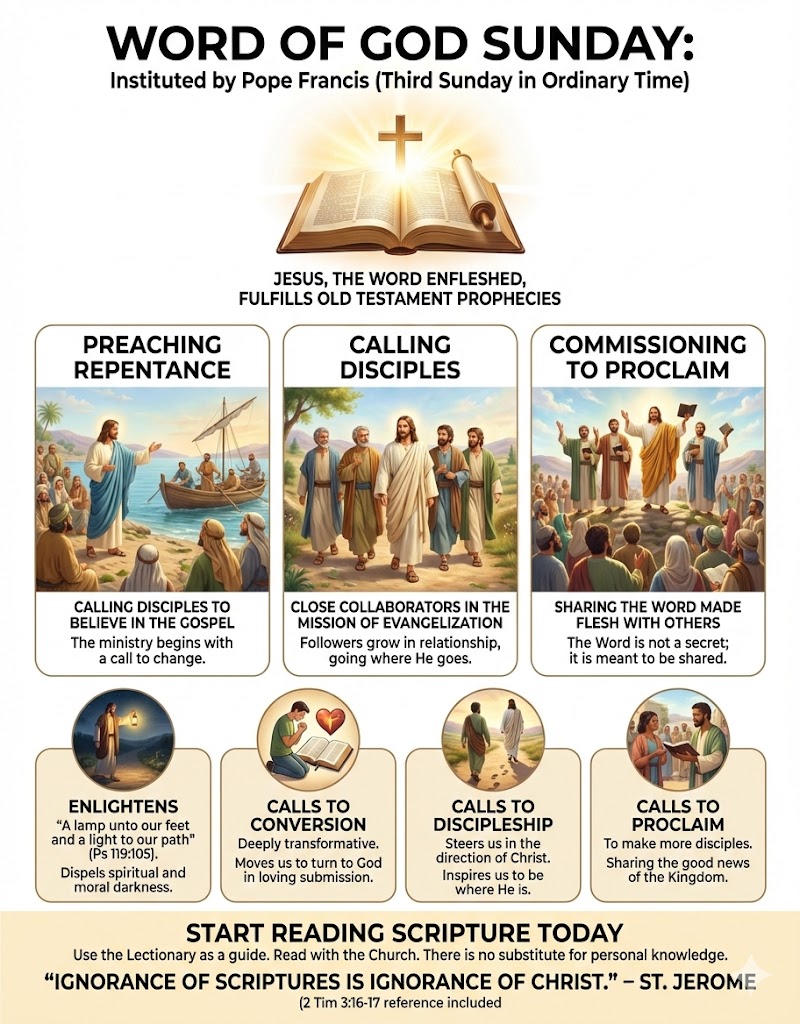
Today, the Church celebrates a relatively new feast which was instituted by Pope Francis in 2019. It is a feast dedicated to the Word of God and is celebrated each year on the Third Sunday in Ordinary Time. The gospel readings for all three lectionary cycles focus on the beginning of the public ministry of Christ and we see how this very ministry is firmly rooted in the Word of God.
First, our Lord is revealed as the One who fulfils the prophecies in the Old Testament. In fact, the Fourth Gospel tells us that Jesus is not just a preacher of the Word, He is the Word of God enfleshed. Second, He begins His ministry by preaching repentance and calling His disciples to believe in the gospel. Third, He calls His first disciples who will be His close collaborators in the mission of evangelisation, in proclaiming the Word of God. So, Jesus is the Word of God. He calls people to repent and believe in Him, the Living Word of God, and then He commissions them to share Him who is the Word made flesh with others. This is why St Jerome, doctor of the Church who translated the scriptures from the original languages into Latin and who wrote volumes of biblical commentary made this strong equivalence: “ignorance of scriptures is ignorance of Christ.”


Permission granted for non-profits to use in ministry
The infographic was created using Nano Banana, Google's Revolutionary AI Image Generator. Infographic may not be sold or used for personal financial gain. Please show your appreciation by letting others know about TheWordThisWeek.NET.
3rd Sunday of Year A
The Light of God Surrounds Me
The darkness seems to be a scary place. We can’t see where we are going, and we can’t identify hazards that might be surrounding us. Darkness feels empty. But the truth is that just because we can’t see what’s in a dark place, it doesn’t mean that there is nothing there. Darkness does not necessarily mean absence, and it certainly does not mean the absence of God. Darkness is a part of life, a backdrop for the stars at night, the space between what you know. Darkness has a way of reminding you of the light you’ve been given on all those other days. This unsettling truth emerges – You have to know the darkness before you can truly appreciate the light. It is that same darkness that makes us open to welcome the soothing rays of light.
The readings that we have heard today provide us with this compelling and consoling message of hope. The light of hope can even be found in the darkness of despair.

Dominican Blackfriars
Permission granted for non-profits to use in ministry
The infographic was created using Nano Banana, Google's Revolutionary AI Image Generator. Infographic may not be sold or used for personal financial gain. Please show your appreciation by letting others know about TheWordThisWeek.NET.
3rd Sunday of Year A
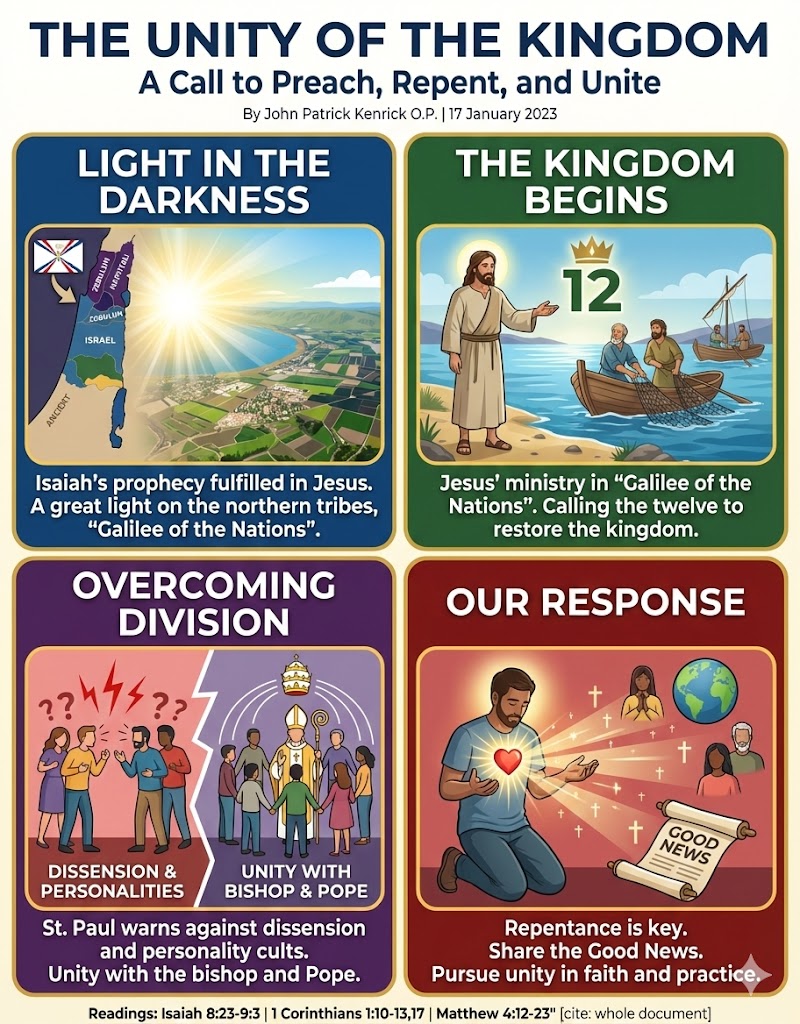
The Unity of the Kingdom
Third Sunday of the Year. Fr John Patrick Kenrick reminds us of the universal call to preach.
One of the many contributions that Pope Benedict made to the life of the Church was to draw our attention to the need to read scripture through the eyes of faith. Pope Benedict was not opposed to the historical-critical method of reading scripture. In fact he insisted that an attention to the context in which scripture had been written is an important part of understanding it. At the same time an exclusive attention to the original context would mean that we completely lose sight of the insight of faith – that the Holy Spirit inspires both scripture and tradition. The scriptures cannot be confined to one age. Their meaning unfolds through developing Church tradition as when, for example, the evangelists refer to OT passages. Today’s reading from Isaiah is a good example.
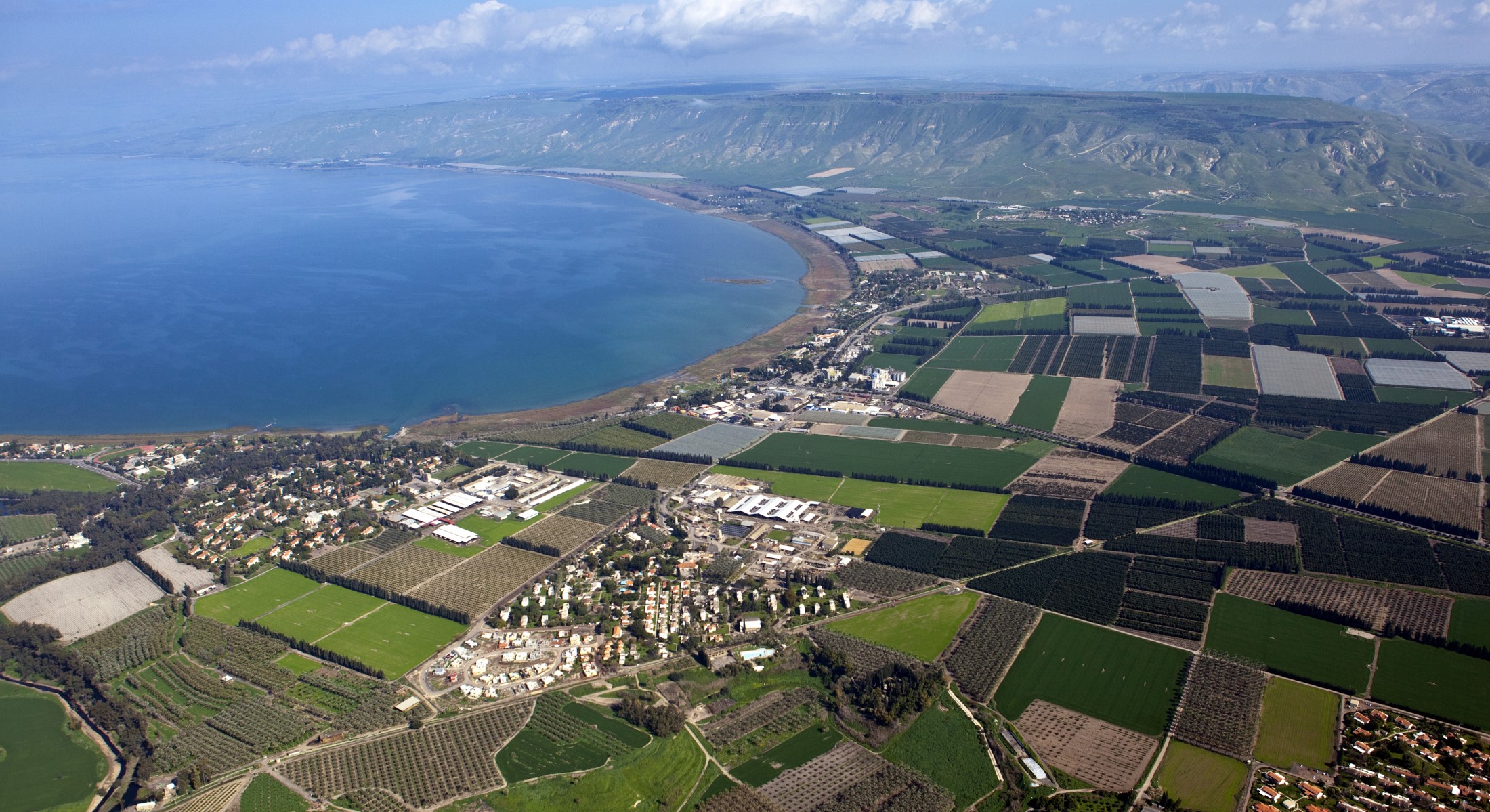
It refers to the lands of Zebulun and Naphtali. These were two of the ten lost tribes of Israel. Zebulun and Naphtali were the first two tribes of the northern kingdom of Israel to be deported by the Assyrians in 722BC. The Assyrians also resettled these lands with people who were not Jewish. Isaiah is predicting a time when, as he puts it, ‘a great light’ will shine on these northern territories, their fortunes will be restored, God Himself will confer glory on them. It will be, says Isaiah, ‘like the day of Midian’. The Day of Midian refers to the famous battle in which Gideon defeated the Midianites and enriched Israel with all the booty he captured.
Permission granted for non-profits to use in ministry
The infographic was created using Nano Banana, Google's Revolutionary AI Image Generator. Infographic may not be sold or used for personal financial gain. Please show your appreciation by letting others know about TheWordThisWeek.NET.
3rd Sunday of Year A
The Light That
Unites Us
Third Sunday in Ordinary Time (A) | Fr Robert Verrill speaks of his personal discovery of the light of Christ’s truth, and he calls us to focus on Him who unites rather than divides.
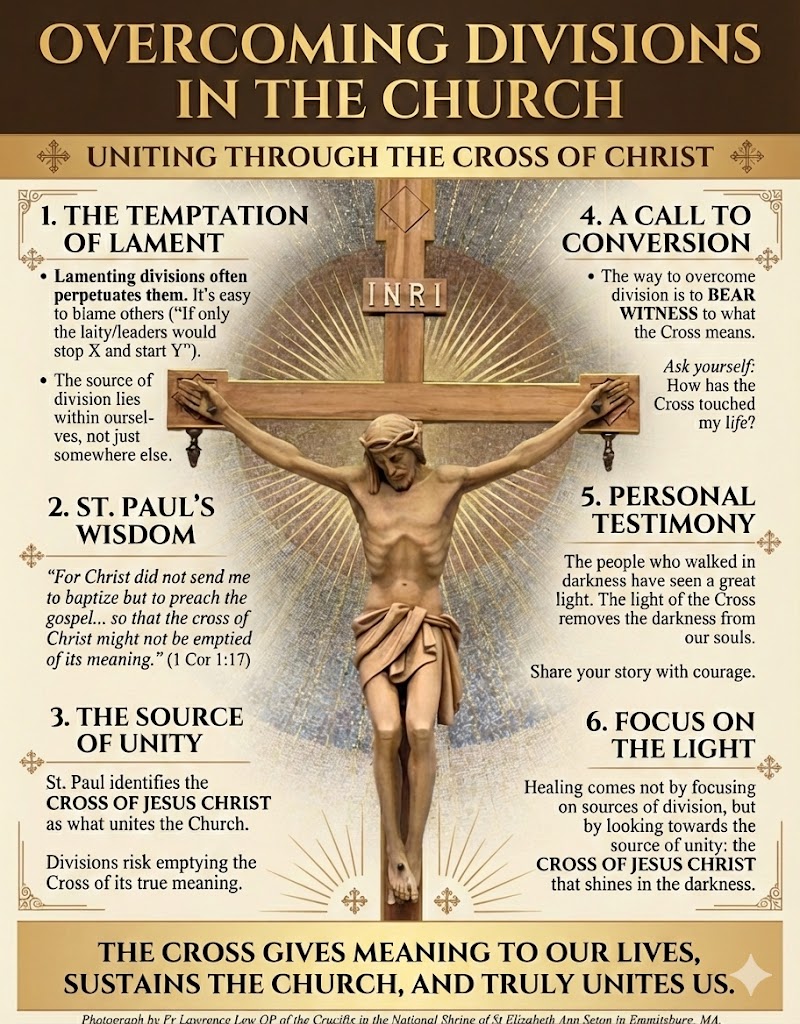
When we lament about the divisions we see within the Church, it’s all too easy to say things that perpetuate these divisions. All too often, our lament takes the form ‘if only the laity or our leaders would stop doing X and start doing Y’. Of course, we should all want the Church to be united, for this is what Christ Himself wanted, but the great temptation is to suppose that the source of division lies somewhere else other than within ourselves.
Now lamenting about divisions within the Church is nothing new. Indeed, in the second reading from St Paul, we hear one of the earliest laments about division within the Church in its history. But what is notable about St Paul’s lament is that he doesn’t simply identify what is dividing the Church. He also points us to what is uniting the Church, namely the cross of Jesus Christ. Thus, St Paul says: “Christ did not send me to baptise but to preach the gospel, …, so that the cross of Christ might not be emptied of its meaning.”
So, in the light of what St Paul says, we should indeed lament divisions within the Church, for divisions risk emptying the cross of Christ of its true meaning. But on the other hand, St Paul also offers us a way of overcoming division: this is to bear witness to what the cross of Jesus Christ truly means. We should therefore be asking ourselves how the cross of Jesus Christ has touched our lives, and we should have the courage to bear witness to this fact.

Permission granted for non-profits to use in ministry
The infographic was created using Nano Banana, Google's Revolutionary AI Image Generator. Infographic may not be sold or used for personal financial gain. Please show your appreciation by letting others know about TheWordThisWeek.NET.
3rd Sunday of Year A
Galilee of the Gentiles
Third Sunday of the Year. Fr Benjamin Earl considers the significance of the place where Christ began his mission.
If you have been paying attention to the readings from St Matthew’s Gospel at Mass over the last few weeks of the Advent and Christmas seasons, it won’t have escaped your notice that the evangelist loves to make a link between prophetic texts from the Old Testament and the coming and action of Christ. Indeed, by the time we get to today’s Gospel reading, from the fourth chapter of his Gospel, St Matthew has already quoted or paraphrased passages especially from the prophet Isaiah, but also from Ruth, Chronicles, Kings, Micah, Hosea, Jeremiah, Deuteronomy, and the Book of Psalms, together with allusions to various other imagery from the Old Testament.
So it is important to understand that there is continuity between the old and the new covenants: Christ’s mission is one that continues God’s repeated calling of his chosen people. Christ completes and fulfils the story told in the Old Testament.
It follows that, in order to understand quite what Matthew is trying to say, and what Christ is doing in carrying out his preaching ministry, it’s necessary to have a certain awareness of that Old Testament story.
Today’s gospel episode, the calling of the first disciples, takes place in Galilee, albeit not in Jesus’ home town of Nazareth. Instead he moves to Capernaum, a town, we are told, on the borders of Zebulun and Naphtali, two of the twelve tribes of Israel.

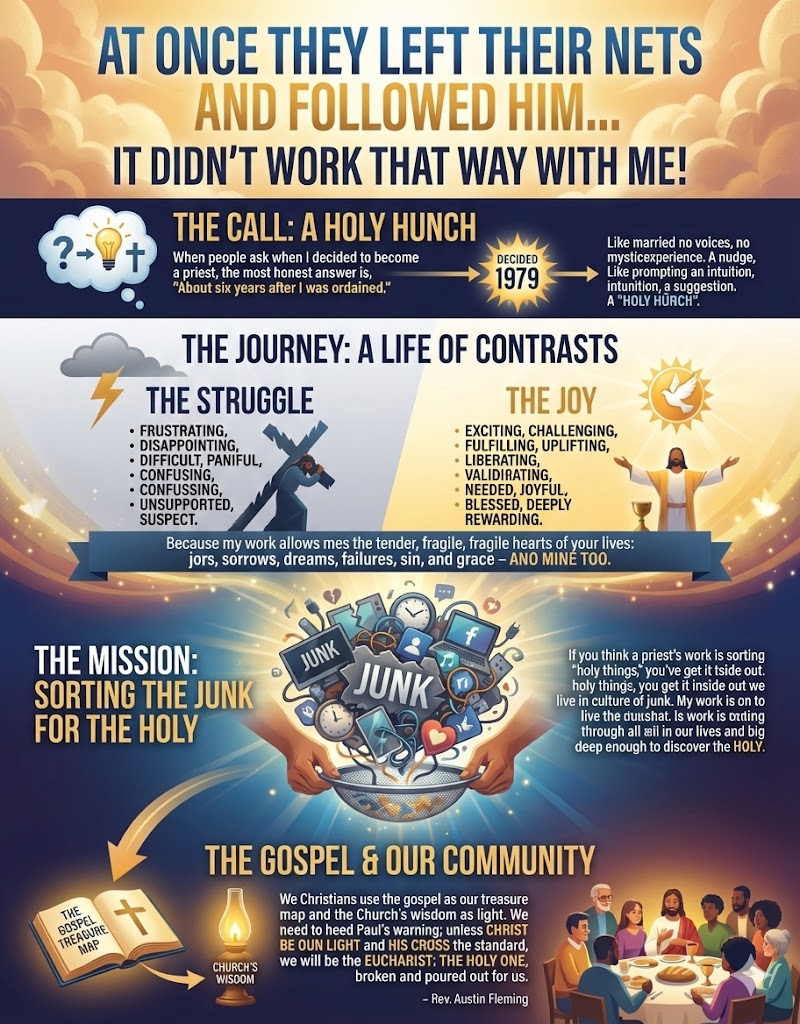
Fr. Austin Fleming
Permission granted for non-profits to use in ministry
The infographic was created using Nano Banana, Google's Revolutionary AI Image Generator. Infographic may not be sold or used for personal financial gain. Please show your appreciation by letting others know about TheWordThisWeek.NET.
3rd Sunday of Year A
At Once They Left Their Nets
and Followed Him…
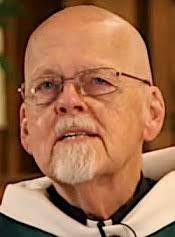
At once they left their nets and followed him…
It didn’t work that way with me!
When people ask me when I decided to become a priest, the most honest answer I can give is,
“About six years after I was ordained.”
I was ordained in 1973. I truly decided to become a priest around 1979.
Those six years were very interesting years!
(That’s a story I may share at another time…)
Monsignor Peter Hahn

Permission granted for non-profits to use in ministry
The infographic was created using Nano Banana, Google's Revolutionary AI Image Generator. Infographic may not be sold or used for personal financial gain. Please show your appreciation by letting others know about TheWordThisWeek.NET.

3rd Sunday of Year A
The Word of God Became Flesh
2020 HOMILY – This Sunday presents to us the first words of Jesus recorded by Saint Matthew repent the kingdom of heaven is at hand this phrase the kingdom of heaven is a very familiar one to us. It appears about 30 times in this Gospel of st. Matthew that we’re focusing on in our liturgical year it refers to our life in Christ. This word who dwells among us it designates a way of life a disposition of our hearts and a joy that comes from God and from his giving us that power of his love. If references what is the very essence of Jesus the Son of God who has come to bring about this kingdom.
Fr. Charles E. Irvin
3rd Sunday of Year A
The People in Darkeness Have Seen a Great Light

If you go out into the North African desert with its rolling and shifting hills of sand, you will likely come upon quicksand. You can also encounter quicksand in our North American swamps, in our Florida Everglades, and even in some of our own inland lakes. Nearer to us you’ll find it in the marshy, reed-filled edges of Michigan’s inland lakes.
Sometimes these spots are called sinkholes. They are pockets of loosely packed sand that has collected in a hole with a really deep bottom. There’s nothing solid at the bottom of these sinkholes. When you step into one you immediately begin to sink down and the more you thrash around the more it sucks you down until you are under the sand and then die of suffocation.
Many people find themselves in spiritual sinkholes. They are being sucked down into alcoholism, drugs, sex, mistreatment of others, and other sorts of addictions. They are caught in behavior patterns that are repeated over and over and over again. Such unfortunates are powerless to stop themselves.
The only way out of quicksand or sinkhole is to reach up and grasp the hand of someone who is standing on solid, rock-hard ground. It takes the two of you to get out. Your rescuer can’t pull you up all by himself, and you, all by yourself, cannot get yourself out.
Fr. Joe Jagodensky, SDS
Permission granted for non-profits to use in ministry
The infographic was created using Nano Banana, Google's Revolutionary AI Image Generator. Infographic may not be sold or used for personal financial gain. Please show your appreciation by letting others know about TheWordThisWeek.NET.
3rd Sunday of Year A
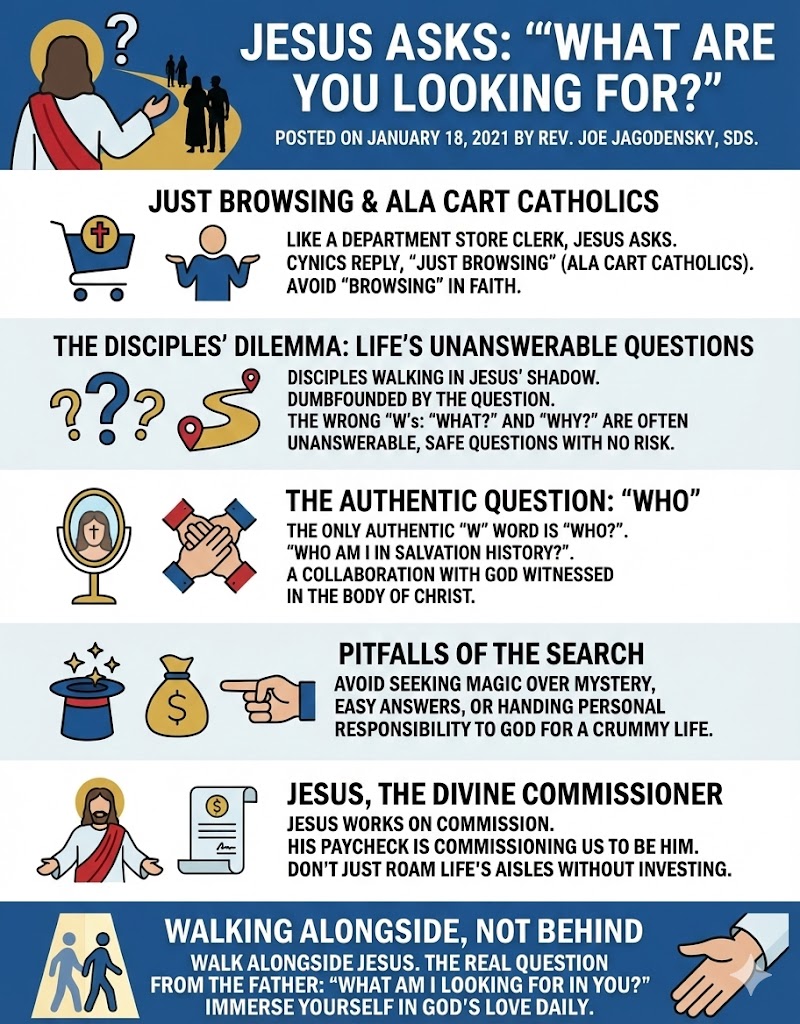
“What are you looking for?”
The department store clerk, working on commission, approaches you and asks, “What are you looking for?” “Just browsing,” you reply.
Lots of browsing in churches and other places of worship these days. It’s what cynics call, “Ala cart Catholics.”
But what about us? We the regulars at this weekly feast and perhaps a browser present somewhere in the congregation.
We are all the disciples walking in the shadow of Jesus Christ. He hears some sandals crunching the sand behind him and wonders what’s going on here. So, he naturally turns around and asks the groupies, “What are you guys looking for?”
They’re dumbfounded because life’s question has been asked to them. “What do I say?” “Because, frankly I don’t know?” It’s the third most question asked right behind, “Why am I here?” What and why? Almost always unanswerable so it’s easy to keep asking it. Safer that way.

Fr. Jude Thaddeus Langeh, CMF

3rd Sunday of Year A
Light reveals what is hidden in darkness

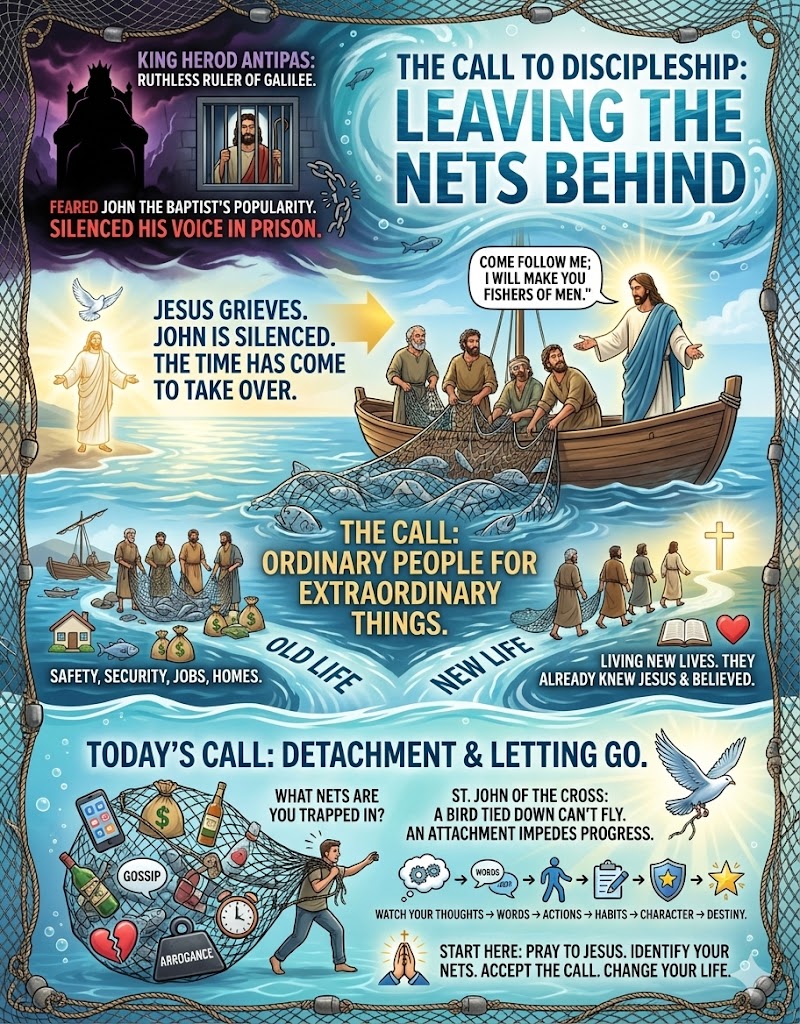
Light reveals what is hidden in darkness. It is very important since it provides energy for animals and plants. Light provides physical energy for the development of all life, including human beings. When identified with Christ, light brings spiritual direction by giving us a proper orientation to God. Jesus Christ brings to this world a message that will bring light to the darkness of any heart. The Good News about the truth of God’s love is capable of overcoming any obstacle, no matter how dark. On this note, the Bible on many occasions, use the word darkness to refer to all that is opposed to God….
One can interpret the First Reading from the Prophet Isaiah 8 as foretelling that the light of Christ, the light of love, has come into the world. The Son of God walked this earth, and a great light shone out. It is the light that led the first disciples to leave and follow him. We live in that light, that love, that meaning. The Good news preached by Jesus is akin to a great light which comes to deliver those who dwell in the land of Darkness.
Deacon Peter McCulloch
Permission granted for non-profits to use in ministry
The infographic was created using Nano Banana, Google's Revolutionary AI Image Generator. Infographic may not be sold or used for personal financial gain. Please show your appreciation by letting others know about TheWordThisWeek.NET.
3rd Sunday of Year A
On Leaving Our Nets Behind
Everyone who wants to follow Jesus has to leave something behind. You can’t live a new life by hanging on to the old one. This letting go is sometimes called Detachment.
Detachment doesn’t mean withdrawing totally from the world, because God loves our world and Jesus wants to heal it (Jn.3:16). But before we can help Jesus make this world a better place, we must first change ourselves. This means we must let some things go (Rom.12:2).
Too many Christians, however, are only lukewarm about their call. They don’t want to be inconvenienced. They don’t want to change. So they drag their nets along after them and sometimes they get tangled up in them.
Joseph Krempa says the problem is that we want the kingdom without changing ourselves. ‘It’s like those who want the meal, but not the cooking; who want the grades but not the study; who want health, but not exercise; who want the salary, but not the work’.
We want all the benefits of God – the peace, the forgiveness, the growth in grace, and the sense of belonging to a spiritual community, but we don’t want to give up the nets, the entanglements that trap us, that hold us back… These are the people, the relationships and the obsessions that separate us from Christ.
Permission granted for non-profits to use in ministry
The infographic was created using Nano Banana, Google's Revolutionary AI Image Generator. Infographic may not be sold or used for personal financial gain. Please show your appreciation by letting others know about TheWordThisWeek.NET.
3rd Sunday of Year A
Shining Light
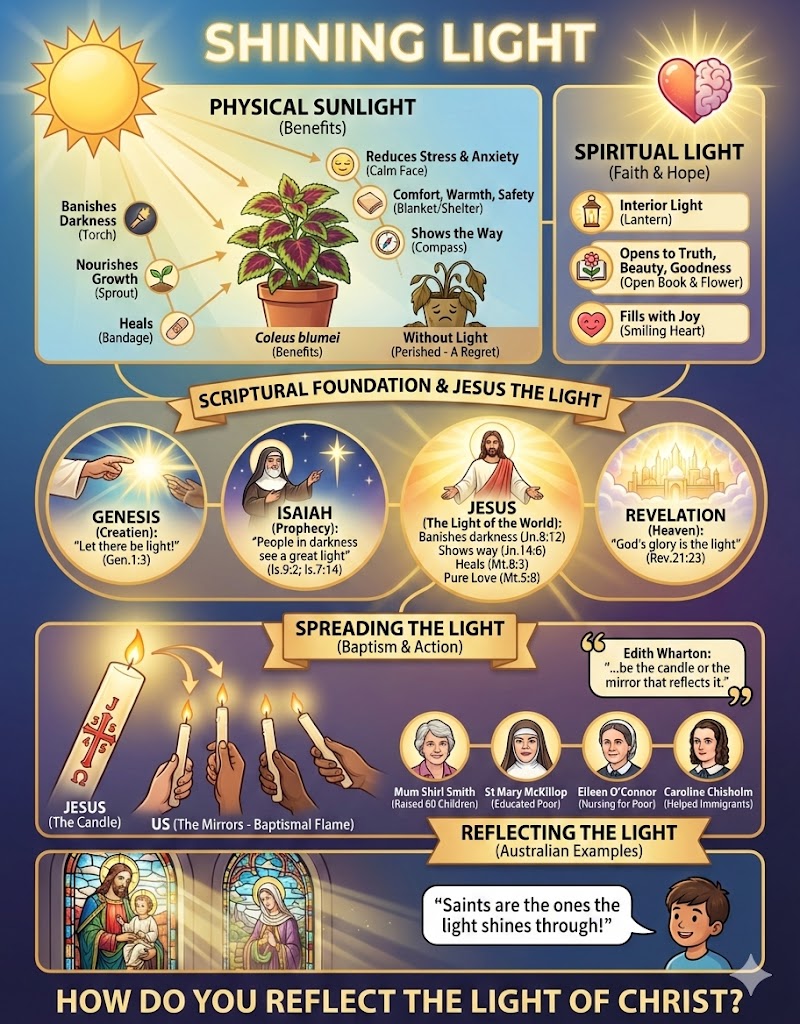
The first pot-plant I ever owned was a coleus blumei (aka ‘Painted Nettle’). I had it long ago, but sadly it didn’t survive.
Like each of us, it needed healthy doses of sunlight, but I didn’t recognise this at the time, and it slowly perished. I’ve always regretted that.
What does sunlight do for us? It banishes the darkness; it nourishes growth, it heals and it reduces our stress and anxiety. Sunlight also offers us comfort, warmth and safety. And it shows us the way.
But there’s another kind of light we also need. It’s the interior light of faith and hope that shines in our hearts and minds. This is the spiritual light that opens us up to truth, beauty and goodness, and it fills us with joy.
Not surprisingly, light is a theme that runs all through Scripture. At the beginning, at the dawn of Creation in Genesis, God commands ‘Let there be light!’ (Gen.1:3). And at the end, in the Book of Revelation, we’re told that in heaven we won’t need the sun or the moon, because God’s glory will give us all the light we need (Rev.21:23).
Permission granted for non-profits to use in ministry
The infographic was created using Nano Banana, Google's Revolutionary AI Image Generator. Infographic may not be sold or used for personal financial gain. Please show your appreciation by letting others know about TheWordThisWeek.NET.
3rd Sunday of Year A
Venerable Mary Glowrey
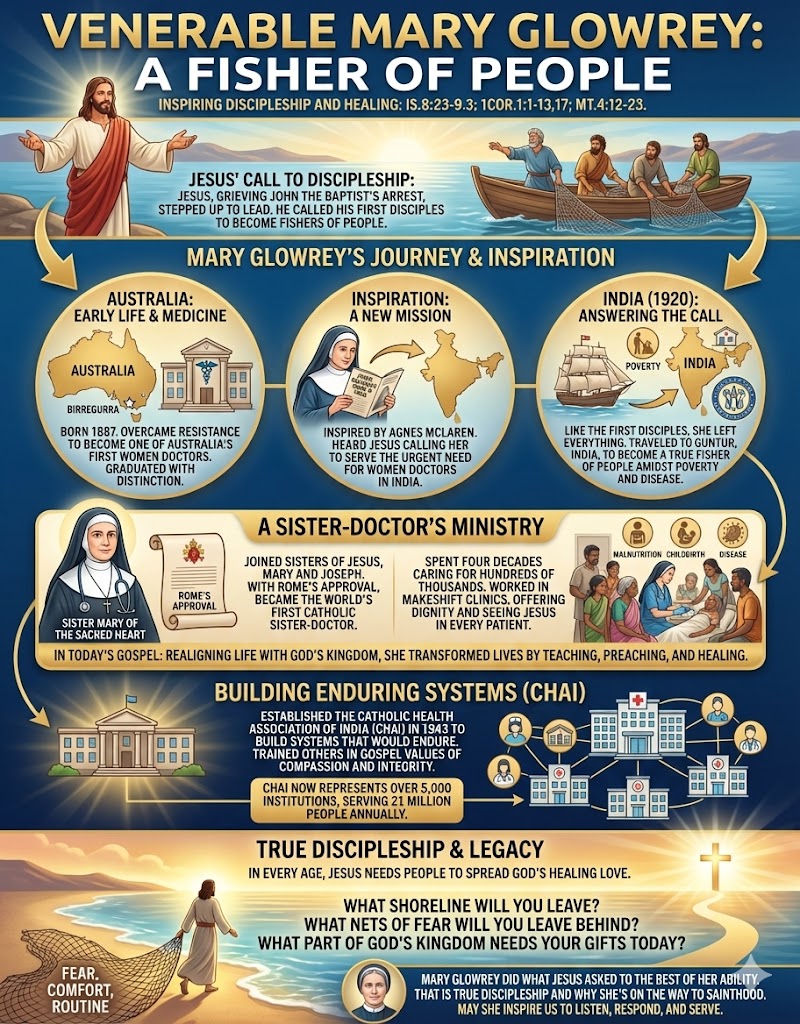
She trained nurses, midwives, doctors and administrators, not only giving them essential skills, but also the Gospel values of compassion, integrity, reverence for life, and respect for the poor.
In every sense Mary Glowrey became a ‘fisher of people,’ drawing good souls into a shared mission of mercy. She died in Bangalore in 1957.
What does all this mean for us today?
In every age, Jesus needs good people to help him spread God’s healing love. Today he is asking us, what shoreline are you prepared to leave to follow him? What nets will you leave behind – nets of fear, comfort, self-doubt or routine?
And what part of God’s Kingdom needs you today, your gifts, your vocation, your courage? Jesus wants you to play an active part in his mission.
Mary Glowrey did not do everything. But she did do what Jesus asked of her, and to the best of her ability. That is true discipleship, and that’s why she’s on the way to sainthood.
Fr. Carmen Mele, O.P.

Permission granted for non-profits to use in ministry
The infographic was created using Nano Banana, Google's Revolutionary AI Image Generator. Infographic may not be sold or used for personal financial gain. Please show your appreciation by letting others know about TheWordThisWeek.NET.
3rd Sunday of Year A
The Great Light
saiah sees God rescuing the Israelites in the land from foreign oppression. He describes his action as “a great light” shining on the people. Matthew tells of Jesus fulfilling this prophecy when he comes to Capernaum. From there Jesus will preach the Kingdom of God with powerful words and deeds.
More and more our time is seen as a “land of shadows”. Certainly, we have cars, cell phones, and other gadgets that make life comfortable. But we are also seeing the breakdown of the family with divorces and out-of-wedlock births. Many today prefer having pets to raising children. Accompanying the destruction of the family, people are losing faith. Yes, almost everyone celebrates Christmas in one way or another, but relatively few attend Sunday mass. One sign of things to come is that young people often answer “none” to polls asking their religion.
Jesus penetrates the shadows of Galilee through his illuminating preaching. He exhorts people to repent in order to experience the wonder of God’s kingdom. For Jesus, repentance consists of more than feeling remorse for our sins. Rather, it means leaving behind the things that lead us away from God and turning to Him with prayer and good works. More to the point, repentance detaches us from the things that fill our minds with vices so that we dedicate ourselves to goodness.
Msgr. Joseph Pellegrino
3rd Sunday of Year A
Light to Those in Darkness

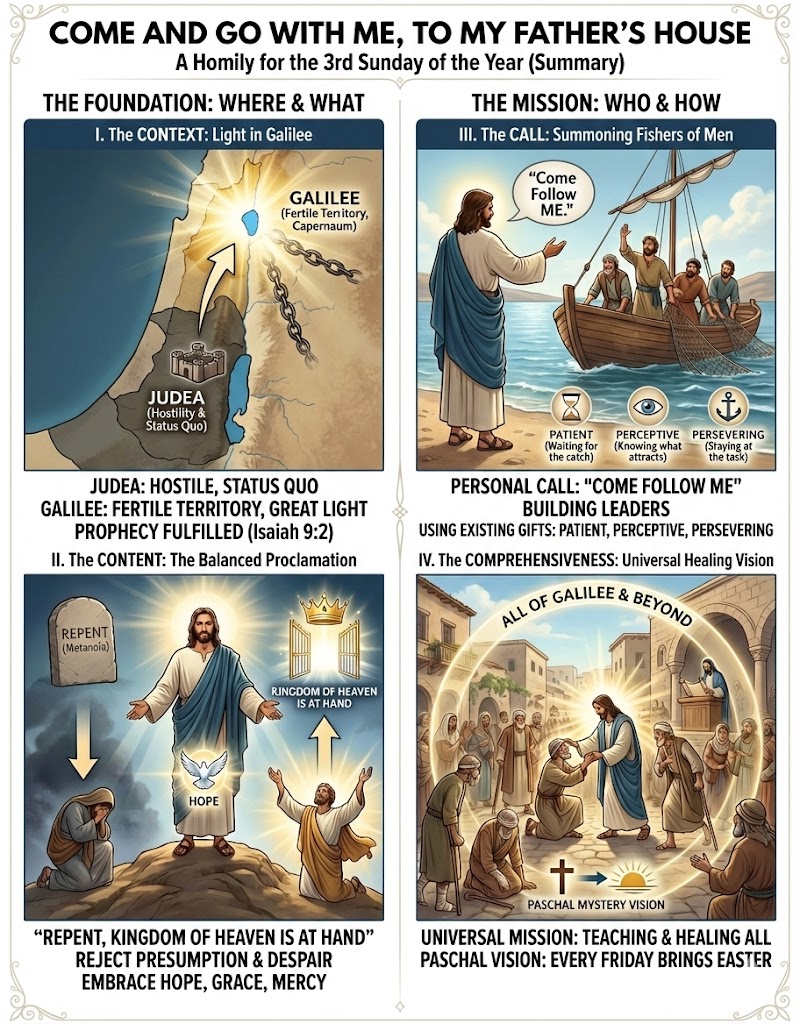
In today’s readings we come upon the same passage twice. In both Isaiah, the first reading, and in our gospel from Matthew we heard: Land of Zebulun and land of Naphtali, the way to the sea, beyond the Jordan, Galilee of the Gentiles, the people who sit in darkness have seen a great light, on those dwelling in a land overshadowed by death light has arisen.
The first is a prophecy. The second is a report. Isaiah said this would happen. Matthew reports that it did happen.
Land of Zebulun, land of Naphtali, where were these places? They were in the northern part of Galilee. One of the cities there was Capernaum. Jesus made Capernaum His base of operation when He started His ministry. These are the people who would first experience the Light.
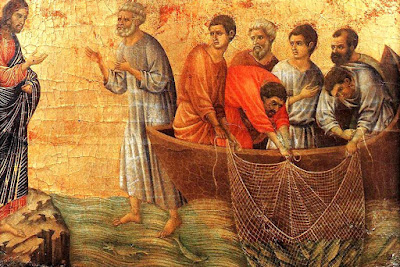
Four of them were fishermen: Simon, later to be called Peter, and his brother Andrew, and James and his brother John. The Lord’s call to them was so powerful that they immediately left their boats and nets. From the very beginning they were told that they would have a mission, they would become fishers of men. The people of Galilee and beyond, far beyond, would no longer walk in darkness.
Msgr. Charles Pope
Permission granted for non-profits to use in ministry
The infographic was created using Nano Banana, Google's Revolutionary AI Image Generator. Infographic may not be sold or used for personal financial gain. Please show your appreciation by letting others know about TheWordThisWeek.NET.
3rd Sunday of Year A
Come and Go with Me, to My Father’s House
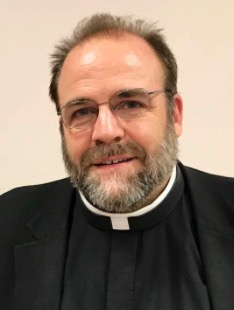
In these early weeks of “ordinary” time we are increasingly introduced to Jesus and to the beginnings of his public ministry. In Matthew’s Gospel today we hear described how Jesus began his public ministry in the wake of the arrest of John the Baptist. And Matthew tells us Four things regarding this ministry of Jesus. They remain for the Church and for all of us who would follow in Jesus’ footsteps important insights for us to acknowledge and imitate.
I The CONTEXT of Jesus Ministry
II The CONTENT of his MINISTRY
III. The CALL of his Ministry
IV The COMPREHENSIVENESS of his Ministry
Father Kevin Rettig
Permission granted for non-profits to use in ministry
The infographic was created using Nano Banana, Google's Revolutionary AI Image Generator. Infographic may not be sold or used for personal financial gain. Please show your appreciation by letting others know about TheWordThisWeek.NET.

3rd Sunday of Year A
Live Out Lord
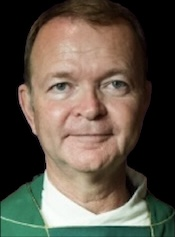
A few years ago a remarkable and very interesting man died in Japan. He was 91 years old and his name was Hiroo Onoda. Hiroo Onoda was a young soldier in World War two sent by the Imperial Japanese army to go to an island in the Philippines on December 26th 1944. Two months later the island was occupied by the Allied forces. Onoda fled to the hills. He had been given instructions never to surrender and he took these instructions very seriously indeed in those days remember.
The Japanese still regarded their emperor as a god to whom absolute loyalty was owed for the next 30 years. Lieutenant Onoda carried on the war and following his instructions meticulously never surrendered. The first time he was told that the war had actually come to an end was near the end of 1945 when a pamphlet was dropped around him. Seeing the war ended August 15th come down from the mountains already Onoda picked up the pamphlet read. It shook his head and said American propaganda he didn’t believe it then the Japanese themselves came up with pamphlets to be airlifted over the place where he was telling him that hostilities had come to an end and ordering him back home. He shook his head and said American propaganda and so he continued hiding out there and inflicting raids on the villages and towns of the island. In the early 50s they tried another tactic.

Permission granted for non-profits to use in ministry
The infographic was created using Nano Banana, Google's Revolutionary AI Image Generator. Infographic may not be sold or used for personal financial gain. Please show your appreciation by letting others know about TheWordThisWeek.NET.

3rd Sunday of Year A
Mender of Nets
Holes develop so that some people feel they don’t have a place there and they find themselves outside that net outside the family of God. How sad when some people feel they have no place in that family. Perhaps it’s not the fault of the fish. Perhaps it is the fault of the net filled with holes. Perhaps we need Menders of Nets if you sometimes feel out of place in the net of God’s family look at the people of sacred scripture. Noah was a drunk and there was a special place for him. In the family of God. Rahab was a prostitute and there was a special place for her. In God’s family…
There is a need for every one of us. In the net of God’s love. It is the net that sometimes needs mending in the middle of the 20th century God sent a very special mender of Nets by the name of John. The 23rd. He saw that the net was in critical need of mending so he summoned together a council to do just that and showed the world that there is indeed room for all in the heart of God. There are those who cast the Nets and there are those who mend the Nets. Both are vital so that the gentlenet of God’s love May Embrace and liberate all that all may find their place their home in the family of God.


3rd Sunday of Year A
Dive In
Sammy Lee was a Korean-American diver whose life was defined by overcoming racial discrimination through unwavering perseverance. As a 12-year-old faced with segregation at public pools, he honed his skills by practicing in a backyard sand pit, a determination that led him to win the 1942 United States National Diving Championships.
Lee went on to achieve historic success, becoming the first Asian American man to win an Olympic gold medal in 1948, eventually earning a second gold and recognition as an outstanding amateur athlete. Despite his fame, discrimination persisted, but Lee refused to be limited by it, drawing strength from his father’s advice to be proud of his identity in order to gain acceptance.
Fr. George Smiga

Permission granted for non-profits to use in ministry
The infographic was created using Nano Banana, Google's Revolutionary AI Image Generator. Infographic may not be sold or used for personal financial gain. Please show your appreciation by letting others know about TheWordThisWeek.NET.
3rd Sunday of Year A
Fishing for People

2020 HOMILY – Peter and Andrew were fishermen. This is probably why when Jesus calls them in today’s gospel, he tells them that they will be fishing for people. To be honest, “fishing for people” is not one of Jesus’ better images. Many factors work against it. First of all, fishing is a predator-prey activity. Those who fish for sport love it. The fish, not so much. If we were looking for an image to describe people being attracted to the gospel, we should be able to come up with one which does not place those so attracted on someone’s dinner plate. Add to this, that fishing carries negative associations in many of our English expressions. We “fish for a compliment.” We become “hooked on drugs” or some other dangerous practice. There is also the expression of “luring someone in” which carries its own negative connotation.
So what can we do to make Jesus’ image of “fishing for people” work in a way that is positive for our spiritual life? We can start by noting that fishing in first century Palestine was different than fishing is today. Peter and Andrew did not fish with a hook and a pole. As the gospel clearly says that they used nets which they threw into the sea. Once we include the net as part of the fishing image, its significance changes. It is no longer hooking an individual. It is now gathering things together. This idea of gathering is the usual way fishing is used in the Bible. Jeremiah talks about God as a fisherman who gathers the exiles from Babylon and returns them to their own country. In another place in the gospels, Jesus describes a net thrown into the sea, and all who are gathered by it enter the kingdom of God. So, when we understand the image of fishing in terms of the net, it becomes an invitation towards unity, a call to gather a community, an opportunity to build a church that will witness to the gospel.