Commentary Intro to Mass Readings for Sunday
CommentaryIntro to Mass Readings for Sunday
January 25, 2026
January 25, 2026
3rd Sunday of Year A




Mass Readings Explained
Dr. Brant Pitre
BIBLE STUDIES
Michal Hunt
Edrianne Ezell
Vince Contreras
Fr. Kieran O’Mahoney
Fr. Thibodeau

Catholic Biblical
Studies
Father Tim Peters, S.Th.D.
Professor of Biblical Theology
St. John’s Seminary
Camarillo, CA
1st READING | PSALM | 2nd READING | GOSPEL

Homily Presentation

Unpacking the Mass
Keith Nester

Larry Broding
Word-Sunday.com
The Light Among the Gentiles
What insights have you had lately? How have they impacted your life?
Light in the Shadow of Empire: Larry Broding on Isaiah
History isn’t just dates and dead kings—it is the raw material of Prophecy. To truly understand the “Great Light” of Christmas and Ordinary Time, you must understand the “Great Darkness” that preceded it. Larry Broding masterfully sets the stage, turning a dusty history lesson into a gripping narrative of political intrigue and divine hope.
Why this commentary is essential for your Homily Prep: Broding provides the critical geopolitical context that makes Isaiah’s words explode with meaning. He moves beyond the poetry to show the gritty reality of the “land of gloom.”
Key Preaching Points:
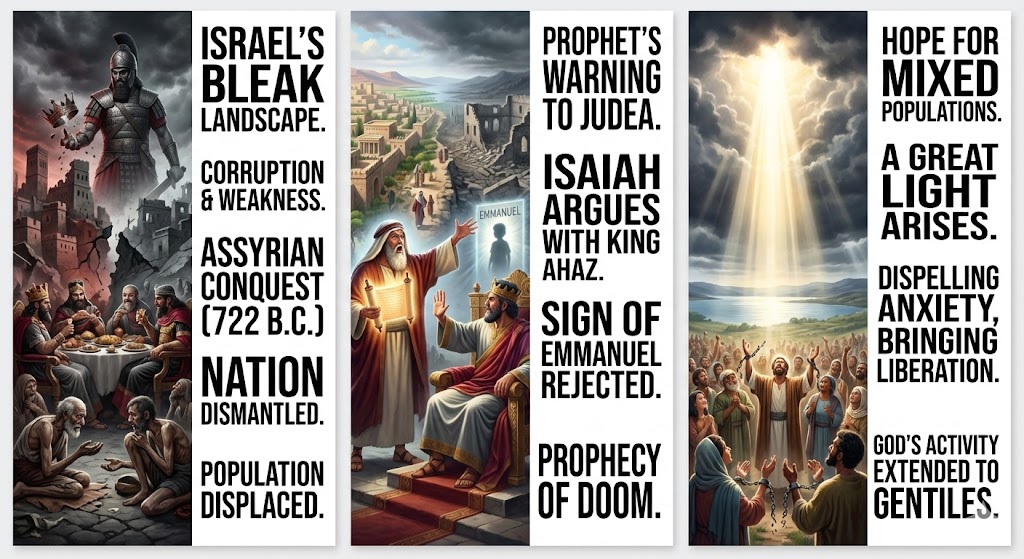
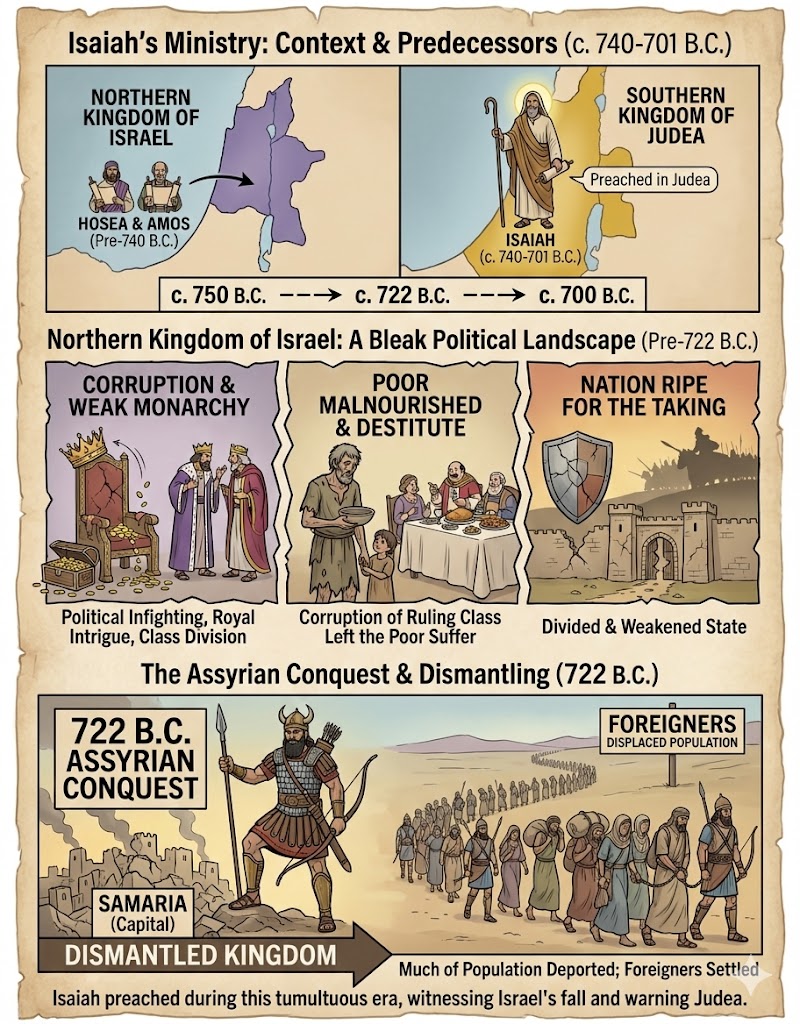
- A Tale of Two KingdomsBroding clarifies the often-confusing timeline: Isaiah preached in the South (Judea) while watching the North (Israel) collapse. He witnessed the “bleak political landscape” where corruption and infighting left the nation “ripe for the taking.”
- The Reality of “Gloom” When Isaiah speaks of darkness, he isn’t being metaphorical about bad moods. He is referencing the Assyrian Conquest of 722 B.C.
- Broding describes a land dismantled, a population displaced, and a ruling class that failed its poor. This historical weight makes the promise of “Light” infinitely more powerful.
- The Warning to Ahaz Explore the tension between the prophet and the politician. Isaiah offered signs (Emmanuel) to King Ahaz, but they were rejected. Broding notes that Isaiah’s prophecy wasn’t just a comfort; it was an argument against a despondent and fearful leadership.
- The Surprise of Universal Hope This is the “ah-ha!” moment for your homily.
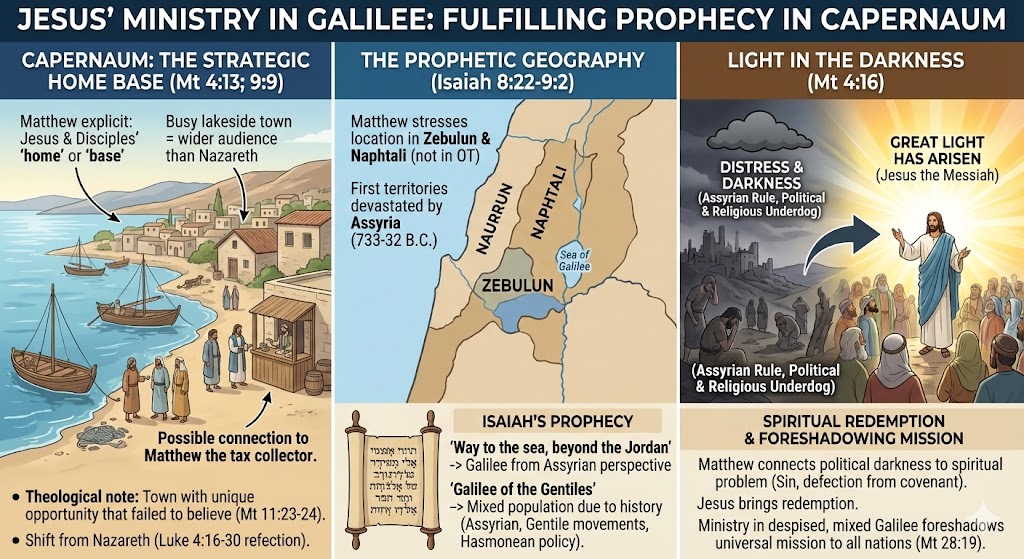
- Isaiah predicts that God will raise the status of the conquered North—specifically the area west of Galilee.
- The Twist: This area was now a “mixed population” of Jews and foreigners. Broding highlights that Isaiah implicitly extended God’s activity to the Gentiles.
- The Connection: This is why Matthew uses this text. Jesus serves as the Light not just for the pure, but for the mixed, the marginalized, and the “Gentiles of the area.”
Read Larry Broding’s full commentary to ground your message of Hope in the powerful reality of History.

Larry Broding
Word-Sunday.com
In Brief
In 1:13, Paul used a set of rhetorical questions to point out the absurdity of their fights. Was Christ to be divided up, like the community had been broken into pieces? Did Paul (or Apollos or Peter) give up his life for the salvation of believers? Was a baptism in the name of an evangelist or missionary efficacious? Of course, the answer to these questions was a resounding “NO!”
In 1:17, Paul simplified his ministry, in order to sharpen his critique of the community. Christ sent him to preach the Good News. This was the definition of an “Apostle.” He was not a baptizer. And Paul did not boast about the quality of his preaching. In fact, he did not promote wisdom, the highest value in the common Greek culture at the time. He was proud of the fact he did not promote wisdom. Instead, he claimed to promote the cross of Christ which had its own, intrinsic power to persuade. Paul was proud, but he knew his limits. And he knew the power of that which he preached.
United by the
Power of the Cross
What causes disagreements among people? Is there wisdom in the phrase: “Never discuss religion or politics?” Why or why not?
Is your church a community or a collection of cliques? It’s a problem as old as the Church itself. In this commentary on 1 Corinthians, Larry Broding dives straight into the “heart of the matter”—how to handle division, ego, and the fragmentation of the faithful.
Why this commentary is essential for your Homily Prep: Broding doesn’t just describe the division; he analyzes Paul’s masterclass in crisis management. He shows how Paul dismantled the “cult of personality” to refocus everyone on the only thing that matters.
Key Preaching Points:
- The Danger of “Spiritual Cliques” Broding paints a vivid picture of the Corinthian church: not a united body, but a fractured group fighting “turf battles.”
- The Factions: Supporters of Paul, Apollos, or Peter.
- The “Super-Christians”: Broding notes the group claiming to be “of Christ”—likely a group that acted superior and “immune” to the conflict, which ironically added to the division.
- The Absurdity of Division Use Paul’s rhetorical questions to challenge your congregation.
- Was Christ divided?
- Did your favorite preacher die for you?
- Is your baptism about the baptizer or the Savior?
- Wisdom vs. The Cross In a culture that obsessed over “wisdom” and high-status rhetoric (Greek culture), Paul did the unthinkable: He refused to play the game.
- Broding explains that Paul “simplified his ministry” to sharpen his critique.
- He didn’t rely on “fancy preaching” or “flashy teaching.” He relied on the intrinsic power of the Cross.
- The True Unifier What actually brings people to church on Sunday? Is it habit? Personal agenda? Broding concludes that while agendas exist, the true power that unites us is the Cross of Christ. It is the only symbol strong enough to supersede our petty divisions.
Read Larry Broding’s full commentary to discover how to preach Unity in a world obsessed with Division.


Larry Broding
Word-Sunday.com
In Brief
4:13 Capernaum was a town on the northern shore of the sea of Galilee. The region of Naphtali lies to the west of the sea; the region of Zebulun lie to the south and west of Naphtali.
4:15 This verse used different titles to describe the same area. Galilee was settled by Jews and non- Jews alike. The road along the western shore of the Sea of Galilee was a major trade road for the area, since it connected the communities along the Mediterranean Sea to Damascus.
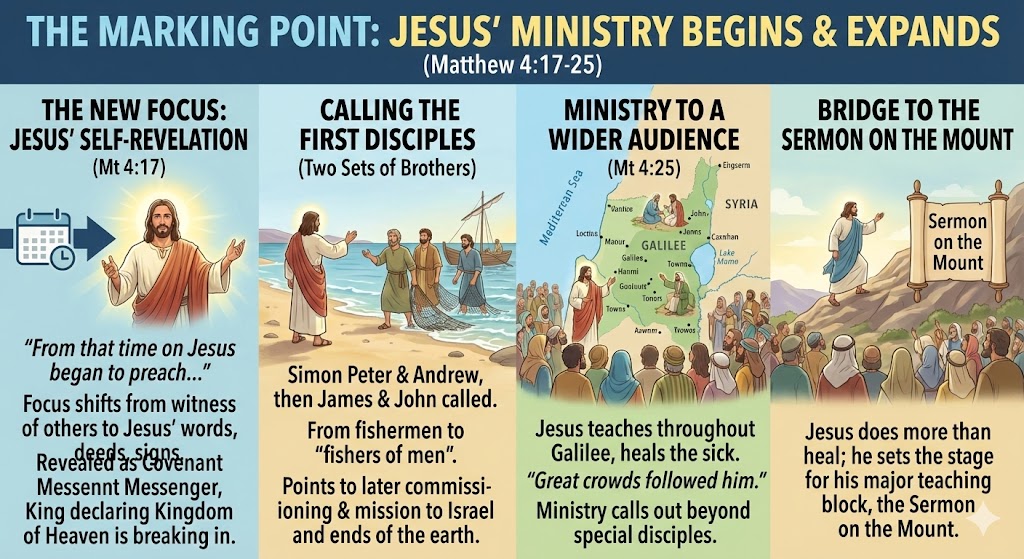
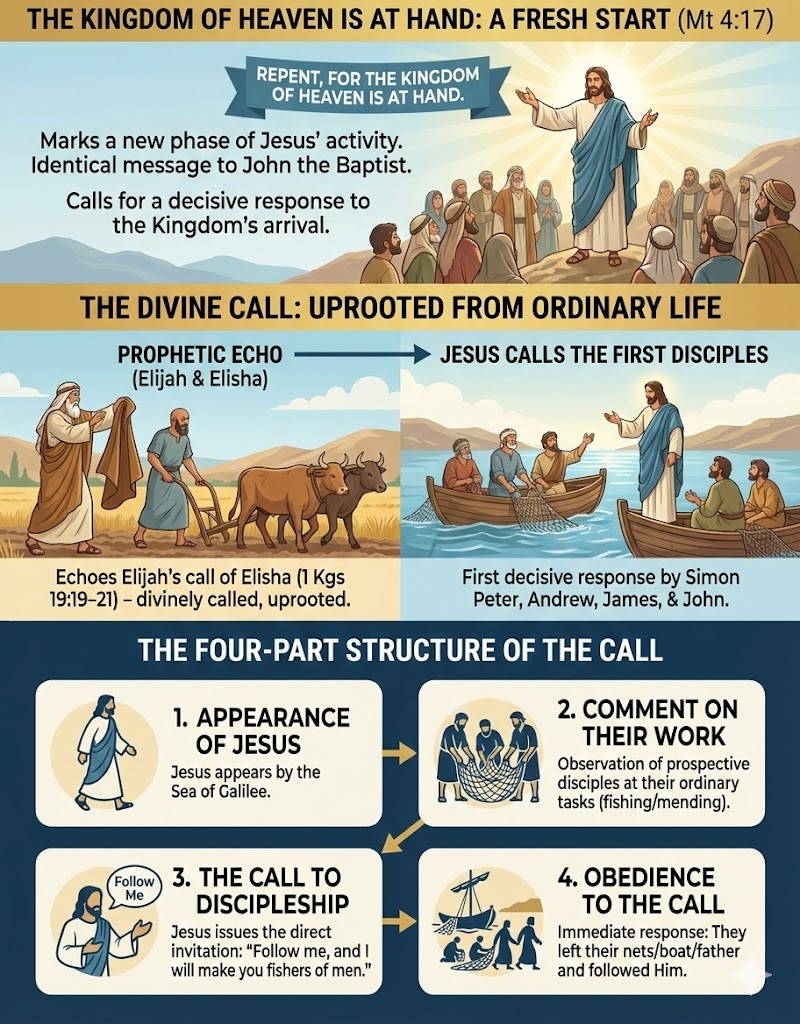
4:19 “Come after me…” This was not an invitation to companionship, but a call to discipleship. According to Matthew, Jesus molded his ministry by preaching (especially in the synagogues) [4:17, 23], calling disciples to follow him [4:18-22], and healing [4:23]. Jesus preached exclusively to the Jews in Galilee, a culturally mixed area (unlike Judea which had a totally Jewish culture). Although he adopted John’s message of repentance, he shifted its focal point. The Kingdom was no longer a coming event. It was at hand. And the subject of the message was missing. Jesus did not preach about a coming Messiah. [4:17]
A Light to the Nations
Who do you know that is wise? Who truly “enlightens” you?
Everyone wants to be an expert. In a world filled with self-help books and guides on how to gain fame and fortune, Larry Broding invites us to look at the one man who didn’t write a book, but became the Light.
Why this commentary is essential for your Homily Prep: Broding moves beyond simple theology and grounds the Gospel in the gritty, diverse reality of first-century Galilee. He explains how Jesus built a movement that changed the world.
Key Preaching Points:
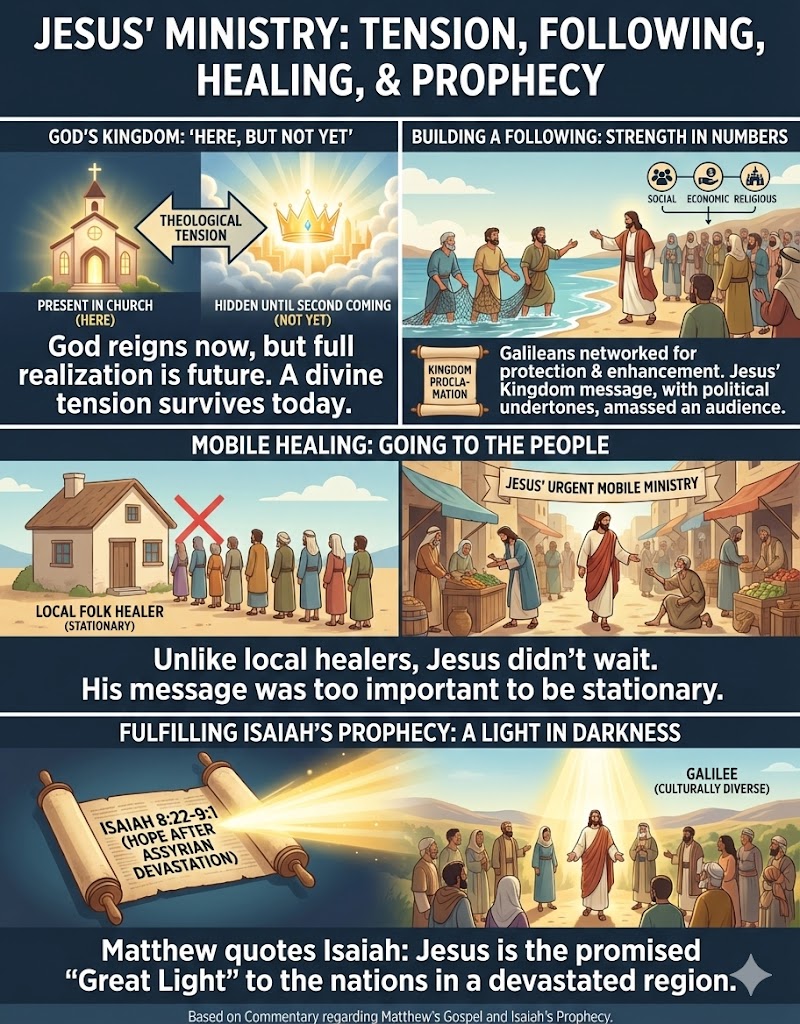
- The “Here… But Not Yet” Paradox Explore the tension of the Kingdom of God. It is present now through the Church, yet remains hidden until the Second Coming.
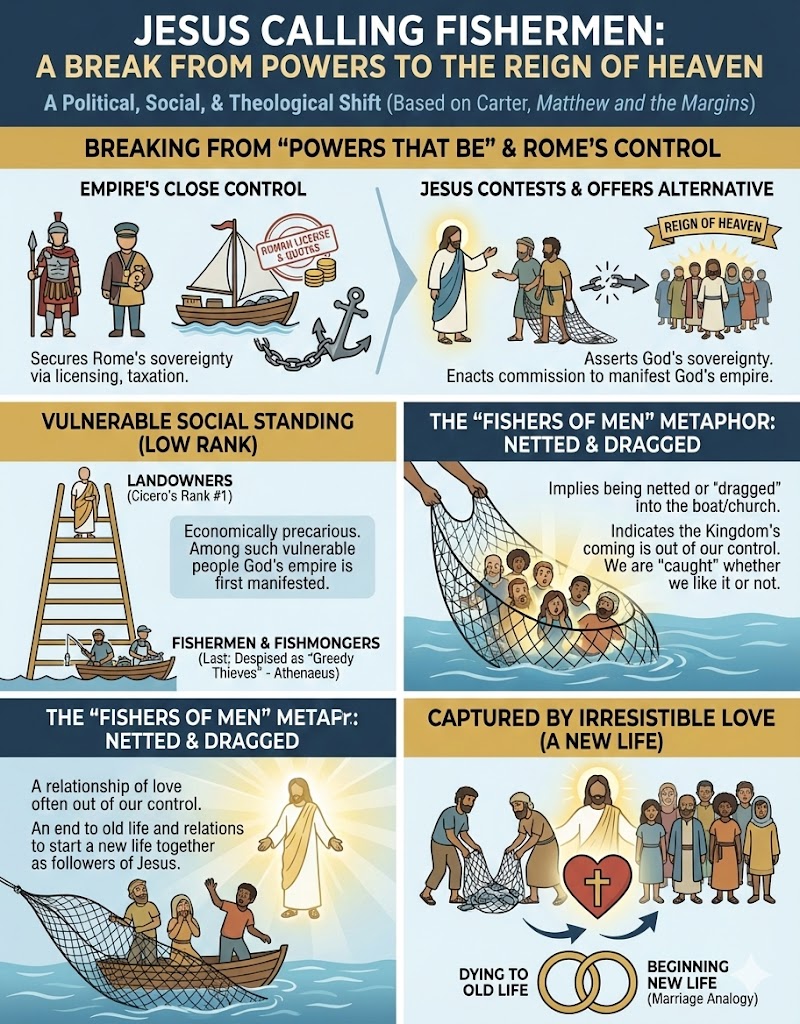
- Jesus the Ultimate Networker Jesus didn’t just wander; he was strategic. Broding details how Jesus tapped into existing social networks of fishermen—groups already organized for economic survival—to build his “fishers of men.”
- Mobile Ministry vs. Local Healers Unlike the folk healers of his day who stayed in their homes, Jesus was mobile. He didn’t wait for the audience; He went to them.
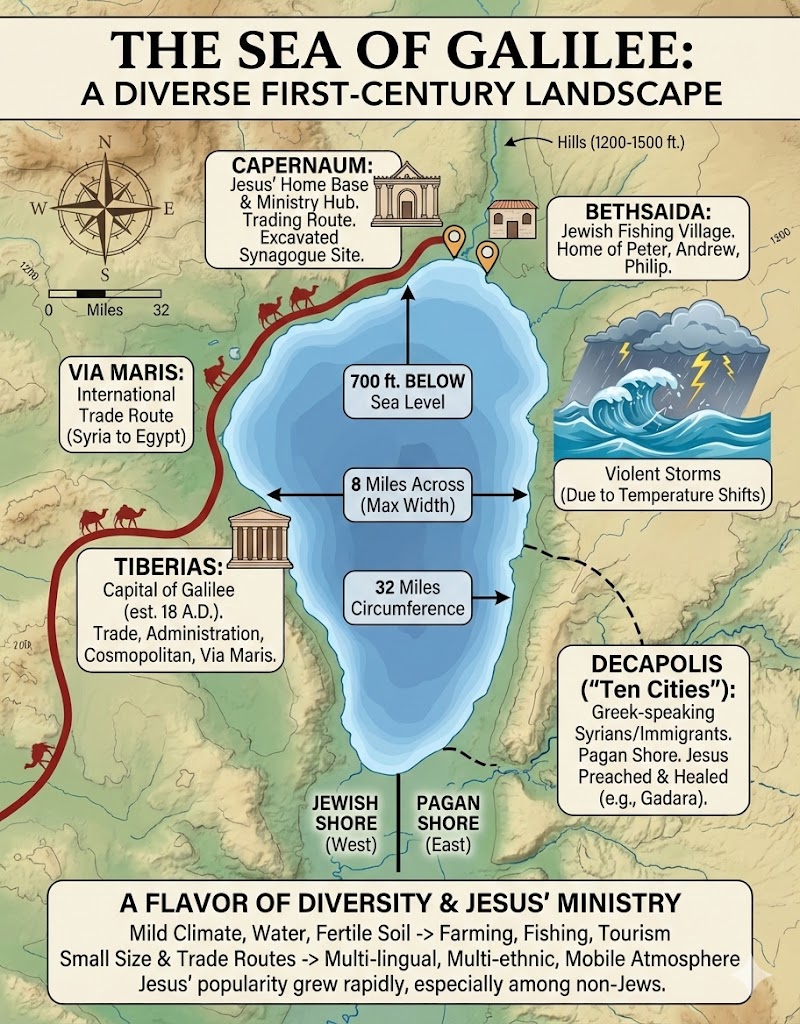
- A Tour of Galilee’s “Melting Pot”Broding takes you on a tour of the Sea of Galilee—700 feet below sea level, surrounded by trade routes and diverse cities.
- West Shore: Jewish fishing villages like Capernaum.
- East Shore: Pagan, Greek-speaking cities of the Decapolis.
- The Lesson: Jesus stood at the crossroads of civilizations, fulfilling Isaiah’s prophecy as a true “Light to the Nations.”
Read Larry Broding’s full commentary to give your congregation a vivid, historical, and spiritually rich “tour” of the Gospel.


Calling the Disciples
Biblical Geography
Calling the Disciples
Jesus Calling Fishermen