Bible Study Discussion Questions
Bible Study Discussion Questions
Bible Study Discussion Questions
January 18, 2026
January 18, 2026
2nd Sunday of Year A


DOWNLOAD (PDF)

Edrianne Ezell
OUR SUNDAY READINGS offers a weekly PDF handout that can be used in various settings, including church bulletins, Bible study groups, homeschooling, and small group discussions. This resources is provided courtesy of Edrianne Ezell who has a Master of Divinity, Weston Jesuit School of Theology.
Isaiah 49:3, 5-6
Reading Closely
1. How would you define the role of a servant? Based on these verses, a servant is defined not just by menial labor, but by identity and purpose derived from God.
- Belonging: The servant belongs wholly to the master ("You are my servant").
- Instrumentality: The servant is the tool through which the master is revealed ("in whom I will be glorified"). The servant’s role is to make the Master look good and accomplish the Master's will, rather than their own.
2. What all does God want this servant to do? God has a two-fold, expanding mission for this servant:
- The Internal Mission: To bring the tribes of Jacob (Israel) back to God and gather them together. This is a ministry of restoration for God’s own people.
- The Global Mission: To be a "light for the nations" (Gentiles). God says the first mission is "too light" (too small) a thing; He wants the servant to bring salvation to the very "end of the earth."
3. What makes this person suitable for carrying out God’s plan? The servant is suitable not because of their own independent power, but because of their origin and resource:
- Predestination: They were formed by God "from the womb" specifically for this purpose. They were made for this job.
- Divine Empowerment: The text states, "My God has become my strength." They are suitable because God sustains them.
4. How does the servant seem to feel about God’s plan? In verses 5 and 6, the servant seems confident and dignified.
- The servant notes that they are "honored in the eyes of the Lord."
- There is a sense of intimacy and security, knowing that God is their strength. Even if the task is huge (reaching the ends of the earth), the servant feels supported. (Note: Verse 4, which is skipped in your selection, usually expresses the servant's human discouragement, but in verses 5-6, the mood shifts back to confidence in God's backing.)
5. How might people have felt about this prophecy?
- The Exiles (Israel): They likely felt a mix of hope and shock. Hope, because God promised to gather and restore them. Shock (and perhaps some jealousy), because God declared that saving only them was "too light a thing."
- The Nations (Gentiles): If they heard it, they might have felt wonder that the God of Israel intended to include them in His salvation.
6. How might people have responded to this prophecy?
- Skepticism: Some might have doubted that a broken people (or a single servant) could possibly affect the "ends of the earth."
- Resistance: Exclusive groups might have resented the idea of sharing their "light" with foreign nations.
- Anticipation: The faithful would have begun looking for this Servant—someone who brings people together rather than driving them apart.
7. Would you want to be the servant? (This is subjective, but here is a balanced perspective)
- Yes: It is a profound privilege to be "honored in the eyes of the Lord" and to be the vehicle for bringing light to the world.
- No: It is an immense burden. Being responsible for the spiritual restoration of a nation and the salvation of the world requires total self-sacrifice and reliance on God, which can be terrifying.
Living the Word
8. In what ways can you serve God? Service to God often mirrors the servant's mission in Isaiah:
- Restoration: Helping to bring "wandering" people back to faith or community (reconciling relationships, inviting people to church).
- Being a Light: Acting with kindness, justice, and integrity in the secular world ("the nations") so that others see God's light through your actions.
- Vocation: Using your specific talents (teaching, healing, building, parenting) as a way to glorify God, just as the servant was "formed from the womb" for a specific purpose.
9. How do you discern God’s will? Just as the servant knew he was "formed from the womb," discernment involves looking at how you were made:
- Internal Clues: What are your natural gifts? What brings you deep, lasting joy (not just temporary fun)?
- External Clues: What do trusted mentors or friends say you are good at? Where is there a need in the world that matches your skills?
- Prayer: Spending quiet time asking God, like the servant, to be your strength and guide.
10. How do you feel about what God may be calling you to do? (Personal reflection questions to help you answer)
- Do you feel "honored" like the servant, or do you feel burdened?
- Do you feel prepared? Remember, the servant claimed, "God has become my strength." If you feel inadequate, it might be an invitation to rely less on yourself and more on God.
- Is your current vision "too light"? Sometimes we dream too small, and God, as in verse 6, challenges us to expand our horizons to do something greater than we imagined.
John 1:29-34
Reading Closely
1. To whom is John speaking? While John the Baptist was previously speaking to priests and Levites from Jerusalem (in verses 19-28), in this specific passage (v. 29), he seems to be addressing the crowd around him and his own disciples. He is making a public declaration to anyone present at the Jordan River.
2. What are all the things John says about Jesus? John attributes several profound titles and roles to Jesus:
- The Lamb of God: The one who takes away the sin of the world.
- The Pre-existent One: A man who comes after him but ranks ahead of him because he existed before him.
- The Baptizer with the Holy Spirit: The one who will not just baptize with water, but with the Spirit.
- The Son of God: The ultimate conclusion of his testimony (v. 34).
3. How do you think John knows these things about Jesus? John admits twice, "I myself did not know him" (meaning he didn't know Jesus's divine identity initially). He knows these things because of direct revelation from God. God gave him a specific sign to look for: "He on whom you see the Spirit descend and remain" (v. 33). When John saw the Spirit descend like a dove, he knew this was the confirmation.
4. How much about Jesus do you think John really understands? John likely understands the magnitude of Jesus's identity (that He is divine and the Messiah) but perhaps not the full method.
- He understands Jesus is greater than himself and pre-existent.
- He understands Jesus deals with sin ("takes away the sin of the world").
- However, like many prophets, he might not have fully grasped how Jesus would take away sin (through death on a cross) or that Jesus would not immediately bring political judgment. (Later in Matthew 11, John sends disciples to ask, "Are you the one?" suggesting his understanding was imperfect).
5. How do you think people react to John’s statements?
- Confusion: Calling a grown man a "Lamb" is a strange metaphor to hear for the first time.
- Intrigue: Hearing that someone ranks higher than the popular prophet John would make people curious.
- Action: In the very next verses (John 1:35-37), two of John's own disciples leave him to follow Jesus. This suggests John’s words were effective—they caused people to switch allegiance.
6. How do you think Jesus reacts to John’s statements? The text doesn't explicitly state Jesus's reaction in this moment, but generally, Jesus accepts John's testimony with humility and validation. He does not interrupt or correct John. By walking "toward him" (v. 29), Jesus is deliberately presenting Himself to be identified, accepting the role John is laying out.
7. What is the role of the Holy Spirit in this passage? The Holy Spirit acts as the Identifier or the Marker.
- The Spirit is the visual sign that allows John to recognize the Messiah.
- The Spirit "remained" on Jesus, signifying a permanent anointing, distinguishing Jesus from the prophets of old who were visited by the Spirit temporarily.
Living the Word
8. When do we use the title Lamb of God?
- In Liturgy: Catholics and many Anglicans/Lutherans sing or say the Agnus Dei ("Lamb of God, you take away the sins of the world...") at every Mass right before Communion.
- In Scripture/Prayer: It is used during the Eucharistic elevation: "Behold the Lamb of God."
- In Song: It is a frequent theme in worship music and hymns (e.g., "Lamb of God" by Twila Paris).
9. What does the title Lamb of God mean to you? (Personal reflection guide)
- Sacrifice: It recalls the Passover lamb whose blood saved the Israelites. It means Jesus is the ultimate sacrifice that ends the need for all other sacrifices.
- Innocence: A lamb is gentle and innocent. It suggests Jesus submitted to death willingly, without fighting back.
- Victory: In the Book of Revelation, the "Lamb who was slain" is the only one worthy to open the scroll of history. It means victory through self-giving love.
10. What testimony would you give about Jesus? If you had to introduce Jesus to a stranger today, what would you say?
- Like John: "This is the one who changed my life" or "This is the one who forgives me."
- Personal experience: "He is the peace in my chaos" or "He is the challenge to my selfishness."
- Theological: "He is God showing us what love looks like."
.
.
.
Create an 8.5×11 infographic with a clean, modern design and large images. Title: [Insert Title Here]. Layout: Three vertical panels with a large header and footer. Style: Colorful, high-contrast, professional, and easy to read.
Footer text: ‘2026 TheWordThisWeek.NET infographic based on commentary from Edrianne Ezell | oursundayreadings.wordpress.com’
Content: [Paste the First Reading/Gospel/Meditation text here]”
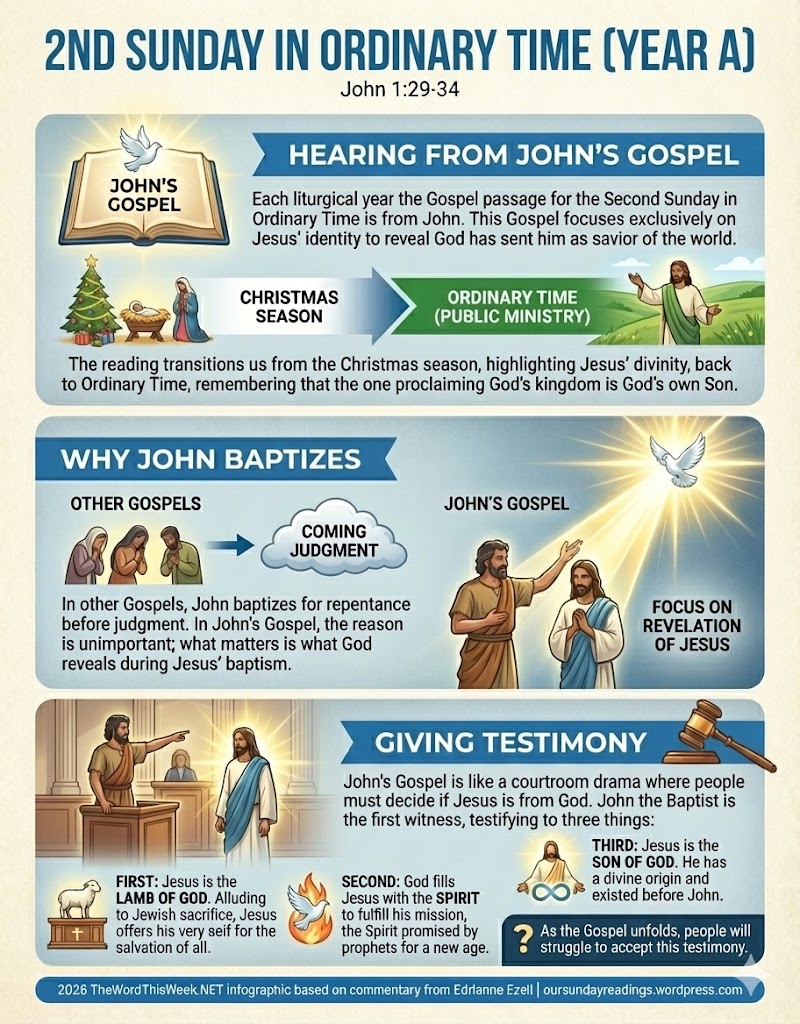

Feel free to use TWTW‘s AI generated visual summaries of Edrianne Ezell ‘s commentary. They are not intended to replace it. Please use them in conjunction with her guide. You can cut, copy and paste any portion of them to use as clip art for your bulletin, or use them as is. When using above infographics please give credit to TWTW and Our Sunday Readings.





Vince Contreras
SUNDAY SCRIPTURE STUDY FOR CATHOLICS offers a weekly PDF handout that can be used in various settings, including church bulletins, Bible study groups, homeschooling, and small group discussions.
1. Promises in the 1st Reading (Isaiah 49:3, 5-6)
Promises Identified:
- The Servant: The Messiah will be God’s faithful servant in whom God is glorified (v. 3).
- Restorer of Israel: He will bring Jacob (the Jewish people) back to God (v. 5).
- Light to the Nations: He will not just save Israel, but be a "light to the nations" (Gentiles) (v. 6).
- Global Salvation: His salvation will reach to the "ends of the earth" (v. 6).
Application to Jesus:
- Jesus fulfills the role of the Servant by perfectly obeying the Father's will, even unto death (CCC 536 notes that at His baptism, Jesus accepts His mission as God's suffering Servant).
- He acts as the Light to the Nations (referenced in Luke 2:32) by opening the covenant to non-Jews.
2. Categories of People in 1 Corinthians 1:1-3
The Two Categories: St. Paul addresses:
- "Those sanctified in Christ Jesus": People who have already been made holy through Baptism and faith.
- "Called to be holy" (saints): People who have a vocation and ongoing duty to live out that holiness.
(Note: Paul also broadens this to "all those everywhere who call upon the name of our Lord Jesus Christ," uniting the local church with the universal church.)
How You Fit In:
- Sanctified: If you are baptized, you have been washed clean and set apart (sanctified) by grace.
- Called: You are currently "under construction." You fit into the second category by striving daily to live a saintly life, answering the universal call to holiness.
3. Titles of Jesus in the Gospel (John 1:29-34)
The Two Titles:
- Lamb of God (v. 29).
- Son of God (v. 34).
Supporting Proof:
- Psalm 2:7: God declares, "You are my Son; today I have begotten you," prophesying the Messiah’s divine sonship.
- CCC 1286: This paragraph explains that in the Old Testament, the prophets announced the Spirit would rest on the Messiah. John the Baptist saw this proof when the Spirit descended and remained on Jesus (John 1:33). This anointing confirmed He was the Son of God.
4. Meaning of "Lamb of God"
The Meaning (Exodus 12:1-3; Isaiah 53:7): John combines two powerful images (CCC 608):
- The Suffering Servant: The silent lamb led to the slaughter to bear the sins of many (from Isaiah).
- The Paschal Lamb: The symbol of Israel's redemption during the Passover (from Exodus).
Where Catholics Hear This: We hear this every Sunday (and daily) at Mass during the Fraction Rite, just before Communion: "Lamb of God, you take away the sins of the world, have mercy on us."
Application to Our Lives (CCC 1293-94): While these paragraphs specifically discuss the symbolism of anointing oil (joy, cleansing, healing), they relate to the "Lamb" because the Spirit anointed Jesus at his baptism.
- In the Mass, we receive the Lamb (Eucharist).
- Like the oil mentioned in the Catechism, this encounter cleanses us (takes away sin), strengthens us (like athletes), and makes us radiate the "perfume of Christ."
5. "Beholding" the Lamb
What it means to Behold: To "behold" is not just to glance, but to gaze with recognition and faith. It means to look at Jesus and acknowledge, "This is the One who saves me."
What Kind of Lamb (Exodus 12:5; 1 Peter 1:19):
- Exodus 12:5: The lamb must be a year-old male without blemish.
- 1 Peter 1:19: Describes Christ as a lamb "unblemished and spotless."
- Meaning: Jesus is sinless and perfect. He is the only offering pure enough to atone for the sins of the world.
6. Living the Sacrificial Lifestyle
Incorporating this into your life: To live like the Lamb of God is to embrace CCC 523 (John's example of serving the Light) and CCC 536 (accepting the mission of the suffering servant).
- Submissiveness: Accepting God’s will over your own plans, even when it is difficult.
- Sacrifice: Being willing to "lay down your life" in small ways—giving your time to someone who needs it, forgiving someone who hurt you (absorbing the sin rather than returning it), and serving without seeking recognition.

Fr. Kieran O’Mahony, OSA
TWTW infographics below were created using core concepts from the PDF above
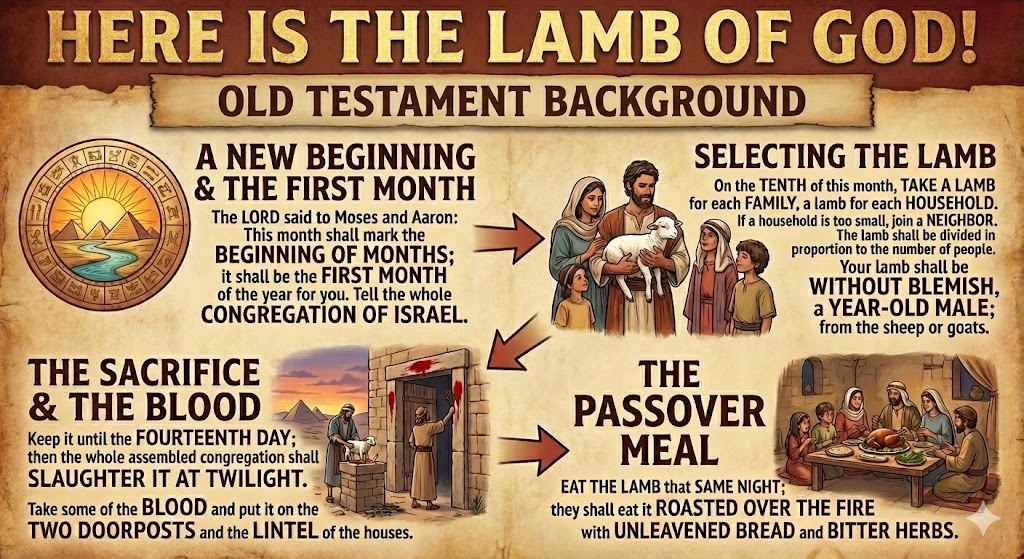
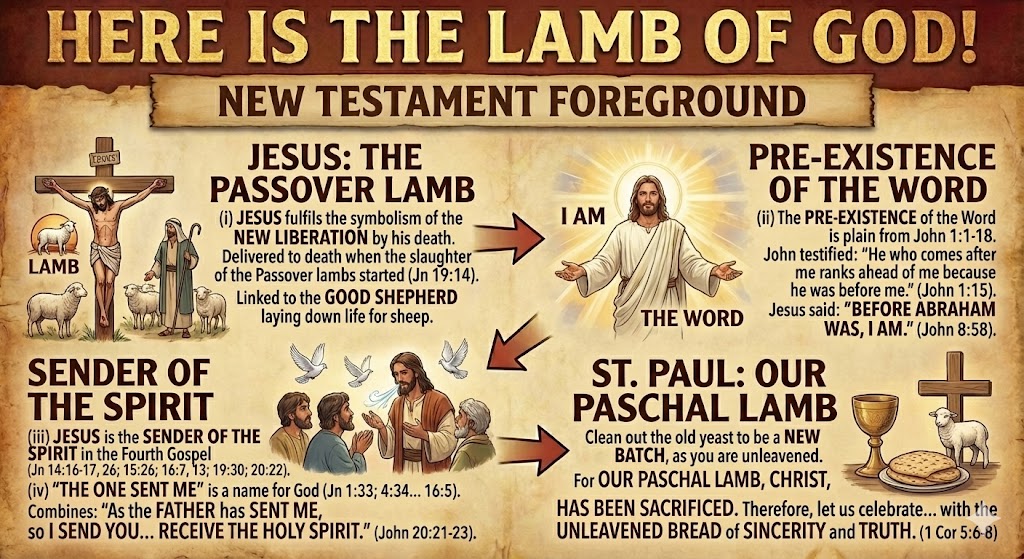
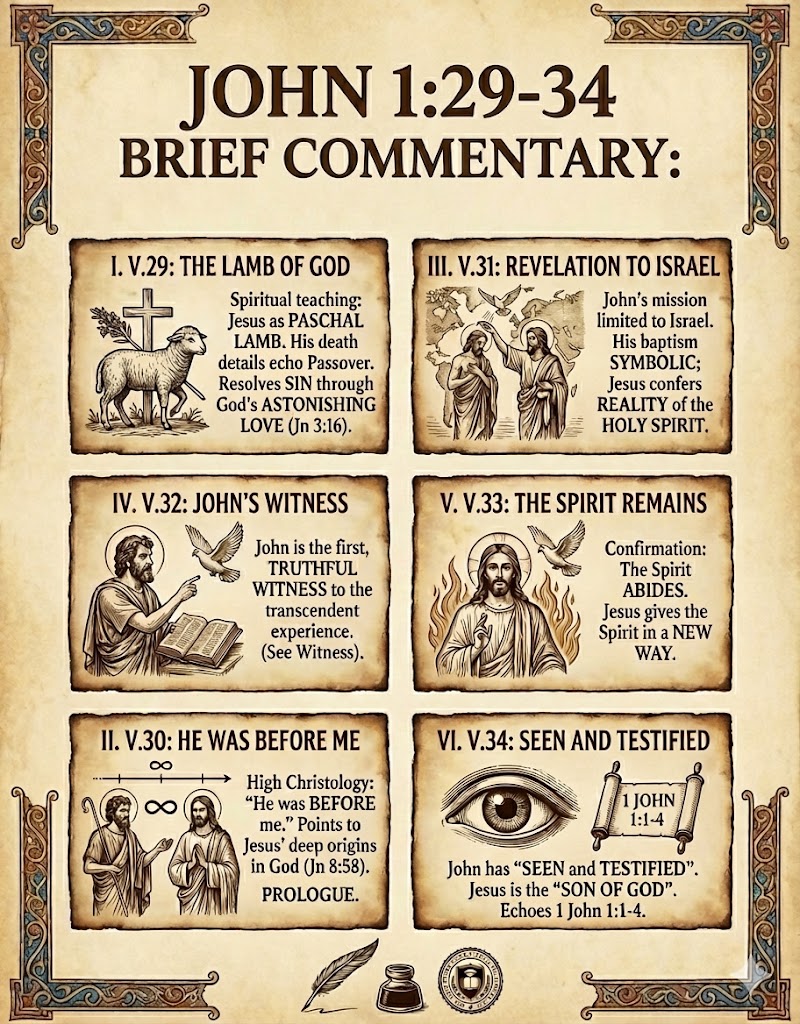
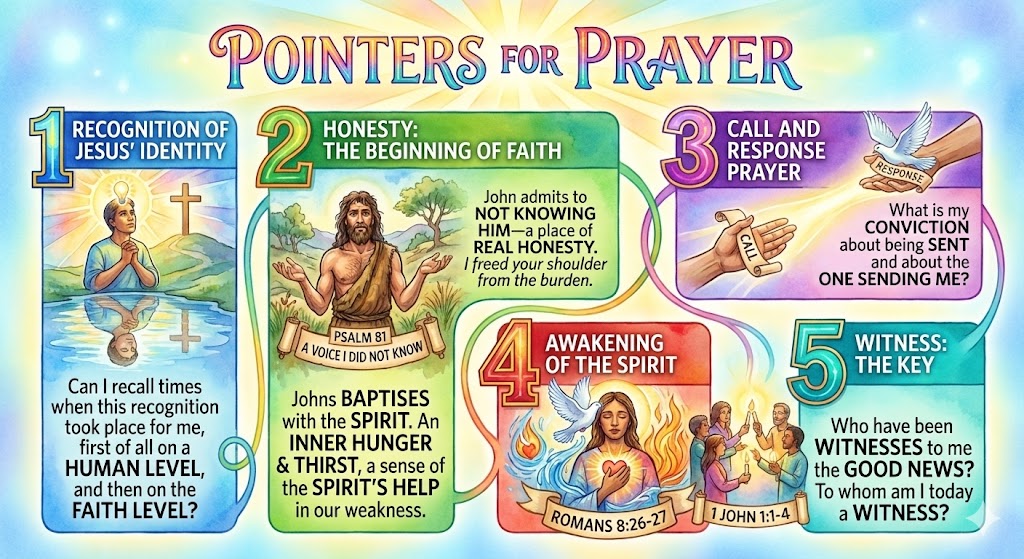
TWTW infographics on this page present Fr. Kieran’s “GOSPEL COMMENTARY” and “POINTER FOR PRAYER” which are presented after each reading’s commentary. Please cross-reference the slides with the PDF if you notice any errors. Non-profits are welcome to utilize the provided graphics in their materials and presentations. Please acknowledge Fr. Kieran O’Mahony, OSA, and his website, taurus.ie. The graphics were designed by TheWordThisWeek.net using Gemini Pro 3 and Nano Banana. Proper attribution is appreciated.

Fr. Clement D. Thibodeau
Echoing God’s Word – Portland Diocese | Download (PDF)
1. The Mystery of Recognition (John 1:31)
In what sense did John not recognize Jesus? John the Baptist was Jesus’s cousin, so he likely knew Jesus the man. However, he says "I did not know him" in the sense that he did not yet fully grasp Jesus’s divine identity and messianic mission until God revealed it.
- The Theological Distinction: There is a difference between knowing about someone and knowing who they truly are in God's plan. John needed the specific sign of the Holy Spirit (John 1:32-33) to move from human familiarity to divine revelation.
The Voice of Early Christians: Yes, putting these words in John's mouth reflects the experience of the early Church. Many Jews and Gentiles had to transition from seeing Jesus as a carpenter or a teacher to recognizing Him as the Son of God. This confession ("I did not know him") validates the experience of gradual conversion—acknowledging that one can be close to the truth without fully seeing it.
The Lament of "Blindness": (Reflection) This sentiment is echoed by St. Augustine, who famously wrote, "Late have I loved thee." The feeling of "blindness" usually comes from realizing that God was present all along, but we lacked the spiritual sight to see Him.
- For your reflection: Have you experienced moments where a struggle or a period of "waiting" in your life suddenly made sense in hindsight, revealing that God was working there the whole time?
2. The Spirit as the Revealer (John 1:32-34; 1 Cor 1)
Why the Spirit makes testimony possible: We cannot testify to what we do not know. According to CCC 683, "No one can say 'Jesus is Lord' except by the Holy Spirit."
- The Revealer: The human mind can grasp historical facts, but only the Spirit can reveal the deep reality of God. In John 1, the Spirit is the visual key that unlocks the identity of the Messiah for John.
- The Connector: Without the Spirit "abiding" in us, Jesus remains an external historical figure. The Spirit makes Him an internal, living reality. As St. Paul notes in 1 Corinthians 1:2, we are "sanctified in Christ Jesus"—this sanctification is the work of the Spirit making us holy and capable of witnessing.
The Necessity of Confirmation (The Seal): We need the "seal" of the Spirit to witness effectively because human willpower is not enough to sustain a life of faith against the world.
- CCC 1285: States that Confirmation "gives us a special strength of the Holy Spirit to spread and defend the faith by word and action as true witnesses of Christ."
- CCC 1303: Explains that this sacrament gives us the "power to confess the name of Christ boldly." Just as the Spirit descended and remained on Jesus to empower His ministry, Confirmation imprints a spiritual mark (character) on us to empower our mission.
3. The Fraction Rite & The Lamb (John 1:29; Isaiah 49)
Why we pray this before Communion: We recite the Agnus Dei ("Lamb of God") during the Fraction Rite because it bridges the gap between the Sacrifice and the Supper.
- Recognition of Unworthiness: Just as John the Baptist felt unworthy to untie Jesus's sandals, we acknowledge our sinfulness right before receiving the All-Holy God.
- The Remedy: We identify Jesus as the only cure. We do not say "Lord, I will try harder"; we say "Lamb of God, you take away the sins." It is a confession of total reliance on His power, not ours.
"The Lamb has taken our sins upon himself": This concept draws from the "Suffering Servant" in Isaiah 49 and Isaiah 53.
- Expiation: It means Jesus acted as a sponge for the evil of the world. He absorbed the consequences of sin (death and separation) so that we wouldn't have to.
- The Broken Bread: As the priest breaks the host, we see a visual symbol of Jesus's body being "broken" on the Cross. We repeat "have mercy on us" because that singular act of breaking is what heals our brokenness.
- Peace: The prayer ends with "grant us peace" because once sin is taken away by the Lamb, the barrier between us and God is removed, resulting in true peace (CCC 1331).
create an 8.5x11 inch infographic with images based on an essay of Fr. Clement D. Thibodeau.
create an 8.5x11 inch infographic with images on a white background based on an essay of Fr. Clement D. Thibodeau.

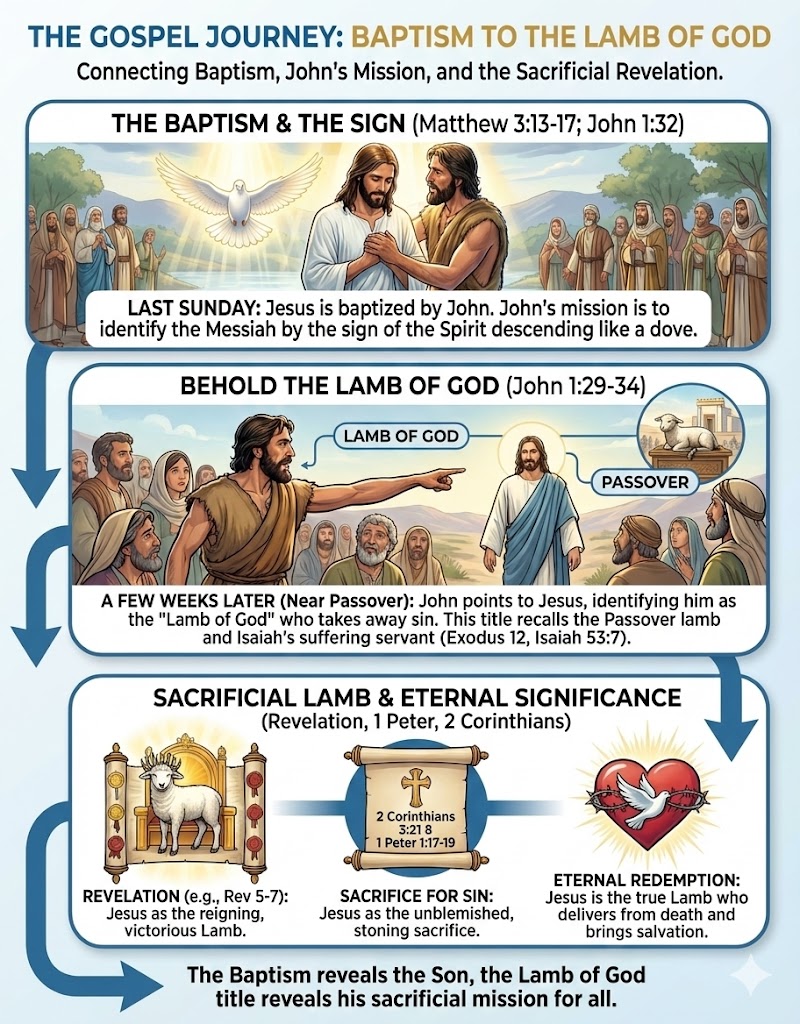
The above bulletin insert was created using Nano Banana Pro with Gemini 3.0. The infographics draw inspiration from the content found in Fr. Clement Thibodeau's Echoing The Word weekly column which was published nearly a decade ago. It may be used by any non-profit ministry.