Free clip art, comics, graphics for bulletins, web pages, presentations, etc. for Baptism of the Lord Year A Isaiah 49:3, 5-6 ; 1 Corinthians 1:1-3 John 1:29-34

Clip art, comics, Bulletin Inserts for Sunday

Clip art, comics, Bulletin Inserts for Sunday

Clip art, comics, Bulletin Inserts for Sunday

Clip art, comics, Bulletin Inserts for Sunday

January 18, 2026

January 18, 2026

2nd Sunday of Year A

FR. LONSDALE'S CLIPARTSUNDAY COMICSBULLETIN INSERTS

First Reading

Isaiah 49:3, 5-6

CLICK HERE FOR A MORE DETAILED ANALYSIS

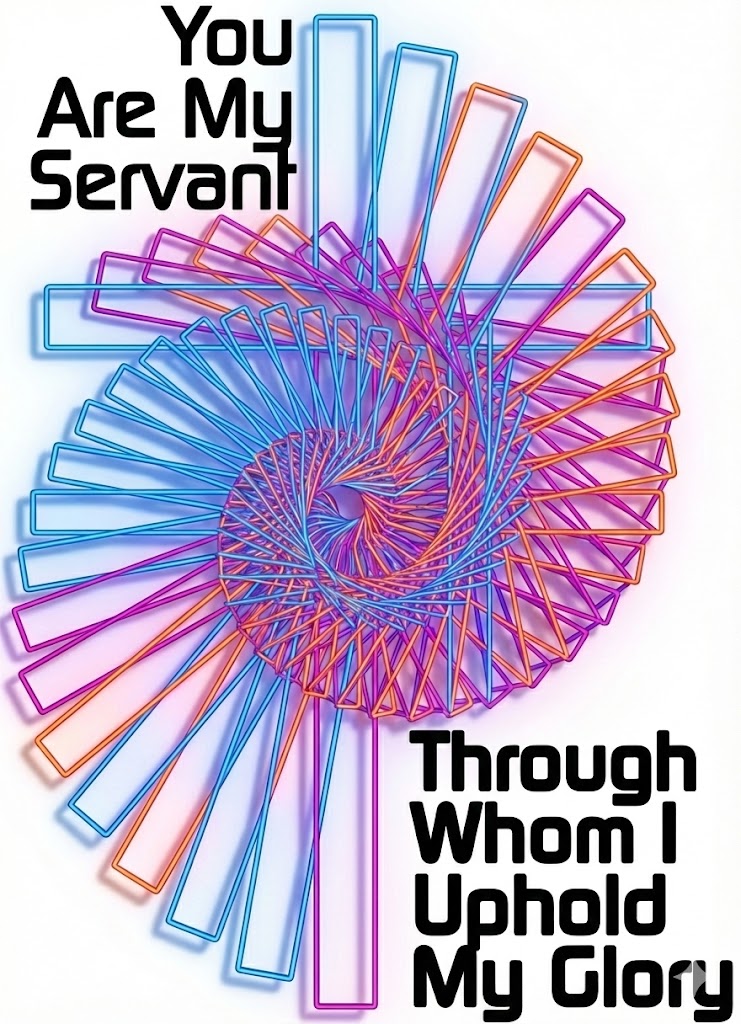
1. The Explicit Identity: "You Are My Servant"

The most direct connection between the artwork and the scripture is the text in the upper left corner: "You Are My Servant."

This is a direct reference to Isaiah 42:1: "Here is my servant, whom I uphold, my chosen one in whom I delight..."

In the biblical context, God is introducing a figure commissioned for a specific task. The artwork places this declaration at the top, establishing the primary subject of the piece.

The font style—blocky, outlined, and glowing—gives the words weight and a sense of divine pronouncement.

2. Divine Support and Purpose: "Uphold My Glory"

The text in the bottom right reads: "Through Whom I Uphold My Glory." This phrase is a theological synthesis of several key elements in the Isaiah text:

  • Divine Support: The word "Uphold" directly connects back to Isaiah 42:1 ("whom I uphold") and Isaiah 42:6 ("I will take hold of your hand. I will keep you..."). The artwork emphasizes that the Servant does not act alone but is sustained by Yahweh.
  • The Manifestation of Glory: While the word "glory" is not explicitly in these specific verses of Isaiah 42, it summarizes the result of the Servant's mission described there. God "delights" in this servant (v.1), and the servant’s task is to establish justice on earth (v.4) and be a light to the nations (v.6). By successfully completing this mission, the Servant reveals God's character and magnifies His glory.

.

3. Visualizing the Mission: The Spiral and the Light

The central graphic element—a complex vortex of rotating rectangles radiating from a dark center—serves as a powerful visual metaphor for the themes found in Isaiah 42:6-7.

  • From Darkness to Light: Isaiah 42:7 describes the Servant's mission: "...to release from the dungeon those who sit in darkness." The artwork visualizes this movement. The center of the spiral is the densest, darkest point. The geometric lines expand outward from this darkness, growing larger and creating a sense of movement toward the edges.
  • A Light for the Gentiles: Isaiah 42:6 calls the Servant "a light for the Gentiles." The golden/yellow outlining of the text and the geometric shapes against the white background suggests illumination spreading outward from a central source.
  • Unfolding Justice: The spiral suggests a continuous, unstoppable process. This reflects the determination of the Servant described in Isaiah 42:4: "He will not falter or be discouraged till he establishes justice on earth." The mission is not static; it is an expanding movement of redemption.

4. The Interpretive Lens: The Subliminal Cross

While Isaiah 42 is an Old Testament text, Christian theology interprets the "Servant" as a prophecy fulfilled by Jesus Christ. The artwork subtly incorporates this interpretation.

The overall arrangement of the rectangular spiral forms a large, latent cross structure that frames the composition. By placing the Isaiah text around a structure that implies the cross, the artist is identifying the "Servant" of Isaiah specifically as Christ, whose mission of bringing light out of darkness was accomplished through his crucifixion and resurrection.

The artwork is a contemporary, geometric visualization of the first “Servant Song” found in Isaiah 42. It uses explicit text drawn from the themes of the passage combined with abstract visual elements—specifically a spiraling vortex framed by a subtle cross—to illustrate the identity, divine support, and expanding mission of the figure God calls “My Servant.”


Second Reading

1 Corinthians 1:1-3

CLICK HERE FOR A MORE DETAILED ANALYSIS

1. The Senders: Paul and Sosthenes (Verse 1)

The image accurately reflects the authorship described in 1 Corinthians 1:1, which states the letter is from "Paul... and our brother Sosthenes."

  • The Primary Author: The "From" field in the image contains the email address paul@apostle2gentiles.com. This corresponds directly to Paul, and the domain name is a clever reference to his specific calling as the "apostle to the Gentiles."
  • The Co-Sender: The "Cc" (Carbon Copy) field includes sosthenes@apostle2gentiles.com. This perfectly illustrates Sosthenes' role as a co-sender or associate mentioned alongside Paul in the opening verse. Sharing the same domain suggests their shared mission.

2. The Recipients: The Church in Corinth (Verse 2)

The image identifies the intended audience specified in 1 Corinthians 1:2, which addresses the letter "To the church of God in Corinth..."

  • The Destination: The "To" field is populated with the address people@corinth_church.org. This is a clear and direct modern equivalent of addressing the collective body of believers, or "church," located in the city of Corinth.

.

3. The Apostolic Greeting (Verse 3)

The main body of the email contains a verbatim quotation of the standard apostolic greeting found in 1 Corinthians 1:3.

  • The Message: The text inside the message box reads: Grace to you and peace from God our Father and the Lord, Jesus Christ. This is the exact wording of Paul's opening blessing to the Corinthian church, establishing the theological foundation of the communication that follows.

4. Thematic Subject and Modern Metaphor

The Medium as Message: By presenting the scripture as an email, the artwork suggests that the ancient text is not a distant, historical artifact but a living, relevant form of communication. Just as an email is a common way to send a message today, this portrayal emphasizes the personal and direct nature of Paul's words to the church.

The Subject Line: The image includes a Subject line of Love. While the word "love" does not appear in the first three verses, it is a central and defining theme of the entire letter of 1 Corinthians (most famously in chapter 13). The artist has chosen to distill the overarching purpose of the letter into this single, powerful word right at the beginning.

The artwork is a creative modernization of the opening verses of Paul’s first letter to the Corinthians. It re-imagines the ancient epistle as a contemporary email, using the familiar fields of a digital message to identify the senders, recipients, and the core greeting found in 1 Corinthians 1:1-3. This approach presents the biblical text as a direct and personal mode of communication.


Gospel

John 1:29-34

CLICK HERE FOR A MORE DETAILED ANALYSIS

1. The Prophetic Declaration: John 1:29

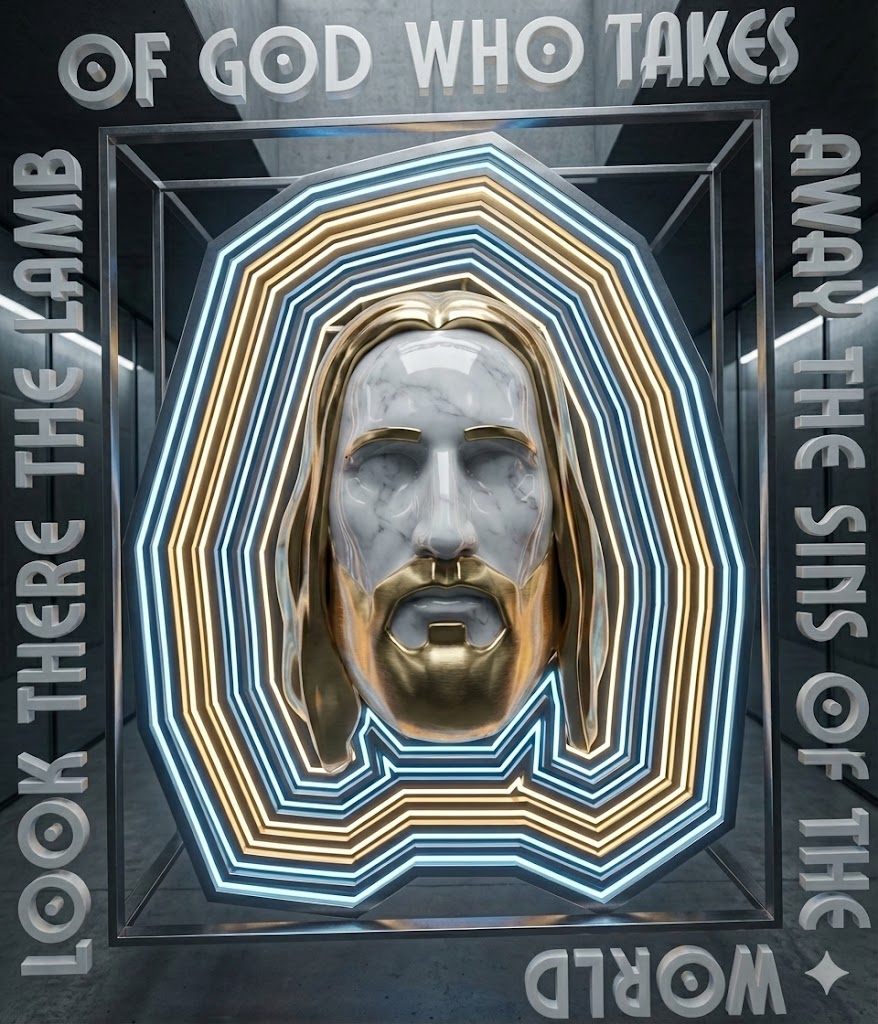
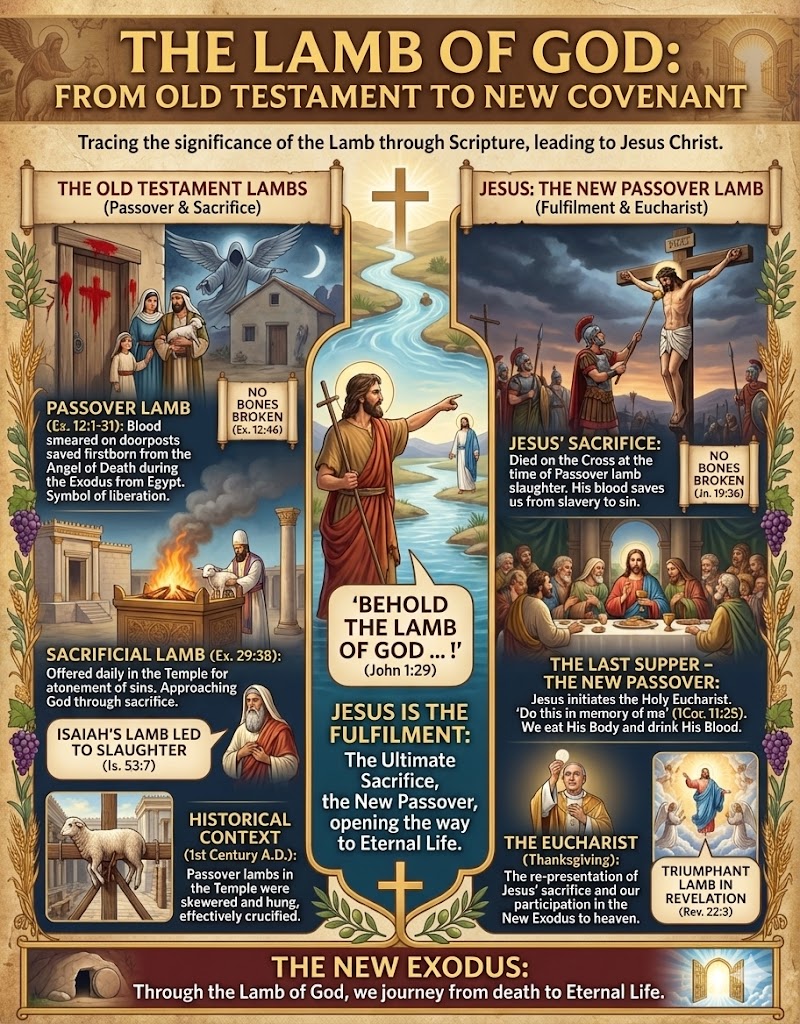
The most significant connection between the artwork and the scripture is the textual border that frames the entire composition. Reading clockwise, starting from the left side, the text spells out the exact proclamation made by John the Baptist in John 1:29.

  • The text begins on the left with "LOOK THERE THE LAMB".
  • It continues across the top with "OF GOD WHO TAKES".
  • It runs down the right side with "AWAY THE SINS OF THE".
  • It concludes on the bottom with "WORLD".

By using these specific words as the boundary of the artwork, the piece literally encloses the central figure within John’s theological definition of His mission: to be the sacrificial "Lamb of God" who removes sin.

2. Visualizing the Revelation: John 1:31-34

The central elements of the artwork visually communicate the themes of revelation and divine identity found in John 1:31-34. In these verses, John emphasizes that his purpose was that Jesus "might be revealed to Israel" (v. 31) and testifies that he saw the Spirit descend on Jesus, confirming Him as "God’s Chosen One" (v. 34).

  • The Central Portrait: The center of the image is a high-contrast face of Jesus. By placing this portrait inside the textual frame, the artwork visually identifies this specific face as the "Lamb of God" mentioned in the surrounding text.
  • The Aura of Revelation: The central face is surrounded by multiple concentric, wavy lines that radiate outward, creating a halo or ripple effect against the dark background. This visual element suggests emanations of power, divinity, or light shining in darkness. It serves as a visual metaphor for the "revelation" of Jesus to Israel spoken of by John, marking Him out from others just as the descent of the Spirit did in the biblical narrative.

This artwork is a direct visual representation of the pivotal moment in John 1:29 where John the Baptist publicly identifies Jesus. The piece frames a stylized portrait of Christ with the exact words of John’s declaration, creating a unified statement of Jesus’ theological identity as the sacrificial “Lamb of God” revealed to the world.

SOURCES: Clip art on the left is from Father Richard Lonsdale © 2000. AI enhanced colorized reimagined clip art of Father Lonsdale’s original images are on the right. To copy the clipart images, click with your right mouse button and use “save picture (or image) as…” To view a complete list of clipart images and commentaries: Lonsdale Commentaries and Clipart
IN THE PARISH

TEXT VERSION

My neighboring pastor put sanitary hot air hand dryers in the rest rooms at his Church and after two weeks took them out. I asked him why and he confessed that they worked fine but when he went in there, he saw a sign that read, “For a sample of this week’s sermon, push the button.”


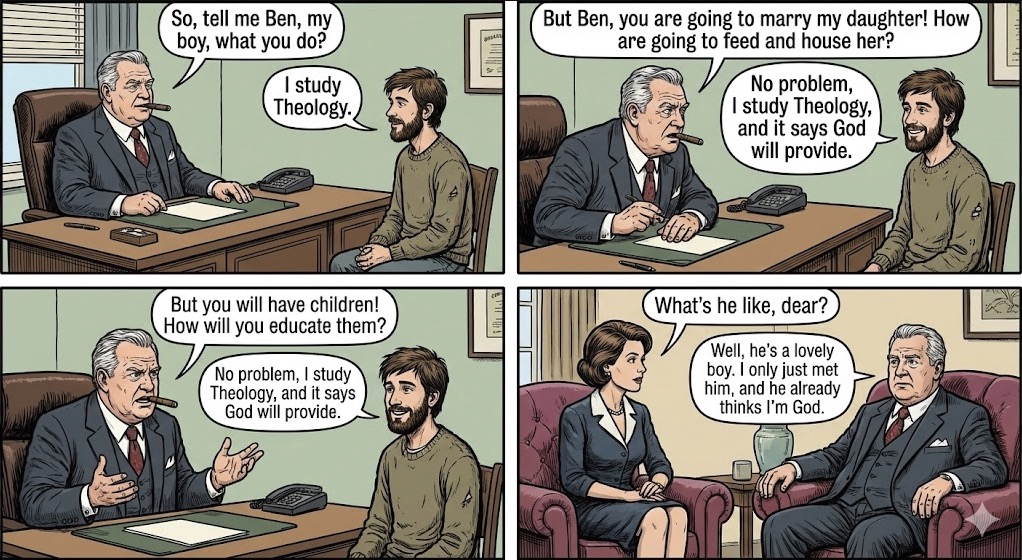
FUTURE SON-IN-LAW

TEXT VERSION

The rich businessman Raymond goes to meet his new son-in-law to be, Ben. He says to Ben, “So, tell me Ben, my boy, what you do?” “I study the Theology,” he replies. “But Ben, you are going to marry my daughter!  How are going to feed and house her?” “No problem,” says Ben, “I study Theology, and it says God will provide.” “But you will have children! How will you educate them?” asks Raymond. “No problem,” says Ben, “I study Theology, and it says God will provide.” When Raymond returns home, his wife anxiously asks him what Ben is like. “Well,” says Raymond, “he’s a lovely boy. I only just met him, and he already thinks I’m God.”


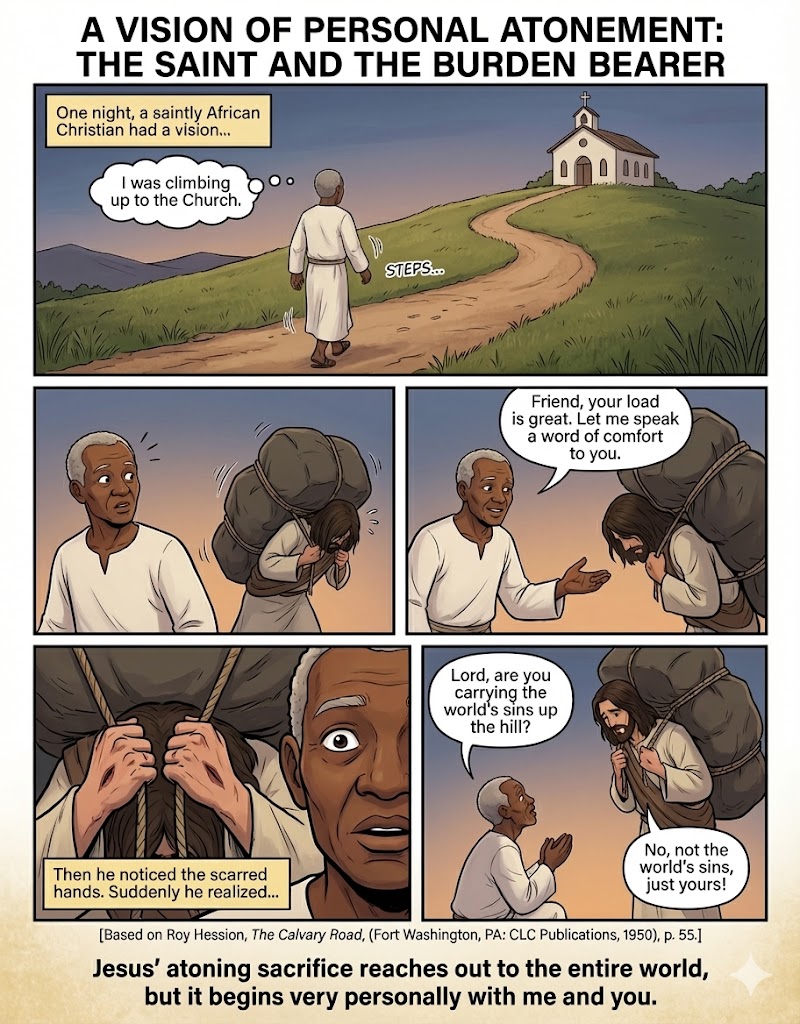
Behold, the Lamb of God…

TEXT VERSION

One day a saintly African Christian told his congregation about a vision he had had the night before. In the vision he was climbing up the hill to the Church. Suddenly he heard steps behind him. He turned and saw a man carrying a very heavy load on his back, climbing that hill. He was full of sympathy for this man and spoke kindly to him. Then he noticed that the man’s hands were scarred. Suddenly he realized that this was Jesus. He said to him, “Lord, are you carrying the world’s sins up the hill?” “No,” said the Lord Jesus, “not the world’s sins, just yours!” [Roy Hession, The Calvary Road, (Fort Washington, PA: CLC Publications, 1950), p. 55.] Jesus’ atoning sacrifice reaches out to the entire world, but it begins very personally with me and you.


God’s Press Conference

TEXT VERSION

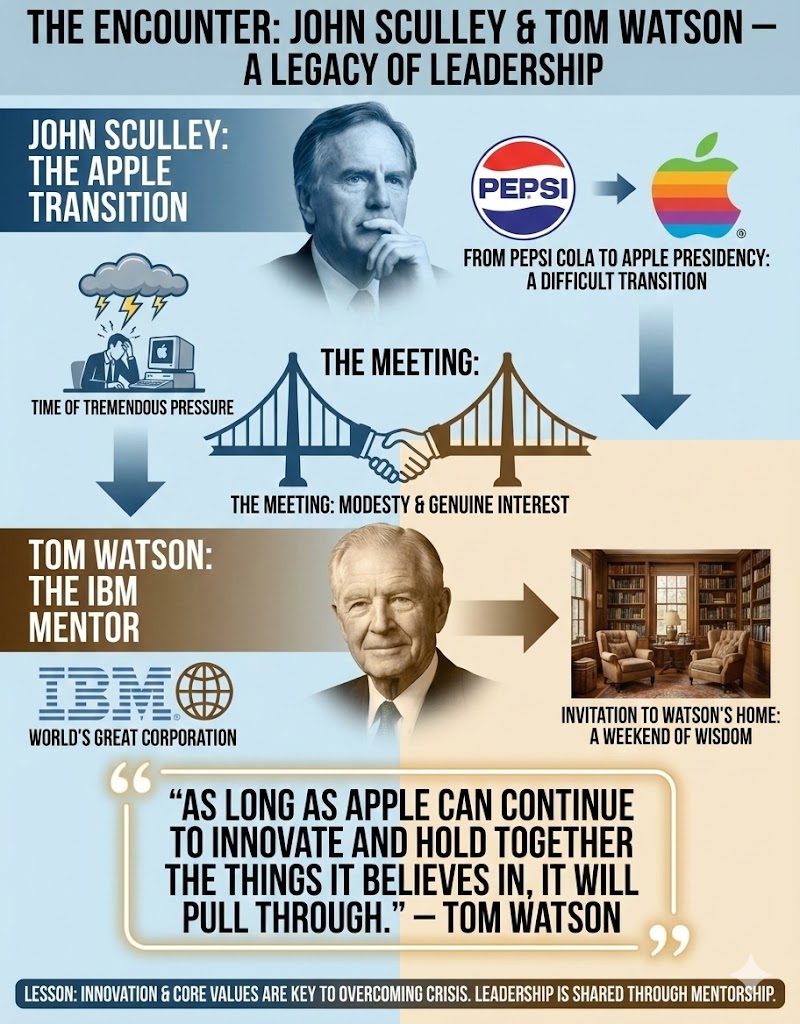
When likable Lou Holtz was announced as the new head football coach at the University of Notre Dame, he was touted as one who would restore the school’s football program to its tradition of excellence. Whenever a new leader appears on the scene, whether it is the new coach of a team or the new president of a corporation, a press conference is usually held to proclaim that leader’s qualifications and potential. Such press conferences usually create some excitement about the leader’s identity and arouse our expectations with glowing promises about what this leader will accomplish. Today’s event of our Lord’s baptism is something like this. It’s as if God Himself called a press conference to reveal His Son Jesus as the long-awaited Messiah and to give us a preview of what His mission would accomplish

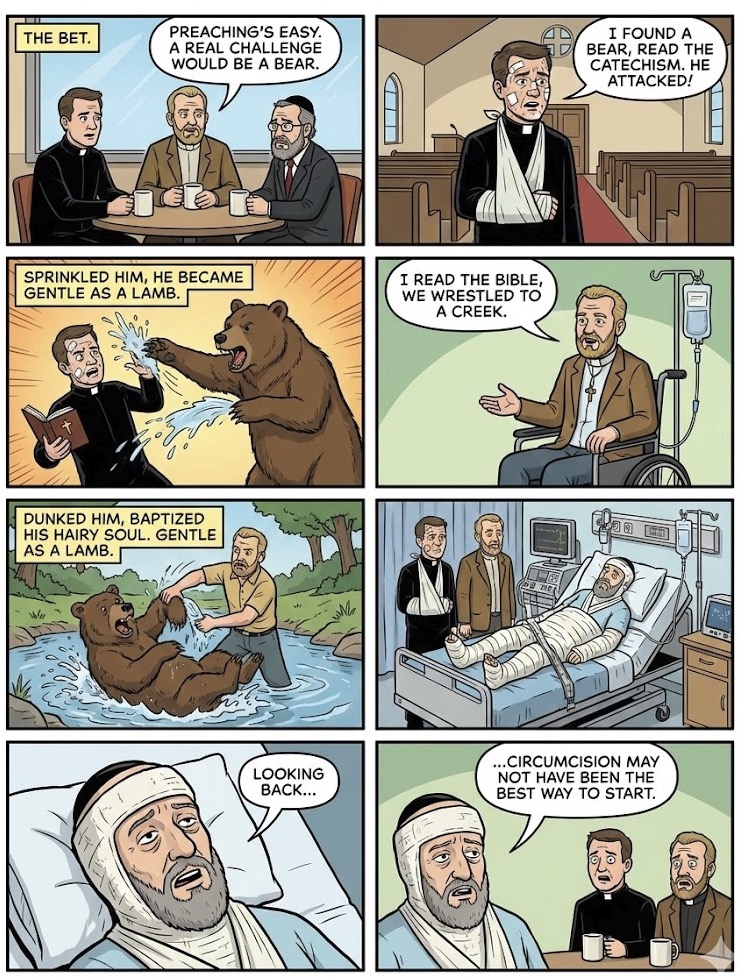
SOURCE: Comic panels were created using AI based on anecdotes/jokes found at Father Tony’s Homilies. Permission is given for them to be freely copied in any publication for non-commercial use.


BAPTISM: Catholic, Baptist, Jewish

TEXT VERSION

A Catholic Priest, a Baptist Preacher and a Rabbi were sitting around drinking coffee. Someone made the comment that preaching to people isn’t really all that hard, a real challenge would be to preach to a bear. One thing led to another, and they decided that each would find a bear and attempt to convert it to their religion. Seven days later, they all came together to discuss their experiences.

Father Flannery, who had his arm in a sling and had various bandages on his body and limbs, went first. ‘Well,’ he said, ‘I went into the woods to find me a bear. And when I found him, I began to read to him from the Catechism. Well, that bear came after me and began to slap me around. So I quickly grabbed my holy water, sprinkled him and, Holy Mary Mother of God, he became as gentle as a lamb.’

Reverend Billy Bob the Baptist spoke next. He was in a wheelchair and had an IV drip. ‘I went out and found me a bear. And then I began to read to my bear from the Bible! But that bear came after me. We wrestled down one hill, until we came to a creek. So, I quickly dunked him and baptized his hairy soul. And just like you said, he became as gentle as a lamb.

The Priest and the Reverend both looked down at the Rabbi, who was lying in a hospital bed. He was in a body cast and traction with IV’s and monitors running in and out of him. The Rabbi looked up and said: “Looking back on it, circumcision may not have been the best way to start? 

SOURCE: Comic panels were created using AI based on anecdotes/jokes found at Father Tony’s Homilies. Permission is given for them to be freely copied in any publication for non-commercial use.

Free Clip Art

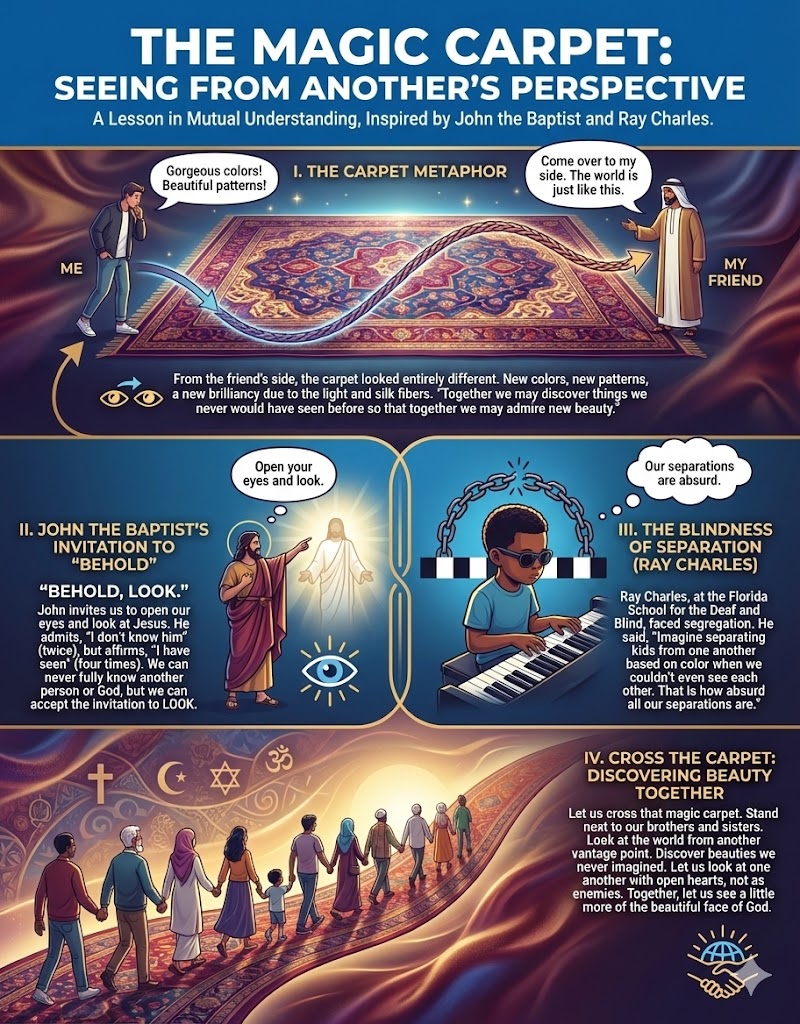
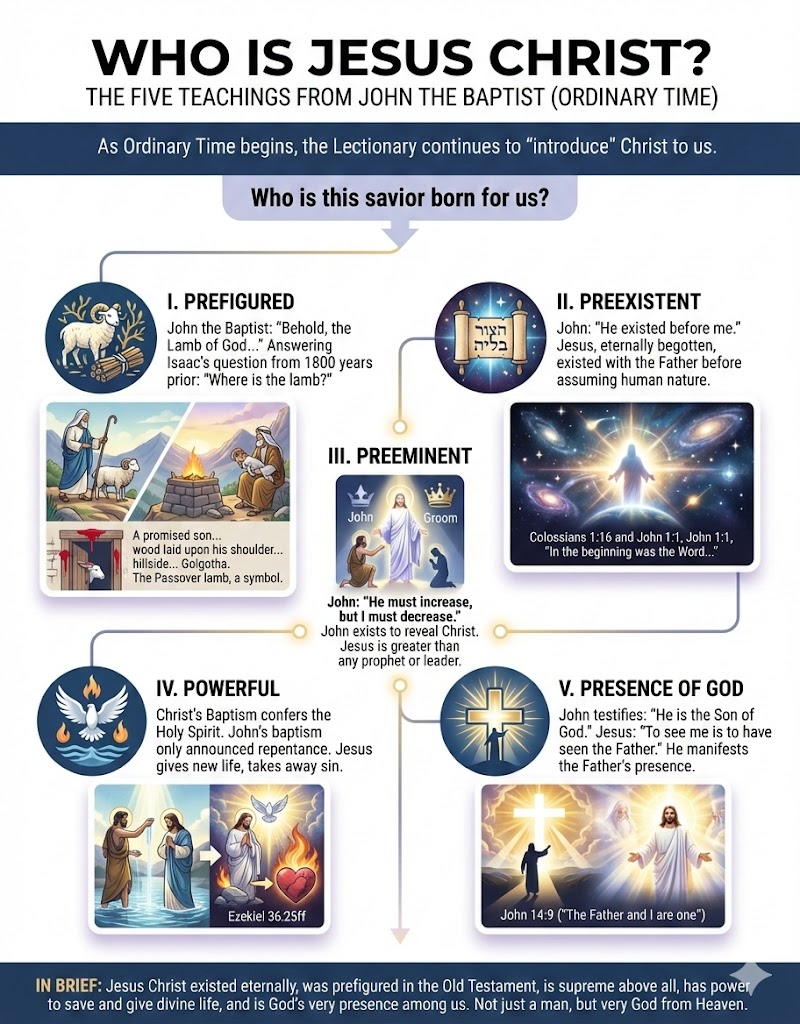
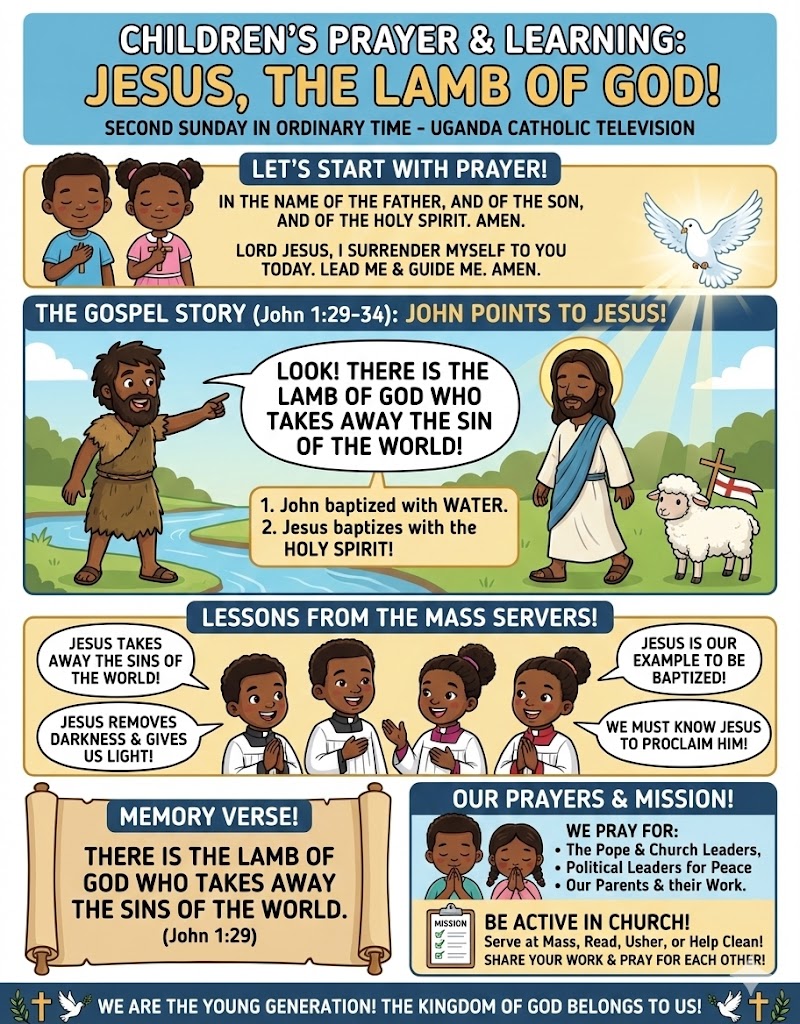
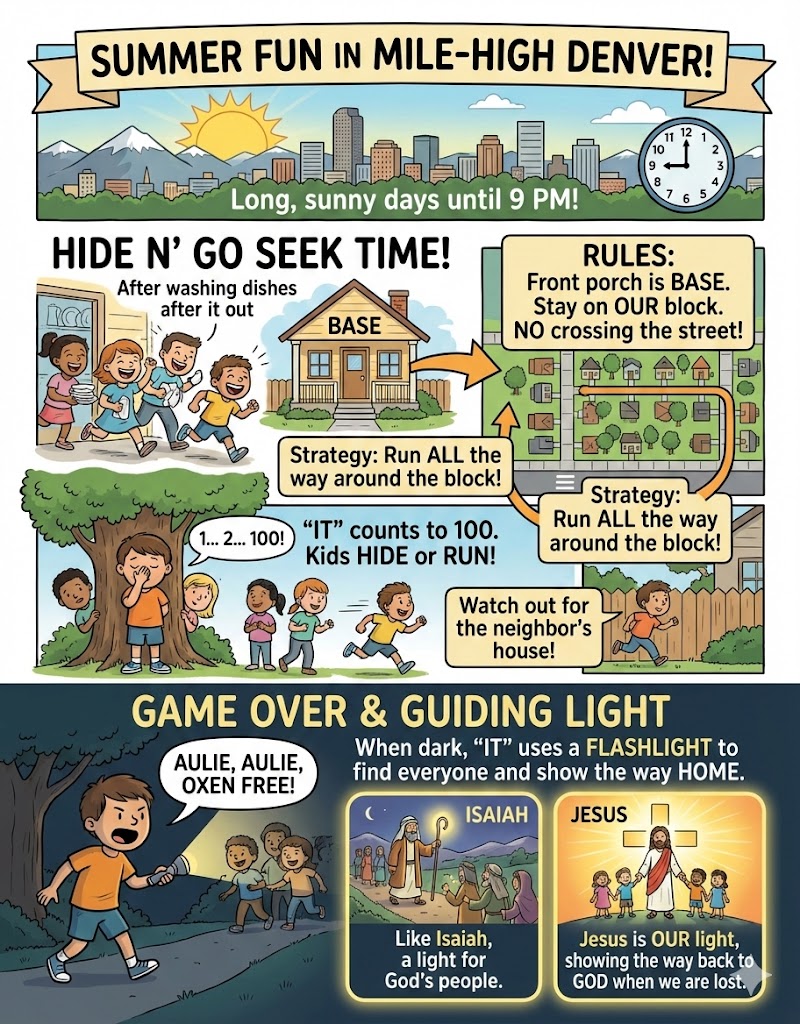
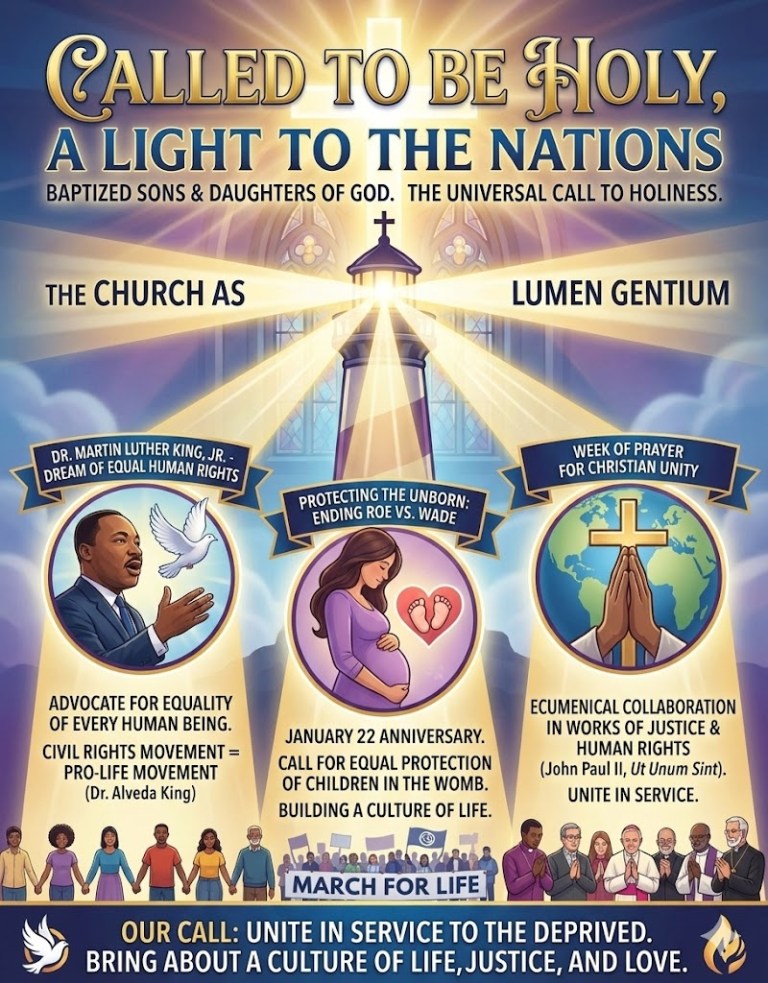
TWTW bulletin inserts on this page were created using Nano Banana and Gemini AI 3.0 Pro. Permission is granted to non-profits to copy, paste them in their publications and websites. Please credit TWTW website.

Free Clip Art