Catechism of the Catholic Church
Catechism of the Catholic Church
Catechism of the Catholic Church
Catechism of the Catholic Church
February 1, 2026
February 1, 2026
4th Sunday of Year A


Doctrinal Homily Outline
by Kevin Aldrich | INDEX
Central idea: The Beatitudes.
Doctrine: Christ’s Beatitudes can teach and transform us.
Practical application: Purification of heart
The Infographics below were created using content from Kevin Aldrich’s webpage.
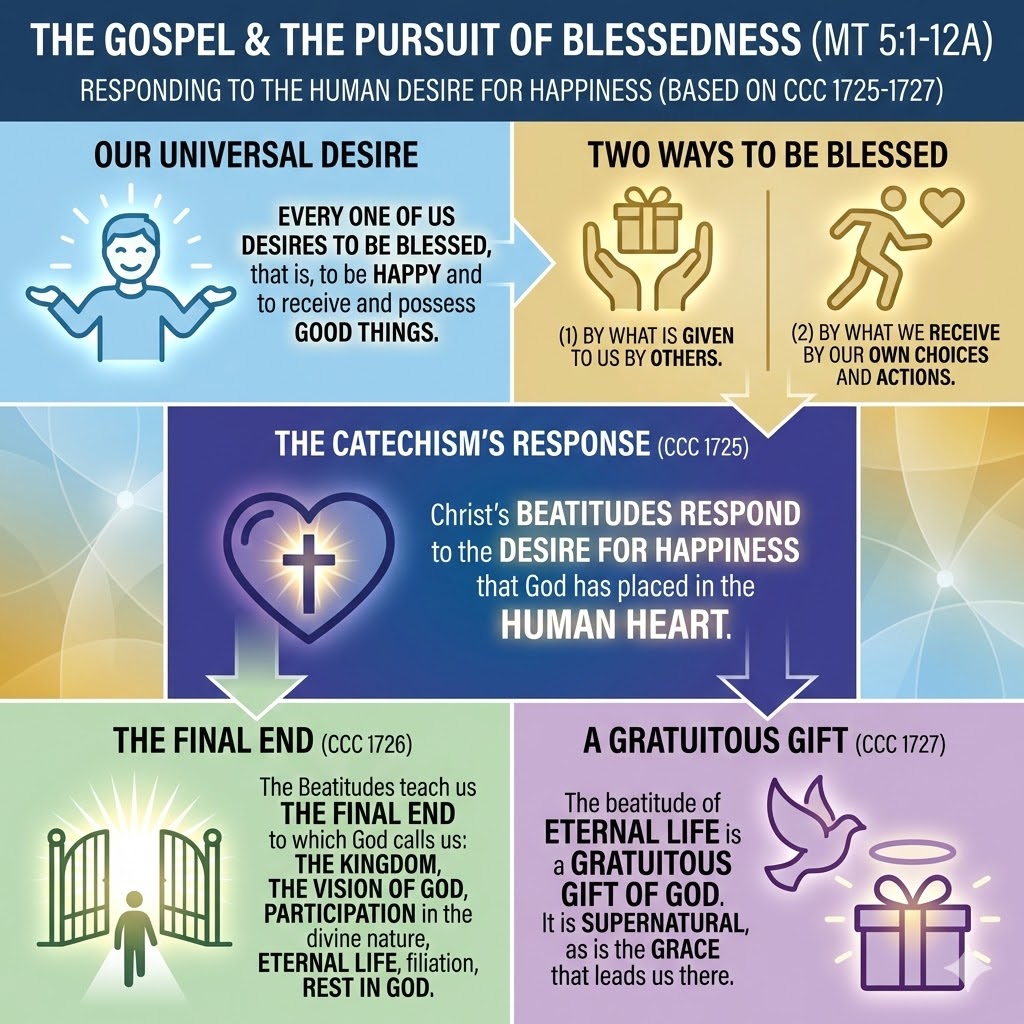



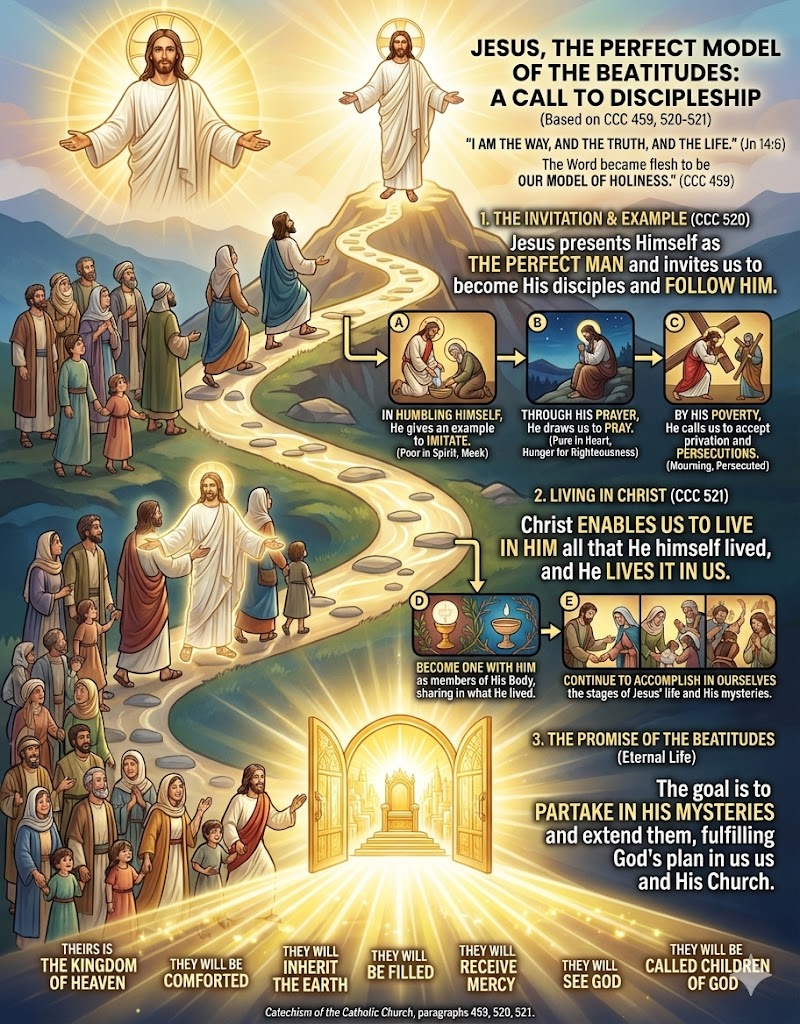
The Divine Paradox
Living the Life of Christ Through the Beatitudes
The Sermon on the Mount begins with a stunning portrait of the Kingdom of Heaven. In the Beatitudes (Matthew 5:1-12a), Jesus lays out a vision of blessedness that upends worldly expectations. He declares that the poor in spirit, the meek, the mourning, and the persecuted are the truly happy ones. This teaching often strikes the modern ear as a beautiful but impossible moral ideal. However, the Catechism of the Catholic Church (CCC), specifically in paragraphs 459, 520, and 521, provides the indispensable hermeneutic for understanding this text. The Catechism teaches that the Beatitudes are not merely a code of conduct to be adhered to, but a self-portrait of Jesus Christ, who is our perfect model. Furthermore, the Christian life is not just an imitation of an external exemplar, but a mystical participation where Christ lives His life within the believer. The scriptural readings from Zephaniah, First Corinthians, and Matthew, illuminated by this catechetical framework, reveal that true discipleship is a divine paradox: it is only by embracing our inherent weakness that we become vessels for the transformative power of Christ’s own life.

The Gospel reading displays the blueprint of Christian holiness. The Beatitudes define the character of Jesus Himself. He is the ultimate “poor in spirit,” entirely dependent on the Father. He is the “meek” one who rides into Jerusalem on a donkey. He is the “peacemaker” who reconciles humanity to God through the blood of His cross. CCC 459 establishes that because Jesus is the incarnate Word, He is our “model of holiness.” When He says, “I am the way, and the truth, and the life,” He indicates that His life—characterized by the Beatitudes—is the only path to the Father. CCC 520 expands on this, noting that Jesus’ entire existence—His silence, prayer, poverty, and suffering—is a revelation inviting us to discipleship. To follow Jesus is to seek to conform our lives to the pattern of the Beatitudes.
However, if the Beatitudes are the pattern, the immediate human response is often a sense of inadequacy. We are naturally inclined toward pride, self-reliance, and the avoidance of suffering. The first and second readings address this reality, establishing the necessary foundation for receiving the pattern of Christ: fundamental humility.
The prophet Zephaniah addresses a people facing judgment, calling on the “humble of the earth” to seek the Lord, justice, and humility. He promises that God will leave as a remnant “a people humble and lowly,” who “shall take refuge in the name of the Lord” (Zeph 2:3; 3:12). This Old Testament “remnant,” known as the anawim, are the precursors to Jesus’ “poor in spirit.” They recognize they have no power of their own and rely wholly on God.
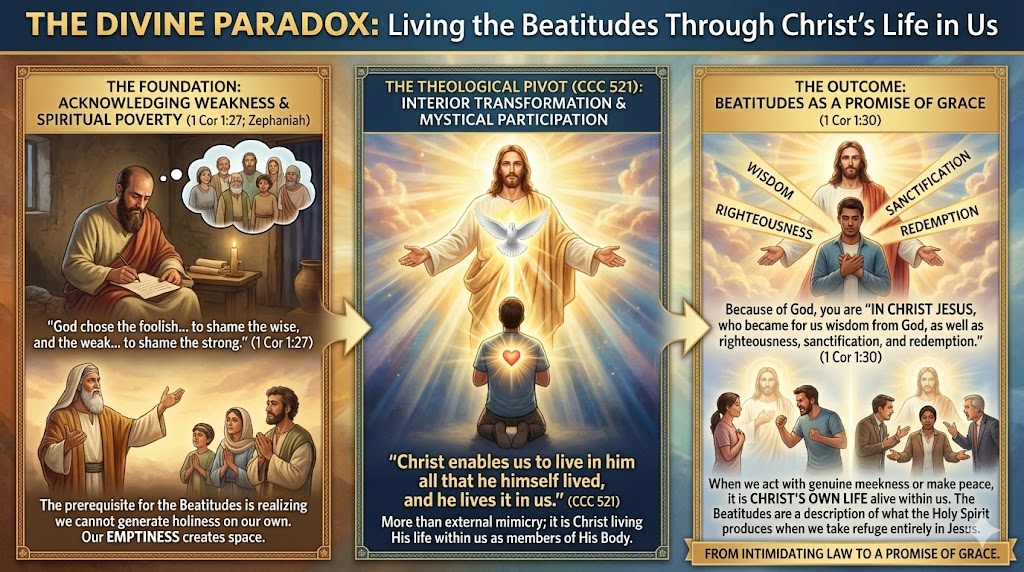
St. Paul, writing to the Corinthians, confirms that this divine preference for the humble continues in the New Covenant. He reminds the community that by human standards, few of them were wise, powerful, or noble. Instead, “God chose the foolish of the world to shame the wise, and God chose the weak of the world to shame the strong” (1 Cor 1:27). Paul strips away any illusion of self-sufficiency. The prerequisite for living the Beatitudes is an acknowledgment of our own spiritual poverty—the realization that we cannot generate holiness on our own.
This brings us to the vital theological pivot provided by the Catechism. If we are weak, and the standard of the Beatitudes is perfection, how can we bridge the gap? CCC 521 provides the profound answer: Christian discipleship is more than just external mimicry; it is an interior transformation. It states: “Christ enables us to live in him all that he himself lived, and he lives it in us.” We are members of His Body, called to continue His mysteries on earth.
When read through the lens of CCC 521, the readings cohere beautifully. The “humble and lowly” remnant in Zephaniah and the “weak” and “despised” in Corinth are not blessed simply because they are downtrodden; they are blessed because their emptiness creates space for Christ to dwell. St. Paul explicitly makes this connection. He writes that due to God, “you are in Christ Jesus, who became for us wisdom from God, as well as righteousness, sanctification, and redemption” (1 Cor 1:30).
We cannot achieve the righteousness required by the Beatitudes through sheer willpower. Instead, Christ becomes our righteousness. When a Christian acts with genuine meekness in the face of aggression, it is Christ’s own meekness alive within them. When a disciple makes peace in a fractured situation, it is the Prince of Peace working through them. The Beatitudes, therefore, move from being an intimidating law to a promise of grace. They are a description of what the Holy Spirit produces in a soul that, recognizing its own poverty, takes refuge entirely in Jesus.
In conclusion, the liturgical readings combined with the teaching of the Catechism present a robust vision of the Christian life. Jesus is the perfect incarnation of the Beatitudes, the model we must look to (CCC 459). Yet, the Scriptures from Zephaniah and Corinthians remind us that we can only approach this model through the gateway of profound humility, recognizing our place among the weak and foolish of the world. It is in this poverty that we discover the greatest treasure: the grace described in CCC 521, where Christ Himself lives His blessed life through us, ensuring that “whoever boasts, should boast in the Lord” (1 Cor 1:31).
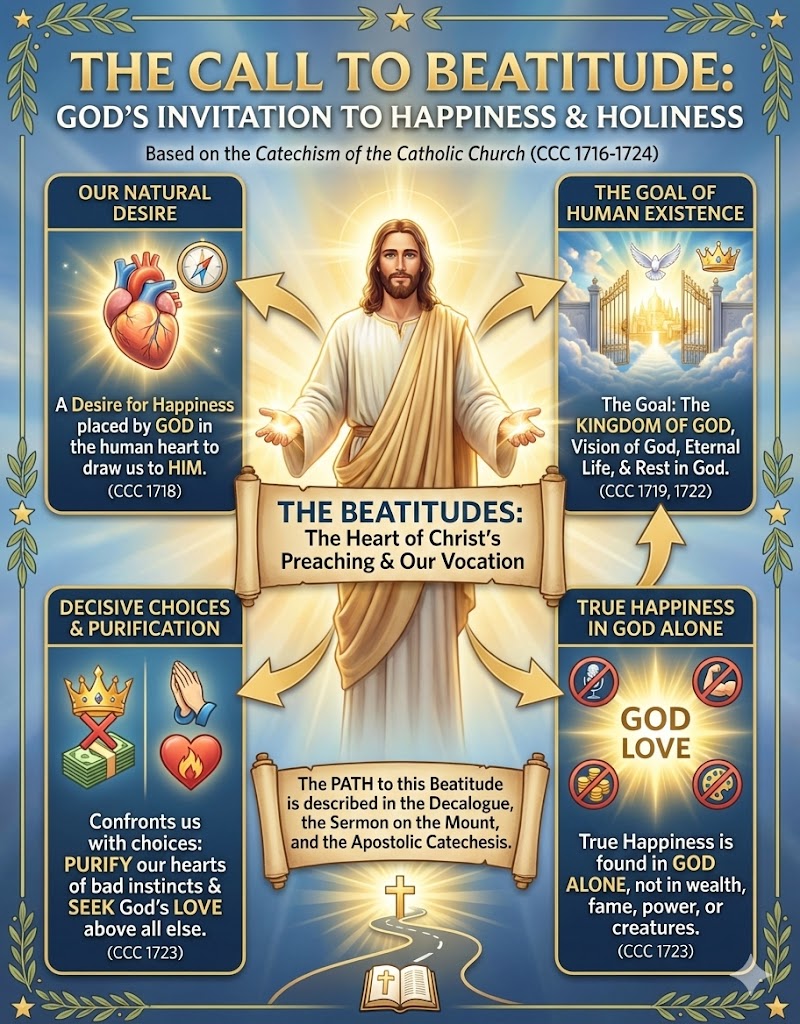
The Architecture of True Happiness
The Humble Remnant and the Gift of Beatitude
The universal human heart aches with a desire for happiness. The Catechism of the Catholic Church opens its section on man’s vocation by identifying this primordial longing, teaching that God placed it in the human heart in order to draw us to Himself, the only one who can fulfill it (CCC 1718). Yet, humanity frequently seeks to satiate this thirst with finite goods—wealth, honor, power, or pleasure—only to find them wanting. The liturgical readings for this Sunday, consisting of the Beatitudes in Matthew’s Gospel, the prophetic call of Zephaniah, and St. Paul’s exhortation to the Corinthians, provide a radical reorientation of this pursuit. When read through the lens of the Catechism (CCC 1716-1724), these scriptures reveal that true beatitude is a divine paradox: it is a supernatural gift found not in human ascent and achievement, but in a profound humility that creates space for the Kingdom of God.
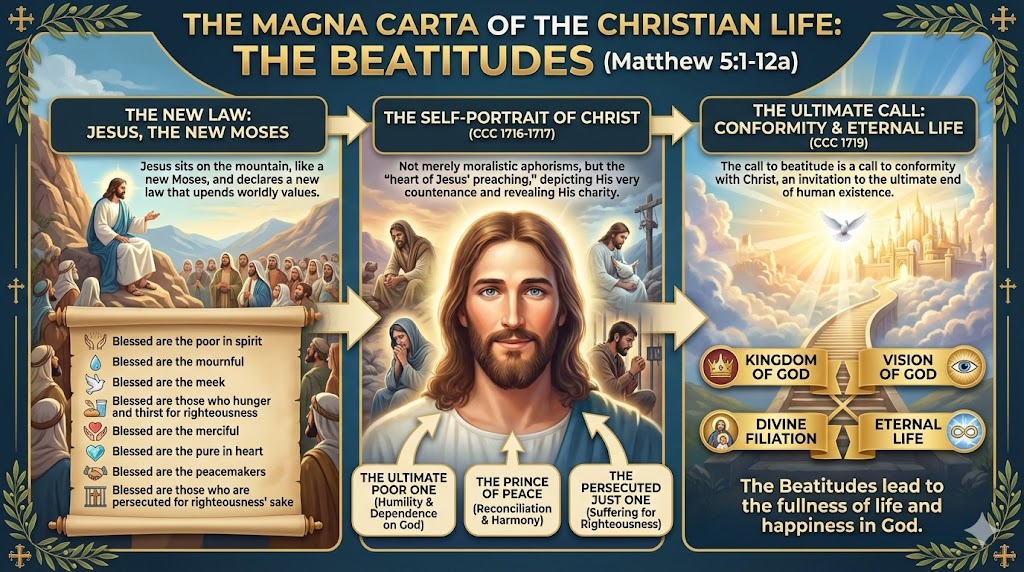
The Gospel reading presents the Magna Carta of the Christian life: The Beatitudes (Matthew 5:1-12a). Jesus sits on the mountain, like a new Moses, and declares a new law that upends worldly values. He calls blessed the poor in spirit, the mournful, the meek, and the persecuted. The Catechism explains that these are not merely moralistic aphorisms but act as the “heart of Jesus’ preaching,” depicting the very countenance of Christ and revealing His charity (CCC 1716-1717). The Beatitudes are a self-portrait of God Incarnate, who is the ultimate Poor One, the Prince of Peace, and the Persecuted Just One. Therefore, the call to beatitude is a call to conformity with Christ. It is an invitation to the ultimate end of human existence, variously described as the Kingdom of God, the vision of God, divine filiation, and eternal life (CCC 1719).
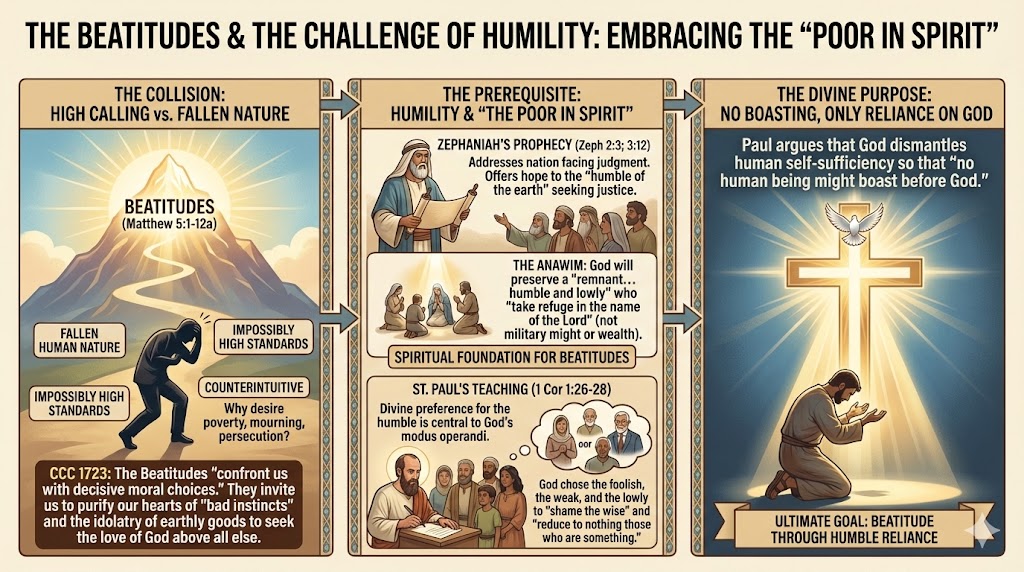
However, this high calling confronts fallen human nature with a difficult reality. The standards of the Beatitudes seem impossibly high and counterintuitive. Why would anyone desire poverty, mourning, or persecution? The Catechism addresses this collision, noting that the Beatitudes “confront us with decisive moral choices.” They invite us to purify our hearts of “bad instincts” and the idolatry of earthly goods to seek the love of God above all else (CCC 1723).
To embrace these decisive choices, a fundamental disposition is required: humility. The first and second readings establish this prerequisite, providing the necessary context for understanding the first beatitude, “Blessed are the poor in spirit.”
The prophet Zephaniah addresses a nation facing judgment for its pride and idolatry. Yet, he offers a sliver of hope to the “humble of the earth” who seek justice. He prophesies that God will preserve a “remnant in your midst, a people humble and lowly,” who shall “take refuge in the name of the Lord” rather than in military might or wealth (Zeph 2:3; 3:12). This Old Testament concept of the anawim—the poor of Yahweh who rely solely on God—is the spiritual foundation for the Beatitudes.
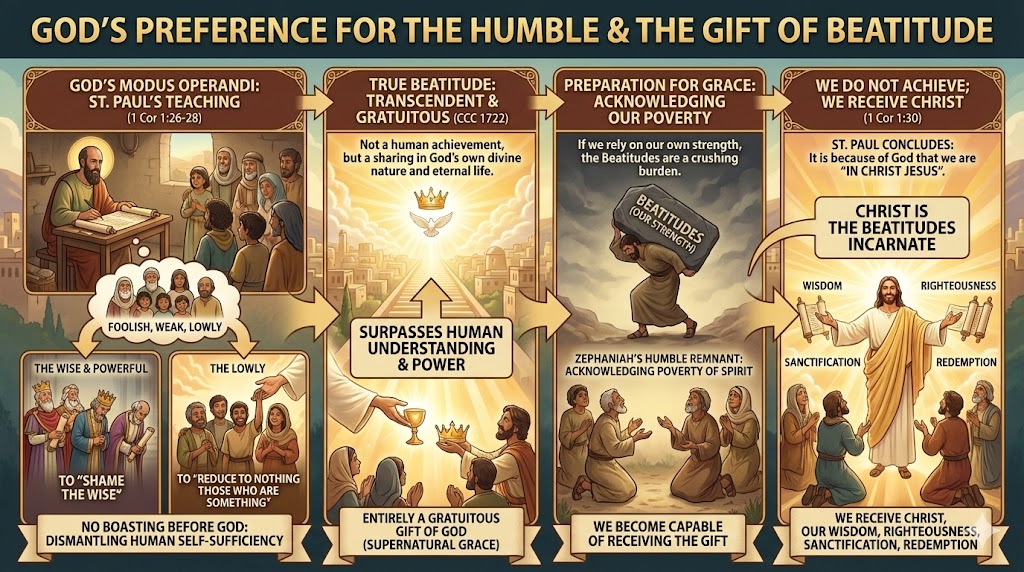
St. Paul, writing to the fractured community in Corinth, points out that this divine preference for the humble is central to God’s modus operandi. He reminds the Corinthians to “consider your own calling”—not many were wise, powerful, or noble by human standards. Instead, God deliberately chose the foolish, the weak, and the lowly to “shame the wise” and “reduce to nothing those who are something” (1 Cor 1:26-28). Paul argues that God dismantles human self-sufficiency so that “no human being might boast before God.”
This insistence on human weakness is not meant to humiliate us, but to prepare us for grace. This brings us to a crucial teaching in this section of the Catechism: true beatitude is transcendent. Because it consists in sharing God’s own divine nature and eternal life, it “surpasses the understanding and the powers of man.” It is entirely a “gratuitous gift of God,” a supernatural grace (CCC 1722).
If we rely on our own strength, the Beatitudes are a crushing burden. But if we join Zephaniah’s humble remnant, acknowledging our poverty of spirit, we become capable of receiving the gift. St. Paul concludes his thought by explaining how this works: it is because of God that we are “in Christ Jesus,” who became for us “wisdom from God, as well as righteousness, sanctification, and redemption” (1 Cor 1:30). We do not achieve the Beatitudes; we receive Christ, who is the Beatitudes incarnate.
In conclusion, the Scriptures and the Catechism converge to show that the pursuit of happiness is ultimately a pursuit of God, who offers Himself to us in Christ. The readings challenge us to abandon the world’s futile paths to satisfaction and to embrace the paradox of the Gospel. By entering the “narrow way” of poverty of spirit, meekness, and reliance on God—the path taken by the humble remnant throughout history—we open our hearts to the supernatural gift of Beatitude, discovering that the Kingdom of Heaven belongs to those who know they cannot build it themselves.

The Prophetic Crucible
Preparing the Way for the God of Love
The history of salvation is not a linear progression of human enlightenment, but a dramatic narrative of divine intervention met with human resistance. The Catechism of the Catholic Church articulates this dynamic, describing how God patiently prepared humanity for the arrival of His Son. This preparation required a specific kind of vessel to receive the promise. Paragraphs 64 and 716 of the Catechism illuminate this process, highlighting God’s use of prophets to purify hope and the necessity of a “poor” and humble remnant to receive the Messiah. The liturgical readings for this Sunday provide a striking illustration of this dynamic, revealing that the prophetic word—from Jeremiah to Jesus Himself—inevitably confronts hardened hearts, and can only be truly received and sustained by the theological virtue of love.

CCC 64 outlines God’s pedagogical plan through the Old Covenant. After choosing Abraham and forming Israel through the Law, God sent prophets not merely to foretell the future, but to “purify” the people’s hope. They were called to call the people back to the covenant, often through radical challenges to the status quo, preparing them for a new and everlasting salvation intended for all nations.
The first reading from Jeremiah is a quintessential example of this prophetic vocation described in CCC 64. God tells Jeremiah that before he was formed in the womb, he was dedicated as a “prophet to the nations.” This call, however, is not an invitation to worldly success. God explicitly warns him: “They will fight against you.” To be a bearer of God’s purifying word is to stand against kings, princes, priests, and the people of the land. The prophetic task necessary to prepare for Christ involves an inevitable crucifixion of the prophet’s ego and safety, requiring absolute reliance on God’s promise: “I am with you to deliver you.”
If Jeremiah shows the preparation, the Gospel from Luke shows the fulfillment, and subsequently, the crisis of reception. CCC 716 explains who was actually prepared to receive this fulfillment. It states that the Holy Spirit, hidden until the time of Christ, began to work through “the poor” to prepare for the Messiah. These “poor”—the humble, meek, and compassionate—were the true remnant waiting for the “Consolation of Israel.”

In Luke’s Gospel, Jesus stands in the synagogue and declares that the prophetic hope is fulfilled in His very person. Initially, the people are amazed. However, they quickly prove they are not the “poor in spirit” described in CCC 716. They demand He perform miracles for their own benefit and hold onto an exclusive, nationalistic view of God’s favor. When Jesus exercises the prophetic role described in CCC 64—purifying their hope by reminding them that God often blesses Gentiles over Israel when Israel is unfaithful—they become enraged. Their violent reaction, attempting to throw Him off a cliff, demonstrates the friction that occurs when the divine word encounters a heart that lacks humility. They wanted a Messiah on their own terms, not the suffering Servant who came for the humble remnant.
The dramatic tension between the prophetic call and human rejection begs the question: What sustains the prophet, and what defines the true remnant? St. Paul provides the answer in the Second Reading: Love.
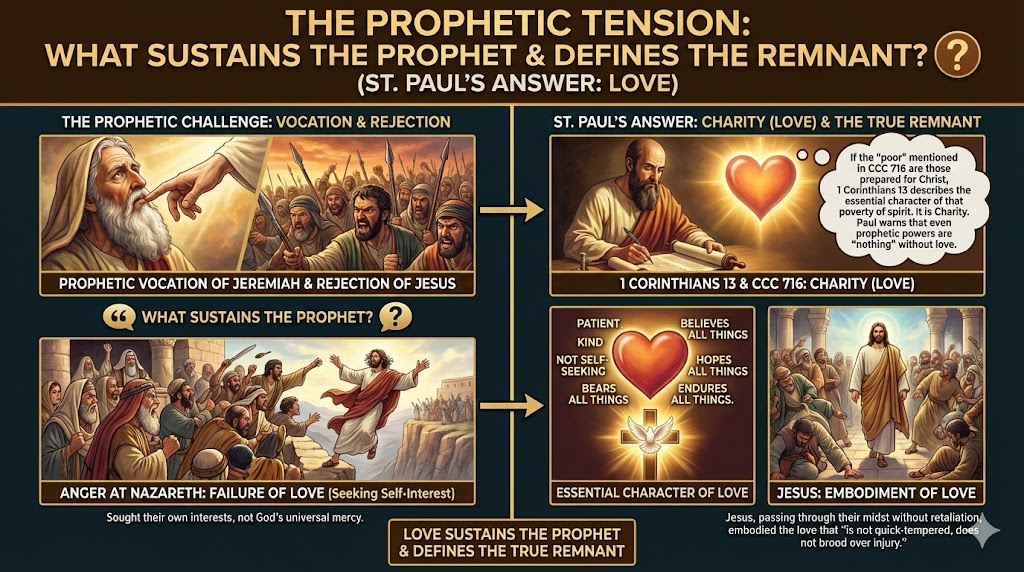
If the “poor” mentioned in CCC 716 are those prepared for Christ, 1 Corinthians 13 describes the essential character of that poverty of spirit. It is Charity. Paul warns that even prophetic powers are “nothing” without love. The prophetic vocation of Jeremiah and the rejection experienced by Jesus can only be endured if one possesses a love that is “patient, is kind,” that ” does not seek its own interests,” and most importantly, “bears all things, believes all things, hopes all things, endures all things.” The anger of the crowd at Nazareth was fundamentally a failure of love; they sought their own interests rather than the universality of God’s mercy. Conversely, Jesus, passing through their midst without retaliation, embodied the love that “is not quick-tempered, does not brood over injury.”
In conclusion, the Catechism teaches that God prepared for Christ through a prophetic history (CCC 64) intended to form a humble remnant capable of receiving Him (CCC 716). The readings confirm that this preparation is a crucible. The Word of God is a “two-edged sword” that exposes the heart. As seen in Jeremiah and Nazareth, it often incites violent opposition from the prideful. The readings therefore invite us to join that humble remnant, armed not with aggression, but with the enduring power of Christ-like love, which alone can sustain the prophetic witness in a resistant world.