Commentary Intro to Mass Readings Sunday Readings
CommentaryIntro to Mass Readings Sunday Readings
June 7, 2026
⭐⭐⭐ Hearers of the Word—PDF | VIDEO



PDF AIDS
Scripture Study for Catholics *


Fr. Francis Martin

Brant Pitre

Kevin Aldrich

Body and Blood of Christ (A)
INSIGHTS FOR HOMILY
PREPARATION
Deut 8:2-3, 14b-16a

Manna from Heaven
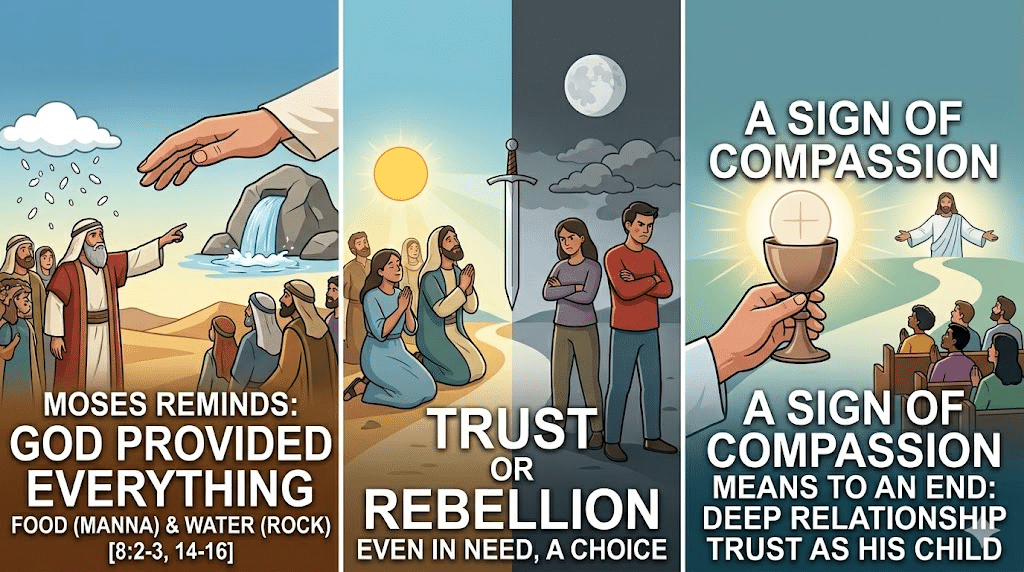
A powerful homily bridges the ancient word with the modern heart. In his insightful commentary, Larry Broding unpacks the profound imagery of Deuteronomy 8, where Moses uses the tender yet challenging dynamic of a parent and a child to describe the Exodus. Broding beautifully connects Israel’s journey of total dependence in the desert to our own approach to the Eucharist this Sunday. It is a must-read resource for any preacher looking to move their congregation from mere routine to deep, relational trust.
Why this commentary matters for your homily:
- Unpacks the Parental Imagery: It explores how Moses used the language of parent and child to symbolize the Exodus experience, giving you a warm, relatable metaphor for your congregation.
- Exposes the Two-Edged Sword of Dependence: It highlights how absolute dependence on God can either encourage trust or spawn pride, resentment, and rebellion, providing a strong psychological hook for your sermon.
- Connects Manna to Eucharist: It seamlessly bridges the Old Testament signs of compassion—water from the rock and manna from heaven—with the full presence of the risen Lord in the sacrament.
- Focuses on the Ultimate Goal: It reminds us that both the desert miracles and the Eucharist are not just gifts to consume, but a means to an end: a deep, living relationship with God.
Read Larry Broding’s full commentary to help your congregation step into a deeper relationship with the risen Lord through a renewed spirit of child-like trust.
AI THOUGHT STARTERS
To strengthen key sections of your homily, here are questions you might ask the AI assistant (simply copy and paste a question into chat bot in the lower right corner of the page):
The Theology of Desert Dependence
- How can I best illustrate the parental metaphor Moses uses in Deuteronomy 8:2-3 to describe God providing everything for a dependent child?
- Deuteronomy 8:3 notes that life requires not only food but the Word of God; what are some modern examples of spiritual malnutrition I can use to contrast with physical hunger?
- Deuteronomy 8:2 refers to the long journey of forty years in the wilderness; how can I frame this period as a necessary time of testing rather than just punishment?
The Human Response to Divine Care
- Deuteronomy 8:14b-16 suggests that physical dependence can lead to either trust or pride; how do I address the subtle ways spiritual pride creeps into a wealthy parish today?
- Moses says to the people, “Remember how God cared for you” in the desert; what interactive preaching techniques can I use to help parishioners actively recall God’s past initiatives in their own lives?
- Moses refers to water from the flinty rock and manna in Deuteronomy 8:15-16; how can I preach on these specific miracles to show that God transforms our most barren situations into signs of compassion?
Connecting the Exodus to the Eucharistic Table
- The Exodus journey suggests that miracles are a means to an end; how can I challenge my congregation to see the Sunday Eucharist as a catalyst for a relationship with God rather than a weekly obligation to fulfill?
- When we look at the risen Lord as the full presence in the sacrament, what theological distinctions should I emphasize to connect the temporary manna of Deuteronomy 8:3 with the eternal nature of the Eucharist?
- Given that child-like trust is required to make the presence of the Lord active in our lives, what concrete spiritual steps can I offer in my homily’s conclusion to help people practice this dependence?
- Deuteronomy 8:16 refers to God feeding the ancestors with manna to humble and test them; how can I explain to my parish that receiving the Eucharist can also be a humbling experience that tests our willingness to rely entirely on God?


Body and Blood of Christ (A)
INSIGHTS FOR HOMILY
PREPARATION
1 Cor 10:16-17
Communion Defines Community
Sharing a meal is one of the most fundamental ways we define our social circles, but the Eucharist takes this human reality and elevates it to the divine. In this profound commentary, Larry Broding challenges us to look past the obvious nature of the statement “communion defines community.” He beautifully explores how Christ’s self-giving at a simple meal does not just bring us together—it molds us into His very Body. This is an essential read for any preacher looking to move their congregation from seeing the Mass as a fractured gathering of individuals to experiencing it as a unified, living Church.
Why this commentary matters for your homily:
- Elevates the Everyday Routine: It uses the universal human experience of table fellowship—sharing meals with family, friends, and co-workers—as a powerful, accessible jumping-off point for your sermon.
- Deepens Eucharistic Ecclesiology: It unpacks how the loaf of bread, as the Body of Christ, acts as the absolute focal point that transforms a gathering of people into a single communion.
- Explores the Power of Self-Giving: It highlights that Christ defined His community not through social commonalities, but through His own self-giving, providing a challenging model of Christian charity for your parish.
- Inspires Personal Reflection: It provides direct, heart-searching questions about who we share Communion with, helping your congregation bridge the gap between liturgy and daily relationships.
Read Larry Broding’s full commentary to help your congregation appreciate how Christ’s communion defines us as part of his community.

AI THOUGHT STARTERS
To strengthen key sections of your homily, here are questions you might ask the AI assistant (simply copy and paste a question into chat bot in the lower right corner of the page):
The Social Dynamics of the Table
- The commentary notes that humans define their social worlds with meals; how can I use local neighborhood or family meal customs to introduce the deeper concept of Eucharistic fellowship?
- While table mates are usually family, friends, or co-workers, the text suggests that the strongest bonds for meal fellowship can transcend these factors; what stories of unexpected unity can I share to illustrate this?
- How can I preach against the modern tendency toward isolation by emphasizing that sharing a meal means acknowledging a shared bond like blood relations, geographic proximity, or shared values?
Christ’s Self-Giving and Identity
- The text refers to Christ defining his community at a simple meal with his self-giving; how can I contrast human social clubs with a community strictly defined by divine sacrifice?
- The commentary suggests his Body was himself and his Blood was his life; what theological language can I use to help parishioners grasp the totality of this self-donation during the Consecration?
- When looking at how Christ shared himself with us, how can I explain the active, transformative nature of the word “molded” to show that Communion changes our very identity?
Becoming the Body of Christ
- The text refers to the loaf of bread, the Body of Christ, as the focal point; how can I visually or rhetorically emphasize the altar and the host as the true center of parish unity during my homily?
- The commentary suggests those who eat the bread become one with the Body; how can I challenge the congregation to see that receiving Communion binds them even to the parish members they may disagree with?
- The text defines the Church as the people who are made one in the Body of Christ and share the life of Christ in common; what concrete stewardship or charity initiatives can I suggest that flow directly from this shared life?
- The commentary asks “Who shares Communion with you?”; what reflective questions can I pose from the pulpit to help people recognize the person sitting in the pew next to them as a true spiritual sibling?

Courtesy of Larry Broding
Body and Blood of Christ (A)
INSIGHTS FOR HOMILY
PREPARATION
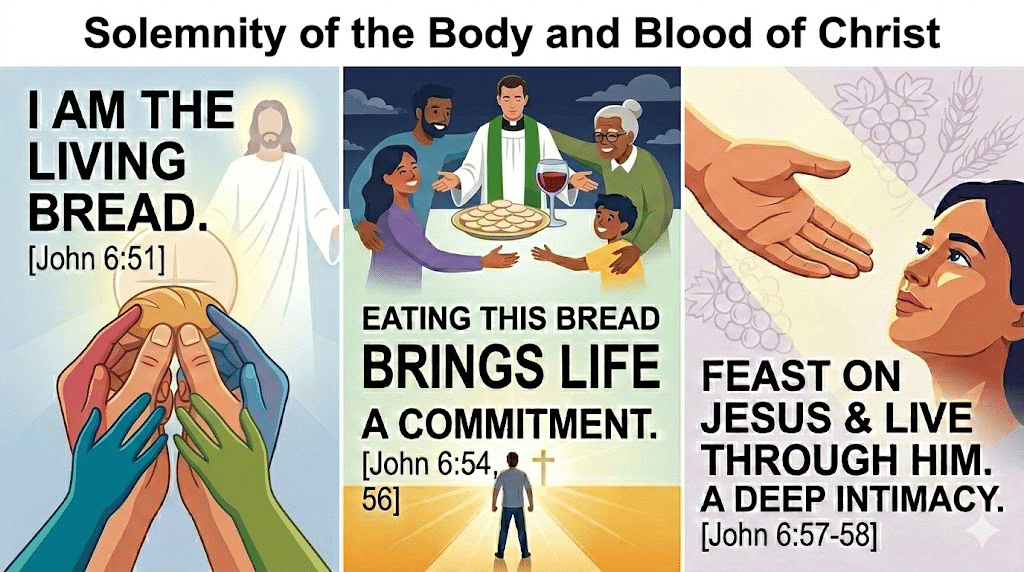
Jn 6:51-58
By Habit or Commitment?
In this week’s commentary, Larry Broding dives straight into the heart of the “Bread of Life” discourse in John 6, capturing the high-stakes, fiery dialogue between Jesus and the crowd. Broding masterfully unpacks how Jesus shifts the conversation from a physical plane—people looking for an easy meal after the multiplication of the loaves—to a radical, spiritual reality. By illuminating the intense, graphic language John uses, this commentary provides preachers with the exact linguistic and theological tools needed to shatter standard sermon tropes and awaken their congregation to the shocking depth of the Eucharist.
Why this commentary matters for your homily:
- Unpacks the Divine Gravity of “I AM”: It connects Jesus’ words to YHWH at Mount Sinai, showing that the “living” God is defined by activity and intervention, transforming how your parish views the divine presence in the host.
- Decodes a Crucial Shift in Verb Tense: It highlights the movement from past tense (the Incarnation) to future tense (the Cross) in John 6:51, providing you with a seamless structural roadmap to bridge Christ’s identity to His saving mission.
- Explores the Shocking Depth of “Gnawing”: It exposes the unusual, graphic verb John uses for eating, giving you raw, powerful imagery to preach on the total, un-nibbled commitment required of a true believer.
- Exposes the Illusion of Comfortable Faith: It contrasts the ancestors who ate manna and died with those who choose true intimacy, helping you challenge parishioners who mistake a comfortable, blessed life for active discipleship.
Read Larry Broding’s full commentary to help your congregation step out of their comfort zones and feast upon the true, life-giving presence of the living God.
AI THOUGHT STARTERS
To strengthen key sections of your homily, here are questions you might ask the AI assistant (simply copy and paste a question into chat bot in the lower right corner of the page):
The Divine Identity and Temporal Shifts
- John 6:51 hearkens back to the title God revealed to Moses at Mt. Sinai; how can I explain the Hebrew concept of YHWH as an active, “doing” presence rather than static existence to my parish?
- The commentary highlights a shift in verb tense from the past “having come down” to the future “will give” in John 6:51; how can I use this linguistic transition to connect the mystery of Christmas to the sacrifice of Good Friday?
- John 6:51 bridges the title “I AM” with bread to show Jesus connecting his identity to his mission; what modern idols can I contrast against this “living” bread that actively gets the job done in our lives?
Semitic Imagery and Radical Commitment
- John 6:53 refers to eating the flesh and drinking the blood of the Son of Man; how can I explain to a modern audience that this Semitic phrase refers to entering into intimacy with the entire, undivided person of Jesus?
- The text suggests the phrase “Son of Man” flowed from a reference to everyone to a reference to the Messiah; what analogies can I use to show that Jesus is simultaneously like everyone else and uniquely God’s Chosen instrument?
- John 6:54 uses an unusual, graphic verb translated as “gnawing” to distinguish the believer from the non-believer; how can I rhetorically challenge my congregation to stop merely “nibbling” at their faith?
Intimate Union and the Cost of Discipleship
- John 6:55 suggests that “true” food and drink meant “only” food and drink in the ancient context; how do I preach that intimacy with Jesus is the only thing that really matters when so many other cultural obligations compete for our time?
- The verb “remain” or “stay” in John 6:56 expresses intimate union between Christ and the believer; how can I translate this vertical intimacy into St. Paul’s horizontal analogy of the Body of Christ uniting parishioners with each other?
- John 6:57 indicates that Jesus became the conduit for the Father’s very life to the believer; how can I map out this chain of dependence—Jesus living through the Father, and us living through Jesus—as a model for daily prayer?
- John 6:58 compares ancestors who ate manna and died with those who eat the living bread; how can I explain that living close to God involves risks like being misunderstood or persecuted, rather than just enjoying a comfortable life?