Commentary Intro to Mass Readings Sunday Readings
CommentaryIntro to Mass Readings Sunday Readings
May 31, 2026
⭐⭐⭐ Hearers of the Word—PDF | VIDEO



PDF AIDS
Scripture Study for Catholics *


Fr. Francis Martin

Brant Pitre

Kevin Aldrich

Most Holy Trinity (A)
INSIGHTS FOR HOMILY
PREPARATION
Exodus 34:4b-6, 8-9

The God of Compassion
Are you looking for a way to breathe fresh energy into your preaching this week? Connecting the Sunday readings to the lived experiences of your congregation is a powerful task, and Larry Broding’s Word-Sunday commentary is an invaluable tool to help you do just that. In his analysis of Exodus 34, Broding masterfully unpacks the profound moment when Moses climbs Mt. Sinai with two new stone tablets, setting the stage for one of the most beautiful self-revelations of God in the Old Testament.
Why this commentary matters for your homily:
- Unpacks True Divine Identity: Broding highlights that God did not reveal Himself as a deity of war, harvest, or nature, but fundamentally as a God of compassion whose love transcends all earthly categories.
- Contextualizes Ancient Symbolism: The commentary helps you explain the cultural weight of the cloud, thunder, and the proclamation of the name YHWH, making these ancient signs vivid and relatable for a modern audience.
- Focuses on the Power of Relationship: It explores Moses’ posture of worship and his crucial ultimate request—asking God to claim the people as “his inheritance”—which provides a perfect bridge to discuss our own unique relationship with the Father.
- Provides Direct Pastoral Application: Broding beautifully connects the text to the present day, offering a comforting reminder you can share with your flock: we remain God’s people, wrapped in His compassion even in times of darkness, opposition, or trial.
Read Larry Broding’s full commentary to help your congregation experience the depth of God’s comforting love and transform your prep time into a powerful message of grace.
AI THOUGHT STARTERS
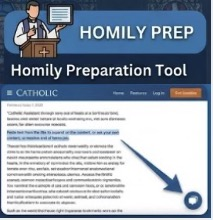
To strengthen key sections of your homily, here are questions you might ask the AI assistant (simply copy and paste a question into chat bot in the lower right corner of the page):
Contextualizing the Divine Encounter
- How can I visually explain to my congregation what the cloud and thunder represented in Exodus 34:5, and how do these ancient signs of divine power contrast with the gentle character God actually proclaims?
- The reading refers to God proclaiming his name in Exodus 34:5-6; what is the deeper theological significance of the name YHWH as the sound of thunder for the Israelite people?
- Moses cut two new stone tablets in Exodus 34:4b after the first ones were broken; how can I preach on this as a sign of God’s willingness to give humanity a second chance?
Unpacking the Character of God
- Exodus 34:6 suggests God is not a deity of war, harvest, or the desert, but a compassionate God; what are some modern idols or false images of God my congregation might hold that contrast with this true identity?
- How does the revelation of a compassionate and loving God in Exodus 34:6 bridge the gap for parishioners who mistakenly believe the Old Testament God is only angry and vengeful?
- What specific historical context can I share to show how radical it was for a deity in the ancient Near East to transcend natural categories through pure love for his people?
Pastoral Application and the Posture of Faith
- Moses reacted in the posture of worship and with a prayer in Exodus 34:8-9; how can I use his immediate response to teach my parish about the proper attitude we should have when experiencing God’s presence in the sacraments?
- In Exodus 34:9, Moses prays for a unique relationship, asking God to make the people “his inheritance”; how does this Old Testament request find its ultimate fulfillment for us in the Catholic Church today?
- The reading suggests God’s love comforts us even in the dark times; can you provide a couple of concrete, relatable modern examples or stories of finding God’s compassion in the face of opposition and oppression to include in my homily?
- How can I use the dialogue between Moses and God in Exodus 34:4-9 to encourage parishioners who feel unworthy of God’s mercy because of their own past stumbles?

Most Holy Trinity (A)
INSIGHTS FOR HOMILY
PREPARATION
2 Corinthians 13:11-13
The Blueprint for Christian Living
Are you looking to deliver a homily that moves beyond abstract theology and truly transforms how your parish lives out their faith each week? In his Word-Sunday commentary on 2 Corinthians 13:11-13, Larry Broding explores Saint Paul’s poignant farewell to the Corinthians, revealing that the Trinity is far more than an intellectual article of faith. Broding beautifully unpacks how the intimate union of Father, Son, and Holy Spirit serves as a practical, everyday blueprint for building a vibrant, loving Christian community.
Why this commentary matters for your homily:
- Reframes the Holy Trinity: The commentary shifts the focus from complex dogma to pastoral reality, showing how the Father of love, the Son of grace, and the Spirit of fellowship model exactly how a parish community should function.
- Defines Distinctive Christian Living: Broding highlights Paul’s call for Christians to live with one mind and one heart, offering you a clear framework to preach on the virtues of joy, uprightness, and constant awareness of God’s presence.
- Provides a Model for Imitation: It explores the powerful implication that because God exists in an eternal exchange of love, we are called to do as God does—freely giving, treating others with authentic charity, and deepening our fellowship.
- Spurs Practical Reflection: The commentary concludes with challenging, concrete questions that you can pose directly to your congregation to help them audit their own lives and look for ways to better reflect God to the world.
Read Larry Broding’s full commentary to help your congregation see the Trinity not just as a mystery to contemplate, but as a living blueprint for their daily lives and relationships.
AI THOUGHT STARTERS
To strengthen key sections of your homily, here are questions you might ask the AI assistant (simply copy and paste a question into chat bot in the lower right corner of the page):
The Trinity as a Blueprint for Community
- Saint Paul refers to an exhortation to live as a community of one mind and one heart in 2 Corinthians 13:11; what are some concrete, modern examples of parish life that reflect this standard?
- The text suggests the Trinity is more than an article of faith but a blueprint for Christian living; how can I help my congregation transition from viewing the Trinity as an abstract doctrine to an everyday model for their relationships?
- 2 Corinthians 13:13 refers to a final blessing invoking the Father, Son, and Spirit; how can I preach on this verse to show how the intimate union of the Triune God should shape our families?
Imitating the Character of God
- Saint Paul implies the God of grace, love, and friendship is the model for Christian community; how can I challenge parishioners to do as God does in their workplaces and neighborhoods?
- The text suggests Christians should always assume they live in the presence of God; what spiritual practices or habits can I recommend in my homily to help busy people maintain this awareness?
- 2 Corinthians 13:11-13 refers to a God who sent his Spirit to be a consoler and friend; how can I use this to offer comfort to parishioners who are currently experiencing loneliness or isolation?
- Since Saint Paul refers to a God who gives the gift of his Son, how can I use the theme of divine generosity to encourage more radical charity and free giving within our parish community?
Homiletic Reflection and Application
- The commentary asks how our lives and communities reflect God; what are some self-examination questions I can pose during the homily to help people honestly assess how they treat others?
- 2 Corinthians 13:11 refers to an exchange of personal greetings and a call to rejoice; how can I address the tension between this biblical command to rejoice and the real-world suffering many in the pews are facing?
- The text asks how we can improve to reflect God to others; can you help me brainstorm a practical, week-long challenge for the parish that focuses on building fellowship based on this reading?

Courtesy of Larry Broding
Most Holy Trinity (A)
INSIGHTS FOR HOMILY
PREPARATION
John 3:16-18
Is Trust in Jesus
Worth The Cost?
Are you looking for a way to help your congregation move past a rigid, duty-bound faith and step into a life-changing relationship with Christ? In his Word-Sunday commentary on John 3:16-21, Larry Broding uses a brilliant contemporary contrast—comparing the scientific, data-driven “faith” of Star Wars with the deep, personal trust demanded by the Gospel. Broding masterfully unpacks the tense encounter between Jesus and Nicodemus to demonstrate that salvation is not about passing a test or flawlessly keeping a law, but about surrendering to a love relationship with the Son of God.
Why this commentary matters for your homily:
- Reframes the True Nature of Faith: The commentary provides a powerful opening analogy to help you explain how Christian faith differs fundamentally from intellectual assent or legalistic duty, anchoring it instead in radical trust.
- Unpacks Key Greek Verbal Tenses: Broding provides excellent linguistic insights into John 3:18, breaking down the present and past perfect tenses of “judgment” versus “trust” to show how our spiritual state in the present echoes into eternity.
- Contextualizes the “Us vs. Them” Temptation: It offers valuable historical background on the isolated Johannine community, helping you address a modern pastoral challenge—how parishes can avoid spiritual narcissism and instead mimic Jesus by inviting outsiders in rather than condemning them.
- Illuminates the Light vs. Darkness Analogy: The text clarifies the parting analogy of John 3, showing how Christ the Light exposes the secret, dark plots of the world, providing comfort to parishioners who feel rejected or subverted for living out their faith.
Read Larry Broding’s full commentary to help your congregation experience the radical, non-condemning love of God and inspire them to build their lives on a foundation of authentic trust.
AI THOUGHT STARTERS
To strengthen key sections of your homily, here are questions you might ask the AI assistant (simply copy and paste a question into chat bot in the lower right corner of the page):
Moving from Legalism to Personal Relationship
- The text suggests that trust of a person, not knowledge of the facts or obedience demanded by duty, defines the Christian life; how can I use the encounter between Jesus and Nicodemus in John 3:1-21 to help parishioners who view their faith purely as a checklist of rules?
- In John 3:16-17, the reading refers to God giving His Son out of love so the world might be saved; what homiletic strategies can I use to contrast this radical love with the data-driven, transactional view of faith common in our modern culture?
- John 3:5-8 refers to a spiritual rebirth initiated by God’s Spirit; how can I explain this concept of being born again from a distinctly Catholic, sacramental perspective during my sermon?
Overcoming Isolation and the Temptation to Condemn
- The commentary suggests that John’s community lived a sheltered existence in fear of authorities, leading to an us-versus-them mentality; how can I address similar trends of modern parish narcissism and tribalism?
- Jesus states in John 3:17 that God did not send His Son into the world to judge it; how can I challenge my congregation to mimic this non-condemning posture when interacting with those who have fallen away from the Church?
- The text suggests that a community built on faith in God’s love rejects narcissism and opens vistas to new possibilities; can you help me brainstorm two practical parish initiatives that move us from a spirit of isolation to one of radical invitation?
Unpacking the Theology of Judgment and Light
- In John 3:18, the reading refers to the one who trusts not being judged, while the one who does not trust is already judged; how can I explain the grammatical weight of these present perfect and past perfect tenses in an accessible way from the pulpit?
- The commentary suggests that those who do not build their spiritual life on trust pretend to be self-reliant but are ultimately self-centered; how can I preach on this definition of judgment as the tragic self-loss of being unable to be found by the Son?
- John 3:19-21 refers to an analogy where Christ is the light and those who oppose Him plot in secret darkness; what comforting insights can I share with parishioners who are currently facing rejection, gossip, or subversion for standing up for their faith?
- Because John 3:16 refers to love requiring sacrifice, what concrete examples of sacrificial love can I include in my homily to show that true faith requires active, costly vulnerability?