

SOURCE: The Jesuit Post

SOURCE: Archdiocese of Brisbane Homilies


SOURCE: Fr. Kevin’s Homilies
True cleansing and purification come from within, and that focusing too much on external appearances or rules can lead to a false sense of superiority and distract from internal flaws and hypocrisy.

Bishop Robert Barron

2021 ARCHIVED HOMILY – Come Back on Saturday, August 24, to view this year’s homily.
SOURCE: Word on Fire
Deacon Peter McCulloch

On a Change of Heart
[Deut.4:1-2, 6-8; Jam.1:17-18, 21b-22, 27; Mk.7:1-8, 14-15, 21-23]
2021 EXCERPT: In the 1997 film ‘As Good as It Gets’, Jack Nicholson plays the part of Melvin Udall, a writer who thinks he’s an expert on love because he’s written 62 romantic novels.
In reality, however, he’s a lonely man who’s obsessed with his cleanliness. He’s constantly washing his hands and avoiding people and dogs. And he’s thoughtlessly cruel. As the story unfolds, it becomes clear that knowing about love and staying clean just aren’t enough, for it’s the heart that really counts.
Like so many in our society today, Melvin Udall thinks that appearance is everything. But even children know that appearances can deceive.
Fr. Andrew Ricci
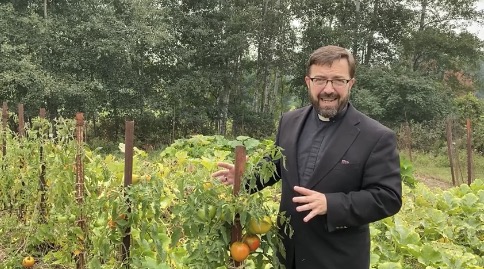
Become Doers, Not Just Hearers
2021 PODCAST: What’s growing in the spiritual garden of our hearts? The Letter of James urges us to welcome the Word of God that was planted in us and become doers, not just hearers.
Fr. Austin Fleming


Be Doers of the Word and Not Posters Only
2015 EXCERPT: If you’re on FaceBook or Pinterest or Twitter, or read a blog or two, you know how often people post scripture verses and religious and spiritual quotes. But just as it’s not sufficient simply to hear the word, to listen to it, neither is it enough to post it online. What we’re called to is doing the Word of God. And “doing the word” is almost always much more difficult than hearing it or reading it – or posting it online.
Dominican Blackfriars


2021 EXCERPT: Jesus took the question of eating with defiled hands and posed a much deeper question about what really defiles the whole person. He moved the debate to what is going on in the heart, because the call to follow Jesus must involve the whole of oneself. It is the call to holiness. Jesus spoke of hypocrisy and lip service, but the real point of this gospel passage isn’t that we become more aware of the hypocrisy or lip service of others. Our gaze should be set steadily on ourselves and our own inner life. Just as in Mass, we pray, ‘may he make of us an eternal offering to you,’ we must pray each day that we will grow in holiness.
Fr. Charles E. Irvin
Evil of Pollution has Many Forms

EXCERPT: Over the past few decades, we’ve all become increasingly concerned with preserving and protecting the natural environment in which we live and upon which we must survive… There is another problem equally as serious to which we’re giving some attention these days… that’s the toxic presence of moral pollution that’s pervasive in our culture and that’s threatening the future lives of our children and grandchildren. Living in a clean world involves more than simply what we’re doing to the material creation God has given us. Living in a clean world also involves the spiritual nature God has likewise given us, what we call the soul. The soul is something that will last forever – it will never die. Consequently, it is of enormous importance in terms of our everlasting happiness or misery. What is the condition of our souls? It’s a question we should not ignore.
Fr. Joe Jagodensky, SDS
2021 EXCERPT: Moses clearly tells his folks what is necessary to stay firm to God’s commandments. Yet, he fails the first commandment and misses out on entering the “Promised Land.” Poor guy. If he only listened to his own words. He lost trusting God with the trust God entrusted with him. Like Moses, forget about the other nine commandments. We just can’t seem to get beyond number one!
We all have the same dilemma working that out in our lives. It’s the risky trust of using the material things of life and then attempting to make them divine. What is of human choice and decision, and what is of divine intervention. That intervention is the saving salvation of our lives. We may decide one way, but it may not be how God wants us to behave.
Fr. George Smiga
We Are the Pharisees

2012 EXCERPT: Søren Kierkegaard, the famous Danish philosopher, was fond of saying that, “Reading the bible is like looking into a mirror.” The bible does not so much speak about the characters that are in its stories as it speaks about us. So every time we approach a biblical passage we need to keep telling ourselves, “This passage is speaking about me.”
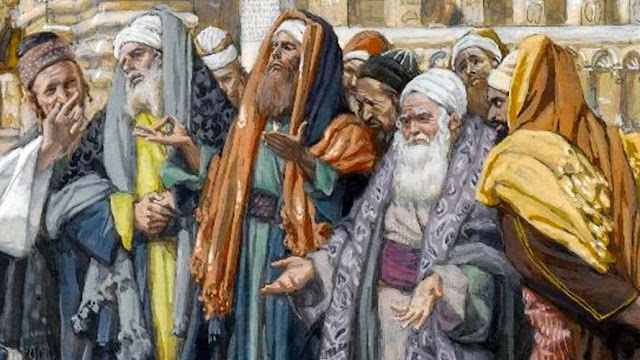
This is very important for us to remember as we listen to today’s gospel, because in today’s gospel Jesus is arguing with the Pharisees. But if we remember Kierkegaard’s admonition, Jesus is not so much criticizing the Pharisees as he is criticizing us. The best way to understand today’s gospel is to approach it with the conviction: We are the Pharisees.
Now two things happen when we take this step. First of all, we grow in sympathy for the Pharisees. If their problem is our problem, we approach them with an attitude that is less quick to judge. This leads to a second fact. When we look at the situation of the Pharisees, we realize that they are not bad people. They are just trying to do what is right. Like Jesus, they honor the law. Like Jesus, they would reject all of those evil actions that Jesus lists at the end of the gospel: unchastity, murder, theft, adultery, greed, malice, deceit. All of these evils the Pharisees, like Jesus, would oppose.
Fr. Anthony Ekpunobi, C.M.

2021 EXCERPT: Today in the gospel, Jesus made it clear that religious laws and customs assist us on the path to holiness. Laws and customs guide us in purifying our hearts towards holiness. This is contrary to the belief of the Pharisees that external observances make one holy. The laws and customs in themselves do not guarantee holiness. Thus Jesus condemned the pharisees who defined the actions of his disciples as unclean. According to Jesus, it is hypocritical to rely solely on external observance. He said; ‘Nothing that goes into a man from outside can make him unclean; it is the things that come out of a man that make him unclean’. The external observance must be connected with the heart in order to produce holiness. For example, being in a state of grace in order to receive holy communion does not involve only going to confession, it also involves the preparation of the heart through prayer. Confession removes those obstacles that prevent the heart from opening and responding to God. The religious laws and customs enable us to put aside our prejudices in order to be open to the reality of the divine life of God.
Msgr. Joseph Pellegrino

Religion, Being Tied to God

2024 EXCERPT: The word religion comes from the Latin word ligare which means to be tied to something or someone… What then is religion? How should people be tied to God. In today’s second reading, The Letter of James answers this question: Religion that is pure and undefiled before God and the Father is this: to care for orphans and widows in their affliction and to keep oneself unstained by the world. The orphans and widows had no one to care for them. They were vulnerable.
Pure religion cares for those who are vulnerable. Who, then, are the vulnerable in our society? Who are the people that have no one to care for them?
- Those who are physically or mentally challenged are
vulnerable… - Children are being preyed upon by the porn industry. The Church has been determined to fight this blight to save our children…
- People who are struggling with their gender identity, people who are forced to leave their homelands to support their families, people who cannot work and are thus homeless, and many, many more are all vulnerable.
Msgr. Charles Pope
The Love of the Law and the Law of Love
2021 EXCERPT: This Sunday’s readings teach a proper understanding of God’s Law and its relationship to our hearts. The readings go a long way toward addressing the false dichotomy that many set up between love and the Law, as though the two were opposed; they are not. If we love God, we want what He wants and love what He loves. The Law describes well what God wants and loves. Indeed, the Law is letting love have its way.
God is Love and His Law (no matter how averse we are to “rules”) is ultimately an expression of His love. In all the readings today, God asks—even commands—that we let love have its way. Let’s look at four teachings on the relationship of Law to God, who is love.
I. The PROTECTION of the Law
II. The PRECISION of the Law
III. The PRIORITY of the Law
IV. The PLACE of the Law
Bishop John Louis

2021 EXCERPT: Let us, therefore, consider three (3) ways by which we can go beyond the rituals in order to enjoy more the blessings of God: (a) approach the rituals with purity of heart, (b) be conscious of the mysteries which the rituals “host”, and (c) be compassionate towards others.
Fr. Michael Chua

2018 EXCERPT: I’ve often heard this accusation, “The Catholic Church is full of man-made rules.” “Where in the Bible does it say that the Sabbath should be moved to Sunday, that we can’t eat meat on Fridays, that abortion is wrong, that two men can’t get married (to each other), that I have to confess my sins to a priest, that we must go to Mass every Sunday, that a woman can’t be a priest? Didn’t the Catholic Church just make all of this stuff up? That’s the problem with the Catholic Church: It’s too concerned with man-made rules, and not with what Christ actually taught.” The surprising thing is that this is often expressed not by Catholic-bashing Protestants, but strangely (or perhaps, not so strangely) by Catholics themselves. The corollary to this is that if these are “man-made rules”, then there is no need to follow them. You can dispense with them as how Christ dispensed with the man-made rules and traditions of the Scribes and Pharisees in today’s gospel passage. Interesting argument but seriously flawed.
Fr. Vincent Hawkswell
2024 EXCERPT: Natural law is “written” in the soul of each person, says the Catechism. It provides “the indispensable moral foundation for building the human community” and constitutes “the necessary basis” for civil law. However, in our present fallen state, its precepts “are not perceived by everyone clearly and immediately,” the Catechism notes; we also need “grace” and God’s “revelation.”
Revealed law comprises the Old Law and the New Law. The Old Law is the law God gave his chosen people to prepare them for Christ’s coming. Much of it is accessible to human reason, but the Old Law states it as part of God’s covenant with his people.
Like natural law, it lays the foundation for beatitude: it is “a light offered to the conscience of every man to make God’s call and ways known to him and to protect him against evil,” says the Catechism. “God wrote on the tablets of the law what men did not read in their hearts.”
Fr. Tommy Lane
Being Friends with God by Living his Commandments

2021 EXCERPT: What can we do to achieve happiness? I would say quite simply, “live as friends of God.” Being friends with God is the way to achieve the happiness meant for us. One of the foundations for being friends with God is living by his commandments. They are for our good. We read in Genesis that God said Adam and Eve could eat of every tree in the garden except one (Gen 3:3). So what did they do? They ate from that one tree, and everything went downhill from there for them and all of us as a result. The commandments are like that command from God to Adam and Eve not to eat from that one tree. The commandments protect us from messing things up. Adam and Eve got into a mess when they disobeyed God. If we do not want to get into a mess, be friends with God. The foundation to be friends with God is to live the commandments.
Fr. John Kavanaugh, S.J.
Disturbing Words

EXCERPT: The fornicators among us are surely going to be disturbed by Jesus’ words. So also the greedy-guts. The same might be said for liars, adulterers, thieves, killers, sensualists, the envious, the arrogant, and the obtuse.
Perhaps the best tack is to scrap the whole Gospel and talk about love or expansion funds. It is not uncommon, after all, for us to expunge those parts of the Gospel that offend us. But usually we have to listen to the stuff and squirm.
It is a funny thing to sit in the pew on Sundays when a whole list of sins and sinners is enumerated from the Gospels or the various Epistles. Our shoulders shrink a bit in hope that we are not mentioned, or at least that the blows fall not too hard. Possibly we feel relieved that smoking and drinking are not mentioned. Some of us may sigh. It is those “others” that Jesus is talking about.
Bishop Frank Schuster
A Path to Healthier and Holier Vocations
2021 EXCERPT: Jesus wants us to consider what can happen when we let our hearts run wild with evil thoughts, unchastity, theft, thoughts of murder, adultery, greed, malice, deceit, licentiousness, envy, blasphemy, arrogance, and folly. When we become enslaved to these passions, our lives can become separated from the vocation God calls us to in our
lives and we can become really unhappy as a result. No one is immune from this, regardless of what kind of clothes you wear when you go to work be it a suit or a cassock. Jesus’ advice here is good for all of us to remember because the vices he lists can lead to all kinds of trouble in life, harming our relationships. If we are not careful, these vices can even lead us to losing our soul, a considerable worse outcome than food poisoning, wouldn’t you say? Jesus wants to liberate us from the vices that try to ensnare us so we can grow closer to the image and likeness the Father originally planned for us.
Christians are a People of Contradiction

2021 EXCERPT: As Christians, we are often a people of contradiction. We call ourselves a community of faith, of hope, and of love but sometimes we can be faithless, hopeless and loveless. Week after week we say, I believe in One God, in Christ who died for us, in one Church, the communion of saints, the forgiveness of sins, and life everlasting. And we do believe. But, being human, sometimes our faith can be long on propositions and short on self-giving and commitment. Sometimes we tend to forget that without a “yes” to Jesus, a “yes” to propositions is sterile. It can become an empty ritual.
